Performance Analysis of Energy Efficient
Error Control Codes for Wireless Sensor
Networks
A.Vinitha
Research Scholar, Dept. of ECE, VFSTR University, Andhra Pradesh, India
ABSTRACT: Due to rapid growth of applications in wireless sensor networks, the data transmitted from the sensornodes are susceptible to exploitation by errors induced by noisy channels and other factors. Hence it is essential to afford a suitableerror control scheme to decrease the bit error rate (BER). In this paper, we cultivate an analytical energy efficiency modelusing adaptive error correction code (AECC) in wireless sensornetworks in fading environments. To acclimatise energy efficiency ofsensor node to channel variations, the packet length is tuned atthe data link layer. In this model, we deliberate the error control ofBose-Chaudhuri-Hochquengh (BCH) coding for NC-FSKreceiver node using AECC scheme and compare it to one of nonAECC.Depending on channel state variation via theACK feedback, the sender can regulate the adequate BCH coderequired for the next transmission.
KEYWORDS: BCH Coding, Adaptive Coding, Energy Efficiency, Fading Channels, Wireless Sensor networks
I.INTRODUCTION
The low-value, fast deployment, the capacity of self-organization and cooperative data-processing, have made wireless sensor networks arealistic solution for an extensive range of utility regions, such as military and place of home place security, health, environment, enterprise andcommercial, and domestic [1]. The maximum considerable assignment in sensornetworks is to overcome the energy constraints considering every sensornode have restrained energy to consume. Since data transmitted over the wireless media is liable to corruption by noise, errorcontrol schemes are necessary to hold the Bit Error Rate (BER) low. Due tothe stringent energy constraint, it is not possible to boom the signalenergy of the transmitted signal in wireless sensor networks. Hence anopportunity way is to use the error control codes to reduce the BER.The encoding and decoding circuitry for error control codes can alsoconsume a sizable amount of energy. However theBER is shown to be directly proportional to the code rate andinversely proportional to energy per symbol noise ratio andtransmitter power level [2].This motivates us to take a look atenergy-efficienterror detection/correction codes.
the cluster head function is switched to other nodes,aiming at higher distributing the energy consumption within thenetwork [4].
II.BACKGROUND WORK
However, the aforementioned solutions are at risk ofchannel impairments, because any radio signal is affected byrandom noise and channel fading [5], [6]. If a node gets acorrupted data packet, the data can be discarded and the nodemaintains anticipating a brand new transmission or the node employs anAutomatic Repeat request (ARQ) system (a retransmissionsystem). However, in both cases, there may be a waste of energywithin the network. A mainly undesirable situation occurswhen the channel circumstance is terrible, causing successive retransmissions. Another approach to growth the strength conservationin WSN is to apply forward error correction (FEC) strategies,lowering the frame errors rate and therefore the numberof retransmissions. Basically, there are training of errorcontrol codes: block codes and convolutional codes. Theconvolutional encoding technique is a method broadly utilized inwireless communication environments like sensor networks given that they commonly present an easier implementation for theequal performance of a competitor block code [7].The difficulty of making use of error control codes to WSNs is thetopic for some of the preceding works in which the overall performance ofblock codes and Viterbi decoded convolutional codes is investigated [9]-[11]. Also, the iterative deciphering algorithm justifiesthe capacity of faster codes in solving the hot-spot trouble andincrease the network lifetime [12]. Error control coding (ECC)is a traditional approach used to growth hyperlink reliability and lowerthe desired transmitted strength. However, lowered power atthe transmitter comes on the price of more energy intakebecause of the decoder on the receiver. Stronger codes providehigher performance with lower power requirements however haveextra complex decoders with higher strength intake thanless complicated errors control codes. If the greater strength consumption atthe decoder outweighs the transmitted energy savings because ofusing ECC, the ECC could not be power-efficient comparedwith an uncoded device.
Previous research the use of ECC in wireless sensor networkstargeted more often than not on long-time enterprise-standard codes suchas Reed-Solomon and convolutional codes. A hybrid schemedeciding on the most energy-efficientof ECC and ARQ is considered in [13], the usage of checksums, CRCs, Reed-Solomon and convolutional codes. A predictive error correction set of rules is supplied in [14] which uses data correlation,but is not an error control code, as there is no encoding.Power-conscious, machine-stage strategies consisting of modulationand MAC protocols, in addition to differing cost and constraintperiod convolutional coding, are considered in [15] to reducedevice power consumption in wi-fi microsensor networks.Depending on the specified bit errors rate (BER), a higher rate convolutional code, or no coding in any respect, can be themaximum energy-efficient method. In this paper, an appropriate error correction code is selected from a list of present codes forwireless sensor network.
III.ADAPTIVE ERROR CORRECTION CODING SYSTEM
Fig. 1 Adaptive Error Correction Coding System in Wireless Sensor Network
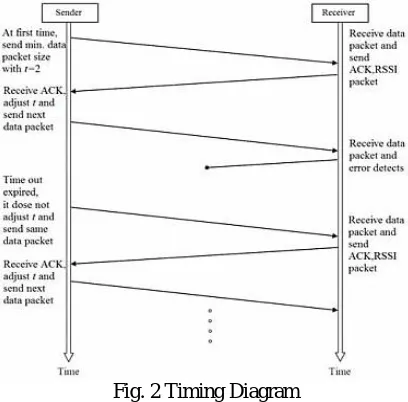
Fig. 2 Timing Diagram
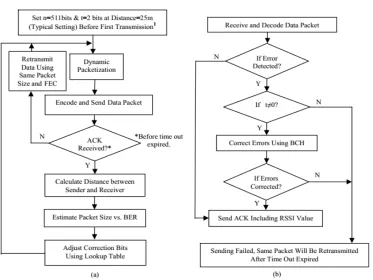
Figure 3 summaries the details of the mechanismbased on the ACK feedback to adapt the required errorcorrection to the next packet transmission. This feedbackrefers to RSSI indicator.
Channel Estimation:We first estimate the raw channel bit error rate (BER) fortypical wireless sensor networks. The probability of biterror is evaluated under a non-coherent FSK modulatedRayleigh fading channel model in wireless sensornetworks, is defined as follows [16]:
, = ………. (1)
( ) = 77−10 log ( ) ………. (2)
where β is the path loss exponent. (Assume a typical β =3.5).
Fig. 3 Proposed Adaptive Error Coding System in Wireless Sensor Network (a) Sender node (b) Receiver node
Optimization Metric: The energy efficiency η is a suitable metric that capturesthe energy and reliability constraints, which is defined as[4]:
= . = (1− ) ……….. (3)
where ηe is the energy throughput, R= (1 - PER) is thepacket acceptance rate, which accounts for data reliability,and
Eeff / Etotal denotes the energy throughput. Therefore,the energy efficiency η represents the useful fraction of thetotal
energy expenditure in a communication link betweenneighbouring sensors.
In this section, the AECC scheme was associated withone of non-AECC, in terms of energy efficiency based ondifferent communication distances and data packet sizeusing HARQ error control over Rayleigh fading channel.The interval of the distances in simulation is 5 meterbecause of the location error in WSNs. The energyefficiency of two types of error control scheme is allsharply reducing with increasing of communicationdistance. Energy efficiency of AECC scheme decreases tosome degree, but the performance of this scheme ismaintained relatively well with increasing ofcommunication distance for various packet size.
IV. CONCLUSION
REFERENCES
[1] I.F. Akyildiz, W. Su, Y. Sankarasubramaniam, and E. Cayirci, “Asurvey on sensor networks,” IEEE Communications Magazine, pp. 102-114, Aug. 2002.
[2] I.F. Akyildiz, W. Su, Y. Sankarasubramaniam, and E. Cayirci, “Wirelesssensor networks: a survey,” Computer Networks: The Int’l Journal ofComp. and Telecom. Net, vol. 38, no.4, pp.393-422, Mar. 2002.
[3] Polastre, J., Hill, J., and Culler, D, “Versatile low power media access forwireless sensor networks,” In Proceedings of ACM international conferenceon embedded networked sensor systems, Maryland, pp. 95107, 2004.
[4] 3. Heinzelman, W. B., Chandrakasan, A., and Balakrishnan, H., “Energyefficient communication protocol for wireless microsensor networks,” InProceedings of the 33rd annual IEEE international conference on systemsciences, Hawaiipp. 210, 2000.
[5] 7. Rappaport, T. S., “Wireless communications: principles and practice,”New York: Prentice Hall, 1996. [6] 8. Proakis, J. G., “Digital communications. New York: McGraw-Hill,”1995.
[7] 9. Hendrix, H., “Viterbi decoding techniques for the TMS320C54x DSPgeneration,” In Texas instruments application report SPRA071A, 2002. [8] Karvonen, H., and Pomalaza-Raez, C, “Coding for energy efficientmultihop wireless sensor networks,” Proc. Nordic Radio Symposium2004/Finnish Wireless Communications Workshop 2004 (NRS/ FWCW2004), Oulu, Finland, 1618 August 2004, pp. 1-5
[9] Kashani, Z.H., and Shiva, M., “BCH coding and multi-hop communication in wireless sensor networks,” Proc. Wireless and Optical NetworksConf. (WOCN) 2006, Bangalore, India, 11-13 April 2006, pp. 1-5
[10] Hajjarian Kashani, Z., and Shiva, M., “Channel coding in multi-hopwireless sensor networks,” Proc. 6th Int. Conf. ITS Telecommunication(ITST) 2006, Chengdu, China, 21-23 June 2006
[11] Sankarasubramaniam, Y., Akyildiz, I.F., and McLaughlin, S.W., “Energyefficiency-based packet size optimization in wireless sensor networks,”Proc. 1st IEEE Int. Workshop on Sensor Networks Protocols and Applications (SNPA03), Anchorage, Alaska, USA, 11 May 2003 (held inconjunction with ICC03)
[12] Vasudevan, S., Goeckel, D., and Towsley, D., “Optimal power allocationin channel-coded wireless networks,” Proc. Annual Allerton Conf. Communication, Control and Computing, Urbana Champaign, USA, 29October1 September 2004
[13] P. Lettieri, C. Fragouli, and M. B. Srivastava, “Low power error controlfor wireless links,” in Proceedings of the 3rd Annual ACM/IEEE International Conference onMobile Computing and Networking (MOBICOM 97),pp. 139-150, Budapest, Hungary, September 1997.
[14] S. Mukhopadhyay, D. Panigrahi, and S. Dey, “Data aware, low costerror correction for wireless sensor networks,” in Proceedings of IEEEWireless Communications and Networking Conference (WCNC 04), vol. 4,pp. 2492-2497, Atlanta, Ga, USA, March 2004.