| INVESTIGATION
Selection-Enhanced Mutagenesis of
lac
Genes Is Due
to Their Coampli
fi
cation with
dinB
Encoding an
Error-Prone DNA Polymerase
Itsugo Yamayoshi,1Sophie Maisnier-Patin,1and John R. Roth1
Department of Microbiology and Molecular Genetics, University of California, Davis, California 95616
ABSTRACTTo test whether growth limitation induces mutations, Cairns and Foster constructed anEscherichia colistrain whose mutant
lacallele provides 1–2% of normal ability to use lactose. This strain cannot grow on lactose, but produces50 Lac+revertant colonies per
108plated cells over 5 days. About 80% of revertants carry a stablelac+mutation made by the error-prone DinB polymerase, which may
be induced during growth limitation; 10% of Lac+revertants are stable but form without DinB; and the remaining 10% grow by
amplifying their mutantlacallele and are unstably Lac+. Induced DinB mutagenesis has been explained in two ways: (1) upregulation
ofdinBexpression in nongrowing cells (“stress-induced mutagenesis”) or (2) selected local overreplication of thelacanddinB+genes on
lactose medium (selected amplification) in cells that are not dividing. Transcription of dinB is necessary but not sufficient for mutagenesis. Evidence is presented that DinB enhances reversion only when encoded somewhere on the F’lacplasmid that carries the mutantlacgene. A new model will propose that rare preexisting cells (1 in a 1000) have10 copies of the F’lacplasmid, providing them with enough energy to divide, mate, and overreplicate their F’lacplasmid under selective conditions. In these clones, repeated replication of F’lacin nondividing cells directs opportunities forlacreversion and increases the copy number of thedinB+gene. Amplification ofdinB+increases
the error rate of replication and increases the number oflac+revertants. Thus, reversion is enhanced in nondividing cells not by
stress-induced mutagenesis, but by selected coamplification of thedinBandlacgenes, both of which happen to lie on the F’lacplasmid.
KEYWORDSdinB;Escherichia coli; adaptive mutation; copy number variant; error-prone polymerase; gene amplification; lactose operon; local over-replication; mutagenesis; plasmid
I
N 1943, Luria and Delbrück described evidence that strong selection detects bacterial mutants that arise prior to selec-tion and cannot be stress-induced (Luria and Delbrück 1943). Others came to the same conclusion using similar stringent selection methods (Newcombe 1949; Lederberg and Lederberg 1952). These experiments showed clearly that the detected mutants were not stress-induced. However, the stringent selec-tion condiselec-tions could only detect mutaselec-tions that formed several generations before selection. These selections could not have detected stress-induced mutations. Thus, the question was left open,“Would less stringent conditions reveal mutations that are induced by growth limitation?”To address this question, Cairns and Foster constructed an
Escherichia coli strain with a leaky lac mutation that just
barely prevents growth on lactose. Any new mutation that increaseslacfunction could allow immediate growth on lac-tose (Cairnset al.1988; Cairns and Foster 1991). Using this selection, parallel cultures failed to show afluctuation in re-vertant number. This result was taken as evidence that weak selection (unlike previous strong selections) could detect mu-tations that arise during selection. If any mumu-tations form after selection is imposed, then it is possible that they are stress-induced (Cairns and Foster 1991).
The absence offluctuation in revertant number was ini-tially the strongest support for stress-induced mutagenesis. Thisfinding argued against selection models, which propose that revertants are initiated by preexisting cells and might be expected to showfluctuation. This support for stress-induced mutagenesis disappeared once it was found that revertants are initiated by preexisting cells with an increased lac copy number. These cells form reversibly either by tandem duplication oflac
Copyright © 2018 by the Genetics Society of America doi:https://doi.org/10.1534/genetics.117.300409
Manuscript received October 17, 2017; accepted for publication December 27, 2017; published Early Online January 4, 2018.
1Corresponding authors: Department of Microbiology and Molecular Genetics, University of California, Davis, 314 Briggs Hall, One Shields Ave., Davis, CA 95616. E-mail:
or by increases in copy number of the whole F’lacplasmid. In either case, the frequency of the copy variants is held at a high steady-state frequency by a balance between rates of copy in-crease and loss (Reamset al.2010). The influences (rates of copy number increase and loss) that maintain this high steady state oppose the Luria–Delbruckfluctuation. That is, revertants in the Cairns–Foster system show nofluctuation, not because revertants form on the plate but because the preexisting initia-tor cells are immune to fluctuation. Later evidence demon-strated in a different way that Lac+revertants are initiated by
cells that form prior to plating, even though these cells show no Luria–Delbruckfluctuation (Sanoet al.2014).
The behavior of the Cairns–Foster system has been widely interpreted as evidence that all cells possess evolved mecha-nisms that sense growth limitation and respond by increasing their general mutation rate (Torkelsonet al.1997), or might even direct mutations preferentially to sites that will improve growth (Foster and Cairns 1992). The error-prone DNA repair polymerase DinB has been proposed to be central to this mu-tagenic mechanism. The idea of stress-induced mutagenesis suggested by the Cairns–Foster system has been expanded to explain origins of cancer (Cairns 1998) and evolution without natural selection (Rosenberg 2001; Mittelman 2013). How-ever, this idea seems unlikely in that it proposes an evolved mechanism for promotion of malignancy.
An alternative to stress-induced mutagenesis is natural selection, acting in subtle ways on preexisting variants. The Cairns–Foster system need not involve any evolved muta-genic mechanism. Instead, this system may include peculiar-ities that allow natural selection to operate on common preexisting variants and favor their conversion to revertants at a rate that gives the appearance of mutagenesis. Selection models propose that revertants are initiated by preexisting cells with multiplelaccopies that arise during nonselective growth prior to plating. These cells are able to replicate their lacgenes more than they replicate their chromosomes (Sano
et al.2014; Patin and Roth 2015, 2016; S.
Maisnier-Patin and J. R. Roth, personal communication).
An early selection model proposed that plated cells with a tandemlacduplication can grow slowly on lactose and im-prove their growth by further amplifying their array of lac genes under selection (Hendrickson et al. 2002; Roth and Andersson 2004). General mutagenesis can occur in cells whoselacamplification includes the dinB+gene. The DinB
protein (Pol IV) is an error-prone repair polymerase that can copy damaged templates and makes frequent errors when copying normal base sequences (Wagner et al. 1999; Ohmoriet al. 2001). The gene for DinB just happens to be located 16 kb from lac on the F’lac plasmid (Kofoid et al. 2003). A newer model for the Cairns system (Maisnier-Patin and Roth 2016; S. Maisnier-Patin and J. R. Roth, personal communication) suggests that mutagenesis under selection requires increasing the copy number of the entire F’lac plas-mid, which includes both the lac and dinB genes. In this model, preexisting initiator cells have a 10-fold increasedlac copy number. These cells form during nonselective pregrowth
and are held at a high steady-state frequency (1 in a 1000) dictated by their rates of copy number increase and decrease (Reamset al.2010; Sanoet al.2014). After plating, selection enhances reversion by allowing initiator cells to replicate their F’lac plasmid more than their chromosome, which provides more opportunities for reversion. Selection enables mutagen-esis because thedinB+copy number increases while thelac
target is replicated repeatedly. By selective overreplicating, F’lac (in excess of the chromosome) selection circumvents two major problems with stress-induced mutagenesis. One problem is theoretical, the other technical.
The theoretical problem with stress-induced general mu-tagenesis is that many, perhaps most, natural conditions that limit growth pose problems that cannot be solved by muta-tions (e.g., lack of nutrients). In such cases, a mechanism for stress-induced mutagenesis would impose potentially disas-trous costs with no hope of benefit. In the face of such costs, selection would favor destruction of the mechanism. This makes the idea of dedicated mechanisms for stress-induced mutagenesis seem unlikely. It is particularly difficult to un-derstand how a dedicated mutagenesis mechanism could ex-plain the origins of cancer. This idea requires an evolved mechanism that senses limitation of somatic cell growth and responds by causing uncontrolled cell division (cancer). The technical problem with stress-induced mutagenesis is that revertants are initiated by highly reversible copy number variants, which do not show a Luria–Delbrückfluctuation test. Thus, the strongest support for stress-induced mutagenesis (ab-sence offluctuation) is eliminated by a technicality. The infl u-ences that maintain the steady-state plasmid copy number and the frequency of initiator cells serves to obscure fluctuation. The number of initiator cells does not change appreciably from one culture to the next, even though the frequency of those initiator cells is established before plating (Sanoet al.2014).
There are three models for reversion in the Cairns–Foster system which predict different effects ofdinB+gene position on
reversion under selection. Thefirst is stress-induced mutagen-esis in nongrowing cells. According to this original model, lim-itation of growth induces the SOS DNA-damage response and the stationary phase sfactor RpoS, which increase the tran-scription level of thedinBgene 10-fold and two- to threefold, respectively (Kim et al. 2001; McKenzie et al. 2000, 2001; Layton and Foster 2003; Lombardo et al. 2004; Galhardo
et al.2009). This model rejects early suggestions that plasmid
transfer is critical for reversion (Galitski and Roth 1995; Radicellaet al.1995). Instead, it proposes that plasmid conju-gation (plasmid transfer) functions make a single-strand nick at the plasmid transfer originoriT(Foster and Trimarchi 1995a). This nick leads to a double-strand break whose repair is accom-plished by the RecA-RecBCD pathway working with the DinB polymerase and causing mutagenesis (Ponderet al.2005; He
et al. 2006). Although DinB is known to be mutagenic and
stress has been shown to increase DinB production (Courcelle
et al.2001; Kimet al.2001; Layton and Foster 2003; Galhardo
et al. 2009), this increase does not seem to be sufficient to
influences the level of mutagenesis as described here. In the selection models below, the stress-induced upregulation ofdinB provides a level of expression that is essential but not sufficient for mutagenesis. Mutagenesis is achieved by increasing the copy number of a properly positioned dinB+gene whose
ex-pression is upregulated by mainly the SOS response.
The second model is selected tandem amplification oflac during growth under selection. In thefirst selection model, thelacregion duplicates during nonselective growth prior to plating on lactose (Anderssonet al.1998; Hendricksonet al. 2002). After being plated, rare duplication-bearing cells grow slowly and improve their growth by expanding the tandem lac amplification. Cells whose lac duplication includes the nearbydinB+gene are expected to show an increased general
mutation rate and produce stable revertants. By this model, all stable revertants arise from precursor cells with a selected tandem (lac dinB+) amplification. This amplification is lost
from cells that acquire a revertantlac+allele. In this model, a
full yield of stable revertants requires adinB+allele located
close tolacon the F’lacplasmid.
The third model is when selected amplification of the entire F’lacplasmid overreplicateslacanddinB+with little cell
di-vision. In our current model for the Cairns–Foster system, selection favors increases in the copy number of the whole F’lacplasmid that coamplifylacanddinB(Maisnier-Patin and Roth 2015, 2016). In this model, upregulation ofdinBgene transcription is necessary but not sufficient for mutagenesis under selection. Reversion requires that the expressed dinB gene be located anywhere on the F’lacplasmid, so it can be coamplified withlac. ThedinB+gene does not need to be near lacwithin this plasmid. The chromosomaldinBgene does not contribute to reversion in either selection model. A detailed de-scription of this model will be presented elsewhere (S. Maisnier-Patin and J. R. Roth, personal communication)
To decide among these three models, we moved thedinB+
gene from its normal position (16-kb away fromlacon the F’lac plasmid) to two other sites on that plasmid. One site is imme-diately adjacent tolac(180-bp away) and the other replaces yebBnear the transfer originoriT, diametrically opposite lac (115-kb away). We also inserted an additionaldinB+gene into
the chromosome. To be certain that the transplanteddinB+
loci are functional, each repositioned allele was shown to re-lieve sensitivity to methyl methanesulfonate (MMS), a DNA alkylating agent that is toxic to strains lacking DinB (Bjedov
et al.2007; Bensonet al.2011). Results show that DinB
pro-vides MMS resistance regardless of its gene position. However, DinB stimulateslacreversion under selection (10-fold) only when a functionaldinB+allele is located somewhere on the
F’lacplasmid, not necessarily near thelaclocus.
ThedinB position effect demonstrated here supports the idea (#3 above) that coamplification oflacanddinBgenes under selection is required for the mutagenesis seen in the Cairns–Foster experiment. The critical directed mutagenesis appears to require increases in the copy number of the whole F’lacplasmid, rather than tandem amplification of thedinB– lacregion within the plasmid.
Materials and Methods
Bacterial strains
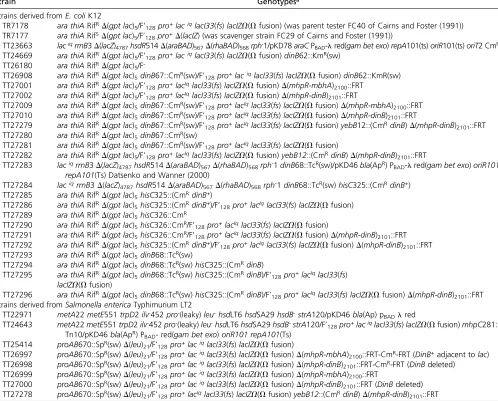
All strains assayed for reversion data are derived fromE. coli K-12. Intermediate strains used to manipulate plasmids are derived from Salmonella enterica (Serovar Typhimurium, LT2). The Cairns–Foster tester strain FC40 (TR7178) and scavenger strain FC29 (TR7177) were provided by Patricia Foster (Cairns and Foster 1991). The genotypes of all strains assayed for reversion and MMS resistance/sensitivity are listed in Table 1, with intermediate strains involved in mu-tant construction.
Strain construction
Deletions and insertions were constructed using recombineering techniques involving Red recombination functions of phagel, as described by Courtet al.(2002) and Thomasonet al.(2014). Deletion junctions and inserted segments were sequenced in their entirety to verify the absence of accumulated point mutations. Transfer of deletions and insertions into isogenic backgrounds was accomplished by construction of plasmids by P22-mediated transduction inSalmonellaand conjuga-tion of these plasmids intoE. coli. Chromosomal mutations were moved between strains by P1-mediated transduction. The 16- and 17-kb plasmid deletions described in Figure 1 were constructed in a highly transformableSalmonellastrain (TT24643) carrying the F’128 plasmid from FC40 (or
TR7178). A PCR product was amplified that includes the chloramphenicol resistance cassette (CmR)flanked by FRT
sequences flanked by terminal F’128 homologies, to direct
the DNA insertion that replaces the deleted material (Datsenko and Wanner 2000). In strain TT27001 (strain #2), this FRT-CmR-FRT product replaced 16 kb between
the normallacanddinBgenes of F’lac(strain #1). In strain TT27002 (strain #3), the FRT-CmR-FRT cassette replaced
17 kb, a region including the dinB gene and extending to the same point near thelacoperon. These CmR-resistant
de-letions were transduced intoSalmonellastrain TT25414, car-rying an F’128plasmid isogenic to that from FC40. A plasmid
encodingflippase was then introduced and the FRT-CmR-FRT
cassette was excised leaving a deletion with one FRT at the deletion junction point (Datsenko and Wanner 2000). These two constructed plasmids (with CmS16 and 17 kb deletions)
were transferred by conjugation into an F-E. colistrain
iso-genic to FC40 (TT26180). The resultingE. colistrains were used in the reversion tests described below.
To insertdinB+at a new site, the donor was theSalmonella
strain (TT26997) with the 16-kb deletion and the FRT-CmR
-FRT cassette neardinB+(strain #2 in Figure 1). A 2.4-kb
fragment was amplified by PCR using the plasmid from strain #2 (Figure 1). The fragment included (CmR-FRT-dinB+), but
not the second FRT (see Figure 1). The primers for this am-plification carried sequence homologous to the sites that would receive the (CmR-FRT-dinB+) fragment. This ampli-fied (CmR-FRT-dinB+) fragment replaced the yebBgene in
TT27002). The samedinB+region was also introduced into
thehisCgene of theE. colichromosome.
Testing MMS sensitivity
E. coliK12 strains with variousdinBgenotypes were grown
overnight in 4 ml LB medium. On the day of the assay, two square LB plates, a control, and a 7.5 mM MMS plate were prepared. Drops (5 ml) of serial dilutions of each culture (1024, 1025, and 1026) were pipetted onto the LB plates with and without MMS. The LB control plate was incubated at 37° for8 hr and the MMS plate for12 hr. This difference in incubation times allowed colonies on both plates to grow to approximately the same size.
Lac reversion assays
Tester and scavenger cells (FC29) were pregrown overnight in NCE medium (Berkowitz et al. 1968) with added MgSO4
(2 mM), glycerol (0.1%), and thiamin (50mM). Cells were
pelleted, washed, and resuspended in NCE medium. Each reversion plate [NCE, 0.1% lactose, and 25 mg/liter 5-bromo-4-chloro-3-indolyl-b-D-galactopyranoside (X-Gal) was plated with109washed scavenger cells and incubated
for 24 hr to remove contaminating carbon sources before plating 108 tester cells. Viability was measured for each
tester strain at day 0. The number of tester cells in the lawn was determined by taking at least six agar plugs from the selection plates. Cells from the plugs were suspended in minimal NCE (no citrate E) medium, diluted, and plated on LB plates containing X-Gal and Rifampicin. Reversion plates were incubated at 37°for 6 days and revertant colony number was scored daily. Each strain was assayed by testing.10 independent cultures.
Testing stability of revertant lac+phenotypes
Revertant colonies appearing on day 5 (absent on day 4) were scored for the stability of their Lac+ phenotype. Each new
Table 1 List of strains
Strain Genotypesa
Strains derived fromE. coliK12 TR7178 ara thiARifRD(gpt lac)
5/F’128pro+laciqlacI33(fs)lacIZV(Vfusion) (was parent tester FC40 of Cairns and Foster (1991))
TR7177 ara thiARifSD(gpt lac)
5/F’128pro+D(lacIZ) (was scavenger strain FC29 of Cairns and Foster (1991))
TT23663 laciqrrnB3D(lacZ)
4787hsdR514D(araBAD)567D(rhaBAD)568rph-1/pKD78araCPBAD-lred(gam bet exo)repA101(ts)oriR101(ts)oriT2 CmR
TT24669 ara thiARifRD(gpt lac)
5/F’128pro+laciqlacI33(fs)lacIZV(Vfusion)dinB62::KmR(sw)
TT26180 ara thiARifRD(gpt lac) 5/F
-TT26908 ara thiARifRD(gpt lac)
5dinB67::CmR(sw)/F’128pro+laciqlacI33(fs)lacIZV(Vfusion)dinB62::KmR(sw)
TT27001 ara thiARifRD(gpt lac)
5/F’128pro+lacIqlacI33(fs)lacIZV(Vfusion)D(mhpR-mbhA)2100::FRT
TT27002 ara thiARifRD(gpt lac)
5/F’128pro+lacIqlacI33(fs)lacIZV(Vfusion)D(mhpR-dinB)2101::FRT
TT27009 ara thiARifRD(gpt lac)
5dinB67::CmR(sw)/F’128pro+lacIqlacI33(fs)lacIZV(Vfusion)D(mhpR-mbhA)2100::FRT
TT27010 ara thiARifRD(gpt lac)
5dinB67::CmR(sw)/F’128pro+lacIqlacI33(fs)lacIZV(Vfusion)D(mhpR-dinB)2101::FRT
TT27279 ara thiARifRD(gpt lac)
5dinB67::CmR(sw)/F’128pro+lacIqlacI33(fs)lacIZV(Vfusion)yebB12::(CmRdinB)D(mhpR-dinB)2101::FRT
TT27280 ara thiARifRD(gpt lac)
5dinB67::CmR(sw)
TT27281 ara thiARifRD(gpt lac)
5dinB67::CmR(sw)/F’128pro+lacIqlacI33(fs)lacIZV(Vfusion)
TT27282 ara thiARifRD(gpt lac)
5/F’128pro+lacIqlacI33(fs)lacIZV(Vfusion)yebB12::(CmRdinB)D(mhpR-dinB)2101::FRT
TT27283 laciqrrnB3D(lacZ)
4787hsdR514D(araBAD)567D(rhaBAD)568rph-1dinB68::TcR(sw)/pKD46bla(ApR) PBAD-lred(gam bet exo)oriR101
repA101(Ts) Datsenko and Wanner (2000) TT27284 laciqrrnB3D(lacZ)
4787hsdR514D(araBAD)567D(rhaBAD)568rph-1dinB68::TcR(sw)hisC325::(CmRdinB+)
TT27285 ara thiARifRD(gpt lac)
5hisC325::(CmRdinB+)
TT27286 ara thiARifRD(gpt lac)
5hisC325::(CmRdinB+)/F’128pro+lacIqlacI33(fs)lacIZV(Vfusion)
TT27289 ara thiARifRD(gpt lac)
5hisC326::CmR
TT27290 ara thiARifRD(gpt lac)
5hisC326::CmR/F’128pro+lacIqlacI33(fs)lacIZV(Vfusion)
TT27291 ara thiARifRD(gpt lac)
5hisC326::CmR/F’128pro+lacIqlacI33(fs)lacIZV(Vfusion)D(mhpR-dinB)2101::FRT
TT27292 ara thiARifRD(gpt lac)
5hisC325::(CmRdinB+)/F’128pro+lacIqlacI33(fs)lacIZV(Vfusion)D(mhpR-dinB)2101::FRT
TT27293 ara thiARifRD(gpt lac)
5dinB68::TcR(sw)
TT27294 ara thiARifRD(gpt lac)
5dinB68::TcR(sw)hisC325::(CmRdinB)
TT27295 ara thiARifRD(gpt lac)
5dinB68::TcR(sw)hisC325::(CmRdinB)/F’128pro+lacIqlacI33(fs)
lacIZV(Vfusion) TT27296 ara thiARifRD(gpt lac)
5dinB68::TcR(sw)hisC325::(CmRdinB)/F’128pro+lacIqlacI33(fs)lacIZV(Vfusion)D(mhpR-dinB)2101::FRT
Strains derived fromSalmonella entericaTyphimurium LT2
TT22971 metA22metE551trpD2ilv-452pro-(leaky)leu-hsdLT6hsdSA29hsdB-strA120/pKD46bla(Ap) p BADlred
TT24643 metA22metE551trpD2ilv-452pro-(leaky)leu-hsdLT6hsdSA29hsdB-strA120/F’
128pro+laciqlacI33(fs)lacIZV(Vfusion)mhpC281::
Tn10/pKD46bla(ApR) P
BAD- red(gam bet exo)oriR101 repA101(Ts)
TT25414 proAB670::SpR(sw)D(leu)
21/F’128pro+laciqlacI33(fs)lacIZV(Vfusion)
TT26997 proAB670::SpR(sw)D(leu)
21/F’128pro+laciqlacI33(fs)lacIZV(Vfusion)D(mhpR-mbhA)2100::FRT-CmR-FRT (DinB+adjacent tolac)
TT26998 proAB670::SpR(sw)D(leu)
21/F’128pro+laciqlacI33(fs)lacIZV(Vfusion)D(mhpR-dinB)2101::FRT-CmR-FRT (DinBdeleted)
TT26999 proAB670::SpR(sw)D(leu)
21/F’128pro+laciqlacI33(fs)lacIZV(Vfusion)D(mhpR-mbhA)2100::FRT
TT27000 proAB670::SpR(sw)D(leu)
21/F’128pro+laciqlacI33(fs)lacIZV(Vfusion)D(mhpR-dinB)2101::FRT (DinBdeleted)
TT27278 proAB670::SpR(sw)D(leu)
21/F’128pro+lacIqlacI33(fs)lacIZV(Vfusion)yebB12::(CmRdinB)D(mhpR-dinB)2101::FRT
aThe letters (sw) following an insertion mutation indicate stand for“swap”and indicate that the inserted drug-resistance determinant replaces the coding sequence of the
colony was removed from the selection plate with a plug of agar. Cells were suspended in NCE and stored at 4°, before dilution and plating for single colonies on nutrient broth (Difco, Detroit, MI) plates containing rifampicin (50 mg/liter) to eliminate scavengers. These plates contained X-Gal (40 mg/ liter) to distinguish unstable revertants (sectored blue“star” colonies) from stable revertants (solid blue colonies).
Data availability
The authors state that all data necessary for confirming the conclusions presented in the article are represented fully within the article.
Results
Moving the dinB+gene to different points in
the genome
To test the three models described above, a functionaldinB+
gene was moved to various positions in the F’128lacplasmid and
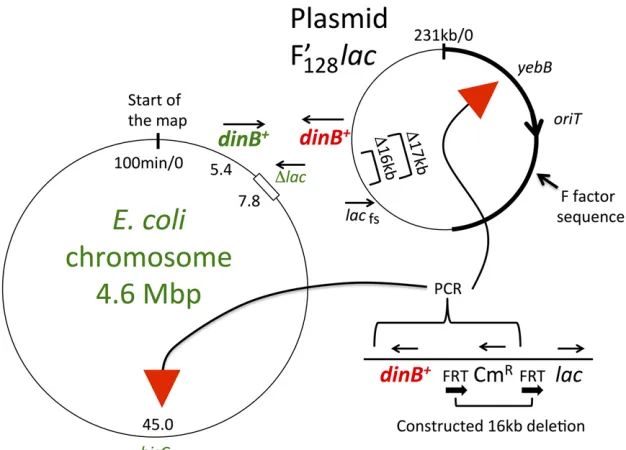
the chromosome of the Cairns–Foster tester strain. The general strategy (Figure 2) is based on a strain whosedinB+allele could
be shown to support both reversion and MMS resistance. This strain was used as a donor of the moveddinB+locus (CmR-FRT
-dinB+). The DNA sequence of the transferred locus was shown
to be identical with that of the functional donor.
To construct these strains, two deletion mutations were constructed in the F’lacplasmid of aSalmonellastrain (see Figure 1 in Materials and Methods). One deletion (17 kb) removes the dinB+gene and the region betweendinB and lac. The other deletion (16 kb) removes the same region but leaves the normal dinB+ gene close to a chloramphenicol
resistance determinant (CmR). This (CmR-FRT-dinB+) region
was PCR-amplified, and used to selectively insert adinB+
allele in place of the episomalyebB gene and the chromo-somalhisCgene. The donor strain containing the 16-kb de-letion produced the same number of Lac+revertants under
selection before and after removal of the antibiotic resis-tance gene FRT-CmR-FRT (strains 2 and 4 in Figure 1) (data
not shown). Both strains show the same resistance to MMS (see below). This demonstrated that the inserted CmRgene
did not affect the function of the transferred dinB+allele
(CmR-FRT-dinB+). Plasmid mutations were combined to
con-struct four plasmid types: the normal version withdinB+16 kb
from lac, a second with the 16-kb deletion (dinB+ located
180 bp from lac), a third with the normal dinB+ removed
by the 17-kb deletion, and a fourth with both the 17-kb de-letion and adinB+insertion replacing theyebBgene 115 kb
from lac. These four plasmids were transferred into E. coli strains whose chromosomes had various combinations of dinB alleles: no, one, or two copies. All of thefinal strains used in reversion tests shared a common E. coli genetic background.
A functional dinB+allele provides resistance to MMS,
regardless of genomic position
In testing the effect of thedinB+gene position on reversion, it
is critical that the relocated gene retains wild-type function. The dinB+gene encodes an error-prone bypass polymerase
that is able to copy a damaged template that blocks progres-sion of normal replication forks (Ohmoriet al.2001). While the DinB repair polymerase can replicate a damaged strand, it is prone to making mistakes that can contribute to general mutagenesis during reversion (Kim et al.1997). DinB pro-vides resistance to DNA alkylating agents such as MMS, which was the basis of a test for DinB functionality devised Figure 1 Deletions and insertions used to movedinB
on the F’128 plasmid. The two deletions described
above (16 and 17 kb) were central to the strain con-structions described later. Strain #1 is the original Cairns–Foster strain withdinB+ located 16 kb from
lac(TR7178). Strain #2 has a 1.5-kb sequence (FRT CmRFRT) replacing the 16 kb betweendinBandlac.
Strain #4, with the 16-kb deletion, hasdinB+closest to
lac, 180-bp away (TT27001). Strains #1, #2, #4, and #6 all show normal reversion under selection. The de-monstrably functionaldinB+allele near CmRin strain
#2 was used as donor for inserting the (CmR-FRT-dinB+)
sequence into new sites. Strain #5 with the 17-kbdinB
deletion (TT27002) received the (CmR-FRT-dinB+)
fragment in place of its plasmidyebBgene to produce strain #6 (TT27282). CmR, chloramphenicol resistance
by Bjedovet al.(2007) and Bensonet al.(2011) (see
Mate-rials and Methods).
Some of the constructed strains described above havedinB+at
positions that do not support reversion. Therefore, it was critical to show that the genes at these sites were functional and had not been damaged in the strain construction process. The dinB+
genes of all of the tested strains were sequenced to show that no mutations had occurred during PCR and linear transforma-tion, and all strains were tested for their resistance to MMS.
The parent Cairns–Foster tester strain is shown in Figure 3, line 2. Isogenic derivatives with no functional dinB gene are sensitive to MMS (lines 7, 9, 10, and 13). Any single copy of thedinB+gene is sufficient to provide resistance to MMS (lines
1, 3, 4, 8, 11, 12, and 14). Strains with multipledinBcopies do not show increased resistance (compare lines 1, 2, and 18). The genomic position of thedinB+gene does not affect the ability to
provide MMS resistance. That is, strains with a single chromo-somaldinBgene are resistant regardless of the position of their functionaldinB allele (compare lines 1 and 14). Strains with dinB+on the F’lacplasmid show the same resistance to MMS
regardless of whetherdinBis located nearlac(line 11) or far fromlacwithin theyebBgene (line 12). Surprisingly, while all strains lacking a functionaldinBgene are sensitive to MMS, this sensitivity is increased by the presence of an F’lacplasmid (com-pare lines 7 and 13 to lines 9 and 10). We suspect that some gene on the F’lacplasmid may either enhance MMS import or reduce SOS expression. A candidate is thepsigene, which minimizes SOS induction following a plasmid transfer (Bailoneet al.1988). In summary, these tests show that a dinB+ allele at its
normal chromosomal position (lines 1 and 3) has a function-ality that is indistinguishable from that of the same allele inserted within thehisCgene (line 16) or at any of three sites on the F’lacplasmid, adjacent to lac(line 11), 16-kb away fromlac(line 8), or 115-kb away fromlac(line 12).
DinB is an error-prone translesion DNA polymerase that provides MMS resistance, but does not contribute to basal mutation rates in normal growing cells (Kubanet al.2004). In the absence of DNA damage, DinB becomes mutagenic only when strongly overexpressed from a multi-copy plasmid
(Kimet al.1997; Wagneret al.1999). The key to
understand-ing the Cairns–Foster system is to determine how DinB ex-pression is elevated sufficiently during selection to increase mutation rates. Previous tests showed that reversion under selection requires the global positive regulator RpoS and in-activation of the SOS repressor protein LexA (McKenzieet al. 2001; Layton and Foster 2003; Lombardoet al.2004; Foster 2005). These proteins are known to regulate multiple genes including dinB(Friedberget al.2006; Battestiet al.2011). The results below show that the transcription increases me-diated by the RpoS and SOS responses are not sufficient for mutagenesis, because reversion occurs only when a normal dinB+gene is located somewhere on the F’lacplasmid, where
it can be selectively coamplified withlac.
Reversion under selection requires a functional dinB+
allele on the F’lac plasmid
In the original Cairns–Foster strain, one copy ofdinB+is located
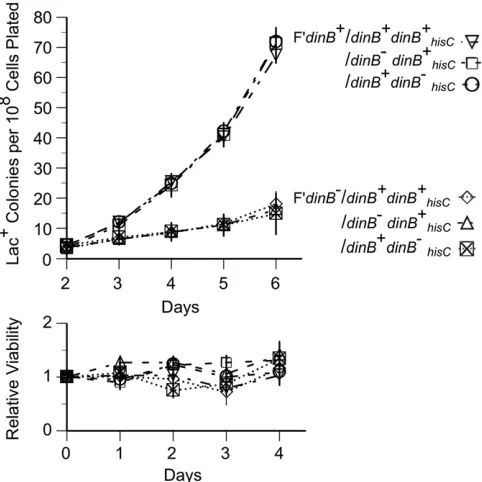
in the chromosome and another on the F’lacplasmid16-kb away fromlac(see Figure 2). As seen in Figure 4, removal of thedinB+gene from the plasmid reduced the revertant yield fivefold, even in a strain with a normal chromosomaldinB+
The bottom of Figure 4 shows that the 10-fold excess of scavenger cells plated with testers prevents lawn growth. Thus, revertant colonies developed in a population that grows very little. It also shows that starved cells do not lose viability in the absence of DinB.
The essential role of the plasmid dinB+ gene was also
tested directly by eliminating the chromosomaldinB+allele.
Figure 2 The relevant loci on chromosome and plas-mid. Thisfigure depicts the genotype of the standard Cairns–Foster strain (TR7178) and the changes intro-duced to test the effect ofdinB+position on reversion. A heavy line indicates the portion of the F’lacplasmid derived from the original F plasmid; the rest of the plasmid is derived from the chromosome of E. coli
(Kofoidet al. 2003). The orientation of thelacand
dinBgenes is reversed by the way in which the plasmid is excised from the chromosome. Two deletions (16 and 17 kb) share an endpoint near lac on the plasmid, but extend different distances to either leave or remove thedinB+gene. The insert is a PCR frag-ment from the 16-kb deletion strain, as described in Figure 1. The yebB gene is located at a maximum distance from lac in the tester F’128lac plasmid. To
In Figure 4, it can be seen that removal of dinB+from the
chromosome has no effect on revertant number, whether or not a functional allele is located on the F’lacplasmid. That is, a chromosomal dinB+copy does not provide mutagenesis to
strains lacking any otherdinB+allele, and removing the
chro-mosomaldinB+allele does not reduce mutagenesis in a strain
carryingdinB+on the F’lacplasmid. Thus, thedinB+copy on the
plasmid is both necessary and sufficient for reversion under selection. This same conclusion was reached earlier for the
Sal-monella version of the Cairns–Foster system (Slechta et al.
2002a, 2003). Two studies have previously addressed dinB+
position effects in E. coli. One of these studies supports the Figure 3 MMS sensitivity of strains withdinB+at various posi-tions. Strains were plated on LB plates with or without 7.5 mM MMS by spotting 5 ml droplets of cultures that had been diluted 1024, 1025, or 1026fold. Thefirst
column from the left denotes line numbers referenced in the text as well as strain numbers (genotypes described in Table 1). The second and third columns describedinB
genotypes in the chromosome (Chrom.) and the F’128 plasmid,
using“+”to indicate dinB+ and “2”to indicate adinBdeletion. For the “+,” annotations in pa-rentheses indicate where a new
dinBallele was inserted, and no annotation means that the dinB
gene is in its original position on the chromosome or F’128
conclusion drawn here (Kimet al.2001) and the other contra-dicts it (McKenzieet al.2001). These results will be discussed later.
The plasmid dinB+gene stimulates reversion regardless
of its position on the F’lac plasmid
The two selection models for the Cairns system make different predictions regarding the effect of thedinB+gene on
rever-sion under selection. Figure 5A describes the reverrever-sion be-havior of three strains with thedinB+allele at different sites
in the F’lacplasmid and a control strain whose plasmid lacks a dinB+gene. The top label in Figure 5A indicates the standard
Cairns–Foster tester strain (TR7178) with dinB+ located
16 kb from lac (strain #1 in Figure 1). The second label indicates strain (TT27001), whose plasmid has the 16-kb de-letion, which places the dinB+promoter180 bp from the
divergentlacpromoter: strain #4 in Figure 1. The third strain (TT27282) carries a plasmid with the 17-kb deletion and a copy ofdinB+inserted atyebB115 kb fromlac: strain #6 in
Figure 1. These three dinB+ strains show equivalent high
yields of Lac+revertants, 57–70 Lac+colonies at day 6,
com-pared to a control strain (TT27002) whose plasmid lacks the dinBallele. Strain #2 in Figure 1, which was used as donor for all transplanted dinB+ alleles and has dinB+ located
1.5 kb fromlac, showed reversion behavior indistinguishable from the three dinB+ strains described in Figure 5A. The
control strain (TT27002) lacksdinB+on the F’plasmid and
shows four- tofivefold fewer cumulative Lac+revertants at
day 5. All the strains in Figure 5A have a chromosomaldinB+
gene, but the same results were obtained for strains carrying the same F’lac plasmids and a chromosomal dinB deletion mutant (data not shown).
The absence ofdinBon the plasmid decreased the number of Lac+ revertant colonies by around fivefold, as seen in Figure 4 and Figure 5A. The remaining revertants (20% of that in the Cairns’strain) are of two equally abundant types (10% of each type) (Figure 5B). One residual type (42 and 45%) is unstable and forms by tandemlacamplification with-out need for reversion of DinB. The second residual type (58 and 55%) is stably Lac+and forms by a sequence change
that occurs by local overreplication oflacwithout benefit of DinB. The original Cairns’strain (TR7178) with a chromo-somal and plasmiddinB+gene produces 14% unstable and
86% stable revertants (scored on day 5). Thus, DinB has no effect on the number of unstable revertants, but a dinB+
allele on the F’lacplasmid stimulates stable revertants eight-fold. At the same time, a chromosomaldinB+gene does not
affect the number of either revertant type.
The position of dinB+on F’lac does not affect the
frequency of unstable revertants
In the Cairns–Foster system,10% of Lac+revertants are due
to a tandem amplification of the mutantlacallele within the F’lac plasmid (Slechta et al. 2002b; Hastings et al. 2004; Kugelberget al.2006). The sequenced duplication endpoints lie in the immediate vicinity of the lac region, with many
endpoints falling within the dinB–lac region that was re-moved by the 16-kb deletion discussed here. The tandem amplification model suggested that mutagenesis was caused by selected tandem coamplification of the dinB+ and lac
genes (Slechtaet al.2003). Short amplifications that include dinBandlacwere suggested to amplify highly, increasing the mutation rate and giving rise to stable revertant cells.
Ampli-fications that do not includedinBor include a segment that is costly to amplify lead to unstable revertants. According to this model, the frequency of unstable revertants might in-crease if one broughtdinB+closer tolacsuch that a higher
fraction oflacduplications could includedinB+.
As seen in Figure 5B, the frequency of unstable revertants is not affected by the position of thedinB+gene on the F’lac
plasmid. Of the revertants, 10–14% are unstably Lac+
regard-less of the distance betweendinBandlac(180 bp, or 16 or 115 kb). This suggests that the process leading to stable rever-tants does not require previous tandem coamplification ofdinB andlac, as suggested by the tandem amplification model. Figure 4 Effects of dinB+ gene position on reversion under selection. Isogenic strains were tested for accumulation of revertants under selec-tion. Four isogenic strains havedinB+alleles at various genomic positions. The top two strains above have adinB+allele on F’lac, and a chromosome
with either a dinB+allele (TR7178) or adinBdeletion formed by drug
cassette replacement (TT27281). The bottom two strains have a F’lac
plasmid whosedinB gene wasremoved by a 17-kb deletion. Their chro-mosome has either a functionaldinB+allele (TT27002) or adinBdeletion
However, the result is consistent with selective amplifi ca-tion of the whole plasmid (model #3). As seen in Figure 5B, regardless of the position ofdinB+on the plasmid, 86–90% of
total revertants are stable (10–14% are unstable). According to the whole-plasmid amplification model, unstable rever-tants are initiated by preexisting cells whose plasmid ac-quired an internal lac duplication before its plasmid copy number increased. Reducing the distance betweendinBand lacdoes not seem to alter the likelihood of an unstable re-vertant. This suggests that unstable revertants are initiated prior to selection by cells with multiple copies of a plasmid with any of a wide variety of internallacduplication types, such that removal of the dinB–lac spacer region does not significantly alter the overall likelihood of alacduplication. Thus, stable and unstable revertants arise by a related series of events that proceed independently. With unstable rever-tants, each act of plasmid transfer between siblings under selection stimulates the unequal recombination events that allow amplification expansion. Tandem amplification of the preexisting duplication improves growth ability and leads to an unstable revertant, while DinB function and mutagenesis are required only for stable revertants.
An extra ectopic chromosomal dinB+gene does not
compensate for lack of dinB+on F’lac
The need for a functional dinB+gene on the F’lacplasmid
might be explained by the fact that the F’lacplasmid has a slightly higher (1–2) copy number than that of the chromo-some. If plasmid copy number explained this, one might ex-pect that any defect caused by removingdinB+from the F’lac
plasmid would be corrected by adding an extra ectopicdinB+
allele to the chromosome. To test this, an extradinB+copy
was inserted into the chromosomalhisCgene. The strain with only this inserteddinB+allele is MMS-resistant (see Figure 1,
lines 14 and 16). Strains with either or both chromosomal dinB+ alleles were tested for reversion with or without a
functionaldinB+gene on the F’lacplasmid. Results are shown
in Figure 6. Strains with a functionaldinB+allele on the F’lac
plasmid all showed the same high revertant yield regardless of whether the chromosome carried the normaldinB+allele,
the allele inserted at hisC, or both of these chromosomal alleles. Recall that lack ofdinB+in the chromosome has no
effect on reversion (Figure 4). Strains lackingdinB+on the
F’lacshowed low reversion, whether their chromosome car-ried the standard dinB+allele, thedinB+allele inserted at hisC, or both. Thus, increasing the dosage of a chromosomal dinB+gene does not compensate for lack of a plasmiddinB+
gene. This result differs from that of McKenzieet al.(2001), who found that addition of an ectopic chromosomal allele did compensate for lack ofdinB+on the plasmid. We suspect that
their results reflect a problem in strain construction, which we discuss later.
Discussion
Evidence is presented that the stablelac+revertants
appear-ing under selection in the Cairns–Foster system depend on the presence of a functionaldinB+allele on the F’lacplasmid
for their formation. These results support our current selec-tion model, in which reversion and mutagenesis require se-lective amplification of the entire F’lac plasmid with its included lac anddinB+genes (Maisnier-Patin and Roth
2015). Stress-induced mutagenesis models propose thatdinB gene transcription is increased during growth limitation (by RpoS-mediated induction and LexA-mediated derepression) and that this increase is important to the reversion process (McKenzie et al.2001; Layton and Foster 2003; Lombardo
et al.2004; Foster 2005; Galhardoet al.2009). While these
expression increases have experimental support, they cannot be the full explanation, since they do not explain thedinB+
position effect. That is, adinB+allele located in the
chromo-some should be induced just as well as one on F’lacplasmid. Figure 5 Effects ofdinBposition on reversion and on fraction of unstable revertants on day 5. (A) Four strains compared with adinB+allele at various
positions in the F’lacplasmid. All strains have a
dinB+allele at the normal position in the chromo-some (Chrom.). The strain (TR7178) has dinB+ located 16 kb fromlacon the F’lacplasmid. The second strain (TT27001) hasdinB+moved nearer to lac(180-bp away). The third strain (TT27282) lacks the normal 17-kbdinBregion but carries a functionaldinB+ inserted at the opposite side of the F’lacplasmid, within theyebBgene (see Figure 2). The fourth strain (TT27002) has a plasmid with nodinB+allele. The lower graph shows lawn cell population, which was assessed by removing plugs from random spots on the selection plate. The re-sults are presented for each strain individually rel-ative to the cell number at the time of plating. (B) The number of Lac+ revertants at day 5 and the percentage of revertants with an unstable or stable Lac+phenotype for each strain of (A) (TT27001;
TR7178; TT27282; and TT27002), and also strain TT27010 withdinBdeleted from both the F’lacplasmid and the chromosome. The stability phenotype was assessed by restreaking Lac+colonies at day 5 from the lactose plates onto rich medium with 5-bromo-4-chloro-3-indolyl-b-D-galactopyranoside, as
AdinB+allele at any genomic position should produce active
DinB protein that has accessin transto the entire genome. Contrary to stress-induced mutagenesis models, the chromo-somal dinB allele makes no contribution and reversion is enhanced under selection only when adinB+allele is located
somewhere on the F’lacplasmid. We propose below thatdinB induction may contribute to the DinB level but provides a level that is insufficient to cause mutagenesis unless the dinB+allele is amplified under selection.
The tandem amplification model predicts that, contrary to the data reported here,dinB+andlacmust be close together
on the F’lacplasmid so that they can both be included in a small region of the F’plasmid that amplifies in tandem under selection. Selection drives expansion of the tandem array in-cluding the (dinB CmRlac) sequence, and improves growth
by adding morelaccopies while it stimulates the reversion rate with more dinB+ copies (Hendrickson et al. 2002;
Slechtaet al.2003; Rothet al.2006). The results reported here show that reversion requiresdinB+to be somewhere on
the F’lacplasmid but not necessarily close tolac. That is, the same numbers of revertants are seen whendinB+is
immedi-ately adjacent to lac, or 16- or 115-kb away fromlac(the
maximum distance possible on the 230-kb plasmid). Thus, the results reported here argue against our previous tandem duplication model.
The results described here are consistent with a model in which revertants are initiated by preexisting cells with10 extra copies of the whole plasmid (Sanoet al.2014). These cells arise during nonselective growth prior to plating on lactose. Of the plated population (108cells), only these
ini-tiator cells (105) have enough energy to divide and
overre-plicate their F’lacplasmid under selection. Mating between sibling cells initiates rolling circle plasmid replication, which enhances reversion by repeatedly copying the mutantlac al-lele in the presence of a mutagenic excess of DinB protein. This model predicts that mutagenesis and enhanced rever-sion under selection depends on adinB+allele located
some-where on the F’lac plasmid, but not necessarily near lac (Maisnier-Patin and Roth 2015, 2016; S. Maisnier-Patin and J. R. Roth, personal communication). The unstable Lac+
revertants are thought to arise from initiator cells whose plasmids have an internallacduplication. Mating between siblings of these initiators stimulates unequal recombination events that allows selective expansion of the tandem array and cell growth without reversion.
This new model resurrects the importance of plasmid transfer in the reversion process, which was suggested early in the history of the Cairns system (Galitski and Roth 1995; Radicella et al.1995; Peters et al.1996). Mating had been rejected previously because only4% of Lac+revertants had
experienced plasmid transfer, based on reconstruction exper-iments using mixtures of genetically marked tester strains (Foster and Trimarchi 1995b). The new model suggests that mating is indeed rare between random plated cells, which are starving under selection, but is frequent between the siblings of the initiator cells, which both have the energy to support mating. Independently plated initiator cells are rare enough (1/1000 cells) that they seldom mate on the plate. Sup-porters of stress-induced mutagenesis propose that mating is unimportant and that plasmid conjugation functions con-tribute only by introducing a single-strand nick at the plasmid transfer origin (oriT). It is proposed that this nick becomes a double-strand break whose repair becomes mutagenic in the presence of DinB (Foster and Trimarchi 1995a; Ponderet al. 2005). This model does not explain why double-strand breaks in the chromosome are so inefficient at causing muta-genesis or how the effects of repairing a break at oriTcan extend to thelaclocus, which is located over 100-kb away fromoriTon the F’lacplasmid (Sheeet al.2011a,b). Stress-induced mutagenesis models do not explain thedinBposition effects described here.
The idea of adinB+position effect was tested previously
for the Cairns–Foster system in bothSalmonellaandE. coli. In
Salmonella, reversion clearly depended on having a dinB+
gene on the F’128plasmid (Slechtaet al.2002a, 2003). The first test inE. colisupported the same conclusion:lac rever-sion requireddinB+on the F’lacplasmid and was not affected
by the chromosomal dinB allele (Kim et al. 2001). This Figure 6 Contribution to reversion of ectopicdinB+copies. The top three
strains all carry an F’lacplasmid with a functionaldinB+gene. Thefirst strain (TT27286) also has adinB+allele at its normal chromosomal loca-tion and an addiloca-tional copy inserted into the chromosomalhisCgene. The second (TT27295) has only thedinB+allele inserted into thehisCgene. The third strain (TT27290) carries the normaldinB+and a Cm+
experiment was done as a Luria–Delbrück fluctuation test rather than a time-dependent accumulation of revertants on solid medium. Parallel cultures of the Cairns–Foster tester strain were plated without scavenger cells on lactose, allow-ing some growth under selection. Revertant (Lac+) colonies
were counted on day 2 in the belief that they resulted from events occurring prior to plating. However, the revertant number in the several cultures after day 2 showed a Poisson distribution, instead of a Luria–Delbrück distribution. This observed distribution was like that seen for revertant accu-mulation in the Cairns–Foster system. The Poisson distribu-tion suggested that revertants either form on the selecdistribu-tion plate (Cairns and Foster 1991) or are initiated by preexisting copy number variants that are not subject to Luria–Delbrück
fluctuation (Sano et al. 2014). In this E. coli position-effect test, revertant number was increased by a lexA(Def) mutation, which causes constitutive expression of dinB by SOS derepression, and was reduced by removal of thedinB+
from the F’lacplasmid (Kimet al.2001). Revertant number was not reduced by removal of the chromosomaldinB+allele.
A different conclusion was drawn when thedinB+position
effect was addressed by McKenzie et al.(2001). In this ex-periment, removal ofdinB from either the plasmid or chro-mosome caused a strong reduction in the number of revertants in the homozygous (dinB2/dinB2) strain. The role of the chromosomal dinB+allele was tested in an unusual
way. Instead of repairing the chromosomal dinB mutation allele or moving the plasmid to adinB+recipient, an ectopic dinB+allele was added to the chromosome of thedinB2/dinB2
homozygote. This addition restored reversion. ThedinB+
al-lele was added to the chromosome at the insertion site of phage l, near the galactose operon. The insertion method was not described, and the expression level of the ectopic allele was not tested. We suspect that the unusual result reported was due to the proximity ofdinB+to the galactose
operon. Expression of the galactose operon is essential to reversion in the Cairns system since growth requires use of the galactose released by the splitting of lactose (Andersson
et al. 1998). It seems possible that derepression of thegal
operon enhances expression of an adjacentdinB+gene, or
that selection for growth on lactose favors amplification of the chromosomalgal-dinBregion during reversion under se-lection. It is also possible that the inserted dinB fragment included a drug-resistance determinant that amplified with dinB+during growth of strains on an antibiotic.
Enhanced lac reversion under selection in the Cairns–Foster system is not evidence for a general phenomenon of stress-induced mutagenesis
Results presented here suggest that the error-prone DinB polymerase enhances reversion in the Cairns system only if its structural gene is located somewhere on the F’lacplasmid and can be selectively amplified withlacusing plasmid con-jugation functions, which are essential for reversion. The colocation of these genes is a peculiarity of the F’lac plas-mid, a laboratory construction that fuses a chromosomallac
fragment with the conjugative F plasmid. ThedinBandlac genes were brought close together when this plasmid formed by recombination between chromosomal REP sequences (Kofoidet al.2003). (REP indicates a“repeated extragenic palindromic”element) Enhanced reversion of thelac muta-tion also depends on the conjugamuta-tion funcmuta-tions of the F’lac dinBplasmid (Galitski and Roth 1995; Radicellaet al.1995; Peterset al.1996) and is not seen for alacmutation located in the chromosome (Foster and Trimarchi 1995a; Radicella
et al.1995). These observations suggested that DinB
muta-genesis duringlacreversion is not due to an evolved global mechanism for creating mutations in response to stress, but is rather an artifact of a particular system that happens to juxta-pose thedinB+andlacalleles on a plasmid whose conjugation
functions can support repeated rolling circle replication of the whole plasmid in cells that divide very little.
Evidence has been presented that reversion requires pos-itive regulation ofdinBby the stationary phase transcription factor RpoS (Layton and Foster 2003; Lombardoet al.2004) and derepression ofdinBby the SOS regulatory protein LexA (McKenzie et al.2001; Foster 2005; Galhardoet al.2009). These observations have been interpreted as evidence for an intricate control mechanism that regulates mutation rates during growth limitation. While these transcription controls do increasedinBexpression, the results presented here sug-gest that this increase is not sufficient to explain mutagenesis in the Cairns–Foster system. We suggest that RpoS2 and LexInd mutations reduce reversion because they lower the
transcription level of DinB. The observed mutagenesis re-quires that the dinB+ gene must not only be transcribed,
but must also be amplified under selection. The transcrip-tional controls of DinB seem likely to have evolved to manage DNA damage repair rather than variation in mutation rates. The critical variation in DinB expression is supplied by selec-tive coamplification ofdinB+withlac. This amplification can
only be effective if there is some expression of the dinB+
gene.
Summary: the take-home lesson of the Cairns–Foster system
(S. Maisnier-Patin and J. R. Roth, personal communication). Understanding how selection works in this system has re-quired the unraveling of multiple arcane aspects of a compli-cated biological situation. It seems likely that many other cases of apparent stress-induced mutagenesis will be simi-larly explicable without regulated mutability once one un-ravels the system-specific peculiarities exploited by selection.
Acknowledgments
We thank members of our laboratory for helpful sugges-tions. This work was supported by National Institutes of Health grant GM-27068.
Literature Cited
Andersson, D. I., E. S. Slechta, and J. R. Roth, 1998 Evidence that gene amplification underlies adaptive mutability of the bacterial lac operon. Science 282: 1133–1135.
Bailone, A., A. Bäckman, S. Sommer, J. Célérier, M. M. Bagdasarian
et al., 1988 PsiB polypeptide prevents activation of RecA pro-tein inEscherichia coli. Mol. Gen. Genet. 214: 389–395. Battesti, A., N. Majdalani, and S. Gottesman, 2011 The RpoS-mediated
general stress response inEscherichia coli. Annu. Rev. Microbiol. 65: 189–213.
Benson, R. W., M. D. Norton, I. Lin, W. S. Du Comb, and V. G. Godoy, 2011 An active site aromatic triad inEscherichia coli
DNA Pol IV coordinates cell survival and mutagenesis in differ-ent DNA damaging agdiffer-ents. PLoS One 6: e19944.
Berkowitz, D., J. M. Hushon, H. J. Whitfield, J. R. Roth, and B. N. Ames, 1968 Procedures for identifying nonsense mutations. J. Bacteriol. 96: 215–220.
Bjedov, I., C. N. Dasgupta, D. Slade, S. Le Blastier, M. Selvaet al., 2007 Involvement of Escherichia coli DNA polymerase IV in tolerance of cytotoxic alkylating DNA lesionsin vivo. Genetics 176: 1431–1440.
Cairns, J., 1998 Mutation and cancer: the antecedents to our studies of adaptive mutation. Genetics 148: 1433–1440. Cairns, J., and P. L. Foster, 1991 Adaptive reversion of a
frame-shift mutation inEscherichia coli. Genetics 128: 695–701. Cairns, J., J. Overbaugh, and S. Miller, 1988 The origin of
mu-tants. Nature 335: 142–145.
Courcelle, J., A. Khodursky, B. Peter, P. O. Brown, and P. C. Hanawalt, 2001 Comparative gene expression profiles following UV expo-sure in wild-type and SOS-deficientEscherichia coli. Genetics 158: 41–64.
Court, D. L., J. A. Sawitzke, and L. C. Thomason, 2002 Genetic engineering using homologous recombination. Annu. Rev. Genet. 36: 361–388.
Datsenko, K. A., and B. L. Wanner, 2000 One-step inactivation of chromosomal genes inEscherichia coliK-12 using PCR products. Proc. Natl. Acad. Sci. USA 97: 6640–6645.
Foster, P. L., 2005 Stress responses and genetic variation in bac-teria. Mutat. Res. 569: 3–11.
Foster, P. L., and J. Cairns, 1992 Mechanisms of directed muta-tion. Genetics 131: 783–789.
Foster, P. L., and J. M. Trimarchi, 1995a Adaptive reversion of an episomal frameshift mutation inEscherichia colirequires conju-gal functions but not actual conjugation. Proc. Natl. Acad. Sci. USA 92: 5487–5490.
Foster, P. L., and J. M. Trimarchi, 1995b Conjugation is not re-quired for adaptive reversion of an episomal frameshift muta-tion inEscherichia coli. J. Bacteriol. 177: 6670–6671.
Friedberg, E. C., G. C. Walker, W. Siede, R. D. Wood, A. Schultzet al., 2006 DNA Repair and Mutagenesis. ASM Press, Washington, DC. Galhardo, R. S., R. Do, M. Yamada, E. C. Friedberg, P. J. Hastings
et al., 2009 DinB upregulation is the sole role of the SOS re-sponse in stress-induced mutagenesis inEscherichia coli. Genet-ics 182: 55–68.
Galitski, T., and J. R. Roth, 1995 Evidence that F plasmid transfer replication underlies apparent adaptive mutation. Science 268: 421–423.
Hastings, P. J., A. Slack, J. F. Petrosino, and S. M. Rosenberg, 2004 Adaptive amplification and point mutation are indepen-dent mechanisms: evidence for various stress-inducible muta-tion mechanisms. PLoS Biol. 2: e399.
He, A. S., P. R. Rohatgi, M. N. Hersh, and S. M. Rosenberg, 2006 Roles of E. coli double-strand-break-repair proteins in stress-induced mutation. DNA Repair (Amst.) 5: 258–273. Hendrickson, H., E. S. Slechta, U. Bergthorsson, D. I. Andersson,
and J. R. Roth, 2002 Amplification-mutagenesis: evidence that
“directed”adaptive mutation and general hypermutability result from growth with a selected gene amplification. Proc. Natl. Acad. Sci. USA 99: 2164–2169.
Kim, S. R., G. Maenhaut-Michel, M. Yamada, Y. Yamamoto, K. Matsuiet al., 1997 Multiple pathways for SOS-induced muta-genesis inEscherichia coli: an overexpression ofdinB/dinP re-sults in strongly enhancing mutagenesis in the absence of any exogenous treatment to damage DNA. Proc. Natl. Acad. Sci. USA 94: 13792–13797.
Kim, S. R., K. Matsui, M. Yamada, P. Gruz, and T. Nohmi,
2001 Roles of chromosomal and episomal dinB genes
encod-ing DNA pol IV in targeted and untargeted mutagenesis in Es-cherichia coli. Mol. Genet. Genomics 266: 207–215.
Kofoid, E., U. Bergthorsson, E. S. Slechta, and J. R. Roth, 2003 Formation of an F9plasmid by recombination between imperfectly repeated chromosomal Rep sequences: a closer look at an old friend (F9(128)pro lac). J. Bacteriol. 185: 660–663. Kuban, W., P. Jonczyk, D. Gawel, K. Malanowska, R. M. Schaaper
et al., 2004 Role of Escherichia coli DNA polymerase IV in in vivo replicationfidelity. J. Bacteriol. 186: 4802–4807. Kugelberg, E., E. Kofoid, A. B. Reams, D. I. Andersson, and J. R.
Roth, 2006 Multiple pathways of selected gene amplification during adaptive mutation. Proc. Natl. Acad. Sci. USA 103: 17319–17324.
Layton, J. C., and P. L. Foster, 2003 Error-prone DNA polymerase IV is controlled by the stress-response sigma factor, RpoS, in
Escherichia coli. Mol. Microbiol. 50: 549–561.
Lederberg, J., and E. M. Lederberg, 1952 Replica plating and in-direct selection of bacterial mutants. J. Bacteriol. 63: 399–406. Lombardo, M. J., I. Aponyi, and S. M. Rosenberg, 2004 General stress response regulator RpoS in adaptive mutation and
ampli-fication inEscherichia coli. Genetics 166: 669–680.
Luria, S. E., and M. Delbrück, 1943 Mutations of bacteria from virus sensitivity to virus resistance. Genetics 28: 491–511. Maisnier-Patin, S., and J. R. Roth, 2015 The origin of mutants
under selection: how natural selection mimics mutagenesis (adaptive mutation), pp. 97–115 inMicrobial Evolution, edited by H. Ochman. Cold Spring Harbor Laboratory Press, Cold Spring Harbor, NY.
Maisnier-Patin, S., and J. R. Roth, 2016 The adaptive mutation controversy, pp. 26–36 inEncyclopedia of Evolutionary Biology, edited by R. M. Kliman. Academic Press, Oxford.
McKenzie, G. J., R. S. Harris, P. L. Lee, and S. M. Rosenberg,
2000 The SOS response regulates adaptive mutation. Proc.
Natl. Acad. Sci. USA 97: 6646–6651.
McKenzie, G. J., P. Lee, M.-J. Lombardo, P. Hastings, and S.
Rosen-berg, 2001 SOS mutator DNA polymerase IV functions in
Mittelman, D. (Editor), 2013 Stress-Induced Mutagenesis. Springer Science+Business Media, New York, NY.
Newcombe, H. B., 1949 Origin of bacterial variants. Nature 164: 150–151.
Ohmori, H., E. C. Friedberg, R. P. Fuchs, M. F. Goodman, F. Hanaoka
et al., 2001 The Y-family of DNA polymerases. Mol. Cell 8: 7–8. Peters, J. E., I. M. Bartoszyk, S. Dheer, and S. A. Benson, 1996 Redundant homosexual F transfer facilitates selection-induced reversion of plasmid mutations. J. Bacteriol. 178: 3037–3043.
Ponder, R. G., N. C. Fonville, and S. M. Rosenberg, 2005 A
switch from high-fidelity to error-prone DNA double-strand break repair underlies stress-induced mutation. Mol. Cell 19: 791–804.
Radicella, J. P., P. U. Park, and M. S. Fox, 1995 Adaptive mutation inEscherichia coli: a role for conjugation. Science 268: 418–420. Reams, A. B., E. Kofoid, M. Savageau, and J. R. Roth, 2010 Duplication frequency in a population ofSalmonella en-tericarapidly approaches steady state with or without recombi-nation. Genetics 184: 1077–1094.
Rosenberg, S. M., 2001 Evolving responsively: adaptive mutation. Nat. Rev. Genet. 2: 504–515.
Roth, J. R., and D. I. Andersson, 2004 Adaptive mutation: how growth under selection stimulates Lac+reversion by increasing
target copy number. J. Bacteriol. 186: 4855–4860.
Roth, J. R., E. Kugelberg, A. B. Reams, E. Kofoid, and D. I. Andersson, 2006 Origin of mutations under selection: the adaptive muta-tion controversy. Annu. Rev. Microbiol. 60: 477–501.
Sano, E., S. Maisnier-Patin, J. Aboubechara, S. Quiñones-Soto, and J. R. Roth, 2014 Plasmid copy number underlies adaptive mu-tability in bacteria. Genetics 198: 919–933.
Shee, C., J. L. Gibson, M. C. Darrow, C. Gonzalez, and S. M. Rosenberg, 2011a Impact of a stress-inducible switch to mutagenic repair of
DNA breaks on mutation inEscherichia coli. Proc. Natl. Acad. Sci. USA 108: 13659–13664.
Shee, C., R. Ponder, J. L. Gibson, and S. M. Rosenberg, 2011b What limits the efficiency of double-strand break-dependent stress-induced mutation in Escherichia coli? J. Mol. Microbiol. Biotech-nol. 21: 8–19.
Slechta, E. S., J. Harold, D. I. Andersson, and J. R. Roth, 2002a The effect of genomic position on reversion of alac
frameshift mutation (lacIZ33) during non-lethal selection (adaptive mutation). Mol. Microbiol. 44: 1017–1032.
Slechta, E. S., J. Liu, D. I. Andersson, and J. R. Roth, 2002b Evidence that selected amplification of a bacteriallac
frameshift allele stimulates Lac+reversion (adaptive mutation)
with or without general hypermutability. Genetics 161: 945– 956.
Slechta, E. S., K. L. Bunny, E. Kugelberg, E. Kofoid, D. I. Andersson
et al., 2003 Adaptive mutation: general mutagenesis is not a programmed response to stress but results from rare coamplifi -cation ofdinBwithlac. Proc. Natl. Acad. Sci. USA 100: 12847– 12852.
Thomason, L. C., J. A. Sawitzke, X. Li, N. Costantino, and D. L. Court, 2014 Recombineering: genetic engineering in bacteria using homologous recombination. Curr. Protoc. Mol. Biol. 106: 1.16.1–1.16.39.
Torkelson, J., R. S. Harris, M. J. Lombardo, J. Nagendran, C. Thulin
et al., 1997 Genome-wide hypermutation in a subpopulation of stationary-phase cells underlies recombination-dependent adaptive mutation. EMBO J. 16: 3303–3311.
Wagner, J., P. Gruz, S. R. Kim, M. Yamada, K. Matsui et al., 1999 ThedinBgene encodes a novelE. coliDNA polymerase, DNA pol IV, involved in mutagenesis. Mol. Cell 4: 281–286.