Experimental Analysis of an Inclined Solar
Still With Flat and Steeped Absorber Plates
Mariyappan 1, Samuel Hansen 2
U.G. Student, Department of Mechanical Engineering, Francis Xavier Engineering College, Vanarpettai, Tirunelveli,
Tamil Nadu, India 1
Associate Professor, Department of Mechanical Engineering, Francis Xavier Engineering College, Vanarpettai,
Tirunelveli, Tamil Nadu, India 2
ABSTRACT: Water and energy are the two most essential resources for sustaining of life. The demand for fresh water is rapidly increasing, while supply has been decreasing over the decades. The shortage of portable drinking water can be resolved through the desalination of seawater. Conventional techniques for desalination are available, but they require a large input of energy, mostly from fossil fuels that contribute to environmental degradation. Solar desalination systems provide the best solution to this problem, by desalinating fresh water economically in an eco-friendly manner. In the present research work, the efficiency and the distillate productivity of an inclined solar still is enhanced by using different using steeped absorber plate configuration to increase the residence time of water inside the inclined still. The daily distillate output was about 3.45 l /day and increased up to 11.3% when steeped absorber used as basin condition.
.KEYWORDS: Solar desalination, Productivity, Inclined still, steeped Absorber plate.
I. INTRODUCTION
Solar still is a simple desalination device without any moving parts to desalinate brackish or saline water with the aid of solar energy. A solar still has a blackened basin with feed saline water at the bottom and a transparent glass cover enclosed at the top. The entire setup is provided with airtight insulation at the side and bottom as shown in Figure 1.1. The solar radiations are received by the outer surface of the glass cover and then transmitted to the inner part of the solar still, where they are absorbed by the blackened surface of the basin. The saline water over the basin heats up and evaporates from the basin and condenses on the inner surface of the glass, as pure distillate leaving the salts and microbes. The efficiency of a solar still can be increased by maintaining a large temperature difference between evaporating and condensing surface with a low amount of vapour leakage
II. LITERATURESURVEY
In a basin still, water will be stagnant on a flat absorber plate, whereas in an inclined still water flows down along an inclined absorber plate. The longer flow of feed water increases the evaporation rate and distillate productivity in an inclined still, when compared with a basin still. The main advantage of the inclined still over basin still is that it can produce fresh water distillate and hot water simultaneously. Inclined stills have two major benefits, when compared with basin stills. The primary advantage of inclined still is that the absorber plate with feed water can be tilted at an optimum angle to receive maximum solar radiation from the sun. The secondary advantage is that it has less feed water on the absorber surface at any instant, which allows the basin water to attain a higher temperature quickly.
Sodha et al. (1981) studied and made an experimental and theoretical investigation on the performance of a multiple wicks- inclined type solar still distiller. In this solar still, blackened wet jute cloth material was used to improve the surface area of the feed water through its capillary action. Here, the series of jute cloth pieces were separated by thin black polythene sheets, and this arrangement of wick material made the inclined surface, irradiated by the sun was always wet. The results showed this wick material usage enhanced 4% efficiency when compared to a conventional basin solar still. Singh & Tiwari (1989) carried out a simple thermal analysis on a triple effect multi-wick solar still. It is as simple as a multistage solar still with (j+n)th effect and from each basin heat is utilized by another basin. Here, from the second and third effect of the solar still, regenerative energy is obtained by flowing water over the surface of the glass as it acts as a basin. The results show that the optimum number of effect is found to be 3 and for a flow rate of 10-2 kg/sec in the 2nd and 3rd effect. Janarthanan et al. (2006) conducted an experiment on the performance of tilted solar still, in which the wick material was made to flow over the water surface. In this system, the effect of water flowing over glass surface was analyzed by considering the heat capacities on two wick surfaces, one on the tilted wick water surface, and the other on the floating wick water surface. The analysis showed that there was not much difference between the theoretical and experimental values for both tilted and floating wick surfaces. Sadineni et al. (2008) studied the theoretical and experimental performance of a weir-type inclined solar still. In this system, the inclined absorber plate was made up of numerous weirs, which controls the flow characteristics of input saline water. This special arrangement of weirs in the absorber plate increases the productivity, 20% higher than that of a simple basin solar still. El-Zahaby et al. (2011) studied the performance of a corrugated steeped solar still. In this system, saline water was sprayed as droplets into the corrugated steeped solar still by a reciprocating feeding mechanism. This special arrangement and design of absorber plate enhance the distillate production. Phillips Agboola et al. (2012) conducted experiments to test the performance of an Inclined Solar Water Desalination (ISWD) system under various typical climatic conditions (winter and summer seasons) prevailed in Northern Cyprus. The daily distilled water obtained during the summer season was found to be 6.41 kg/m2, which was very high and almost double the amount of distilled water (3.327 kg/m2 ), obtained in the winter season. The daily efficiency was found to be 52.4% in summer season while the efficiency dropped in winter to 43.6%.
IIIEXPERIMENTALSETUPANDPROCEDURE
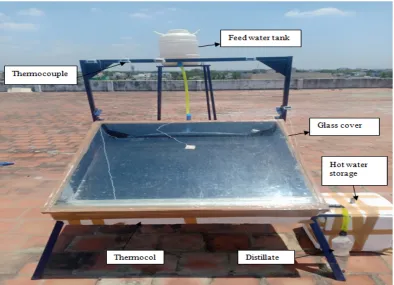
The outdoor experiments were conducted at the campus of Francis Xavier Engineering College, Tirunelveli, Tamil Nadu, India, (8 º44’N, 77 º42’E), with test facility located at the roof of Mechanical Engineering Department, during the month of March 2019. The schematic drawing of the integrated solar still setup used in this experimental study is shown in Figure 3.1.
Figure 3.1 Schematic drawing of inclined type solar still
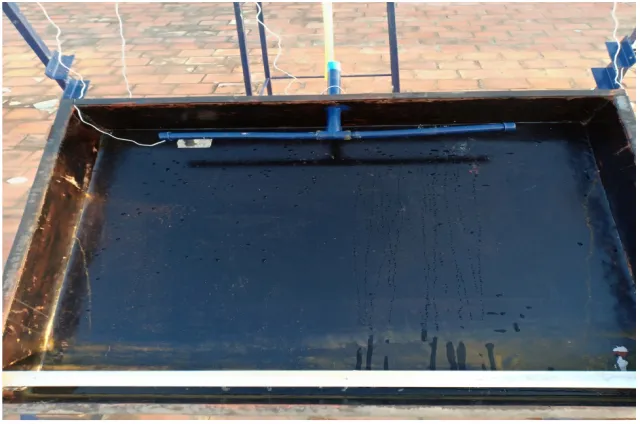
The feed water from water tank was supplied to the basin through a horizontal distribution pipe fixed on the top portion of the basin with 20 small holes. The outer surface of the basin was insulated by 25 mm thermocol. The drain was provided at the lower edge of the glass inner side to collect the condensate. This condensate was collected by a drain and delivered to a measure jar through a flexible hose. Another drain was provided to collect excess raw water from the basin bottom. Figure 3.2 shows the photographic view of the inclined type solar still.
Figure 3.3 a & b shows the different types of absorber plates used in the inclined type solar still
Figure 3.3 a Flat absorber
IVRESULTSANDDISCUSSIONS
4.1 Variation of ambient temperature with Global Radiation
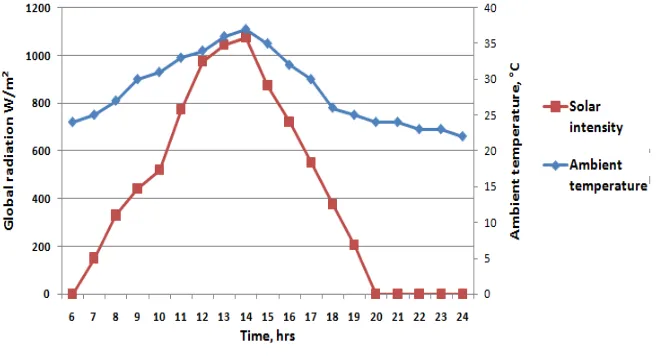
Figure 4.1 shows the average atmospheric temperature and global radiation variation with respect to local time during the experimental period. Here the solar radiation the maximum value of 1065 W/m2 at 2.00 p.m. The sky was clear and there was no freeze during the experimental days. Also, the global radiation and ambient temperature are almost same for all the experimental days and conditions. Experimental results of the days with average atmospheric conditions have been considered for analysis.
Figure 4.1 Variation of global radiation with ambient temperature.
4.2 Variation of basin water temperature with respect to time
Figure 4.2 shows the variation of basin water temperature for various absorber plate conditions. For all conditions, the variations are almost uniform and the water still reaches the maximum temperature around 2 p.m. For flat absorber, the mass flow rate is high and therefore the basin water temperature is low when compared to steeped absorber. But in steeped absorber the basin water temperature is relatively higher, since the water flows at a low mass flow rate due to the groove arrangement.
4.3 Variation of hourly productivity with respect to time
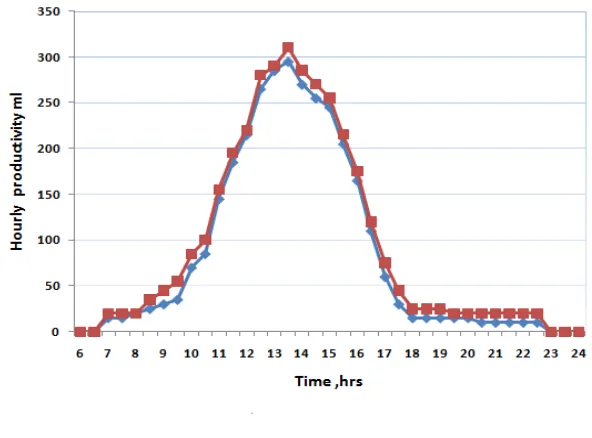
Figure 4.3 shows the variations in hourly production rate for different absorber plate configurations in the inclined type still. The flat absorber plate is the basic material for the inclined type solar still. In flat absorber, a maximum production rate of 295 ml of distilled water was achieved at 2.00 p.m. The productivity was further increased by using stepped absorber plate, which retains the water inside the basin and reduces the mass flow rate. In stepped absorber, a maximum production rate of 320 ml of distilled water was achieved at 2.30 p.m..For flat and stepped absorbers, the daily distillate productivity was 3.095 ml/day and 3.435 ml/day respectively.
Figure 4.3 Variation of hourly productivity with respect to time.
V. CONCLUSION
In this work, a performance study was made on different absorber plates. Also, the performance of an inclined type solar still was experimentally investigated with various absorber plates (flat absorber and steeped absorber). Based on this experimental study, steeped absorber was found to be the best absorber material for the solar desalination application. A comparative study was made for different absorber conditions used in the inclined solar still. The result indicates that the total production rate was increased by 1 1 .3%, when stepped absorber was used instead of flat absorber.
REFERENCES
[1] Sodha, MS, Kumar Ashvini, Tiwari, A & Tyagi, G 1986, ‘Progresses in simple multiple wick solar still: analysis and performance’, Solar Energy, vol. 26, pp. 127-131.
[2] Singh, AK & Tiwari, GN 1989, ‘Performance study of double effect distillation in a multi wick solar still’, Energy Convers. Mgmt, vol. 33, no. 3, pp. 207-214.
[4] Sadineni, SB, Hurt, R, Halford, CK & Boehm, RF 2008, ‘Theory and experimental investigation of a weir -type inclined solar still’, Energy, vol. 33, pp. 71-80.
[5] El-Zahaby, AM, Kabeel, AE, Bakry, AI, El-Agouz, SA & Hawam, OM 2011, ‘Enhancement of solar still performance using a reciprocating spray feeding system’, Desalination, vol. 267, pp. 209–16.