ABSTRACT
EDWARDS, ERICA RENEE. Licensing as a Component of Competitive Strategy: A Comparative Analysis and Case Study. (Under the direction of Michelle Jones.)
The purpose of this study was to investigate how licensing is used as a strategic tool within the apparel industry, to understand the relationship between licensing as a strategic tool and lifestyle branding, and to understand how license reacquisition impacts the competitive strategy of firms. Using a Three Phase methodology this study explored
licensing, license reacquisition, and how the two relate to competitive strategy. Phase I was the creation of a major licensing studies taxonomy, which was used to gain insight into the strategic uses of licensing within other industries. Phase II, consisted of two components included case studies of three leading apparel firms that participate in licensing and
interviews with individuals from these three firms and other apparel industry representatives. Phase II was essential in understanding licensing as a strategic tool and how licensing and reacquisition are used competitively within the apparel industry. Phase III was the creation and validation of a theoretical model which depicts the relationship between strategic licensing, lifestyle branding, and reacquisition within the apparel industry to gain a competitive advantage. This research provides a foundation for future research in an emerging area of study by establishing a framework and theoretical model relating to licensing within the apparel industry.
industry licensing is used predominantly to extend the brand’s presence beyond its core, and fulfill a particular niche or white space in the market.
Phase II helped satisfy Research Objective Two, which was to understand the relationship between licensing as a strategic tool, and lifestyle branding. The study found that licensing broadens the scope and appeal of the brand, and allows the brand to offer products beyond its core. Positioned strategically these products add to the lifestyle image and assortment of the brand owner, and aids in the progression of a lifestyle branding strategy.
Phase II was also instrumental in satisfying Research Objective Three, which was to investigate why and how firms reacquire license agreements, and how such a decision impacts the firm’s competitive strategy. The rights granted in a license agreement can be reacquired for various reasons including protection of quality and brand image, and
overcoming a compromised market position. Reacquisition can also be the result of a control strategy, as having 100% control makes the brand owner more competitive in terms of
identity, direction, and positioning against competitors. It has made the apparel industry more competitive while challenging the industry to constantly improve.
The fourth research objective was to develop a theoretical model that depicts the relationship between competitive strategies, licensing as a strategic tool, and license
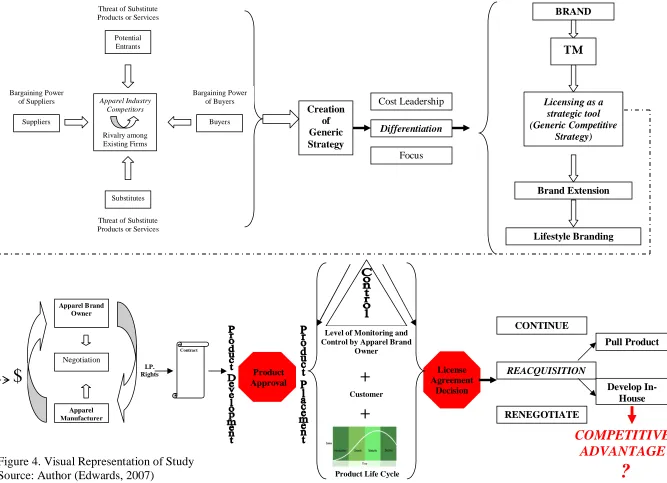
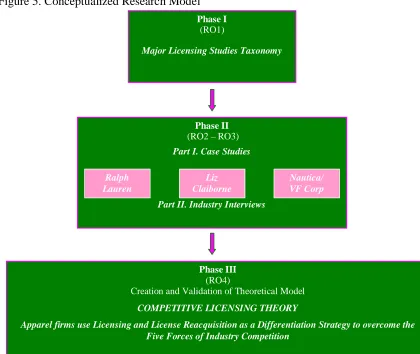
reacquisition. The third phase visually depicts this relationship and presents the Competitive Licensing Theory, which states that: Apparel firms use Licensing as a Differentiation
Licensing as a Component of Competitive Strategy: A Comparative Analysis and Case Study
by
Erica Renee Edwards
A thesis submitted to the Graduate Faculty of North Carolina State University
In partial fulfillment of the Requirements for the degree of
Master of Science
TEXTILES
Raleigh, NC 2007
Approved by:
___________________________ _______________________
Dr. Pamela Banks-Lee Dr. Nancy L. Cassill
DEDICATION
This work is dedicated to all those who have believed in me, fought for me, prayed for me, and rejoiced with me during this journey. To my family and friends who
undoubtedly love me when I am right, and when I am wrong, I can only hope that each and every one of you know how much I love you in return.
Love is patient, love is kind. It does not envy, it does not boast, it is not proud. It is not rude, it is not self seeking, it is not easily angered, it keeps no record of wrongs. Love does not
delight in evil but rejoices with the truth. It always protects, always trusts, always hopes, always perseveres. Love never fails.
BIOGRAPHY
Erica Renee Edwards was born on April 30, 1983 in Roanoke Rapids, North Carolina. Her parents are Mr. and Mrs. William and Lillie Edwards, and she has six brothers William Jr., Gary, Toby, Steven, Joshua, and Justin, and a sister Cheryl. Erica currently has four nieces LaKecia, Brianna, Shaquanda, Diamond, and three nephews Darius, Demonte, and Amir. Even though not biologically related, Erica has another brother Cornelius Jones.
She attended public school in Halifax County, North Carolina, and graduated in 2001 from Northwest Halifax High School. She enrolled at North Carolina State University in the fall of 2001, and graduated with a degree in Textile and Apparel Management on May 15, 2005. While enrolled as an undergraduate Erica was a member of Alpha Kappa Alpha Sorority, Incorporated, and served as a peer mentor. After obtaining her Bachelor’s degree, she again enrolled at North Carolina State University as a graduate student the fall semester of 2005. She is currently working towards satisfying the requirements of the Master’s Degree in Textile Technology and Management, and looks forward to graduating in 2007.
ACKNOWLEDGMENTS
I have often said that my graduate school experience has been a war full of battles, some of which were harder to overcome than others. Ultimately I leave this experience a stronger, more confident, and professional individual. I am most thankful to Dr. Michelle Jones for all that she has done for me over the years. Without her help, I would not be where I am today. Thank you for believing in me, encouraging me, guiding me, and fighting for me. I don’t think you will ever understand the amount of respect and admiration that I have for you. I must also thank the other members of my committee Dr. Nancy Cassill and Dr. Pamela Banks-Lee for all their advice and guidance along the way.
I would like to thank my family for all the love, support, and guidance that has been given to me over the years. I am most grateful to my parents for all that they have done and continue to do. To my daddy, thank you for being a provider and giving that security that only a father can give. To my mom, thank you for praying for me, even when I’m not praying for myself. I know that no matter how rough the real world gets I can always come home to loving and open arms.
I have to thank all of my friends who have been there for me when I needed to “take a break” and enjoy the beauty of life. To my closest and true friends, your love and your friendship mean so much to me, you are not obligated to love me, but you do, and I greatly appreciate it. More importantly, you never doubted me, always encouraged me, and were there to share in every triumph and trial with me.
TABLE OF CONTENTS
LIST OF TABLES ... viii
LIST OF FIGURES...x
CHAPTER 1 ...1
Introduction...1
Purpose of Study ...4
Research Questions ...4
Research Objectives ...4
Significance...5
Scope ...5
Limitations ...6
Conceptual Definitions ...7
CHAPTER 2 ...8
Review of Literature...8
The Business of Licensing ...8
Types of Licensing ...12
International Licensing ...21
Porter’s Theory of Competitive Advantage ...22
Differentiation ...29
Licensing to Leverage Competitive Forces...30
Licensing to Leverage Competitive Forces in Other Industries...33
Licensing via Brand Extension as a Competitive Strategy...37
Lifestyle ...42
Licensing and Lifestyle...44
License Reacquisition ...46
CHAPTER 3 ...56
Methodology ...56
Purpose of Study...56
Research Questions ...56
Research Objectives ...58
Research Design ...58
Case Study Protocol...70
Operational Definitions...79
CHAPTER FOUR ...80
Introduction...80
Data Collection Overview ...80
Phase I...80
Phase II...83
Findings ...149
Research Objective One...149
Research Objective Two ...154
Research Objective Three ...155
Research Objective Four...158
CHAPTER FIVE...165
Conclusions...166
Research Question One...166
Research Question Two ...167
Research Question Three ...168
Implications...170
Industry Recommendations ...172
REFERENCES...176
APPENDICES ...188
Appendix A...189
LIST OF TABLES
Table 1. Licensed Product Categories ...13
Table 2. Porter’s Five Forces and Related Variables ...27
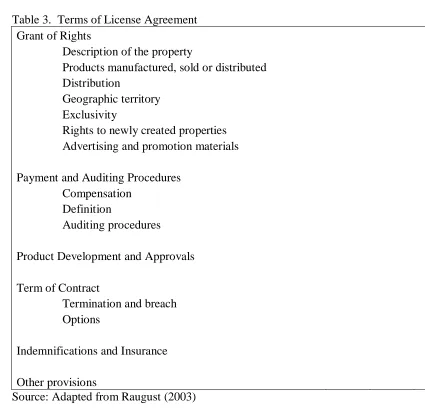
Table 3. Terms of License Agreement ...53
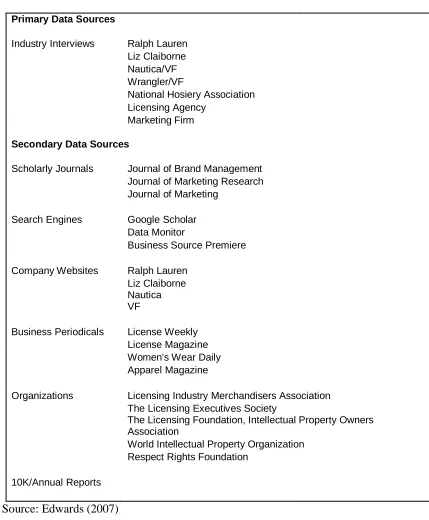
Table 4. Data Sources...61
Table 5. Preliminary Results for RO1 ...66
Table 6. Interview Question Summary...79
Table 7. Licensing Research Taxonomy ...82
Table 8. Ralph Lauren Collections...85
Table 9. Ralph Lauren Financials ...90
Table 10. Ralph Lauren Brands ...91
Table 11. Ralph Lauren Product Offerings...92
Table 12. Ralph Lauren Licenses...94
Table 13. Ralph Lauren Competitors ...97
Table 14. Ralph Lauren SWOT Analysis ...98
Table 15. Liz Claiborne Financials ...109
Table 16. Liz Claiborne Brands ...110
Table 17. Liz Claiborne Acquisitions...112
Table 18. Liz Claiborne Licensees...113
Table 19. Liz Claiborne Competitors...116
Table 20. Liz Claiborne SWOT Analysis...117
Table 21. VF Financials...125
Table 23. Nautica/VF Product Categories ...127
Table 24. Nautica's Licensed Product Categories ...129
Table 25. VF Corporation's Major Competitors ...130
Table 26. VF Corporation SWOT Analysis ...131
Table 27. Interviewee Demographics...137
Table 28. Question2 and Question 3 ...138
LIST OF FIGURES
Figure 1. Apparel Related Licensed Categories...13
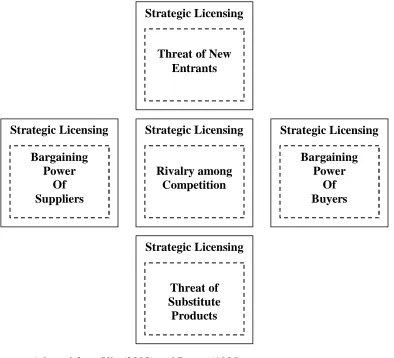
Figure 2. The Five Forces that Determine Industry Profitability...24
Figure 3. Product Life Cycle...51
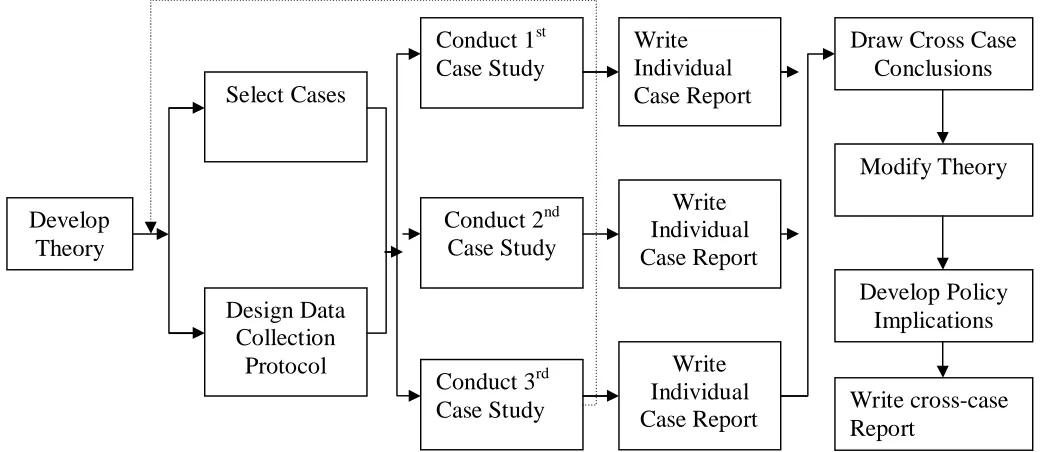
Figure 4. Visual Representation of Study...55
Figure 5. Conceptualized Research Model...59
Figure 6. Multiple Case Design (Holistic)...62
Figure 7. Modified Multiple Case Design (Holistic) Utilizing Porter’s Five Forces...64
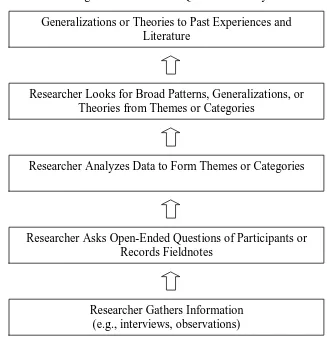
Figure 8. The Inductive Logic of Research in a Qualitative Study...67
Figure 9. Case Study Method...69
Figure 10. Case Study Method Modified ...78
Figure 11. Modified Competitive Licensing Theory ...144
CHAPTER 1 Introduction
Over the years many brand owners have explored the hidden potential of their brand through extensions into other product categories via licensing. Licensing is defined as the process of leasing the rights to a legally protected entity, for a specific purpose, defined geographic area, and for a limited time, in return for a negotiated payment (Raugust, 2004). While the success of licensing has contributed to the profit margin of many firms, it has catapulted some brands to an iconic status wherein the brand not only has a loyal consumer base, but also represents a lifestyle.
The history of licensing dates back to the 19th century (Raugust, 2004) and has become multifaceted, spanning a diverse range of industries. To date, licensing has proven to be very lucrative for the participating parties. The maturation of the licensing business resulted in worldwide sales of over $107 billion in 2003 (Raugust, 2004), and combined sales of $71.25 billion in the United States and Canada in 2006 (Retail sales, 2007). Fashion licensing, a well established area in the licensing business, accounted for 14% of sales in the United States and Canada at $9.8 billion in 2006, down 2% from 2005 (Retail Sales, 2007).
Haddad Apparel of New York claimed net sales of $250 million from marketing tops, bottoms, and outwear for such names as Barbie, Scooby Doo, Harley Davidson, NFL and others. Paradoxically, the apparel industry has seen slight declines in licensed sales from 2001 to 2004 (License, 2006). According toThe Licensing Letter, “The merger of Federated and May Company in 2006 caused tremendous shrinkage of brands and is on track to develop more private label business, thus eliminating chances for licensed revenue” (Survey Results, 2007, p.3). Trends in celebrity branding have put traditional brands such as Polo, Tommy Hilfiger, and Nautica at a severe disadvantage as celebrity brands such as Rocawear, Phat Pharm and Sean Jean occupy half the retail estate in department stores (Towle, 2003). The growth opportunity presented by private label products and trends in celebrity branded apparel have resulted in increased flagship operations by national brands such as Ralph Lauren. While many apparel companies are actively participating in licensing, some industry leaders like Ralph Lauren, Tommy Hilfiger and Liz Claiborne have began reacquiring licenses, which were previously granted to manufacturers.
Previous research (Conner, 1995; Gallini, 1984; Shepard, 1987) on licensing as a strategic tool focuses on technologically innovative intellectual property such as patents, and addresses the following areas:
-Deterrence of New Market Entrants: (Gallini, 1984; Rockett, 1990) -First Mover Advantage: (Eswaran, 1994)
-Information Sharing: (Gallini & Winter, 1985)
-The Role of Competition: (Fosfuri, 2004) -Situational Licensing: (Yi, 1999)
Past researchers (Raugust, 2004; Revoyr, 1995; Schlicher, 1996; Smith & Parr, 1998) have studied various aspects of the licensing business from how the business works to legal aspects and guidelines. These works, while not specifically related to the apparel industry have outlined the major aspects of the licensing business, such as contract negotiation, distribution, and legal rights, however they lack information as to how licensing can be used to compete strategically in the apparel industry. With an
increasing number of new products being offered on the market via brand extensions, and the emergence of the lifestyle brand concept, it is important to understand licensing and its role in the apparel industry. As the practice of licensing continues to gain popularity and complexity, a growing importance is also placed on understanding licensing as a viable marketing tool and element of competitive strategy.
Purpose of Study
The purpose of this research is to investigate how licensing is used as a strategic tool within the apparel industry, the relationship between licensing as a strategic tool and lifestyle branding, and how license reacquisition impacts the competitive strategy of firms.
Research Questions
RQ1: What is the relationship between Porter’s Five Forces, Porter’s Generic Strategy and licensing as a strategic tool?
RQ2: How do apparel firms use licensing to gain a competitive advantage? RQ3. How does license reacquisition impact a firm’s competitive strategy?
Research Objectives
In order to answer the research questions specific research objectives have been formulated:
RO1: To understand licensing in general and how licensing has been used as a part of a competitive strategy.
RO2: To understand the relationship between licensing as a strategic tool and lifestyle branding.
RO4. To develop a theoretical model that depicts the relationship between competitive strategies, licensing as a tool, and the impact of license reacquisition.
Significance
With worldwide sales well over $100 billion (Retail sales, 2007) it is important for any firm (particularly those within the apparel industry due to its highly fragmented nature) to understand how licensing can be used strategically to remain competitive. This research is beneficial to the textile and apparel industry because no previous research exists that examines the role of strategic licensing in the industry. Many apparel firms who currently participate, or would like to participate in licensing can gain valuable insight from analysis of the industry’s most successful firms. The knowledge gained from this research will not only benefit brand owners in the apparel industry but generally all brand owners with trademarks who wish to gain a competitive advantage via
licensing. This research will also provide an understanding as to why firms choose to reacquire licenses. Understanding reacquisition also gives insight into exit strategies of participating licensors.
Scope
Limitations
1. This study uses a qualitative research design. Due to the qualitative nature, this study is fundamentally interpretive (Creswell, 2003), and may include personal
interpretation by the author. However, such a qualitative study avoids sampling error and bias normally associated with a quantitative study (Malhorta, 1999). In addition
qualitative studies are exploratory in nature and provide the opportunity to observe and collect data not readily available through quantitative measures. Most quantitative studies do not allow the researcher to gain clarification or further insight into the answers given by respondents, which is also overcome by using qualitative methods.
2. This study includes the use of industry interviews. Industry representatives may be limited in the information that they can publicly disclose. However, this study will not rely solely on one industry representative, therefore reducing the dependency of one individual, and further increases the opportunity to gain information that is not private. While this study will not rely solely on one industry representative, it will include one individual per chosen firm. Limitations associated with such a decision include the risk of having one individual speak on behalf of an entire firm.
4. As there are many aspects of the licensing business, this research is limited to the strategic uses of licensing. While the case study analysis of leading firms has limited generalizability, the data gathered will provide a foundation from which future
researchers can use as a framework to examine other firms of different sizes, price tiers, and target markets. Further research can also be extended through quantitative analysis.
Conceptual Definitions
Brand – Name, term, sign, symbol or design or a combination of these intended to identify the goods and services of one seller or group of sellers and to differentiate them from those of competition (Keller, 1998).
Brand Extension – When a firm uses an established brand name to introduce a new product, or is combined with an existing brand (Keller, 1998).
Brand Loyalty – A deeply held commitment to re-buy or re-patronize a preferred product or service consistently in the future, thereby causing repetitive same brand or same brand-set purchasing, despite situational influences and marketing efforts having the potential to cause switching behavior (Chaudhuri & Holbrook, 2001).
Fashion Licensing – The licensing of the name of a kind of clothing or a product designer on a designer or apparel brand (Gockel, 1999/2000).
License Reacquisition – The act of withdrawing from a license agreement by the licensor (Author, 2007).
Licensee - The party that acquires the rights to utilize a property, usually for a retail product but sometimes for promotional use for a service (Raugust, 2004).
Licensing – A lease agreement in which a licensee rents the rights to a legally protected property from a licensor for use in conjunction with a product or service (Raugust, 2004). Licensor – The property owner (Raugust, 2004).
Lifestyle brand – A brand that embodies the values, images and associations of an actual or aspired lifestyle of a customer segment (Moore, 1995).
CHAPTER 2 Review of Literature
The aim of this study is to examine how licensing is used as an element of competitive strategy for apparel firms, and how reacquisition is included in this strategy. This work seeks to identify connections between selected theories of licensing strategy through an exploration and identification of common assumptions. The literature review includes information that will aid in the understanding of licensing as a form of brand extension and the relationship of licensing to lifestyle branding. This chapter concludes by examining license reacquisition, and presents a model of license reacquisition within the apparel industry.
The Business of Licensing
“Licensing is the process of leasing the rights to a legally protected entity, for a defined geographic area and for a limited time, in return for a negotiated payment known as a royalty” (Raugust, 2004, p3). According to Keller (2003), licensing involves
with an established brand, name, logo, or any other intellectual property is a key basis to create positive consumer response via licensing.
Through licensing, the licensor avoids many of the risks associated with
developing a new product line in-house, as those risks are assumed by the licensee. The major risks are financial, including non-recoupable investments such as research and development, manufacturing, and marketing expenditures (Raugust, 2004). Licensors bear little financial risks including those costs associated with developing the property and financial fortunes of the licensee (Raugust, 2004). One of the most significant risks of the licensor is the threat of losing control of the property (Raugust, 2004). Potential loss of control can lead to dilution of brand image and value.
Each participating party has certain responsibilities to fulfill, as every agreement made between the licensing parties is unique in its specifics. Licensors are responsible for creating the property (if new) and for preserving its overall integrity and longevity and setting a strategy that maintains its attributes, while the major responsibilities of the licensee include the design and manufacture of the authorized products (Raugust, 2004). Some responsibilities can be shared by both the licensor and licensee including
advertising and marketing.
plans and allowing licensed manufacturers to carry out the manufacturing and
distribution. Licensing provides an avenue for new product categories to be tested, and allows a property’s customer base to be expanded into new product categories.
A major benefit to the licensee is the consumer awareness to the product lines which can inherently translate into financial benefit. Licensing brings a manufacturer a built-in (existing) audience, and can enhance the licensee’s property with positive attributes such as the quality associated with Ralph Lauren (Raugust, 2004). Additional marketing clout is also generated for the licensee. Raugust (2004) discusses how the advertising of Liz Claiborne apparel created demand for Bausch & Lomb’s Liz Claiborne eyewear, and how NASCAR die-cast vehicles helped market NASCAR apparel.
As previously stated, there are risks associated with licensing. If one of the license parties files for bankruptcy, the impact for the other party can be pernicious. Due to the fact that both parties in a licensing agreement are inextricably tied, the
This is of particular concern in the apparel industry as many of these companies are exceptionally dependent on licensing relationships (Ash & Danow, 2004), and many large design houses do not manufacture non-core products themselves. Because these firms rely on other firms for manufacturing, the value of the brand rests in the hands of a licensee and is captive to the failures of that licensees business as a whole (Ash & Danow, 2004). If the licensing agreement does not safeguard the licensed asset in the event of licensee’s bankruptcy, the value of the licensors brand, property, reputation, and integrity could be compromised (Ash & Danow, 2004). Particular steps that can be taken include separating different types of payment to the licensor, tying termination to the financial condition and not bankruptcy, and obtaining a security interest in the licensed property.
Over the years, there have been an increasing number of firms participating in licensing. With such a growing trend, licensing has become a $107 billion business (Raugust, 2004). In 2004 the worldwide licensing industry was worth approximately $170 billion at retail, with the US generating approximately $110 billion and
Success of licensing depends on consumers’ desire for goods with a perceived difference based on brand name, trademark, or image (Burns, 2002). By creating a certain image, licensed products can generate consumer interest, patronage and loyalty, and most importantly, having the right license ultimately permits both parties to enter a market that they had been unable to reach before (Arnold, 2003).
Types of Licensing
Table 1. Licensed Product Categories
Licensed Product Classifications Art
Celebrities/Estates Entertainment/Character Fashion
Music Non-Profit Publishing Sports
Trademark/Brands Toys/Games Other
Source: Adapted from Raugust, K (2001).
Figure 1. Apparel Related Licensed Categories
Source: Author (Edwards, 2007)
Art
Art licensors are relatively small and very fragmented, and includes museums, print houses, fine artists, and designers who create their art in order to exploit it commercially by selling their own properties for licensed art merchandise (Gockel, 1999/2000). Art has been among the fastest growing licensing sectors in the late 1990’s and early 2000’s, both in terms of cumulative sales and in the number of participants
Apparel and Apparel Related Licensed Product Categories
Entertainment/Character Celebrity/Estates
Sports Fashion
Art
(Raugust, 2004). The bulk of art licensing is attributable to individual artists, which can be classified into two categories from a licensing strategy perspective. Fine artists represent the first category and include artists who create art for art’s sake (licensing is a secondary concern), and artists who create art with merchandise in mind, which
represents the majority of the sector (Raugust, 2004). While some designers’ names eventually become brands, the ultimate goal of most art licensing programs is to combine desirable artwork with a recognized name to maximize sales. Manufacturers and retailers equally benefit from licensed artwork and artist-brand properties because they allow them to tap into a marketplace where consumers are purchasing products that reflect their own senses of style, color and design (Battersby &Grimes, 1999, p. 136). Apparel related products associated with this licensed category predominately include accessories, such as the Metropolitan Museum of Art’s silk scarves (Raugust, 2004). Textile products associated with this category include decorative accessories, furniture and home furnishings.
Celebrities and Estates
The licensing of living and deceased celebrities usually focuses more on
promotional deals that usually involve the use of a famous person’s name on packaging for premiums or advertising rather than on licensed merchandise (Raugust, 2004).
“During recent years, the line between person and brand has blurred, and celebrities have begun applying techniques from the corporate world to their careers: marketing and protecting a brand identity, trademarking and licensing their names, launching their own product lines and embracing product endorsements to boost their perceived value to consumers (Towle, 2003, p1).” In 1984, the Babe Ruth estate became one of the first to trademark a deceased celebrity's name and litigate against its misuse, clearing the way for other (living and dead) public figures to protect their names and likenesses as intellectual property (Towle, 2003).
“A cornerstone of many recent celebrity brands has been a fashion line, which offers another opportunity for an artist to convey an image and a message to the
Character and Entertainment Licensing
Generating billions of dollars in revenues each year, it is one of the most
profitable types of licensing. It is difficult to measure the precise revenue from character licensing accurately, due to two recent trends in the industry: a trend towards long-term relationship agreements between the licensor and the licensee, and a trend towards structuring of partial payment of royalties in terms of equity in licensee operations (Gockel, 1999/2000). These trends make measuring revenue difficult because structured payments over a specified amount of time may or may not be reported on a yearly basis as are other products and categories. This sector contains two groups of properties with very different traits: “hot” or short-term properties and classic or long-term properties (Raugust, 2004). Short-term properties have a lifespan expectancy of three to five years, while long-term properties have a potential lifespan of decades (Raugust, 2004). This product type is also the most concentrated with just a few large players dominating the licensing activity, such as Disney and Warner Brothers.
The Walt Disney Company extends the Disney brand name to merchandise ranging from apparel, toys, home décor and books to interactive games, food and beverages, stationery, electronics and animation art. The company is routinely
Disney continues to reign as the world's largest licensor with global retail sales of $23 billion for 2006 (Disney, 2006). Achieving more than $2 billion annually in global retail sales, Disney ranks as the world's 12th largest apparel brand (Disney, 2006). Disney began licensing its characters for toys made by Mattel in the 1950’s, and is now
responsible for some 3,000 contracts for 16,000 products with top manufacturers
worldwide (Keller, 2003). In 2004, Disney introduced a couture line that started out as a collection of knit tops, and now includes accessories, sleepwear and apparel for toddlers. Most recently Disney lost a 16-year court battle regarding royalties to 25 name
derivatives from Winnie the Pooh that contributes $6 billion yearly to the Disney Company (Lozito, 2007).
Fashion Licensing
Fashion licensing can be defined as the licensing of the name of a clothing or product designer on a designer or apparel brand (Gockel, 1999/2000). It consists of non-personality driven apparel labels, and designer names such as Ralph Lauren, Liz
(2004), control over the brand is an important concern wherein some designers have purchased their licensees or taken licensed lines in-house when the felt they were losing control over marketing, merchandising, design or any other facet of the line. Thus future revenues from licensing may depend upon strategic decisions about production and line extension (Gockel, 1999/2000).
Due to the fact that the fortunes of fashion licensing tend to mirror those of the apparel industry, some fashion labels tend to shy away from licensing in response to financial difficulties and concentrate on core products controlled in-house (Raugust, 2004). Other trends relating to fashion licensing include private label agreements between fashion brands and retailers, granting exclusive rights to the retailer as a store brand. Such a deal gives the retailer a point of differentiations from its competitors and is lucrative for the designer or apparel label by reducing costs and increasing revenues (Raugust, 2004). According to Gockel (1999/2000), nearly all of the major fashion players are positioning themselves as a lifestyle brand, suggesting growth opportunities in the area of licensing.
Licensing is also used in the luxury fashion segment. Luxury fashion brands viewed licensing as last resort in the 1990’s as control of manufacturing and distribution were of paramount importance (WWD, 2004). While some luxury designers are just beginning to see licensing as a means to diversify the business, others such as Gucci, Versace, and Jean Paul Gaultier say licensing in moderation and with strict control can fortify a business, and strengthen a brand, according to Women’s Wear Daily (2004).
America (PVH website, 2007). The company relies on a multiple brand, channel, and price point strategy to provide stability amid shifting market trends and retail
consolidation (Molaro, 2007). According to the PVH website, in 2004, one in every three dress shirts sold in the U.S. was a PVH product. PVH's portfolio of licensed brands include designer labels such as Geoffrey Beene, Kenneth Cole, and Chaps; celebrity labels including the Sean John and Donald J. Trump labels; and eight distinctive brands including Calvin Klein Collection, Calvin Klein, and Izod. The company's brands are offered at a variety of price points and in multiple channels of distribution—a strategy that is tailored to capture consumers at all levels and reduces the reliance on any one demographic group, merchandise preference or distribution channel (Molaro, 2007). PVH develops both domestic and international brand extensions, with over 150 licensees in more than 100 countries (Molaro, 2007).
Corporate Trademark and Brand Licensing
When company names, logos, or brands are licensed on products, this is referred to as corporate trademark or brand licensing; one of the fastest-growing segments of the licensing business, mainly because licensing provides enormous strategic, marketing and earning benefits. According to The Licensing Letter, this is the largest sector accounting for $18 billion in retail sales in the U.S. and Canada in 2003.
Firms have different motivations for licensing their corporate trademarks. According to Raugust (2004), a growing number of trademark owners are initiating licensing efforts, with strategies that are primarily promotional, lifestyle, and some extension, and for many different reasons including:
b.) to protect the company’s trademarks c.) to develop new revenue streams
d.) to enter new product categories in a relatively risk free and cost effective way However, strategic concerns about brand extension and dilution of equity may arise. Inappropriate licensing can potentially dilute brand meaning with consumer’s and
marketing focus within the organization, as the risk that the product will not live up to the reputation established by the brand is always prevalent (Keller, 2003). According to Keller (2003), Eddie Bauer disappointed industry analysts for not focusing on their merchandise assortment when in late 2000 the firm entered into a two year licensing agreement with Compaq for special edition Compaq Presario 1400 notebooks.
Sports Licensing
Sports licensing has been transformed from the relatively small and fragmented industry it once was and has evolved into a highly sophisticated, $13 billion-plus industry (Gockel, 1999/2000). While there are many professional sports that have their respective licensing programs, professional sports licensing particularly refers to the licensing programs of the four major leagues: National Football League, National Basketball Association, National Hockey League, and Major League Baseball- accounting for a large proportion of the licensing revenue (Gockel, 1999/2000).
In addition about 160 colleges and universities in the U.S. are involved in collegiate licensing, marketing their rights primarily to the apparel market with
officials as part of a larger positioning effort that stretches well beyond arenas and stadiums (Collegiate Licensing, 2007). According to Pat Battle of Collegiate Licensing Company, higher level people within the universities are seeing licensing as an
opportunity to present the University’s brand in the marketplace; this is important as schools compete against each other for students, grants, funding and other scarce resources (Collegiate Licensing, 2007). “Sports licensing is primarily a fan-driven, seasonal phenomenon, with sales of products based on individual teams largely of regional interest (Raugust, 2004, p 35).”
As of 2005, collegiate licensing was a $2.8 billion industry, with the top selling product video games selling 1.8 million units of NCAA College Football property (Sosnowski, 2006). According to the Collegiate Licensing Company, the University of North Carolina ranked number one for five consecutive years as the top licensed product in terms of sales, with t-shirts accounting for the top selling product, and Nike accounting for the top collegiate apparel licensee (Sosnowski, 2006).
International Licensing
industry, and the leveling effect of the internet on the availability of information have led to the parallel growth of licensing worldwide.
Licensing offers a particularly effective way of entering foreign markets because it can offer simultaneously both a low-intensity (and therefore low risk) mode of market participation and adaptation of product to local markets (Arnold, 2003). In licensing agreements, the local licensee has considerable autonomy in designing the products into which it incorporates the licensed characters. The other major advantage of licensing is that, despite the low level of local involvement required of the international licensor, the business is essentially local and shares the same risks associated with those of the local business that holds the license. Therefore import barriers do not apply. There are two main disadvantages of licensing. First, although it facilitates the creation of localized product, licensing is characterized by very low levels of marketing control, with the licensee usually having to obtain approval from the international vendor for product design and specification. Second, licensing runs the risk of creating future local competitors, through the sharing of intellectual property. This could potentially lead to the local licensee retracting from the international licensor and imitating the technology. Over time the local firm is likely to develop into a position in which it can launch its own rival business. The best firms suited for participation in international markets via
licensing are those who are innovators and can retain a competitive advantage.
Porter’s Theory of Competitive Advantage
“The essence of strategy formulation is coping with competition, and the strongest competitive force or forces determine the profitability of an industry and so are of
framework that analyzes the five forces of industry competition that determines the attractiveness of a market.
In any industry, the rules of competition are embodied in five competitive forces: the threat of new entrants, the threat of substitutes, the bargaining power of buyers, the bargaining power of suppliers, and the rivalry among the existing competitors. See Figure 2. The collective strength of these five competitive forces determines the ability of firms in an industry to earn, on average, rates of return on investment in excess of the cost of capital (Porter, 1985). It is often used to analyze the attractiveness of an industry structure. Industry profitability as well as the strength of each of the five competitive forces are a function of industry structure and vary by industry. Firms have the power through their competitive strategies to influence the five forces.
One reason marketers have been forced to use so many financial incentives or discounts is that the marketplace has become more competitive, with both demand-side and supply-side factors contributing to the increase in competitive intensity (Keller, 2003). According to Michael Porter (1998), competition is at the core of the success or failure of firm that determines the appropriateness of a firm’s activities that can
in nature and can be shaped by the individual firm. While industry attractiveness is partly a reflection of factors over which a firm has little influence, competitive strategy has considerable power to make an industry more or less attractive (Porter, 1985).
Many apparel firms use licensing as a component of their competitive strategies to gain a competitive advantage. Whether they participate as the brand owning licensor or manufacturing licensee, each party can potentially increase their competitive positions. Licensing in some cases has added an additional 60% markup to the retail price of generic apparel products (Henricks, 1998). Licensing has also been used successfully by some apparel firms to reduce debt, increase sales and improve profit margins (Raugust, 2004). Other firms have been able to employ a full time licensing strategy that focuses on brand marketing plans and allows for no in-house production. While these licensing strategies employed in the apparel industry vary, they have all been used to gain a competitive advantage, and strengthen a firm’s competitive position.
Figure 2. The Five Forces that Determine Industry Profitability
Threat of New Entrants
New entrants to an industry bring new capacity, the desire to gain market share, and often substantial resources (Porter, 1998). The severity of this threat depends on the existing barriers and the reaction from existing competitors. However, as these
conditions change, so does the seriousness of the threat. Strategic decisions involving a large segment of an industry can have a major impact on the conditions determining the threat of entry (Porter, 1998).
Bargaining Power of Buyers
Customers have great bargaining power as they have the ability to force prices down and demand higher quality or more service. Customers also have an advantage and become a competitive force because they are able to play competitors off against each other. The power that each buyer has depends on a number of market variables and the relative importance of its sales to the industry compared with its overall business (Porter, 1998).
Bargaining Power of Suppliers
The bargaining power that buyers and suppliers have can increase and decrease, as the factors creating supplier and buyer power change with time or as a result of a firm’s strategic decisions. In the apparel industry, retailers have become more concentrated and control has passed to large chains, the industry has come under increasing pressure and suffered falling margins. The industry has not been able to differentiate its products or cause switching costs that lock the buyers in enough to neutralize these trends (Porter, 1998).
Threat of Substitute Products
The threat of competition from substitute products occurs if multiple products are found to perform the same function (Porter, 1990). Substitution is seen as a threat in any industry as it places a ceiling on industry prices and therefore limits the industry’s
potential. The industry stands to potentially lose earnings and suffer in growth unless it can upgrade the quality or differentiate its product. Those substitute products that
deserve the most attention strategically are those that are subject to trends improving their price-performance trade-off with the industry’s product, or those products that are
produced by industries earning high profits (Porter, 1998). A major reason why industries grow is due to penetration against substitutes, and likewise, a major reason why industries decline is the emergence of substitutes.
Rivalry among Existing Firms
battles. In principle, an industry could be so rivalrous that the market can support only one firm. The intensity of this rivalry depends on the saturation within the industry (Bruer, 2006). According to Porter (1990), rivalry may stem from a variety of sources including:
a.) numerous and equally balanced competitors b.) slow industry growth
c.) high fixed or storage costs
d.) economies of scale and overproduction
e.) high exit barriers such as economic, strategic, and emotional factors
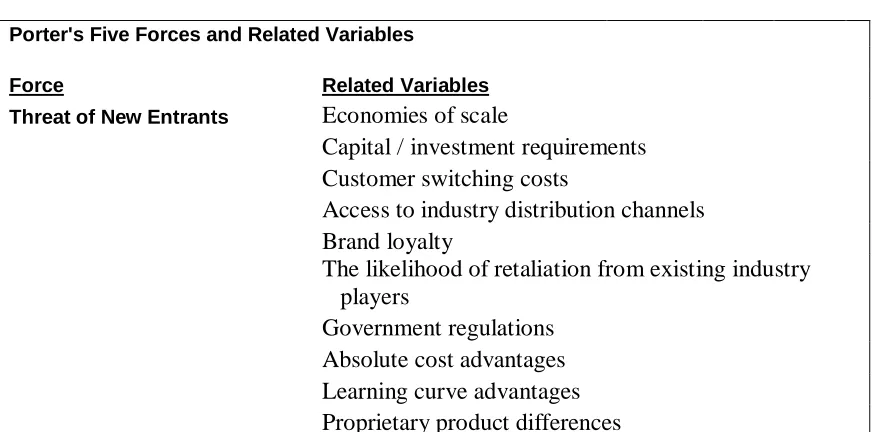
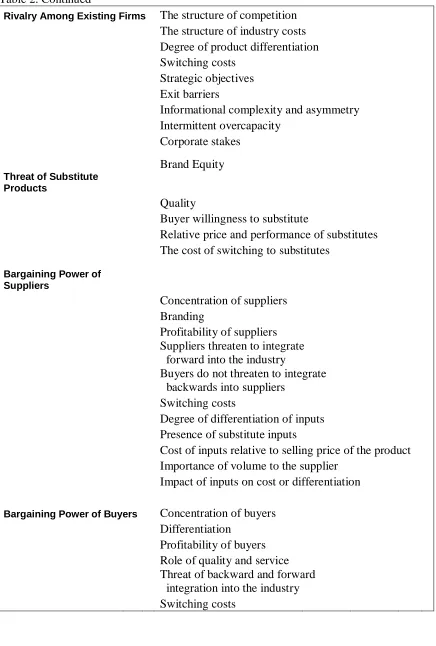
In addition to the identified sources of industry rivalry noted by Porter, other related variables have been identified in marketing literature. As seen below, Table 2 provides a listing of variables related to the forces of industry competition. Many of these variables are associated with more than one force, and can be manipulated by firms to overcome the threats posed by industry competition.
Table 2. Porter’s Five Forces and Related Variables
Porter's Five Forces and Related Variables
Force Related Variables
Threat of New Entrants Economies of scale
Capital / investment requirements Customer switching costs
Access to industry distribution channels Brand loyalty
The likelihood of retaliation from existing industry players
Table 2. Continued
Rivalry Among Existing Firms The structure of competition
The structure of industry costs Degree of product differentiation Switching costs
Strategic objectives Exit barriers
Informational complexity and asymmetry Intermittent overcapacity
Corporate stakes Brand Equity
Threat of Substitute Products
Quality
Buyer willingness to substitute
Relative price and performance of substitutes The cost of switching to substitutes
Bargaining Power of Suppliers
Concentration of suppliers Branding
Profitability of suppliers Suppliers threaten to integrate forward into the industry
Buyers do not threaten to integrate backwards into suppliers
Switching costs
Degree of differentiation of inputs Presence of substitute inputs
Cost of inputs relative to selling price of the product Importance of volume to the supplier
Impact of inputs on cost or differentiation
Bargaining Power of Buyers Concentration of buyers
Differentiation
Table 2. Continued
Bargaining leverage Buyer Volume
Buyer information availability
Availability of existing substitute products Buyer Price Sensitivity
Price of Total Purchase Pull-through
Brand Identity
Decision Makers' Incentives
Source: Adapted from Porter (1985) and 12 Manage Rigor and Relevance Website (2007)
Differentiation
According to Porter (1985), there are three generic strategies that firms within any industry can use to gain a competitive advantage: cost leadership, differentiation, and focus. Although all three strategies can be observed within the apparel industry, not all apparel firms can achieve success via any generic strategy. Differentiation can be based on a number of factors including the product itself, and the marketing approach.
Licensing is recognized in the building of marketing strategies, as evidence indicates more than 70% of Fortune 500 companies have a licensing program in place (Brand Strategy, 2004). Licensing is used within the apparel industry as a differentiation strategy
distinctiveness in a product (Park & Park, 2007). Firms pursing a differentiation strategy within the apparel industry include The Limited and Ralph Lauren (David, 2003).
Differentiation alone does not guarantee a competitive advantage. “A risk of pursuing a differentiation strategy is that the unique product may not be valued highly enough by customers to justify the higher price. A differentiator, therefore, must always seek ways of differentiating that lead to a price premium greater than the cost of
differentiating. A successful differentiation strategy however, allows a firm to charge a higher price for its product and to gain customer loyalty because consumers may become strongly attached to the differentiation features (David, 2003, p 176).” Positive consumer response can be created through licensing from the strong, favorable, and unique
association with an established brand’s intellectual property (Battersby & Grimes, 1999).
Licensing to Leverage Competitive Forces
Licensing is a business tool that can be used to overcome the threats posed by the forces of industry competition. The threat of new entrants can be leveraged through licensing in many ways. Licensing most often is used strategically as a tool to deter entry of new competitors, and in some proven cases choose the industry’s competition.
non apparel related textile products looking to gain entry into the apparel industry. Such a situation could deter entry of potential apparel industry entrants as well as potential entrants from other industries.
Brand loyalty is an important variable related to the threat of new entrants.
Firm’s with brands that exhibit strong brand equity and have a high level of brand loyalty present a significant barrier for new entrants to compete with. If these firms choose to license their brand name and associated intellectual property, new entrants that do not have such an established history have less of a significant threat.
The bargaining power exerted by customers can also be leveraged via licensing. Buyers have the ability to force prices down and demand higher quality or more service. According to McAfee (2002), if the buyer does not value the good highly, the buyer can credibly threaten not to buy the good at all. Within the apparel industry licensed products have been shown to command price premiums. Apparel manufacturers participating in licensing have been able to use this to their advantage by offering licensed products that bear brand names synonymous with high quality. Presumably apparel manufacturers that participate in licensing do so because one of the main benefits is in the use of the licensors brand name.
While suppliers pose a large threat within any industry, licensing is a key way to reduce this threat. Suppliers pose a threat as they can exert bargaining power on industry participants through the reduction of quality of purchased goods and services or by raising prices. Relating to apparel licensing, the threat posed by manufacturers
willing to purchase those brands with high equity, and a strong brand name. While powerful suppliers can squeeze profitability out of an industry according to Porter (1998), it is presumed that apparel manufacturers with such power would not need to acquire licenses, as all activities done by a firm should be those that create a sustainable competitive advantage.
While substitute products place a ceiling on industry prices, licensing can be used to leverage this threat in similar ways as the threat posed by suppliers. A major factor related to the threat posed by substitute products is the buyer’s willingness to substitute. While substitute products are a threat, the severity of this threat largely depends on the buyer. Brands with high brand equity and a loyal customer base that license their products are more likely to have buyers who are less willing to choose substitute products; thereby greatly reducing the threat.
significant influence on suppliers, as suppliers can reap the benefits of these assets through licensing. This also creates extra barriers for competitors.
Whether centered on new competitors or the rivalry among existing ones,
competitors are a threat, and are the basis of two of the five competitive forces. The right competitors however can strengthen rather than weaken a firm’s competitive position in many industries serving a variety of strategic purposes that increase a firm’s sustainable competitive advantage (Porter, 1985). Strategically, competitors can increase
competitive advantage, improve current industry structure, aid in market development, and deter entry. More specifically, competition can be used to deter entry in the following ways:
-Increase the Likelihood and Intensity of Retaliation -Block Logical Entry Avenues
-Crowd Distribution Channels
Licensing to Leverage Competitive Forces in Other Industries
Due to the fact that licensing can be used to take advantage of intellectual property and gain extra profits, many industries have realized the full potential of their intellectual property. Empirical research exists that shows how licensing is used within other industries to strategically compete against competitors and overcome forces of industry competition.
simple R & D model with competing technologies wherein access to the market is restricted to only two firms, who have sole capability for researching and developing processes for the production of the good. The study finds that under asymmetry in returns to research, reflecting an asymmetry in market positions, a successful researcher attempts to secure some of its market position by licensing some of its current technology to its rivals (Gallini, 1984). In other words, where there is a difference in market position (between the incumbent and rivals or possible licensees) which leads to and is reflected in the rate of return to research, the incumbents market position is not compromised through the act of licensing some of its technology, as the entrant may either buy a license or do research that is much more costly. Such a strategy could be used within the apparel industry as some firms such as Nano-Tex have spent millions on researching textile innovations such as nanotechnology.
Rockett (1990) contends that licensing can be used by an incumbent firm to choose the competition by showing that if entry of the latter (weaker competitor) firm prevents entry by the former (stronger competitor), the incumbent might opt to license to the weaker firm. In doing so the licensor succeeds at crowding the market, which possibly deters entry of stronger firms which would have been more formidable competitors. Rockett demonstrates that the incumbent can use a strategy of inducting firms that would have remained outside the industry in the absence of licensing to
fragmented, such a strategy could still be used by a firm with high brand equity. If an apparel brand owner is licensing its brand name in a non-core product category, to a weaker firm (in terms of brand equity and name recognition), this could deter a stronger competitor. Furthermore, by licensing its brand name to the weaker competitor, the weaker competitor will represent that brand in the market, thus strengthening the brand owner’s competitive position.
Eswaran (1994) also provides research contributing to the strategic uses of licensing to deter market entry. Eswaran argues that an incumbent firm in a market threatened by entry can exploit its first-mover advantage by licensing its technology not to a potential entrant but to firms that would have remained outside the industry. His work demonstrates how the incumbent may subsidize the variable costs of its licensees in order to deter entry by setting a royalty that is sufficiently low, and also by inviting licensees. Even when entry is not deterred the incumbent might opt to invite outsiders as licensees and lower their variable costs. While this strategy may not be as easy to
According to Oster (1995), the bargaining power of innovators and potential licensees is affected by the early exclusive licenses introducing asymmetries into an industry. Early exclusive licensed create an unleveled playing field for the competition because they are not readily available to the competition, presenting an automatic
disadvantage. Therefore the competition which is already behind on the technology must invest in research and development in attempts to remain competitive. Exclusive licenses that are introduced early in a technology’s life cycle create a competitive advantage for the licensor that resists the bargaining power of buyers and suppliers. Such a strategy would again be applicable to a patentable textile innovation such as products including nanotechnology, and not as applicable to apparel trademarks and copyrights, due to the innovative nature of patents.
Unfortunately licensing can create unnecessary competitors, and potentially harm a licensor’s competitive position. Apparel firms participating in licensing that have high brand equity have an advantage over competitors at overcoming such an obstacle.
Having high brand equity allows a firm to create a differentiated product in which consumers are willing to pay a premium for, based on such an advantage. The second most common way that firm’s manage to harm their competitive position is in the relinquishment of its competitive advantage in exchange for royalty (Porter, 1985). Previous researchers have also found that firms are often reluctant to license their technologies since they may be giving their rivals the knowledge necessary to develop a similar or even better technology (Gallini & Winter, 1985; Scherer, 1980;).
advantage. Competitive advantage can result from a firm’s ability to perform some activities in unique ways, which create and sustain intangible assets such as brand image and customer relationships. Porter argues that such intangible assets are not valuable in and of themselves, but become valuable when they fit industry structure and a particular business strategy.
Licensing via Brand Extension as a Competitive Strategy
In today’s apparel industry, consumers are exposed to a proliferation of brand alternatives. As a type of intangible asset of a firm, brands are used to create awareness of the product, and for years brand extensions have been seen as a vital part of growing a brand. In the 1990’s, 81% of all new products introduced in the market were brand extensions (Keller, 2003). According to Keller (2003), brand extension refers to using an established brand name identified with a product in one market for a new product in another market. Leveraging the brand name, which is one of the firm’s most valuable hidden assets (Bhat & Reddy, 1994) can substantially reduce the risk of introducing a new product by building on consumers’ familiarity with and knowledge of an established brand (Forney, Park and Brandon, 2005). A successful brand extension can change the meaning and image of a brand, by improving the strength, favorability, or uniqueness of its associations (Keller, 1998). According to Smith and Park (1992), the choice of brand strategy can play a significant role in the success of new products which are brand extensions.
a strong brand identity can facilitate entry, or more precisely, can enhance an entrant’s ability to compete against incumbent rivals.
According to a study examining the evaluative criteria of fashion brand extension (Forney, et al, 2005), the strength of the branded products promotes brand loyalty when making purchase decisions in new product categories, even though purchase frequency may differ. When considering brand extension and its strategic use by a firm, it is important to understand the role of brand loyalty among the consumer base. By building on consumers brand loyalty, preference, and recognition, brand extension strategies seek to increase revenues by prompting consumer purchases across product categories (Keller, 1998). Branding is essential to building product image (Cleary, 1981) and it influences a product’s perceived worth, increases the brand’s value to the customer, leads to brand loyalty (Rooney, 1995), and enhances the effects of brand extensions (Smith & Park, 1992). Brands with high brand equity and a loyal customer base that license their products are more likely to have buyers who are less willing to choose substitute products.
affect, that is, consumers’ global or overall favorable or unfavorable evaluation of the brand, whereas another class of associations comprises beliefs about the brands product and non-product attributes (Keller, 1993).
Lane and Jacobson (1997) investigated the reciprocal impact of brand leveraging (influence of brand extensions on brand evaluations). The study involved 209 subjects who were asked to evaluate 4 brand names and the corresponding brand extensions (both congruent and incongruent). Results from this study indicated that extension evaluations do have an impact on brand evaluations. The results provided support for a reciprocal impact that flows from brand extension to brand evaluation, which is present across individuals and different types of attribute cues. The findings from this study indicated that reciprocal effects should be considered when firms leverage their brands as brands are not immune to extension induced attitude change.
part in an extension’s success; earlier line extensions have helped in the market
expansion of the parent brand; and incremental sales generated by line extensions may more than compensate for the loss in sales due to cannibalization.
As a result of the widespread success of [brand extension] strategy, many brands are becoming affiliated with a portfolio of diverse products (Dacin & Smith, 1994). Dacin and Smith (1994) examined brand portfolio characteristics (number of products affiliated with the brand, variance in quality across these products, and degree to which the products are interrelated) on brand strength. The experiment based findings indicate that the number of products affiliated with a brand was positively related to consumers’ confidence in and favorability of their evaluations of the quality of an extension of the brand. This study found that when portfolio variance and subjects’ confidence in and favorability of their judgments of extension quality variance was low, there was a positive relationship between the number of products affiliated with a brand and consumers’ confidence in their judgments of the quality of an extension of the brand. The strength of this relationship diminished considerably when portfolio quality variance was high. Finally the study also found that the effect of parent brand extension fit on consumers’ confidence in and favorability of their quality evaluations of extensions decreased as portfolio relatedness decreased. This study concludes that the number of products affiliated with a brand does not automatically harm the brand and may even strengthen it.
or tarnished in some way (Pepall & Richards, 2002). Even more difficult than the
introduction of a lower priced extension is an upward extension with the introduction of a more expensive product. Generally, it is difficult to sufficiently change people’s
impressions of the brand to justify a significant upward extension (Pepall & Richards, 2002). According to Mininni (2006), a lack of understanding of the consumer and the marketplace can lead to failures, while the wrong category extension can create the perception of diminishment of the value of the brand. Ries and Trout (1986) contend that extensions are potentially ruinous because they dilute a brand’s position in a consumer’s mind.
Brand Dilution
In the textile and apparel industry intellectual property can be in all forms including patents, trademarks, and copyrights. While patents are more eminent in the textile sector, trademarks and copyrights are more prominent among apparel firms. According to the Federal Trademark and Dilution Act of 1995, trademark dilution is defined as the lessening of the capacity of a famous mark to identify and distinguish goods or services, regardless of the presence or absence of (1) competition between the owner of the famous marks and other parties, or (2) likelihood of confusion, mistake, or deception. When brand name accessibility decreases and is diluted, it is less likely that the brand will be recalled and enter the consumers’ consideration set in decision making situations. Even more, when aspect accessibility decreases (and is diluted), even
While many firms enjoy success in their brand extension ventures, the strategy, however, is risky because the product may not always be accepted; 30-35% of new products fail (Booz, Allen & Hamilton 1982; Crawford 1979; Reddy, Holak & Bhat 1994). Prior research has examined the sensitivity of brands to the success or failure of extensions (Keller & Aaker, 1992; Loken & Roedder, 1993). In a study by the
Association of National Advertisers in 1984 (as cited by Reddy, et al, 1994), it was found that 27% of line extensions across all industries fail. Even those extensions that are not classified as failures do not necessarily enjoy equal success, as an extension may
cannibalize sales of existing products and dilute the image of the original brand over time (The Economist, 1990 as cited by Reddy et al, 1994). According to a study done by John, Loken and Joiner (1998), extensions carry the risk of diluting what the brand name means to consumers, especially in the case of extensions that are inconsistent with the brand’s image or fail to meet consumer expectations. The results of three experimental investigations concluded that the risk of brand and line extensions does not stop at the parent brand level. Inconsistent extensions carry the risk of diluting important consumer beliefs about individual products that carry the parent brand name, with beliefs about flagship products being the most immune to dilution. Although Keller and Lehmann (2006) reported that parent brands are not particularly vulnerable to failed brand
extensions, the risk of the parent brand potentially being damaged increases when there is a high degree of similarity or fit involved.
Lifestyle
because they are associated with a certain lifestyle. This study also found the effect of brand extension on fashion products appears to involve cross-shopping behavior where consumers of a specific brand in one product category purchase products with the same brand in another product category. By offering a similar aesthetic appeal across product categories, designer, national, or private label apparel brands are extending into multiple product categories (Abend, 1997).
According to Marshal Cohen of NPD, lifestyle marketing is an overused and misunderstood practice used today; however, he also states that it is the most important thing that a brand can do (personal communication, Fall 2006). A lifestyle brand is a focused retail brand targeted at a specific market segment defined by lifestyle (Helman & Chernatony, 1999). The goal of lifestyle marketing is to connect with the consumer through their lifestyle choices by assessing how individuals spend their time, what they consider important about their surroundings, their opinions on various issues, and their interests (Michman, 1991). O’Shaughnessy (1987) proposes that consumer buying follows an overall consumption system or lifestyle. According to Helman & Chernatony (1999), an inspiration for the good life generates goals, some of which result in demand for specific products that contribute to the desired lifestyle. As cited by Helman & Chernatony, Solomon (1994) suggested that lifestyle is not simply about allocating time and money; it embraces the symbolic nuances that differentiate groups, and is about shared values or tastes, particularly those reflected in consumption patterns.
Licensing and Lifestyle
From new and old properties to soon to be released properties, licensors are realizing the importance of creating lines that fit consumer’s lifestyles and interests, which involves more than putting popular licenses on new products (Facenda, 2005). Proof of this fact was shown at the 2005 Licensing Show where almost every one of the attending licensors seemed to focus on appealing to consumers' lifestyles in one way or another.
products (Raugust, 2004). According to Raugust, the idea is that a property captures the essence of a lifestyle experienced or desired by its target audience. Art properties, fashion labels, and home furnishings brands are some of the many licenses that can be positioned as lifestyle properties. Driven by retailer’s positive reception to lifestyle brands and cross merchandising, the demand for non-apparel items has increased dramatically (Scardino, 2005).
One lifestyle brand that has been maintained a constant presence in licensing is Barbie, which not only has a presence in dolls but apparel, fragrance, a collection of DVD’s, an online component, and a Barbie Live show (Facenda, 2005). But since Barbie has a window of about five years with girls, the property has to be continually reinvented and refreshed. Mattel has also partnered with Benetton to create Barbie by Benetton, a line of four dolls exclusive to Benetton. Benetton, a high-end apparel chain, represents a new channel of distribution for Mattel (Facenda, 2005).
ambiance (Agins, 2000). In January of 2007 Ralph Lauren formed a Global Brand Concepts group to create new lifestyle brands for specialty and department stores, which helps partner design, marketing and advertising for a full range of products. With the new group, Polo is drawing on its core skills to control the crucial aspects of the brand creation process, including product development and branding (Much, 2007).
While the company has fared well at high-end stores such as Saks, the new group gives Polo a chance to have a presence at mid-priced retailers, where it traditionally hasn't had a presence (Much, 2007). Polo announced on February 1, 2007 that they would be partnering with J.C. Penney to create a lifestyle brand. The brand which will be exclusive to J.C. Penney will be called American Living and will include moderately priced men’s, women’s and children’s clothing, accessories and home products, and will be available Spring 2008.
License Reacquisition
In today’s global economy licensing is used as a strategic tool by firms to contribute to the success of their business. The practice of extending a brand via
licensing is prevalent throughout many industries. With the emergence and acceptance by consumers of lifestyle branding, there are ever increasing opportunities for licensing to be used to extend an apparel brand. Many empirical studies have concluded that brand extension and licensing are tools that can be used to successfully contribute to a firm’s profit margin, growth strategies, and loyal customer base.
either to increase control over their brand activities or because they feel they can generate more profit by controlling manufacturing than through royalties” (Raugust, 2004, p10). In March of 1999, Ralph Lauren terminated a 19 year-old license agreement with Oxford industries for boy’s clothing. Presumably, this decision came after Oxford’s license agreement with Tommy Hilfiger and news of more potential licenses with Hilfiger. Firms have pulled out when the licensee is also producing products for a competitor, and this is most commonly caused by the competitor’s license detracting from prospective sales, or manufacturing favoring the competitor (Henricks, 1998). According to Raugust (2004), in 2001, Tommy Hilfiger acquired its European licensee, T.H. International, and Nautica brought its childrenswear business in-house. Ralph Lauren also acquired its Italian licensee, PRL Fashion of Europe, which was one of a series of purchases of licensed manufacturers to complete Polo’s strategy of directly controlling all of its European activities (Raugust, 2004).
Ralph Lauren has continued its reacquisition of licenses; recently the company reacquired its Lauren women’s line from Jones Apparel in 2003. Again in 2005, Ralph Lauren made headlines when the company reacquired its footwear license for the Polo and Ralph Lauren names to establish full control over the brand (Gorman, 2005). The footwear license agreement was first reached with Reebok in 1996. Ralph Lauren reported paid $110 million to reassume such rights, and made investments to