Nuclear Data from AMS & Nuclear Data for AMS
±
some examples
A. Wallner1,2, M. Bichler3 T. Belgya4, K. Buczak1, I. Dillmann5, O. Forstner1, R. Golser1, F. Käppeler6, A. Klix7, G. Korschinek8, A. Krasa9, W. Kutschera1, C. Lederer1, A. Mengoni10, M. Paul11, A. Plompen9, A. Priller1, V. Semkova12, P. Steier1
1
VERA Laboratory, Faculty of Physics, University of Vienna, Währinger Strasse 17, A-1090, Austria 2
Department of Nuclear Physics, Australian National University, Canberra, ACT 0200, Australia 3
Atominstitut, Vienna University of Technology, Austria 4
Dep. of Nuclear Research, Institute of Isotopes, Hungarian Academy of Sciences 5
GSI Helmholtzzentrum für Schwerionenforschung GmbH, Planckstraße 1, D-64291 Darmstadt, Germany 6
Karlsruhe Institute of Technology (KIT), Campus Nord, Institut für Kernphysik, Karlsruhe, Germany 7
Institut für Kern- und Teilchenphysik, TU Dresden and FZ Rossendorf, Germany 8
Maier-Leibnitz-Laboratory, Faculty of Physics, TU Munich, James-Franck-Strasse, Garching, Germany 9
European Commission, Joint Research Centre, Institute for Reference Materials and Measurements, Geel, Belgium 10
Agenzia nazionale per le nuove tecnologie, l'energia e lo sviluppo economico sostenibile (ENEA), Bologna, Italy 11
Racah Institute of Physics, Hebrew University, Jerusalem, Israel 12
NAPC Nuclear Data Section, International Atomic Energy Agency, A-1400 Vienna, Austria
Abstract. We summarize some recent cross-section measurements using accelerator mass spectrometry (AMS). AMS represents an ultra-sensitive technique for measuring a limited, but steadily increasing number of longer-lived radionuclides. This method implies a two-step procedure with sample activation and subsequent AMS measurement. Applications include nuclear astrophysics, nuclear technology (nuclear fusion, nuclear fission and advanced reactor concepts and radiation dose estimations). A series of additional applications involves cosmogenic radionuclides in environmental, geological and extraterrestrial studies. There is a lack of information for a list of nuclides, as pointed out by nuclear data requests. An overview of some recent measurements is given and the method is illustrated for some specific neutron-induced reactions.
1 Introduction
Nuclear data ± i.e. nuclear reaction and nuclear structure data ± are an essential ingredient for nuclear based research. Production of radionuclides through nuclear reactions needs to be well-known for many applications. Cross sections are one basic nuclear property. They are of importance in nuclear physics applications (nuclear technology), space technology, nuclear astrophysics (nucleosynthesis, cosmo-chemistry, meteorites) and medical applications (hadron therapy, radiation dose measurements). Moreover, production rates are the quantity for cosmogenic nuclides, which are utilized in a wide range of applications: for 14C-dating, geological and environmental studies. Depending on the nuclide and research topic, particle energies between thermal and up to GeV¶V are relevant. As a consequence different types of nuclear reactions, from thermal neutron capture to heavy ion spallation reactions might be the dominant reaction channels.
For specific reactions accelerator mass spectrometry (AMS) offers a powerful tool to measure cross sections. The advantage compared to decay counting is independent of the half-lives of the reaction products. The combination of activation and subsequent AMS measurement was applied for a range of measurements where off-line decay counting is difficult or impossible due to long half-lives of reaction products or due to the DEVHQFH RI VXLWDEOH -ray transitions. The interested reader will find a comprehensive summary of AMS in nuclear physics and astrophysics up to 1990 in [1] and in the subsequent AMS proceedings [2]. AMS was also used for measuring half-life values of long-lived radionuclides [3,4]; and also for the search of super-heavy elements [1,5,6] and for other exotic rare nuclides [1].
In this paper we will focus on nuclear reaction data and in particular on cross-section measurements. In the following we will restrict ourselves to the production of long-lived radionuclides, i.e. where the technique of AMS has its great advantage: AMS represents an
ultra-EPJ Web of Conferences DOI: 10.1051/
C
Owned by the authors, published by EDP Sciences, 2012 ,
epjconf 20123/
01003 (2012)
35
501003
This is an Open Access article distributed under the terms of the Creative Commons Attribution License 2 0 , which . permits unrestricted use, distributi and reproduction in any medium, provided the original work is properly cited.
EPJ Web of Conferences
sensitive technique for measuring a limited, but steadily increasing number of longer-lived radionuclides. The advantage compared to conventional mass spectrometers like TIMS, ICPMS, is its unsurpassed sensitivity for the abundance of specific nuclides.
Counting atoms directly via mass separation and particle acceleration with charge exchange completely suppresses molecular interference and for a few cases isobaric interference is completely excluded as well, and hence highest sensitivities are obtained. A disadvantage is that AMS needs often elaborate sample preparation and is a costly technique; and like all mass spectrometric techniques it is sample destructive.
2
&RPSDULVRQ RI µDFWLYDWLRQ
$06¶ ZLWK
other techniques
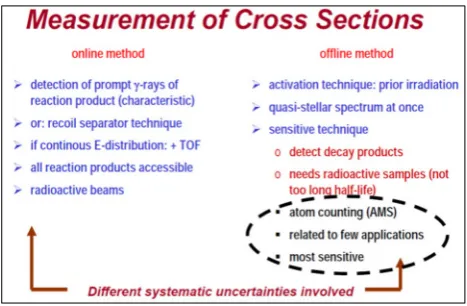
In general, cross section measurements can be classified into two complementary techniques: online and offline methods (see Fig. 1). The online method makes use of the detection of the prompt and characteristic radiation associated with the production of a specific nuclide, or selectively detects the reaction product itself by means of the recoil separator technique. Typical examples of experimental facilities in this ³GLUHFW PRGH´ DUH -among many others- e.g. the DRAGON setup at TRIUMF (combined with recoil separator technique [7]) and LUNA at Gran Sasso [8] for charged particle induced reactions; and e.g. in Europe GELINA [9] and the n_TOF facility at CERN [10] for studying neutron-induced reactions.
The second and independent offline method makes use of the activation technique, with sample irradiation and subsequent measurement of the reaction product. After the irradiation the number of produced radioactive nuclei can be quantified either by decay-counting or by mass spectrometric methods. This method is mostly restricted to radioactive products; however, it represents a very sensitive technique due to potential long irradiation periods. Long-lived radionuclides have often been inaccessible to decay counting techniques, e.g. because of low activity or an unfavorable decay scheme.
Figure 1: Comparison of online and offline methods. Quasi-stellar spectra are used in nuclear astrophysics (see 4.1).
AMS as an off-line method represents an independent and complementary method to online measurements. A
comparison of AMS data allows studying systematic contributions to the total uncertainty associated e.g. with online methods, which otherwise are hard to quantify.
3 Sample activation & subsequent AMS -
a tool to measure cross sections
Due to our interest in long-lived reaction products we do not face any limitations from radioactive decay during W\SLFDO VDPSOH DFWLYDWLRQV 1HXWURQV SURWRQV .SDUWLFOHV
RU ¶V etc. are usually produced at dedicated irradiation facilities. However, in some cases reactions were studied in inverse kinematics where a beam of heavy ions is directed into a gas cell containing the lighter reaction partner (e.g. He) [11,12]. Usually, after activation, the irradiated sample has to be converted into a chemical form to suit the subsequent AMS measurement. If the reaction product is of the same chemical element, the isotope ratio of produced radionuclide and the stable target nuclide can directly be measured with AMS. In case of producing a different element, however, a well-known amount of spike (a stable nuclide of the same element as the freshly produced radionuclide) needs to be added and relative to the spike the unknown radionuclide is measured again as isotope ratio.
Neglecting radioactive decay, and with Nr the number of
produced radionuclides and N0 the number of target
nuclides in the sample, the isotope ratio Nr/N0, generated
in an activation experiment is directly related to the cross section V for a specific reaction and to the neutron fluence )
0å:'; 04
Lê¾®0¾
This equation is true for a specific particle energy E. If the particle energy is not mono-energetic (see Fig. 2) the integral cross section over the experimental energy distribution is obtained, i.e. a spectrum-averaged cross section will be measured. As an example, the neutron capture reaction 54)H Q 55Fe can be written as
ê¾:JáÛ;L (A 99 :'; (A 98 ® s 0¾
This equation contains two simple quantities for calculating the cross-section value: (1) the isotope ratio which is measured in our case using AMS; and (2) the particle fluence, which can either be monitored as a current in case of charged-particle induced reactions, or relative to a well-known monitor reaction or also through the target¶s intrinsic activity.
AMS is a relatively new method for measuring cross sections. Paul and co-workers first introduced AMS to cross-section measurements in nuclear physics for the 26
Heavy Ion Accelerator Symposium 2012
Improved and highly accurate nuclear data are urgently required for the design of advanced reactor concepts. This demand holds for minor actinides but also for the main fuel materials. Existing data for neutron induced reactions have been obtained e.g. by time-of-flight techniques via detection of the SURPSW FDSWXUH -rays. A difficulty in experiments on DFWLQLGHV LV WKH VDIH GLVFULPLQDWLRQ DJDLQVW WKH VWURQJ -background from the competing fission channel. If the reaction product is radioactive, decay counting techniques can be applied for measuring the amount of produced radionuclides. In case of long-lived reaction products direct counting techniques in combination with neutron activation might be utilized. Such long-lived radionuclides might either be the direct product of a reaction, or a decay product of a directly produced short-lived nuclide.
Recent measurements of neutron-induced reactions on actinides by combining neutron activation and subsequent AMS measurements at the VERA laboratory [22] were performed within the European EFNUDAT [56] and EUFRAT programs [57]: neutron activations were performed at neutron producing facilities at KIT [31], IRMM [35], and the Center for Energy Research, Budapest (former IKI) [30]. As shown in Table 2 neutron capture studies on the main actinides 232Th, 235U and 238U are performed applying AMS: in case of 2358 Q 236U no chemistry is required and the material can be directly used in AMS for 236U/235U isotope ratio measurements. Some long-lived radionuclides listed in Table 2 are decay products of the directly produced short-lived nuclides: e.g. 239Pu and 233
U from 239U and 233Th, respectively. For a quantitative measurement, 239Pu and 233U had to be separated from the nat
U and natTh bulk material by dedicated actinide chemistry. Within EFNUDAT two projects were performed with the goal to determine simultaneously the neutron capture cross sections of 235U and 238U from natU samples [58] via neutron irradiations at thermal (cold) and keV-neutrons: 235U and 238U were activated in well defined, intense neutron fields at the Van de Graaff accelerator of KIT and the Budapest Research Reactor. The reaction product 236U and the decay product of 239U, 239Pu, were subsequently counted by AMS at VERA.
Within EUFRAT two additional projects with
irradiations at IRMM are underway for studying (1) neutron capture on 232Th and 238U with neutron energies between 0.5 and 3 MeV; and (2) fast neutron induced reactions on natTh and natU samples (see Tab. 2). Different neutron energies were achieved from simultaneous irradiations at several angles relative to the incoming beam.
The AMS measurements are finished for those samples activated with lower neutron energies (thermal to 426 keV), and are in progress for the samples irradiated with energies between 0.5 and 3 MeV. The fast neutron-induced reactions were studied at different AMS laboratories (ETH Zurich, ANSTO/Sydney, VERA/Vienna). These measurements are finished as well and data analysis is in progress now.
4.4. Nuclear Technology - Advanced nuclear systems
Concepts for hybrid reactors, e.g. accelerator-driven systems or accelerator-driven transmutation of nuclear
waste, combine a µpowerful¶ particle accelerator with a reactor. Particles with energies between a few hundred MeV and GeV will be impinging on a spallation target. For such systems nuclear data are required for much higher energies than in conventional systems. Note, similar particle energies are also obtained with particle accelerators which are in use for hadron therapy in cancer treatments. Clearly, in this energy region there is need for more experimental data. Therefore, dedicated research programs were initiated, e.g. HINDAS (High and Intermediate energy Nuclear Data for Accelerator-driven Systems, supported by the European Commission), to obtain a thorough understanding and complete modelling of nuclear reactions in the 20-2000 MeV region. To achieve this, an ambitious experimental and theoretical programme was launched which included also a series of AMS measurements for quantifying production of long-lived radionuclides from spallation [59, 60].
4.5. Environmental, geological and extra-terrestrial applications
The concentrations of rare radionuclides in our environment provide unique information. The measurement of such radionuclides allows tracing anthropogenic activities or environmental processes. Man-made radionuclides will enter the environment via different processes, e.g. from nuclear weapons tests, as accidental local fallout products, from nuclear-fuel reprocessing plants, or from industrial or medical applications. Production in anthropogenic processes needs to be understood which allows distinguishing their signature from cosmogenic or in-situ production.
Cosmogenic nuclides are produced via interactions of primary and secondary cosmic rays with matter, i.e., meteorites, planetary surfaces, interstellar dust particles, and planetary atmospheres. As such data are needed for p-, n- .-
and µ-induced reactions. For these studies the particle flux, particle energy spectra and the cross-sections are a basic ingredient. Reaction mechanisms include low-energy neutron capture, but spallation reactions become dominating for higher energetic particles (MeV and above).
Only very few experimental data are available, in particular for neutron-induced reactions, mainly due to the difficulty to generate well-defined and intense beams for nuclear reaction experiments. Exemptions were dedicated measurement campaigns as e.g. listed in Ref. [24-28, 59, 60] (see also ref. therein). Recently, neutron beam-lines with quasi mono-energetic neutrons in the energy range up to 200 MeV became available, (see [61-63]).
5. Summary
EPJ Web of Conferences
The advent of new powerful irradiation facilities, e.g. FRANZ (Frankfurt Neutron Source at the Stern-Gerlach
Zentrum [63]), SARAF (Soreq Applied Research
Accelerator Facility, [64]) or powerful reactors [17] will provide new exciting possibilities for AMS.
References
[1] W. Kutschera, M. Paul, Ann.Rev.Nucl.Part.Sci. 40 (1990) 411.
[2] AMS proceedings are published in Nucl. Instr. and Meth. B: e.g. vol. B268 (2010), B259 (2007), B223-224 (2004). [3] N. Kinoshita et al., Science 335 (2012) 1614.
[4] W. Kutschera et al., Phys. Rev. Lett. 45 (1980) 592. [5] F. Dellinger et al., Phys. Rev. C 83 (2011) 015801. [6] P. Ludwig et al., Phys. Rev. C 85 (2012) 024315. [7] D. Hutcheon, Nucl. Instr. and Meth. A498 (2003) 190. [8] A. Formicola et al., Nucl. Instr. and Meth. A507 (2003). [9] D. Tronc, J.M.Salomé, K.Böckhoff, NIM 228 (1985) 217;
and D. Ene et al., NIM A 618 (2010) 54-68
[10] E. Chiaveri et al., J. Korean Phys. Soc. 59 (2011) 1620. [11] M. Paul et al., Nucl. Phys. A718 (2003) 239c.
[12] K.E. Rehm et al., Nucl. Instr. and Meth. A647 (2011) 3. [13] M. Paul, W. Henning, W. Kutschera, E.J. Stephenson and
J.L. Yntema, Phys. Lett. 94B (1980) 303.
[14] K. Knie et al., Nucl. Instr. and Meth. B172 (2000) 717. [15] B. Dittrich et al., Nucl. Instr. and Meth. B52 (1990) 588. [16] B. Limata et al., Phys. Rev. C82 (2010) 015801. [17] R.C. Pardo et al., Nucl. Instr. Meth. B (2012),
doi:10.1016/j.nimb.2012.01.047.
[18] J.M. Sisterson et al., Nucl. Instr. and Meth. B123 (1997) 324.
[19] D. Robertson et al., Phys. Rev. C 85 (2012) 045810. [20] K. Fifield, S. Tims, T. Fujioka, W. Hoo, S. Everett, Nucl.
Instr. and Meth. B268 (2010) 858.
[21] Jiang Shan et al., Nucl. Instr. and Meth. B (2012), doi: 10.1016/j.nimb.2012.02.011.
[22] P. Steier et al., Nucl. Instr. and Meth. B240 (2005) 445. [23] A. Wallner et al., Publications of the Astronomical Society
of Australia (PASA) 29 (2012) 115.
[24] K. Nishiizumi et al., Geochim. Cosmochim. Acta 93 (2009)2163.
[25] S. Sekimoto et al., Nucl. Instr. and Meth. B (2012), doi: 10.1016/j.nimb.2012.03.005.
[26] A. Wallner et al., Nucl. Instr. and Meth. B (2012). doi: 10.1016/j.nimb.2012.03.029.
[27] I. Leya, R. Michel, Nucl. Instr. and Meth. B269 (2011) 2487.
[28] R.C. Reedy, Nucl. Instr. and Meth. B (2012), doi: 10.1016/j.nimb.2011.08.034.
[29] http://www.ati.ac.at/.
[30] http://www.iki.kfki.hu/nuclear/research
[31] W. Ratynski, F. Käppeler, Phys. Rec. C37 (1988) 595. [32] C. Lederer et al. Phys. Rev. C85 (2012) 055809. [33] G. Feinberg et al. Phys. Rev. C85 (2012) 055810. [34] K. Seidel et al., Fusion Eng. Des.81 (2006) 1211. [35] C. Sage et al., Phys. Rev. C 81 (2010) 064604.
[36] R. Reifarth et al., Nucl. Instr. and Meth. A 608 (2009) 139.
[37] S.K. Hui et al., Nucl. Instr. Meth. B172 (2000) 642. [38] H. Nassar, Paul et al., Phys. Rev. Lett. 96 (2006) 041102. [39] A. Arazi et al., Phys. Rev. C74 025802 (2006).
[40] H. Nassar, Paul et al., Phys. Rev. Lett. 94 (2005) 092504. [41] I. Dillmann et al., Phys. Rev. C79 (2009) 065805. [42] I. Dillmann et al., Nucl. Instr. Meth. B268 (2010) 1283. [43] G. Rugel et al., Nucl. Instr. and Meth. B259 (2007) 683. [44] A. Wallner et al., Journal of Physics, Conf. Series 202
(2010) 012020.
[45] A. Wallner et al., Nucl. Instr. and Meth. B259 (2007) 677. [46] A. Wallner, Nucl. Instr. and Meth. B268, 1277 (2010). [47] F. Käppeler, R. Gallino, S. Bisterzo and W. Aoki, Rev.
Mod. Phys. 83 (2011) 157.
[48] D.L. Bowers et al., J. Radio. Nucl. Chem. 123 (1988) 461. [49] S. Fetter et al., Fus. Eng. Des. 13, 239 (1990).
[50] R.A. Forrest, Fus. Eng. Des. 81, 2143 (2006). [51] A. Wallner et al., Europ. Phys. J. A17, 285 (2003). [52] R.K. Smither, L.R. Greenwood, J. Nucl. Mater. 122 &123,
1071 (1984).
[53] A. Wallner et al., J. of the Korean Physical Society 59 (2011) 1378.
[54] D. Weselka et al., Proc. Intern. Conf. Nuclear Data for Science and Technology, FZ Jülich, 13±17 May 1991, Germany, S.M. Qaim (ed.), (Springer-Verlag 1992) 559. [55] M.B. Chadwick et al., Nucl. Data Sheets 112 (2011) 2887. [56] http://www.efnudat.eu/
[57] http://irmm.jrc.ec.europa.eu/activities/eufrat/ [58] A. Wallner et al., J. of the Korean Physical Society 59
(2011) 1410.
[59] R. Michel et al., Nucl. Instr. and Meth. B 103 (1995) 183; and R. Michel et al., Proc. Int. Conf. Nucl. Data for Science and Technology, Santa Fee, 26.09. - 01.10.2004, AIP Conf. Proc. Vol. 769 (2005) 1551.
[60] Leray S., Proc. Int. Workshop on Nuclear Data for the Transmutation of Nuclear Waste. GSI-Darmstadt, Germany, September 1-5, 2003, ISBN 3-00-012276-1 [61] H. Harano, R. Nolte, Metrologia 48 (2011) S292-S303 [62] H. Conde et al, Nucl. Instr. and Meth. A 292 (1990) 121. [63] www.tlabs.ac.za
[64] U. Ratzinger et al., in Proceedings of IPAC'10, Kyoto, Japan, May 23-28, MOPEC059 (2010).