ESSAYS ON PRICING AND MATCHING ON TWO-SIDED PLATFORMS
Melati Nungsari
A dissertation submitted to the faculty of the University of North Carolina at Chapel Hill in partial fulfillment of the requirements for the degree of Doctor of Philosophy in the Department of Economics.
Chapel Hill 2015
Approved by: Gary Biglaiser Fei Li
c
ABSTRACT
MELATI NUNGSARI: Essays on Pricing and Matching on Two-Sided Platforms (Under the direction of Gary Biglaiser.)
This dissertation consists of two essays on applied microeconomic theory, both focusing on an economy where a single monopolist operating a two-sided matching platform is strategically choosing prices to maximize profit. In this world, searching for a long-term partners is costly, and the monopolist lessens this inconvenience by providing a pool of potential partners to agents in exchange for a fee. Agents are searching for long-term partners while on the platform and have preferences over their potential partner’s characteristics. The first essay in this dissertation studies the case where agents are horizontally differentiated. In the second essay, I study the case where agents are vertically differentiated and also care about a random horizontal component, modeled by using an idiosyncratic matching shock. As will be evident, a very important finding in the second essay is the effects of externalities on pricing.
is simply because there is no competition for ideal matches and the fact that one man is able to marry his favorite woman does not exclude another man from doing the same. In this model, faced with no externalities, agents are behaving socially optimal. The firm has no incentive to distort the matching behavior of agents by charging a non-zero per-interaction price.
ACKNOWLEDGMENTS
“Talked my head off
Worked my tail off
Cried my eyes out
Walked my feet off
Sang my heart out
So you see, There’s really
not much left of me.”
- Shel Silverstein
It has been a long five years of learning, making mistakes, and growing. Now that I have reached the end of my Ph.D journey, I am both incredibly relieved and excited at starting my career as an economist. There are a countless number of individuals who have helped me along the way, most of whom will not be mentioned in name here. Needless to say, I am grateful to every single person who has aided me. Thank you from the bottom of my heart.
for their insightful comments that have helped shape the essays in this dissertation. I would also like to thank the UNC Childcare Scholarship for enabling the graduate student parents of a feisty little boy, Erhan, to actually get work done during the day.
TABLE OF CONTENTS
LIST OF TABLES . . . x
LIST OF FIGURES . . . xi
1 Pricing and Matching with Horizontal Types . . . 1
1.1 Introduction . . . 1
1.2 Literature Review . . . 6
1.3 Model . . . 9
1.3.1 Environment . . . 9
1.3.2 Baseline: Uniform Pricing . . . 11
1.3.3 Two-Part Tariffs . . . 17
1.4 Conclusion . . . 24
1.5 Appendix . . . 25
2 Pricing and Matching with Vertical Types . . . 31
2.1 Introduction . . . 31
2.2 Literature Review . . . 38
2.3 Model . . . 40
2.3.1 Environment . . . 40
2.3.2 Agent’s Problem . . . 42
2.3.3 Dynamics . . . 47
LIST OF TABLES
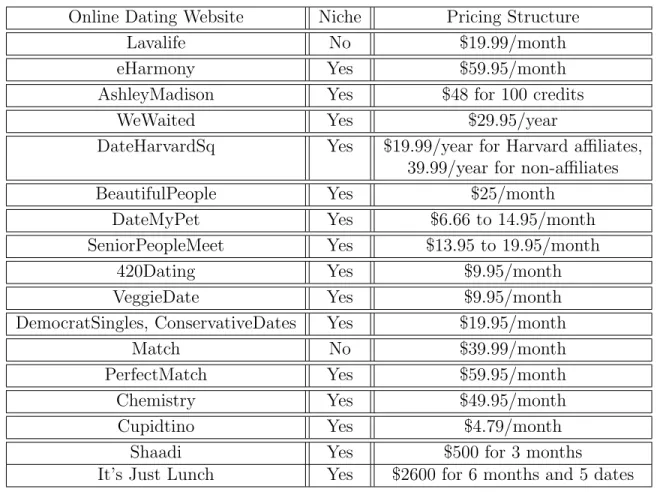
1.1 Pricing Structures of Online Dating Firms . . . 6
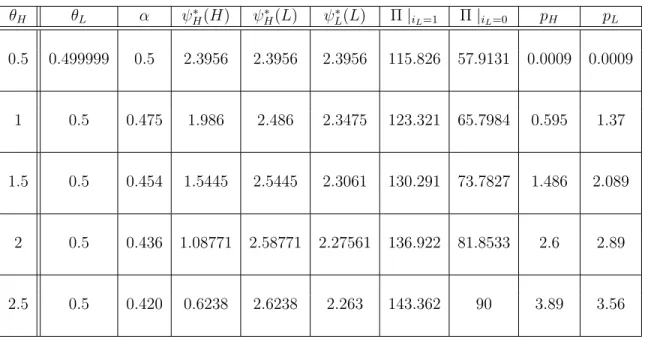
2.1 Uniform DistributionNumericalExample (Region 1) . . . 72
2.2 Uniform Distribution Numerical Example (Region 2) . . . 73
2.3 Uniform Distribution Numerical Example (Region 3) . . . 74
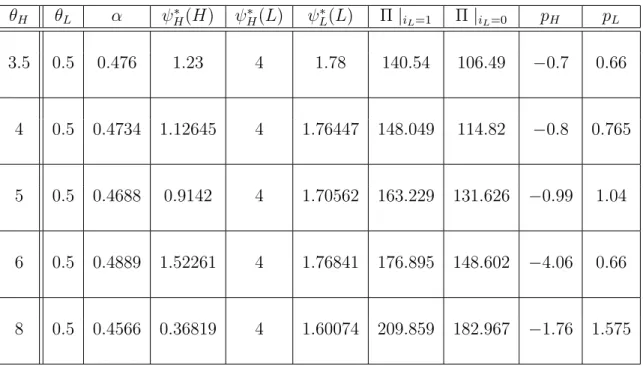
2.4 Uniform Distribution Numerical Example (Region 4) . . . 74
2.5 Cases From the Point of View of the H Type . . . 80
2.6 Cases From the Point of Viewof the LType . . . 80
2.7 Flow Utilities for Example 10 . . . 83
2.8 TwoPoint Example: θH =4,θL=1,γ =2,δ =0.9, and q= 21 . . . . 84
2.9 Flow Utilities for Example 11 . . . 85
2.10 Two Point Example: θH = 3.5, θL= 1.5, γ = 2, δ = 0.9, and q= 12 . . 85
2.11 Flow Utilities for Example 12 . . . 85
2.12 Two Point Example: θH = 3, θL= 2, γ = 2, δ= 0.9, andq =21 . . . . 86
2.13 Flow Utilities for Example 13 . . . 87
LIST OF FIGURES
1.1 A New York Times article featuring FarmersOnly.com . . . 4
2.1 Illustration of F(ψ) whenq = 0.5 and γ = 2 . . . 79
2.2 LyingonOnline Dating Platforms . . . 94
Chapter 1
Pricing and Matching with Horizontal Types
1.1
Introduction
The study of sided markets is relatively new in industrial organization. A two-sided market is a market where agents are brought together by a platform or network. The platform is segmented into two “sides”, where it is assumed that the two sides face some level of difficulty in coming together without the help of the platform. There are many examples of real-life two-sided markets. One well-researched market is the credit card network. The two sides of a credit card platform (say, Visa) are the consumers (users) who own and use the cards and the merchants (sellers) who choose to accept Visa payments. The more merchants who accept Visa cards and the more membership benefits offered by Visa, the more attractive the network becomes to users. On the other hand, merchants also prefer to join a credit card network that is home to a large number of customers. Another example is Alibaba.com, a Chinese company that facilitates B2B (business-to-business) transactions. Alibaba functions as a medium to bring suppliers, wholesalers, and manufacturers together, essentially forming a trading network between all levels of suppliers. Some other examples include video games platforms like Nintendo Wii (where the two sides are the game developers and players), heterosexual nightclubs (men and women), and the college Greek system (current members of a fraternity and alumni).
that are studied in the literature. For example, agents on one side of the market may compete with other agents on the same side for the attention of members from the opposite side of the market. In this case, utility is strictly decreasing in the number of agents on the same side. Agents may also exhibit increasing utility in the number of agents on the other side of the market, preferring that there be more agents on the opposite side to potentially match with. Utility may, of course, exhibit both of these characteristics, which can be seen in the case where the platform studied is a dating or marriage market. In this situation, agents both prefer a variety and large numbers of potential matches and also compete within their own side to obtain a match.
Besides caring about the number of agents on either of the sides, agents may also care about particular types of agents. In the case where all agents on a side agree on the ranking of a type for the opposite side, types are said to be vertically differentiated. In a highly simplified world where everyone cares only about beauty, attractiveness would be a vertically differentiated characteristic. The case where all agents do not agree on the ranking of types and each type of agent has their ’ideal’ type is called horizontal differentiation. For example, in real-life, we see many examples of characteristics for which agents prefer types closer to their own. In general, everyone does not agree that there is a ‘best’ or ideal Body Mass Index (BMI) for a potential match. This of course varies from person to person. It can also be argued that many people would prefer a match whose body type resembles their own, and exhibit decreasing utility the further their match’s BMI moves away from theirs.
negative prices is subsidizing women’s entrance fee and providing free drinks upon entry to the club.
One may ask the natural question of the necessity of studying two-sided markets versus focusing efforts on single-sided markets with no physical intermediary or plat-form. What can a two-sided market explain that a one-sided market cannot? First of all, even though most markets can be thought of as being “two-sided”, most markets do not have a platform that strategically behaves in setting prices or organizing the market to provide access to agents. Moreover, Rochet and Tirole (2006) argue that a two-sided market should be defined as one in which the volume of transactions between end-users depend on the structure of the market andnot only on the overall level of fees charged by the platform. In particular, a two-sided platform’s value is really the benefits or access it is able to provide to the agents. They stress that the effectiveness of a platform as an intermediary depends heavily on the fact that the two sides of the market cannot easily get together on their on.
contribution to the field.
Figure 1.1: A New York Times article featuring FarmersOnly.com
There are many pricing schedules that are offered by two-sided platforms. Arm-strong (2006) characterizes three main factors that determine the structure of prices offered to the two groups. The first and most important is the relative size of inter-group externalities. For concreteness, suppose that the two sides of the market are sides A and B. If A exerts a large positive externality on B, the platform will ag-gressively target agents on side A. In a competitive market setting, A’s benefits to
want to charge per-interaction fees in the case where the platform has successfully managed to court a good distribution of agents from the opposite side. The final characteristic that may determined the pricing structure is whether or not agents on both sides single or multi-home. Agents who single-home choose to use only one platform while agents who multi-home use many platforms.
One particular real-life application that I would like to focus on due to having a large number of agents who search while on the platform are online dating websites. The online dating industry is extremely successful with total revenues from 2012 reaching $2.1 billion.1 One of the biggest players in this market, eHarmony, reported that they were responsible for nearly 5% of marriages in the US in the year 2009.2 Although the industry in general has been doing extremely well, a subset of these dating websites has been even more successful. This subset of websites are niche websites. Niche dating platforms are platforms are platforms that cater to agents who are interested in matching with partners with very specific attributes. For example, the website FarmersOnly.com caters to “farmers, ranchers, animal lovers, nature lovers and other rural and country folk with traditional values.” Figure 1 depicts the popularity of said dating websites through coverage in popular media.3 This preference of wanting to be matched with somebody else whose type is close to your own is modeled in this paper using horizontally differentiated characteristics.
As the survey of prices in Table 1 indicates, online dating websites use a variety of pricing structures. I will first solve the model where the firm only charges a fixed fee to enter the platform (uniform pricing), and then extend this to the model where the firm charges a fixed fee and per-transaction fees afterward in each period for each date (two-part tariffs). The main result of the paper is that two-part tariff pricing reduces to uniform pricing in a steady-state equilibrium; that is, that per-interaction
1IBISWorld Dating Services 2014 Market Research Report.
2www.eharmony.com
Table 1.1: Pricing Structures of Online Dating Firms Online Dating Website Niche Pricing Structure
Lavalife No $19.99/month
eHarmony Yes $59.95/month
AshleyMadison Yes $48 for 100 credits
WeWaited Yes $29.95/year
DateHarvardSq Yes $19.99/year for Harvard affiliates, 39.99/year for non-affiliates
BeautifulPeople Yes $25/month
DateMyPet Yes $6.66 to 14.95/month
SeniorPeopleMeet Yes $13.95 to 19.95/month
420Dating Yes $9.95/month
VeggieDate Yes $9.95/month
DemocratSingles, ConservativeDates Yes $19.95/month
Match No $39.99/month
PerfectMatch Yes $59.95/month
Chemistry Yes $49.95/month
Cupidtino Yes $4.79/month
Shaadi Yes $500 for 3 months
It’s Just Lunch Yes $2600 for 6 months and 5 dates
prices are set to zero. Intuitive reasoning as to why this is true will be given in a later section. This chapter proceeds as follows: Section 1.2 will explore previous contributions to the literature, Section 1.3 presents the model and results, Section 1.4 concludes, and Section 1.5 is the appendix.
1.2
Literature Review
the platform serves. This externality could of course involve usage or membership to the platform. For example, Rysman (2009) posits that merchants on a credit card platform do not care about how many other merchants on the platform there are but the merchants do care about how many customers are subscribed to the platform. In a sense, a platform’s attractiveness and value is derived completely from its ability to provide each side with interactions with agents from the opposite side. This is a common theme in the two-sided literature: most work is done on
between group externalities and do not focus on much on competition within a side to obtain interactions with agents on the other side. In fact, it seems as though this subset of the literature may lead to a very fertile ground of research, since many two-sided markets possess this characteristic of competition within a side. For example, it’s very easy to see how a dating website exhibits this behavior. Even though there may be many agents on the opposite side, agents on a particular side always faces competition from agents on their side to obtain a good match.
One of the seminal papers in the two-sided market literature is Armstrong (2006). Armstrong (2006) places a strong emphasis on the effects of inter-group network ex-ternalities on pricing. In particular, as stated in the introduction, he posited three main pricing structures from the point of view of the firm. He expands the earlier work by Rochet and Tirole (2006) by modifying the specifications of agent utili-ties, the structure of platform fees, and the structure of platform costs. Armstrong presents three models of two-sided markets: monopoly platforms, competing plat-forms where agents join a single platform (single-home), and ‘competitive bottle-necks’ where one group of agents joins all platforms (multihomes).
of market power in order to study policy questions. These policy questions include those of price regulations and dealing with mergers of platforms. Weyl also studies socially optimal pricing for a monopolistic platform and compares it to Pigouvian, profit-maximizing and Ramsey prices.
There are of course many variations to the main frameworks employed in the two-sided market literature. For example, Hagiu (2006) studies two-two-sided platforms in which the sellers and buyers on the platform do not arrive at the same time. Cabral (2011) considers a dynamic model of competition between networks where consumers die and firm continuously compete Bertrand-style for new consumers. He then goes on to studying termination charges within wireless communications networks, where customers and eligible for lower prices for a set period and then pay higher prices once that period is over.
The seminal paper in the matching literature is undoubtedly the paper by Gale and Shapley (1962). In a two-sided matching model, agents often have a preference over all the agents on the other side from whom they would form a match with. Hoppe et al. (2011) work off the basic assortative matching framework and present a model of costly signaling with heterogeneous agents. Kojima and Pathak (2009) study stability in two-sided matching markets. They find that under some regularity conditions, the proportion of agents with incentives to lie about their preferences when all other agents are truthful approached zero as the market becomes very large. Azevedo and Leshno (2012) found that in both the discrete and continuum two-sided matching markets with heterogeneous agents, stable matchings have a very simple structure, with matches being formed if agents on each side are ranked above a certain threshold.
on each side of the market not only has a positive effect due to large choice (i.e. pos-itive inter-group network externalities), but also a negative effect due to competition between agents on the same side (i.e. negative intra-group network externalities). Agents resolve the trade off between these externalities differently; in particular, agents with low outside options face stronger competition effects than they do choice effects. Thus, these agents have a higher willingness to pay for a platform restricting choice, and vice versa. Damiano and Li (2007) study the problem of a monopoly matchmaker that uses a schedule of entrance fees to sort different types of agents on the two sides of a matching market into exclusive ‘meeting places’, where agents randomly form pairwise matches and obtain a match with probability one.
The model presented in this paper combines elements from the matching and pricing literatures. In particular, it extends the Salop (1979) model to incorporate matching. The Salop (1979) model is a variant of the Hotelling (1929) model of spa-tial competition. Salop (1979) introduces an economy consisting of two industries: a monopolistically competitive industry with differentiated brands and decreasing av-erage costs and a competitive industry producing a homogeneous commodity. Agents incur a transportation cost for buying a brand that deviates from his or her most-preferred brand and this then influences the pricing structure. This model provides a benchmark for subsequent analyses with non-uniform preferences.
1.3
Model
1.3.1
Environment
the corresponding density functionf. Agents and the firm discount at the same rate
δ.
I will explore two cases for pricing from the point of view of the monopolist. First, I will consider the baseline case when the monopolist only charges a fee to join the platform, and charges nothing else for further interactions with other agents. The second case that I consider will be when the monopolist charges a two-part tariff to all agents; that is, agents get charged a fixed fee to first enter the platform and then get charged a fee for each interaction they have with others on the platform. I will be focusing on equilibrium in steady-state.
Faced with the pricing schedule set by the monopolist, timing in this model proceeds as follows:
1. Agents decide whether or not to join the platform.
2. Agents who decide to join the platform receive a random draw of a new match. They either pay or not for this draw, depending on the pricing strategy em-ployed by the firm.
3. Agents meet up, learn each other’s type, and decide whether or not to marry. If both agents decide to marry, they obtain their matching utility (defined below) and leave the platform forever.4 If one or both of the agents decide not to marry, they continue searching by proceeding to the next period.
I assume that there is a matching benefit b >0 which is common to all agents. This term captures the overall benefit that individuals obtain when married. An agent’s
ideal type is assumed to be her own and agents face a cost which increases in distance with marrying a type that is not her own. This cost is denoted by c > 0 and serves
4I have made the modeling decision to assume that a marriage is forever and divorces never
as a per-unit distance cost of marrying away from an agent’s ideal type. In real life, if I used height as a main characteristic that people match on, it’s easy to see that one’s ideal type is probably not the tallest or shortest person in the world. Rather, people probably desire to marry others who are of similar heights to themselves.
I can now define the matching utility obtained by agent x when he chooses to marry agent y as
ux(y)≡ b−c|x−y|
1−δ (1.1)
This utility is multiplied by 1−1δ, which is a result of geometric discounting and takes into account the fact that a marriage lasts forever if agents decide to leave the platform. The distance metric | measures the shortest arc-length between x and y
on the unit circle.
1.3.2
Baseline: Uniform Pricing
Agent’s Problem
Assume that the monopolist charges only a fixed fee f to all agents. I first intro-duce the strategy for the agents. In general, agents can choose to marry whomever they want–however, we will see later on that optimality dictates that all agents will employ a ‘threshold’ strategy when deciding who to marry. All agents obtain 0 as a reservation utility.
Definition 1 An agent’s strategy is a function s: [0,1]→ {accept, reject}
treat this cost as sunk when they are making their marrying decisions once on the platform.
Definition 2 The Bellman Equation for an agent of type x is
Vx(.) = max{
ux(.) 1−δ, δ
Z 1
0
Vx(.)dF(.)} (1.2)
where Cx ≡ δ
R1
0 Vx(.)dF(x) is the expected discounted continuation utility of being
on the platform.
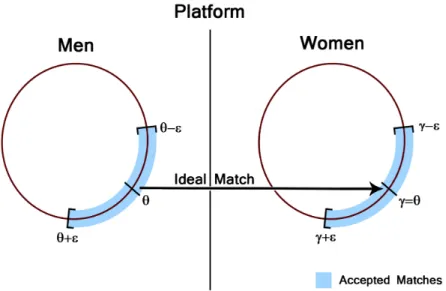
Using standard techniques used in search models, I show that the optimal strategy for the agent will be a threshold strategy, where agent x will accept and marry all agents who are in the-ball aroundx; that is, xwill accept any agent in [x−, x+] and reject all agents outside of this interval. This can easily be seen from the Bellman equation.
To see this, note that the right-hand side is what the agents obtain if they reject their current draw. This value, which is denoted Cx, is constant regardless of the draw. The left-hand side of what the agents obtain if they accept their current draw and it increases as | x−y | decreases, where y is the type of the agent that
x is deciding whether or not to marry. Next, I derive . For a visual aid on the
-threshold strategy, please refer to Figure 2.
Proposition 1 The -threshold for each agent is given by
= min{1 2,
−c(1−δ) +p(1−δ)(c2(1−δ) + 4bδ)
2cδ } (1.3)
Figure 1.2: Illustration of the −strategy employed by agents
y, then y will want to form a match with agent x. This is a very nice result of this model and comes from the strong assumption of uniformity in types along the circumference of the circle. Without the uniform distribution of types, it is unclear whether this problem is tractable. In particular, a match between x and y would only form in the situation with non-uniform types if both x is within the -interval of y, and vice versa. The -threshold in my model is constrained to be at most 12, following the fact that types are distributed on the unit circle with circumference 1. This assumption is imposed to ensure that an agent’s -ball does not overlap itself twice around the circle.
Proposition 2 Given any other strategy employed by y 6= x, x’s best response will always be an -threshold.
Now, define ¯= −c(1−δ)+ √
(1−δ)(c2(1−δ)+4bδ)
2cδ . For the case when ¯ < 1
2, that is when the
-threshold is non-binding, I can do simple comparative statics on the parameters of the model. In the case where = 1
2, the -threshold is said to be binding and the parameters of the model have no effects on agent’s optimal behavior.
• ∂ ∂b >0 • ∂
∂δ <0 • ∂
∂c <0
This proposition has intuitive interpretations. The term corresponds to how picky an agent is when it comes to matching. A larger corresponds to a larger potential matching set and so the agent is less picky since she is willing to marry agents whose types are considerably further from her own. As the overall benefit that an agent obtains increases; that is as b becomes larger, an agent is on average more keen on marrying regardless of the type of the match she draws in that period. This will cause the agent to be less picky and thus increases the -ball of acceptance. As δ
increases, the agent becomes more patient and so is willing to wait for longer to get a good marriage match. This causes his or her -ball to shrink and she is willing to stay on the platform for longer to wait to marry someone whose type is closer to her own. Note that this is only true since agents only pay a waiting cost of δfor staying on the platform to search. Once a per-interaction price is imposed on the agents to obtain a new match and continue searching, the cost of staying on the platform increases in proportion to the fee imposed. An increase in the cost of matching away from an agent’s own type, c, causes agents to be more picky. Holding every other parameter constant, as c increases, agents face a heavier penalty of marrying away from their own types. This causes them to be less likely to accept ‘bad’ matches of agents whose types are far from their own, which will in turn decrease . A higher per-unit distance matching cost causes agents to want to wait for better draws of matches in hopes that the match will be closer to their own type, all else equal.
Dynamics
agents on the platform. At the beginning of time t, there is a mass of µt agents already on the platform. At the same time, a mass of size 1 of agents are born outside the platform and a proportionit of these agents choose to join the platform. Agents who are on the platform marry at rate ot in periodt, where otis endogenous and determined by the threshold term.
Thus, in each period t, a mass of size (1−ot)µt remains on the platform after the exit of the otµt agents who have married in the period. A new group of agents of size it then decide to enter the platform. This gives the transitional equation for
µt as
µt= (1−ot)µt+it (1.4)
In solving for the constant distribution of agents in steady-state, I set the total inflows equal to total outflows in each period, which gives
otµt=it ∀t (1.5)
which implies that
µ= i
o (1.6)
Since agents are uniformly distributed on the unit circle, the probability that any agent obtains a match is precisely the length of their -interval. Thus, it must be that ot = 2 ∀t. This reduces the steady-state equation to
µ= i
2 (1.7)
Monopolist Pricing
I assume that the monopolist fully commits to a path of constant prices throughout time and can perfectly observe the types of the agents.5 The monopolist solves the following problem in steady-state.
max f 2f
s. t. (IR) : Cx()−f ≥0 ∀x
The solution to this optimization problem is simple. The objective function is strictly linearly increasing inf. The monopolist will setf so that Cx =f where Cx =C ∀x since the-thresholds are independent of type. This implies that the monopolist lets all types onto the platform, effectively setting it = 1 ∀t. From the point of view of the monopolist, all agents are identical. This then reduces the earlier steady-state equation to
µ= 1
2 (1.8)
Equilibrium
Combining the steady-state condition with the solution to the agent’s problem allows me to examine the steady-state equilibrium. As shown below, the probability that an agent obtains a match approaches 1 as time progresses in this model.
Proposition 4 A symmetric steady-state equilibrium exists where all agents marry while on the platform in finite time.
5As we see later, an important fact to note here is that since the monopolist can perfectly observe
Proof. Given the price f charged by the monopolist, it is clear that all agents will participate. The mass of agents who participate will be determined by the steady-state condition in (1.8). What needs to proven now is whether all of the agents will marry while on the platform. Since agents are uniformly distributed, they are essential identical and have the same. Since the distribution of agents on both sides is uniform, the probability of being married is given by
P(married) = 2 1 = 2
Since each period is identical and independent, the probability that an agent has yet to marry by time T is
P(not married by time T) = T
Y
t=1
P(not married) = (1−2)T
As T → ∞, we have that P(not married by time T)→0, since 2≤1.
This result is again a consequence of having agents uniformly distributed. All agents have the same -thresholds, which reduces and simplifies the model signif-icantly. In the case where agents are not uniformly distributed, agents may have different -thresholds, which means that each agent will have a distinct probability of marrying in each period. This complicates solving the model significantly; in fact, as stated previously, it is not clear whether this problem is even tractable.
1.3.3
Two-Part Tariffs
assumed to fully commit to a set of prices from the beginning of time and can also perfectly observe types.
The timing proceeds as follows. In each period, the monopolist sets the fixed price f. Given f, agents decide whether or not to join the platform. Once agents have paid the pricef, agents must paypin next period to obtain a new random draw of a date. Once agents receive the draw, they meet up in the same period, learn each other’s characteristics and decide whether or not to marry. If they marry, they leave the market forever and obtain the flow matching utility in each period thereafter. If they do not marry, they must move to the next period and pay another p in order to obtain a new random draw.
In this part of the model, I wish to characterize the signs on the prices f and p. In particular, I am interested in whether or not the per-interaction price p is zero. As before, I am focusing on a steady-state equilibrium. Since the firm can perfectly observe prices, it can use said prices to affect the matching behavior of agents on the platform. In particular, the firm can manipulate per-interaction prices to change the behavior of agents when it comes to deciding who to marry. A per-interaction price that is not zero is distortionary–that is, it forces agents to change the set of people they marry in a way that they may be would not have in the absence of prices. In particular, a positive per-interaction price causes agents to be less picky, making them increase the set of agents from the opposite side that they would be willing to marry.
Agent’s Problem
The agent’s matching utility remains the same from the baseline model. In particular, the matching utility for type x who chooses to match with typey is
ux(y)≡ b−c|x−y|
where the utility is discounted since I assume that if and when agents match, they do so forever. Just as a reminder, the distance function | measures the shortest arc-length between x and y, b > 0 is the benefit of matching which is the same for all agents, c >0 is the cost function for matching with a person whose characteristic is far from your own.
Agents take prices to be given when they match. Type x’s Bellman equation is now given by
Vx(.) = max{u x(y) 1−δ , δ(
Z 1
0
Vx(.)dF(.)−p)} (1.10) The difference between the Bellman equation here and the one from the baseline model is that I have to take into account the fact that agents must pay p in order to obtain a new random draw in the next round. I can solve for the -thresholds similarly in this case.
Proposition 5 All agents have the same -threshold given by
= min{1 2,
c(δ−1) +pc(δ−1)(c(δ−1)−4δ(b+pδ))
2cδ }
Note that the now depends on the per-interaction price p. For ease of notation, define
¯
= c(δ−1) +
p
c(δ−1)(c(δ−1)−4δ(b+pδ)) 2cδ
The expression for includes the min function to ensure that the-interval does not wrap twice around the circle. I can now demonstrate simple comparative statics on the -thresholds.
Proposition 6 In the case where ¯≤ 1
2, we have that
• ∂ ∂p ≥0 • ∂
• ∂ ∂δ ≤0 • ∂
∂c ≤0
Recall that a largerindicates that an agent is less picky, while a smaller indicates that an agent is becoming more picky with respect to whom he or she marries. I obtain the standard results that we have already seen with the three parameters of the model (δ, c and b). An agent becomes less picky as she becomes more patient. This is an intuitive result: as δ→1, the agent values the future more and is comfortable with staying on the platform to obtain a good marriage partner. However, comparing this result to the one obtained from the baseline model, I would expect this result to be attenuated by the fact that an agent has to pay a cost to stay on the platform in each period compared to the baseline model where staying on the platform was costless once you had already paid the fixed fee f. As the matching cost cincreases, agents become less picky and would rather marry an agent whose type is very close to their own. As the matching benefitbincreases, agents obviously become less picky as they prefer to just marry anyone.
The most interesting comparative static is obtained when I analyze how changing the per-interaction fee affects the-threshold of the agent. The previous proposition gives that an agent becomes less picky aspincreases. This is intuitive since a higherp
corresponds to a higher cost of staying on the platform. Increasing the per-interaction price will encourage agents to marry quicker since being on the platform becomes more costly. Agents will marry quicker by increasing the length of their -intervals, which in turn enlarges the possible marrying set.
Dynamics
it(f, p) agents who join the platform. Note that the outflow rate depends on the per-interaction price p, and since the firm gets to decide how many people to join the platform, the inflow rate is also an indirect choice variable from the firm. The firm essentially controls the inflow rate by changing the f.
The transitional equation for µt is
µt+1 = (1−ot(p))µt+it(f, p) (1.11) In steady-state, I am able to use the condition that total outflow from the platform, which iso(p)µ, is equal to total inflow onto the platform, which is i(f, p). This then allows me to solve for a constant mass of agents on the platform.
o(p)µ=i(f, p) (1.12)
I can simplify this further by recalling that agents find matches at rate 2(p), giving that o(p)≡2(p). The steady-state condition finally becomes
µ= i(f, p)
o(p) (1.13)
Monopolist’s Problem
The monopolist steady-state profit can be written as
Πss = 2(i(f)f +
∞ X
t=0
δt+1pi(f)(1−o(p))t) (1.14)
on the platform and discounts each of these periods by δ. This gives the expression
P∞
t=0δt+1pi(f)(1−o(p))t in the profit function. The new cohort of agents who join the platform will be charged f and there are i(f) of them, giving the term i(f)f. The constant in front of the profit function, although irrelevant to the optimization problem, is present to signify that the platform extracts this sum of profits from two sides of the market.6
Evaluating (1.14) gives
Πss= 2(if+ δip
1−δ(1−o)) (1.15)
Since types are observable, we have only a participation constraint in the firm’s optimization problem, which is given as follows.
max p,f Πss
s. t. (IRx) Cx(p)−f ≥0 ∀x
whereCx is the expected lifetime utility of xbeing on the platform. By Proposition 5, the -thresholds for all agents are the same and so Cx =C ∀x. This means that the optimal f will be
6An important fact to note is that there are essentially two ways of calculating profits: the first
is to follow the same cohort for their entire lives and the second is to monitor the dynamics onto and off the platform, taking into account different cohorts that enter at different times. This way of writing profit would be expressed as
∞
X
t=0
2{f it(f) +µtp}
This way of writing profit is incorrect since it allows for the firm to profitably deviate in equilibrium.
The reason is because since there is a mass of agents who remain from last period (t−1), the firm
could potentially renege on their commitment to a price path, reoptimize, and charge higher prices
from timet onwards to the old cohort. My calculation of the profits follow the cohort who joined
C =f (1.16) Referring back to the dynamics, note that since the monopolist can observe types, he will charge f to bind the individual rationality constraint. As we will see later, the firm will also let inall agents whose individual rationality constraints bind onto the platform. (1.13).
Equilibrium
Now, I solve for equilibrium by combining the steady-state conditions, firm optimality conditions, and agent’s optimal matching behavior.
Proposition 7 Consider the profit function given by (1.15).
• Πss is linear ini and ∂Π∂iss >0, implying that i is optimally set to be 1.
• The firm optimally sets p= 0.
From the proposition, the firm wants to let everyone who wants to join the plat-form on so that it can extract more surplus. However, combining the steady-state conditions with firm’s optimality gives us the following proposition.
Proposition 8 A symmetric, steady-state equilibrium in this model has the following characteristics:
1. The per-interaction price is p= 0 for all agents.
2. The fixed fee is then set so that f =C|p=0 for all agents.
3. i is set so that
i= 1
4. The probability that any agent on the platform receives a match approaches 1
The equilibrium characterization is very clean and simplistic for two reasons. The first is that since agents are uniformly distributed over the circumference of a circle and the firm can perfectly observe types, agents are essentially identical to the firm. Secondly, given the utility specification, the-thresholds are the same for all agents, and that if one agent is willing to marry another, then a marriage necessarily forms. In other words, if one man’s type is in a woman’s -ball, then the woman’s type is necessarily within the man’s -ball. If the -thresholds were different in any way, the matching equilibrium would be very messy, leading to a correspondingly messy pricing equilibrium in steady-state.
1.4
Conclusion
In this essay, I have presented a stylized model where a monopolist operates a two-sided matching platform in the presence of horizontally-differentiated agents. Agents prefer to match with their own type but will accept matches within an -ball of their own type. I explored two pricing equilibriums: one where I assume that the monopolist charges a uniform fixed fee and another where the monopolist charges a two-part tariff.The main finding in this paper is that the two-part tariff case reduces to the uniform pricing case, where the fixed fee is charged to extract all surplus from agents and the per-transaction fee is set to 0. I have also found that all agents will find a match in finite time once on the platform. These results are very clean and the model provides a good foundation to study other issues related to two-sided matching platforms. In particular, one might imagine a model where the monopolist splits the one platform containing all of the agents who are distributed along the circumference of the circle into smaller platforms which cater to a more narrow and ‘specialized’ set of agents. Studying a model like this would shed some light on niche dating websites and their increasing popularity amongst internet users, as highlighted early in the paper.
would price in the presence of vertically-differentiated agents. In the next chapter, I study this question by introducing a two-type model where agents match on not only type but also an idiosyncratic shock which measures a horizontal component in preferences. In the second chapter, externalities, and in particular, rivalry between agents, will play an important role in how optimal pricing is determined. Since every agent agrees on the ranking of characteristics, everyone will want to match with a high type and will expend a considerable amount of effort, time, and money staying on the platform to do so. The monopolist will price accordingly to correct this externality and I find that it is optimal for some parameter ranges to charge a non-zero (distortionary) per-interaction price.
One last note to be made is that the horizontal differentiation model studied in this chapter does not exhibit the same externalities that the vertical model in the next chapter does. In a horizontal differentiation model, agents do not agree on the ranking of the characteristics–in fact, each agent has their own ideal type. This being, there is no competition amongst agents for the ‘best’ type because there essentially is none. An agent’s ability to marry his or her ideal type does not take away from another agent’s ability to do so as well. This being, externalities are not present, the agents behave socially and privately optimally, and the monopolist does not have an incentive to manipulate their matching behavior by charging a non-distortionary per-interaction price.
1.5
Appendix
Proposition
(1)
Proof. To find the -threshold for an agentx, I must find the type ¯y for which x is indifferent between forming a match with and not. That is,
ux(¯y) 1−δ =δ
Z 1
0
By the definition of ¯y, we have that | y¯−x |=. We also have that the right-hand side of the previous equation can be rewritten as
δ
1−δ(
Z x+
x−
(ux(y)−ux(¯y))dy+
Z 1
0
ux(¯y)dy)
because agents receive the same utility outside of the -interval since they choose not to match. The symmetry of the -interval allows for much simplification. Now, (1.17) may be rewritten as
b−c
1−δ = δ
1−δ(2
Z x+
x
c(−(y−x))dy+ (b−c)) (1.18) Solving (1.18) yields
= −c(1−δ) +
p
(1−δ)(c2(1−δ) + 4bδ) 2cδ
where >0. To avoid the problem of having an-interval that wraps more than once around the circle, I impose the condition that ≤ 1
2, as stated in the proposition. Now, I complete the proof by showing that >0.
> 0 ⇐⇒ −c(1−δ)+
√
(1−δ)(c2(1−δ)+4bδ)
2cδ > 0 ⇐⇒ −c(1−δ) +p(1−δ)(c2(1−δ) + 4bδ) > 0
⇐⇒ c2(1−δ)2+ 4bδ(1−δ) > c2(1−δ)2 ⇐⇒ 4bδ(1−δ) > 0
⇐⇒ b > 0 which is always true.
Also note that is also always a real number, since the term underneath the square root is positive ⇐⇒ b > −c24δ(1−δ), which is always true since b >0.
Proof. The strategy for player x is determined by his or her optimization problem in (1.2). Cx does not depend on the type of agent y but his discounted matching utility u1x−(y)δ strictly decreases in the distance between x and y. This being, there must be a threshold type ¯y for whichx is indifferent between dating and not. This type ¯y must define a threshold strategy forx.
Proposition
(3)
Proof. Taking derivatives gives
∂ ∂b =
1−δ p
c(δ−1)(c(δ−1)−4bδ) >0
∂ ∂c =
−b(1−δ)
p
c(δ−1)(c(δ−1)−4bδ) <0
∂ ∂δ =
c(δ−1)−2bδ+ √
c(δ−1)(c(δ−1)−4bδ)
2δ2√c(δ−1)(c(δ−1)−4bδ) < 0 ⇐⇒ c(δ−1)−2bδ+pc(δ−1)(c(δ−1)−4bδ) < 0
⇐⇒ pc(δ−1)(c(δ−1)−4bδ) < 2bδ−c(δ−1)
⇐⇒ c(δ−1)(c(δ−1)−4bδ) < 4b2δ2−4bδc(δ−1) +c2(δ−1)2 ⇐⇒ −4bcδ(δ−1) < 4b2δ2−4bδc(δ−1)
⇐⇒ 4b2δ2 > 0 which is always true since b, δ > 0
Proposition
(5)
did, with the exception that the expected continuation value incorporates the per-interaction price ¯p. Thus the indifference condition for all agents is the following equation
ux(¯y) (1−δ) =δ(
Z 1
0
V(y)dy−p¯)
We may then repeat the steps done in Proposition 2 to obtain the . In particular, we note that since
= min{1 2,
c(δ−1) +pc(δ−1)(c(δ−1)−4δ(b+ ¯pδ))
2cδ }
we have that≥0 ⇐⇒p¯≥ −α
δ and ¯pis a real number ⇐⇒ (π(δ−1)−2δ(α+ ¯pδ))≤ 0 ⇐⇒ p¯≥ δ(π−2δ2α)2 −π.Since
−α δ ≥
δ(π−2α)−π
2δ2 , we have that the condition that ¯p≥
−α δ ensures that ∈R+.
Proposition
(6)
Proof. Taking derivatives of gives
∂ ∂p =
δ(1−δ)
p
c(δ−1)(c(δ−1)−4δ(b+pδ)) ≥0
∂ ∂b =
1−δ p
c(δ−1)(c(δ−1)−4δ(b+pδ)) ≥0
∂ ∂δ =
c(δ−1)−2δ(b+pδ2) +p
c(δ−1)(c(δ−1)−4δ(b+pδ)) 2δ2p
c(δ−1)(c(δ−1)−4δ(b+pδ)) ≤0
∂ ∂c =
−(1−δ)(b+pδ)
p
Proposition
(7)
Proof. It is easy to see from (1.15) that Πss is linear ini, and so i would optimally be set to be 1. To see the second point, refer to the argument made for the case for one type of agents in the next chapter.
Proposition
(8)
Proof. 1 is proven from the previous proposition. Next, I set out to prove 2. Since types are observable, the firm has two pricing tools to extract all surplus from agents. The firm can extract all this surplus using a combination of p and f. In particular, for any p that the monopolist chooses, since C is a function of p, f will just be set so that C(p) = f. This is precisely the entire amount of surplus that agents can extract. To prove 3, note that I am focusing on steady-state equilibrium. Combining the steady-state conditions from (1.13) gives 3. To prove 4, we reiterate the steps from Proposition 4.
Given the price f charged by the monopolist, it is clear that all agents will participate. The mass of agents who participate will be determined by the steady-state condition in (1.8). What needs to proven now is whether all of the agents will find a match. Since agents are uniformly distributed, they are essential identical and have the same . Since the distribution of agents on both sides is uniform, the probability of finding a match is given by
P(finding a match) = 2 1 = 2
P(not found a match by timeT) = T
Y
t=1
P(not found a match) = (1−2)T
Chapter 2
Pricing and Matching with Vertical Types
2.1
Introduction
An important incorporation into the two-sided platform literature is the search aspect. Agents on both sides of the market can search for matches with agents on the opposite side, and do so in a way that maximizes their expected utility while on the platform. For example, in the heterosexual marriage or dating market, agents search for the best partners they can obtain.1 Two-sided matching platforms traditionally do not involve prices. For example, two popular applications of the study of matching platforms are the kidney exchange market (Roth, S¨onmez, and
¨
Unver (2005), Roth, S¨onmez, and ¨Unver (2007)) and student-to-school matchings in American cities (Abdulkadiro˘glu, Pathak, and Roth (2005), Abdulkadiro˘glu et al. (2005)). This of course, has an exception: the worker-firm market has been studied extensively in the labor economics literature where, as in Bulow and Levin (2006), wages are taken as prices.
This essay models how a profit-maximizing monopolist firm would price services on a platform where vertically differentiated agents pay to search for matches. It combines two well-established literatures by embedding a pricing model into the Mc-Call (1970) search and matching framework. In my model, there are two types of agents: H types (the studs) and L types (the duds). Everyone on the platform universally agree on the ranking of the agents—H types are strictly preferred to L
types. I allow for an element of randomness in the matching process. In particu-lar, agents are assumed to obtain their match’s vertical type plus a random shock when they match. This random shock ψ can be seen as a way to model horizontal differentiation when matching. I assume that this matching shock is the same for both agents. This complication in my model introduces the possibility for a more realistic matching model since it incorporates a less rigid matching utility structure. In particular, two studs may not match with each other if they receive a very bad random draw during their date. This utility specification also allows me to study a
1In such markets, such as the one studied in the paper, it is often assumed that both agents
world where the match quality can be neatly decomposed into two effects: vertical and horizontal.
The main contribution of this essay is to study how externalities affect pricing on a two-sided matching platform, an issue that is understudied in the literature. The only other paper that studies externalities and how they affect matching is Shimer and Smith (2001), where they highlight two externalities: the thick-market
externality and the congestion externality. The thick-market externality stems from the fact that studs do not internalize the fact that if they marry and leave the platform, they make it harder for other agents on the platform to meet them. The congestion externality can be seen when studs never match with duds, which creates a ‘congestion’ problem for the duds who pay the cost of having to go on many dates with people who are not willing to marry them. I find these two externalities in my paper as well, as highlighted in my numerical example in Section 2.5.
It is also important to note that the literature has yet to study a world where agents choose to match on both a vertical and horizontal component. This paper simultaneously studies such a market and also incorporates pricing into it. I have found a unique externality in this paper, which is that agents tend to match too aggressively on the vertical component and not aggressive enough on the horizontal component. In particular, since all agents agree on the quality of the vertical compo-nent, there is a negative externality imposed on all other agents on the market when one agent successfully marries the studs and take him or her away from the mar-ket. This externality is not present in the horizontal matching component, where an agent does not take away from another agent’s ability to receive a good idiosyncratic matching shock draw if she receives one.
particular, the the choice of prices affect the agents’ optimization problems, which in turn affectsα, which agents take as given when making their optimization decisions. As we will see later, studs always benefit from an increase in α; that is, studs are always happier when there are more other studs on the platform. However, this may not be true for duds. In particular, if the parameterization is such that studs never
marry duds, duds may be negatively effected by an increase in the number of studs on the platform.
The matching framework that I utilize is one where utility is non-transferable and matching is ‘random’, which means that agents receive random draws of a date while on the platform. The draw is such that you meet an H type with probability
αand Lwith probability 1−α. Non-transferable utility means that an agent cannot induce another agent to match with him or her by offering some utility or transfer as a reward. This is in contrast to transferable utility, where agents may bargain over the matching surplus. In an ideal world, modeling the marriage and dating market would require incorporating a partial transferable utility model, where a portion of the match surplus is fixed and the rest is up for bargaining between the two agents. However, this adds a significant level of mathematical complexity to the model. Previous papers in the literature have chosen to either model utility as being transferable or non-transferable. According to American cultural norms and observations from real-life and the world of online dating, one cannot usually obtain a match by paying off the other person on a date. Thus, I assert that my assumption of non-transferable utility is realistic.
the firm will want to correct any externalities and deviations from social optimality. It does so in my model by using the only (imperfect) instrument available to them, which is the per-interaction price. Another externality stems from the fact that everyone dislikes duds. Having more duds on the platform decreases α, which in turns decreases the utility of the studs. This is suboptimal from the point of view of the firm since it cares most about the studs, who have more utility (and thus, surplus) to be extracted. As we shall see in the paper, the efficient level for per-interaction prices is zero. In the case where the firm wants to correct externalities, it may charge high positive per-interaction prices to duds to increase their cost of being on the platform and encourage them to marry faster, and may charge negative prices to studs to encourage them to take longer to marry in order to improve the attractiveness of the platform.
Now, I would like to highlight and elaborate on four interesting features of my model. The first is one that connects the role of the profit-maximizing monopolist to the traditional matching literature. Recall that utility is non-transferable in my model. As I have previously explained, in the case where types are perfectly observ-able, the monopolist problem is equivalent to a social planner’s problem, where the objective is to maximize the total surplus in the economy. In this case, the monop-olist operates as a social planner who maximizes the total expected utility of agents on the platform, only to extract it all using prices.
Proposition 9 (Browning, Chiappori, and Weiss (2014)) Suppose utility is trans-ferable. A stable assignment must maximize total surplus over all possible
assign-ments.
Proposition 9 then tells us that in the case where utility is transferable, a stable
assignment, which corresponds to the steady-state equilibrium in my model, must maximize total surplus. In other words, in the case where types are perfectly observ-able, the monopolist charges prices to essentially reallocate surplus amongst agents
my model shifts the allocation of utility amongst agents from being non-transferable to utility being transferable.
The second feature of the model concerns the horizontal differentiation ‘shock’ parameter. In the matching literature, types are usually either assumed to be hori-zontal or vertical, but not both. As previously explained, in allowing for a horihori-zontal differentiation component, I am able to a model a more realistic version of reality, where agents may care about multiple components of a characteristic when look-ing for a match. In the previous essay of this dissertation, I have explored the pricing equilibrium for a model where agents are purely horizontally differentiated, with characteristics distributed uniformly on the unit circle. It turns out that the horizontal differentiation component utilized in this paper can be rationalized by preferences on the Salop circle described in Salop (1979) as well. In particular, for any distribution function F of agents on the Salop circle, I can choose the cost of matching away from an ideal type so that the matching shock ψ in my model is distributed according to F. This provides a nice bridge connecting the first essay of this dissertation with this one, and also strengthens the connection between models of pure horizontal differentiation with mine.
function of the matching platform.
The last feature of the model is related to aggregation. In real-life, we observe that agents may match on many dimensions of characteristics; for example, I may have horizontal preferences over height and weight for a match, and a vertical preference for wealth. In other words, my ideal match may be somebody who is not only close to me in physical size, but also the richest in the world. In my model, I assume an aggregation of preferences, since agents are only allowed to have preferences over a single vertical and horizontal dimension. However, a result from Flanders (2014) gives that aggregating N vertical and horizontal dimensions into a single dimension results in the same matching outcome and profit for the firm. Thus, my assumption of agents only matching on a single dimension is not limiting.
The outline of the paper proceeds as follows. Section 2 first reviews the literature. Section 3 provides the model setup. In Section 4, I explore the pricing equilibrium for a baseline model in which there are no externalities; that is, when there is only one type of agent. Section 5 explores the more general case with two types in depth. It is divided into three subsections. The first studies the case where the monopolist firm is able to operate two distinct platforms, each catering only to agents of the same type. The second subsection studies the case when the firm cannot do so and only operates one platform, and when types are perfectly observable. In this subsection, I first outline the monopolist’s problem and then explore four cases of the distributional assumptions for the idiosyncratic matching shockψ. In particular, Case I looks at when there are no to small idiosyncratic matching shocks, Case II looks at when ψ is uniformly distributed on [0, m], Case III looks at when ψ is distributed according to a two-point mass distribution, and Case IV looks at when
when the monopolist firm operates only one platform and types are not observable. Section 6 then concludes.
2.2
Literature Review
This paper combines three literatures: search, matching, and pricing, The matching literature can be traced back to the seminal paper by Gale and Shapley (1962). Many papers in the literature have since focused on proving equilibrium properties of specific matching functions. In particular, a lot of attention has been paid to two classes of utility functions: transferable and not. Utility is said to be transferable
when an agent can offer a certain amount of utility to another agent to match with her. In particular, agents may bargain over the resulting match surplus. Utility is non-transferable when this is not the case. My paper focuses on the case when utility is non-transferable. Another issue of interest when studying matching models is assortation. Positive assortation in equilibrium implies that high types match with other correspondingly high types, whereas negative asportation means that high types match with low types. Assuming nontransferable utility, Becker (1973) proved conditions under which positive assortation occurs. Although my paper does not address the issue of assortation explicitly, I do find ‘separating’ steady-state equilibrium where studs (high types) only match with other studs and do not match with low types. As in many other matching papers, I also assume that matching is random, exogenous, and non-targeted. Agents in matching models can either be
horizontally or vertically differentiated. Horizontal differentiation models assume that an agent wants to match with another agent whose type is closest to their own whereas vertical differentiation models have agents whose types can be represented as quality, where the ranking of types (quality) is agreed upon by all individuals in the model.
into a single number, defined as agent’s pizazz, and takes a value in the interval [0,1]. Burdett and Coles analyze the matching equilibrium by studying steady-state conditions and find a rich set of equilibria. Agents match in assortative partitions in equilibrium, where the interval [0,1] for both types of agents is broken up into distinct pieces with agents in the same piece matching randomly with each other. In the third subsection of section 5, I will elaborate on modeling difficulties that result from the case when types are unobservable in my paper and expand on some of my planned future work that involves extending Burdett and Coles (1997) to include lying and pricing.
The search literature, on the other hand, started with the study of job search in the labor market (McCall (1970), Burdett (1978), Mortensen and Pissarides (1994), Rogerson, Shimer, and Wright (2005)). It has since expanded to include other appli-cations as well, including the marriage and dating market (e.g. Cornelius (2003)). As highlighted in the introduction, applications of search theory to the dating market usually assumes non-transferable utility, as this mirrors real-life more closely than the assumption of transferable utility. In particular, Burdett and Wright (1998) and Adachi (2003) both study properties of equilibria in a search models with non-transferable utility.
The closest paper to this is Bloch and Ryder (2000), where they study the pro-vision of matching services in a model of two-sided search. Agents are distributed on the unit interval and their utility is equal to the index of their mate. Bloch and Ryder (2000) find that in a search equilibrium, agents form subintervals and are only matches to agents inside their own class, a result that closely mirrors that of Burdett and Coles (1997). The two main differences between my paper and theirs is my inclusion of theψ and the fact that I assume that the monopolist utilizes a two-part tariff pricing structure. I am primarily interested in the signs of the per-interaction prices–be it positive, the ‘efficient’ (or, as we see later, the ‘no externalities’) level of 0, or even negative. Bloch and Ryder (2000), on the other hand, study how two separate pricing structures (uniform and commissions on the matching surplus) af-fect equilibrium behavior in agents. A similar paper is Damiano and Li (2007). In this model, the monopolist again faces two sides of the market with each side having characteristics distributed on a compact interval. The monopolist is able to choose a sorting and pricing structure in order to maximize revenue. They then show that the revenue-maximizing sorting is efficient.
2.3
Model
2.3.1
Environment
the distribution ofH types on the platform,α, that makes the mass of agents on the platform constant.
I assume that firm can charge a two-part tariff2– a fixed price f which is charged to all agents for access onto the platform and per-interaction (or per-date) price
p. Once agents are on the platform, they may begin searching for matches. They pay p to receive a new date, and will meet a H with probability α and L with probability 1−α. As previously highlighted, this probability α is endogenous and will be determined in equilibrium by using steady-state conditions.
Once the agents pay p, they will meet each other in the next period, learn each others’ types, receive a matching shock ψ and decide whether or not to marry. If both agents decide to marry, they do so forever. If one or both do not want to marry, they will both continue searching by paying p in this period to continue to the next period. The idiosyncratic shock ψ is drawn from a distribution on [0, m] with cumulative distribution F and density function f. A intuitive interpretation for ψ is given below.
The utility that an agent i receives when marrying agent j forever is a function of the draw ψ and is given by
ui(ψ | j) =
θj +ψ
1−δ (2.1)
There are two characteristics of the matching utility that I would like to elaborate on. First of all, note that agents receive the other agent’s type as utility and not their own. This also means that all agents in the model prefer theH type. Secondly, note that the shockψ is the same for all agents. I useψ as a horizontal characteristic
2I have made a modeling choice to study only the case where the firm charges a two-part tariff.
‘proxy’. For example, if we assume that agents are either studs or duds, the shock
ψ may measure both agents’ love for the game show Wheel of Fortune, which is revealed during the date. This matching utility of θj+ψ is obtained discounted by a factor of 1−1δ, since I assume that once agents marry, they leave the platform and stay married forever.
2.3.2
Agent’s Problem
In each period, agents simply decide whether or not to match or continue searching in the next round.
Definition 3 Define a strategy for type i as
si : [0,1] × {L, H} → {accept,reject}
The interpretation for the strategy is that it takes theψ-draw and type of the opposite agent as arguments and returns a decision on whether or not to form a match. The steady-state Bellman equation for type i conditional on meeting j is then
Vi(ψ | j) = max{
θj +ψ
1−δ , δ(αVi(ψ | H) + (1−α)Vi(ψ | L))−pi} (2.2)
where I define the expected continuation utility of being on the platform as being
Ci ≡δ(αVi(ψ | H) + (1−α)Vi(ψ | L))−pi
In studying the Bellman equation from (2.2), I first prove the existence of a value function V(.) that makes (2.2) hold.
Proposition 10 Let X ⊂R and
B ≡ {f :X →R : f is bounded and continuous}
The mapping T :B →B defined by (2.2) has a unique fixed point.
Note that the right-hand side of (2.2) is independent of theψ draw and the left-hand side is increasing in ψ. This implies that i’s optimal strategy takes the form of a
threshold strategy.
Definition 4 Agents optimally choose to match when the ψ draw is higher than a threshold, and choose to continue searching otherwise. Formally,
s∗i(ψ, j) =
reject if ψ ≥ψi∗(j)
accept if ψ < ψi∗(j)
(2.3)
There are then two thresholds for each agent of type i, ψi∗ = {ψi∗(H), ψ∗i(L)}. The optimal interior thresholds satisfy the followng equation
θH +ψi∗(H)
1−δ =
θL+ψi∗(L)
1−δ =Ci (2.4)
studs are naturally both pickier than duds to date anyone else and also picker when it comes to dating duds than other studs.
Proposition 11 For any i∈ {L, H}, ψi∗(L)> ψi∗(H) at the interior.
The previous proposition informs us that any fixed type of an agent is pickier about dating duds than studs. This is an easy consequence of studs being seen as universally more attractive. In the next proposition, I study the relative between the expected continuation utilities of the two types of agents.
Proposition 12 In a steady-state equilibrium, CH > CL.
Corollary 5 For all j ∈ {L, H}, ψH∗(j)> ψL∗(j)
From the above propositions, I can deduce that H always has the upper hand in determining whether or not a match forms when two agents meet. This means that we can reduce the set of thresholds to characterize. In particular, L’s threshold for matching withH (ψL∗(H)) is meaningless since the decision whether or not to marry depends solely on ψ∗H(L). Thus, I now only have to characterize three thresholds:
ψH∗ (H), ψH∗(L), ψL∗(L).
The expected life continuation utilities CH and CL can be recursively expressed. It may be easier to expand Ci ∀i ∈ {H, L} in order to see how it depends on the thresholds. I first rewrite CH. With probability α, an H agent will meet another
H agent. There are then two cases for the random draw ψ—it is either higher than the threshold ψ∗H(H), in which case the two H agents marry, or it is lower than the threshold ψH∗(H), in which case the H types will continue searching and obtain their expected continuation utility of being on the platform, CH. Similarly, with probability 1−α, an H agent meets aL agent. In the case where the random draw
the right-hand side of the equation. The entire utility is also discounted by δ. This results in the following expression for CH.
CH =αδ[
Z ψ∗H(H) −a
CH f(ψ)dψ+
Z a
ψ∗
H(H)
θH +ψ
(1−δ)f(ψ)dψ]
+(1−α)δ[
Z ψH∗(L) −a
CHf(ψ)dψ+
Z a
ψ∗H(L)
θL+ψ
(1−δ)f(ψ)dψ]−pH
=⇒ CH =
δ[α E(uH,H | match) + (1−α)E(uH,L | match)]−pH 1−δ[αF(ψ∗
H(H)) + (1−α)F(ψH∗(L))]
(2.5)
where
E(uH,H | match) =
Z a
ψ∗
H(H)
θH +ψ
(1−δ)f(ψ)dψ and
E(uH,L | match) =
Z a
ψ∗H(L)
θL+ψ
(1−δ)f(ψ)dψ
Similarly, I can rewriteCL. As before, with probabilityα,Lmeets anH type. Recall that studs always have the upper hand in the matching process. This means that in the scenario where LmeetsH, the relevant threshold will be ψH∗(L) and not ψ∗L(H). In the case where the draw ψ is higher than the threshold ψH∗(L), L will form a match with H; and in the case where the draw is not high enough, L will have to continue searching and obtain CL. Similar reasoning also holds for when L meets anotherL with probability 1−α.
CL =αδ[
Z ψH∗(L) −a
CLf(ψ)dψ+
Z a
ψH∗(L)
θH +ψ
(1−δ)f(ψ)dψ]
+(1−α)δ[
Z ψL∗(L) −a
CLf(ψ)dψ+
Z a
ψ∗
L(L)
θL+ψ
=⇒ CL=
δ[α E(uL,H | match) + (1−α)E(uL,L | match)]−pL
1−δ[αF(ψ∗H(L)) + (1−α)F(ψL∗(L))] (2.6) where
E(uL,H | match) =
Z a
ψ∗
H(L)
θH +ψ
(1−δ)f(ψ)dψ and
E(uL,L | match) =
Z a
ψ∗L(L)
θL+ψ
(1−δ)f(ψ)dψ
Obtaining simpler forms from the recursive formulations of both CH and CL allow me to prove some comparative statics relating to the expression in (2.5) and (2.6). An important note to make is that the following proposition holds α fixed. In equilibrium, however, α is not fixed and determined endogenously. This is because of the previously mentioned fixed point problem: αaffects the thresholds, which then in turn affect α. However, it is useful to have the comparative statics by holding α
constant, since the agents themselves take α as constant when they optimize.
Proposition 13 For distributions with continuous support, in a steady-state equi-librium the following is true:
1. All thresholds strictly decrease with prices.
2. All thresholds strictly increase with δ.
3. ∂CH
∂α >0
4. ∂ψH∗(H)
∂α >0,
∂ψH∗(L) ∂α >0