Simulation-Based Selective Opening Security for Receivers
under Chosen-Ciphertext Attacks
Zhengan Huang1, Junzuo Lai2,3,, Wenbin Chen1, Man Ho Au4, Zhen Peng5, and Jin Li1
1. School of Computer Science, Guangzhou University, Guangzhou, China
[email protected], [email protected], [email protected]
2. College of Information Science and Technology, Jinan University, Guangzhou, China 3. State Key Laboratory of Cryptology, Beijing, China
4. Department of Computing, The Hong Kong Polytechnic University, Hung Hom, Hong Kong
5. Westone Cryptologic Research Center, Beijing, China
August 16, 2018
Abstract. Security against selective opening attack (SOA) for receivers requires that in a multi-user setting, even if an adversary has access to all ciphertexts, and adaptively corrupts some fraction of the users to obtain the decryption keys corresponding to some of the ciphertexts, the remaining (potentially related) ciphertexts retain their privacy. In this paper, we study simulation-based selec-tive opening security for receivers of public key encryption (PKE) schemes under chosen-ciphertext attacks (RSIM-SO-CCA).
Concretely, we first show that some known PKE schemes meet RSIM-SO-CCA security. Then, we introduce the notion of master-key SOA security for identity-based encryption (IBE), and extend the Canetti-Halevi-Katz (CHK) transformation to show generic PKE constructions achieving RSIM-SO-CCA security. Finally, we show how to construct an IBE scheme achieving master-key SOA security.
Keywords:simulation-based security, selective opening security for receivers, chosen-ciphertext attacks, public-key encryption, identity-based encryption
1 Introduction
Selective opening attacks (SOA) concern a multi-user scenario, where an adversary breaks into a subset of honestly created ciphertexts and tries to learn information on the plaintexts of some unopened (but potentially related) ciphertexts. The notion of selective opening attacks is considered in two settings: sender corruption and receiver corruption. In the sender corruption setting, there is one receiver and many senders; senders may be corrupted, with the corruption exposing their coins and messages. In the receiver corruption setting, there is a single sender and many receivers; each receiver has its own public and secret key; receivers may be corrupted, with corruption exposing their secret key. For each setting, there are two ways to formalize the requirement of selective opening security notion [1, 4], namely indistinguishability-based (IND-SO) and simulation-based (SIM-(IND-SO) ones.
the joint plaintext distribution should be “efficiently conditionally re-samplable”. On the other hand, SIM-SO security requires that anything that can be computed by an adversary from all the ciphertexts and the opened messages together with the corrupted information can also be computed by a simulator with only the opened messages. SIM-SO security imposes no limitation on the message distribution, and it implies IND-SO security. The selective opening security is further classified into two notions, security against selective opening chosen-plaintext attacks (SO-CPA) and that against selective opening chosen-ciphertext attacks (SO-CCA), depending on whether the adversary has access to a decryption oracle or not.
In this paper, we study simulation-based selective opening security for receivers of public key encryption (PKE) schemes under chosen-ciphertext attacks (RSIM-SO-CCA).
1.1 Our Contribution
We first show that some known PKE schemes meet RSIM-SO-CCA security. More specifically, we show that the DDH-based PKE scheme (for single-bit messages) proposed by Cramer and Shoup in [11] and the DCR-based PKE scheme proposed by Cramer and Shoup in [12] both achieve RSIM-SO-CCA security.
Then, we introduce the notion of master-key selective opening security (mSO) for identity-based encryption (IBE), which focuses on IBE in the setting ofmultiple private key generators [34, 33]. In a master-key selective opening attack for IBE, after seeing the challenge ciphertexts, the adversary can corrupt some of the private key generators, by obtaining their master secret keys. The goal of master-key SOA security is to guarantee that the messages of the users, whose private key generators are uncorrupted, are still confidential. As pointed out by Bellare et al. [3], the standard security notions for IBE naturally provide security against non-adaptive receiver corruption (i.e., the adversaries are allowed to query the private key generation oracle). However, to the best of our knowledge, SOA security notions for IBE in the adaptive receiver corruption setting have never been formalized, and are less studied. Our mSOA security notions focus on SOA security in the adaptive receiver corruption setting. Furthermore, we stress that in the experiments defining mSOA security, the adversaries are actually more powerful. They are allowed to corrupt theprivate key generators,not the receivers (users), evenafter seeing the challenge ciphertexts.
Next, we show a generic construction of RSIM-SO-CCA secure PKE schemes, by applying the CHK method [9] to any SIM-sID-mSO-CPA secure IBE scheme. Note that the CHK method does not work in the sender corruption setting [19]. Our result shows that it does work in the receiver corruption setting.
Finally, we show that a hybrid IBE scheme constructed from an identity-based key encap-sulation mechanism (IB-KEM) scheme and a data encapencap-sulation mechanism (DEM) scheme, is SIM-sID-mSO-CPA secure, if the underlying IB-KEM scheme is IND-sID-CPA secure, and the DEM scheme has some special properties.
1.2 Related Work
chosen-plaintext attacks (SSIM-SO-CPA) is achievable as well if the lossy encryption is “effi-ciently openable”. Recently, Hofheinz et al. [23] showed how to construct SSIM-SO-CPA secure PKE schemes with compact ciphertexts.
Hemenway et al. [19] showed that SIND-SO-CCA secure PKE can be obtained from selective-tag weakly secure and separable selective-tag-based PKE with the help of chameleon hashing. Hofheinz [22] showed how to get (SIND/SSIM-SO-CCA) secure PKE with compact ciphertexts from all-but-many lossy trapdoor functions (ABM-LTF). Recently, Boyen and Li [8] presented an ABM-LTF construction from lattices and obtained a SIND-SO-CCA secure PKE from lattices.
For SSIM-SO-CCA security, Fehr et al. [17] proved that sender-equivocable (NC-CCA) secu-rity implies SSIM-SO-CCA secusecu-rity, and showed how to construct PKE schemes with NC-CCA security based on hash proof systems with explainable domains andL-cross-authentication codes (L-XAC, in short). Huang et al. [24, 25] showed that using the method proposed in [17] to con-struct SSIM-SO-CCA secure PKE,L-XAC needs to bestrong. Heuer et al. [20, 21] showed that some practical PKE schemes is SSIM-SO-CCA secure in the random oracle model. Recently, Libert et al. [31] presented an ABM-LTF construction from lattices and used it to obtain a SSIM-SO-CCA secure PKE from lattices.
SOA for Receivers. Hazay et al. [18] showed that RSIM-SO-CPA secure PKE schemes can be achieved from non-committing encryption for receiver (NCER) [10] and RIND-SO-CPA secure PKE schemes can be achieved from a tweaked variant of NCER which, in turn, can be instanti-ated from a variety of basic, well-established, assumptions. Recently, Jia et al. [27] showed that the PKE scheme based on HPS [12] achieves RIND-SO-CCA security and provided a general construction of RIND-SO-CCA secure PKE schemes by combining any RIND-SO-CPA secure scheme with any regular CCA secure scheme, along with an appropriate non-interactive zero-knowledge proof. In this paper, we consider RSIM-SO-CCA secure PKE schemes.
SOA for IBE.Bellare et al. [3] considered the SOA security in the IBE setting and proposed a general paradigm to achieve SIM-SO-CPA security from IND-ID-CPA secure and “One-Sided Publicly Openable” (1SPO) IBE schemes. For SIM-SO-CCA secure IBE, Lai et al. [28] gave a generic construction from an IND-ID-CCA secure extractable IBE with “One-Sided Public Openability”(1SPO), a collision-resistant hash function and a strengthened cross-authentication code.
2 Preliminaries
Notations. Throughout this paper, we denote the security parameter by λ ∈ N. For n ∈ N,
let [n] := {1,2,· · · , n}. We use boldface to denote vectors, e.g., x. For vector x, let |x| de-note the number of components in this vector, and x[i] denote its ith component for i ∈[|x|]. For a set I ⊆ [|x|], let x[I] := (x[i])i∈I, and x[|x|]\I := (x[i])i /∈I. For a finite set S, we de-note by s ← S the process of sampling s uniformly random from S. For a distribution X, we denote by x ← X the process of sampling x from X. For a probabilistic algorithm A, let RA denote the randomness space of A. We denote by y ← A(x;r) the process of running A on input x and with randomness r ∈ RA, and assigning y the result. We write y ← A(x) for y ← A(x;r) with uniformly chosen r ← RA. For vectors x and r with |x| = |r|, we writeA(x;r) := (A(x[1];r[1]), A(x[2];r[2]),· · · , A(x[|x|];r[|x|])). We write PPT for probabilistic polynomial-time.
For any eventevt(e.g.,bad1 in Fig. 13) defined in a gameG, wlog, we denote by Pr [evt] the probability thatevtoccurs in G.
The decisional Diffie-Hellman assumption.We recall the decisional Diffie-Hellman (DDH)
assumption and its variant as follows.
Definition 1 (The DDH assumption). Let Gq be a cyclic group of prime order q. We say
that the decisional Diffie-Hellman (DDH) assumption holds forGq, if for any PPT distinguisher D,
|Pr [D(g, ga, gb, gab) = 1]−Pr [D(g, ga, gb, gc) = 1]|
is negligible, where g←Gq\ {1} and a, b, c←Zq.
As pointed out in [10], the DDH assumption implies that for g ← Gq \ {1}, a, b ← Zq, (g, ga, gb, gab) and (g, ga, gb, gab+1) are computationally indistinguishable. Formally, we have the following lemma.
Lemma 1. If the DDH assumption holds for Gq, then for any PPT distinguisher (denoted by DDDH1),
|Pr [DDDH1(g, ga, gb, gab) = 1]−Pr[DDDH1(g, ga, gb, gab+1) = 1]|
is negligible, where g←Gq\ {1} and a, b←Zq.
The Decision Composite Residuosity assumption.We recall Paillier’s decision composite
residuosity (DCR) assumption [32] and its variant as follows.
Let p, q, p0, q0 be distinct odd primes withp= 2p0+ 1 and q= 2q0+ 1, where both p0 and q0 areλ bits in length. LetN =pqand N0 =p0q0. Then the group Z∗N2 can be decomposed as an
inner direct productGN·GN0·G2·S, whereGi is a cyclic group of orderi, andSis the subgroup
of Z∗N2 generated by (−1 modN2). It’s easy to see that the order of 1 +N modN2 in Z∗N2 is
N, and for anym∈ZN, (1 +N)mmodN2 = 1 +mN. LetG denote a DCR instance generator, which takes 1λ as input and returns numbersN and N0 as above.
Definition 2 (The DCR assumption). We say that the Decision Composite Residuosity
(DCR) assumption holds forG, if for any PPT distinguisherD,
|Pr [D(N, g2) = 1]−Pr [D(N, g2N) = 1]|
is negligible, where (N, N0)← G(1λ) and g←Z∗
Exprsim-so-cca-realPKE,A (λ) DEC(i, c) : Exprsim-so-cca-idealPKE,A,S (λ)
(pk,sk)←(Gen(1λ))n If (i, c)∈C, then return⊥ (M, s1)←S1(1λ)
C← ∅, Iopen← ∅ Ifi∈Iopen, then return⊥ m:= (m[i])i∈[n]← M
(M, s1)←ADEC1 (pk) m←Dec(sk[i], c) (I, s2)←S2((1|m[i]|)i∈[n], s1)
m:= (m[i])i∈[n]← M Returnm out←S3(m[I], s2)
c←(Enc(pk[i],m[i]))i∈[n] Return (m,M, I,out)
C← {(i,c[i])|i∈[n]}
(I, s2)←ADEC2 (c, s1)
Iopen←I out←ADEC
3 (sk[I],m[I], s2)
Return (m,M, I,out)
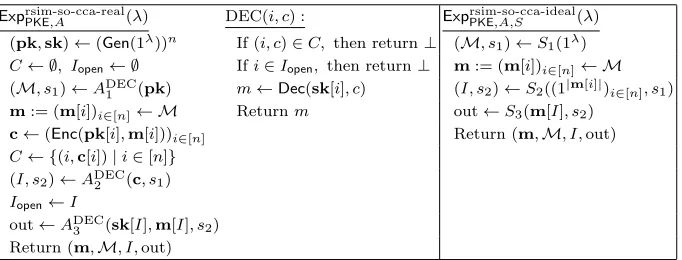
Fig. 1.Experiments for defining RSIM-SO-CCA security of a PKE schemePKE.
As pointed out in [10], the DCR assumption implies that for (N, N0)← G(1λ) andg←Z∗
N2,
(N, g2N) and (N,(1 +N)·g2N) are computationally indistinguishable. Formally, we have the following lemma.
Lemma 2. If the DCR assumption holds for G, then for any PPT distinguisher (denoted by
DDCR1),
|Pr [DDCR1(N, g2N) = 1]−Pr[DDCR1(N,(1 +N)·g2N) = 1]|
is negligible, where (N, N0)← G(1λ) and g←Z∗
N2.
The formal definitions of IBE, strong one-time signature and IB-KEM are recalled in Ap-pendix B, C and D, respectively.
3 Simulation-based SOA security for receivers under chosen-ciphertext attacks
In this section, we formalize the notion of simulation-based selective opening security for receivers under chosen-ciphertext attacks (RSIM-SO-CCA security). Similar to other security notions in the CCA setting, in the following experiment defining SO-CCA security for receivers, the adversary is given access to a decryption oracle. However, compared with SIM-SO-CCA security for senders, there are some subtleties in our formalization. First, in the receiver setting, there are n public/secret key pairs, so the adversary has to specify the secret key when she makes decryption queries. Second, in our following definition, we require that the adversary cannot query the decryption oracle on the opened secret keys. This is a very mild and reasonable condition, since once the adversary has obtained the secret key of some user, she can decrypt all the ciphertexts received by the user. It’s not necessary for the adversary to query the decryption oracle on the opened secret keys.
The formal definition is as follows.
Definition 3 (RSIM-SO-CCA). A public-key encryption scheme PKE = (Gen,Enc,Dec) is
RSIM-SO-CCA secure, if for any polynomially bounded functionn >0, and any PPT adversary A, there is a PPT simulator S, such that for any PPT distinguisher D, the advantage
Advrsim-so-ccaPKE,A,S,D(λ) :=|Pr[D(Exprsim-so-cca-realPKE,A (λ)) = 1]−Pr[D(Exprsim-so-cca-idealPKE,A,S (λ)) = 1]|
CS.Gen(1λ) : CS.Enc(pk, m) : CS.Dec(sk,(u, v, w, e)) : g1←Gq\ {1}, z←Z∗q (g1, g2, h, θ, ϕ, hk)←pk (x, y, a, b, a0, b0)←sk
x, y, a, b, a0, b0←Zq r←Zq α←HEvl(hk,(u, v, w))
g2←gz1, h←gx1g y
2 u←gr1, v←gr2 Ifua+αa
0
vb+αb06=e, then return⊥
θ←ga
1gb2, ϕ←ga
0
1 gb
0
2 w←gm1 hr δ←w·(uxvy) −1
hk←HGen(1λ) α←HEvl(hk,(u, v, w)) Ifδ= 1, thenm←0
pk←(g1, g2, h, θ, ϕ, hk) e←(θϕα)r Ifδ=g1, thenm←1
sk←(x, y, a, b, a0, b0) Return (u, v, w, e) Else, thenm← ⊥
tk←z Returnm
Return (pk, sk, tk)
Fig. 2.Construction ofPKECS.
Remark 1. We note that Iopen 6= ∅ only if the adversary has made the opening query. The
definition can be extended to the version where the adversary is allowed to make multiple opening queries adaptively [6, 17]. For simplicity, in this paper we only consider the adversaries making one opening query.
4 Concrete constructions of RSIM-SO-CCA secure PKE
In this section, we show that some known PKE schemes meet RSIM-SO-CCA security. More specifically, we show that the DDH-based PKE scheme (for single-bit messages) proposed by Cramer and Shoup in [11] and the DCR-based PKE scheme proposed by Cramer and Shoup in [12] both achieve RSIM-SO-CCA security.
4.1 RSIM-SO-CCA secure PKE under the DDH assumption
We show that the Cramer-Shoup encryption scheme [11] for single-bit messages meets RSIM-SO-CCA security.
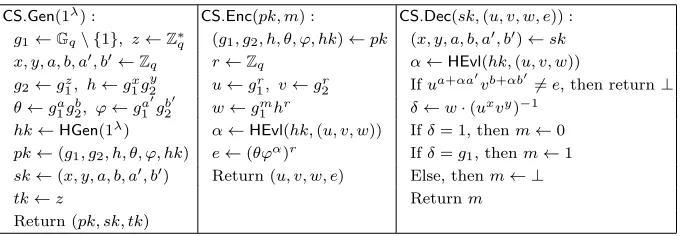
LetGq be a cyclic group of prime orderq, and Hash= (HGen,HEvl) be a family of collision-resistant (CR) hash functions Λ(·) :G3q → Zq. The Cramer-Shoup encryption scheme [11] (for single bit) PKECS := (CS.Gen,CS.Enc,CS.Dec) is shown in Fig. 2. We refer the readers to [11] for the correctness of PKECS. We stress that here we set a trapdoor key tk which isz satisfying
g2 =g1z (see Fig. 2). The additional trapdoor key is useless for normal encryption/decryption, but will be used in the following security proof.
Formally, we have the following theorem. The proof is inspired by that of Hazay et al. [18].
Theorem 1. PKECS (for single-bit messages) is RSIM-SO-CCA secure.
Proof. For any PPT adversaryAattacking PKECS in the sense of RSIM-SO-CCA, letqddenote the number of decryption queries made by A. We prove the theorem with a sequence of games
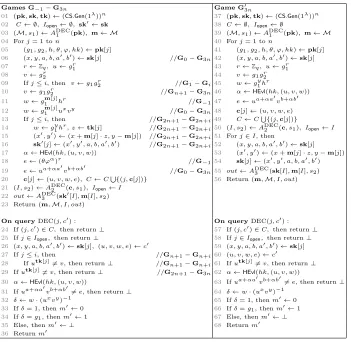
G−1−G3n,G03n in Fig. 3.
Firstly, note that the view of A in game G−1 is exactly the same as inExprsim-so-cca-realPKECS,A , so the final outputs of these two games are identical, i.e.,G−1 =Exprsim-so-cca-realPKECS,A .
Games G0 and G−1 are identical except that the challenge ciphertext vector is encrypted with secret keysk(lines 06,12,19). We stress that the view ofAin gameG0 is exactly the same as in G−1. That’s because for all j ∈[n], sk[j] = (x, y, a, b, a0, b0, z), pk[j] = (g1, g2, h, θ, ϕ, hk), we have that
Games G−1−G3n Game G03n
01 (pk,sk,tk)←(CS.Gen(1λ))n 37 (pk,sk,tk)←(CS.Gen(1λ))n
02 C← ∅, Iopen← ∅, sk0←sk 38 C← ∅, Iopen← ∅
03 (M, s1)←ADEC1 (pk), m← M 39 (M, s1)←ADEC1 (pk), m← M
04 Forj= 1 ton 40 Forj= 1 ton
05 (g1, g2, h, θ, ϕ, hk)←pk[j] 41 (g1, g2, h, θ, ϕ, hk)←pk[j]
06 (x, y, a, b, a0, b0)←sk[j] //G0−G3n42 (x, y, a, b, a0, b0)←sk[j]
07 r←Zq, u←gr1 43 r←Zq, u←g1r
08 v←g2r 44 v←g1gr2
09 Ifj≤i, then v←g1gr2 //G1−Gi45 w←gy1hr
10 v←g1gr2 //Gn+1−G3n46 α←HEvl(hk,(u, v, w))
11 w←gm[1 j]hr //G−147 e←ua+αa
0
vb+αb0
12 w←gm[1 j]uxvy //G0−G3n48 c[j]←(u, v, w, e)
13 Ifj≤i, then //G2n+1−G2n+i49 C←CS{(j,c[j])}
14 w←gy1hr,z←tk[j] //G
2n+1−G2n+i50 (I, s2)←ADEC2 (c, s1), Iopen←I
15 (x0, y0)←(x+m[j]·z, y−m[j]) //G2n+1−G2n+i51 Forj∈I, then
16 sk0[j]←(x0, y0, a, b, a0, b0) //G2n+1−G2n+i52 (x, y, a, b, a0, b0)←sk[j]
17 α←HEvl(hk,(u, v, w)) 53 (x0, y0)←(x+m[j]·z, y−m[j])
18 e←(θϕα)r //G−154 sk[j]←(x0, y0, a, b, a0, b0)
19 e←ua+αa0vb+αb0 //G
0−G3n55 out←ADEC3 (sk[I],m[I], s2)
20 c[j]←(u, v, w, e), C←CS{
(j,c[j])} 56 Return (m,M, I, out)
21 (I, s2)←A2DEC(c, s1), Iopen←I
22 out←ADEC3 (sk0[I],m[I], s2)
23 Return (m,M, I, out)
On queryDEC(j, c0) : On queryDEC(j, c0) :
24 If (j, c0)∈C, then return⊥ 57 If (j, c0)∈C, then return⊥
25 Ifj∈Iopen, then return⊥ 58 Ifj∈Iopen, then return⊥
26 (x, y, a, b, a0, b0)←sk[j], (u, v, w, e)←c0 59 (x, y, a, b, a0, b0)←sk[j]
27 Ifj≤i, then //Gn+1−Gn+i60 (u, v, w, e)←c0
28 Ifutk[j]6=v, then return⊥ //Gn+1−Gn+i61 Ifutk[j]6=v, then return⊥
29 Ifutk[j]6=v, then return⊥ //G2n+1−G3n62 α←HEvl(hk,(u, v, w))
30 α←HEvl(hk,(u, v, w)) 63 Ifua+αa0vb+αb06=e, then return⊥
31 Ifua+αa0vb+αb06=e, then return⊥ 64 δ←w·(uxvy)−1
32 δ←w·(uxvy)−1 65 Ifδ= 1, thenm0←0
33 Ifδ= 1, thenm0←0 66 Ifδ=g1, thenm0←1
34 Ifδ=g1, thenm0←1 67 Else, thenm0← ⊥
35 Else, thenm0← ⊥ 68 Returnm0
36 Returnm0
Fig. 3.GamesG−1−G3n in the proof of Theorem 1. Note that lines ending with a range of gamesGj1−Gj2
(resp.Gj) are only executed when a game within the range is run, and for the “Gi,Gn+i,G2n+i” above, we
require that 1≤i≤n.
e=ua+αa0vb+αb0 =g1r(a+αa0)gr(b+αb2 0) = (g1ag2b·(g1a0g2b0)α)r = (θ·ϕα)r.
Hence, we derive thatG0=G−1.
For i∈[n], games Gi and Gi−1 are identical, except for the generation of v for j =i(line 09). More specifically, when j = i,v = g1g2r in Gi, and v =g2r in Gi−1. It is easy to see that for any PPT algorithm D distinguishing Gi and Gi−1, we can construct a PPT distinguisher DDDH1 to distinguish (g1, gz1, g1r, g1rz) and (g1, g1z, g1r, g1rz+1) based on D with almost the same advantage. The construction is very trivial so we omit the details here. According to Lemma 1, we derive that for any PPT algorithm D,
|Pr [D(Gi) = 1]−Pr [D(Gi−1) = 1]|
≤ |Pr [DDDH1(g1, gz1, gr1, g1rz+1) = 1]−Pr [DDDH1(g1, g1z, gr1, g1rz) = 1]|
is negligible. Thus, with a standard hybrid argument, we derive that for any PPT algorithmD, |Pr [D(Gn) = 1]−Pr [D(G0) = 1]|is negligible.
For i ∈ [n], let bad denote the event in game Gn+i−1 that the adversary submits a de-cryption query (j, c0 = (u, v, w, e)) satisfying ((j, c0) ∈/ C)V
(j /∈ Iopen)V(j = i)V(utk[j] 6=
v)V
(ua+αa0vb+αb0 = e) where α ← HEvl(hk,(u, v, w)). Games Gn+i and Gn+i−1 are identical untilbadoccurs. According to the fundamental lemma of game-playing [2], for any PPT distin-guisher D, |Pr[D(Gn+i) = 1]−Pr[D(Gn+i−1) = 1]| ≤Pr[bad].With the help of the following lemma, we have that|Pr[D(Gn+i) = 1]−Pr[D(Gn+i−1) = 1]|is negligible. Then with a standard hybrid argument, for any PPT algorithm D,|Pr [D(G2n) = 1]−Pr [D(Gn) = 1]|is negligible.
Lemma 3. Pr [bad]is negligible.
The proof of this lemma is very similar to that of [11, Claim 2]. For completeness, we provide it in Appendix A.
Now we stress that in games G2n+1 −G3n, for any decryption query (j, c0 = (u, v, w, e)) satisfying u0tk[j]6=v0, the decryption oracle always returns ⊥(line 29).
Fori∈[n], gamesG2n+iandG2n+i−1are identical, except that in the generation of challenge ciphertext vector ofG2n+i, when j=i,w and sk0[j] will be updated (lines 13-16). For clarity, we usesk[i] = (x, y, a, b, a0, b0) to denote the originalith secret key, andsk0[i] = (x+m[i]·z, y−
m[i], a, b, a0, b0) to denote the corresponding updated secret key. Firstly, note thatsk0[i] is indeed a valid secret key forpk[i] = (g1, g2, h, θ, ϕ, hk), since the tuple (a, b, a0, b0) of sk0[i] is the same as that of the original, validsk[i], and
g1x+m[i]·zg2y−m[i]=gx+1 m[i]·zg1z(y−m[i]) =gx1g1zy=g1xg2y =h.
Next, note that decrypting the updated c[i] = (u, v, w, e) where w = g1yhr, with the updated secret keysk0[i], we can still recoverm[i]. That’s because when decryptingc[i] = (u, v, w, e), we have that forα←HEvl(u, v, w),e=ua+αa0vb+αb0 and
w·(ux+m[i]·zvy−m[i])−1 =g1yhr(gr(x+1 m[i]·z)(g1gr2)y−m[i])−1
=g1yg1rxg2ry(g1rx+m[i]·rzgy1−m[i]g2ry−m[i]·r)−1
=g1yg1rxg2ry(grx1 g2m[i]·rg1y−m[i]g2ry−m[i]·r)−1
=g1m[i].
Thirdly, note that the only differences betweensk0[i] andsk[i] are the elements (x+m[i]·z, y−
m[i]) (resp. (x, y)). We also note that the only procedure involving (x+m[i]·z, y−m[i]) (resp. (x, y)) during the decryption in G2n+i (resp. G2n+i−1) is the computation of ux+m[i]·zvy−m[i] (resp. uxvy), for any ciphertext (u, v, w, e). For any ciphertext (u, v, w, e) satisfying logg1u = logg2v=r for somer, we obtain that
ux+m[i]·zvy−m[i]=g1r(x+m[i]·z)g2r(y−m[i]) =g1rxgry2 =uxvy.
In other words, for any ciphertext (u, v, w, e) satisfying logg1u = logg2v, its decryption with
S1(1λ) : S2((1|m[i]|)i∈[n],se1) : S3(m[I],se2) :
(pk,sk,tk)←(CS.Gen(1λ))n (pk,sk,tk, C, s1)←se1 (pk,sk,tk, C, I, s2)←se2, Iopen←I
C← ∅ Iopen← ∅ Forj∈I, then
Iopen← ∅ Forj= 1 ton (x, y, a, b, a0, b0)←sk[j], z←tk[j] (M, s1)←A1DEC(pk) (g1, g2, h, θ, ϕ, hk)←pk[j] (x0, y0)←(x+m[j]·z, y−m[j])
e
s1←(pk,sk,tk, C, s1) (x, y, a, b, a0, b0)←sk[j] sk[j]←(x0, y0, a, b, a0, b0)
Return (M,se1) r←Zq, u←g r
1 out←ADEC3 (sk[I],m[I], s2)
v←g1gr2, w←gy1hr Returnout
α←HEvl(hk,(u, v, w))
e←ua+αa0vb+αb0 On queryDEC(j,(u, v, w, e)) :
c[j]←(u, v, w, e) If (j, c0)∈C, then return⊥
C←CS{
(j,c[j])} Ifj∈Iopen, then return⊥ (I, s2)←ADEC2 (c, s1) (x, y, a, b, a0, b0)←sk[j], z←tk[j]
e
s2←(pk,sk,tk, C, I, s2) Ifuz6=v, thenbad←true; return⊥
Return (I,se2) α←HEvl(hk,(u, v, w))
Ifua+αa0vb+αb0 6=e, then return⊥
δ←w·(uxvy)−1
Ifδ= 1, then returnm0= 0 Ifδ=g1, then returnm0= 1
Else, returnm0=⊥
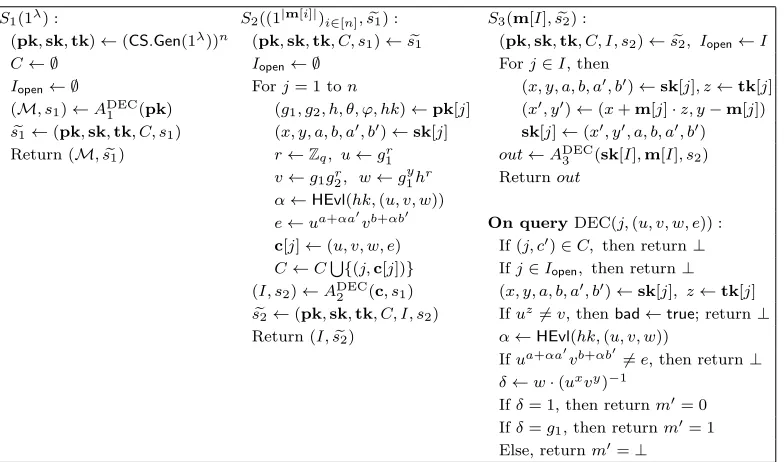
Fig. 4.SimulatorS = (S1, S2, S3) in the proof of Theorem 1.
decryption oracle will always return⊥. Hence, we obtain the conclusion thatG2n+i=G2n+i−1. Then with a sequence of hybrid games, we obtain G3n=G2n.
Now we stress that in game G3n, during the generation of the challenge ciphertext vector, for everyj∈[n], w=g1yhr and sk0[j] = (x+m[j]·tk[j], y−m[j]).
Note that game G3n can be written as G03n, which implies that G03n = G3n. Therefore, a PPT simulatorS forAcan be constructed as shown in Fig. 4. S simulatesG03nforA perfectly, so we derive that Exprsim-so-cca-idealPKECS,A,S =G03n, which concludes this proof. ut
Remark 2.As pointed out in [10], the aforementioned scheme can be extended to support any polynomial-size message space, i.e.,m= logg1(w·(uxvy)−1) can be determined efficiently.
4.2 RSIM-SO-CCA secure PKE under the DCR assumption
We show that the PKE scheme under the DCR assumption, proposed by Cramer and Shoup in [12], meets RSIM-SO-CCA security. We note that this scheme supports exponential-size message space.
LetHash= (HGen,HEvl) be a family of collision-resistant (CR) hash functionsΛ(·): (Z∗N2)2 →
{0,1,· · ·,2λ−1}. The DCR-based PKE scheme [12]PKE
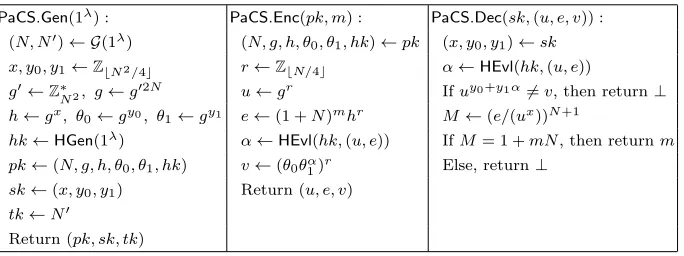
PaCS := (PaCS.Gen,PaCS.Enc,PaCS.Dec)
is shown in Fig. 5. For public key pk= (N, g, h, θ0, θ1, hk), the corresponding message space is
ZN. We refer the readers to [12] for the correctness ofPKEPaCS. Again, here we set a trapdoor
key tk which is N0 as above (see Fig. 5). The additional trapdoor key is useless for normal encryption/decryption, but will be used in the following security proof.
Formally, we have the following theorem. The proof is inspired by that of Hazay et al. [18].
PaCS.Gen(1λ) : PaCS.Enc(pk, m) : PaCS.Dec(sk,(u, e, v)) : (N, N0)← G(1λ) (N, g, h, θ
0, θ1, hk)←pk (x, y0, y1)←sk
x, y0, y1←ZbN2/4c r←ZbN/4c α←HEvl(hk,(u, e))
g0←Z∗
N2, g←g
02N u←gr Ifuy0+y1α6=v, then return⊥
h←gx, θ
0←gy0, θ1←gy1 e←(1 +N)mhr M←(e/(ux))N+1
hk←HGen(1λ) α←HEvl(hk,(u, e)) IfM= 1 +mN, then returnm
pk←(N, g, h, θ0, θ1, hk) v←(θ0θα1)r Else, return⊥
sk←(x, y0, y1) Return (u, e, v)
tk←N0
Return (pk, sk, tk)
Fig. 5.Construction ofPKEPaCS.
Proof. LetCRTMdenote a PPT algorithm which takesa0, N0, a1, N1∈Nas input, whereN0, N1 are relatively prime, and employs the Chinese Remainder Theorem to return x ∈ ZN0N1 such
thatx=a0 modN0, and x=a1modN1.
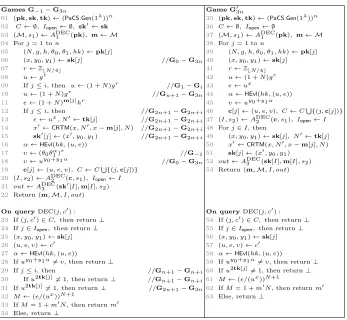
For any PPT adversary A attacking PKEPaCS in the sense of RSIM-SO-CCA, letqd denote the number of decryption queries made by A. We prove the theorem with a sequence of games
G−1−G3n,G03n in Fig. 6.
Firstly, note that the view of A in game G−1 is exactly the same as inExprsim-so-cca-realPKEPaCS,A , so the final outputs of these two games are identical, i.e.,G−1 =Exprsim-so-cca-realPKEPaCS,A .
In game G0, lines 06,18 are added. G0 and G−1 are identical except that the challenge ciphertext vector is encrypted with secret keysk. We stress that the view of AinG0 is exactly the same as inG−1. That’s because for allj ∈[n],sk[j] = (x, y0, y1),pk[j] = (N, g, h, θ0, θ1, hk), we have
v=uy0+y1α=gr(y0+y1α)= (gy0gy1α)r = (θ0θα
1)r.
Hence, we derive thatG0=G−1.
For i∈[n], games Gi and Gi−1 are identical, except for the generation ofu for j =i(line 09). More specifically, whenj=i,u= (1 +N)gr= (1 +N)(g02N)r inGi, andu=gr= (g02N)r inGi−1. Since g0 ← Z∗N2 =GN ·GN0 ·G2·S, g02N is uniformly distributed over GN0, and with
overwhelming probability the order ofg02N isN0. Note that the uniform distributions overZbN/4c
and ZN0 are statistically indistinguishable. Therefore, the distribution of the above (g02N)r and
the uniform distribution over GN0 are also statistically indistinguishable. In other words, the
distribution of (g02N)ris statistically indistinguishable from that ofeg
2N, where e
g←Z∗N2. Hence,
if there is some PPT algorithm D distinguishing Gi and Gi−1 with non-negligible advantage, then we can construct a PPT distinguisherDDCR1 to distinguish (N,(1 +N)eg
2N) and (N, e g2N) based on D with non-negligible advantage, contradicting Lemma 2. The construction is very trivial so we omit the details here. Thus, with a standard hybrid argument, we derive that for any PPT algorithmD,|Pr [D(Gn) = 1]−Pr [D(G0) = 1]|is negligible.
Now we stress that in games Gn+1−G3n, during the generation of the challenge ciphertext vector, for every j∈[n], the computation of uis u= (1 +N)gr (line 10).
Fori∈[n], letbaddenote the event that in gameGn+i−1the adversary submits a decryption query (j, c0 = (u, e, v)) satisfying ((j, c0)∈/ C)V
(j /∈Iopen)V(j = i)V(u2tk[j]6= 1)V(uy0+y1α =
Games G−1−G3n Game G03n
01 (pk,sk,tk)←(PaCS.Gen(1λ))n 35 (pk,sk,tk)←(PaCS.Gen(1λ))n
02 C← ∅, Iopen← ∅, sk0←sk 36 C← ∅, Iopen← ∅
03 (M, s1)←ADEC1 (pk), m← M 37 (M, s1)←ADEC1 (pk), m← M
04 Forj= 1 ton 38 Forj= 1 ton
05 (N, g, h, θ0, θ1, hk)←pk[j] 39 (N, g, h, θ0, θ1, hk)←pk[j]
06 (x, y0, y1)←sk[j] //G0−G3n40 (x, y0, y1)←sk[j]
07 r←ZbN/4c 41 r←ZbN/4c
08 u←gr 42 u←(1 +N)gr
09 Ifj≤i, then u←(1 +N)gr //G
1−Gi43 e←ux
10 u←(1 +N)gr //Gn+1−G3n44 α←HEvl(hk,(u, e))
11 e←(1 +N)m[j]hr 45 v←uy0 +y1α
12 Ifj≤i, then //G2n+1−G2n+i46 c[j]←(u, e, v), C←CS{(j,c[j])}
13 e←ux,N0←tk[j] //G2n+1−G2n+i47 (I, s2)←ADEC2 (c, s1), Iopen←I
14 x0←CRTM(x, N0, x−m[j], N) //G2n+1−G2n+i48 Forj∈I, then
15 sk0[j]←(x0, y0, y1) //G2n+1−G2n+i49 (x, y0, y1)←sk[j], N0←tk[j]
16 α←HEvl(hk,(u, e)) 50 x0←CRTM(x, N0, x−m[j], N)
17 v←(θ0θα1)r //G−151 sk[j]←(x0, y0, y1)
18 v←uy0 +y1α //G
0−G3n52 out←ADEC3 (sk[I],m[I], s2)
19 c[j]←(u, e, v), C←CS{(j,c[j])} 53 Return (m,M, I, out) 20 (I, s2)←A2DEC(c, s1), Iopen←I
21 out←ADEC3 (sk0[I],m[I], s2)
22 Return (m,M, I, out)
On queryDEC(j, c0) : On queryDEC(j, c0) :
23 If (j, c0)∈C, then return⊥ 54 If (j, c0)∈C, then return⊥
24 Ifj∈Iopen, then return⊥ 55 Ifj∈Iopen, then return⊥
25 (x, y0, y1)←sk[j] 56 (x, y0, y1)←sk[j]
26 (u, e, v)←c0 57 (u, e, v)←c0
27 α←HEvl(hk,(u, e)) 58 α←HEvl(hk,(u, e))
28 Ifuy0 +y1α6=v, then return⊥ 59 Ifuy0 +y1α6=v, then return⊥
29 Ifj≤i, then //Gn+1−Gn+i60 Ifu2tk[j]6= 1, then return⊥
30 Ifu2tk[j]6= 1, then return⊥ //Gn+1−Gn+i61 M←(e/(ux))N+1
31 Ifu2tk[j]6= 1, then return⊥ //G2n+1−G3n62 IfM= 1 +m0N, then returnm0
32 M←(e/(ux))N+1 63 Else, return⊥
33 IfM= 1 +m0N, then returnm0
34 Else, return⊥
Fig. 6.GamesG−1−G3n in the proof of Theorem 2. Note that lines ending with a range of gamesGj1−Gj2
(resp.Gj) are only executed when a game within the range is run, and for the “Gi,Gn+i,G2n+i” above, we
require that 1≤i≤n.
a standard hybrid argument, for any PPT algorithmD, |Pr [D(G2n) = 1]−Pr [D(Gn) = 1]|is negligible.
Lemma 4. Pr [bad]is negligible.
Now we stress that in gamesG2n+1−G3n, for any decryption query (j, c0 = (u, e, v)) satisfying u2tk[j]6= 1, the decryption oracle always returns⊥ (line 31).
Fori∈[n], gamesG2n+iandG2n+i−1are identical, except that in the generation of challenge ciphertext vector of G2n+i, when j =i, eand sk0[j] will be updated (lines 12-15). For clarity, we use sk[i] = (x, y0, y1) to denote the original ith secret key, and sk0[i] = (x0, y0, y1) to denote the corresponding updated secret key. Firstly, note that sk0[i] is indeed a valid secret key for
pk[i] = (N, g, h, θ0, θ1, hk). The reasons are as follows: (i) the tuple (y0, y1) of sk0[i] is the same as that of the original, valid sk[i]; (ii) gx0 = h = gx, since g = g02N ∈ GN0, and the Chinese
Remainder Theorem guarantees that x0 = xmodN0. Next, note that decrypting the updated
c[i] = (u, e, v), wheree=ux, with the updated secret keysk0[i], we can still recoverm[i]. That’s because when decrypting c[i] = (u, e, v), we have that for α←HEvl(u, e),
(e/(ux0))N+1=
ux ux0
N+1 =
(1 +N)x·grx (1 +N)x0
·grx0
N+1 =
(1 +N)x·hr (1 +N)x0
= (1 +N)(x−x0)(N+1) = (1 +N)x−x0 = (1 +N)m[i]
= 1 +m[i]N.
Thirdly, note that the only differences between sk0[i] and sk[i] are the elements x0 (resp. x). We also note that the only procedure involving x0 (resp. x) during the decryption in G2n+i (resp. G2n+i−1) is the computation of (ux
0
)N+1 (resp. (ux)N+1), for any ciphertext (u, e, v). Recall that tk[i] =N0. For any ciphertext (u, e, v) satisfying u2tk[i]=u2N0 = 1, we claim that (ux0)N+1 = (ux)N+1. The reason is as follows. The fact u2N0 = 1 implies that the order of u divides 2N0. Thus, there are three possibilities.
(1) If the order ofu is 1, then obviously we have (ux0)N+1= (ux)N+1.
(2) If the order of u is 2, then uN+1 = 1 because N is odd. Thus, we still have (ux0)N+1 = (ux)N+1.
(3) If the order ofuisη ∈ {p0, q0, N0}, then we derive thatη|(x−x0) (i.e., x=x0 modη), since x=x0 modN0 and N0=p0q0. Hence, (ux0)N+1= (ux)N+1.
In other words, for any ciphertext (u, e, v) satisfying u2tk[i] = 1, its decryption with sk0[i] and that withsk[i] (i.e.,the response of the decryption oracle) are identical. Therefore, even receiving
sk0[i] as the response of the opening query (wheni∈I) in G2n+i, the view ofA is the same as that inG2n+i−1, except that Asubmits some decryption query (i,(u, e, v)) satisfyingu2tk[i]6= 1 before the opening query. On the other hand, both in G2n+i and G2n+i−1, for any decryption query (i,(u, e, v)) satisfyingu2tk[i]6= 1, the decryption oracle always returns⊥(line 31). Hence, we have the conclusion thatG2n+i=G2n+i−1. Then with a sequence of hybrid games, we obtain
G3n=G2n.
Now we stress that in game G3n, during the generation of the challenge ciphertext vector, for everyj∈[n], e=ux and sk0[j] = (x0, y0, y1).
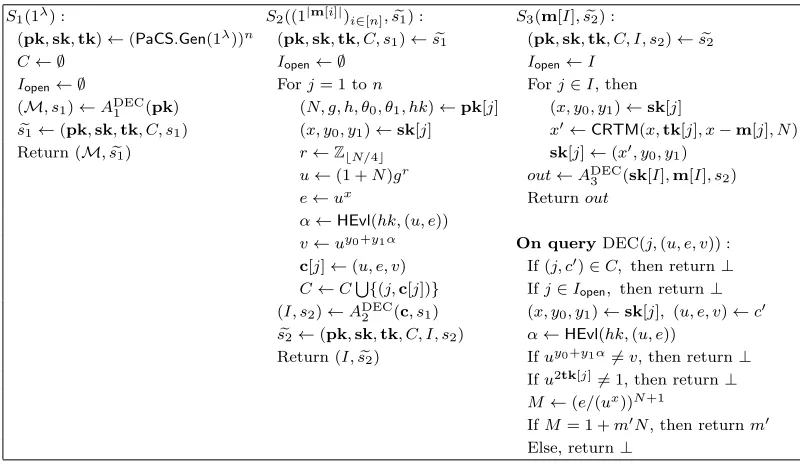
Note that game G3n can be written as G03n, which implies that G03n = G3n. Therefore, a PPT simulatorS forAcan be constructed as shown in Fig. 7. S simulatesG03nforA perfectly, so we derive that Exprsim-so-cca-idealPKE
PaCS,A,S =G
0
3n, which concludes this proof. We catch up with the proof of Lemma 4.
Proof (of Lemma 4).Parsepk[i] = (N, g, h, θ0, θ1, hk),sk[i] = (x, y0, t1) andtk[i] =N0. Denote theith challenge ciphertext inGn+i−1 by c[i] = (u, e, v).
GameGn+i−1 setsbadiff adversaryA, without obtainingsk[i] by opening query, submits a decryption query (i, c0 = (u0, e0, v0)) such that (i, c0) ∈/ C,u02N0 6= 1, and u0y0+y1α0 = v0, where
α0 =HEvl(hk,(u0, e0)). There are four possible cases.
Case 1.(u0, e0, v0) = (u, e, v).
Since (i, c0) ∈/ C, this case occurs only when A submits such a decryption query before receivingc. In bothGn+iandGn+i−1,u= (1+N)gr = (1+N)(g02N)r. As mentioned earlier, the distribution of (g02N)r and the uniform distribution over GN0 are statistically indistinguishable.
Hence, the distribution ofu is statistically indistinguishable from the uniform distribution over (1+N)·GN0. Notice thatAmakes at mostqddecryption queries, and that the best circumstance
forA is that each decryption query will helpA to eliminate one possible value ofu. Hence, the probability that Case 1 occurs is at most qd
N0−q
d, which is negligible.
S1(1λ) : S2((1|m[i]|)i∈[n],se1) : S3(m[I],se2) :
(pk,sk,tk)←(PaCS.Gen(1λ))n (pk,sk,tk, C, s1)←se1 (pk,sk,tk, C, I, s2)←se2
C← ∅ Iopen← ∅ Iopen←I
Iopen← ∅ Forj= 1 ton Forj∈I, then
(M, s1)←ADEC1 (pk) (N, g, h, θ0, θ1, hk)←pk[j] (x, y0, y1)←sk[j]
e
s1←(pk,sk,tk, C, s1) (x, y0, y1)←sk[j] x0←CRTM(x,tk[j], x−m[j], N)
Return (M,se1) r←ZbN/4c sk[j]←(x
0, y 0, y1)
u←(1 +N)gr out←ADEC
3 (sk[I],m[I], s2)
e←ux Returnout
α←HEvl(hk,(u, e))
v←uy0+y1α On queryDEC(j,(u, e, v)) :
c[j]←(u, e, v) If (j, c0)∈C, then return⊥
C←CS{
(j,c[j])} Ifj∈Iopen, then return⊥ (I, s2)←ADEC2 (c, s1) (x, y0, y1)←sk[j], (u, e, v)←c0
e
s2←(pk,sk,tk, C, I, s2) α←HEvl(hk,(u, e))
Return (I,se2) Ifu
y0+y1α6=v, then return⊥
Ifu2tk[j]6= 1, then return⊥
M←(e/(ux))N+1
IfM= 1 +m0N, then returnm0
Else, return⊥
Fig. 7.SimulatorS = (S1, S2, S3) in the proof of Theorem 2.
HEvl(hk,(u, e)). Thus, the probability thatA generates c[i] beforehand is less than qd
N0−q d.
Case 2.(u0, e0) = (u, e) andv0 6=v.
In this case, α0 =α and u0y0+y1α0 =uy0+y1α=v6=v0. Hence,G
n+i−1 will not setbad.
Case 3.(u0, e0)6= (u, e) andα0 =α.
Since Hash is a CR hash function, Case 3 occurs with negligible probability.
Case 4.(u0, e0)= (6 u, e) andα0 6=α.
Since Z∗N2 can be decomposed as an inner direct product GN·GN0·G2·S, for any a∈Z∗
N2,
acan be uniquely written asa=a(N)a(N0)a(2)a(S), wherea(i) ∈Gi and a(S)∈S.
From the public key pk and the challenge ciphertext vector c, for sk[i] = (x, y0, y1), all the information about (y0, y1) that A learns is: (i) θ0 =gy0; (ii) θ1 =gy1; (iii) v =uy0+y1α = (1 +N)y0+y1α(gr)y0+y1α. Since the order of g (resp., 1 +N) isη0 ∈ {p0, q0, N0}(resp., N), allA
learns from (i)-(iii) is actually
loggθ0 =y0 modη0, (1)
loggθ1 =y1 modη0, (2)
log1+N(v/(gr)y0+y1αmodN0) =y0+y1αmodN. (3)
And for the decryption query (i,(u0, e0, v0)), Gn+i−1 sets bad only if u0y0+y1α
0
= v0 and u02N0 6= 1. Notice thatu0y0+y1α0 =v0 implies (u02N0)y0+y1α0 =v02N0, and u02N0 6= 1 implies
(u0(N))2N0 = (u0(N)u0(N0)u0(2)u0(S))2N 0
=u02N0 6= 1.
Denote the order of (u0(N))2N0 byη. Then we deriveη∈ {p, q, N}, and
log(u0 (N))2N
0 v02N 0
Since η|N, equation (3) implies that
log1+N(v/(gr)y0+y1αmodN0)≡y
0+y1α (modη). (5)
Because N and N0 are relatively prime, for every b ∈ {0,1}, yb modη and ybmodη0 are independent. So equations (1)-(2) provide no information abouty0 modηory1modη. Equations (3) (resp. equation (5)) and (4) are linearly independent sinceα0 6=α. So we have the following conclusions:
(i) If η = N, equations (3)-(4) uniquely determine y0, y1 ∈ ZN. Hence, the probability that A submits a decryption query (i,(u0, e0, v0)) where u02N0 6= 1 for the first time, such that
Gn+i−1 setsbad, is N1. At best, each decryption query will help the adversary to eliminate one possible value. Therefore, whenη=N, the possibility thatGn+i−1 setsbadin Case 4 is at most qd
N−qd, which is negligible.
(ii) If η 6= N, then η = p or q. Equations (5)-(4) uniquely determine y0, y1 ∈ Zη. Hence, the probability that A submits a decryption query (i,(u0, e0, v0)) where u02N0 6= 1 for the first time, such thatGn+i−1 setsbad, is 1η. At best, each decryption query will help the adversary to eliminate one possible value. Therefore, whenη 6=N, the possibility thatGn+i−1 setsbad in Case 4 is at most qd
η−qd, which is negligible.
u t
5 Generic construction of RSIM-SO-CCA secure PKE
In this section, we firstly introduce the notion of master-key selective opening security for IBE. Then based on this notion, we extend the Canetti-Halevi-Katz (CHK) transformation [9] to show generic constructions achieving RSIM-SO-CCA security. Finally, we show how to construct an IBE scheme meeting master-key SOA security.
5.1 The notions of master-key SOA security for IBE
Roughly speaking, in a master-key selective opening attack for IBE, after seeing the challenge ciphertexts, the adversary can corrupt some of the private key generators, by obtaining their master secret keys. The goal of master-key SOA security is to guarantee that the messages of the users, whose private key generators are uncorrupted, are still confidential.
Master-key SOA security for IBE.We formalize the notion of master-key selective opening security (mSOA security) for IBE as follows. More specifically, we present the notion of mSOA security under selective-identity, chosen-plaintext attacks. This security notion is sufficient for our RSIM-SO-CCA secure PKE constructions.
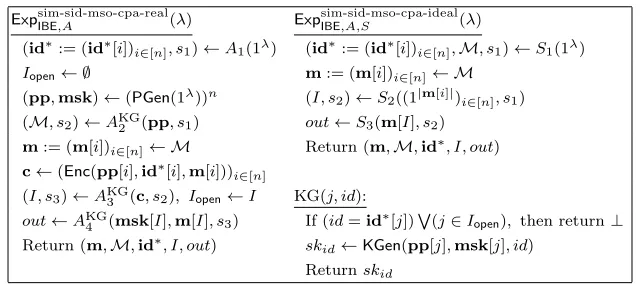
Definition 4 (SIM-sID-mSO-CPA).An IBE schemeIBE= (PGen,KGen,Enc,Dec)is
SIM-sID-mSO-CPA secure, if for any polynomially bounded n >0, any PPT adversary A, there is a PPT simulator S, such that for any PPT distinguisher D, the advantage
Advsim-sid-mso-cpaIBE,A,S,D (λ) :=|Pr[D(Expsim-sid-mso-cpa-realIBE,A (λ)) = 1]−Pr[D(Expsim-sid-mso-cpa-idealIBE,A,S (λ)) = 1]|
Expsim-sid-mso-cpa-realIBE,A (λ) Expsim-sid-mso-cpa-idealIBE,A,S (λ)
(id∗:= (id∗[i])i∈[n], s1)←A1(1λ) (id∗:= (id∗[i])i∈[n],M, s1)←S1(1λ)
Iopen← ∅ m:= (m[i])i∈[n]← M
(pp,msk)←(PGen(1λ))n (I, s
2)←S2((1|m[i]|)i∈[n], s1)
(M, s2)←AKG2 (pp, s1) out←S3(m[I], s2)
m:= (m[i])i∈[n]← M Return (m,M,id∗, I, out)
c←(Enc(pp[i],id∗[i],m[i]))i∈[n]
(I, s3)←AKG3 (c, s2), Iopen←I KG(j, id): out←AKG
4 (msk[I],m[I], s3) If (id=id∗[j])W(j∈Iopen), then return⊥ Return (m,M,id∗, I, out) skid←KGen(pp[j],msk[j], id)
Returnskid
Fig. 8.Experiments for defining SIM-sID-mSO-CPA security of an IBE schemeIBE.
Remark 3.As pointed out by Bellare et al. [3], the standard security notions for IBE naturally provide security againstnon-adaptivereceiver corruption (i.e., the adversaries are able to obtain the secret key of any identitywhich is not equal to the challenge identity, by querying the private key generation oracle KG(·)). However, to the best of our knowledge, SOA security notions for IBE in theadaptive receiver corruption setting (i.e., the adversaries are able to obtain the secret key of any identity, including the challenge identity, after receiving the challenge ciphertext vectors) have never been formalized, and are less studied. Our mSOA security notions focus on SOA security in the adaptive receiver corruption setting. Furthermore, we stress that in the experiments defining mSOA security, the adversaries are actually more powerful. They are allowed to corrupt the private key generators, not the receivers (users), even after seeing the challenge ciphertexts. In other words, an mSOA adversary can obtain the master secret keys corresponding to the opened ciphertexts, and an adversary, in the experiments for some “general” SOA security for IBE in the receiver corruption setting, can only obtain the user secret keys, which the mSOA adversary can also obtain by running algorithm KGen. Hence, our mSOA security notions are strictly stronger than the “general” SOA security for IBE in the receiver corruption setting.
Remark 4.The notion of indistinguishability-based mSOA security for IBE, and the notions of mSOA security under fully identity or/and chosen-ciphertext attacks can be similarly defined.
5.2 RSIM-SO-CCA secure PKE from IBE
We show a generic construction of RSIM-SO-CCA secure PKE schemes, by applying the CHK method [9] to any SIM-sID-mSO-CPA secure IBE scheme. Note that the CHK method does not work in the sender corruption setting [19]. Our result shows that it does work in the receiver corruption setting.
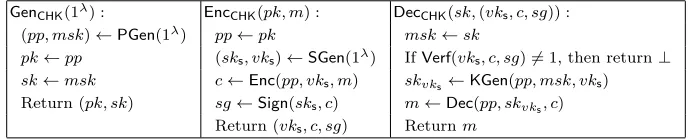
Generic construction. Let IBE = (PGen,KGen,Enc, Dec) be an IBE scheme, and SIG =
(SGen,Sign,Verf) be a signature scheme. The PKE schemePKECHK= (GenCHK,EncCHK,DecCHK),
constructed according to the well-known CHK transformation [9], is shown in Fig. 9. Verifying correctness is trivial. We turn to security analysis.
Theorem 3. IfIBE is SIM-sID-mSO-CPA secure, and SIGis strong one-time, then PKECHK is
GenCHK(1λ) : EncCHK(pk, m) : DecCHK(sk,(vks, c, sg)) :
(pp, msk)←PGen(1λ) pp←pk msk←sk
pk←pp (sks, vks)←SGen(1λ) IfVerf(vks, c, sg)6= 1, then return⊥ sk←msk c←Enc(pp, vks, m) skvks←KGen(pp, msk, vks) Return (pk, sk) sg←Sign(sks, c) m←Dec(pp, skvks, c)
Return (vks, c, sg) Returnm
Fig. 9.Construction ofPKECHK.
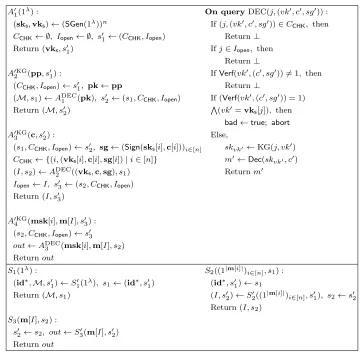
Proof. For any PPT adversary A = (A1, A2, A3) attacking PKECHK in the sense of
RSIM-SO-CCA, we construct a PPT adversary A0 = (A01, A20, A03, A04), attacking IBE in the sense of SIM-sID-mSO-CPA, as shown in Fig. 10.
In Fig. 10, let bad denote the event that A submits a decryption (j,(vk0, c0, sg0)) ∈/ CCHK
satisfying j /∈ Iopen, vk0 = vks[j] and Verf(vk0,(c0, sg0)) = 1. Note that (c0, sg0) = (6 c[j],sg[j])
since (j,(vk0, c0, sg0))∈/ CCHK. Hence, it’s easy to show a PPT adversaryAsig, based on A, can
break the underlying strong one-time signatureSIGwith advantage n1Pr [bad]. Strong one-time unforgeability of SIGguarantees Pr [bad] is negligible.
Denote the final output of Exprsim-so-cca-realPKECHK,A by (mA,MA, IA, outA), and the final output of
Expsim-sid-mso-cpa-realIBE,A0 by (mA0,MA0,vks, IA0, outA0). SinceA0 perfectly simulatesExprsim-so-cca-realPKE
CHK,A forAunless eventbadoccurs, we derive that Pr [(mA0,MA0, IA0, outA0) = (mA,MA, IA, outA)] =
1−Pr [bad]. In other words, for any PPT distinguisherD,
|Pr [D(mA0,MA0, IA0, outA0) = 1]−Pr [D(mA,MA, IA, outA) = 1]|=nAdvstr-ot
SIG,Asig(λ), (6)
whereAdvstr-otSIG,A
sig(λ) denotes the advantage ofAsig attacking SIG(see Appendix C).
Considering thatIBEis SIM-sID-mSO-CPA secure, there is a PPT simulatorS0= (S10, S20, S30), such that the final output ofExpsim-sid-mso-cpa-idealIBE,A0,S0 (denoted by (mS0,MS0,id∗, IS0, outS0)) is
com-putationally indistinguishable from (mA0,MA0,vks, IA0, outA0), i.e., for any PPT distinguisher
D,
|Pr [D(mS0,MS0,id∗, IS0, outS0) = 1]
− Pr [D(mA0,MA0,vks, IA0, outA0) = 1]| ≤Advsim-sid-mso-cpa IBE,A0,S0,D (λ).
Therefore,
|Pr [D(mS0,MS0, IS0, outS0) = 1]
− Pr [D(mA0,MA0, IA0, outA0) = 1]| ≤Advsim-sid-mso-cpa
IBE,A0,S0,D (λ). (7)
Based on S0, we construct a PPT simulator S in the sense of RSIM-SO-CCA in Fig. 10. Denote the final output of Exprsim-so-cca-idealPKECHK,A,S by (mS,MS, IS, outS). Obviously we have that (mS,MS, IS, outS) = (mS0,MS0, IS0, outS0), which implies that for any PPT distinguisherD,
Pr [D(mS,MS, IS, outS) = 1] = Pr [D(mS0,MS0, IS0, outS0) = 1]. (8)
Combining equations (6)-(8), we derive that for any PPT distinguisher D,
|Pr [D(Exprsim-so-cca-realPKECHK,A ) = 1]−Pr [D(Exprsim-so-cca-idealPKECHK,A,S ) = 1]|
≤nAdvstr-otSIG,A
sig(λ) +Adv
sim-sid-mso-cpa
IBE,A0,S0,D (λ).
A01(1λ) : On queryDEC(j,(vk0, c0, sg0)) :
(sks,vks)←(SGen(1λ))n If (j,(vk0, c0, sg0))∈C
CHK,then CCHK← ∅, Iopen← ∅, s10 ←(CCHK, Iopen) Return⊥
Return (vks, s01) Ifj∈Iopen, then
Return⊥
A0KG 2 (pp, s
0
1) : IfVerf(vk
0,(c0, sg0))6= 1, then
(CCHK, Iopen)←s01, pk←pp Return⊥
(M, s1)←ADEC1 (pk), s02←(s1, CCHK, Iopen) If (Verf(vk0,(c0, sg0)) = 1) Return (M, s0
2)
V
(vk0=vks[j]),then bad←true; abort
A0KG 3 (c, s
0
2) : Else,
(s1, CCHK, Iopen)←s02, sg←(Sign(sks[i],c[i]))i∈[n] skvk0 ←KG(j, vk0) CCHK← {(i,(vks[i],c[i],sg[i])|i∈[n]} m0←Dec(skvk0, c0)
(I, s2)←ADEC2 ((vks,c,sg), s1) Returnm0
Iopen←I, s03←(s2, CCHK, Iopen) Return (I, s0
3)
A0KG
4 (msk[i],m[I], s03) :
(s2, CCHK, Iopen)←s03
out←ADEC
3 (msk[i],m[I], s2)
Returnout
S1(1λ) : S2((1|m[i]|)i∈[n], s1) :
(id∗,M, s01)←S10(1λ), s
1←(id∗, s01) (id ∗, s0
1)←s1
Return (M, s1) (I, s02)←S20((1|m[i]|)i∈[n], s01), s2←s02
Return (I, s2)
S3(m[I], s2) :
s02←s2, out←S30(m[I], s 0 2)
Returnout
Fig. 10.AdversaryA0= (A01, A02, A30, A04) and simulatorS= (S1, S2, S3) in the proof of Theorem 3.
Remark 5. Similar to the original CHK transformation [9], the above theorem is proved in the standard model. Since strong time signatures can be constructed based on any one-way functions [29], if we construct an IBE scheme achieving SIM-sID-mSO-CPA security in the standard model (resp. ROM), we obtain a standard-model (resp. ROM) construction of RSIM-SO-CCA secure PKE.
Remark 6.Theorem 3 can be extended to the indistinguishability-based notions.
5.3 Construction of master-key SOA secure IBE
In the following, we show an IBE construction achieving SIM-sID-mSO-CPA security in the ideal cipher model. Our construction is inspired by the work of Heuer and Poettering [21]. Roughly speaking, consider a hybrid IBE scheme constructed from an identity-based key encapsulation mechanism (IB-KEM) scheme and a data encapsulation mechanism (DEM) scheme. Our result is as follows. The IBE scheme is SIM-sID-mSO-CPA secure in the ideal cipher model, if the underlying IB-KEM scheme is IND-sID-CPA secure, and the DEM scheme has some special properties, “permutation-driven” and “simulatability”, introduced in [21].
(Partial) permutation.For a finite domainD, we say that a relationR=R(l)×R(r)⊆ D×Dis a partial permutation, if the following two conditions hold: (i) for anya1, a2, b∈ D, if (a1, b)∈R and (a2, b)∈R, thena1 =a2; (ii) for anya, b1, b2 ∈ D, if (a, b1)∈Rand (a, b2)∈R, thenb1=b2. We say thatRis a permutation onDif in addition|R|=|D|. Trivially, any blockcipherEk, where kis the secret key, with domainDis a permutation onD. Throughout this paper, letP(D) (resp. PP(D)) denote the set of all permutations (resp. partial permutations) onD. AnyR∈ PP(D) can be completed to a full permutation by adding sufficiently many (a, b)∈(D \R(l))×(D \R(r)) to it (of course, updating R(l) and R(r) at every step). Furthermore, as pointed out in [21], if R ← PP(D) and (a, b) ← (D \R(l))×(D \R(r)), then the above obtained full permutation is uniformly distributed inP(D).
Data encapsulation mechanism.A data encapsulation mechanism (DEM) scheme,
associat-ed with a finite key spaceK, consists of two efficient algorithms (D.enc,D.dec). The encapsulation algorithm D.enc(k, m) takes a key k ∈ K and a valid message m as input, and outputs a ci-phertextc. The decapsulation algorithm D.dec(k, c) takes k∈ K and c as input, and returns a messagem or⊥, which indicates thatcis invalid. For correctness, we require that for any valid message m and anyk∈ K, ifc←D.enc(k, m), then D.dec(k, c) =m.
An oracle DEM for a domain D is a DEM where both the encapsulation/decapsulation algorithms are allowed to access to a permutation onD (in both directions). Specifically, for an oracle DEMODEM= (OD.enc,OD.dec) associated with key space K, we write
c←OD.encfp(k, m) and m or⊥ ←OD.decfp(k, c),
which means that OD.enc,OD.dec both access to permutation fp. Correctness requires that for any valid message m, any k ∈ K and any fp ∈ P(D), if c ← OD.encfp(k, m), then
OD.decfp(k, c) =m.
Definition 5 (Permutation-driven DEM [21]). For two key spaces KE and KO, a DEM
(D.enc,D.dec), associated with key space K =KE × KO, is called (KE,D)-permutation-driven, if there exists an oracle DEM ODEM = (OD.enc,OD.dec) for domain D associated with key space KO, and a blockcipher (Eke)ke∈K
E on domain D, such that for any valid message m, any
ko ∈ KO, and ciphertext c, D.enc((ke, ko), m) := OD.encEke(ko, m) and D.dec((ke, ko), c) := OD.decEke(ko, c).
Definition 6 (Simulatable oracle DEM [21]).Consider an oracle DEMODEM= (OD.enc,
OD.dec) for domain D associated with key space K. ODEM is called -simulatable, if there exist two PPT algorithms Fake and Make, and a negligible function , such that the following conditions hold:
1. AlgorithmFake(k,|m|)takes a keyk∈ Kand the length of a messagemas input, and outputs a ciphertext c and some state information st. Algorithm Make(m, st) takes a valid message m and st as input, and outputs a partial permutationfpp ∈ PP(D).
Expind-sid-cpaIBKEM,A (λ) KG(id) : (id∗, s
1)←A1(1λ), b← {0,1} Ifid=id∗, then return⊥
(pp, msk)←PGen(1λ), (k
0, c)←Encap(pp, id∗) skid←KGen(pp, msk, id)
k1← K, b0←A2KG(pp, c, kb, s1) Returnskid
Return (b0=b)
Fig. 11.Experiment for defining IND-sID-CPA security of an IB-KEM schemeIBKEM.
PGenhyb(1λ) : KGenhyb(pp, msk, id) : Enchyb(pp, id, m) : Dechyb(pp, sk
id,(c1, c2)) :
(pp, msk)←PGen(1λ) sk
id←KGen(pp, msk, id) (k, c1)←Encap(pp, id) k←Decap(pp, skid, c1)
Return (pp, msk) Returnskid c2←D.enc(k, m) Ifk=⊥, then return⊥
Return (c1, c2) m←D.dec(k, c2)
Returnm
Fig. 12.Construction ofIBEhyb.
3. If (c, st) ← Fake(k,|m|), fpp ← Make(m, st), and fp ∈ P(D) is obtained by adding all (a, b)←(D \R(l))×(D \R(r)) to fpp, then we have
Pr [c6=OD.encfp(k, m)]≤,
where the probability is also taken over all steps of (a, b)←(D \R(l))×(D \R(r)).
4. The total running time of Fake(k,|m|) and Make(m, st) is at most the running time of
OD.enc(k, m), not counting the latter’s oracle queries.
As shown in [21], some blockcipher-based DEM schemes standardised by NIST (e.g., [13, 16, 14, 15]) are permutation-driven and simulatable.
IND-sID-CPA security for IB-KEM. We present the notion of IND-sID-CPA security for
IB-KEM as follows.
Definition 7 (IND-sID-CPA). An IB-KEM scheme IBKEM = (PGen,KGen, Encap,Decap)
is IND-sID-CPA secure, if for any PPT adversary A, the advantage
Advind-sid-cpaIBKEM,A (λ) := 2|Pr[Expind-sid-cpaIBKEM,A (λ) = 1]−1 2|
is negligible, where Expind-sid-cpaIBKEM,A (λ) is defined in Fig. 11.
Construction of master-key SOA secure IBE. Let KE and KO be two key spaces. Let
IBKEM= (PGen,KGen,Encap,Decap) be an IB-KEM scheme for session key spaceK=KE×KO. For a DEM schemeDEM= (D.enc,D.dec) andIBKEM= (PGen,KGen,Encap,Decap), the hybrid IBE construction IBEhyb = (PGenhyb,KGenhyb, Enchyb,Dechyb) is shown in Fig. 12. Verifying correctness is trivial. Now we turn to security analysis. Formally, we have the following theorem.
Theorem 4. If DEM is (KE,D)-permutation-driven, where its underlying oracle DEM ODEM
associated with key spaceKOis-simulatable and its underlyingE is modeled as an ideal cipher,
and IBKEM is IND-sID-CPA secure and E-independent, then IBEhyb is SIM-sID-mSO-CPA
Games G0−G4 On queryKG(j, id):
01 Iopen← ∅, KE← ∅, KQ← ∅ 27 If (id=id∗[j])W(j∈Iopen), then
02 (id∗:= (id∗[i])i∈[n], s1)←AE1(1λ) 28 Return⊥
03 (pp,msk)←(PGen(1λ))n 29 skid←KGen(pp[j],msk[j], id)
04 (M, s2)←A2KG,E(pp, s1) 30 Returnskid
05 m:= (m[i])i∈[n]← M
06 Fori= 1 ton On queryE+(ke, a):
07 (k[i],c1[i])←Encap(pp[i],id∗[i]) 31 Ifke∈KE\ {ke[Iopen]}, //G3−G4
08 (ke[i],ko[i])←k[i] 32 thenbad3←true; abort //G3−G4
09 Ifke[i]∈KES
KQ, then //G1−G4 33 Ifa /∈Ek(le),then
10 bad1←true; abort //G1−G4 34 b← D \Ek(re)
11 c2[i]←OD.encE(k
e[i],·)
(ko[i],m[i]) //G
0−G1 35 Eke←EkeS{(a, b)}
12 (c2[i], sti)←Fake(ko[i],|m[i]|) //G2−G4 36 KQ←KQS{ke}
13 fpp(i)←Make(m[i], sti) //G2−G3 37 ReturnEk+e(a)
14 Eke[i]←f (i)
pp //G2−G3
15 IfOD.encE(ke[i],·)(ko[i],m[i])6=c2[i], //G2−G3 On queryE−(ke, b):
16 thenbad2←true; abort //G2−G3 38 Ifke∈KE\ {ke[Iopen]}, //G3−G4
17 KE←KES{
ke[i]}, KQ←KQS{
ke[i]} 39 thenbad3←true; abort //G3−G4
18 c[i]←(c1[i],c2[i]) 40 Ifb /∈E(kre),then
19 (I, s3)←AKG3 ,E(c, s2), Iopen←I 41 a← D \E(kle)
20 Fori∈I //G4 42 Eke←EkeS{(a, b)}
21 fpp(i)←Make(sti,m[i]) //G4 43 KQ←KQS{ke}
22 Eke[i]←f (i)
pp //G4 44 ReturnEk−e(b)
23 IfOD.encE(ke[i],·)(ko[i],m[i])6=c2[i], //G4
24 then abort //G4
25 out←AKG4 ,E(msk[I],m[I], s3)
26 Return (m,M,id∗, I, out)
Fig. 13.GamesG0−G4 in the proof of Theorem 4. Note that lines ending with a range of gamesGj1−Gj2
(resp.Gj) are only executed when a game within the range is run. Here{ke[I0]}:={ke[i]|i∈I0}.
Proof. Before going into the formal proof, we introduce some notation. As pointed out in [21], any uniformly distributed partial permutationR=R(l)×R(r)⊆ D × D can be completed to a uniformly distributed full permutation, by adding sufficiently many uniformly chosen pairs from (D \R(l))×(D \R(r)). Although Eke ∈ P(D) (for any ke ∈ KE), in the following proof, we abuse notation and let “Eke” denote the partial permutation which will be completed to Eke. Additionally, letEk+e(·) : E
(l) ke → E
(r)
ke and Ek−e(·) : E (r) ke → E
(l)
ke be two maps as follows: for any (a, b)∈Eke,E+
ke(a) =b andE
−
ke(b) =a.
Now we turn to the formal proof. For any PPT adversary A attacking IBEhyb in the sense of SIM-sID-mSO-CPA, let qe denote the number of permutation queries made by A. We prove the theorem with a sequence of gamesG0−G4 in Fig. 13.
Firstly, note that the view ofAin gameG0is exactly the same as that inExpsim-sid-mso-cpa-realIBEhyb,A ,
so the final outputs of these two games are identical, i.e.,G0=Expsim-sid-mso-cpa-realIBEhyb,A (λ).
Games G1 and G0 are identical until bad1 (lines 09 and 10) occurs. Thus, for any PPT distinguisherD, |Pr[D(G1) = 1]−Pr[D(G0) = 1]| ≤Pr[bad1].Note thatbad1 occurs iff during the generation of the challenge ciphertext vector inG0, the ith iteration of OD.enc would have access to a non-empty permutation E(ke[i],·) for some i ∈ [n]. Let bad(i)1 denote the event
B1(1λ) : On queryKGA(j, id):
KE← ∅, KQ← ∅, (id∗, s1)←AE1(1λ) If (id=id∗[j]) W
(j∈Iopen), then return⊥ sB1 ←(id∗, s1, KE, KQ) Ifj6=i, then
Return (id∗[i], sB1) skid←KGen(pp[j],msk[j], id)
Else, BKG
2 (pp, c, k,(id∗, s1, KE, KQ)) : skid←KG(id)
pp[i]←pp, Iopen← ∅ Returnskid
(pp[n]\{i},msk[n]\{i})←(PGen(1λ)) j∈[n]\{i}
(M, s2)←A2KGA,E(pp, s1) On queryE+(ke, a):
m← M Ifa /∈Ek(le),then
Forj= 1 toi−1 b← D \E(kre)
(k[j],c1[j])←Encap(pp[j],id∗[j]) Eke←EkeS{(a, b)}
(ke[j],ko[j])←k[j] KQ←KQS
{ke}
c2[j]←OD.encE(k
e[j],·)
(ko[j],m[j]) ReturnEk+e(a) KE←KES
{ke[j]}, KQ←KQS {ke[j]}
c[j]←(c1[j],c2[j]) On queryE−(ke, b):
Forj=i Ifb /∈Ek(re),then
(ke[i],ko[i])←k a← D \E(l) ke Ifke[i]∈KES
KQ, thenβ0←1 Eke←EkeS{(a, b)}
Else,β0←0 KQ←KQS{
ke}
Returnβ0 ReturnE−
ke(b)
Fig. 14.AdversaryB= (B1, B2) in the proof of Theorem 4.
by β the challenge bit of Expind-sid-cpaIBKEM,B . Note that B perfectly simulates G0 for A until the ith iteration of OD.enc during the generation of the challenge ciphertext vector. When β = 0, the distribution of (ke[i],ko[i]) in B’s simulation is identical to that in G0. In other words, Pr [β0 = 1|β= 0] = Pr [bad1(i)]. On the other hand, when β = 1, k[i] = k is uniformly and independently sampled from K. Hence, Pr [β0 = 1|β= 1] ≤ qe+n
|K| . Since IBKEM is
IND-sID-CPA secure, we have that
Advind-sid-cpaIBKEM,B (λ) = 2
Pr[Expind-sid-cpaIBKEM,B (λ) = 1]− 1 2
=Pr [β0 = 1|β = 0]−Pr [β0 = 1|β= 1] ≥
Pr [bad(i)]−qe+n |K|
is negligible. Thus, Pr [bad(i)1 ]≤Advind-sid-cpaIBKEM,B (λ) +qe+n
|K| is negligible. A union bound shows that
Pr [bad1]≤n·(Advind-sid-cpaIBKEM,B (λ) + qe+n
|K| ).
Now, we stress that inG1, for each iteration of OD.encduring the generation of the challenge ciphertext vector,OD.enc always accesses to an empty permutation.
B10(1λ) : On queryKGA(j, id):
Iopen← ∅, KE← ∅, KQ← ∅ If (id=id∗[j])W(j∈Iopen), then (id∗, s1)←AE1(1λ), sB
0
1 ←(id ∗, s
1, Iopen, KE, KQ) return⊥ Return (id∗[i], sB0
1 ) Ifj6=i, then
skid←KGen(pp[j],msk[j], id)
B0KG2 (pp, c, k,(id∗, s1, Iopen, KE, KQ)) : Else,
pp[i]←pp skid←KG(id)
(pp[n]\{i},msk[n]\{i})←(PGen(1λ))
j∈[n]\{i} Returnskid
(M, s2)←A2KGA,E(pp, s1)
m← M On queryE+(ke, a):
Forj= 1 ton Ifke∈KE\ {ke[Iopen]}
Ifj=i, then thenbad3←true
(ke[j],ko[j])←k, c1[j]←c Ifa /∈Ek(le),then
Else, b← D \Ek(re)
(k[j],c1[j])←Encap(pp[j],id∗[j]) Eke←EkeS{(a, b)}
(ke[j],ko[j])←k[j] KQ←KQS{
ke} Ifke[j]∈KES
KQ, then abort ReturnEk+e(a) (c2[j], stj)←Fake(ko[j],|m[j]|)
fpp(j)←Make(m[j], stj) On queryE−(ke, b):
Eke[j]←f (j)
pp Ifke∈KE\ {ke[Iopen]}
IfOD.encE(ke[j],·)(ko[j],m[j])6=c2[j],then abort thenbad3←true
KE←KES{
ke[j]}, KQ←KQS{
ke[j]} Ifb /∈E(kre),then c[j]←(c1[j],c2[j]) a← D \E(kle) (I, s3)←AKG3 ,E(c, s2), Iopen←I Eke←EkeS{(a, b)}
Ifi∈I, then returnβ0= 0 KQ←KQS{
ke} out←AKG4 ,E(msk[I],m[I], s3) ReturnEk−e(b)
Ifbad3=true, thenβ0←1
Else,β0←0
Returnβ0
Fig. 15.AdversaryB0= (B01, B 0
2) in the proof of Theorem 4. Here{ke[Iopen]}:={ke[i]|i∈Iopen}.
Games G3 and G2 are identical until bad3 (lines 31, 32, 38 and 39) occurs. Thus, for any PPT distinguisher D, |Pr[D(G3) = 1]−Pr[D(G2) = 1]| ≤Pr[bad3].Note that bad3 occurs iff A submits a query on (ke, x) to oracles E+ or E−, such that ke ∈ KE\ {ke[Iopen]}. Let bad(i)3
denote the event bad3 which is caused by the the query (ke, x) satisfying ke =ke[i]. Similarly, for any fixedi∈[n], we construct a PPT IND-sID-CPA adversary B0 attacking IBKEM, based on A, as shown in Fig. 15. Denote by β the challenge bit of Expind-sid-cpaIBKEM,B0 . When β = 0, B0’s
simulation for A and game G2 are identical except for the case i ∈ I. In B0’s simulation, if i ∈ I, B0 will return β0 = 0 directly, without continuing the simulation for A. We stress that in this case (i.e., i ∈ I), bad(i)3 does not occur and will not occur. Therefore, the probability thatbad(i)3 occurs inB0’s simulation (whenβ = 0) and the probability inG2 are equivalent. In other words, Pr [β0 = 1|β= 0] = Pr [bad(i)3 ]. On the other hand, when β = 1, (ke[i],ko[i]) =k is uniformly and independently sampled from K. We claim that ke[i] is uniformly distributed from A’s point of view. The reason is as follows. Among all the elements that A sees, only (c1[i],c2[i]) might contain information aboutke[i]. Note thatke[i] is independent ofc1[i], because
ke[i] independent of the computation of Encap. ke[i] is also independent of c2[i], since c2[i] is computed with Fake(ko[i],|m[i]|) and ke[i] is independent of ko[i] and uniformly distributed. Hence, the probability thatAgenerateske=ke[i] is at most qe
|K|. Thus, Pr [β
S1(1λ) : On queryKG(j, id):
Iopen← ∅, KE← ∅, KQ← ∅ If (id=id∗[j])W(j∈Iopen),then
(id∗, s1)←AE1(1λ) Return⊥
(pp,msk)←(PGen(1λ))n skid←KGen(pp[j],msk[j], id)
(M, s2)←A2KG,E(pp, s1) Returnskid
e
s1←(id∗,pp,msk, s2, I0, KE, KQ,(Eke)ke∈KQ)
Return (id∗,M,se1) On queryE
+(ke, a): Ifke∈KE\ {ke[I
open]}, then abort S2((1|m[i]|)i∈[n],se1) : Ifa /∈E
(l) ke,then (id∗,pp,msk, s2, I0, KE, KQ,(Eke)ke∈KQ)←se1 b← D \E
(r) ke
Fori= 1 ton Eke←EkeS{(a, b)}
(k[i],c1[i])←Encap(pp[i],id∗[i]) KQ←KQS{ke}
(ke[i],ko[i])←k[i] ReturnE+
ke(a)
Ifke[i]∈KES
KQ, then abort
(c2[i], sti)←Fake(ko[i],|m[i]|) On queryE−(ke, b):
KE←KES
{ke[i]}, KQ←KQS
{ke[i]} Ifke∈KE\ {ke[I
open]}, then abort c[i]←(c1[i],c2[i]) Ifb /∈Ek(re),then
(I, s3)←AKG3 ,E(c, s2), Iopen←I a← D \Ek(le)
e
s2←(s3, Iopen, KE, KQ,(Eke)ke∈KQ,(sti)i∈[n]) Eke←EkeS{(a, b)}
Return (I,se2) KQ←KQ
S{
ke} ReturnEk−e(b) S3(m[I],se2) :
(s3, Iopen, KE, KQ,(Eke)ke∈KQ,(sti)i∈[n])←se2
Fori∈I
fpp(i)←Make(m[i], sti), Eke[i]←fpp(i)
IfOD.encE(ke[i],·)(ko[i],m[i])6=c
2[i], then abort
out←AKG4 ,E(msk[I],m[I], s3)
Returnout
Fig. 16.SimulatorS = (S1, S2, S3) in the proof of Theorem 4.
Since IBKEMis IND-sID-CPA secure,
Advind-sid-cpaIBKEM,B0(λ) = 2
Pr[Expind-sid-cpaIBKEM,B0(λ) = 1]−
1 2
=Pr [β0 = 1|β = 0]−Pr [β0 = 1|β= 1] ≥
Pr [bad(i)3 ]− qe |K|
is negligible. Thus, Pr [bad(i)3 ]≤Advind-sid-cpaIBKEM,B0 (λ) +|K|qe is negligible. A union bound shows that
Pr [bad3]≤n·(Advind-sid-cpaIBKEM,B0(λ) +
qe |K|).