ARPA Whitepaper v0.7
Derek Zhang*, Alex Su*, Felix Xu*, and Jiang Chen*
*Arpachain
Abstract
We propose a secure computation solution for blockchain networks. The correctness of compu-tation is verifiable even under malicious majority condition using information-theoretic Message Authentication Code (MAC), and the privacy is preserved using Secret-Sharing. With state-of-the-art multiparty computation protocol and a layer2 solution, our privacy-preserving computa-tion guarantees data security on blockchain, cryptographically, while reducing the heavy-lifting computation job to a few nodes. This breakthrough has several implications on the future of de-centralized networks. First, secure computation can be used to support Private Smart Contracts, where consensus is reached without exposing the information in the public contract. Second, it enables data to be shared and used in trustless network, without disclosing the raw data during data-at-use, where data ownership and data usage is safely separated. Last but not least, compu-tation and verification processes are separated, which can be perceived as compucompu-tational sharding, this effectively makes the transaction processing speed linear to the number of participating nodes. Our objective is to deploy our secure computation network as an layer2 solution to any blockchain system. Smart Contracts[41] will be used as bridge to link the blockchain and compu-tation networks. Additionally, they will be used as verifier to ensure that outsourced compucompu-tation is completed correctly. In order to achieve this, we first develop a general MPC network with advanced features, such as: 1) Secure Computation, 2) Off-chain Computation, 3) Verifiable Computation, and 4)Support dApps’ needs like privacy-preserving data exchange.
CONTENTS
Contents
1 Motivations 1
1.1 Off-Chain Computation . . . 1
1.2 Secure Computation . . . 1
1.3 Centralized Dataset . . . 1
1.4 Data Security in Exchange . . . 2
2 Contributions 2 3 Background 3 3.1 Multiparty Computation (MPC) . . . 3
3.2 Other Candidates of Secure Computation . . . 4
3.2.1 Homomorphic encryption . . . 4
3.2.2 Zero-Knowledge Proof (ZKP) . . . 5
3.2.3 zk-SNARK . . . 5
3.2.4 Trusted Execution Environment (TEE) . . . 5
3.3 Comparison . . . 7
3.3.1 Trust Dependency . . . 7
3.3.2 Scalability and Flexibility . . . 7
3.3.3 Practical Efficiency . . . 7
3.3.4 Conclusion . . . 8
4 System Overview 10 4.1 Interoperability . . . 11
4.2 ARPA Virtual Machine (AVM) . . . 11
5 ARPA Multiparty Computation Protocol 12 5.1 Computation Phase . . . 12
5.1.1 Sharing secrets . . . 12
5.1.2 Evaluating circuits . . . 13
5.1.3 Information Theoretic MAC . . . 14
5.1.4 Revealing outcomes . . . 15
5.2 Preprocessing Process . . . 16
5.2.1 Compiling functions . . . 17
6 The Secure Computation processes 17 6.1 Smart Contract . . . 19
6.2 Nodes Selection . . . 21
6.3 Off-Chain Computation . . . 21
6.4 Computation Verification . . . 22
6.5 MAC with Off-chain computation . . . 23
6.6 Data Storage . . . 24
7 Cryptoeconomics 24 7.1 Economic Rationality . . . 25
7.2 Identity and Reputation . . . 26
7.3 Accountable safety . . . 26
7.4 Uncoordinated majority . . . 27
7.5 Bribing attacker model . . . 28
CONTENTS
7.6.1 Nakamoto Consensus . . . 29
7.6.2 Lottery Consensus . . . 29
7.7 Token Usage . . . 30
8 Experiments 30 8.1 Vickrey Auction . . . 30
8.2 Deep Learning . . . 31
9 Ecosystem & Applications 32 9.1 Design . . . 32
9.2 Participants . . . 33
9.2.1 Computation Nodes . . . 33
9.2.2 Data Providers . . . 33
9.2.3 Data Consumer . . . 33
9.2.4 Model providers . . . 33
9.2.5 Data / Model Backers . . . 33
9.3 Business Flow for Data Renting . . . 34
1 MOTIVATIONS
1
Motivations
1.1 Off-Chain Computation
Current blockchain technology reaches on-chain consensus in such a way that a smart contract [41] runs on every blockchain node. There is no final authority in a decentralized network, such as Bitcoin [29], so that every miner has to validate each transaction before accepting and recording it on the blockchain. In other words, there is no way to verify the result without actually running it on a trustless network. The most prominent problem is the amount of transaction fee for every transaction. As the network grows, the amount of computation in the network combined can easily exceed the gas limit[36], causing more forks and raising more security issues.
Off-chain Computation solves this problem by bringing the computation work off the public net-work, and by verifying the result in public, only when disputes arise. The key in off-chain computation is to have verifiable property in the out-sourced computation task. This property effectively solves the scalability issue[22] on blockchain networks. Therefore, we can achieve the throughput of the network being linear to the participating notes.
1.2 Secure Computation
One of the ostensible selling points of blockchain technology is its potential to bring greater trans-parency to financial markets. At its core, blockchain is a means for humans to conduct secure, verifiable, and recordable transactions online without a centralized party. As consensus is reached in public and the result is auditable, the blockchain is claimed to be transparent and public-accessible by design.
However, full transparency can be problematic in the real world. Imagine you opened an account at a bank and soon find out that its ledgers are public, where anyone can access the transaction history of your account (and others). Or, if you made a transaction using Bitcoin at an ice-cream truck and the cashier would be able to know how much money is in your account.
Unfortunately, a privacy feature is not shipped with today’s blockchain technology. The growing demand for blockchain and smart contract [37, 4, 14] technologies sets the challenge to protect users from intellectual property theft and other attacks[3]: security, confidentiality and privacy are the key issues holding back the adoption of blockchain[24].
ARPA is built to provide secure computation capability as an off-chain solution for most blockchain networks.
1.3 Centralized Dataset
Large internet companies collect data from users’ online activities to train recommendation systems that predict the customers’ future interest and actions. Health data from different hospitals and gov-ernment organizations can be used to produce new diagnostic models, while financial companies and payment networks can combine transaction history, merchant data, and account holder information to train more accurate fraud-detection engines.
All this data needs to be aggregated from an individual level, but the profits realized from the data have never been shared with the data contributors. The General Data Protection Regulation (GDPR[39]) made it clear that data holders have the responsibility to facilitate the portability of the data. To really enforce this regulation, our data should not be stored at the companys hard drive as it faces the inevitable risk of being breached.
Unfortunately, companies have found it difficult to protect their critical data from determined attackers. The convention with data holding is ill-formed in the following ways:
2 CONTRIBUTIONS
2. Unfair value distribution - individual users never get paid for their data
3. Established player dominance creates an unfriendly moat that deters new and innovative chal-lengers from competing.
4. Talented individuals can’t build a good model without joining the company
We need a decentralized data sharing scheme that enable everyone to build models on it, reward those who contribute to it, and at the same time keep the data secure.
1.4 Data Security in Exchange
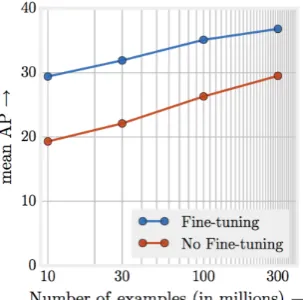
There is a tension that arises when individuals, companies, or governments deal with sensitive data. On the one hand, data science is a fundamental component of the informational age. We often hear that data is the new oil: there is immense financial and social value in acquiring raw data. A recent paper from Google [11] (Figure 1) confirms a well-known fact that data size is positively correlated to model performance, regardless of model quality. It explains the motivation for companies to collecting extensive amount of user data.
On the other hand, the more value there is to be gained by piecing data together, the more cautious everyone has become about data sharing, since data breaches can cause financial, legal, and political harms. This appears to be a central trade-off: we can share data in order to learn new insights that benefit the society as a whole, or we can isolate data into protected silos that safeguard our individual privacy.
Privacy-preserving computation is the solution for this paradox.
Figure 1: Data size and model performance
2
Contributions
Secure Computation Computation is carried out securely so that no participating node can learn anything more than its prescribed output.
3 BACKGROUND
Layer2 Solution Combining secure and verifiable computation, the heavy-lifting work of com-putation is done off-chain. Essentially, making our secure comcom-putation protocol adaptable to any existing blockchain network.
Scalability ARPA is designed as a Layer2 solution. Because the verification has complexity of O(1), the on-chain network will never reach its computation (gas) limit. Therefore, we can improve the computation scalability and TPS(transaction per second) of any network. The computation capacity is increased linearly to participating nodes.
Efficiency State-of-the-art implementation of MPC protocol is used to speed-up the secure com-putation.Though this implementation, 5-6 magnitudes of speed improvement are achieved compared to Fully Homomorphic Encryption (FHE).
Availability World’s first general purpose MPC network for secure computation. With high avail-ability and low cost, we promote data security and privacy practice that is difficult to achieve other-wise.
3
Background
3.1 Multiparty Computation (MPC)
Multiparty Computation(MPC) is a way by which multiple parties can compute some function of their individual secret inputs, without any party revealing anything to the other parties about their input, other than what can be learned from the output. Unlike traditional cryptographic tasks, where the adversary is outside the system of sender and receiver, the adversary is a part of the participants. This model frees the cryptographers from the centralized paradigm to the distributed paradigm. Many unsolved problems like Yao’s millionaires’ problem [42] or secure auction system [8] can be perfectly settled. In a sense, MPC is rather a new paradigm than a specific cryptographic algorithm.
MPC can be considered as a configurable framework with a mixture of crypto tools, which gives participants the right to organize the specific protocol according to the security level and efficiency limitation of a scenario. The beauty of multiparty protocols is that they use a rich body of tools and sub-protocols, some of which have been developed especially for MPC and others previously developed for the cryptographic non-distributed setting. These tools include zero-knowledge proof (ZKP) [33], probabilistic encryption, information-theoretic Message Authentication Code (MAC), various distributed commitment schemes, and oblivious transfer [32]. Most importantly, secret-sharing [31] and computing with shares of a secret is fundamental to achieving secure multiparty computation. In particular, the polynomial secret sharing of Shamir [35] in the case of passive adversary is a cornerstone in multiparty computations, and the verifiable secret sharing [12] plays an analogous role in the Byzantine adversary case.
There are various MPC protocols built with different assumptions in terms of security models. For example, Sharemind [7] and VIFF [17] assume a semi-honest scenario where the adversary will follow the given protocol but only try to reveal others’ private input. Whereas, under malicious situation the participants will manipulate whatever they need to get the data, including colluding and/or malicious computation.
3 BACKGROUND
orders of magnitude over the past decade (Figure 2). Both for comparison purposes and to account for the effects of Moore’s law, we also show the performance of native AES computation over the same time period.
Figure 2: Efficiency Improvement over MPC
Our goal is to build a MPC network with high availability for the first time, where any business needs for secure computation can be conducted on the network or by using smart contracts on existing blockchains such as Ethereum or EOS. This will bring several benefits: 1) MPC computation will be as simple as plug-and-play. No prior knowledge is needed to set it up correctly. 2) Since dedicated nodes run MPC, the cost for conducting such work will be much lower. and 3) The MPC ”cloud” can bring awareness to the business world, as well as the general public, so that more secure computation can be conducted using MPC.
3.2 Other Candidates of Secure Computation
In the past ten years, several technologies towards practical secure computation protocols have been proposed and studied. These efforts have been classified into three primary domains, i.e. homomor-phic encryption (HE), multiparty computation (MPC), and trusted execution environment (TEE).
3.2.1 Homomorphic encryption
Homomorphic Encryption(HE) is a form of encryption that allows computation on ciphertext, gener-ating an encrypted result which, when decrypted, matches the result of the operations as if they had been performed on the plaintext. With such a tool, one could outsource storage and/or computation without endangering data privacy. Because HE allows calculation on encrypted data while remaining encrypted, it has been extensively researched as a candidate for secure computation.
Figure 3: Homomorphic Encryption
3 BACKGROUND
that accompanied the running of additions and multiplications. This allowed practical somewhat homomorphic encryption (SHE) to develop into fully homomorphic encryption (FHE).
Nevertheless, cutting-edge homomorphic schemes cannot provide an efficient way to compute large depth arithmetic circuits due to the following constraints. First, “bootstrapping” adds an extra cost to an already quite heavy process. Currently, practical use of HE focuses mainly on optimization of an evaluated function, which avoids expensive processes by limiting the circuit multiplication depth. In addition, using HE schemes will lead to a huge ciphertext expansion, by the overhead from 2,000 to 500,000 or even 1,000,000 (times) according to the scheme and the targeted security level. This is due to the fact that homomorphic schemes must be probabilistic to ensure semantic security, and to the particular underlying mathematical structures. As we can see, SHE schemes are the most promising today in HE variants, and it will be utilized in our secure computation program mentioned later.
3.2.2 Zero-Knowledge Proof (ZKP)
Zero-Knowledge Proof (ZKP) is a method by which one party (the prover Peggy) can prove to another party (the verifier Victor) that she knows a value x, without conveying any information apart from the fact that she knows the value x. Recent blockchain project was developed to leverage ZKP as a trusted off-chain computation solution. In this protocol, the function is compiled into a circuit and transmitted to a third-party execution environment where the data will be evaluated using the circuit. Similar to FHE scheme, it cannot prove that the actual amount of work being done in remote environment. In addition to that, ZKP simply cannot guarantee the computation is secured from hacker of malicious party.
3.2.3 zk-SNARK
Zero-Knowledge Succinct Non-Interactive Argument of Knowledge (zk-SNARK) is a protocol which creates a framework in which a person – called prover – can quickly convince another person – called verifier – that she or he “knows” a secret without revealing anything about the secret. The first constructions of SNARK protocols were inspired by the Probabilistically Checkable Proof (PCP) theorem which shows that (Nondeterministic Polynomial time) NP problems statements have “short” PCPs[26]. New instantiations were found which allow faster and shorter proofs, when a pre-processing state is permitted.
zk-SNARKs intend to enhance the privacy of users transacting on the Zcash blockchain. With cryptocurrencies such as Bitcoin, an individual can identify user addresses and track the movement of value between transacting parties on the blockchain. In this case, Bitcoin only provides users with pseudonymous protection, rather than complete anonymity. zk-SNARKs are designed to solve this problem by completely encrypting user transaction information on the Zcash blockchain. An abstract zk-SNARK description can be denoted as Alg. 1
Algorithm 1 zk-SNARK
KeyGen: (vk, pk)←KeyGen(circuit C, λ).
Prover: π←Prover(pk,public input x,secret inputw) Verifier: ∃ws.t. C(w, x)←Verifier(π, vk, x)
3.2.4 Trusted Execution Environment (TEE)
3 BACKGROUND
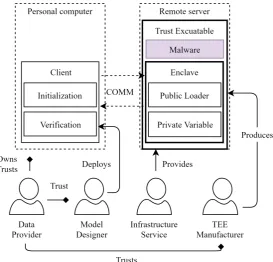
stored on a persistent memory. In addition, it shall be able to provide remote attestation that proves its trustworthiness for third-parties.
Hardware manufacturers are eager to propose their own trusted hardware solutions but lack a general standard over different platforms. Most prominent process unit designers have embedded their hardware secure module in their products (Ex. Intel Software Guard Extensions (SGX), ARM TrustZone, AMD Secure Encrypted Virtualization (SEV) and NVIDIA Trusted Little Kernel (TLK).
Figure 4: Trust Execution Environment
Software Guarded Execution (SGX) is a set of instructions promoted by Intel to enable code to be run at private region of CPU. The benefit of such implementation is that the application is secured at hardware level with cost of developing a software. Most solutions to provide privacy to smart contracts are based on SGX, which was a sensible choice years ago. Several projects existed are using SGX as off-chain computation solution.
However, recent attacks have proven SGX to be inadequate. This seemingly secure protocol is, in fact, not secure at all. The remote attestation does not prevent a malicious cloud service provider from first faithfully responding to remote attestation queries, but then emulate the rest of the protocol (such as KeyGen and CSR) outside of the enclave. In other words, SGX is not a protocol designed for “Universal Composition” (UC) where, the real-world behavior and the ideal-world definition (function) of a protocol are computationally indistinguishable for every adversary-controlled environment. In simple term, with TEE, one can trust the hardware but not the person controlling the hardware. Therefore, the SGX stack is best used in a permissioned network[20], where all nodes are pre-approved and the environment is certified and trusted.
3 BACKGROUND
3.3 Comparison
3.3.1 Trust Dependency
Privacy-preserving computation can be sorted into two development directions: secure computation and trusted computation. The prior mainly focuses on the cryptography security brought by hard problems that are elaborately designed using mathematics. The security is derived purely from the number theory, which means even with unaffordable computing power, an adversary cannot break the encryption. The latter one starts from a different point, which tries to enforce the computing involvement to consistently behave in the expected way. Enforcing the behavior is achieved by hardware authentication, memory encryption, specific instruction design, etc. These technologies are always bound to the hardware platform such as the memory storage or processing elements.
Obviously, both Homomorphic Encryption and MPC belong to secure computation, and Trusted Execution Environment(TEE) is the effort of trusted computation. In brief, secure computation is more suitable to be used in permissionless network while trusted computation relies more on physical entities and can be used in a permissioned network such as Hyperledger[38].
3.3.2 Scalability and Flexibility
Given the foundation of mentioned computation methods, it can be observed that one can evaluate a secure computation on any computing power, either a data center or an edge device such as an automobile and phone. Due to the TEE’s design methodology, users have to transplant the program from one platform to another by fitting their work into the safes. This feature makes the TEE less flexible than the pure protocol solutions. Considering the underlying device independency, MPC or HE can take advantage of mutual tool chains of hardware manufacturers and have future potentials for hardware accelerations.
As for different scenarios of computation, MPC can transform into a suitable pattern to make a trade-off between computation complexity and secureness. The nature of MPC can also satisfy various data-privacy input conditions. HE may support multiparty input as well by using distributed encryption and decryption, but the overhead of bootstrapping limits the secure functions evaluated on the HE.
3.3.3 Practical Efficiency
Thanks to the continuous effort of cryptographers and computer scientists in the last decade, different frameworks of MPC designed to solve various type of cases have been invented. We will develop a general purpose MPC network that achieves security in a malicious, dishonest, majority n-party setup.
Taking Intel SGX[27] as the representative of TEE, the main overhead of SGX, compared with plaintext manipulating, is caused by fetching input from normal memory to the enclave local memory that involves encryption. According to the experiments on the enclaves, the Intel enclave instructions did not achieve the best performance. On the other hand, the optimal algorithm on plaintext cannot get the same throughput when processing enclave local memory.
3 BACKGROUND
bootstrapping which enables unlimited multiplication depth is not listed in table. This may bring another slowdown in FHE computation.
Category Scheme Security parameter Operation
HE
Hardware
imple-mentation n q homomorphic multiplication
YASHE-NTT 4096 125 bits 6.5ms
YASHE-NTT 16384(SIMD) 512 bits 48ms
YASHE-NTT 32768(SIMD) 1228 bits 121ms
MPC
Software implementation Statistical security parameter Mult triples generations
MPC 128 bits 0.23ms
Overdrive: High Gear 128 bits 0.43ms
Overdrive: Low Gear 128 bits 0.067ms
Table 1: Performance Comparison of HE and MPC
3.3.4 Conclusion
In this section we discussed the history of MPC and its cryptographic properties and demonstrated that it is actually a very good candidate for mutually-distrusted parties to conduct secure computa-tion together a very similar setting to the blockchain network.
We also visited several technologies currently existing as candidates of secure computation, namely Homomorphic Encryption, Zero-Knowledge Proof, and Trusted Execution Environment. Our dis-coveries indicate that, while some technologies have advantage such as computation efficiency, they are not offering security and features needed in a permissionless network. In essence, we need to be able to verify the secureness, correctness and privacy-preservingness of computation. Detailed aspects under consideration are as follows:
Efficiency The speed of computation. Our experiments have found that, TEE is on par with clear text computation. Followed by MPC, about one magnitude slower, as forementioned. As for ZK-SNARK, it has around 103 times overhead[6]. The least favorable choice in terms of efficiency is FHE, with about 107 to 108 times slower.[9]
Privacy-preserving Privacy-preserving here refers to the capability of evaluating a function on a dataset, while not revealing the detail to anyone. This is the core of secure computation.
Proof of Correctness Prove that the computation work is actually using the prescribed function. In a trustless network, it is very important to prove that a certain function is evaluated in a correct way. In blockchain, it is simply done by repeated computation on every node running the smart contract. Consensus can be made once every participating node reaches on the same result. However, in the context of secure computation, computation is not carried out on every node but delegated to certain node(s) for the task. One needs to submit proof that computation has done the work with prescribed routine, or the result cannot be trusted.
Proof of Computation Prove the amount of work the participating node has done.
3 BACKGROUND
the beginning of the block. It is trivial work for nodes to verify the result (hash) and prove that the node has indeed solved the puzzle. In a computation network, it is also important to know how much work has been done in the computation, so the node can be rewarded with a corresponding token. In MPC, the amount of computation can be proved by counting the triples consumed during the computation.
Proof of Secureness Prove that the computation is actually carried out in the secured environ-ment.
When computation is not repeated on every node, one needs to submit proof that the compu-tation is carried out in a secured environment. Although this is what TEE is designed for, this seemingly naive question is actually very hard to prove. As mentioned earlier, secure computation is a cryptography process that guarantees the computation process is following the protocol or the result cannot be accepted. But trusted computation, on the other hand, enforces the process to be consistent with designed security (i.e. run the function) using trusted hardware. Nevertheless, in a permissionless network, one cannot convince other nodes to trust his result just by claiming it got remote attestation from a centralized server. Furthermore, even the remote attestation proves the security of the environment, one cannot prove the code is executed in that trusted environment.
A final conclusion with all facts related to blockchain construction is listed in table 2.
MPC FHE ZK-SNARK TEE
Efficiency Acceptable to Fast Prohibitively Slow Acceptable Fast
Privacy-preserving Yes Yes No No
Trustless Yes Yes No No
Proof of Correctness Yes No Yes No
Proof of Computation Yes No No No
Proof of Secureness Yes Yes No No
4 SYSTEM OVERVIEW
4
System Overview
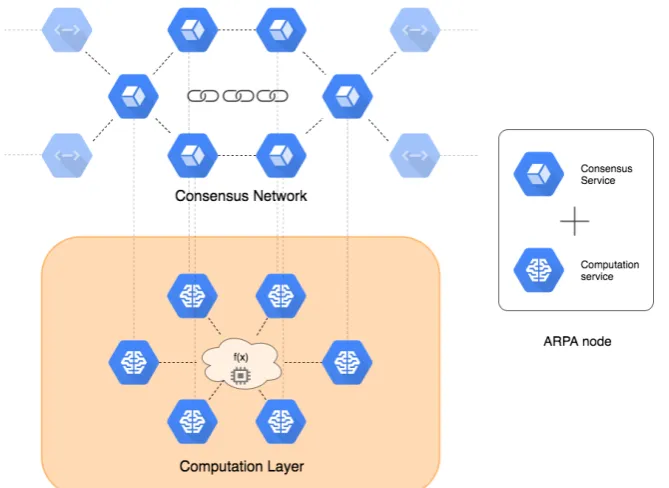
The ARPA network is designed with two layers: consensus layer and computation layer. The com-putation layer is responsible for conducting ARPA’s Multiparty Comcom-putation protocol, while the consensus layer makes sure that transactions and other metadata are recorded and reach consensus. Each blockchain node is comprised of two layers/services.
The system’s overall design is illustrated in Figure 5.
Figure 5: ARPA overview
Consensus layer ARPA’s network is designed as a permissionless network where participants can join autonomously, contribute their computation resources, and earn economic return. To achieve this, we need to faithfully record the transaction information, as well as verification scheme for the computation. This allows the network to form the quorum based on historical performance (with a credit system).
The consensus service includes Account Signature, Computation Verification, Node Communi-cation, Credit system, and Consensus protocol. A decentralized ledger is implemented to record transnational and stateful data.
We leverage Secret Sharing and Threshold Signature to create decentralized randomness in block generation. This uncertainty is used to prevent anyone from seizing control of the block by creating above average probability of block-signing rights.
Computation layer This layer is mainly a protocol for participating nodes to jointly perform secure Multiparty Computation (MPC) with arandom quorum, additional coordination, model com-pilation, Secret Sharing, distributed storage, error handling, computation proof generation, decen-tralized preprocessing, network load-balancing, and other tools to make sure nodes in a quorum can finish task with designated cryptography features.
The MPC protocol is designed with an economic incentive/penalty so that it will cost a malicious node more than it can gain from the system.
4 SYSTEM OVERVIEW
4.1 Interoperability
The need for privacy-preserving computation is universal. It would be a greater benefit for other popular blockchains, such as Ethereum and EOS, to have secure computation capability. Therefore, APRA’s system is designed to be inter-operable with other blockchain systems, while maintaining our own chain as a standalone network for secure computation. To be able to conduct off-chain computation, our network nodes need to monitor smart contract information on other chains, and act upon requests from these smart contracts. This realization of secure computation is called Private Smart Contract. This completely obscures the data from the public, while keeping the computation auditable. Private Smart Contracts will later be described in further detail.
4.2 ARPA Virtual Machine (AVM)
Similar to Ethereum Virtual Machine (EVM), The Arpa Virtual Machine is a Turing Complete Virtual Machine that can run smart contracts in it. However, to enable secure computation and other advanced features such as Private Smart Contract, AVM is shipped with a stronger toolset with close to native performance. To this end, AVM adopts WebAssembly(WASM), a binary instruction for a stack-based Virtual Machine, which lets us do more with less. WASM brings faster code, smaller deliverables, and less overhead. The Virtual Machine can execute bytecode compiled from scripting language, such as JavaScript and Python, for better adoption and less learning curve.
To enable the execution of ”Private Smart Contract”, a smart contract that can protect data privacy, function privacy, participants’ identify and their state change, the EVM has a built-in function cryptography library for easier computation dispatch and verification.
5 ARPA MULTIPARTY COMPUTATION PROTOCOL
5
ARPA Multiparty Computation Protocol
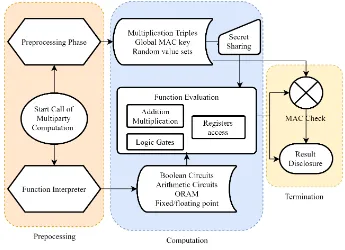
The protocol implemented in ARPA’s computation network is organized as Figure 6. The procedure can be viewed as a two-phase protocol: Preprocessing and Computation. The computation phase is the main procedure that involves secret sharing, function evaluation, and revealing outcomes. On the other hand, the preprocessing phase is the foundation which provides necessary raw materials for computation. We separate these two phases apart because preprocessing is independent of both the function and the data.
Figure 6: ARPA MPC protocol
5.1 Computation Phase
During the computation phase, the main task is to securely evaluate an arbitrary circuit on pri-vate inputs which is keep secret throughout and reveal the result only when the parties follow the prescribed protocol. This phase can be concluded as a 3-stage protocol: input, evaluation, output. After private inputs are provided and secretly shared, all parties perform addition and multiplication on shared values, collaboratively, according to the arithmetic circuit. Eventually, results are opened after computing verification.
5.1.1 Sharing secrets
At the beginning of the computation phase, the input needs to be shared among all parties. This process is called secret sharing. Secret sharing is the method of distributing a secret among a group of participants, each of whom is allocated a share of the secret. The secret can be revealed only when a sufficient number of shares are combined together. Individual shares are unreadable ciphertext on their own.
A secret sharing scheme usually consists of two main functions, Share and Reconstruct.
Share allows one party to share a secret, x, among n parties such that the secret remains secure
against an adversary up tot−1 parties in a (t, n)-threshold scheme. WhileReconstructallows any
5 ARPA MULTIPARTY COMPUTATION PROTOCOL
scheme to work effectively under universally composable security so that the threshold is set to n, meaning our system is secure up ton−1 colluded malicious parties.
In theInputstep, parties need to use shares of random values: each partyPi holds some ri and
the secret value ri is uniformly random and not known by any party. First, every party sends their
share ri ofr to partyPprovider. This is called a ‘partial opening’ because nowPprovider discovers the
value of r by summing the shares. Party Pprovider then broadcasts his inputx−r. PartyP1 sets its
share of x as x1 =x−r+r1, and for P i sets its x share of asxi =ri. In practice, it is not always
P1 who does a different computation. Now we turn xinto hxi and shares are xi.
5.1.2 Evaluating circuits
On ARPA’s MPC framework, the function to be evaluated should be expressed in an arithmetic circuit representative. A general method to transfer high-level functions into arithmetic circuits are included in our compiler. which is concretely described in the preprocessing phase in section5.2. This compilation is done prior to computation phase.
The arithmetic circuit basically consists of addition and multiplication operations. In the eval-uation step, since the secret sharing scheme is additive and linear, addition can be done via local computation which has no communication cost. Specifically, to computeha+biorhα·ai, each party simply does ai+bi orα·ai. We then get the ha+bi andhα·ai in secret shares type.
Multiplication on secret values, however, requires some interaction between the parties. Beaver’s triples are used to facilitate the online multiplication. When parties are scheduled to computehx·yi given hxi and hyi one available ‘triple’hai,hbi,hci, wherec=a×b is taken from the pre-processed raw material. Then, by broadcasting xi−ai and yi−bi, each party can computex−aand y−b.
Which now means these intermediates are publicly known. Eventually everyone can locally compute zi = (x−a)(y−b) +xi(y−b) +yi(x−a) +ci, so that they have a secret share ofhzi.
hzi=hci+d· hbi+e· hai+d·e
=ha·b+ (x−a)·b+ (y−b)·a+ (x−a)·(y−b)i =hx·yi
(1)
The upshot is that with enough amount of triples, the MPC engine can perform any multiplication depth computing on secret shared data, and hence we can compute any arithmetic circuit. For the reason that some intermediates like x−a are opened for subsequent procedure, triples cannot be reused because this would reveal information about the secrets.
Importantly, it can be observed that triples are independent of not only the input data, but also the circuit to be evaluated. This means that we can generate these triples at any point prior to evaluating the circuit. The value of triples are not known by any parties when generated. Each party only knows a share of each of ‘some values’ for which they are told this relation holds. Moreover, since addition, scalar multiplication, and field multiplication are inexpensive in terms of communication and computation, the computation phase is both highly efficient and information-theoretically secure. With the methodology of addition and multiplication on secret shares, we can build any com-putable functions on arithmetic circuits. Taking an example of secure signed floating number multi-plication like Alg.2 [2] which involves exponents addition, sign bit operation and mantissa multipli-cation. Specifically, multiplication of two floating point numbers hv1, p1, z1, s1i and hv2, p2, z2, s2i is
performed by first multiplying their mantissa v1 and v2 to obtain a 2l-bit product v. The product
5 ARPA MULTIPARTY COMPUTATION PROTOCOL
Combining the above, we have now established roughly how to evaluate an arithmetic circuit.
Algorithm 2 Secure Floating Number Multiplication Require: h[v1],[p1],[z1],[s1]i,h[v2],[p2],[z2],[s2]i
Ensure: h[v],[p],[z],[s]i ←FLMul(h[v1],[p1],[z1],[s1]i,h[v2],[p2],[z2],[s2]i)
Method:
1: [v]←[v1][v2];
2: [v]←Trunc([v],2l, l−1);
3: [b]←LT([v],2l, l+ 1);
4: [v]←Trunc(2[b][v] + (1−[b][v], l+ 1,1);
5: [z]←OR([z1],[z2]); 6: [s]←XOR([s1],[s2]);
7: [p]←([p1] + [p2] +l−[b])(1−[z]); 8: returnh[v],[p],[z],[s]i;
5.1.3 Information Theoretic MAC
When using multiplication triples and a linear secret-sharing scheme with threshold t, we obtain a passively secure MPC protocol that tolerates up to t corruptions. In the dishonest majority setting with up ton−1 corruptions, the most natural secret sharing scheme to use is simple additive secret sharing, where x ∈ F is shared between n parties by distributing n random shares xi satisfying
x=Pn
1xi. Clearly, anyn1 shares reveal no information about the secret. However, to achieve active
security, this is not enough to guarantee correct opening.
Message Authentication Code (MAC) is a value that can be used to confirm a message has been created by a certain party who knows the MAC key, and to detect if a message has been changed. The main tool for achieving active security in modern, secret sharing-based protocols is information-theoretic MAC, as mentioned in the [13] [13]. A typical information-information-theoretic MAC scheme is listed as Alg.3.
Algorithm 3 MAC Check Procedure
Require: global MAC key shares αi, public sets of opened values a1, . . . , at, associated MAC value
sharesγ(aj)i
Ensure: succeed ifMACCheckpassed, or ∅if inconsistant MAC value is found.
Method:
1: All parties samples a seed si and ask Committo broadcast τsi.
2: All parties openτsi and add up to get an agreed seed s.
3: All parties sample random vector rons
4: Each player computes the public value a←Pt
j=1rj·aj.
5: Player icomputes γ(a)i←Ptj=1rj·γ(aj)i, and σi ←γi−αi·a. 6: Player iasksCommit to broadcast τσi.
7: Every player openτσi.
8: Ifσ1+· · ·+σn= 0, the players output ∅and abort.
5 ARPA MULTIPARTY COMPUTATION PROTOCOL
MAC plays a crucial role in making MPC verifiable. MAC check scheme makes sure that malicious party in the group can not bypass the security check by blending the verification value into the computation process.
5.1.4 Revealing outcomes
Once we have the MAC representations, it is fairly easy to describe the online phase of an MPC pro-tocol in the preprocessing model. Since both of the authenticated secret-sharing methods described are linear, the parties can perform linear computations by simply computing locally on the shares. We can also add a public constant c to a shared value [x] :P1 adds c to her share, and each partyPi
adjusts their MAC byc·αi.
To multiply two secret-shared values, the parties need a random authenticated multiplication triple from the preprocessing phase. We also need some additional preprocessing data for sharing inputs, in the form of random authenticated masks where only the party providing input knows the value. When outputting a result of the computation the parties must check the MACs using the MAC check procedure described previously, which we denote by Q
M ACCheck. In summary, the computation process can be concluded as the protocol Alg.4
Algorithm 4 Computation Phase Protocol
Initialize: The parties first invoke the preprocessing to get the shared secret key α , a sufficient number of multiplication triples (hai,hbi,hci), and random values hri, as well as single random valueshti,hei. Then the below steps are performed according to the compiled function structure. Input: To share secret input x of partyPinput, involved parties take a random valuehri. Then do
the following:
1. hri is opened toPinput.
2. Pinput broadcasts←x−r.
3. The parties computehxi ← hri+.
Add: To add hxi,hyi, the parties locally compute hxi+hyi Multiply: To multiply hxi,hyi, the parties do the following
1. Sacrifice
a) htiis opened publicly, take two triples for check
b) Evaluatet· hci − hhi −σ· hfi −ρ· hgi −σ·ρ, whereρ:=t·c−h, σ:=b−g c) Sacrifice one triple and authenticate the other
2. Multiplication
(a) Take one authenticated triple
(b) Evaluate hzi=hci+· hbi+δ· hai+·δ, where:=x−a, δ:=y−b
Output: The parties unite to reveal output y in the presence of hyi. Correctness of computation should be checked first. Then do the following:
1. Generate random linear combination coefficient ri =ei. Then compute a=Pjrjaj, where
aj are opened intermediates.
2. Pi commits tori=Pjrjγ(aj)i,hyi, γ(y)i.
3. Openα.
4. Checkα·a=P
iγi,α·y=
P
iγ(y)i. If MAC check passed, output y:=
P
5 ARPA MULTIPARTY COMPUTATION PROTOCOL
5.2 Preprocessing Process
The preprocessing model began with Beaver’s “circuit randomization” technique, which allows any arithmetic circuit to be securely computed by randomizing the inputs to each multiplication gate, using a multiplication triple, which is a triple of secret shared values hai,hbi,hci where aand b are uniformly random (in a finite field) and c= a·b. Given this, two secret shared values hxi, hyi can be multiplied by publicly reconstructing d=x−a ande=y−b and then computing
Sinceaandbare uniformly random, revealingdandedoes not leak any information on the inputs x,y. The key advantage of this approach is that any MPC protocol based on linear secret sharing that operates on circuits in a gate-by-gate manner can now be easily recast in the preprocessing model: the preprocessing phase simply consists of creating many multiplication triples, and in the online phase the circuit is securely evaluated using these triples. Note that additions and linear operations can be evaluated locally because the secret sharing scheme is linear. After evaluating the circuit, each party broadcasts their secret shares of the outputs and reconstructs the result. The preprocessing stage is completely independent of both the inputs to the function being computed and the function itself (apart from an upper bound on its multiplicative size), and creating triples is typically the bottleneck of a protocol.
Algorithm 5 Preprocessing Phase Protocol
Initialize: generates global MAC keyα and distributed key βi
1. The players agree on the public key pk
2. EachPi generates αi,βi, and defineα:=Piαi
3. EachPi computes eαi =Enc(αi),eβi =Enc(βi), and zero-knowledge proves on ciphers
4. Compute eα =eα1· · ·eαn, and DistDecit to each party. Random Values: generates random values for secret sharing
1. EachPi generates ri, and definer:=ri.
2. EachPi computes eri =Enc(ri), and zero-knowledge proves on ciphers.
3. Compute er =eri· · ·ern. andDistDec it to each party. Triples: generates multiplicative triples for online computation
1. EachPi generates ai,bi, and definea:=
P
iai,b:=
P
ibi.
2. EachPi computes eai =Enc(ai),ebi =Enc(bi), and zero-knowledge proves on ciphers.
3. Compute ea=eai· · ·ean,eb =ebi· · ·ebn. and DistDecit to each party. 4. Compute ec=eaeb, and DistDecit to each party.
Considering the malicious security model, we introduced two methods to solve the following issues: First, Zero-knowledge is applied to prove that certain values lie within a certain bound in case that the adversaries introduces noise to pollute honest parties’ input. Second, distributed decryption allows corrupted party to add noise in triples, where we use sacrifice to double check triples validation.
6 THE SECURE COMPUTATION PROCESSES
Figure 7: Sample Arithmetic Circuit
5.2.1 Compiling functions
An MPC compiler translates a conventional function into an arithmetic or boolean circuit, in order for it to be accepted in MPC virtual machine. Corresponding to the normal compiler, which transforms high level language to assembly code, The MPC compiler turns the high-level function into MPC-friendly instructions.
The difference between arithmetic and Boolean function is not about functionality but the modal-ity. The reason to choose one representative depends on the functions type to perform. Due to the mathematical basis, cryptography tools rely mainly on computation of field elements, which are treated as single input but not a string of bits. Then it makes sense to represent in arithmetic ways. However, many applications involve non-arithmetic operations like integer comparison, which is a basic procedure in many computations. In this case, implementing this non-arithmetic operation as an arithmetic one would be very inefficient, and Boolean circuits are a more natural representation.
Circuits Arithmetic Boolean
Elements Bit{0,1} /F2 Finite field (Fpk)s Underlying Operations OR,NOT,AND,XOR Addition, Multiplication
Transform Like an Arithmetic Logic Unit in processor
0 as addition neutral 1 as multiplication neutral
OR(a, b) =a+b−a×b
Table 3: Circuit Comparison
The two representatives of circuits can be transformed to each other by an arbitrary translation shown in Table 3. The computable functions class of Boolean circuits of polynomial size correspond to the class of arithmetic circuits of polynomial size. Actually, we can picture arithmetic circuits as a generalization of Boolean circuits to arbitrary fields. There have been many papers that worked on extending cryptographic methods that work well for computations represented as Boolean circuit to the setting of computations which are best captured by arithmetic circuits, to get efficiency improvements for those circuits, or on bridging between methods adapted to both circuits, to capture computation whose best representation is a mix between the two.
6
The Secure Computation processes
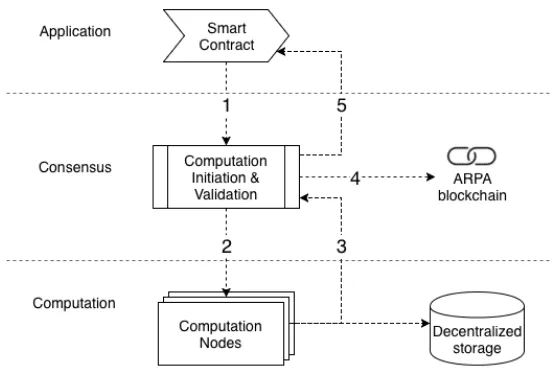
The Secure Computation process starts from the application layer, typically by triggering a smart contract. To support off-chain computation, our network will observe smart contract events on a designated blockchain network, execute the computation work on ARPA, then submit results and proofs back to the smart contract. This process consists of 5 steps, as illustrated in Figure 8.
6 THE SECURE COMPUTATION PROCESSES
Figure 8: The Secure computation process
the network while keeping the detail in private. The smart contract was created by the data provider (who charges a fee for providing information but doesn’t want to expose the data to the public), or by several parties who want to engage in some private business logic.
To support off-chain computation, the smart contract could be one on another blockchain network. Our nodes can optionally observe the particular event defined in smart contract. And the result can be sent back to the smart contract by sending a message to the smart contract.
Once the smart contract received the deposit and other necessary information, such as data provider and function to be evaluated, the observing nodes will broadcast the event in the ARPA network, inviting other parties to join the MPC task.
2. All computation nodes who are interested in participating in the computation will start the bidding process. They are asked to deposit minimum required token to be eligible (detailed in Cryptoeconomics section). Next, a group of computation nodes are randomly selected, based on node’s performance and condition, success rate, latency, etc. The random function used in this selection process is a decentralized random function, discussed in subsection 6.2.
One thing worth mentioning is that the data provider and data consumer are included in the group, making the computation nodes impossible to collude. This design is required so that at least one party is honest. Because our threshold protocol is secure up to n-1 parties, we can claim that this setup iscryptographically guaranteed to be secure.
Once the quorum is determined, all bidding notes will know the result locally. This is a very important feature because even if the bribing attacker exists, he doesn’t know whom to bribe or attack. The selected nodes don’t need to broadcast the fact that they are selected, but instead they hold the cryptographic proof till the end of the process.
6 THE SECURE COMPUTATION PROCESSES
result, making it impossible to forge. The results and MAC values will be signed with all nodes’ secret keys to prevent forgery.
MACs are information-theoretic secure to convey the correctness of computation, so that the computation is verifiable. The validation complexity isO(1), which means it consumes constant time to compute. Therefore it is possible to be executed in any VM.
4. If the verification is passed, the payment will be processed, the gas fee will be distributed, and the meta-data of the transaction will be recorded on the blockchain. The ARPA consensus algorithm is discussed in section 7.6.
5. The result and MACs will also be sent back to smart contract. All nodes running smart contract will validate the authenticity of MACs, and then check the MAC’s correctness. The detail of verification procedure is detailed section 6. If the smart contract is running on another blockchain network, then other nodes will reach consensus by their own consensus algorithm.
6.1 Smart Contract
A smart contract is executable code that runs on the blockchain to facilitate, execute and prove an agreement between untrusted parties without the involvement of a trusted third party. The benefit of a smart contract is that it can reliably transfer value, make decisions or perform computation as if there is a trusted third party. It also makes the whole executing process transparent, as anyone on the chain can audit the smart contract code and run the code to verify the results. The data processed or generated by a smart contract is also traceable in the receipt.
With many advantages, a smart contract has its limitations. The correctness of the smart contract is based on a network-wide consensus, which naturally requires every validating node to re-run it for verification purpose. This redundancy makes executing the smart contract very expensive, or in another words, the usability of the smart contract is limited. Another concern is privacy, as the smart contract itself and its data are transparent to every node on the blockchain network.
Therefore, our approach to support off-chain computation for other chains is using smart contracts to carry the meta operations, including computation initiation, task broadcasting, and validation, so that the blockchain can reach consensus with computation proof. A pseudo-code example is provided to illustrate this concept. All of the heavy-lifting computation, including secret sharing and multiparty computation, are conducted by the MPC network.
1 /* * W r i t t e n in S o l i d i t y - l i k e pseudo - c o d e . */
2 c o n t r a c t A r p a C o n t r a c t {
3 s t r u c t T r a n s a c t i o n {
4 u i n t 2 5 6 t x n I d ;
5 a d d r e s s d a t a C o n s u m e r ;
6 a d d r e s s d a t a P r o v i d e r ;
7 s t r i n g d a t a A d d r e s s ;
8 u i n t 2 5 6 n u m P a r t i c i p a n t s ;
9 u i n t 2 5 6 f u n d ;
10 b o o l i s F i n i s h e d ;
11 }
12
13 s t r u c t M p c R e s u l t {
14 // MPC may f a i l for v a r i o u s reasons , e . g . the f u n d is not e n o u g h to pay
15 // c o m p u a t i o n fee g e n e r a t e d at run - time , or s o m e p a r t i e s a b o r t e d the
16 // c o m p u a t i o n .
17 b o o l s u c c e s s ;
18 // MAC v a l u e s are for MPC c o r r e c t n e s s v e r i f i c a t i o n .
19 u i n t 2 5 6[] m a c V a l u e s ;
20 }
6 THE SECURE COMPUTATION PROCESSES
22 m a p p i n g (u i n t 2 5 6 = > T r a n s a c t i o n ) p u b l i c t x n s ;
23 u i n t 2 5 6 p u b l i c n e x t T x n I d ;
24
25 e v e n t T r a n s a c t i o n C r e a t i o n ( T r a n s a c t i o n txn ) ;
26 e v e n t T r a n s a c t i o n C o m p l e t i o n ( T r a n s a c t i o n txn ) ;
27
28 /* *
29 * C o n s t r u c t o r f u n c t i o n .
30 */
31 f u n c t i o n A r p a C o n t r a c t () p u b l i c {
32 n e x t T x n I d = 0;
33 }
34
35 /* *
36 * D a t a c o n s u m e r c a l l s t h i s f u n c t i o n to i n i t i a t e an i n s t a n c e of MPC and
37 * d e p o s i t s f u n d for d a t a u s a g e and c o m p u a t i o n fee .
38 */
39 f u n c t i o n s t a r t T r a n s a c t i o n (
40 a d d r e s s d a t a C o n s u m e r ,
41 a d d r e s s d a t a P r o v i d e r ,
42 s t r i n g d a t a A d d r e s s ,
43 u i n t 2 5 6 n u m P a r t i c i p a n t s ,
44 u i n t 2 5 6 f u n d ) p u b l i c p a y a b l e r e t u r n s (b o o l s u c c e s s ) {
45 r e q u i r e(msg.v a l u e == f u n d ) ;
46 t x n I d = n e x t T x n I d ;
47 n e x t T x n I d += 1;
48 txn = T r a n s a c t i o n (
49 txnId ,
50 d a t a C o n s u m e r ,
51 d a t a P r o v i d e r ,
52 d a t a A d d r e s s ,
53 n u m P a r t i c i p a n t s ,
54 fund ,
55 /* i s F i n i s h e d = */ f a l s e) ;
56 t x n s [ t x n I d ] = txn ;
57 // P u b l i s h new t r a n s a c t i o n i n f o r m a t i o n to n o t i f y mpc n e t w o r k
58 // to s t a r t c o m p u a t i o n .
59 e m i t T r a n s a c t i o n C r e a t i o n ( txn ) ;
60 r e t u r n t r u e;
61 }
62
63 /* *
64 * The c o n s e n s u s l a y e r of MPC n e t w o r k w i l l c a l l t h i s f u n c t i o n to r e p o r t
65 * c o m p l e t i o n of MPC and u p l o a d mpc r e s u l t ( i n c l u d i n g MAC v a l u e s ) for
66 * v e r i f i c a t i o n .
67 */
68 f u n c t i o n s u b m i t R e s u l t (u i n t 2 5 6 txnId , M p c R e s u l t m p c R e s u l t )
69 p u b l i c r e t u r n s (b o o l s u c c e s s ) {
70 txn = t x n s [ t x n I d ];
71 r e q u i r e(! txn . i s F i n i s h e d ) ;
72 u i n t 2 5 6 r e m a i n i n g F u n d = txn ;
73
74 if ( v e r i f y M p c R e s u l t ( m p c R e s u l t ) ) {
75 // Pay the fee to e v e r y p a r t y .
76 r e m a i n i n g F u n d -= txn . d a t a U s a g e F e e ;
77 txn . d a t a P r o v i d e r .s e n d( txn . d a t a U s a g e F e e ) ;
78 for ( w o r k e r : m p c R e s u l t . p a r t i c i p a n t s ) {
79 r e m a i n i n g F u n d -= w o r k e r . c o m p e n s a t i o n ;
80 w o r k e r .a d d r e s s.s e n d( w o r k e r . c o m p e n s a t i o n )
81 }
6 THE SECURE COMPUTATION PROCESSES
83 r e q u i r e( r e m a i n i n g F u n d >= 0) ;
84 // If the d a t a c o n s u m e r d e p o s i t e d e x t r a fund , or MPC v e r i f i c a t i o n
85 // failed , r e f u n d the m o n e y to d a t a c o n s u m e r .
86 if ( r e m a i n i n g F u n d > 0) {
87 d a t a C o n s u m e r .s e n d( r e m a i n i n g F u n d ) ;
88 }
89
90 txn . i s F i n i s h e d = t r u e;
91 // P u b l i s h new t r a n s a c t i o n i n f o r m a t i o n to n o t i f y mpc n e t w o r k
92 // to s t a r t c o m p u a t i o n .
93 e m i t T r a n s a c t i o n C o m p l e t i o n ( txn ) ;
94 r e t u r n t r u e;
95 }
96
97 f u n c t i o n v e r i f y M p c R e s u l t ( M p c R e s u l t m p c R e s u l t ) p u b l i c r e t u r n s (b o o l s u c c e s s ) {
98 // S o m e MPC f r a m e w o r k v e r i f i e s MAC by c h e c k i n g ( sum == 0) .
99 // T h i s is o n l y for i l l u s t r a t i o n p u r p o s e .
100 r e t u r n m p c R e s u l t . s u c c e s s && sum ( m p c R e s u l t . m a c V a l u e s ) == 0;
101 }
102 }
Listing 1: ARPA Smart Contract
6.2 Nodes Selection
The nodes who will be participating in the computation are randomly selected based on a decen-tralized random function(DRF). One good candidate of such function is RANDAO, which is also a proposed in Ethereum PoS system[10].
Combined with randomness from DRF, participating nodes are also selected based on the node’s performance, condition, success rate, latency, etc.
6.3 Off-Chain Computation
Currently on-chain consensus is reached when everyone is receiving the same result, by executing smart contracts on each individual VM. There is no final authority when decentralized. Everyone has to validate every transaction in order to agree with others. The most prominent problem is the amount of gas consumed for every block. The reason that everyone has to repeat the same calculation is that blockchain is a trustless network and everyone must do the same and reach to the same result to trust others. In other words, there is no way to verify the result without actually going over the whole process, i.e. executing the code, in a trustless network.
Computation-intensive calculations are expensive on Ethereum and solidity is not good at ex-pressing complex functionality. One way to compute complex function is to simply run it off-chain. Various solutions[19, 18] are focused on how to prove the correctness of an off-chain computation.
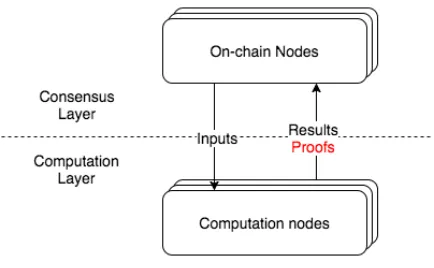
In order to bring computation off-chain, we need a verifiable scheme in the computation delegation process. For example, if one wants to prove that they have been somewhere, the best proof is an item that is unique to that place, such as a souvenir. We can think of off-chain computation as a delegation process, and the envoy has to prove that he actually did finish the task. Similar to this concept, an off-chain computation scheme needs a verification scheme that:
1. Can prove that the computation is faithfully done,
2. The amount of work done cannot be exaggerated, and more importantly,
6 THE SECURE COMPUTATION PROCESSES
Figure 9: Off-chain computation
This relationship is illustrated in Figure 9
We use Information Theoretic MAC to attain these desired properties. The following section will describe how MAC is used and why it can become the critical component in off-chain computation.
6.4 Computation Verification
Computation Verification scheme is the cornerstone of verifiable computation. As mentioned earlier, the current state of smart contract execution is duplicated across all nodes on blockchain. However, using MPC, the computation is guaranteed by mathematics and can be safely delegated to another set of nodes. In other words, the process can be trusted by a third party, as long as they provide proof that the process is done in a correct way. This question can be further broken down into three conceptual parts:
1. The computation is conducted with prescribed function and correct input data,
2. The proof cannot be forged, and
3. The proof can be verified by other nodes.
Under our MPC protocol, we are securing up to n-1 malicious notes using MAC. As described earlier, MAC is a value that can be used to confirm a message has been created by a certain party who knows the MAC key, and to detect if a message has been changed.
While the Smart Contract is being executed, a secure computation request is sent out from an external blockchain node to the computation layer. The computation network then selects several nodes for the task, and data provider’s node is also included in the group. If any other party deviates from the protocol, such as sending incorrect result, the proof-carrying data will not be reconciled and the result will be discarded. Therefore, part 1 is guaranteed by our MPC protocol cryptographically. After each party in the computation group finishes their work, they sign their MAC with their own private key, and store them on the DHT-based distributed storage. This prevents the MAC from being forged by a third party. Therefore, the proof cannot be forged and can be trusted to be authentic, even on a publicly-accessible storage. This produces desired property of part 2.
6 THE SECURE COMPUTATION PROCESSES
Therefore, under the protocol, we know that if MAC does not pass the check, it means the computation was wrong because some node did it incorrectly. On the opposite, if the MAC does pass the check, we know that the computation was done correctly and the result can be trusted.
In summary, we now can conclude that the secure computation can be broken down into compu-tation and verification parts. Further, we are able to prove that by using a privately-signed MAC, we can trust the related result, as well the identity of the signer.
6.5 MAC with Off-chain computation
In our off-chain computation phase, MAC is used in secret sharing schemes to ensure that corrupted parties cannot lie about their share and cause an incorrect value to be opened during reconstruc-tion. The following equation shows how MAC proves correctness and integrity of computareconstruc-tion. The protocol is under a full threshold active security model where security is guranteed even there is one honest party. This particular party can be data provider or computation initiator who has natural motivation to follow rules.
An authenticated secret valuex∈Fis defined as the following:
hxi= (x1, . . . , xn, m1, . . . , mn, α1, . . . , αn) (2)
where each party Pi holds an additive sharing tuple (xi, mi, αi) such that:
x=
n
X
i=1
xi, x·α= n
X
i=1
mi, α= n
X
i=1
αi. (3)
When open a valuehxi, all players do the following protocol:
1. Compute σi =mi−αxi.
2. Call FCommitwith (Commit, σi) to receive handleτi
3. Broadcastσi to all parties by calling FCommitwith (Open, σi).
4. If P
iσi 6= 0 then abort and output⊥; otherwise continue.
The protocol achieves the integrity and correctness of computation by information-theoretic se-curity of secret sharing and the following property.
X
i
σi=
X
i
(mi−αxi) =
X
i
mi−α
X
i
xi
X
i
σi=
X
i
(mi−αix) =
X
i
mi−x
X
i
αi
(4)
It can be observed that, when given a MAC global key or value x, the protocol can check the result with MACs. These two ways can be used to ensure the correctness of computation by checking on intermediate and result by checking on output. Now we can see how MAC helps to protect the computation when at least 1 party act honestly.
Furthermore, we can also find that the broadcast value i leaks no information on either secret value or MAC value because they are not correlated. Therefore, it is possible to transfer this check from computation layer to consensus layer, which helps to reach consensus on-chain. Also, the final summation ofiis mathematically simple to deploy any kind of virtual machine. In conclusion, MAC check is the ideal operation to promote consensus and protect computation privacy.
7 CRYPTOECONOMICS
can check that the output is indeed correct. This characteristic enables the separation of the input parties, computing parties, and the validator. After the protocol is executed, anyone acting as the validator can retrieve the transcript of the protocol from the bulletin board, and determine if the result is valid or not by using only the circuit and the output. The protocol will instruct computing parties to make part of their conversation public and logged on the bulletin. The verification is reached by linear commitments on secret inputs instead of traditional use of non-interactive zero knowledge proof.
The more ambitious properties that public auditable MPC is willing to achieve are universal veri-fiability, where the validators must not know the output and observe any process of the computation, but still hold computing parties accountable by Pedersen commitment.
6.6 Data Storage
The Distributed Hash Table (DHT) is a decentralized distributed storage system that provides a look-up service similar to a hash table. The data is distributed over the whole network of nodes, while any data is searchable by querying any node. To achieve that, the DHT (Figure 10) defines a key space (for example, 160-bit string) and maps the entire data set onto this key space. The key space is then partitioned into chunks and assigned to nodes so that a node is only responsible for storing part of the data set. Another property is that every node keeps an index of mapping from key to the address of node(s) which stores the data with that key. With an overlay network connecting all nodes, a query that reaches any node can leverage the index to be routed to the node hosting queried data.
Figure 10: DHT lookup
The decentralization and fault tolerance nature enable DHT to be more resilient to a hostile attacker than a typical centralized storage system. DHT can also be designed to have Byzantine fault tolerance[23]. This makes it feasible to handle MAC value storage in ARPA’s network, as no individual MPC node can be trusted. On the other hand, if we choose an arbitrary MPC node to store the MAC value, there is a chance that the node will supply a forged value, either because it happens to be a malicious node or it is under hostile attack.
7
Cryptoeconomics
7 CRYPTOECONOMICS
and received immediate notice. The algorithm is designed to work in asynchronous systems and is optimized to be high-performance, with an impressive overhead runtime, and only a slight increase in latency. However, the solution works on a permissioned system, meaning that the nodes have to be authorized to join the network. This property works well on closed blockchain system like Hyperledger[1], Steller[25] and Ripple[34].
The Bitcoin network, on the other hand, is a permissionless network. It works in parallel to generate a blockchain allowing the system to overcome Byzantine failures and reach a coherent global view of the system’s state. To achieve decentralized consensus on a permissionless network, Bitcoin invented a new consensus scheme called proof-of-work. This consensus scheme has three major properties:
1. The ”work” is a NP hard problem to prover but easy to verify by verifier.
2. The more stake (computation device) and cost (electricity) a node is willing to put into the system, the higher the chance that this node will be the first to solve the work.
3. The node who solves the work first will be rewarded and its ledger is broadcasted and trusted.
The prover, who found the hash value that satisfies the nonce, can be trusted because he puts tremendous efforts/cost/stake in this game, and it would not be a rational decision to hack the system. Otherwise he gained nothing with depreciating token value.
The difference between PBFT and Bitcoin is that the former makes an honest assumption of participants (a permissioned network), while the later gives a more realistic and real-world assump-tion of Economic Rationality[30], a concept from neoclassical economics, which is maximization of subjective utility. Chain-based blockchain systems like Bitcoin or Ethereum prefer plausible liveness to correctness, while BFT consensus algorithm can ensure transactional correctness but may not be able to finalize conflicting blocks and can get stuck.
In Ethereum and other blockchain networks based on the Nakamoto(Proof-of-Work, or PoW) consensus, the fundamental assumption is that the computation resource is scarce. If everyone is verifying transactions, there will be no final state of transaction history agreed by everyone. If a leader in the network propose a block of transaction and everyone else only has to verify that, the situation is alleviated. Therefore, consensus is reached based on block of transactions, proposed by a participating node who solved a cryptographic puzzle using fairly large amount of computation power. This brings a trustworthy ”finality” to the blockchain network. In essence, Bitcoin created a game where verification (of the hash work) is much more simpler than the computation of the function(verify the transactions). Nakamoto consensus protocol transfers the trust needed to verify transactions to a puzzle game. With economic rationality mentioned ahead, the finality of the state is set by a trusted leader who solves the hash puzzle.
Similar to how Bitcoin reached decentralized consensus, our work makes Economic Rationality assumption to MPC, so that the cryptographic protocol can be deployed as a permissionless network. On the contrary to the assumption of Proof-of-Work consensus, ARPA designed the MPC protocol where verification of computation is even simpler than hash verification, using information theoretic MAC. This feature opens new possibilities of consensus, explained in theConsensus(7.6) section.
7.1 Economic Rationality
We aim to deploy an MPC network with cryptoeconomics considered. While in cryptography the most basic assumption is that some parties are simply honest (or not), in economics the assumption is that the parties are rational and their utilities can be quantified, such that with a proper incentive mechanism all (or at least most) of them can be discouraged from deviating the protocol.
7 CRYPTOECONOMICS
where deviating the protocol, or even sabotaging the whole network, is in the best interest for the participating nodes, they would do so for their own benefit. On the contrary, participants will follow the protocol if the incentive received when following protocol is more than expected return from breaking it.
We designed a incentive system that will punish those who deviates from the protocol, and the punishment is more than the expected return when colluding with others. This will eliminate participating nodes to take chance in the system. This system will be explained in detail in section 7.3.
Sybil attack is common in peer-to-peer network, in which spawning identities will help the attacker to gain disproportional advantage on voting or influence. In PoW consensus scheme, the spawned nodes are bounded by the real computation power on their physical machine. Therefore, the risk of sybil attack is mitigated.
We designed a credit system that each node is in multiround game system, and it is the best interest for them to keep the same identity (than register a new address) and follow the protocol.
Without rationality, one can simply believe that the super admin of AWS (or anyone with un-limited computation resources) can attack Bitcoin and destroy its belief system. But in reality, it doesn’t have to be worried because
1. A rational person would not do so without a budget.
2. When invested with computation resources, a rational participant would rather make more economic return by staking in the game than sabotage a network with some upfront cost.
3. A rational person will not assume that others would so that
Therefore, it can be concluded that this sabotage behavior will never happen.
With a properly designed incentive system, one brings the question from a mathematical (ab-solute) perspective to a more realistic angle, where every participant can be ”guided” to follow the protocol, and those who don’t will be punished.
7.2 Identity and Reputation
At the time a new node joins the computation network, it is allocated a unique account in the consensus layer. The account will be served as public identity of such node. With asymmetric encryption, the network can generate private/public key pairs as the identity for a node. The public key serves as the node identification and information authentication. To prove the authenticity of the result, one has to sign the MAC value with its private key.
7.3 Accountable safety
The computation node participating in the computation has to put up a stake in order to participate in a computation task.
We require the staking value to be:
x=max(computation stake, intel value stake)·security multiplier
where:
computation stake= (total computation resources estimated)∗(n−1)
and Security multiplier can be a constant determined by the network