International Journal of Advance Research In Science And Engineering http://www.ijarse.com
IJARSE, Vol. No.3, Issue No.9, September 2014 ISSN-2319-8354(E)
329 |
P a g e
www.ijarse.com
A NOVEL MODULAR MULTILEVEL CONVERTER BASED
STATCOM COMPENSATION WITH FUZZY CONTROLLER
Anil Chowdary Mandalapu
1, Yohan Babu Puvvadi
2, Dr.K.Ravichandrudu
31,2
E.V.M College of Engineering And Technology (India)
3
NRI Institute Of Technology (India)
ABSTRACT
In this paper a new method four-leg topology is suggested for shunt compensation, the modular multilevel
converters (MMC) based on the half-bridge converters, to achieve higher performance as a STATCOM in a
distorted and unbalanced medium-voltage large-current (MV-LC) system. Further, an extended Fuzzy based
STATCOM is proposed in order to manage more accurate compensation for high-power applications. Both
proposals can be controlled for various purposes such as reactive power and unbalance compensation, voltage
regulation, and harmonic cancellation. One interesting application for the Fuzzy logic based STATCOM could be
the improvement in power quality and performance of the electrified railway traction power supply system. Both the
MMC and the EMMC-based STATCOM along with their proposed control strategies were simulated.
Index Terms: Harmonics, Medium-Voltage Large-Current (MV-LC), Modular Multilevel Converters,
Unbalanced Compensation, Fuzzy Logic.
I INTRODUCTION
Modern medium-voltage distribution systems supply nonlinear loads such as single-phase ac traction systems. These
loads make the network to operate under undesired conditions, i.e., distorted, uncontrolled reactive power and
significant unbalance enforcement [1], [2]. Therefore, these associated in-evitable issues ought to be simultaneously
resolved to achieve acceptable power quality level. Meanwhile, mitigation of all these power quality problems by
means of a single compensator is a challenging task in a medium-voltage network [3],[4].A full-bridge cascaded
converter (FBCC) could be directly connected to a medium-voltage network [5], [6]. However, the FBCC has been
established as the most preferred solution for managing reactive power in distribution systems, improving the power
quality in the medium-voltage high-power industries. Un-like diode-clamped multilevel converters (DCMC) and
flying-capacitor-clamped multilevel converters (FCMC), the FBCC introduces lower total losses along with higher
reliability [7], [19].Meanwhile, they have their restrictions when operating under distorted unbalance situations in a
International Journal of Advance Research In Science And Engineering http://www.ijarse.com
IJARSE, Vol. No.3, Issue No.9, September 2014 ISSN-2319-8354(E)
330 |
P a g e
www.ijarse.com
FBCC, connected in delta or star type, is unable to fully compensate the source currents when the un-balanced loads
containing harmonics. A delta-connected FBCC cannot generate zero sequence components flowing through the
fourth neutral-wire. Also, balancing an unbalanced load using a star-connected FBCC is faced with some
complications. Assume that a star-connected FBCC-based STATCOM is balancing three different active powers
supplied by the source. Then, a certain average real power has to either flowing into or out of individual series
connected full-bridge converters (leg). This results in either dc-link build-up or discharge of capacitors in that leg. In
other words, the unbalanced currents of the star connected FBCC imposes unequal active power exchange by the
FBCC legs. This makes the dc voltage balancing for the storage capacitors in all three legs much complicated [9].
The idea of modular multilevel converters (MMC) was first introduced by Marquardt for medium-voltage
applications [10].These converters consist of two similar parallel half-bridge cascaded converters (HBCC) per phase
(three-phase in star-connected configuration). Due to the modularity of these converters, they are very attractive for
high voltage dc transmission (HVDC), flexible ac transmission systems (FACTS), and medium-voltage drives [11],
[12]. The main advantage of ap-plying the MMC as a STATCOM [13] is that they could operate under unbalanced
and distorted voltages and currents properly, while voltages of the dc-link capacitors remains balanced [9].
Hence, this paper proposes a new type of the MMC topology as a STATCOM in order to achieve full compensation
of MV-LC loads, i.e., harmonic elimination, reactive power optimization and in particular balancing the three or
four-wire systems. The full compensation using the proposed STATCOM is achieved without any coupling
transformer for MV-LC applications (high-power). Nevertheless, available power semiconductor technology may
impose limitations due to the voltage and current ratings, losses, and switching frequency. Hence, here the EMMC is
proposed that is composed of parallel connection of multiple MMC per phase in order to deal with large-current
requirements. There are two main differences between the EMMC and just parallel connection of MMC: 1) two or
more MMC in an EMMC share the common dc-link (positive and negative common points); and 2), the presence of
the coupling inductors that lowers down considerably the circulating current between them. The EMMC produces
higher quality waveforms for the network compared to the MMC, reducing the conductive electromagnetic
interference concerns in large-current applications. Also, paralleling multiple MMC improves reliability,
performance, and efficiency of the overall system, making it more flexible. This paper is initially focusing on
description of the MMC-based STATCOM, both the proposed power circuit and control algorithms.
II. MMC-BASEDSTATCOM PROPOSITION
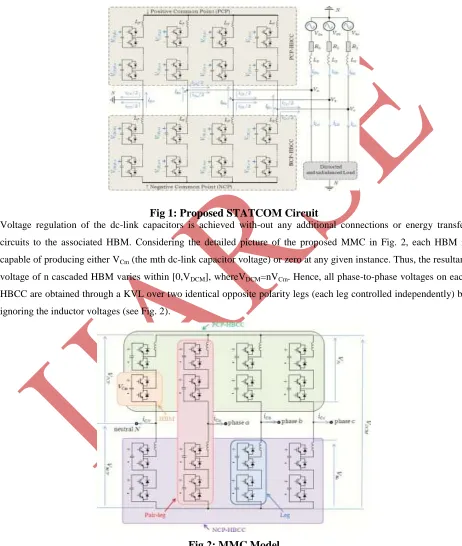
The MMC-based STATCOM is composed of two parallel connected complementary HBCC as shown in Fig. 1.
Each star-connected HBCC has either three or four similar legs (cascaded HBM). While one HBCC has a negative
common point (NCP), the other one has a positive common point (PCP). Both the NCP and PCP are float. To
International Journal of Advance Research In Science And Engineering http://www.ijarse.com
IJARSE, Vol. No.3, Issue No.9, September 2014 ISSN-2319-8354(E)
331 |
P a g e
www.ijarse.com
number of levels, in a general (n+1)-level MMC, is defined by the available n identical HBM cascaded in each leg.
Then, all (n+1)-level legs are connected to the network using an inductive filter (LF).
Fig 1: Proposed STATCOM Circuit
Voltage regulation of the dc-link capacitors is achieved with-out any additional connections or energy transfer
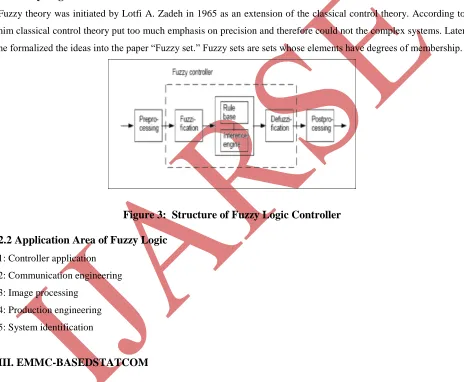
circuits to the associated HBM. Considering the detailed picture of the proposed MMC in Fig. 2, each HBM is
capable of producing either VCm (the mth dc-link capacitor voltage) or zero at any given instance. Thus, the resultant
voltage of n cascaded HBM varies within [0,VDCM], whereVDCM=nVCm. Hence, all phase-to-phase voltages on each
HBCC are obtained through a KVL over two identical opposite polarity legs (each leg controlled independently) by
ignoring the inductor voltages (see Fig. 2).
International Journal of Advance Research In Science And Engineering http://www.ijarse.com
IJARSE, Vol. No.3, Issue No.9, September 2014 ISSN-2319-8354(E)
332 |
P a g e
www.ijarse.com
In other words, the voltage between any two phases of an HBCC can be adjusted between +VDCM and –VDCM,
−VDCM/2. Although the voltage across a leg has a dc component, there exists no dc component on any phase-to-phase
voltage of an HBCC. To enable compensation of inductive loads, the value of VDCM must be chosen greater than
peak-to-peak amplitude of the line voltage [14]. It should be noticed that both legs of a pair-leg are controlled such
that supplying constantly one half of the total current per phase for the MMC.
2.1 Fuzzy Logic
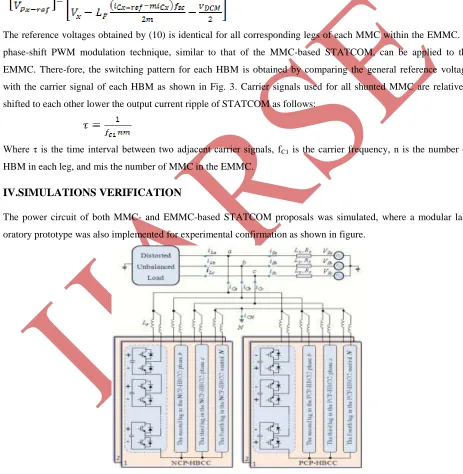
Fuzzy theory was initiated by Lotfi A. Zadeh in 1965 as an extension of the classical control theory. According to
him classical control theory put too much emphasis on precision and therefore could not the complex systems. Later
he formalized the ideas into the paper “Fuzzy set.” Fuzzy sets are sets whose elements have degrees of membership.
Figure 3: Structure of Fuzzy Logic Controller
2.2 Application Area of Fuzzy Logic
1: Controller application
2: Communication engineering
3: Image processing
4: Production engineering
5: System identification
III. EMMC-BASEDSTATCOM
Here the EMMC-based STATCOM is proposed for full compensation of the MV-LC loads such as electric traction
systems. The suggested high power STATCOM comprises of two or more identical MMC all connected in parallel.
A simple model of the EMMC-based STATCOM, having two MMC, is shown in Fig. 6. While all MMC have the
same electrical specification, all NCP legs connected together, and the same is done for all PCP legs to achieve a
better voltage regulation for the capacitors. Hence, voltage regulation for the HBM capacitors is managed without
International Journal of Advance Research In Science And Engineering http://www.ijarse.com
IJARSE, Vol. No.3, Issue No.9, September 2014 ISSN-2319-8354(E)
333 |
P a g e
www.ijarse.com
3.1 Switching Modulation of the EMMC
Considering the discussed current sharing for the EMMC-based STATCOM, (3) has to be rewritten in order to
calculate the instantaneous reference voltages for each leg (VNx and VPx) of the EMMC-based STATCOM containing parallel
MMC as follows:
=
The reference voltages obtained by (10) is identical for all corresponding legs of each MMC within the EMMC. A
phase-shift PWM modulation technique, similar to that of the MMC-based STATCOM, can be applied to the
EMMC. There-fore, the switching pattern for each HBM is obtained by comparing the general reference voltage
with the carrier signal of each HBM as shown in Fig. 3. Carrier signals used for all shunted MMC are relatively
shifted to each other lower the output current ripple of STATCOM as follows:
Where τ is the time interval between two adjacent carrier signals, fC1 is the carrier frequency, n is the number of
HBM in each leg, and mis the number of MMC in the EMMC.
IV.SIMULATIONS VERIFICATION
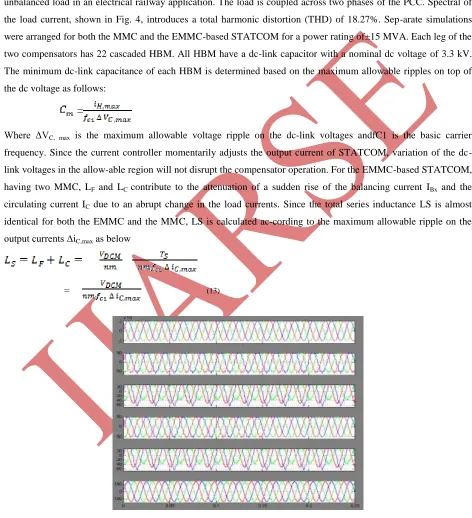
The power circuit of both MMC- and EMMC-based STATCOM proposals was simulated, where a modular
lab-oratory prototype was also implemented for experimental confirmation as shown in figure.
International Journal of Advance Research In Science And Engineering http://www.ijarse.com
IJARSE, Vol. No.3, Issue No.9, September 2014 ISSN-2319-8354(E)
334 |
P a g e
www.ijarse.com
4.1 Simulations
Simulations were carried out using PSIM, while the control algorithm was managed with MATLAB; then, they were
linked together using SIMCOUPLER of the PSIM. Assume that a 25-kV network is supplying a distorted
unbalanced load in an electrical railway application. The load is coupled across two phases of the PCC. Spectral of
the load current, shown in Fig. 4, introduces a total harmonic distortion (THD) of 18.27%. Sep-arate simulations
were arranged for both the MMC and the EMMC-based STATCOM for a power rating of±15 MVA. Each leg of the
two compensators has 22 cascaded HBM. All HBM have a dc-link capacitor with a nominal dc voltage of 3.3 kV.
The minimum dc-link capacitance of each HBM is determined based on the maximum allowable ripples on top of
the dc voltage as follows:
=
Where ΔVC, max is the maximum allowable voltage ripple on the dc-link voltages andfC1 is the basic carrier
frequency. Since the current controller momentarily adjusts the output current of STATCOM, variation of the
dc-link voltages in the allow-able region will not disrupt the compensator operation. For the EMMC-based STATCOM,
having two MMC, LF and LC contribute to the attenuation of a sudden rise of the balancing current IBx and the
circulating current IC due to an abrupt change in the load currents. Since the total series inductance LS is almost
identical for both the EMMC and the MMC, LS is calculated ac-cording to the maximum allowable ripple on the
output currents ΔiC,max as below
= (13)
International Journal of Advance Research In Science And Engineering http://www.ijarse.com
IJARSE, Vol. No.3, Issue No.9, September 2014 ISSN-2319-8354(E)
335 |
P a g e
www.ijarse.com
Here, the PS–PWM modulation technique is applied to both compensators with a switching frequency offC1 =1000
Hz. Fig. shows the Simulated references of a pair-leg coupled with phase a, neglecting the series inductor voltage
drop. EMMC currents, the source-end currents after compensation with the EMMC-based STATCOM, the MMC
currents and the source-end currents after compensation with the MMC-based STATCOM, respectively. It can be
seen from Fig. 11(d) and (f) that while both MMC and EMMC balance the source-end currents, the EMMC-based
STATCOM produce much smoother currents than those of the MMC. Additionally, the source-end currents are in
phase with the fundamentals of positive sequence voltages, containing no reactive components. Since each leg has
22 HBM, the equivalent switching frequency, considering output current ripple in (13),could be up to 22 kHz for the
MMC and 44 kHz for the EMMC.
VI. CONCLUSION
This paper proposes a novel type of Fuzzy based STATCOM for a full compensation of unbalanced and distorted
nonlinear load in the MV-LC networks under the presence of both the load and the source harmonics. This modular
Fuzzy based STATCOM introduces a transformerless design, employing several isolated units composed of a
number of cascaded HBM. Then, this STATCOM is developed by paralleling a number of MMC to achieve higher
efficiency, higher reliability, lower weight and size, lower switching frequency and lower ratings for the switches.
Various control strategies are suggested for both MMC and the EMMC in order to generate the reference currents
for the compensator, followed by another strategy to get their corresponding reference voltages. Another controller
i.e, Fuzzy is responsible for regulating all dc-link capacitor voltages at a predetermined level. Simulations results
were arranged for both the MMC and Fuzzy based STATCOM.
REFERENCES
[1] P.-C. Tan, R. E. Morrison, and D. G. Holmes, “Voltage form factor control and reactive power compensation in
a 25-kV electrified railway system using a shunt active filter based on voltage detection,” IEEE Trans.
Ind.Appl., vol. 39, no. 2, pp. 575–581, Mar./Apr. 2003.
[2] M. T. Bina and M. D. Panahlou, “Design and installation of a 250 kVAr D-STATCOM for a distribution substation,”Elsevier: Electric Pow. Syst.Res., vol. 73, no. 3, pp. 383–391, Apr. 2005.
[3] F. Z. Peng and J. Wang, “A universal STATCOM with delta-connected cascade multilevel inverter,” inProc.
35th Annu. IEEE Pow. Electron.Spec. Conf., Aachen, Gennany, Jun. 2004, pp. 3529–3533.
[4] R. E. Betz, T. Summerst, and T. Furney, “Using a cascaded H-bridge STATCOM for rebalancing unbalanced
voltages,” inProc. 7th Int. Conf.Pow. Electron., Daegu, Korea, Oct. 2007, pp. 1219–1224.
International Journal of Advance Research In Science And Engineering http://www.ijarse.com
IJARSE, Vol. No.3, Issue No.9, September 2014 ISSN-2319-8354(E)
336 |
P a g e
www.ijarse.com
[6] H. Akagi, S. Inoue, and T. Yoshii, “Control and performance of a transformerless cascade PWM STATCOM with star configuration,” IEEE Trans. Ind. Electron., vol. 43, no. 4, pp. 1041–1049, Jul./Aug. 2007.
[7] C. K. Lee, J. S K. Leung, S. Y R. Hui, and H. S. H. Chung, “Circuit-level comparison of STATCOM technologies,” IEEE Trans. Pow. Electron.,vol. 18, no. 4, pp. 1084–1092, Jul. 2003.
[8] R. E. Betz, T. Summers, and T. Furney, “Symmetry compensation using an H-bridge multilevel STATCOM with
zero sequence injection,” inProc.Ind. Appl. Conf., Oct. 2006, pp. 1724–1731.
[9] H. M. Pirouz and M. T. Bina, “New transformerless STATCOM topology for compensating unbalanced
medium-voltage loads,” inProc. 13th Eur. Conf. Pow. Electron. Appl., Barcelona, Spain, Sep. 2009, pp. 1–9.
[10] R. Marquardt, “Stromrichters chaltungen mitverteilten Energiespeichern,” German Patent DE 10 103 031, Jan.
24, 2001.
[11] S. Rohner, S. Bernet, M. Hiller, and R. Sommer, “Modulation, losses and semiconductor requirements of
modular multilevel converters,” IEEE Trans. Ind. Electron., vol. 57, no. 99, pp. 2633–2642, Aug. 2009.
[12] J. Rodr´ıguez, S. Bernet, B. Wu, J. O. Pontt, and S. Kouro, “Multi-level voltage-source-converter topologies for
industrial medium-voltage drives,” IEEE Trans. Ind. Electron., vol. 54, no. 6, pp. 2930–2945, Dec.2007.
[13] C. D. Schauder, “Advanced static var compensator control system,” U.S.Patent 5 329 221, Jul. 12, 1994. [14] M. T. Bina and A. K. S. Bhat, “Averaging technique for the modeling of STATCOM and active filters,”IEEE
Trans. Pow. Electron., vol. 23, no. 2, pp. 723–734, Mar. 2008.
[15] M. Hagiwara and H. Akagi, “Control and experiment of pulse-width-modulated modular multilevel
converters,”IEEE Trans. Pow. Electron., vol. 24, no. 7, pp. 1737–1746, Jul. 2009.
[16] H. Akagi, E. Watanabe, and M. Aredes, Instantaneous Power Theory and Applications to Power Conditioning.