Differing-Inputs Obfuscation and Applications
Prabhanjan Ananth
Dan Boneh
Sanjam Garg
Amit Sahai
Mark Zhandry
Abstract
In this paper, we study of the notion of differing-input obfuscation, introduced by Barak et al. (CRYPTO 2001, JACM 2012). For any two circuitsC0 andC1, a differing-input obfuscator
diO guarantees that the non-existence of an adversary that can find an input on whichC0 and C1 differ implies that diO(C0) and diO(C1) are computationally indistinguishable. We show many applications of this notion:
- We define the notion of a differing-input obfuscator for Turing machines and give a con-struction for the same (without converting it to a circuit) withinput-specific running times. More specifically, for each input, our obfuscated Turning machine takes time proportional to the running time of the Turing machine on that specific input rather than the machine’s worst-case running time.
- We give a functional encryption scheme that allows for secret-keys to be associated with Turing machines, and thereby achievesinput-specific running times. Further, we can equip our functional encryption scheme withdelegation properties.
- We construct a multi-party non-interactive key exchange protocol with no trusted setup where all parties post only logarithmic-size messages. It is the first such scheme with such short messages. We similarly obtain a broadcast encryption system where the ciphertext overhead and secret-key size is constant (i.e. independent of the number of users), and the public key is logarithmic in the number of users.
All our constructions make inherent use of the power provided by differing-input obfuscation. It is not currently known how to construct systems with these properties from the weaker notion of indistinguishability obfuscation.
1
Introduction
General-purpose program obfuscation aims to make arbitrary computer programs “unintelligi-ble” while preserving their functionality. The first formal study of the problem of obfuscation was undertaken by Hada [Had00] and Barak et al. [BGI+12]. Barak et al. proposed the notion ofvirtual black-box (VBB) obfuscation. This notion requires that the obfuscation does not leak anything more than what can be learnt with just a black-box oracle access to the function. Unfortunately, in the same work, Barak et al. showed a family of circuits that cannot be VBB obfuscated.
Weaker variants Obfuscation.
In light of this impossibility result, Barak et al. left open the problem of realizing weaker notions of obfuscation such as indistinguishability obfuscation and differing-inputs obfuscation (see below for further explanation).al. [GGH13a], gave the first candidate construction for a general-purpose obfuscator satisfying this notion.
The stronger notion of differing-inputs obfuscation [BGI+12] states that the existence of an adversary that can distinguish between obfuscations of circuitsC0 andC1 implies the exis-tence of an adversary that can actuallyextract an input on which the two circuits differ. The starting point for our work is the conjecture that the Garg et al. construction (and variants of it [BR13, BGK+13]) indeed achieves the differing-inputs obfuscation notion. Perhaps the strongest evidence for this conjecture is provided by analysis of this construction and variants in suitable generic models [GGH+13b, BR13, BGK+13].1
The focus of this paper is to show (1) how to bootstrap the notion of differing inputs obfus-cation to build differing inputs obfuscators for Turing Machines with per-input running time, and (2) how to leverage differing inputs obfuscation to obtain a number of interesting applica-tions. Before we turn to our main results, we first illustrate the usefulness of differing inputs obfuscation with two simple examples.
Warmup: Extractable Witness Encryption for NP.
As a warmup example, we will show how differing-inputs obfuscation can be used to construct extractable witness encryption, a primitive which already has the flavor of extraction. The notion of extractable witness encryption for NP recently introduced in [GGSW13, GKP+13a] states that given an NP language L, an extractable witness encryption scheme for L is an encryption scheme that takes as input an instancexand a message bitb, and outputs a ciphertextc. Ifx∈Landwis a valid witness forx, then a decryptor can usew to decryptc and recoverb. Furthermore, security requires that any adversary that can decrypt ciphertextccorresponding to instancexcan be used to extract a valid witness forx.
Now we present our construction of extractable witness encryption, which is analogous to the construction of witness encryption from indistinguishability obfuscation as in Garg et al. [GGH+13b]. We define the circuitsC
x,bfor b∈ {0,1}taking was input as follows. If wis a valid witness forx, then Cx,b outputsb and⊥otherwise. Differing-input obfuscation ofCx,b will serve as an encryption of the bit b. Correctness of decryption is immediate. Recall that the security of differing-inputs obfuscation states that existence of a distinguisher between the obfuscations of the two circuits implies the existence of an adversary that can find an input on which the two circuits differ. Thus, by the security of differing-inputs obfuscation, we conclude that an adversary breaking the semantic security of the above encryption scheme can be used to extract a valid witness forx.
Example of restricted use software.
We find the differing-inputs obfuscation notion stated in its contrapositive form, i.e. non-existence of an adversary that can find input on which the two circuits differ implies the non-existence of an adversary that can distinguish between the obfuscations of the two circuits, as more insightful when considering applications. We highlight how this interpretation can be useful for applications such asrestricted-use software:Software developers often want to release multiple tiers of a product with different price points, allowing for different levels of functionality. In principle, each customer could be pro-vided a separate version of the software, enabling only the features he needs. Ideally, a developer could just have flags corresponding to each feature in his software. The developer could then create a customized version of the software simply by starting with the full version and then turning off the features the consumer does not want directly at the interface level — requiring minimal additional effort. However, if this is all that is done, then it would be easy for an attacker to bypass these controls and gain access to the full version or the code behind it. The
1
other alternative is for a software development team to carefully remove all unused components — an elaborate task. Can we have the best of both worlds? Our solution is for a developer to release an obfuscated version of the program that takes as input a signature on the cus-tom set of functionality flags that the consumer has paid for. Next, we argue that for this application, differing-inputs obfuscation suffices. Assuming unforgeability, no efficient malicious user can generate a signature on any set of attributes besides the ones provided to it. Given that observation, differing-inputs obfuscation immediately implies that the obfuscated program with selected features turned off in the perspective of the user is indistinguishable from the obfuscation of the program with unwanted parts removed at the start.
On the other hand, note that indistinguishability obfuscation would not suffice here: This is because the program with the unwanted parts removed implements a different functionality from the original program, and therefore, indistinguishability obfuscation alone does not guarantee security in this setting.
1.1
Our Results
We obtain the following results:
Differing-input obfuscation for Turing Machines:
We define the notion of differing-input obfuscator for Turing machines and give a construction for Turing machines with bounded length inputs (without converting it to a circuit), assuming the existence of a differing-input obfuscator for circuits and SNARGs for P [BCCT13]. Additionally, assuming SNARKs for P [BCCT13], we can construct a differing-input obfuscator even for the setting where the length of the input is not bounded. (We stress that it is only for this extension that we need to assume SNARKs.) Moreover, our construction achievesinput-specific running times(explained below). This means that evaluating the obfuscated machine on inputxdoes not depend on the worst-case running time of the machine but just on the running time of the unobfuscated machine on inputx.Input-specific runtime. Most tasks in cryptography are well suited for circuits and not for Turing machines. Hence, most cryptographic applications require that a Turing machine be first transformed to a circuit, leading to inefficiency. This is especially true when computing on encrypted data. For example, consider the case of fully-homomorphic encryption (FHE): Consider computing a specified Turing machine on an encrypted input. If we were to first convert this Turing machine to a circuit, this would mean that on every input, the evaluation will take time proportional to the worst-case running time rather than time it takes for evaluation on that specific input. The first variants of FHE that achieve these properties were given by [GKP+13b, GKP+13a]. We use ideas from both of these works in our constructions and achieve input-specific running times which may be substantially better than worst-case. Oblivious RAM techniques for relaxing the need to convert a Turing machine to a circuit were also explored in [OS97, LO13].
Functional Encryption for Turing Machines:
We give a selectively secure functional encryption scheme that allows for secret-keys to be associated with Turing machines and thereby achieves input-specific running times. Further, the scheme can be equipped with delegation properties. We note that for the case of single-key functional encryption [SS10], the problem of supporting Turing Machines and achieving input-specific runtimes was previously introduced and resolved by Goldwasser et al. [GKP+13a].survey of related work). While ciphertexts and secret keys in their system are constant size (i.e., independent of the number of users), the size of their public-key islinearin the total number of usersN. The reason for the linear-size public-key is an obfuscated program used for decryption that takes as input (a representation of) the recipient setS ⊆[N] and a recipient private key
SKi. The program verifies that recipienti is part of the recipient set S, and if so, outputs a ciphertext decryption key. Since the recipient set can be linear size, the obfuscated program had to be linear size, thereby forcing the public-key to be linear size.
A natural approach to shrink the decryption program in the public-key is as follows: instead of giving the program the recipient setS as an argument, we give it a short proof thatiis inS. The obfuscated decryption program will check the proof, and if valid, will decrypt the given ciphertext. A simple proof for the statement i ∈ S can be built from collision resistant hash functions using Merkle hash trees [Mer88]. Unfortunately, indistinguishability obfuscation (iO) is insufficient for proving security of this approach using current techniques. The problem is that usingiO, we can only puncture a certain PRF embedded in the obfuscated program if the resulting program is identicalto the original program. However, because the proofs fori ∈S
are succinct, thereexistfalse proofs. That is, for any setS0⊆[N] for whichi6∈S0, there exists a convincing (false) proof thati∈S0. These false proofs prevent us from applyingiOto argue that the punctured program is indistinguishable from the original program. While false proofs exist, finding a false proof will break collision resistance of the hash function used to construct the Merkle tree. Therefore, differing-inputs obfuscation can be applied because no polynomial time algorithm can distinguish the punctured program from the original program.
To make this idea work, we have to further modify the mechanism used in the broadcast system of [BZ13]. Our final construction, presented in Section 4, is such that proving security requires two applications of diO in three hybrid games. We also show that the same idea can be used to improve the multiparty non-interactive key exchange (NIKE) from [BZ13] so that, even when there is no trusted setup, all parties post at most a logarithmic-size message (in the number of users) to the public bulletin board.
1.2
Concurrent and Independent Work
A concurrent and independent work of [BCP14] also studies differing inputs obfuscation (which they call extractable obfuscation) and obtains a number of applications for differing inputs ob-fuscation. This work overlaps in part with our own, but there are differences: Most notably, on the one hand, [BCP14] demonstrate a remarkable implication showing that indistinguishability obfuscatorsmust satisfy a weak form of differing inputs obfuscation for any pair of circuits that only differ on a polynomial-size set of inputs2. Most notably on the other side, we stress that the applications of multi-party non-interactive key exchange protocol and broadcast encryption given in this paper do not appear in their work. Furthermore, their main application of ob-fuscating Turing machines has restrictions on the input length and running time3 whereas our result does not have have such restrictions.
1.3
Subsequent Work
Subsequent to the posting of our work online, many applications of differing-inputs obfuscation have been studied. Assuming differing-inputs obfuscation, Goldwasser et al. [GGG+14] con-struct compact indistinguishability-secure multi-input FE schemes. Bellare and Tessaro [BT13] construct polynomially many hard-core bits from any one-way function assuming differing-inputs
2
We note, however, that none of the applications we consider here would work with weak differing inputs obfus-cators.
3
obfuscation. Using our construction of diO for Turing machines, Pandey et al. [PPS13] construct a 4-message concurrent zero knowledge protocol.
Boyle et al. [BP13] show that extractability obfuscators for Turing machines and SNARKs cannot co-exist with respect to specific (unnatural) auxiliary input distributions, and in partic-ular, their result does not rule out the auxiliary input distributions we use in our work. Garg et al. [GGHW13] show that if a specific type of obfuscation exists (one that is not implied by differing inputs obfuscation), then differing-inputs obfuscation for circuits cannot exist with re-gard to specific (unnatural) auxiliary input distributions. Although we find this follow-up work to ours intriguing, the assumption that their specific type of obfuscation exists is also not a natural one. Furthermore we stress that in the applications we consider, we limit ourselves to more natural families of auxiliary information that are unaffected by these results.
2
Preliminaries
2.1
Notation
We represent the security parameter byλ. A functionf is said to be negligible in a variablenif for every polynomialp, we havef(n)< p(n)1 . For an algorithmA, we use the notationo←A(i) to denote that the output ofAon input iis o. We user←− S$ to denote thatr is drawn from the spaceS uniformly at random.
We assume that the reader is familiar with the concept of Turing machines. We denote the running time of Turing machine M on input xby time(M, x). We say that the output of two Turing machines on an input are the same if the output tapes of the two Turing machines are identical.
For every NP-language L, we associate a corresponding relation RL such that an instance x∈L iff there exists a witnesswsuch that (x, w)∈RL. Furthermore, we say an instancexis a “valid” (or a true) instance iffx∈L. Correspondingly, those instances that don’t belong to the language are referred to as invalid (or false) statements.
2.2
Differing-inputs Obfuscation for circuits and TMs
We recall the notion of differing-inputs obfuscation from Barak et. al. [BGI+12]. Next we present this notion for both circuits and Turing machines. Before we go ahead with the definition, we describe the notion of differing-inputs circuit family. Intuitively, we call a circuit family to be differing-inputs circuit family if there does not exist any PPT adversary who given two circuits, which are sampled from a distribution defined on this circuit family, can output a value such that both the circuits differ on this input.
Definition 1. A circuit familyC associated with a PPTSampleris said to be a differing-inputs circuit family if for every PPT adversaryA there exists a negligible functionαsuch that:
Prob[C0(x)6=C1(x) : (C0, C1,aux)←Sampler(1λ), x← A(1λ, C0, C1,aux)]≤α(λ). We now define the notion of differing-inputs obfuscation for a differing-inputs circuit family.
Definition 2. (Differing-inputs Obfuscators for circuits) A uniform PPT machinediO
is called a Differing-inputs Obfuscator for a differing-inputs circuit family C = {Cλ} if the following conditions are satisfied:
• Correctness: For all security parametersλ∈N, for all C∈ C, for all inputsx, we have that
• Polynomial slowdown: There exists a universal polynomialp such that for any circuit C, we have|C0| ≤p(|C|), where C0 =diO(λ, C).
• Differing-inputs: For any (not necessarily uniform) PPT distinguisher D, there exists a negligible function α such that the following holds: For all security parameters λ∈ N,
for(C0, C1,aux)←Sampler(1λ), we have that
|Prob[D(diO(λ, C0),aux) = 1] − Prob[D(diO(λ, C1),aux) = 1]≤α(λ)
The concept of differing-inputs obfuscation can be thought of as a generalisation of indistinguish-able obfuscation. This is because, indistinguishindistinguish-able obfuscation is defined for circuits which are identical on all inputs and hence such circuits trivially satisfy the definition of differing-inputs circuit familes. We conjecture that the construction defined in Garg et al. [GGH+13b] and its optimizations from [BR13, BGK+13] satisfies this stronger notion of differing-inputs obfuscation. In this work, using this notion we obtain many applications.
We now consider the case when we are obfuscating Turing machines. Even before we define the inputs property for Turing machines we first need to define the notion of differing-inputs Turing machines family. Before we define this, we consider the family of Turing machines
M which is equipped with SamplerM which efficiently samples two Turing machines from M
along with auxiliary information. For simplicity, we assume that everyM ∈ Mon an input x
outputs the time it runs in, in addition to its output.
Definition 3. A Turing machine family Massociated with a sampler SamplerM is said to be a differing-inputs Turing machine family if for every PPT adversary, the following holds
Prob[M0(x)6=M1(x) : (M0, M1,aux)←Sampler(1λ), x← A(1λ, M0, M1,aux)] =negl(λ) Remark 1. Note that for simplicity we have assumed, that all Turing machines in family M
outputs the time τx in addition to the output on input x. The above definition in particular implies that there does not exist any efficient adversary who can produce x such that the two Turing machines output by the sampler onxrun in different times. We stress that this has been done for simplicity and our definition can also deal with a family of machines with different running times by just padding.
Similar to the case of circuits, we define the notion of inputs obfuscation for a differing-inputs family of Turing machines.
Definition 4. (Differing-inputs Obfuscators for Turing machines) A uniform PPT machinediOis called a Turing machine differing-inputs Obfuscator defined for differing-inputs Turing machine familyM, if the following conditions are satisfied:
• Correctness: For all security parameters λ ∈ N, for all M ∈ M, for all inputs x, we
have that
Prob[M0(x) =M(x) : M0←diO(λ, M)] = 1
• Differing-inputs obfuscation property: For any (not necessarily uniform) PPT dis-tinguisher D, there exists a negligible function α such that the following holds: For all security parametersλ∈N, for(M0, M1,aux)←SamplerM(1λ)we have that
|Prob[D(diO(λ, M0),aux) = 1] − Prob[D(diO(λ, M1),aux) = 1]≤α(λ)
• Succinct: The size ofM0 isp(λ,|M|), where|M|denotes the size of the Turing machine M.
• Input-specific run time: The running time ofM0 on an input xisp(λ,time(M, x)). Remark 2. Our definition of differing-inputs obfuscation just says that the definition can be with respect to a class of admissible samplers, instead of with respect to all possible samplers. This would allow us to circumvent all known trade-off results for differing-inputs obfuscation including the recent results by Boyle et al. [BP13] and Garg et al. [GGHW13] (note there are no impos-sibility results), which are only with respect to specific auxiliary information. Our applications would then hold with respect to a particular sampler outputting specific auxiliary distribution, if the assumption held for a different class of samplers, possibly, associated to a different auxiliary distribution.
We can also consider the notion of indistinguishability obfuscation for Turing machines. The definition is very similar to the above definition except that the indistinguishability of obfus-cations holds only only for Turing machines which are same on all inputs. We present the formal definition in Appendix A for the sake of completeness. We note that our construction of Turing machine differing-inputs obfuscation also satisfies the definition of Turing machine indistinguishable obfuscation since Definition 4 implies Definition 6.
3
Differing-inputs Obfuscators for Turing Machines
In this section, we construct differing-inputs obfuscators for Turing machines. The advantage of considering obfuscation of Turing machines over circuits is two-fold. Firstly, the running time of the obfuscated Turing machine would be input specific. Secondly, the size of the obfuscation does not depend on the worst case running time of the Turing machine. Since the real world applications are programs it is more natural to consider obfuscation of Turing machines rather than circuits.
Our construction is based on the assumption that the differing-input obfuscator for all circuits exists along with well studied assumptions such as the existence of FHE, SNARKs and collision resilient hash functions.
3.1
Tools
We now describe the main cryptographic tools that we use in our construction.
Universal Turing machines. Universal Turing machine takes as input a Turing machine, an input on which the Turing machine is executed and a time to indicate the number of steps of execution. The output of the univeral Turing machine is basically the output of the Turing machine on that input if the execution is completed within the time limit, which is given as input to the universal Turing machine. Otherwise, the universal Turing machine outputs⊥. We consider a variant of the universal Turing machine, that instead of outputting the entire result of execution, will just output one particular bit from the result of execution. More formally, we define the variant as follows. For every 1≤i≤t, represent byUTM(i)y,t(·), the following program: It takes as input a Turing machine M0 and executes M0 on y for t steps. If the execution is completed withintsteps then output theithbit of the output of the execution otherwise output
⊥.
converts the machine into an oblivious Turing machine M using the Pippenger-Fischer [PF79] transformation. It then constructs a new Turing machineMFHE which takes a ciphertext along with a FHE public key as input and executes the oblivious Turing machine fully homomorphi-cally on the ciphertext fortnumber of steps. The output of the compiler isMFHE. The compiler, denoted byCompileTMFHE, is described formally in Appendix B.2.
SNARKs. Succinct non interactive arguments of knowledge, referred to as SNARKs, are arguments where the proof sent by the prover to the verifer is succinct. By succinct we mean that the size of the proof is upper bounded by a fixed polynomial in the security parameter and is independent of the instance for which the proof is given. Further, SNARK verifier runs in time that depends only on the size of the input instance and the security parameter, and not on the size of the witness. In addition to these properties, SNARKs also satisfy the property of extractability – there exists an extractor that given a trapdoor and a convincing proof, can extract a witness used to generate the proof. SNARKs have been constructed under knowledge assumptions [BCCT13]. The formal details of SNARKs are presented in Appendix B.3. We denote the SNARK proof system we use by (Setup, P, V).
We occasionally refer to a weaker notion of SNARKs, referred to as SNARGs (Succinct Non-interactive Arguments of Knowledge) [BCCT13, GW11]. In place of the extractability property, SNARGs have the weaker property of soundness – there does not exist any efficient dishonest prover who can convince a verifier with non-negligible probability that a false statement belongs to a language.
Hash functions. The final tool we require for our construction are collision-resilient hash functions that map arbitrary length input to a fixed length output. More formally, we consider a hash function H: {0,1}∗ → {0,1}l(λ), where l is a polynomial4. There are constructions of such functions known in the literature [Mer90, Dam90, GK03]. Henceforth, we refer to such functions as collision-resilient size reducing hash functions.
3.2
Construction
We are now ready to describe the construction. Before we do this, we first describe a class of programs P, represented by a circuit family to which we apply differing-inputs obfuscation for circuits. Each program in this class is indexed by (g1, g2,CRS,PK1,PK2). We denote such a program by P(g1,g2,CRS)
(SK1,PK1,PK2). Here, (PK1,SK1),(PK2,SK2) denotes the FHE public key-secret key pairs, g1, g2 denote the encryptions of M with respect to PK1 and PK2 respectively and
CRSdenotes the common reference string output by the SNARK setup algorithm. We describe
P(g1,g2,CRS)
(SK1,PK1,PK2) in Figure 1.
We are now ready to give the construction of differing-inputs obfuscation of a differing-input Turing machine family denoted byM.
The obfuscation of a Turing machine is captured by the obfuscate algorithm, denoted by
ObfuscateTM. As in Garg et. al. [GGH+13b], we view the execution of the obfuscated
Tur-ing machine on an input as an evaluation algorithm, denoted byEvaluateTM.
ObfuscateTM(1λ, M): The obfuscation algorithm on input a security parameter and a Turing
machineM ∈ Mdoes the following:
4More formally, we do the following. We consider a hash function family from which we sample a hash functionH.
P
(g1,g2,CRS)(SK1,PK1,PK2)
Given input (
i, e
(1i), e
(2i), h
x, t, ϕ
)
,
P
((gSK,PK1,g2,CRS) )proceeds as follows:
1. Execute the SNARK verifier
V
on input (
e
(1i), e
2(i), g
1, g
2, h
x, t, i
) along with
CRS
and proof
ϕ
.
The SNARK proof system (
P, V
) is defined for the language
L
where (
e
(1i), e
2(i), g
1, g
2, h
x, t, i
)
are instances in
L
with witnesses
x
such that:
M
FHE(i)=
Compile
TMFHE(
UTM
x,(i)2t,
2
tlog
2
t) and
e
(i) 1
=
M
(i)
FHE
(
PK
1, g
1)
and
e
(2i)=
M
FHE(i)(
PK
2, g
2) and
H
(
x
) =
h
x(1)
2. If the verifier rejects then output 0; otherwise, output
Decrypt
FHE(
e
(1i),
SK
1).
Figure 1 A template of a program in the program classP.
1. Generate (PK1FHE,SK1FHE)←SetupFHE(1λ) and (PK2 FHE,SK
2
FHE)←SetupFHE(1λ).
2. Generate ciphertextsg1=EncryptFHE(PK 1
FHE, M) andg2=EncryptFHE(PK 2 FHE, M).
3. ComputeCRSby executing the setup algorithmSetupcorresponding to the SNARK proof system, denoted by (Setup, P, V) for the relation described in Equation 1 in Figure 1. 4. Generate a differing-inputs obfuscation for the circuitP1 =P(g1,g2,CRS)
(SK1
FHE,PK1FHE,PK2FHE)
as P1obf=
diO(P1, λ).
5. The output of this algorithm isσ= (P1obf,PK1FHE,PK 2
FHE, g1, g2,CRS).
EvaluateTM(σ = (P1obf,PK1FHE,PK 2
FHE, g1, g2,CRS), x): On input the obfuscation of a Turing machineM and inputx, theEvaluateTM algorithm outputsM(x) as follows.
1. Compute the hash ofxusing the hash function,Hand denote the result byhx (=H(x)). 2. Repeat the following for stepst= 0,1,2, . . .:
- Execute CompileTMFHE(UTM (i) x,2t, 2
tlog2t)5, for all 1≤i≤2t, to obtainM(i,t) FHE
6.
- Computee(i,t)1 =MFHE(i,t)(PK1FHE, g1) ande (i,t) 2 =M
(i,t) FHE(PK
2
FHE, g2), where 1≤i≤2t. - For every 1≤i≤2t, compute SNARK proofϕi, using proverP, that the encryptions
e(i,t)1 ande(i,t)2 as well as the hash valuehx are computed correctly as in Equation 1 in Figure 1.
- For every 1≤i≤2t, run P1 obf(i, e
(i,t) 1 , e
(i,t)
2 , hx, t, ϕi). If the output of the program is ⊥ 7 then go to the beginning of the loop. Else, first assign b
i to be the output ofP1obf. Consider the concatenation of bi, for 1≤i≤2t to be out. The output of
EvaluateTM isout.
5
A universal Turing machine that executes an input Turing machine forT steps, itself takesO(TlogT) number of steps.
6
Note that we need to execute the compile algorithm for every output bit. But, we know that the output length of a Turing machine cannot exceed the running time required to produce that output. And so, we execute the compile algorithm for 2t number of steps.
7Here we assume that the output tape of the Turing machine contains⊥until the execution of the Turing machine
Remark:
The construction as described above relies on the existence of SNARKs. Later, in Lemma 1 stated in Appendix C, we will see that we need SNARKs because we need to extract the witnessxcorresponding to the NP-statement in Equation 1 described in Figure 1.Alternatively, differing inputs obfuscation assuming just SNARGs can be achieved if the inputs to the Turing machine are upper-bounded by some fixed parameter as follows. Instead of passing hx to the program in Figure 1, we can directly pass x to the program. Note that this could not be done if the input length was not apriori bounded because the input length of the circuit implementing the program in Figure 1 is fixed. Since we are directly includingxas part of the input, we can use SNARGs instead of SNARKs since the whole purpose of using SNARKs was to obtainx.
We first show that the construction satisfies both the succinctness as well as the input-specific running time properties. The proof of correctness as well as proof of security is presented in Appendix C. UsingdiOfor Turing machines, we then construct a functional encryption scheme where the secret keys are succinct and the decryption time is input-specific. The details are presented in Appendix D. We also present a delegatable functional encryption scheme in Ap-pendix E.
Size of Obfuscation: We now upper bound the size of the obfuscated Turing machine which is obtained by feeding as input, Turing machineM, to theObfuscateTM algorithm. Denote the
output of theObfuscateTM algorithm to be (P1obf,PK1FHE,PK 2
FHE, g1, g2,CRS).
• The size of the FHE public keys (PK1FHE,PK2FHE) can be upper bounded by a polynomial in the security parameter.
• The size of the FHE encryptionsg1 andg2 depends on the size of the message, which is in this case, Turing machineM along with the security parameter. That is, the size ofg1 andg2 can be upper bounded by a polynomial in (λ,|M|).
• The size of the common reference string CRS is a polynomial in the security parameter (refer to Appendix B.3).
• The size of the obfuscation P1obf is a polynomial in (λ,|P1|), where|P1| represents the
size of the circuit ofP1. We now argue about the size ofP1. ProgramP1 consists of two main components – the SNARK verifier circuit and the decryption circuit. The size of the SNARK verifier circuit is a polynomial in its inputs. The inputs to the SNARK verifier circuit consists of the following.
- A pair of encryptions of Turing machine M. The size of this is a polynomial in (λ,|M|).
- Encryptions of a single bit of the output of the Turing machine. The size of this is just a polynomial inλ.
- Index of the output bit. The size of this is logarithmic in the running time of the Turing machine. Since we are only interested with efficient Turing machines, we can loosely upper bound this quantity by the security parameterλ.
- Iteration number t. Observe that this too can be can be loosely upper bounded by the security parameterλ.
The decryption circuit on the other hand takes a ciphertext corresponding to the encryption of a single bit and hence, the size of the decryption circuit is a polynomial in the security parameter. Combining all the facts, we get|P1|to be a polynomial in (λ,|M|).
• In the first step, the FHE compiler is executed which takes time which is a polynomial in 2t, and hence at most time T, and the size of the universal Turing machineUTMi
(x,2t)
(Refer Appendix B.2). Further, the size of the universal Turing machine is a polynomial in|x|and the security parameterλ. Hence, the running time of the compiler is essentially a polynomial in (λ, T,|x|).
• In the second step,MFHE(i,t)is executed twice and the running time of this step is a polynomial in (T, λ).
• In the third step, a SNARK proof is computed and the running time of this is nothing but the running time of the SNARK prover. The running time of the SNARK prover is a polynomial in (λ,|M|,|x|, T).
• In the fourth step, the obfuscation algorithm is evaluated. Since this obfuscation is in the form of a circuit, the running time of this depends on the size of the obfuscation, which is nothing but a polynomial in (λ,|M|).
Finally, the running time of computing hash on input xis a polynomial in (|x|, λ). From the above points, we have that the running time of the Evaluate algorithm is a polynomial in (λ,|M|, x, T).
4
Multiparty Key Exchange and Broadcast Encryption
with Small Parameters
In this section, we build multiparty non-interactive key exchange (NIKE) and broadcast encryp-tion from differing-inputs obfuscaencryp-tion. Our construcencryp-tions can be built from any differing-inputs obfuscator and any collision-resistant hash function.
First, we review Merkle hash trees and puncturable pseudorandom functions (PRFs). Given a collision-resistant hash function H : X2 → X, a Merkle hash tree [Mer88] gives another collision-resistant hash function H : Xn → X where n = 2k for some fixed k. The input consists of 2k blocks x
k[i] ∈ X for i ∈ {1, . . . ,2k}. These blocks are set as the leaves of a binary tree with 2k leaf nodes. The value at each internal node is obtained by hashing the values of that node’s children. The output of H is the value at the root of the tree. More precisely, for each j ∈ {0, . . . ,2k−1−1}, blocks xk[2j] and xk[2j+ 1] are hashed using H to obtainxk−1[j] = H(xk[2j], xk[2j+ 1]). This process is repeated for k−1, k−2, . . . ,1 until a single blockx0∈ X is obtained. The output ofHis set tox0.
We need the following standard property of Merkle Hash Trees. Let y ∈ X and x ∈ Xn such thatx[i] =y for somei. SinceHis collision resistant we can treat h=H(x) as a binding commitment tox. The property we need is that, givenhandy, it is possible to produce a short proof that x[i] = y. The proof consists of xk[i] and the values at all siblings of nodes on the path fromxk[i] to the root of the Merkle tree. The size of a proof is O(logn) elements of X. False proofs exist, but they lead directly to a collision for H. These proofs can be generalized to the case wherey consists of p(not necessarily contiguous) blocks, and the size of proof will beO(plogn) elements ofX.
Following [BW13, BGI13, KPTZ13], a puncturable pseudorandom function F is a pseudo-random function (PRF) that supports the a procedureFx←F.Puncture(x) where
Fx(y) = (
F(y) ify6=x
⊥ ify=x
secure if no efficient adversaryAcan distinguish the correct z from a randomz. We note that the PRF construction of Goldreich, Goldwasser, and Micali [GGM86] satisfies this functionality and notion of security.
4.1
Non-interactive Multiparty Key Exchange
A NIKE protocol consists of the following three algorithms:
- Setup(λ, n): The setup algorithm takes a security parameter λand a numbern of users. It outputs public parametersPP.
- Publish(PP, i): Each party executes the publishing algorithm, which takes as input the public parameters and the index of the party, and generates two values: a user secret key
SKiand a user public value PVi. UserikeepsSKias his secret, and publishesPVi to the other users.
- KeyGen(PP, i,SKi,{PVj}j=1,...,n): Finally, each party derives the shared key k using the public parametersPP, their secretSKi, and the other parties’ public values{PVj}j=1,...,n.
Static security for a NIKE protocol is defined by the following experiment denoted by EXP(b) and parameterized by the total number of partiesnand a bitb∈ {0,1} on an adversaryA:
PP←Setup(1λ,1n)
(SKi,PVi)←Publish(1λ, i) fori= 1, . . . n b0← A PP, {PVi}i=1,...,n, k∗
where
k0←KeyGen(PP,{PVi}i=1,...,n,SK1,1),k1← {0,1}λ, andk∗←kb
Forb= 0,1 letWb be the event thatb0= 1 inEXP(b) and defineAdvKE(λ) =|Pr[W0]−Pr[W1]|. Definition 5. A multiparty key exchange protocol (Setup,Publish,KeyGen) is statically secure if, for any PPT adversaryAand any integern, the function AdvKE(λ)is negligible.
ConstructionLetF be a puncturable pseudorandom function,f :X → Ya one-way function, andH:Yn → Y a Merkle Hash Tree.
- SetupNIKE(1λ,1n): The Setup
NIKE algorithm takes the security parameterλand a number
of usersnand computes the following:
1. Generate an instance F of a puncturable pseudorandom function with security pa-rameterλ.
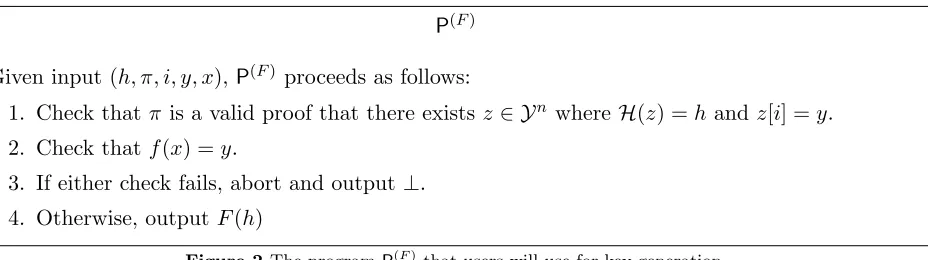
2. Compute the differing-inputs obfuscation P1obf of the programP1 =P(F) from
Fig-ure 2, using the size of the circuit to be max{|P(F)|,|P(h∗,Fh∗)
2 |} where P
(h∗,Fh∗) 2 is defined in Figure 3 in Appendix F.
It sets the public parameters as
PP=P1obf
- PublishNIKE(1λ, i): User ichooses a randomxi∈ X, and computesyi=f(xi)∈ Y. Useri keepsxi as its secret key, and publishesyi as its public value.
- KeyGenNIKE(PP,{yj}j=1,...,n, xi, i): To compute the shared secret, user i computes the Merkle hash h = H(y1, . . . , yn), and constructs a proof π that it knows a z such that
H(z) =handz[i] =yi. Then it computesk←P1obf(h, π, i, yi, xi).
P
(F)Given input (
h, π, i, y, x
),
P
(F)proceeds as follows:
1. Check that
π
is a valid proof that there exists
z
∈ Y
nwhere
H
(
z
) =
h
and
z
[
i
] =
y
.
2. Check that
f
(
x
) =
y
.
3. If either check fails, abort and output
⊥
.
4. Otherwise, output
F
(
h
)
Figure 2The programP(F) that users will use for key generation.
Parameter sizes.
Secret keys in our scheme just elements in the domain of a one-way function, which is independent of the number of users. published values are images, which are also independent of the number of users. The public key is an obfuscation of the program in Figure 2, which only depend logarithmically on the number of users.Untrusted Setup.
As described, our key exchange requires a trusted setup. However, as in [BZ13],SetupNIKE can be run independently fromPublishNIKE. Therefore, we can set party 1as the “master party” who runsSetupNIKE in addition to PublishNIKE, and publishes the public
key along with his published value. We note that the material published by player 1 is still relatively small: polylogarithmic in the number of users. This is in contrast to the scheme of [BZ13], where player 1 must publish material of sizepolynomial in the number of users.
Security.
The security of our scheme is given by the following theorem:Theorem 1. The scheme above is statically secure ifHis a collision resistant Merkle hash tree, F is a secure punctured PRF,f is a secure one-way function, and theP1obf is a differing-input obfuscation ofP(F).
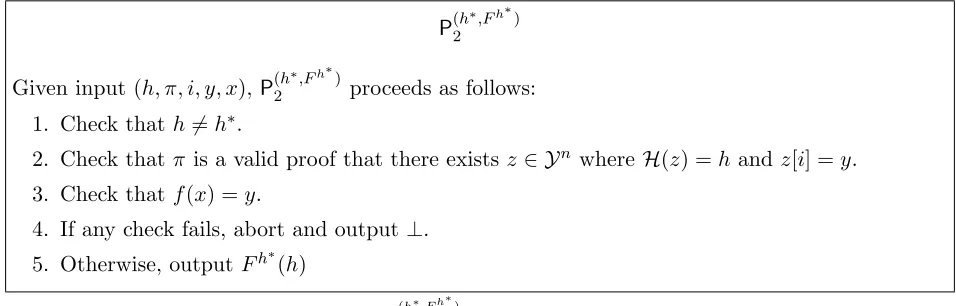
Here we sketch the proof — the full proof appears in Appendix F. Let h∗ be the the hash of the published valuesy1, . . . , yn. We punctureF ath∗, and add a check to the programP(F) thath6=h∗, resulting in a programP(h∗,Fh
∗ )
2 . The only inputs whereP(F)and P(h ∗,Fh∗)
differ have the form (h∗, π, i, y, x) where f(x) =y and π is a valid proof that there exists z ∈ Yn whereH(z) =h∗ andz[i] =y. We argue that such inputs are hard to compute. There are two cases:
• y = yi. Then x is a pre-image of yi under f. We can use such an input to break the one-wayness off.
• y6=yi. Then sinceπis valid, buth∗=H(y1, . . . , yn) withyi 6=y, the proof must yield a collision on the underlying collision resistant hashH.
Therefore, the only inputs onP(F) and P(h∗,Fh∗)
2 differ are hard to compute. Differing inputs obfuscation thus implies that the obfuscations of the two programs are indistinguishable. At this point, the adversary’s view only depends on the punctured PRFFh∗, and the security ofF shows that the shared secretk=F(h∗) is therefore indistinguishable from random, as desired.
4.2
Broadcast Encryption
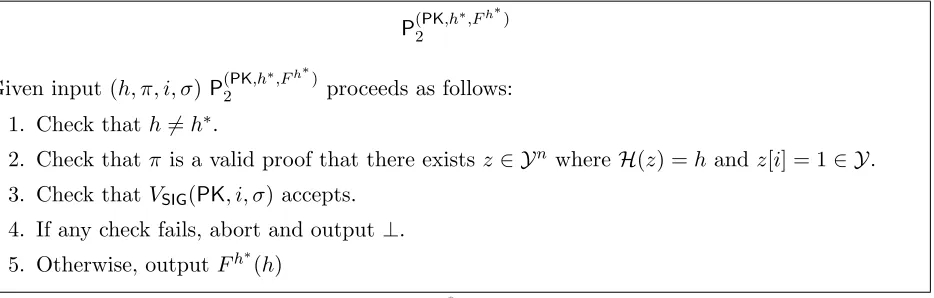
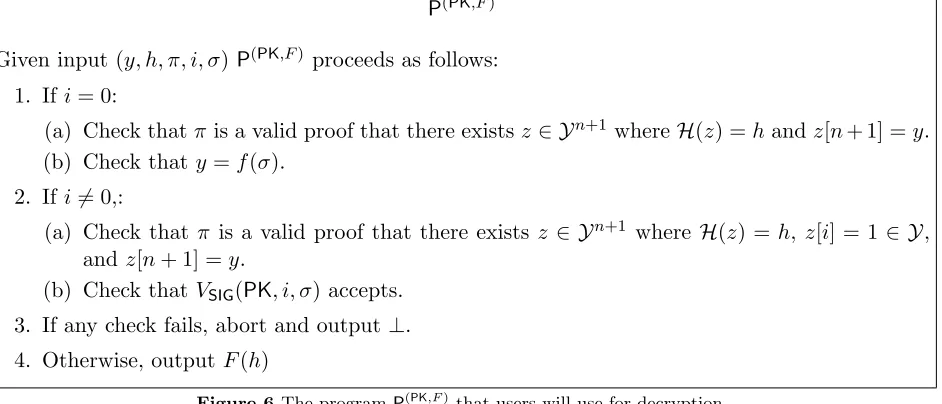
of users). However, the encryption key resulting from this conversion contains a public value for every user, and is therefore linear in size. In Appendix F, we give a direct construction using many of the same ideas as above. Our construction maintains constant-sized ciphertexts and secret keys while shrinking the public encryption key to logarithmic in the number of users.
Acknowledgements
We thank Rafael Pass for encouraging us to clearly specify the results for which we require SNARKs as against SNARGs. The first author would like to thank Alon Rosen for explaining the implications of the result in [BCPR13] and specifically clarifying the class of extractable one way functions ruled out by the existence of indistinguishability obfuscation.
References
[BCCT13] Nir Bitansky, Ran Canetti, Alessandro Chiesa, and Eran Tromer. Recursive com-position and bootstrapping for snarks and proof-carrying data. InProceedings of the 45th annual ACM symposium on Symposium on theory of computing, pages 111–120. ACM, 2013.
[BCP14] Elette Boyle, Kai-Min Chung, and Rafael Pass. On extractability obfuscation. In TCC, 2014.
[BCPR13] Nir Bitansky, Ran Canetti, Omer Paneth, and Alon Rosen. Indistinguishability obfuscation vs. auxiliary-input extractable functions: One must fall. 2013. http: //eprint.iacr.org/.
[BFM88] Manuel Blum, Paul Feldman, and Silvio Micali. Non-interactive zero-knowledge and its applications. In STOC, pages 103–112, 1988.
[BGI+12] Boaz Barak, Oded Goldreich, Russell Impagliazzo, Steven Rudich, Amit Sahai, Salil P. Vadhan, and Ke Yang. On the (im)possibility of obfuscating programs. J. ACM, 59(2):6, 2012.
[BGI13] Elette Boyle, Shafi Goldwasser, and Ioana Ivan. Functional signatures and pseu-dorandom functions. Cryptology ePrint Archive, Report 2013/401, 2013.
[BGK+13] Boaz Barak, Sanjam Garg, Yael Tauman Kalai, Omer Paneth, and Amit Sahai. Protecting obfuscation against algebraic attacks. Cryptology ePrint Archive, Re-port 2013/631, 2013. http://eprint.iacr.org/.
[BGW05] Dan Boneh, Craig Gentry, and Brent Waters. Collusion resistant broadcast encryp-tion with short ciphertexts and private keys. Advances in Cryptology — CRYPTO 2005, pages 1–19, 2005.
[BP13] Elette Boyle and Rafael Pass. Limits of extractability assumptions with dis-tributional auxiliary input. Cryptology ePrint Archive, Report 2013/703, 2013. http://eprint.iacr.org/.
[BR13] Zvika Brakerski and Guy N. Rothblum. Virtual black-box obfuscation for all cir-cuits via generic graded encoding. Cryptology ePrint Archive, Report 2013/563, 2013. http://eprint.iacr.org/.
[BS03] Dan Boneh and Alice Silverberg. Applications of multilinear forms to cryptography. Contemporary Mathematics, 324:71–90, 2003.
[BW13] Dan Boneh and Brent Waters. Constrained Pseudorandom Functions and Their Applications. Advances in Cryptology — AsiaCrypt 2013, pages 1–23, 2013. [BZ13] Dan Boneh and Mark Zhandry. Multiparty key exchange, efficient traitor tracing,
and more from indistinguishability obfuscation. Cryptology ePrint Archive, Report 2013/642, 2013. http://eprint.iacr.org/.
[Dam90] Ivan Bjerre Damg˚ard. A design principle for hash functions. InAdvances in Cryp-tology—CRYPTO’89 Proceedings, pages 416–427. Springer, 1990.
[Del07] C´ecile Delerabl´ee. Identity-Based Broadcast Encryption with Constant Size Ci-phertexts and Private Keys. 2:200–215, 2007.
[DPP07] C´ecile Delerabl´ee, Pascal Paillier, and David Pointcheval. Fully collusion secure dynamic broadcast encryption with constant-size ciphertexts or decryption keys. PAIRING 2007, (July), 2007.
[FN94] Amos Fiat and Moni Naor. Broadcast encryption. Advances in Cryptology — CRYPTO 1993, 773:480–491, 1994.
[GGG+14] Shafi Goldwasser, S. Dov Gordon, Vipul Goyal, Abhishek Jain, Jonathan Katz, Feng-Hao Liu, Amit Sahai, Elaine Shi, and Hong-Sheng Zhou. Multi-input func-tional encryption. InEUROCRYPT, 2014.
[GGH13a] Sanjam Garg, Craig Gentry, and Shai Halevi. Candidate multilinear maps from ideal lattices. InEUROCRYPT, 2013.
[GGH+13b] Sanjam Garg, Craig Gentry, Shai Halevi, Mariana Raykova, Amit Sahai, and Brent Waters. Candidate indistinguishability obfuscation and functional encryption for all circuits. Proc. of FOCS (to appear), 2013.
[GGHW13] Sanjam Garg, Craig Gentry, Shai Halevi, and Daniel Wichs. On the implausibility of differing-inputs obfuscation and extractable witness encryption with auxiliary input. Cryptology ePrint Archive, Report 2013/860, 2013. http://eprint.iacr. org/.
[GGM86] Oded Goldreich, Shafi Goldwasser, and Silvio Micali. How to Construct Random Functions. Journal of the ACM (JACM), 33(4):792–807, 1986.
[GGSW13] Sanjam Garg, Craig Gentry, Amit Sahai, and Brent Waters. Witness encryption and its applications. In STOC, 2013.
[GK03] Shafi Goldwasser and Yael Tauman Kalai. On the (in) security of the fiat-shamir paradigm. In Foundations of Computer Science, 2003. Proceedings. 44th Annual IEEE Symposium on, pages 102–113. IEEE, 2003.
[GKP+13a] Shafi Goldwasser, Yael Kalai, Raluca Ada Popa, Vinod Vaikuntanathan, , and Nickolai Zeldovich. How to run turing machines on encrypted data. InCRYPTO, 2013.
[GKP+13b] Shafi Goldwasser, Yael Kalai, Raluca Ada Popa, Vinod Vaikuntanathan, and Nick-olai Zeldovich. Succinct functional encryption and applications: Reusable garbled circuits and beyond. InSTOC, 2013.
[GW11] Craig Gentry and Daniel Wichs. Separating succinct non-interactive arguments from all falsifiable assumptions. InProceedings of the 43rd annual ACM symposium on Theory of computing, pages 99–108. ACM, 2011.
[Had00] Satoshi Hada. Zero-knowledge and code obfuscation. pages 443–457, 2000.
[LO13] Steve Lu and Rafail Ostrovsky. Distributed oblivious ram for secure two-party computation. InTCC, pages 377–396, 2013.
[Mer88] Ralph Merkle. A digital signature based on a conventional encryption function. In CRYPTO, pages 369–378, 1988.
[Mer90] Ralph C Merkle. One way hash functions and des. In Advances in Cryptol-ogy—CRYPTO’89 Proceedings, pages 428–446. Springer, 1990.
[OS97] Rafail Ostrovsky and Victor Shoup. Private information storage (extended ab-stract). pages 294–303, 1997.
[PF79] Nicholas Pippenger and Michael J Fischer. Relations among complexity measures. Journal of the ACM (JACM), 26(2):361–381, 1979.
[PPS13] Omkant Pandey, Manoj Prabhakaran, and Amit Sahai. Obfuscation-based non-black-box simulation and four message concurrent zero knowledge for np. Cryptol-ogy ePrint Archive, Report 2013/754, 2013. http://eprint.iacr.org/.
[Sah99] Amit Sahai. Non-malleable non-interactive zero knowledge and adaptive chosen-ciphertext security. InFOCS, pages 543–553, 1999.
[SF07] Ryuichi Sakai and Jun Furukawa. Identity-Based Broadcast Encryption. IACR Cryptology ePrint Archive, 2007.
[SS10] Amit Sahai and Hakan Seyalioglu. Worry-free encryption: functional encryption with public keys. InCCS, pages 463–472, 2010.
[SW08] Elaine Shi and Brent Waters. Delegating capabilities in predicate encryption sys-tems. InAutomata, Languages and Programming, pages 560–578. Springer, 2008.
A
Indistinguishability Obfuscation for Turing machines
and FE for Turing machines: Definitions
A.1
i
O
for Turing machines
We define the notion of indistinguishability obfuscation for Turing machines similar to the definition of indistinguishability obfuscation for circuits. Note that the two Turing machines that need to be obfuscated in the security game, should not only be identical on all inputs but they also need to having the same running time on all the inputs. Note that the definition of differing-inputs obfuscation for Turing machines implies the following definition and hence our construction in Section 3 also satisfies this definition.
Definition 6. (Indistinguishable Obfuscators for Turing machines) A uniform PPT machineiOTM is called a Turing machine indistinguishable Obfuscators for the Turing machine familyM, if the following conditions are satisfied:
• Correctness: For all security parameters λ ∈ N, for all M ∈ M, for all inputs x, we
have that
Prob[M0(x) =M(x) : M0←iOTM(λ, M)] = 1
• Indistinguishable Obfuscation: For any (not necessarily uniform) PPT distinguisher D, there exists a negligible function αsuch that the following holds: For all security pa-rameters λ ∈ N, for all M0, M1 ∈ M,aux such that for all x, M0(x) = M1(x) and
time(M0, x) =time(M1, x)we have that
In addition to the above properties if iOTM satisfies the following properties, with respect to a universal polynomialp, then we say thatiOTM issuccinctand has input-specific run time.
• Succinct: The size ofM0 isp(λ,|M|), where|M|denotes the size of the Turing machine M.
• Input-specific run time: The running time ofM0 on an input xisp(λ,time(M, x)).
A.2
Functional Encryption for Turing machines
We cast the definition of functional encryption in Garg et al. [GGH+13b] for the case of Turing machines. Though the notion of functional encryption for Turing machines have already been defined by Goldwasser et al. [GKP+13a], our definition differs from their definition in many ways – (i) single key versus many key queries, (ii) simulation based versus indistinguishability game based and so on. While defining FE for Turing machines we restrict the adversary to make only certain type of function queries which is based on the running time of the function. This is to avoid trivial attacks where the attacker will be able to distinguish the encryptions of two messages by choosing a function query whose running time is significantly different on both the messages.
Definition 7. Let the message space be S = Sλ. A functional encryption scheme defined for a family of Turing machinesMT, parameterized by a Turing machine T, consists of four algorithmsFE={Setup,KeyGen,Encrypt,Decrypt}:
• Setup(1λ)- a polynomial time algorithm that takes the unitary representation of the security paramterλand outputs a public paramteres PPand a master secret key MSK.
• KeyGen(MSK, f) - a polynomial time algorithm that takes as input the master secret key
MSKand a functionf implementable by a Turing machine M ∈ M and outputs a corre-sponding secret keySKf.
• Encrypt(PP, x) - a polynomial time algorithm that takes the public parameters PP and a stringx∈ S and outputs a ciphertext CT.
• Decrypt(SKf,CT)- a polynomial time algorithm that takes a secret keySKf and ciphertext encrypting messagex∈ S and outputs f(x).
A functional encryption scheme is correct for Mif for all M ∈ Mand all messages x∈ S :
Prob[(PK,MSK)←Setup(1λ);Decrypt(KeyGen(MSK, f),Encrypt(PK, x)) =f(x)] =negl(λ) We now define the (fully) indistinguishability security for functional encryption which is de-scribed in form of an indistinguishability game between an attackerAand a challenger.
Setup: The challenger runs (PK,MSK)←Setup(1λ) and givesPPto A.
Query: A submits queries fi ∈ M. We assume, without loss of generality that fi can be represented by a Turing machineMi which, on an input x, outputsfi(x) along with the time taken byMi to execute onx. The adversaryAis then givenSK←KeyGen(MSK, fi)
Challenge: The adversary then outputs messages (x0, x1) such that f(x0) = f(x1) for all f submitted byAduring the query phase.
Query: Aexecutes another query phase. It submits queries of the formfi ∈ Mwhich are rep-resented by Turing machinesMi as in the previous Query phase. Iffi(x0) =fi(x1), adversary
Guess: Aeventually outputs a bitb0 in{0,1}.
The advantage of an adversaryAis defined to be|Prob[b0 =b]−1 2|.
Definition 8. A functional encryption scheme is (fully) indistinguishability secure if for any PPT adversaryA, the advantage ofA in the above indistinguishability game is negligible. In addition to the above properties, we also consider the following two properties for functional encryption schemes for Turing machines.
• Succinctness: A functional encryption scheme is said to be succinct if the functional key generated using KeyGen for the function f is p(λ,|M|), where p is a polynomial andM
denotes the size of the Turing machine representing the functionf.
• Input-specific run time: A functional encryption scheme is said to have input-specific run time if the decryption algorithm on input a functional key for a function f along with an encryption of x, takes time p(λ,time(M, x)), where M is the Turing machine representing the functionf.
A weaker notion, calledselective security can also be considered where the adversary submits his challenge message to the challenger even before the challenger executes the setup phase.
B
Background
B.1
Fully Homomorphic Encryption
We define the notion of fully homomorphic encryption (FHE) scheme. It consists of four PPT algorithms (KeyGen,Encrypt,Decrypt,Eval) defined as follows.
• KeyGen(1λ): On input a security parameter 1λ it outputs a public key PKFHE and a
decryption keySKFHE.
• Encrypt(m,PKFHE): On input a messagem and public keyPKFHE it outputs a ciphertext
denoted byCT.
• Decrypt(CT,SKFHE): On input a ciphertext and a decryption key SKFHE it outputs a
messagem.
• Eval(CT,PKFHE, f): On input a ciphertext, a public key8and a functionf, outputs another
ciphertextCT0 such that the decryption ofCT0 yields the messagef(m).
The security of FHE is defined very similar to the security of the IND-CPA public key encryp-tion scheme. There does not exist any PPT adversary A such that, for any pair of messages
m0, m1, the probability that on inputEncrypt(m0,PKFHE) it outputs 0 is negligibly close to the
probability that on inputEncrypt(m1,PKFHE) it outputs 0.
B.2
FHE for Turing machines
We present the construction of the compiler verbatim from Goldwasser et. al. [GKP+13a] be-low. The compiler, denoted by CompileTMFHE, takes as input a Turing machineM and a number of stepst, and produces a Turing machine that computes the FHE evaluation ofM fortsteps. Letbxdenote the FHE encryption of x.
CompileTMFHE(M, t):
8
• First, transform M into an oblivious Turing machine MO by applying the Pippenger-Fischer transformation [PF79] for time bound t. This transformation results in a new Turing machine MO and a transition functionδ for MO. Namely, δ takes as input tape input bitb, a statestateand outputs a new statestate0, new contentb0for the tape location, and bitnextindicating whether to move left or right; namelyδ(b,state) = (state0, b0,next). Let the movement function next be such that next(i) indicates whether the head on the input tape ofMO should move left or right after stepi.
• Based on (MO,next), construct a new Turing machine MFHE that takes as input a FHE public keyPKFHE and an input encryption xb. MFHE applies the transition functionδFHE
(the FHE evaluation ofδusingPKFHE)ttimes. Each cell of the tapes of MO corresponds to an FHE encrypted value forMFHE. The state ofMFHEat timeiis the FHE encryption of the state ofMOcorresponds to an FHE encrypted value forMFHE. The state ofMFHEat timeiis the FHE encryption of the state ofMOat timei. At stepi, the transition function δFHEtakes as input the encrypted bit from the input tapebbthat the head currently points at, the current encrypted statestate[ and outputs an encrypted new statestate[0 and a new contentbb0. To determine whether to move the head left of right, computenext(i).
• Output the description ofMFHE.
The running time ofCompileTMFHEandMFHEis polynomial int. The Turing machineMFHE takes as input a public key and a ciphertext and then performs the FHE evaluation of M on the ciphertext. The resulting answer is then output byMFHE.
B.3
Succinct Non Interactive Arguments of Knowledge
We now give background for succinct non-interactive arguments of knowledge. We present the details verbatim from Goldwasser et al. [GKP+13a]. We define the universal relation as a canonical form to represent verification-of-computation problems.
Definition 9. [BCCT13] The universal relation is the setRU of instance-witness pairs(y, w) = ((U, x, t), w), where |y|,|w| ≤t andU is a Turing machine, such that U accepts (x, w) after at mosttsteps. We denote byLU the universal language corresponding toRU. For anyc∈N, the
universal NP relation is the setRU,c, defined asRU with the additional constraint thatt≤ |x|c. A SNARK is a triple of algorithms (Setup, P, V) that works as follows.
• The generator Setup on input the security parameter λ, samples a reference string CRS
(since we consider publicly verifiable SNARKs, theCRScan also contain the public verifi-cation state). TheSetupalso takes as input a time boundB but we set this toB =λlogλ which will never be achieved for NP language. Therefore, for simplicity, we do not make
B explicit from now on.
• The honest proverP(CRS, y, w) produces a proofπfor the statementy= (U, x, t) given a valid witnessw.
• The verifierV(CRS, y, π) takes as input theCRS, the instancey and a proofπand deter-ministically verifiesπ.
The SNARK is adaptive if the prover may choose the statement after seeingCRS.
Definition 10. A triple of algorithms(Setup, P, V)for the relation RU,c, where Setupis prob-abilistic andV is deterministic, is a SNARK if the following conditions are satisfied:
• Completeness: For every large enough security parameterλ∈N, and for every
instance-witness pair(y, w) = ((U, x, t), w)∈RU,
• Proof of knowledge: For every polynomial-size proverP∗ there exists a polynomial-size extractor Ext such that for every large enough security parameterλ∈ N, every auxillary
inputz∈ {0,1}poly(λ), and every constantc:
Prob[CRS←Setup(1λ); (y, π)←P∗(CRS, z); w←Ext(CRS, z) :
V(CRS, y, π) = 1 and(y, w)∈/RU,c] = negl(λ).
• Efficiency. There exists a universal polynomial p such that, for every large security parameterλand every instancey= (M, x, t),
1. The generator Setup(1λ) runs in timep(λ);
2. The proverP(CRS, y, w)runs in timep(λ,|U|,|x|, t); 3. The verifier V(CRS, y, π)runs in time p(λ,|U|,|x|); 4. An honestly generated proof has size p(λ).
Bitansky et al. [BCCT13] demonstrated a SNARK proof system under knowledge of exponent assumptions.
B.4
IND-CPA secure PKE
An IND-CPA (or semantically) secure Public Key Encryption scheme consists of three PPT algorithms (KeyGen,Encrypt,Decrypt) described as follows.
1. KeyGen(1λ): On input 1λ, it outputs public keyPK
PKE and decryption keySKPKE.
2. Encrypt(m,PKPKE): On input messagemand the public key, it outputs a ciphertextCT.
3. Decrypt(CT,SKPKE): On input a ciphertextCTand the decryption key, it outputsm.
The IND-CPA scheme is said to be semantically secure if for any PPT adversaryA, there exists a negligible functionαsuch that the following is satisfied for any two messagesm0, m1 and for b∈ {0,1}:
|Prob[A(1λ,Encrypt(m0,PKPKE)) =b]−Prob[A(1λ,Encrypt(m1,PKPKE)) =b]| ≤α(λ)
B.5
Simulation sound NIZK
We define the notion of simulation sound non-interactive zero knowledge [Sah99], which is a specific type of NIZK [BFM88] proof system. Intuitively, this notion says that there does not exist any efficient adversary even after receiving “fake” proofs for statements of his choice he cannot output any convincing proof, including fake proofs, for a statement for which he had not received any proof before.
More formally, a simulation-sound NIZK satisfies the following property along from the completeness and zero knowledge properties of any NIZK proof system. Consider the following game defined for PPT any adversaryA. The game begins with the execution of the simulator of the NIZK proof system who generates a fake CRS and a corresponding trapdoor. Then,
A is given oracle access to a simulator which has a corresponding trapdoor. The adversary can submit any statement to this oracle and he will correspondingly get back a convincing proof (which is accepted by the NIZK verifier). The game ends withAoutputting (x,Π). The adversary wins the game if (1) x was not equal to any of the statements he had queried the oracle and (2)xis not in the language for which the NIZK is defined and (3) Π is accepted by the NIZK verifier. We now define the simulation soundness property of a NIZK proof system.
C
Proof of Security of
di
O
for TMs
We prove the correctness as well as the security of thediOfor TMs scheme presented in Section 3. Crucial to both these properties is the following lemma which shows that the program class can be implemented by a differing-inputs circuit family. To do this, we first define a PPT algorithm
SamplerMP corresponding to the program class P as follows. The sampler SamplerMP receives as input security parameterλalong with (M0, M1,auxM), where (M0, M1,auxM) is the output of SamplerM, which is the sampler algorithm of M. The sampler SamplerMP first executes the setup algorithm of FHEtwice to obtain (PK1FHE,SK1FHE),(PK2FHE,SK2FHE). Then, the Turing machinesM0andM1are encrypted using the public keysPK1FHEandPK
2
FHEto obtaing1andg2 respectively. Finally, execute the setup algorithm of the SNARK proof system to obtainCRS. Output the programs P(g1,g2,CRS)
(SK1
FHE,PK1FHE,PK2FHE)
and P(g1,g2,CRS)
(SK2
FHE,PK1FHE,PK2FHE)
. The auxillary information,
denoted byauxM
P , consists of (auxM,PK1FHE,PK 2
FHE,CRS).
Lemma 1. Consider a class of programsP, defined as before. LetP1 =P(g1,g2,CRS)
(SK1
FHE,PK1FHE,PK2FHE)
and
P2 = P(g1,g2,CRS)
(SK2
FHE,PK
2
FHE,PK
2
FHE)
along with auxillary informationauxMP be the output of sampler algo-rithmSamplerMP . There does not exist any PPT adversary Aon input (P1,P2,auxMP ) outputs y such that P1(y) 6= P2(y), with non-negligible probability under the assumption that M is a differing-inputs Turing machine family.
To prove this, we assume that there exists an adversaryAthat outputsy such thatP1(y)6=
P2(y). UsingA, we construct another adversaryAM which violates the differing-inputs prop-erty of M arriving at a contradiction. Before we proceed further, we make a notational simplification. We assume that the input to P1 (or P2) can be parsed as (z, ϕ), where z = (i, e(i)1 , e(i)2 , g1, g2, hx, t, ϕ).
We present the following claims that will be useful when we calculate the probability of suc-cess ofAM. The first claim says that if the programsP1 andP2 differ on any input y= (z, ϕ) then the verifiers both inP1 andP2 accept the proofϕ. Recall that any program inP has two components, namely the SNARK verifier along with FHE decryption circuit. The second claim states that if both the programs differ on any input (z, ϕ) then the output of P1 (resp.,P2) is the decryption ofe(i)1 (resp.,e(i)2 ). Hence, as a consequence, we have that the decryption ofe(i)1
(with respect toPK1FHE) different from the decryption ofe (i)
2 (with respect toPK 2
FHE). We now
state the claims.
Claim 11. If there exists ay= (z, ϕ) such thatP1(y)6=P2(y) then the verifier in bothP1 and
P2 acceptϕ.
Proof. The first observation is that the verifier as part ofP1 is same as the verifer which is part ofP2. The second observation is that the verifier inP1 (resp.,P2) does not reject the proofϕ. This is because, if the verifier in P1 (resp., P2) rejects then the output of P1 (resp., P2) is 0 which will contradict our hypothesis that the output of the two programs are different.
Claim 12. If there existsy= (i, e(i)1 , e(i)2 , hx, t, ϕ) such thatP1(y)6=P2(y) then the output of
P1 (resp., P2) is the decryption of e(i)1 (resp.,e2(i)) with respect toPK1FHE (resp.,PK2FHE). Proof. From Claim 11, we have that the verifiers as part of bothP1 andP2 accept and hence, the output ofP1(y) is the decryption ofe(i)1 with respect toPK1FHE and similarly, the output of
P2 is the decryption ofe(i)2 with respect toPK2FHE.
Now, consider the following adversary. Since (P, V) which is a SNARK system has knowledge extractability property we assume that there exists an extractor Ext = (Ext1,Ext2) such that
extracts a witness corresponding to that instance9.
AM(M0, M1,auxM): (SK1FHE,PK
1
FHE)←SetupFHE(1λ)
(SK2FHE,PK 2
FHE)←SetupFHE(1λ)
(CRS,td)←Ext1(1λ) g1←EncryptFHE(PK
1 FHE, M0) g2←EncryptFHE(PK
2 FHE, M1) DenotediO(λ,P(g1,g2,CRS)
(SK1
FHE,PK
1
FHE,PK
2
FHE)
) byP1
DenotediO(λ,P(g1,g2,CRS)
(SK2
FHE,PK1FHE,PK2FHE)
) byP2
y← A(P1,P2,auxMP = (PK1FHE,PK2FHE, g1, g2,CRS)) Parseyas (z, ϕ)
x←Ext2(z, ϕ,CRS,td) Outputx
The next claim shows that if A can produce an input y such that P1(y) 6= P2(y) with non-negligible probability thenAM violates the security game of the differing-inputs corresponding to the familyM(Definition 4). Before we go ahead and prove the claim, we first observe that the distribution of (P1,P2,auxMP ) as input to A in the description ofAM is the same as the output distribution ofSamplerMP .
Claim 13. Let (P1,P2,auxM
P ) ← Sampler M
P (1λ). If there exists an adversary A on in-put (P1,P2,aux) outputs y with non-negligible probability then the adversary AM on input (M0, M1), which is the output ofSamplerM(1λ), producesxsuch thatM0(x)6=M1(x). Proof. Suppose the adversaryAoutputsy such that P1(y)6=P2(y) with non-negligible proba-bility. We make the following two observations that will prove the above claim.
• Using Claim 11, we have the fact that the verifier accepts the proofϕcorresponding to the instance z with non-negligible probability, where y can be parsed as (z, ϕ) is the output of A. From the knowledge extractability property, we have the fact that the extractor outputs a valid witnessxwith non-negligible probability. Since,xis a valid witness toz, we have the fact thate(i)1 is an encryption ofM0(x) with respect to public keyPK1FHEand
similarly,e(i)2 is an encryption ofM1(x) with respect to public keyPK2FHE.
• Using Claim 12, we have that the output of program P1 (resp., P2) is the decryption of g1 (resp., g2) with respect to PK1FHE (resp., PK
2
FHE). Rephrasing this in terms of first
observation, the output of P1 on input y is M0(x) and the output of P2 on input y is M1(x). Since,y is such thatP1(y)6=P2(y) with non-negligible probability, we have that M0(x)6=M1(x). This completes the proof.
The above claim contradicts the assumption thatMis a differing-inputs Turing machine family and this provesP is a differing-inputs circuit family.
Corollary 2. Differing-inputs obfuscation for the circuit familyP exists under the assumption that IND-CPA FHE exists, SNARKs exists, collision resistant hash functions and differing-inputs obfuscation exists for any differing-differing-inputs circuit family.
We now prove the correctness and the security of the differing-inputs obfuscation scheme.
9
We emphasise that this is the only place where we need the extractability property. As mentioned a couple of times before, if the length of the witness (which in this case is the input toM0orM1) is bounded above apriori then