James K. Biedler,
1,2Hongguang Shao
2,3and Zhijian Tu
2Department of Biochemistry, Virginia Polytechnic Institute and State University, Blacksburg, Virginia 24061 Manuscript received August 25, 2007
Accepted for publication September 24, 2007
ABSTRACT
ITmD37E, a unique class II transposable element (TE) with an ancient origin, appears to have been involved in multiple horizontal transfers in mosquitoes asITmD37Esequences from 10 mosquito species of five genera share high nucleotide (nt) identities. For example,ITmD37Esequences fromAedes aegypti andAnopheles gambiae, which have an estimated common ancestor of 145–200 million years ago, display 92% nt identity. The comparison ofITmD37Eand host mosquito phylogenies shows a lack of congruence. The wide distribution of conservedITmD37Es in mosquitoes and the presence of intact copies suggest that this element may have been recently active.
T
RANSPOSABLE elements (TEs) are mobile ge-netic elements that are able to replicate and in-crease their copy number in a genome (Doolittleand Sapienza1980). They are divided into RNA-mediated (class I) and DNA-mediated (class II) elements on the basis of their mechanism of transposition. Class I elements include long terminal repeat (LTR) retrotransposons, non-LTR retrotransposons, and SINEs, all retrotrans-posing via an RNA intermediate. Class II elements in-cludeTc1,mariner, and theP element, which transpose by a ‘‘cut-and-paste’’ mechanism.Horizontal transfer has been reported for many class II elements in insects (Kidwell1992; Robertson1993, 2002; Bonnivardet al.2000; Handlerand McCombs 2000; Silvaet al.2004). We have previously described a DNA TE named ITmD37Ein mosquitoes, which has a unique DD37E catalytic triad (Shaoand Tu2001). Here we report the ancient origin, evolution, and horizontal transfer ofITmD37Eelements in mosquitoes.
ITmD37E in mosquitoes: A representativeITmD37E
element fromAn. gambiaeis 1.3 kb in length and con-tains a 1008-bp open reading frame (ORF) and imper-fect 27-bp terminal inverted repeats. Insertions are flanked by a TA dinucleotide target-site duplication.
A genomic database search revealed 18 and 3 elements, respectively, in theAe. aegyptiandAn. gambiaegenomes. Full-length copies with intact ORFs could be found only in An. gambiae. Additional ITmD37E element copies were obtained from other mosquito species using ge-nomic library screening and polymerase chain reaction and submitted to NCBI (see supplemental File S2 at http://www.genetics.org/supplemental/ for information about sequences used in this study). Interestingly, no representatives could be found in theCulex pipiensEST database or in the newly released genomic assembly (http://www.vectorbase.org).
ITmD37E TEs found in divergent taxa suggest an ancient origin: Database searches (NCBI) revealed the existence ofITmD37Erepresentatives in divergent fresh-water invertebrates such asPhilodina roseola(Arkhipova and Meselson 2005), Dugesia ryukyuensis, and Hydra
magnipapillata (Figure 1). All three H. magnipapillata
sequences were found in the EST database and are short sequences. Two of the three sequences include the region spanning the second D and E residues that are a part of the DD37E catalytic triad motif. The only
D. ryukyuensissequence that could be found was from an EST database and this sequence contains all three residues of the triad. The H. magnipapillatasequences group with mosquitoITmD37Esequences, having strong phylogenetic support. TheP. roseolaandD. ryukyuensis
sequences are more distantly related to the mosquito
ITmD37E sequences, although they have the DD37E motif. They may simply represent a sampling from a divergent paralogous lineage. In summary, this analysis 1Corresponding author:Department of Biochemistry, Virginia
Polytech-nic Institute and State University, 315 Fralin, W. Campus Dr., Blacksburg, VA 24061. E-mail: [email protected]
2These authors contributed equally to this article.
3Present address: Monell Chemical Senses Center, Philadelphia, PA 19104.
suggests that the ITmD37E TEs are a longstanding group.
High nucleotide identities between copies from di-vergent hosts suggest horizontal transfer: Several spe-cies from five genera haveITmD37E copies that share high nucleotide (nt) identities in their coding regions (Table 1). Sequences fromAe. aegyptiandAn. gambiae, which have an estimated common ancestor of 145–200 million years ago (MYA) (Krzywinskiet al.2006), have 93% identity in the coding region. The conservation is not restricted to the coding regions, as both 59- and 39 -untranslated regions (UTRs) have a consistently high degree of conservation. The 162-bp 59-UTR and the 125-bp 39-UTR have 90 and 87% nt identity, respectively. Sequence comparisons between other highly divergent
species such asAe. aegyptiandToxorhynchites amboinensis
also demonstrate high nt identities (.95%).
It is important to note that of 300 class II elements from Ae. aegyptiandAn. gambiae, there are only 2 ele-ments with copies sharing at least 80% nt identity for 500 bp or more between the two genomes. Two hundred forty-eightAe. aegyptielements and 52 An. gambiae ele-ments (http://tefam.biochem.vt.edu/tefam/index.php) were used as queries in BLASTN against Ae. aegyptior
An. gambiaewhole-genome sequences and then output was filtered for minimum 80% nt identity and mini-mum hit lengths of 500 bp. AaegITmD37E_Ele4 and
AgamITmD37E_Ele1 have the highest identities, with 90% for 1300 bp½alignment by CLUSTAL_X (Thompson
(Swofford 2002) results in 92%. The next highest identity match was betweenTangoelements (80% iden-tity over a 500-bp fragment), which have been reported to be involved in horizontal transfer (Coyand Tu2007).
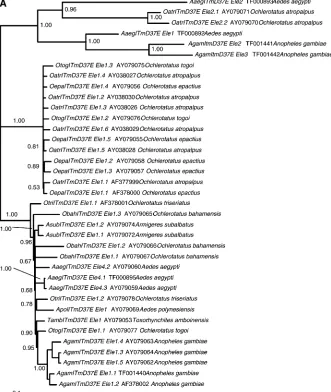
Host and ITmD37E phylogenies are incongruent: Comparison of the host species vitellogenin C (Vg-C) andITmD37Ephylogenies shows that there is a lack of congruence (Figure 2, A and B). There are three major
Ae. aegypti 95.2 78.9 93.2 95.3 79.0 95.4
Ae. polynesiensis 93.2 78.4 91.1 93.0 78.7 93.2 93.2
O. triseriatus 94.6 80.6 92.1 94.2 81.1 94.6 93.9 92.0
Numbers are percentages. Only coding regions were compared because they were the only sequence available for some copies. Pairwise nt identities were determined by PAUP (Swofford2002) after alignment with CLUSTAL_X (Thompsonet al.1997).Ae. ae-gypti,AaegITmD37E_Ele 4.1;Ae. polynesiensis,ApolITmD37E_Ele1;Ar. subalbatus,AsubITmD37E_Ele1.2;O. atropalpus,OatrITmD37E_Ele1.1; O. epactius,OepaITmD37E_Ele1.1; O. togoi,OtogITmD37E_Ele1.1; O. triseriatus, OtriITmD37E_Ele1.1;An. gambiae,AgamITmD37E_Ele1.1; T. amboinensis,TambITmD37E_Ele1.See supplemental File S1 at http://www.genetics.org/supplemental/ for methods. Refer to supple-mental File S2 for sequence information.
groups in Figure 2A. The group at the bottom of Figure 2A shows a marked lack of congruence. TheAn. gambiae
sequences do form a clade, but nevertheless the phy-logeny is perplexing compared to the host phyphy-logeny. For example, the relative distances between sequences of Ae. aegypti (from both the library screen and the genomic database) and several other species such as
T. amboinensisandAn. gambiae(distant relatives),Ae. poly-nesiensis,Ochlerotatus triseriatus, andO. bahamensis(closely related species) do not make sense when compared to the host phylogeny. The phylogeny involving these se-quences is neither in agreement nor the same compared to the host phylogeny when the two are superimposed.
Selection pressure and codon bias are not responsi-ble for the high conservation found between three
ITmD37E copies from Ae. aegypti, T. amboinensis, and An. gambiae: It is possible that selection pressure or
codon bias could contribute to the high conservation of
ITmD37E sequences. To investigate these possibilities,
ITmD37E sequences from each of the three most di-vergent host species (Ae. aegypti, An. gambiae, and
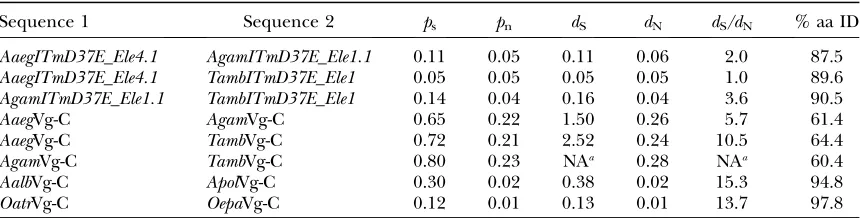
T. amboinensis) were analyzed for selection pressure (Table 2).dS/dN, a ratio of the synonymous and
non-synonymous substitutions between two sequences, was determined by SNAP (Neiand Gojobori1986; Korber 2000). Values ranged from 1.0 to 3.6 for all pairwise comparisons, showing very low to no significant selec-tion. There is no concern for substitution saturation in these cases, aspsandpnvalues are low.psandpnare the
proportion of observed synonymous and nonsynony-mous substitutions, respectively.dS/dNvalues for Vg-C,
a host gene known to be relatively rapidly evolving (Isoe 2000), were also obtained from the same three species. These values are significantly higher than that found for
ITmD37E sequences. Because these Vg-C comparisons are possibly saturated with respect to synonymous sub-stitution (ps is near or exceeding 0.75), we also
com-pared Vg-C sequences from closely related species in the Aedes and Ochlerotatus genera, which havepsvalues
sim-ilar to those of the above-mentionedITmD37Esequence comparisons. These Vg-C comparisons also displayed highdS/dNvalues, ranging from 13.7 to 15.3. Therefore,
the lowdS/dN values from the ITmD37E comparisons
suggest that the high sequence identity between the
ITmD37Eelements does not result from high selection pressure. The effective number of codons (Wright1990) determined by PDA (http://dpdb.uab.es/pda/pda.asp) (Casillasand Barbadilla2004) for all threeITmD37E sequences is 59–60, demonstrating no codon bias. Pos-sible values range from 20 (one codon per aa—high bias) to 61 (all codons used equally—no bias). These analyses suggest that selection pressure and codon bias are not responsible for the observed high degree of conservation. Discussion: There are generally three lines of evi-dence used to make a case for horizontal transfer: the discovery of sequences from divergent taxa having high nt identities, incongruence between TE and host phy-logenies, and a ‘‘patchy TE distribution’’ among related host taxa. We have shown the first two types of evidence here, and the support for the third is weak but worth mentioning (see below). First, high nt identities have been found betweenITmD37Esequences from 10 spe-cies of five genera (Table 1, Figure 2A). Particularly noteworthy is the comparison of copies fromAe. aegypti
andAn. gambiae, species that are estimated to have di-verged between 145 and 200 MYA. Second, host and TE phylogenies are clearly incongruent (Figure 2). Here we have many copies with such high nt identities that branch lengths are very short and phylogenetic resolution is low for some sequences. Finally, regarding patchy distribu-tion, noITmD37Erepresentatives could be found in the
C. pipiens genome assembly (http://www.vectorbase.
org) by database search or by genomic library screen (not shown). While this is consistent with patchy dis-tribution resulting from horizontal transfer, it is possible thatITmD37Ewas simply lost from this lineage.
When all these evidences are taken together, the case for horizontal transfer of ITmD37E in mosquitoes is strong. While alternative explanations can be provided, they are not likely. It could be argued that ITmD37E
copies have inserted into genomic regions having a low substitution rate. However, this argument is hard to make, given the nt identities of 92% between copies fromAe. aegyptiandAn. gambiae, species with a common ancestor from 145 to 200 MYA. This argument requires that conservedITmD37Ecopies from all species be inserted into locations with low substitution rates. We have de-termined the location of AgamITmD37E_Ele1 copies because chromosomal assignment is available only for
An. gambiae. Copies are present on all chromosome arms (determined by BLAST using Ensembl; not shown). Although we cannot completely rule out the low-sub-stitution-rate hypothesis, it seems unlikely.
ITmD37E could have been ‘‘co-opted’’ for a host function and therefore be highly conserved. First, it is unlikely that such an indispensable function in so many divergent mosquitoes would have been lost from
C. pipiens. Second, substitution analysis performed to detect selection pressure by SNAP (Neiand Gojobori 1986; Korber2000) (http://hcv.lanl.gov/content/hcv-db/SNAP/SNAP.html) using sequences from the three divergent speciesAe. aegypti,An. gambiae, andT. amboi-nensisshows a rather weak selection for sequences with this degree of conservation (Table 2). Even when we compare ITmD37E sequences to Vg-C, a gene under moderate selection, ITmD37E sequences still demon-strate a much lower selection pressure yet have much higher sequence conservation. Therefore, there is no in-dication that high conservation ofITmD37Esequences is due to selection. A low dSforITmD37Esequences is
AgamVg-C TambVg-C 0.80 0.23 NAa 0.28 NAa 60.4
AalbVg-C ApolVg-C 0.30 0.02 0.38 0.02 15.3 94.8
OatrVg-C OepaVg-C 0.12 0.01 0.13 0.01 13.7 97.8
Manually codon-aligned sequences (see supplemental File S4 at http://www.genetics.org/supplemental/) were used to determine selection pressure by SNAP (http://hcv.lanl.gov/content/hcv-db/SNAP/SNAP.html) (Korber 2000), a program that uses the method of Neiand Gojobori(1986).AgamITmD37E_Ele1.1andTambITmD37E_Ele1 have intact coding sequences.AaegITmD37E_Ele4.1has multiple frameshifts that were corrected by codon alignment. Most Vg-C sequences were obtained from Isoe(2000). See supplemental File S1 for methods.
a
consistent with the horizontal transfer hypothesis, as there has not been enough time for the accumulation of substitutions. This makes sense if horizontal transfer was recent and therefore not enough time had elapsed for selection to become evident bydS/dNanalysis. Third, we
have also shown that the conservation is not from codon bias, as the effective number of codons (Wright1990) for these sequences is very high, demonstrating effec-tively no bias.
It is difficult to determine the direction of horizontal transfer, but the relatively high nt identities among copies in both divergent and closely related taxa suggest that ITmD37E has been introduced into mosquitoes recently in evolution. It is interesting that both An. gambiaeandAe. aegypti have long coexisted in parts of Africa, providing a possible ecological connection for horizontal transfer, although we can only speculate about the mechanism. A common virus is a likely can-didate, where TE insertions that do not inactivate the viral copy are excised and inserted into a naive genome after infection. Although thepiggybac TE from a lepi-dopteran cell line has been found to be responsible for insertional mutations in baculoviruses (Fraser et al. 1983), no direct evidence for viral transmission as a mech-anism for horizontal transfer has been demonstrated.
The ITmD37E family has been very successful in mosquitoes evidenced by its widespread distribution in 10 species of five genera. Except for those found in a few other invertebrate species (Figure 1), to our knowledge no other ITmD37E representatives are known at this time. It will be interesting to see if this group is restricted to invertebrates.
The horizontal transfer ofITmD37Eand the presence of several copies with intact ORFs indicate thatITmD37E
has been recently active. Of the 39 mosquito copies used in this study, 9 from five species of four genera have intact ORFs. This may suggest thatITmD37Eelements are good candidates for developing molecular tools for transgenesis, as there has been significant success in using class II elements as molecular tools in mosquitoes (Adelman et al.2002; Perera et al.2002; O’Brochta
et al. 2003). Efforts to determine the transposition activity ofITmD37Eare currently underway.
We thank Jun Isoe from the laboratory of Henry Hagedorn for providing genomic libraries and Vg-C sequences and Shirley Luckhart for providing theAn. gambiaegenomic library. This work was supported by a grant from the National Institutes of Health (AI42121) to Z.T.
LITERATURE CITED
Adelman, Z. N., N. Jasinskieneand A. A. James, 2002 Development
and applications of transgenesis in the yellow fever mosquito, Ae-des aegypti. Mol. Biochem. Parasitol.121:1–10.
Arkhipova, I. R., and M. Meselson, 2005 Diverse DNA transposons
in rotifers of the class Bdelloidea. Proc. Natl. Acad. Sci. USA102:
11781–11786.
B , E., C. B , B. D and D. H , 2000 A scenario for the hobo transposable element invasion, deduced from the structure of natural populations of Drosophila melanogaster us-ing tandem TPE repeats. Genet. Res.75:13–23.
Casillas, S., and A. Barbadilla, 2004 PDA: a pipeline to explore
and estimate polymorphism in large DNA databases. Nucleic Acids Res.32:W166–W169.
Coy, M. R., and Z. Tu, 2007 Genomic and evolutionary analyses of
Tango transposons in Aedes aegypti, Anopheles gambiae and other mosquito species. Insect Mol. Biol.16:411–421. Doolittle, W. F., and C. Sapienza, 1980 Selfish genes, the
pheno-type paradigm and genome evolution. Nature284:601–603. Fraser, M. J., G. E. Smithand M. D. Summers, 1983 Acquisition of
host cell DNA sequences by baculoviruses: relationship between host DNA insertions and FP mutants of Autographa californica and Galleria mellonella nuclear polyhedrosis viruses. J. Virol.
47:287–300.
Handler, A. M., and S. D. McCombs, 2000 The piggyBac
transpo-son mediates germ-line transformation in the Oriental fruit fly and closely related elements exist in its genome. Insect Mol. Biol.
9:605–612.
Huelsenbeck, J. P., and F. Ronquist, 2001 MRBAYES: Bayesian
in-ference of phylogenetic trees. Bioinformatics17:754–755. Isoe, J., 2000 Comparative analysis of the vitellogenin genes of the
Culicidae. Ph.D. Thesis, University of Arizona, Tucson, AZ. Kidwell, M. G., 1992 Horizontal transfer of P elements and other
short inverted repeat transposons. Genetica86:275–286. Korber, B., 2000 Computational analysis of HIV molecular
sequen-ces, pp. 55–72 inHIV Signature and Sequence Variation Analyisis, edited by A. G. Rodrigoand G. H. Learn. Kluwer Academic
Pub-lishers, Dordrecht, The Netherlands.
Krzywinski, J., O. G. Grushkoand N. J. Besansky, 2006 Analysis of
the complete mitochondrial DNA from Anopheles funestus: an improved dipteran mitochondrial genome annotation and a temporal dimension of mosquito evolution. Mol. Phylogenet. Evol.39:417–423.
Nei, M., and T. Gojobori, 1986 Simple methods for estimating the
numbers of synonymous and nonsynonymous nucleotide substi-tutions. Mol. Biol. Evol.3:418–426.
O’Brochta, D. A., N. Sethuraman, R. Wilson, R. H. Hice, A. C.
Pinkertonet al., 2003 Gene vector and transposable element
behavior in mosquitoes. J. Exp. Biol.206:3823–3834.
Perera, O. P., I. R. Harrelland A. M. Handler, 2002 Germ-line
transformation of the South American malaria vector, Anopheles albimanus, with a piggyBac/EGFP transposon vector is routine and highly efficient. Insect Mol. Biol.11:291–297.
Robertson, H. M., 1993 The mariner transposable element is
wide-spread in insects. Nature362:241–245.
Robertson, H. M., 2002 Evolution of DNA transposons in
Eukar-yotes, pp. 1093–1110 inMobile DNA II, edited by N. L. Craig,
R. Craigie, M. Gellertand A. M. Lambowitz. American Society
for Microbiology, Washington, DC.
Ronquist, F., and J. P. Huelsenbeck, 2003 MrBayes 3: Bayesian
phy-logenetic inference under mixed models. Bioinformatics 19:
1572–1574.
Shao, H., and Z. Tu, 2001 Expanding the diversity of the
IS630-Tc1-mariner superfamily: discovery of a unique DD37E transposon and reclassification of the DD37D and DD39D transposons. Genetics159:1103–1115.
Silva, J. C., E. L. Loretoand J. B. Clark, 2004 Factors that affect
the horizontal transfer of transposable elements. Curr. Issues Mol. Biol.6:57–71.
Swofford, D. L., 2002 Phylogenetic Analysis Using Parsimony (*and
Other Methods).Sinauer Associates, Sunderland, MA.
Thompson, J. D., T. J. Gibson, F. Plewniak, F. Jeanmouginand D. G.
Higgins, 1997 The CLUSTAL_X windows interface: flexible
strategies for multiple sequence alignment aided by quality anal-ysis tools. Nucleic Acids Res.25:4876–4882.
Wright, F., 1990 The ‘effective number of codons’ used in a gene.
Gene87:23–29.