Laboratory Performance of Randomly
Oriented Plastic Waste in Subgrade of Flexible
Pavement
Dr. A.I.Dhatrak 1, Sunilkumar D. Konmare 2
Associate Professor, Department of Civil Engineering, Government College of Engineering, Amravati, Maharashtra,
India1
PG Student, Department of Civil Engineering, Government College of Engineering, Amravati, Maharashtra, India2
ABSTRACT: Plastic waste problem is now become very critical issue in aspect of decomposition, which is a challenge to environmental control system. Now plastic is not used for particular use, it becomes addiction in daily life of human being as well as in industry. Huge quantity of plastic waste is found in MSW i.e. drinking bottle, carry bags, packing paper etc. This plastic can be effectively used for improving the performance of flexible pavement, also solve the problem of disposal of plastic waste. The aim of project is to improve engineering properties of soil by using Plastic waste strips/ chips. On the basis of various research paper studies, it is observed that the soil stabilization using waste plastic bottles chips is an alternative method for improvement of sub grade soil of pavement used for construction of flexible pavement. This paper is based on the experimental work study on use of plastic waste in soil used for construction of flexible pavement and an attempt is made to control plastic waste pollution for green Environment as Geo environment trend. Experimental work includes compaction and CBR behaviours of plastic strips reinforced in soil. Comparative study of plain soil and composite soil was also studied in present research work.
KEYWORDS:Clayey Soil, Plastic Strips/Chips, CBR test.
I. INTRODUCTION
Several experimental studies have also been conducted to explore the effect of various parameters on the shear strength and compressibility characteristics of soils with randomly distributed plastic waste strips/chips in soil. The common results from the literature included the increase in shear strength, unconfined compressive strength and tensile strength of the soil. It is evident that the studies presented in literature focus mainly on the strength and deformation characteristics of soil with the reinforcement. Furthermore, the study on the use of plastic waste as a reinforcing material has been limited as field application approach. Hence in this project, ‘Laboratory Performance of Randomly Oriented Plastic Waste in Subgrade of Flexible Pavement’was studied, to determine the compaction and CBR behavior of plastic strip reinforced in subgrade of flexible pavement. Comparative Study of Plain Soil and Composite Soil (optimum percentage of plastic strips mixed soil) was also Studied.
II. LITERATUREREVIEW
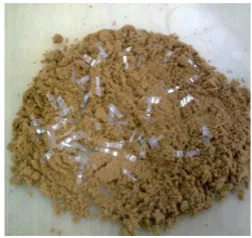
engineering as reinforcing material. The plastic waste mixed soil behaves as reinforced soil, similar to fiber reinforced soil. Figures 1 & 2. show the plastic waste chips and the plastic waste mixed soil respectively, which is used in his experimental study.
Fig. 1 Plastic Chips Fig. 2 Plastic Waste Mixed Soil
Babu, G.L.Sivakumar et.al (2011) presented paper on ‘Compressibility and permeability behaviour of plastic waste mixed Sand’. According to their investigation ,they provided experimental results on the one dimensional compression test and permeability for plastic waste mixed sand. Based on experimental test results, it was observed that the compressibility and permeability reduced significantly with addition of a small percentage of plastic waste to the soil. An empirical relation has been formulated among void ratio, permeability and percentage of fibre content. In his analysis, to investigate the effects of plastic waste on the engineering properties of soils, a series of tests were performed on sand. One-dimensional consolidation test was performed for different percentages of plastic waste mixed sand. The fibre reinforced sand sample is shown in Figure.3 which was used in his experimental study.
Fig. 3 Sand Mixed with Plastic Waste
Choudhary A.K. et.al (2010) studied CBR behavior of waste plastic strip reinforced soil. In his study, a series of California Bearing Ratio (CBR) tests were carried out on randomly reinforced soil by varying percentage of HDPE strips with different lengths and proportions. Results of CBR tests demonstrated that inclusion of waste HDPE strips in soil with appropriate amounts improved strength and deformation behavior of subgrade soils substantially. The proposed technique can be used to advantage in embankment/road construction.
Dr. D S V Prasad et.al. (2009)attempts are made to investigate the stabilization process with model test tracks over sand soil subgrade. The result shown that, the load carrying capacity of the model flexible pavement system has significantly increased for both murrum and flyash subbases reinforced with waste plastics as well as waste tyre rubber reinforced subbase model flexible pavement laid on sand subgrade. According to their cyclic load test results, it is observed that, waste plastics reinforced model flexible pavement has shown better performance in comparison with waste tyre rubber reinforced model flexible pavement for both murrum and flyash subbases. At all the deformation levels, murrum reinforced with different alternatives in model flexible pavements has shown better performance compared to flyash subbase reinforced with different alternatives.
Summary
Several experimental studies have also been conducted to explore the effect of various parameters on the shear strength and compressibility characteristics of soils with randomly distributed plastic waste strips/chips in soil. The common results from the literature included the increase in shear strength, unconfined compressive strength and tensile strength of the soil. Based on the experimental investigations following are some of the results obtained by various research work.
i) There is a good improvement in the strength of soil with inclusion of plastic waste.
ii) The compressibility and permeability reduced significantly with addition of a small percentage of plastic waste to the soil.
iii) Results of CBR tests demonstrated that inclusion of waste HDPE strips in soil with appropriate amounts improved strength and deformation behaviour of subgrade soils substantially.
iv) Using plastic bottles as a soil stabiliser is an economical and gainful utilization since there is scarcity of good quality soil for embankments and fills.
v) Waste plastics and waste tyre rubber could be used as alternative reinforcement materials in place of conventionally used reinforcing materials.
III.MATRIALANDMETHODOLOGY Material
Plastic Waste
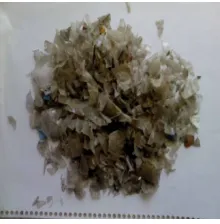
In this study, waste plastic bottles strips/chips was used, which was produced from drinking water bottles. Drinking water bottles are also locally called as Bislari Bottle. Waste plastic strips/ chips are locally available in MIDC Amravati which is produce from waste drinking water bottles. Plastic strips/chips produced in MIDC by Plastic Granulator. Plastic granular is simple mechanical unit, fitted with sharp cutter, which is cuts plastic waste into Plastic waste strips. Plastic Strips/chips were randomly mixed with soil. The plastic waste strips/chips, which was used in project shown as figure 4.
Fig. 4 Waste Plastic Bottle Strips /Chips
Soil
Methodology
Various laboratory tests were performed to determine the compaction characteristic, strength characteristic and stress strain. Characteristic of soil mixed with varying percentage of randomly oriented plastic bottles strips/chips. It was mainly included compaction test to determine OMC and MDD, and CBR soaked & unsoaked tests to determine the effectiveness as well as optimum percentage of plastic waste in the soil.
Laboratory CBR tests were perform to calculate the optimum percentage of plastic waste strips/chips. In this test, plastic waste strips were mixed with soil in percentage of dry weight of soil ie 0%, 0.5%, 1.0%, 1.5%,2.0% 2.5% etc. Clayey soil mixed with optimum 2% plastic strips/chips by randomly oriented is called composite soil. Composite subgrade is earth embankment of road work improved with randomly oriented optimum 2% plastic waste strips/chips.
Test Program Introduction
Detailed schedule / test program for present study is presented in below.
1. Routine Tests on Clayey Soil
The Soil used, in these investigations was obtained from the premises of Govt. Engineering College Amravati. The following tests were performed to determine the properties of the clay soil.
i) Grain Size Distribution: Grain size distribution of the soil was determined by Mechanical Sieve analysis with relevant IS standard.
ii) Atterberg Limit: Liquid limit and plastic limit of the soil were determined as per IS-2720 (PART-V) 1965.
iii) Standard Proctor Test: Standard proctor test was carried out to determine optimum moisture content and maximum dry density of the soil as per IS-2131-1963
iv) Unconfined Compressive Strength: Unconfined compressive strength tests were carried out to determine UCS of the soil as per IS-2720 (part-10), 1973.
2. Laboratory Tests
To study the reinforcing effects of randomly mixed plastic bottle strips, the following laboratory tests were performed on each mix.
a) Standard Proctor Test
Standard proctor tests were carried out to determine optimum moisture content and maximum dry density of the plastic strips/chips mixed soil sample with varying percentages of plastics strips with relevant IS standard.
b) CBR Test
Laboratory CBR tests were carried out to determine CBR values of the plastic strips/chips mixed soil with varying percentages of plastics strips with relevant IS standard.
c) Tests on Composite Soil
The following laboratory tests were performed on composite soil for comparative study of composite soil and plain soil (natural subgrade soil without plastic strips)
i) Consistency Limit: Consistency limit was determined by Casagrande’s apparatus as per IS-2720 (PART-V) 1965.
ii) Free Swell Index: Free swell index was determined as per IS: 2720 (Part XL) -1977.
iii) Swelling Pressure: Swelling pressure was determined as per IS: 2720 (Part- XII) – 1977.
iv) Unconfined Compressive Strength: Unconfined compressive strength was determined as per IS: 2720 (Part-10) – 1973.
v) Shear Strength Parameter by Direct Shear Test: Shear strength parameter was determined by direct shear test as per IS: 2720 (Part 39/ sec- I) – 1977 (Reaffirmed 1987).
IV.TESTRESULTS ANDDISSCUSSION
The results of various tests were carried out during the experimental investigation have been presented in this section.
1. Index Properties of the Soil
Table 1 Index Properties of Soil
Sr No Property Values
1 Specific Gravity of Soil ( %) 2.67
2 Liquid Limit (%) 54.32
3 Plastic Limit (%) 27.21
4 Shrinkage Limit (%) 13.00
5 Plasticity Index (%) 27.11
6 Gravel (%) 1.40
7 Sand (%) 18.60
8 Silt and Clay (%) 80.00
9 IS Classification CH
10 Maximum Dry Density (kN/m3) 16.00
11 Optimum Moisture Content (%) 19.60
12 Compressive Strength (kN/m2) 16.25
2. Compaction Properties
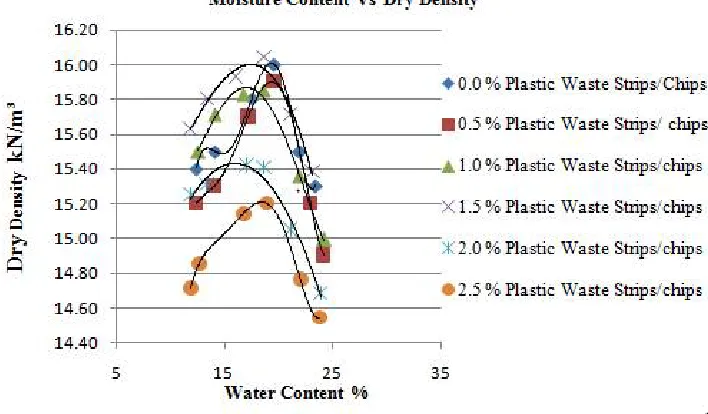
The maximum dry density and optimum moisture contents of the soil with different percentage of plastic strips contents are reported in the Table 2. These data indicate that the maximum dry density decreases with the increase in the plastic strips/chips content, which is due to lower density of plastic strips than the soil particles. The moisture content vs dry density relationships of the plain and composite soil are shown from figure 5.
Table 2 MDD & OMC for Randomly Mixed Soil with Different Percentage of Plastic Strip
Plastic Content (%) OMC (%) MDD (kN/m³)
0 (Plain Soil) 19.60 16.00
0.5 19.60 15.90
1.0 18.59 15.85
1.5 18.69 16.00
2.0 18.71 15.41
2.5 18.94 15.20
3. California Bearing Ratio (CBR)
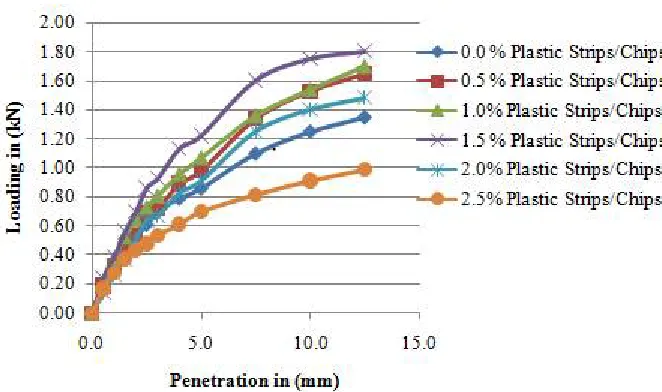
The laboratory unsoaked and soaked CBR tests were performed with varying percentage of plastic waste strips/chips randomly oriented in soil .i.e. 0%, 0.5%, 1.0%, 1.5%,2.0%2.5% . Table 3 shows the result of CBR tests of soil at varying plastic strips/chips contents. The results shows that there is an increase in CBR values due to plastic strips reinforcement within a range from 11% to 30% for unsoaked condition and 40% for soaked condition. The maximum improvement in unsoaked CBR value is 6.4% at 1.5% plastic strips/chips randomly oriented in soil, and maximum improvement in soaked CBR value is 3.0% at 2.0% plastic strips/chips randomly oriented in soil. As per IRC-37, flexible pavement should be design at 4 day soaked CBR value. Therefore for present study, optimum plastic strip content is 2.0% Hence 2.0% plastic strips content and 3.0% soaked CBR value can be used for design flexible pavement with composite subgrade as a Geo- environmental trend. The load- penetration curves obtained from the CBR tests for plain soil and randomly oriented with strip contents ranged from 0 % to 2.5 % are shown in figure 6 and 7.
Fig. 7 Soaked CBR of soil with varying percentage of Plastic Strips /chips
Table 3 CBR Values for Randomly Mixed Soil with Different Percentage of Plastic Strip
Plastic Strips/chips randomly oriented in soil (%)
MDD
(kN/m3) OMC (%)
UNSOAKED (%)
SOAKED (%)
0.0 16.0 19.6 4.5 1.7 0.5 15.9 19.6 5.1 1.5 1.0 15.9 18.6 5.4 1.6 1.5 16.0 18.7 6.4 1.7 2.0 15.4 18.7 4.8 3.0 2.5 15.2 18.9 3.6 1.4
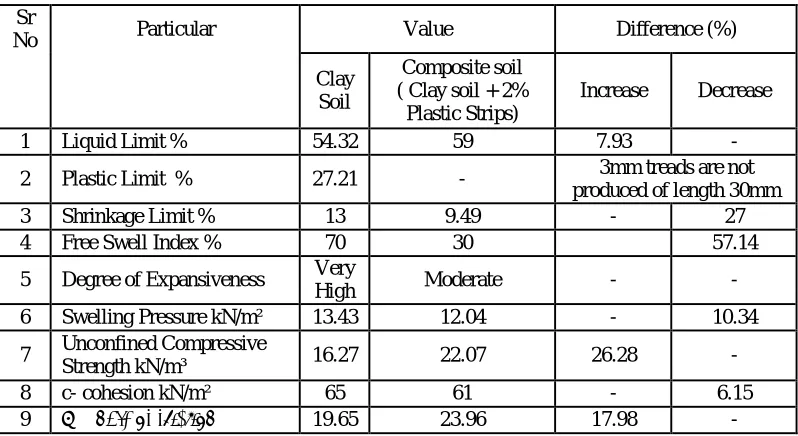
Table 4 Comparison between Clayey and Composite Soil
Sr
No Particular Value Difference (%)
Clay
Soil
Composite soil ( Clay soil + 2%
Plastic Strips)
Increase Decrease
1 Liquid Limit % 54.32 59 7.93 -
2 Plastic Limit % 27.21 - 3mm treads are not produced of length 30mm 3 Shrinkage Limit % 13 9.49 - 27 4 Free Swell Index % 70 30 57.14
5 Degree of Expansiveness Very
High Moderate - - 6 Swelling Pressure kN/m² 13.43 12.04 - 10.34
7 Unconfined Compressive
Strength kN/m³ 16.27 22.07 26.28 - 8 c- cohesion kN/m² 65 61 - 6.15
4. Comparison between Clayey and Composite Soil
On basis of laboratory comparative study for clayey and composite soil. It shows that, there is improvement in engineering properties of clayey plain soil, due to randomly oriented optimum 2.0% plastic strips/ chips. This will be help to develop new pavement stabilization technique. Comparison between clayey and composite soil is presented in Table 4.
V. CONCLUSION
The present study has shown quite encouraging results and following important conclusion can be drawn from the study
1. Maximum dry density of Plastic strips/chips mixed soil decreases with increase in plastic strip content. 2. Optimum moisture content does not vary much more with addition of plastic strips/chips.
3. The Optimum plastic strip/chips content corresponding to maximum value of soaked CBR is found to be 2.0 % 4. On the basis of laboratory CBR test study, due to randomly oriented plastic in soil, unsoaked and soaked CBR
values are increased by 30 and 40% respectively. Therefore plastic waste strips/chips can be used as reinforcement/ stabilization material for subgrade.
5. Optimum percentage of plastic strip content is 2, for maximum soaked CBR valve i.e. 3%. Therefore 2% plastic strips /chips, and 3% soaked CBR value can be used for design of flexible pavement with composite subgrade.
REFERENCES
[1] Ashraf, A., Arya,S., Dhanya, J., Joseph, M., Varghese, M., and Veena, M., “Soil Stabiliisation Using Raw Plastic Bottles”, Proceedings of Indian Geotechnical Conference Kochi, December 15-17, Paper No. H-304, 2011.
[2] Sivakumar Babu, G.L., Chouksey, S., Anoosha, G., and Geetha, M.K., “Strength and Compressibility Response of Plastic Waste Mixed Soil”, Indian Geotechnical Conference –, GEOtrendz, December 16–18, 2010.
[3] Choudhary, A.K., Jha, J.N. and Gill, K.S., “A Study on CBR Behaviour of Waste Plastic Strip Reinforced Soil”, Emirates Journal for Engineering Research, 15 (1), 51-57, 2010.
[4] Dhatrak, A.I., and Konmare, S.D., “Performance of randomly oriented plastic waste in flexible pavement”, International Journal of Pure and Applied Research in Engineering and Technology (IJPRET), ISSN: 2319-507X, Volume 3 (9), 193-202, 2015.
[5] Punmia,B.C., Jain, A., and Jain, A., Soil Mechanics and Foundations, Laxmi Publications (P) Ltd., New Delhi,India,2005. [6] Khanna, S.K. and Justo, C.E.G., Highway Engineering, Nem Chand & Bros., Roorkee -247667, India, 2009.
[7] Prasad, D.S.V., Prasad Raju, G.V.R., and Anjan Kumar, M., “Utilization of Industrial Waste in Flexible Pavement Construction”, EJGE, Vol. 13, Bund. D
[8] Arora, K.R., Soil Mechanics and Foundation Engineering, Standard Publishers Distributors, Delhi-110006, India, 2009.