Block Truncation Coding for Gray Scale
Image using Different Coding
Syed Mohammed Khawar, Prof. Syed Imran Ahmed, Prof. B. P. S. Sengar
Research Scholar, Department of Computer Science & Engineering, All Saints College of Technology, Bhopal, India Assistant Professor, Department of Computer Science & Engineering, All Saints College of Technology, Bhopal, India
Head of Dept, Department of Computer Science & Engineering, All Saints College of Technology, Bhopal, India
ABSTRACT: In the present era of multimedia, the requirement of image/video storage and transmission for video conferencing, image and video retrieval, video playback, etc. are increasing exponentially. As a result, the need for better compression technology is always in demand. Modern applications, in addition to high compression ratio, also demand for efficient encoding and decoding processes, so that computational constraint of many real-time applications is satisfied.Two widely used spatial domain compression techniques are block truncation coding (BTC) and vector quantization (VQ). BTC method results in good quality image with high bit-rate, while the VQ is well known for low bit-rate but produces poor quality images. In further work of this paper is BTC-PF includes BTC algorithm as well as vector quantization method for purpose of pattern fitting for gray and color image.
KEYWORDS: Block Truncation Code (BTC), PSNR, Block Size, Compression Ratio
I. INTRODUCTION
The rising multimedia technology and growth of GUI based software have made digital image data an inherent part of modern life. When a 2-D light intensity function is sampled and quantized to create a digital image, the amount of data generated may be large in volume that it results in tremendous storage, processing and communication requirements. Therefore, the theory of data compression becomes more and more important for reducing the data redundancy to save more hardware space and transmission bandwidth.
In computer science and information theory, data compression is the process of encoding information using less number of bits or some other information bearing units. Compression is useful as it helps to reduce the consumption of expensive resources such as hard disk space or transmission bandwidth [1] [2]. BTC is a simple and fast lossy compression technique for gray scale images. The basic idea of BTC [3] is to perform moment preserving quantization for blocks of pixels. The input image is divided into non-overlapping blocks of pixels of sizes 4×4, 8×8 and so on. Mean and standard deviation of the blocks are calculated. Mean is considered as the threshold and reconstruction values are determined using mean and standard deviation.
Then a bitmap of the block is derived based on the value of the threshold which is the compressed or encoded image. Using the reconstruction values and the bitmap the reconstructed image is generated by the decoder. Thus in the encoding process, BTC produces a bitmap, mean and standard deviation for each block. It gives a compression ratio of 4 and bit rate of 2 bits per pixel when a 4×4 block is considered. This method provides a good compression without much degradation on the reconstructed image. But it shows some artifacts like staircase effects or raggedness near the edges. Due to its simplicity and easy implementation, BTC has gained wide interest in its further development and application for image compression.
algorithm represents the image in terms of its binary edge map, mean information, and the intensity information on both sides of the edges.
II. LITERATURE SURVEY
Jing-Ming Guo et al. [1], Block truncation committal to writing (BTC) has been thought of extremely economical compression technique for many years. Moreover, this method can provide excellent processing efficiency by exploiting the nature parallelism advantage of the dot diffusion, and excellent image quality can also be offered through co-optimizing the class matrix and diffused matrix of the dot diffusion. According to the experimental results, the proposed DDBTC is superior to the former error-diffused BTC in terms of various objective image quality assessment methods as well as processing efficiency.
A modified Block Truncation Coding using max-min quantizer (MBTC) is proposed in this paper to overcome the above mentioned drawbacks. In the conventional BTC, quantization is done based on the mean and standard deviation of the pixel values in each block. In the proposed method, instead of using the mean and standard deviation, an average value of the maximum, minimum and mean of the blocks of pixels is taken as the threshold for quantization.
Jayamol Mathews et al. [2], with the emerging multimedia technology, image data has been generated at high volume. It is thus important to reduce the image file sizes for storage and effective communication. Block Truncation Coding (BTC) is a lossy image compression technique which uses moment preserving quantization method for compressing digital gray level images. Even though this method retains the visual quality of the reconstructed image with good compression ratio, it shows some artifacts like staircase effect, raggedness, etc. near the edges. A set of advanced BTC variants reported in literature were studied and it was found that though the compression efficiency is good, the quality of the image has to be improved. A modified Block Truncation Coding using max-min quantizer (MBTC) is proposed in this paper to overcome the above mentioned drawbacks. In the conventional BTC, quantization is done based on the mean and standard deviation of the pixel values in each block. In the proposed method, instead of using the mean and standard deviation, an average value of the maximum, minimum and mean of the blocks of pixels is taken as the threshold for quantization. Experimental analysis shows an improvement in the visual quality of the reconstructed image by reducing the mean square error between the original and the reconstructed image. Since this method involves less number of simple computations, the time taken by this algorithm is also very less when compared with BTC. Seddeq E. Ghrare et al. [3], with the continuing growth of modern communication technologies, demand for image data compression is increasing rapidly. Techniques for achieving data compression can be divided into two basic approaches: spatial coding and Transform coding. This research paper presents a proposed method for the compression of digital images using hybrid compression method based on Block Truncation Coding (BTC) and Walsh Hadamard Transform (WHT). The objective of this hybrid approach is to achieve higher compression ratio by applying BTC and WHT. Several grayscale test images are used to evaluate the coding efficency and performance of the hybrid method and compared with the BTC and WHT respectively. It is generally shown that the proposed method gives better results. Ki-Won Oh et al. [4], this paper presents a parallel implementation of hybrid vector quantizer-based block truncation coding using Open Computing Language (OpenCL). Processing dependency in the conventional algorithm is removed by partitioning the input image and modifying neighboring reference pixel configuration. Experimental results show that the parallel implementation drastically reduce processing time by 6~7 times with significant visual quality improvement.
III. MATERIAL AND METHODS
BTC-VQ Method
Again, this hybrid method can also be used in image feature extraction. That means the compressed data due to this method can directly be used to compute image features like, edge [5-6], and so on.
The method of selection of the best fit pattern for an image block B of size
n
n
is as follows. For an image block B, let the pixels coordinates arex
1,
x
2,...
..
x
n2and the corresponding pixel intensities aref
(
x
i)
. Available patterns are, say,P
1,
P
2...
...,
P
Mof sizen
n
and the levels present in a pattern are represented byt
where1
t
Q
.Thus, any pattern is represented as
)
)(
(
)
(
1
k
A
d
k
k
A
d
km
(1)2 2
2
k
(
A
d
)
(
k
k
)(
A
d
)
km
(2) Solving for A and d we get
)
(
2
)
2
(
1k
k
k
k
k
m
A
(3))
(
2
1k
k
k
k
m
d
(4)Hence, intensity
f
ˆ
(
x
i)
of the pixels of the corresponding block in the reconstructed image is given by
1 1)
(
ˆ
C
x
if
d
A
C
x
if
d
A
x
f
i i i (5)It is clear that a = A − d and b = A + d, where a and b are the quantization levels for partition.
IV. EXPERIMENTAL ANALYSIS
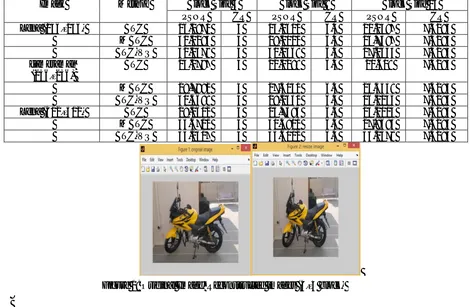
Performance of the MBTC and BTC-VF has been evaluated for a set of standard test images, viz., ‘lena256’, ‘cameraman’, and ‘lena512’. The first two images are of size 256×256 and other image is of size 512×512. MBTC and BTC-PF is compared with conventional BTC. Table I shows the comparative performance results of BTC, MBTC and BTC-VF. The performance is measured based on three parameters PSNR and CR. From Table I, it is seen that performance of the method MBTC and BTC-VF is better than BTC algorithm on the basis of the two performance measures. For all the test images with 4×4, 8×8 and 16×16 blocks, though the compression ratio is same as that of BTC, PSNR and values are high when compared with BTC. It shows an enhancement in the visual quality of the reconstructed image.
V. CONCLUSION
The objective of this paper is to develop an image compression method for which the decoder would be very efficient. Such method is suitable in situations where image or image is compressed once but decoded frequently. It is clear that
Image Method Block Size 4 Block Size 8 Block Size 16
PSNR CR PSNR CR PSNR CR
Lena (256×256) BTC 26.1870 4 23.2611 6.4 21.2497 7.5294
MBTC 31.0293 4 28.0011 6.4 25.7397 7.5294
BTC-VQ 32.1578 4 31.2568 6.4 27.2653 7.5294
cameraman (256×256)
BTC 24.2787 4 22.0288 6.4 20.608 7.5294
MBTC 29.7992 4 27.5040 6.4 25.3539 7.5294
BTC-VQ 30.5689 4 28.2531 6.4 26.1245 7.5294
Lena (512×512) BTC 29.0602 4 25.7395 6.4 23.1014 7.5294
MBTC 33.6711 4 30.4800 6.4 27.8683 7.5294
BTC-VQ 35.2517 4 35.6012 6.4 33.2578 7.5294
TABLE I: COMPARATIVE PERFORMANCE RESULTS OF BTC, MBTC AND BTC-VQ ALGORITHMS
Figure 1: Original Image, Reconstructed images (4×4 block)
bit-rate but produces poor quality images. In his paper the study of different types of technique for image compression. Although the BTC and BTC-VQ provides satisfactory image quality, future work can be put to develop a better low bit rate and high image quality algorithm.
REFERENCES
[1] Jing-Ming Guo, Senior Member, IEEE, and Yun-Fu Liu, Member, IEEE, “Improved Block Truncation Coding Using Optimized Dot Diffusion”, IEEE TRANSACTIONS ON IMAGE PROCESSING, VOL. 23, NO. 3, MARCH 2014.
[2] Jayamol Mathews, Madhu S. Nair, “Modified BTC Algorithm for Gray Scale Images using max-min Quantizer”, 978-1-4673-5090-7/13/$31.00 ©2013 IEEE.
[3] Ki-Won Oh and Kang-Sun Choi, “Parallel Implementation of Hybrid Vector Quantizerbased Block Truncation Coding for Mobile Display Stream Compression”, IEEE ISCE 2014 1569954165.
[4] Seddeq E. Ghrare and Ahmed R. Khobaiz, “Digital Image Compression using Block Truncation
Coding and Walsh Hadamard Transform Hybrid Technique”, 2014 IEEE 2014 International Conference on Computer, Communication, and Control Technology (I4CT 2014), September 2 - 4, 2014 - Langkawi, Kedah, Malaysia.
[5] M. Brunig and W. Niehsen. Fast full search block matching. IEEE Transactions on Circuits and Systems for Video Technology, 11:241 – 247, 2001.
[6] K. W. Chan and K. L. Chan. Optimisation of multi-level block truncation coding. Signal Processing: Image Communication, 16:445 – 459, 2001.
[7] C. C. Chang and T. S. Chen. New tree-structured vector quantization with closed-coupled multipath searching method. Optical Engineering, 36:1713 – 1720, 1997.