IJEDR1604125 International Journal of Engineering Development and Research (www.ijedr.org) 839
Improved Energy Efficiency of Wireless Sensor
Network and Reduction in Data Loss through
Improved CCWM
1
Neha Aggarwal, 2Surekha,3Priyadarshini
1
PG Student, Dept. of ECE, 2Asstt. Prof., Dept. of ECE, 3Head of Dept. Of Electronics and Communication Engineering 1
Department of ECE, 1
Ludhiana College of Engineering & Technology, PTU , Ludhiana, India
_______________________________________________________________________________________________________
Abstract—Today Wireless Sensor Networks (WSNs) are widely used and its utilization depends severely upon individual
sensor nodes which have limited energy. So energy efficiency is the main issue in WSNs which is needed to be improved. Batteries in the sensor nodes are usually infeasible to be recharged or replaced. When whole of the energy of the sensor node is consumed, then it dies out, then the data of that region of respective sensor node gets lost. So the energy efficiency and data loss reduction in the WSN is one of the very important performance indicators. Thus, solving the efficient-energy coverage and data loss reduction problem is an important issue for a WSN network. So scheduling the activities of the devices in a WSN to save the network’s energy and loss of data in order to increase networks lifetime is done. Taking this aspect into consideration, an Improved Cluster Chain Weight Metrics(ICCWM) approach has been discussed that selects the appropriate cluster heads in the network and then forms the balanced clusters that balances load and then it sets some threshold value for the non CH (Cluster Head) nodes. When a node in a cluster reaches that threshold level then the neighbouring nodes of that cluster will share its data so as to prevent the data before the node dies out. Also the energy that would be wasted for retransmission attempts and the time required by the CH (Cluster Head) to check the died out node and acknowledgement procedure would be prevented. In the proposed work the energy efficiency is improved by around 10% from the existing CCWM approach. This approach not only balances the load but conserves the energy of the sensors so that the network can work for a longer time. Hence the data loss reduction is also done. The performance of improved CCWM technique is carried out through simulation tests, which proves the effectiveness of this technique in terms of Total Energy Consumed vs Transmission Range, No of Clusters vs Transmission Range and Total Energy Consumption Over Time.
IndexTerms—CCWM, ICCWM, Wireless Sensor Network, Cluster Head
________________________________________________________________________________________________________
I.INTRODUCTION
Nowadays wireless sensor network is a popular research area due to its vast usage in different areas. A sensor network is comprised of sensing, processing, communication ability which helps to observe, instrument, react to events and phenomena in a specified environment [12]. This kind of network enables to connect the physical world to environment. By networking tiny sensor nodes, it becomes easy to obtain the data about physical phenomena which was very much difficult with conventional ways. Wireless sensor network typically consists of tens to thousands of nodes. These nodes collect, process and pass this collected information to a central location. WSNs have unique characteristics such as low duty cycle, power constraints and limited battery life, redundant data acquisition, heterogeneity of sensor nodes, mobility of nodes, and dynamic network topology, etc [17].
Wireless networks require some creative medium access procedures to share the limited broadcast bandwidth in a fair and efficient manner. WSNs are developing as both a vital new domain in the IT environment and a hot research including system design, networking, distributed algorithms, programming models, data management, security and social components. WSNs are rapidly picking up the popularity as they are potentially low cost solutions. The fundamental thought of sensor network is to scatter minor sensing gadgets over a particular geographic zone for some specific purposes like target tracking, surveillance, environmental screening and so on. These tiny devices are equipped for sensing a few progressions of parameters and communicating with different units [4].
IJEDR1604125 International Journal of Engineering Development and Research (www.ijedr.org) 840 communication; therefore sensor network dedicated routing protocols may be required for energy efficient routing scheme. In WSN there are many routing protocols that minimize the used energy, extending subsequently the life span of the WSN. Energy awareness is essential in routing protocol design issue.
WSNs have achieved a widespread applicability in many application domains ranging from precision agriculture, office automation and animal welfare to home. Although sensor network implementation have initiated to appear, the industry still be prepared for the maturing of this technology to realize its full benefits [4]. Due to the limited communication range of sensors, large geographical areas cannot be covered. In addition, a large number of Internet subscriptions are needed to connect cluster heads or base station of each cluster to the Internet in order to relay data from fields to users through Internet. As each sensor network has an individual Web interface, users do not have a complete view of different geographic sensor fields. A large scale sensor network with a common application interface is, therefore, significantly required
II.ENERGYEFFICIENCYINWSNS
Energy efficiency and sensing coverage are essential metrics for enhancing the lifetime and the utilization of WSNs. Many protocols have been developed to address these issues, among which, clustering is considered a key technique in minimizing the consumed energy [8]. However, few clustering protocols address the sensing coverage metric. The energy constraint in WSNs is a major challenge to the development of many potential applications. Several research projects investigated such constraint. Hierarchical routing protocols are considered among the most important routing protocols that are designed to reduce the energy consumption in WSNs. However most of such protocols focused on reducing the energy consumption with no regard to the sensing coverage achieved by the network [18]. The sensing coverage, which is an important metric in several applications such as military, surveillance represents a good measure of how efficient the deployment of the sensor nodes was and how much the network resources were utilized.
A sensor network consists of a large number of small, low cost devices with sensing, processing, and transmitting capabilities. The main goal of the operation is to observe a region and relay information to a sink node or set of sink nodes called BS. There are two ways to forward the data to the BS [21]:
Direct hop communication: In this type of communication every sensor transmits its data directly to the sink. The sink is the BS where each node transmits its data using its energy hence leading to less energy efficiency utilization.
Multi hop communication: In this type of communication, the sensors are communicating with the neighbors that forward the information in the direction of the sink. In this type the energy can be efficiently utilized. BS sets the route for the data transmission from node to sink.
III.TECHNIQUESUSEDINCOREWORK
The features of WSN includes: constrained resources (bandwidth and energy), data-centric application and dynamic configuration and so on. There are many technical challenges associated with sensor networks, such as self organizing algorithm, energy efficient routing protocols, data aggregation technology and network lifetime improvements [21, 22]. The energy for sensor networks is very important. It is infeasible to replace battery of sensor. Therefore, conserving energy so as to prolong the network lifetime is becoming is becoming one of the key challenges. Recent researches had addressed these topics such as power aware channel access, routing and broadcasting, data aggregation protocol and so on. Data is a major application of wireless sensor networks. Currently there are some efficient energy data collecting protocols:
LEACH (Lower Energy Adaptive Clustering hierarchy): It is a clustering protocol, using randomly rotation of cluster head to balance energy of network. The principal of LEACH is how to determine the cluster head and cluster. The cluster head accepts data from other sensors in its own cluster and makes data aggregation then sends it to BS.
TEEN (Threshold Sensitive Energy Efficient): It is a hierarchical protocol designed for sudden changes in the sensed environment [14]. The response of the network in time-critical applications is extremely important, obliging the network to operate in a reactive mode. The sensor network architecture in TEEN is based on hierarchical grouping. The nodes close to upper level clusters are used to transfer data from other nodes that are further away, a process that goes on the next level cluster until the sink is reached. The main advantage of TEEN is that it works well in conditions where sudden changes in the sensed attributes occur. On the other hand, in large area networks and when the number of layers in the hierarchy is small, TEEN tends to consume considerable amounts of energy, because of long distance transmissions. Moreover, when the number of layers increases, the transmissions become shorter and there exists a considerable overhead in the setup phase, as well as the operation of the network.
SHORT (The Shortest Hop Routing Tree protocol): [15] efficiently collects useful data from a remote wireless sensor network to the base station and provides energy efficiency. This protocol selects the node with the largest value of residual energy as the leader.
ECLH (The Extending Lifetime of Cluster Head): routing protocol [16] has self-configuration and hierarchal routing properties. It elects cluster heads based on the votes that it collects from the network nodes.
IV. CLUSTERCHAINWEIGHTMETRICSAPPROACH(CCWM)
IJEDR1604125 International Journal of Engineering Development and Research (www.ijedr.org) 841 considering performance parameters in a random network and then the clusters are formed. Number of nodes that can be accommodated in the cluster without degrading network performance is considered. For uniform load distribution, a local clustering mechanism is proposed. This mechanism will be called in the cluster so that cluster head rotation can take place within the cluster and that too when some specific condition is met. Data are transmitted through short parallel chains following scheduling mechanism. A mechanism has been devised that selects CH based upon network service parameters such as residual energy, path loss factor and node degree. But here the data lost when a node dies out is not considered due to which the efficiency of the network to work for the longer time is reduced. And there is also the considerable data loss. Keeping in view the above problem a new improved CCWM approach is designed that reduces the data loss due to dying out node and also improves the energy efficiency so that the network works for the longer time.
V.IMPROVEDCCWMAPPROACH
In the existing CCWM approach the energy was wasted when once a node dies then its battery dies out. So a new improved CCWM approach is proposed which enhances the network lifetime by improving energy efficiency of the network. A local clustering mechanism is adopted within the cluster to reduce computation and communication cost and set some threshold value above the zero level for all nodes so that when a node attains that threshold level the data of that node is shared by its neighboring nodes before that node dies. This leads to save energy and time needed for acknowledgement process and data loss once a node dies. It follows multi-hop routing to transfer the data to the base station.
V.I Basis of Approach
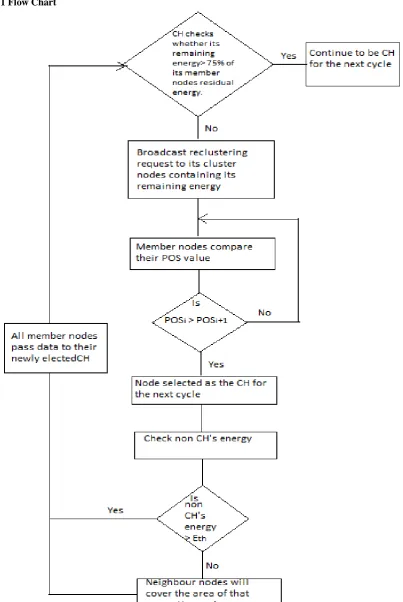
CH’s residual energy should be more than 75% of its member nodes residual energy in its cluster. The transmission range for each node is set to 25m.
The threshold value for the non CH nodes is set to be the 20% of node’s initial energy.
The maximum number of nodes that a CH can accommodate that is the node degree is taken to be 20. V.II Procedure of Algorithm
The cluster head is selected which will be having the higher calculated value of position metrics(POS). The two CHs cannot be the member nodes that is they should not be the immediate neighbors of each other.
For each node find out all the nodes that lies in its transmission range and they are to be stored in its neighboring table. Calculate the maximum node degree that a node can accommodate. The maximum value of it can be taken as 20.
To determine the total path loss for each node, sum of distances with all its neighbors is to be calculated using the Euclidean distance formula.
P
v =∑
{dist(v,v’)}
(1)Equation (1) will help in determining total loss. Here v is source node and v’ are the neighboring nodes Average energy of each node is to be calculated using equation (2).
E
AVG= 1/N
V. ∑E
V(2)
Here Ev is the residual energy of all neighboring nodes.
Position function (pos) for each node is to be calculated using equation (3).
POS = A Nv + B.Eavg + C.(1/Pv)
(3)
Where A,B,C are the weight factors. And A+B+C=1
Nv is the node degree of the node Eavg is the average energy of the node
IJEDR1604125 International Journal of Engineering Development and Research (www.ijedr.org) 842 V.111 Flow Chart
Figure 1 Flow Chart of ICCWM V.IV Simulation Parameters
IJEDR1604125 International Journal of Engineering Development and Research (www.ijedr.org) 843 initial energy of 2J. Nodes threshold value is set to 20% of initial energy i.e. 0.4J. the energy consumed in electronics for transmitting and receiving Eelec is taken to be 50 nJ/bit. While the energy consumed by amplifier to transmit at a longer distance Eamp is taken to be 100pJ/bit/m2. Data packet size is taken as 2000 bits.
VI SIMULATION RESULTS
In this section the results are calculated for number of clusters vs. transmission range, total energy consumption vs. transmission range and total energy consumption vs. time. In this, ICCWM performance benefits have been evaluated through several simulations. For this purpose, we have used MATLAB R2008a to compare the results obtained from the proposed algorithm with the existing method.
VI.I Total Energy Consumption Vs. Transmission Range
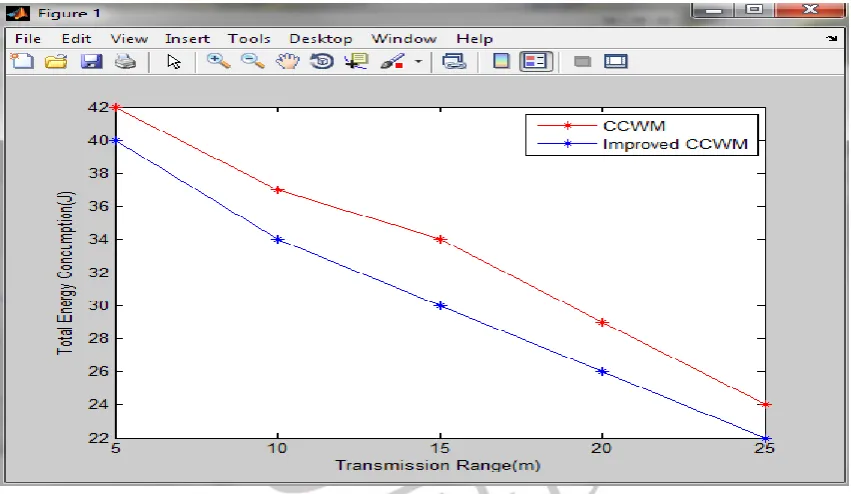
With the increase in transmission range, average number of CHs will decrease. This is due to the fact that nodes with large transmission range will cover larger area. As a result, the number of clusters formed will be less. The cluster formation is non uniform and the maximum nodes that can be accommodated for efficient energy utilization by any cluster is 20.Lesser the transmission range more will be the number of clusters. Larger number of clusters results in more consumption of energy. ICCWM consumes the energy in a more balanced way. As distances increase, energy consumption also increases. But by setting some threshold value for non CH nodes total energy consumption seems to be less in proposed approach as compared to the existing CCWM approach as shown in figure 2.
Figure 2 Total Energy Consumption vs. Transmission Range
From figure 2 it is concluded that the total energy consumed is lesser in case of ICCWM. At the transmission range of 25m the energy consumed by CCWM is 25J whereas it is just 22J in ICCWM. So there is on approximate 12% energy reduction in ICCWM as compared to CCWM.
VI.II Number Of Clusters Vs. Transmission Range
IJEDR1604125 International Journal of Engineering Development and Research (www.ijedr.org) 844
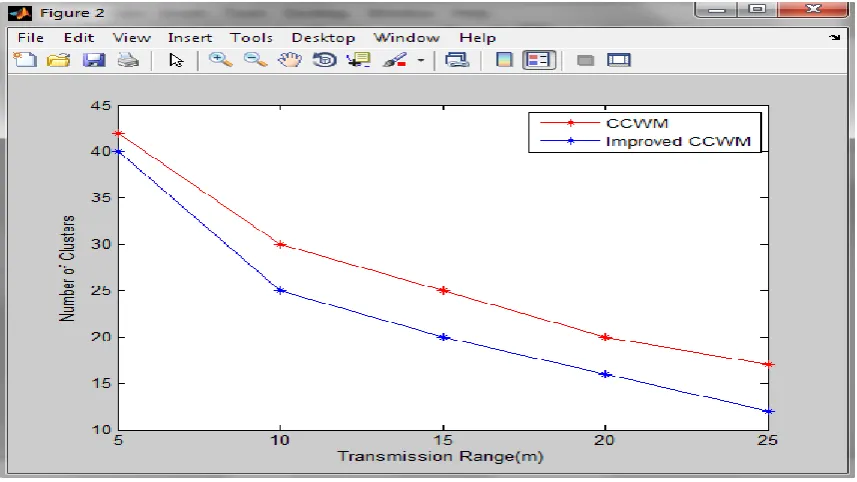
Figure 3 Number of Clusters vs. Transmission Range
From fig 3 it is concluded that at the transmission range of 25m clusters formed are lesser in case of ICCWM as compared to CCWM. In ICCWM clusters formed are approx. 12 while in CCWM clusters formed are 17 approx. so this approach proves its significance in this aspect also.
VI.III Total Energy Consumption Over Time
Energy consumed by a cluster can be found out by calculating the energy consumed by non-CH in transferring data to the CH and the energy consumed by the CH to transfer the aggregated data to the base station. Energy consumed by a non-CH is the energy used for signal transmission or reception and for sensor amplifier. While Energy consumed by the CH involves energy consumed while receiving data from all the non-CH nodes, energy consumed during aggregation of data and forwarding of data to the base station.
So total energy consumed in a cluster is:
Ecluster = ECH + E NON-CH (4)
ICCWM reduces energy consumption of the network significantly as compared to CCWM. This is due to the fact that when a node reaches that predefined threshold level then its neighbouring nodes of that cluster will share its data. So in this way data lost by the died node is prevented and the energy wasted due to recollection of that data and retransmission attempts is prevented. And also the time slot assigned for that node goes that went empty is prevented. In this selection criteria path loss factor has been considered along with energy and degree. The CH can switch dynamically and consequently traffic load among all the nodes in a cluster. Data transfer is done through multiple paths using scheduling , thus energy consumed by the nodes will be less. Thus a fair approach is designed that balances well between inter-cluster and intra-cluster approach. Total energy consumption over the time is shown in fig 4.
IJEDR1604125 International Journal of Engineering Development and Research (www.ijedr.org) 845 Figure4 Total Energy Consumption Over Time
From fig 4 it is concluded that energy consumption is more in the existing CCWM technique. At the time of 500s, ICCWM approach consumed only 90J energy while CCWM used 100J of the energy. While at 320 s ICCWM consumed 63J while CCWM requires 80J. So energy efficiency of 10-21% is achieved in present work using ICCWM.
VII TABULATION RESULTS OF ICCWM AND CCWM APPROACH
Parameter
Algorithm
Total energy
consumption(J)
vs transmission
range(m)
No of
clusters vs
Transmission
range
Total energy
consumption(J)
over time(s)
ICCWM
22J
12
90J
CCWM[15]
25J
17
100J
Percentage Improvement
12
29
10
Comparative study of existing CCWM and ICCWM approach is shown in table 5.1. In this table we can see that at transmission range of 25m total energy consumption in proposed approach is 22J while it is 25J in existing approach . Number of clusters formed are 12 and 17 resp. At 500s the total energy consumption is 90J and 100J in ICCWM and CCWM respectively. Hence energy efficiency is improved in present work using threshold level and the network work for a longer time.
VIII CONCLUSION
In the proposal an approach is defined for energy efficiency in the WSN network. A modification in existing CCWM approach is made to achieve the objectives of the research in which an energy threshold is set for each node. If any node attains the energy threshold then that node’s data is replaced by neighboring sensors so there is a reduction in the energy dissipation and data loss. Using this approach the number of clusters formed are lesser in number and total energy consumption has reduced. Data lost by the died node is prevented and the energy wasted due to recollection of the data and retransmission attempts is prevented.
REFERENCES
[1] Yan-Xiao Li, Lian-Qin, and Qian-Liang, “A centralized energy efficient routing protocol for wireless sensor networks”, IEEE Radio Communications Magazine, pp. 8-13, Mar 2005.
[2] Shan Gao, Chinh T. Vu, and Yingshu Li, “Sensor Scheduling for k-Coverage in Wireless Sensor Networks”, 2005.
[3] Sobeih A., Chen W., Hou C., Kung L., Li N., Lim H., Tyan H. Y., and Zhang H., “A Simulation Environment for Wireless Sensor Networks”, Proceedings of the 38th
Annual Simulation Symposium (ANSS’05), San Diego, California, USA, IEEE, pp. 104-119, 2006.
[4] John Paul Walters, Zhengqiang Liang, Weisong Shi, and VipinChaudhary, “Security in WSNs: Issues and Challenges”, ICACT, Volume: 5, Issue: 4, 1043-1048, 2006.
[5] Huang C.F. and Tseng Y.C., “The Coverage Problem in a Wireless Sensor Network”,2010.
[6] Stefanos Andrew, Nikolidakis, Dionisis Kandris, Dimitrios Vergados and Christos Douligeris, “Energy Efficient Routing in Wireless Sensor Networks Through Balanced Clustering”. september 2010, Vol 14, Issue 11, pp: 14-19.
[7] WazirZada Khan, Mohammed Y. Aalsalem, Mohammed Naufal Bin Mohammed Saad and Yang Xiang, “ Energy Efficient Clustering and Cluster Head Rotation Scheme for Wireless Sensor Networks”, (IJACSA) International Journal of Advanced Computer Science and Applications, Vol. 3, No. 5, 2011.
[8] Zhou X. and Xiao B., “A Clustering-Based K-Coverage Algorithm for Mobile Wireless Sensor Networks”, JOURNAL OF NETWORKS, VOL. 7, NO. 4, APRIL 2012.
[9] Gandham Roy, Dawande Milakha, Prakash Ramesh and Venkatesan Sirdana, “Energy Efficient Schemes for Wireless Sensor Networks with Multiple Mobile Base Stations”, October 2012, Vol 38, Issue 11, pp: 35-39.
[10] Mark Adam Perillo, “Role Assignment in Wireless Sensor Networks: Energy-Efficient Strategies and Algorithms”.Nov 2012. [11] Singh S. and Meenaxi, “A Survey on Energy Efficient Routing in Wireless Sensor Networks”, International Journal of Advanced Research in Computer Science and Software Engineering, Volume 3, Issue 7, July 2013.
IJEDR1604125 International Journal of Engineering Development and Research (www.ijedr.org) 846 [13] Tarek S., “An Enhanced Energy Saving Approach for WSNs”, The 4th International Conference on Emerging Ubiquitous Systems and Pervasive Networks EUSPN, pp. 199-206, (2013).
[14] Prakash goud P. and Umakant P., “Energy Efficient Aggregation With Divergent Sink Placement For Wireless Sensor Networks”, International Journal of Ad hoc, Sensor & Ubiquitous Computing (IJASUC), Vol.4, No.2, (2013).
[15] Shilpa M., Jyoteesh M. and Umakant P., “An energy balanced QoS based cluster head selection strategy for WSN”, Egyptian Informatics Journal 15, pp. 189–199, (2014).
[16] Gyanendra Prasad Joshi, Seung Yeob Nam and Sung Won Kim, “Cognitive Radio Wireless Sensor Networks: Applications, Challenges and Research Trends”.
[17] Karim Seada, Marco Zuniga, Ahmed Helmy and Bhaskar Krishnamachari, “Energy Efficient Forwarding Strategies for Geographic Routing in Lossy Wireless Sensor Networks”.
[18] Sanjay Eknath Gawali, Prof. D. S. Mantri, “Lifetime Energy Efficient Opti006DSAization for WSN”.
[19] KuthadiVenuMadhav, Rajendra.C and Raja Lakshmi Selvaraj, “Connected k-coverage problem in sensor networks”, in Proceedings of the International Conference on Computer Communications and Networks, 2014.
[20] Wei Ye, John Heidemann and Deborah Estrin, “An Energy-Efficient MAC Protocol for Wireless Sensor Networks”. April 2014.
[21] Shih Eonis, Cho Sikonsi, Ickes Nikon, Min Rutin, Sinha Arshad, Wang Andrew and Chandrakasan Aasing, “Physical Layer Driven Protocol and Algorithm Design for Energy Efficient Wireless Sensor Networks”, 2014.