QCD prediction of jet structure in 2D trigger-associated momentum
correla-tions and implicacorrela-tions for multiple parton interaccorrela-tions
Thomas A. Trainor1
1CENPA 354290 University of Washington, Seattle, Washington, USA
Abstract.The expression “multiple parton interactions” (MPI) denotes a conjectured QCD mechanism rep-resenting contributions fromsecondary(semi)hard parton scattering to the transverse azimuth region (TR) of jet-triggered p-pcollisions. MPI is an object of underlying-event (UE) studies that consider variation of TR
nchorptyields relative to a trigger condition (leading hadron or jetpt). An alternative approach is 2D trigger-associated (TA) correlations on hadron transverse momentumptor rapidityytin which all hadrons from allp-p events are included. Based on a two-component (soft+hard) model (TCM) of TA correlations a jet-related TA hard component is isolated. Contributions to the hard component from the triggered dijet and from secondary dijets (MPI) can be distinguished, including their azimuth dependence relative to the trigger direction. Mea-surede+-e−
andp- ¯pfragmentation functions and a minimum-bias jet spectrum from 200 GeVp- ¯pcollisions are convoluted to predict the 2D hard component of TA correlations as a function ofp-pcollision multiplicity. The agreement between QCD predictions and TA correlation data is quantitative, confirming a dijet interpretation for the TCM hard component. The TA azimuth dependence is inconsistent with conventional UE assumptions.
1 Introduction
In a high-energy physics (HEP) context dijet production has long been accepted as an important mechanism for hadron formation by parton fragmentation [1–3]. But in a heavy-ion context “freezeout” from a flowing bulk medium is assumed to be the nearly-exclusive hadron pro-duction mechanism [4–6], and there are claims that bulk-medium collectivity may even play a role inp-p,p-A and d-A systems [7]. Previously-accepted contributions from minimum-bias (MB) dijets to high energy collisions are displaced by the claimed presence of strong collective mo-tion (flows) in a thermalized bulk medium or quark-gluon plasma to explain spectrum and correlation structure.
Such claims are based in part on thea priori assump-tion that all hadrons with transverse momentum pt < 2 GeV/c emerge from a thermalized bulk medium [8]. But that interval includes more than 90% of minimum-bias (MB) jet fragments, according to jet measurements and QCD predictions [9–12]. Analysis of spectra and corre-lations does appear to confirm a dominant role for dijet production at low ptin all collision systems [10, 12–17]. But we can further extend the QCD description of MB di-jet manifestations at lowpt, at least inp-pcollisions.
In previous studies a jet-relatedhard componentwas isolated from the pt spectrum of 200 GeV p-p colli-sions by means of its charge multiplicitynchdependence, leading to a two-component (soft+hard) spectrum model (TCM) [15]. The spectrum hard component forp-p spec-tra has been described quantitatively by a pQCD calcula-tion [12] based on a MB jet (hard-scattered parton)
spec-trum [18] and measured parton fragmentation functions (FFs) [9]. Those results establish that the spectrum and angular-correlation hard components inp-pcollisions are jet related [10, 12],
The present study extends that program with a method to predict 2D trigger-associated (TA) hadron correlations arising from dijets produced in high-energyp-pcollisions based on measured FFs and a large-angle-scattered par-ton spectrum [19–21]. Identification of unique triggered-dijet contributions to TA correlations inp-pcollisions may then probe the phenomenon of multiple parton interactions (MPI) and test claims of bulk collectivity inp-A,d-A and heavy ion (A-A) collisions at the Relativistic Heavy-Ion Collider (RHIC) and the Large Hadron Collider (LHC).
In this paper we define 2D trigger-associated (TA) cor-relations, derive a TA two-component model (TCM) and extract a TA hard component (HC) that may represent dijet fragments. We then derive a system to predict the TA HC via a measured MB jet spectrum and parton FFs. Compar-isons with measured TA hard components serve to identify kinematic limits on dijet formation in p-p collisions. We isolate triggereddijets from secondary dijets (MPI) and test underlying-event (UE) assumptions.
2 p-p spectra and dijet production
The TCM for 2D TA correlations is based on the TCM for 1Dytspectra from p-pcollisions which we briefly sum-marize here. Thep-pspectrum TCM is derived from the nchdependence ofptor transverse rapidityyt ≡ln[(mt+
pt)/mπ] spectra. A “soft” component S(yt) with fixed C
Owned by the authors, published by EDP Sciences, 2015
yt (1/n s ) (1/y t ) d 2 n ch /dy t d h S0 nˆch = 1 11.5
200 GeV p-p
10-6 10-5 10-4 10-3 10-2 10-1
1 2 3 4 5
(a)
ns / Dh nh
/ n
s
200 GeV p-p
eikonal trend 0 0.02 0.04 0.06 0.08 0.1 0.12 0.14
0 5 10 15 20 25
(b) yt (1/n h ) H(y t ,nch ) H0 10-5 10-4 10-3 10-2 10-1 1
2 3 4 5
(c)
nch / Dh
nj
/ P
h
Dh = 2
Dh = 1 1 1.2 1.4 1.6 1.8 2 2.2 2.4 2.6 2.8 3
0 5 10 15 20
(d)
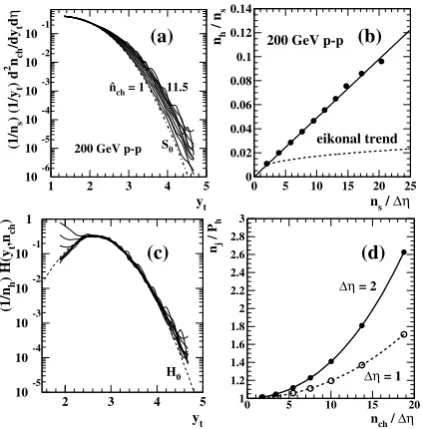
Figure 1.(a)ytspectra for eleven multiplicity classes from 200 GeV p-pcollisions. (b) Ratio of hard/soft multiplicitiesnh/ns vs the soft multiplicityns. (c) Spectrum hard components in the formH(yt)/nhfrom the spectra in panel (a). (d) Number of dijets per hardp-peventnj/Phvs total multiplicity densitynch/∆η.
shape onytis observed to scale with multiplicity approx-imately proportional tonch. A “hard” componentH(yt), also with fixed shape onyt, is observed to scale approx-imately asn2
ch. The soft+hard terminology was adopted when the two components were later associated with spe-cific physical processes via physical model comparisons.
Figure 1 (a) shows spectra for eleven multiplic-ity classes (within one unit of η) normalized by soft-component multiplicity ns derived (after the fact) from the hard-component systematics. (The parameter ˆnch is the uncorrected observed multiplicity, about 50% of the corrected multiplicity.) The fixed soft-component model S0(yt) is represented by the dash-dotted curve. Subtract-ing that curve from the normalized spectra results in hard componentsH(yt)/ns with integralsnh/nsobserved to be proportional tons as shown in panel (b). The ratioH/nh then has a fixed shape and amplitude as shown in panel (c), with unit-normal model functionH0(yt) (dashed curve) ap-proximately Gaussian onytnear the distribution mode.
Based on a dijet hypothesis we haveρh(ns)=nh/∆η=
αρ2
s ≡ f(ns)(∆η)2¯nch,j, where α ≈ 0.0055 is inferred from the second panel, f(ns) is the dijet frequency per event per unitη, 2¯nch,jis the MB dijet fragment multiplic-ity into 4π(≈3.5 for 200 GeVp- ¯p) and(∆η)∈[0.5,1] is the fraction of a triggered dijet that appears in the angular acceptance. Given those systematics we can estimate the probability of soft (no dijet in the acceptance) and hard (at least on dijet) event types asPs(ns)=exp[−∆ηf(ns)] and
Ph=1−Ps. The number of dijets per hard event∆ηf/Ph (≥1) for two∆ηvalues is plotted in panel (d).
yt,trig (1/N evt ) dn trig /yt,trig
dyt,trig n = 5
Ps = 0.48003 Ph = 0.51997 T
PsTs PhTh
PhDhHh
10-5 10-4 10-3 10-2 10-1
1 2 3 4
(a) yt,trig yt,assoc 1 1.5 2 2.5 3 3.5 4 4.5
1 2 3 4
(b) yt,trig yt,assoc 1 1.5 2 2.5 3 3.5 4 4.5
1 2 3 4
(c) yt,trig yt,assoc F(y ta ,ytt ,nch ) 1 2 3 4 1 2 3 4 10-5 10-4 10-3 10-2 10-1 (d)
Figure 2. (a) Calculated TCM trigger spectrumT(yt,trig) (solid
curve) compared to the spectrum inferred from data from 200 GeV p-pcollisions (solid points). Also shown are trigger spec-tra for softTs (dotted) and hardTh (dashed) events. (b) TCM for conditional-associated spectra A(yt,assoc|yt,trig). (c) TCM for
conditional-associated hard component Ahh(yt,assoc|yt,trig). (d) TCM for joint 2D TA correlationsF(yt,assoc, yt,trig).
3 Trigger-associated (TA) TCM
2D TA correlations are constructed as follows: From each p-p event with nch hadrons in acceptance ∆η select the highest-pthadron as the “trigger;” thench−1 other hadrons are “associated.” Form all trigger-associated pairs (exclud-ing self pairs) with no ptcuts (resulting in MB TA corre-lations, no hadrons excluded), the joint pair density de-noted byF(yta, ytt) =T(ytt)A(yta|ytt). Subtract calculated TCM TA soft components to obtain conditional associated TA data hard componentAhh(yta|ytt). For UE/MPI studies determine the associated hard-component azimuth depen-dence relative to the trigger direction.
The TA TCM is based on the assumption that there are no correlations; each hadron represents an independent sample from the fixed single-particle (SP) spectrum. The trigger-particle spectrum T(ytt) is modeled by the com-pound probability that a hadron appears at ytt (the nor-malized SP hadron spectrum) and no other hadron in that event has a largeryt, represented by Poissonvoid
proba-bility G(ytt)=exp[−nΣ(ytt)], wherenΣ(ytt) is the spectrum integral aboveytt.
yt,trig
yt,assoc
1 1.5 2 2.5 3 3.5 4 4.5
1 2 3 4
(a)
yt,trig
yt,assoc
1 1.5 2 2.5 3 3.5 4 4.5
1 2 3 4
(b)
y
t,trig yt,assoc
Adata
/ A
TCM
n = 2
y
t,trig yt,assoc
Adata
/ A
TCM
n = 6
1 2
3 4
1 2
3 4
10-1
1
1 2
3 4
1 2
3 4
10-1
1
(d) (c)
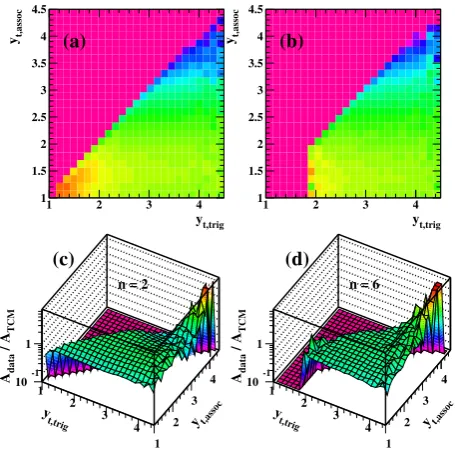
Figure 3. (a), (b) Conditional-associated TA correlations
A(yt,assoc|yt,trig) forn=2, 6 multiplicity classes of 200 GeVp-p collisions. (c), (d) Ratio data/TCM forA(yt,assoc|yt,trig) and for n=2, 6 multiplicity classes of 200 GeVp-pcollisions.
with the conditionyta ≤ ytt. For each ytt condition the associated-hadron spectrum is normalized tonch−1. Panel (c) shows the associated hard component (for hard events only)Ahh(yta|ytt) obtained from the SP spectrum hard com-ponent by following the same procedure. Figure 2 (d) shows the combination of associated soft and hard com-ponents multiplied by the trigger spectrum to obtain the full TA joint distributionF(yta, ytt) TCM.
Figure 3 (a,b) shows associated conditional distribu-tions A(yta|ytt) for two multiplicity classes obtained by dividing the measured joint distribution F(yta, ytt) by the measured trigger spectrum T(ytt). The general similar-ity with Fig. 2 (b) is apparent. To further demonstrate the correspondence with the TA TCM panels (c,d) show data/model ratios. Foryta<2.5 the agreement is good (ra-tio near unity). The devia(ra-tions from unity above that point are expected and reveal the jet-related correlation structure that is the object of this study.
4 Associated-conditional hard component
The TA associated-conditional hard component of hard events can be extracted from measured TA correlations by subtracting TCM soft-component models in the form
PhRhAhh(yta|ytt,nch) = A−PsRsAs−PhRhAhs, (1)
where the trigger ratios areRx=Tx/T, andPsandPhare the estimated soft and hard event-type probabilities.
Figure 4 (a,b) shows associated conditional hard com-ponents Ahh(yta|ytt)from hard eventsfor two multiplicity classes. The amplitude increasing with event multiplicity confirms that the number of dijets increases well above 1, as in Fig. 1 (d). Rescaling the amplitudes by the calcu-lated dijet number from that panel we obtain panels (c,d):
yt,trig yt,assoc
1 1.5 2 2.5 3 3.5 4 4.5
1 2 3 4
(a)
yt,trig
yt,assoc
1 1.5 2 2.5 3 3.5 4 4.5
1 2 3 4
(b)
//
yt,trig yt,assoc
1 1.5 2 2.5 3 3.5 4 4.5
1 2 3 4
(c)
yt,trig yt,assoc
1 1.5 2 2.5 3 3.5 4 4.5
1 2 3 4
(d)
Figure 4.(a), (b)Per-eventhard components ofAhh(yt,assoc|yt,trig)
for multiplicity classesn = 2, 5 respectively of 200 GeV p-p
collisions. (c), (d)Per-dijethard components ofAhh(yt,assoc|yt,trig)
for multiplicity classesn = 2, 5 respectively of 200 GeV p-p
collisions based on trends in Fig. 1 (d).
the jet-related correlations per dijet averaged over dijets does not change substantially over annch interval where the dijet number per event increases by a factor 2.
5 TA partition for fragmentation functions
To establish a direct comparison between the system of fragmentation functions conditional on MB dijet spectrum and 2D TA correlations the FF system must be partitioned into trigger and associated components. The method fol-lows that adopted to construct the TA TCM.
Figure 5 (a) showse+-e−FFs for three dijet energies
plotted on fragment total rapidityy=ln[(p+E)/mπ]. The data evolution with parton/jet energy or rapidity ymax = ln(2Ejet/mπ) is self-similar, the invariant shape described by a beta distribution. That regularity leads to a simple parametrization of FFs that is accurate over a large en-ergy range (solid curves through the data). The complete FF ensemble fore+-e−collisions is shown as a surface in Figure 5 (b) extending up to 30 GeV jets (all RHIC jets at 200 GeV). The FF ensemble is separated into trigger and associated components by defining void probability G(ytrig)=exp[−nΣ(ytrig)] just as for the TA TCM.
St(ytrig|ymax) = Gt(ytrig|ymax)(∆η)D(ytrig|ymax),(2)
y
2 dn
ch
/dy 1 10
p (GeV/c)
e+-e -OPAL
TASSO 14, 44 GeV
14 44
√s = 91 GeV
ymax
0 1 2 3 4 5 6 7 8
0 2 4 6
(a) (b)
(c) (d)
Figure 5. (a) Fragmentation functions (FFs) from TASSO [22] and OPAL [23] plotted on rapidityy=ln[(E+p)/mπ]
illustrat-ing self-similar energy scalillustrat-ing in that format. (b) Parametriza-tion ofe+-e−
light-flavor quark FFs from 3 to 30 GeV based on the beta distribution (solid curves in previous panel) [9]. (c) Trigger-fragment component of FF ensemble in panel (b). (d) Associated-fragment component of FF ensemble in panel (b).
6 FF convolutions and Bayes’ theorem
To provide a direct comparison between FF systematics and jet-related TA correlations requires transforming from trigger and associated fragments both conditional on par-ton energy to associated fragments conditional on trigger fragments by integrating over the parton degree of free-dom. The transformation makes use of Bayes’ theorem.
We first obtain the trigger-fragment spectrum averaged over the MB jet spectrumSp(ymax). The FF trigger-parton joint distribution isFt p(ytrig, ymax)=Sp(ymax)St(ytrig|ymax) shown in Fig. 6 (a). The marginal projection ontoytrig is the trigger-fragment spectrum
St(ytrig) =
Z ∞
ytrig
dymaxSp(ymax)St(ytrig|ymax) (3)
≡ Gt(ytrig)(∆η)Du(ytrig),
defining marginal void probabilityGt(ytrig) as a spectrum-weighted average of the Gt(ytrig|ymax). Figure 6 (b) showsSt(ytrig) (solid curve) as the marginal projection of
Ft p(ytrig, ymax) ontoytrigand the parton spectrumSp(ymax) as the marginal projection ontoymax (dash-dotted curve) based on measured jet spectra (e.g. open squares). Sim-ilarly, Fap(yassoc, ymax) = Sp(ymax)Da(yassoc|ymax) has marginal projectionDa(yassoc) integrating to2¯nch,j−1.
To proceed we use a relation represented schematically by
Fat(a,t) ≈ Z
dymaxFap(a,p)Ft p(t,p)/Fp(p) (4)
→
Z
dymaxFap(a,p)Fpt(p,t)/Sp(p)
ymax ytrig
1 1.5 2 2.5 3 3.5 4 4.5 5 5.5 6
1 2 3 4 5 6
(a)
yx
D(y
x
), S(y
x
)
1 px (GeV/c) 10
Sp eDu
Da St
ytH(yt)/f
Sp(ymax)
10-4
10-3
10-2
10-1
1 10
2 3 4 5 6
(b)
ymax
ytrig
1 2 3 4 5 6
2 4 6
(c) (d)
Figure 6. (a) Joint trigger-parton distributionFt p(ytrig, ymax)
ob-tained by combining the FF trigger component in Fig. 5 (c) with measured MB jet (scattered parton) spectrum Sp in panel (b). (b) ProjectionSt(ytrig) of the joint distribution in panel (a) onto
ytrig (solid curve) compared to the p-pspectrum hard compo-nent (per dijet) in the form ytH(yt)/f (solid points). (c) Par-ton spectrum ensemble Sp(ymax|ytrig) conditional on trigger ra-pidity, derived from Eq. (6). (d) The sought-after FF associated-conditional distribution Da(yassoc|ytrig) defined in Eq. (5) that can be compared with the corresponding TA hard component
A∗hh(yt,assoc|yt,trig) from triggered dijets. This example is for quark FFs fromp- ¯pcollisions.
to remove by integration the parton degree of freedom and obtain FF TA correlations. Converting all the joint distri-butions to the formA(x, y)=B(x|y)C(y) via the chain rule and canceling common marginal distributions we obtain
Da(yassoc|ytrig)≈ Z
dymaxDa(yassoc|ymax)Sp(ymax|ytrig).(5)
We require the missing conditionalSp(ymax|ytrig) that may be obtained by an application of Bayes’ theorem
Sp(ymax|ytrig)≈
St(ytrig|ymax)Sp(ymax)
St(ytrig)
. (6)
Figure 6 (c) shows the conditional distribution Sp(ymax|ytrig). Note the difference between St(ytrig|ymax) in Fig. 5 (c) andSp(ymax|ytrig) in Fig. 6 (c). Figure 6 (d) shows the sought-afterDa(yassoc|ytrig) (in this case forp- ¯p quark FFs) that can be compared with TA hard compo-nents from p-p collisions. Those trigger-associated dis-tributions derived from FFs for e+-e−and p- ¯p collisions
and in each case for gluon jets and light-flavor quark jets (four combinations) can be compared directly with TA hard componentsA∗hh(yt,assoc|yt,trig) for triggered dijets.
7 QCD predictions vs TA data
(a)
yt,trig
yt,assoc
yt,trig
2nassoc (yt,trig
)
p-p e-e
n = 5
1 1.5 2 2.5 3 3.5 4 4.5
1 2 3 4 0.25
0.5 0.75 1 1.25 1.5 1.75 2 2.25 2.5 2.75 3
1 2 3 4
(c) (b)
Figure 7. (a) Repeat of Fig. 6 (d) for comparison with p-pdata. (b) TA conditional-associated hard componentA∗
hh(yt,assoc|yt,trig)
corresponding to triggered (primary) dijets. The z axis (log scale) is the same as in panel (a). (c) Projection of FF calculations ontoytrig
for LF quark (solid) and gluon (dashed) jets and forp- ¯p(lower) ande+-e−
(upper) collisions compared to data from panel (b) (points).
derived from reconstructed jets. I am interested in compar-isons of correlation structure, amplitudes (z axis), possible kinematic boundaries and 1D projections ontoyt,trig and
yt,assoc. Note that whereas the TA associatedtotalis con-strained tonch−1 when projected ontoyt,trig(e.g. Fig. 3) the TA hard component is not. Each column sums to the physical hadron fragment number modulo a small bias.
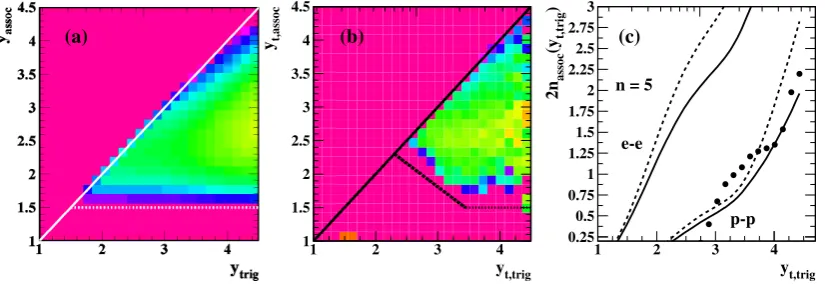
Figure 7 (a) repeats the fourth panel of Fig. 6 show-ing the TA associated hard componentDa(yassoc, ytrig) de-rived from p- ¯pdijet FFs as in the previous section. Panel (b) shows A∗hh(yt,assoc, yt,trig), the part of Ahh correspond-ing to a hard trigger correlated with the dijet to which it belongs (as opposed to uncorrelated contributions from soft triggers and secondary dijets that have been subtracted fromAhhaccording to the TCM). Those data should be di-rectly comparable with the TA constructions from single-jet FFs. The z-axis scales are the same. The amplitudes and general structure correspond well over large momen-tum and energy intervals. There is some disagreement for the smallest hadron rapidities which provides information on the real kinematic limits to jet formation.
Figure 7 (c) shows projections of data from the first panel (lower solid curve) and second panel (points) onto yt,trig(ytrigfor the first panel). The other curves correspond to calculations for gluon jets frome+-e−andp- ¯pcollisions (dashed) and quark jets frome+-e−collisions (upper solid curve). The comparison indicates that FFs fromp- ¯p colli-sions are strongly favored by the TA correlation data.
Figure 8 (a) shows the predicted joint trigger-fragment distribution Fat(yassoc, ytrig) = St(ytrig)Da(yassoc, ytrig) based on FFs fromp- ¯pcollisions. The most-probable trig-ger fragment appears near 1 GeV/c, and the most proba-ble associated fragment near 0.75 GeV/c. Panel (b) shows the corresponding data in the form Fhh((yassoc, ytrig)) =
Th(yt,trig)Ahh(yt,assoc, yt,trig). Again the z-axis scales are the same and there is general agreement in amplitude and structure. The disagreements for smaller hadron momenta reveal real kinematic bounds on jet formation that are not reflected in the prediction that assumes QCD factorization. These distributions represent the absolute yield of MB jet-related hadron pairs andbased on measured jet properties
demonstrate that the great majority of jet fragments ap-pears below 2 GeV/c, contradicting conventional assump-tions about the final-state structure of high-energy nuclear collisions.
Figure 8 (c) shows projections of the first panel (solid curve) and second panel (solid points) onto yassoc and yt,assoc respectively. The projection onto yassoc is
Da(yassoc), the MB mean associated-fragment distribution mentioned at the end of Sec. 6. Also shown is the trigger-fragment spectrumSt(ytrig). The two together must sum toDu(y), the MB mean jet fragment distribution [12, 21] that is in turn comparable with the p-p spectrum hard component in the form ytH(yt)/f(ns) (open points) from Refs. [12, 15]. The quantitative agreement of the predicted 2D structure and 1D projections with measured spectra and correlations reveals a self-consistent theory-data sys-tem in which MB dijets play a dominant role.
Note that so-called “dihadron correlation analysis” on 1D azimuth based on trigger and associated pt cuts [24] typically acknowledges only a very small fraction of the total jet fragment population, for instance a rectangle at upper right in Fig. 8 (b) bounded byyt,assoc ∈ [3.3,4] (≈ [2,4] GeV/c) andyt,trig ∈[4,4.5] (≈[4,6] GeV/c), includ-ing much less than 1% of all MB jet fragments.
8 Implications for MPI
ytrig yassoc
1 1.5 2 2.5 3 3.5 4 4.5
1 2 3 4
(a)
yt,trig yt,assoc
yt,assoc yt,assoc
A
* hh
(yt,assoc
)
n = 2
Da
St
ytaH/f
1 1.5 2 2.5 3 3.5 4 4.5
1 2 3 4 10
-5 10-4 10-3 10-2 10-1 1 10
2 3 4 5
(c) (b)
Figure 8.(a) Predicted joint TA distributionFat(yassoc, ytrig)=St(ytrig)Da(yassoc|ytrig) from FFs and a MB dijet spectrum. (b) Measured
TA joint distributionFat∗(yt,trig, yt,assoc)=Th(yt,trig)A ∗
hh(yt,assoc|yt,trig) corresponding to triggered (primary) dijets. The z axis (log scale) is the same as in panel (a). (c) Projection of FF calculations ontoyassocfor LF quark jets fromp- ¯pcollisions (solid curve) compared to
Da(yt,assoc), the projection of data from panel (b) ontoyt,assoc(solid points) and thep-pMB spectrum hard component (open points).
yt,trig
yt,assoc
1 1.5 2 2.5 3 3.5 4 4.5
1 2 3 4
(a)
yt,trig yt,assoc
1 1.5 2 2.5 3 3.5 4 4.5
1 2 3 4
yt,trig
yt,assoc
1 1.5 2 2.5 3 3.5 4 4.5
1 2 3 4
(c) (b)
Figure 9.TA conditional hard componentsAhh(yt,assoc|yt,trig) for low-multiplicity events (small probability of secondary dijets) and for
three azimuth regions relative to the trigger direction – (a) toward, (b) trans, (c) away – showing a substantial contribution to the trans region from the triggered dijet.
(MPI) [29] uncorrelated with the trigger may contribute to the TR.
Figure 9 shows associated-conditional distributions from the three azimuth regions (a) toward, (b) trans and (c) away respectively. Figure 4 (a) is essentially the az-imuth average over those three panels. The small event multiplicities for this class insure that the probability of a second dijet is small (less than 10%). The prominent jet structure in toward (a) and away (c) intervals is expected. However, the substantial dijet contribution in the TR re-gion (b) is not consistent with standard UE assumptions.
Based on MB correlation studies of p-p and Au-Au collisions the triggered dijet should actually contribute sig-nificantly to the TR region, as in Refs. [13, 16, 17]. In the MB case the same-side and away-side dijet peaks on azimuth are sufficiently broad that they overlap by a con-siderable amount, thus contributing substantially to the TR region. That result is consistent with the picture of a dijet as radiation from a color dipole in which substantial radia-tion (ultimately hadrons) should emerge near the midplane of the dipole, corresponding to the TR region in a nuclear collision. If higher-energy jets are triggered the additional hadron fragments appear near the dijet axis, giving the
im-pression that the SS and AS peaks are localized near 0 and π. However, the MB dijet base remains a common part of all dijets no matter what the jet energy. The presence of the MB dijet contribution to the TR has caused some con-fusion in interpretation of TR systematics, including infer-ence of a substantial MPI contribution to low-multiplicity p-pcollisions that actually arises from the triggered dijet. It is apparent from Fig. 1 (d) that event multiplicity con-trols the dijet rate and thus the MPI rate, not a dijet trigger.
9 Discussion
Several lessons can be derived from this quantitative com-parison of predicted TA correlations derived from mea-sured FFs and jet spectra with meamea-sured TA correlations.
9.1 The importance of low-energy jets
on analysis with data models motivated by strong flow as-sumptions and interpretations imposed from a flow con-text. Information in the data is typically suppressed in fa-vor of preconceived notions, by projection to subspaces, by strong ptcuts eliminating most hadrons and pairs, by defining ratios that obscure jet contributions and by ignor-ing collision centralities where jet structure is most ob-vious. We should instead establish as differentially and comprehensively as possible the real network of jet man-ifestations in yields, spectra and correlations from high-energy nuclear collisions and explicit phenomenology of event-wise-reconstructed jets and dijets in p-p, A-A, and e+-e− collisions. This study of TA correlations
compar-ing QCD jet theory to data is an extension of a continu-ing program to establish a MB jet reference for all nuclear collisions. The consistent message from all such studies has been that dijets make a strong contribution to hadron production at lower hadron momentum, increasingly so in higher-multiplicity p-pand more-central A-A collisions. Descriptions of nuclear collisions that omit that large dijet component cannot be successful and should be excluded.
9.2 How well does the TCM describe nuclear data?
The TCM has been applied to yields, spectra, angular and yt×ytcorrelations and now to TA correlations. The TCM has previously been related quantitatively to pQCD cal-culations based on measured dijet production and frag-ment distributions, and quantitative agreefrag-ment has been observed in all cases. Such comparisons rely on an ac-curate and convenient parametrization of quark and gluon FFs obtained separately from e+-e− and p- ¯p collisions.
They also rely on the recent development of a universal parametrization of jet spectra that describes spectra accu-rately for allp-pcollision energies below 2 TeV.
In the present study a theory prediction for the jet-related hard component of measured TA correlations is established for the first time. The description relies on a more elaborate algebraic system than previous theory comparisons with spectrum structure. From FFs as con-ditional distributions on fragment rapidity concon-ditional on parton rapidity we obtain analogous distributions of asso-ciated hadrons conditional on trigger hadrons that can be compared with TA hard-component data.
An error in any step of a long sequence could have resulted in falsification. The probability chain rule could have been inappropriate, as could application of Bayes’ theorem. And the partition of FFs into trigger and asso-ciated components might have been mistaken. But the fi-nal comparison between predictions and data shows agree-ment at the 10% level with no adjustable parameters. It seems that various assumptions were basically correct and the use of measured jet properties was in fact appropriate. Comparing theory with 2D data in Figs. 7 and 8 we find that as for 1D spectrum comparisons we again encounter quantitative agreement except for the lowest hadron momenta where we discover the real kinematic bounds on jet formation that could not be anticipated by the prediction simply because there has been no previous
information on that nonperturbative aspect. The compari-son confirms that dijets are produced in nuclear collisions down to 3 GeV jet energy (the most probable energy) but not lower, and that fragments from low-energy jets extend down to 1 GeV/c (trigger) and 0.35 GeV/c (associated), the data consistent only with FFs fromp- ¯pcollisions.
9.3 Isolation of triggered dijets from secondaries
In a given p-pevent only the triggered dijet can be com-pared with the predictions from FFs that are predicated on a single dijet being present in 4π. However, in p-p colli-sions there is a nonzero probability that secondary dijets may appear within the detector acceptance, and for higher multiplicities secondary dijets approach a certainty. Based on p-p spectrum dijet systematics we can predict accu-rately the frequency of dijets in all p-p collision events and the number of dijets per hard event. We also pre-dict the probability that a trigger hadron in a hard event is jet-related. We can then sort the full TA associated hard component into three parts: (a) soft trigger vs hard A (all dijets), (b) hard trigger vs secondary dijets and (c) hard trigger vs triggered dijet. Only combination (c) should be correlated and is the primary objective of this study. The other terms are modeled by the uncorrelated TCM hard component in Fig. 1 (c) and subtracted, the required am-plitudes obtained accurately from spectrum studies.
10 Summary
In previous work we reported trigger-associated (TA) cor-relations from 200 GeV p-pcollisions as a joint distribu-tionFon trigger and associated hadron transverse rapidi-tiesyt. The joint distribution can be factored into a trigger spectrumT and associated distributionsAconditional on trigger rapidity. We defined a two-component (soft+hard) model (TCM) of TA correlations and isolated data hard components ofAthat can be associated with dijet produc-tion. Specifically, hard componentAhh includes jet corre-lations that are of primary interest.
In the present study we construct a quantitative prediction for TA hard component Ahh derived from measured parton fragmentation functions (FFs) and a minimum-bias (MB) jet spectrum. The derivation trans-forms parton-fragment conditional distributions to hadron trigger-associated conditional distributions by integrating over the parton degree of freedom. The probability chain rule and Bayes’ theorem are used in the transformation.
fragments. This analysis confirms that minimum-bias jets make a large contribution top-p,p-A and A-A collisions especially at lower hadron momenta (≈0.5 - 1 GeV/c).
The analysis includes isolation of single triggered di-jets from other untriggered secondary didi-jets that become prominent in higher-multiplicity p-pcollisions. The sec-ondary dijets can be identified withmultiple parton inter-actions(MPI) that are a subject of underlying-event (UE) studies. Given the trigger-hadron direction the associated conditional distribution can be obtained for separate az-imuth regions corresponding to those conventionally de-fined in UE studies. We observe a substantial contribution from the triggered dijet to the transverse or “trans” region symmetric about π/2, whereas the conventional assump-tion in UE analysis is that the triggered dijet makes no contribution to the trans region.
This material is based upon work supported by the U.S. Department of Energy Office of Science, Office of Nuclear Physics under Award Number DE-FG02-97ER41020.
References
[1] S. M. Berman, J. D. Bjorken and J. B. Kogut, Phys. Rev. D4, 3388 (1971).
[2] R. D. Field and R. P. Feynman, Phys. Rev. D15, 2590 (1977).
[3] R. P. Feynman, R. D. Field and G. C. Fox, Nucl. Phys. B128, 1 (1977).
[4] F. Becattini, M. Bleicher, T. Kollegger, M. Mitrovski, T. Schuster and R. Stock, Phys. Rev. C 85, 044921 (2012).
[5] M. Gyulassy and L. McLerran, Nucl. Phys. A750, 30 (2005).
[6] B. Muller, Acta Phys. Polon. B38, 3705 (2007). [7] W. Broniowski and P. Bozek, arXiv:1311.6412. [8] J. Adamset al. (STAR Collaboration), Phys. Rev. C
72, 014904 (2005).
[9] T. A. Trainor and D. T. Kettler, Phys. Rev. D 74, 034012 (2006).
[10] T. A. Trainor, Int. J. Mod. Phys. E17, 1499 (2008). [11] T. A. Trainor and D. T. Kettler, Phys. Rev. C 83,
034903 (2011).
[12] T. A. Trainor, Phys. Rev. C80, 044901 (2009). [13] G. Agakishiev, et al. (STAR Collaboration), Phys.
Rev. C86, 064902 (2012).
[14] J. Adamset al.(STAR Collaboration), Phys. Rev. C 73, 064907 (2006).
[15] J. Adamset al.(STAR Collaboration), Phys. Rev. D 74, 032006 (2006).
[16] R. J. Porter and T. A. Trainor (STAR Collaboration), J. Phys. Conf. Ser.27, 98 (2005).
[17] R. J. Porter and T. A. Trainor (STAR Collaboration), PoSCFRNC2006, 004 (2006).
[18] T. A. Trainor, Phys. Rev. D89, 094011 (2014).
[19] D. J. Prindle (STAR Collaboration),
arXiv:1406.5225.
[20] T. A. Trainor and D. J. Prindle, Phys. Rev. D 88, 094018 (2013).
[21] T. A. Trainor, arXiv:1407.6422.
[22] W. Braunschweiget al.(TASSO Collaboration), Z. Phys. C47, 187 (1990).
[23] M. Z. Akrawy et al. (OPAL Collaboration) Phys. Lett. B,247, 617 (1990).
[24] H. Agakishiev et al. (STAR Collaboration), arXiv:1010.0690.
[25] T. A. Trainor, Phys. Rev. D87, 054005 (2013). [26] R. Field, Acta Phys. Polon. B42, 2631 (2011). [27] T. Affolderet al.(CDF Collaboration), Phys. Rev. D
65, 092002 (2002).
[28] V. Khachatryan et al. (CMS Collaboration), Eur. Phys. J. C70, 555 (2010).
![Figure 5. (a) Fragmentation functions (FFs) from TASSO [22]and OPAL [23] plotted on rapidity y = ln[(E + p)/mπ] illustrat-ing self-similar energy scaling in that format](https://thumb-us.123doks.com/thumbv2/123dok_us/8181118.1366328/4.595.62.281.69.299/figure-fragmentation-functions-plotted-rapidity-illustrat-similar-scaling.webp)