IJEDR1501042
International Journal of Engineering Development and Research (www.ijedr.org)225
Develop a Model for Cable Reeling Drum with Fuzzy
tool in MATLAB
1Vivek S. Ayar 2Sagar S. Jani 3Suvas H. Joshi 1M.Tech. Scholar, 2 Research Scholar, 3 Research Scholar
Mechanical Engineering Department
1Chamos Matrusanstha Department of Mechanical Engineering,Changa, India.
2, 3 Dr. Jivraj Mehta Institute of Technology,Department of Mechanical Engineering, Mogar, India ________________________________________________________________________________________________________ Abstract - sometimes it is very important to establish relationship between various performance and control parameters. Today many modeling techniques available to establish relationship between performance parameters and control parameters for material handling equipments. Application of fuzzy logic Technique provide a time saving ,non-functional, free form approach to capture effect of control parameters like Cable length ,Cable diameter ,Travel speed etc. on performance parameters like Inner diameter of drum ,Number of teeth of sprocket ,Motor RPM etc. for cable reeling drum. Also result of Fuzzy model is compared with Mathematical Model, which is developed by using data fit software. There are three membership function used for both inputs and outputs parameter in mamdani type fuzzy inference engine of MATLAB.
Index Terms - CRD, MAMDANIFIS, Modelling & Simulation
I.INTRODUCTION
Various data obtained from experiments need to be checked or treated in a number of different ways to get meaningful insight into the system being studied. For modeling of cable reeling drum, it is important to select a suitable modeling technique or tool to capture the relationship between input and output of the system efficiently and accurately. In past few years, many simulations and models have been tried to give a clear view about the cable reeling drum performance under varied operating parameters. When mathematical models are not up to the mark to capture the input/output relationship within the limits of permissible error and sufficient data regarding the system available, fuzzy logic is a pertinent tool to model successfully the system behavior. In situations where data available is also limited and insufficient to ensure a reliable Mathematical model and ANN model, fuzzy logic models serve to capture the nature of the process.
Figure 1 Complexity of system & precision level of different models II.FUZZY MODELLING
Fuzzy logic is a form of mathematical logic in which truth can assume a continuum of values between 0 and 1.Fuzzy logic is designed for situations where information is inexact and traditional digital on/off decisions are not possible. It divides data into vague categories such as "hot", "medium" and "cold".
Conventional methods of reasoning through arithmetic operation or whatever the operation available in symbolic logic, particularly proposition logic and predicted logic are not sufficient to handle the situation which involve the variable which can’t be determined by the words TRUE and FALSE. So that the power of reasoning used by human being in solving problem involving such deterministic variable can also be embedded into a computer system is the program under consideration and in this respect the fuzzy logic is a very power full tool which helps us in conveying our reasoning ability to the computer system. So that the computer can also solve the problems involving this type of variables like health, age, hotness or coldness, depression, etc. Fuzzy logic can be im.0-7plemented in hardware, software, or a combination of both. It provides a simple way to arrive at a definite conclusion based upon vague, ambiguous, imprecise, noisy, or missing input information. Fuzzy logic approach to control problems mimics how a person would make decisions, only much faster.
IJEDR1501042
International Journal of Engineering Development and Research (www.ijedr.org)226
Fuzzy logic is a super set of conventional or Boolean logic and contains similarities and differences with Boolean logic. Fuzzy logic is similar to Boolean logic, in Boolean logic results are returned by fuzzy logic operations when all fuzzy memberships are restricted to 0 and 1. Fuzzy logic differs from Boolean logic in that it is permissive of natural language queries and is more like human thinking; it is based on degrees of truth. The graphical representations of fuzzy and Boolean sets are different as well which is shown in Figure 2.Figure - 2 Difference between Fuzzy Set and Boolean Set Fuzzy set
A fuzzy set is a set whose elements have degrees of membership. That is, a member of a set can be partial member (e.g. less than 100% membership and greater than 0% membership) or a full member (100% membership status). In traditional sets, an element of the set X is either a member or a non-member of the subset Y. There are no partial members in traditional sets. A fuzzy set is a set whose elements have degrees of membership.
Membership function
The degree of an element's membership in a fuzzy set is defined by membership function. Numerous functions like trapezoidal, triangular, sinusoidal etc. are available for representing the membership of elements in fuzzy sets. The use of appropriate membership function for specific variable requires experience and skill.
Fuzzy operations
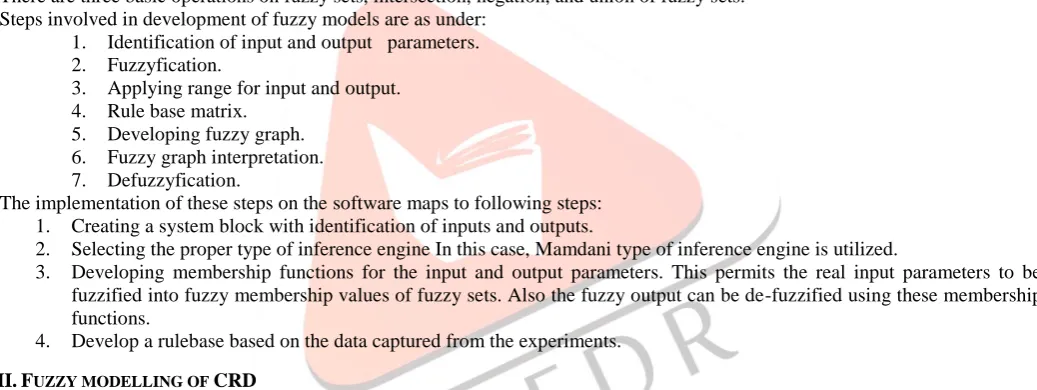
There are three basic operations on fuzzy sets, intersection, negation, and union of fuzzy sets. Steps involved in development of fuzzy models are as under:
1. Identification of input and output parameters. 2. Fuzzyfication.
3. Applying range for input and output. 4. Rule base matrix.
5. Developing fuzzy graph. 6. Fuzzy graph interpretation. 7. Defuzzyfication.
The implementation of these steps on the software maps to following steps: 1. Creating a system block with identification of inputs and outputs.
2. Selecting the proper type of inference engine In this case, Mamdani type of inference engine is utilized.
3. Developing membership functions for the input and output parameters. This permits the real input parameters to be fuzzified into fuzzy membership values of fuzzy sets. Also the fuzzy output can be de-fuzzified using these membership functions.
4. Develop a rulebase based on the data captured from the experiments. III.FUZZY MODELLING OF CRD
IJEDR1501042
International Journal of Engineering Development and Research (www.ijedr.org)227
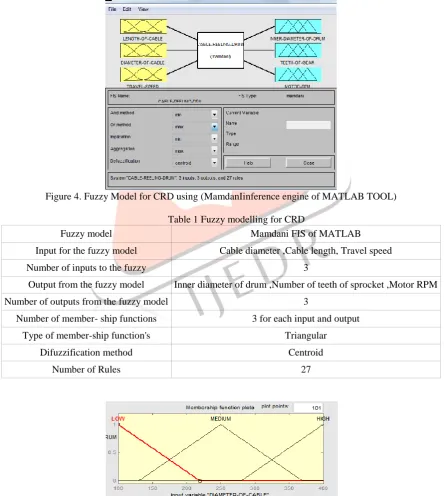
Figure 3 Schematic fuzzy Model for CRD ProcessFigure 4. Fuzzy Model for CRD using (MamdanIinference engine of MATLAB TOOL) Table 1 Fuzzy modelling for CRD
Fuzzy model Mamdani FIS of MATLAB
Input for the fuzzy model Cable diameter ,Cable length, Travel speed
Number of inputs to the fuzzy 3
Output from the fuzzy model Inner diameter of drum ,Number of teeth of sprocket ,Motor RPM
Number of outputs from the fuzzy model 3
Number of member- ship functions 3 for each input and output
Type of member-ship function's Triangular
Difuzzification method Centroid
Number of Rules 27
CABLE
REELIN
G
DRUM
(CRD)
CABLEDIAMETER
CABLE LENGTH
TRAVEL SPEED
DRUM DIA.
MOTOR RPM NO. OF TEETH
IJEDR1501042
International Journal of Engineering Development and Research (www.ijedr.org)228
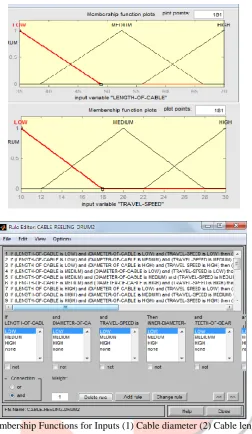
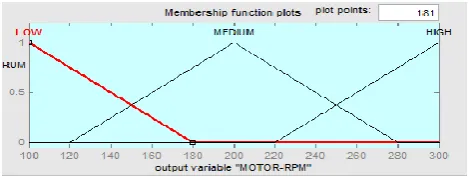
Figure 5 Membership Functions for Inputs (1) Cable diameter (2) Cable length (3) Travel speedIJEDR1501042
International Journal of Engineering Development and Research (www.ijedr.org)229
Figure 7 Fuzzy rule-base for CRD (2) Number of teeth of sprocket (3) Motor RPM IV.RESULT AND DISCUSSION:
After analyzing the comparison between mathematical and programming method to relate the input and output parameters or to find out the output parameters from input parameters with the consideration of particular range of input and out parameters, we can conclude that with the help of MATLAB programming using fuzzy tool the process is quite easy, less time consuming, with negligible human error, less human effort and cost effective too.
The table developed for the calculations result of both methods shows the actual difference for the same.
In mathematical calculations we have to consider the tolerances of about 0 to 100 units of input parameters, while in the case of MATLAB programming there is no need of consideration of any tolerances.By applying the fuzzy logic and MATLAB programming method for obtaining the relationship between all the input and output parameters considered in the study, we get all the output parameters in a particular range that we have given in the beginning.
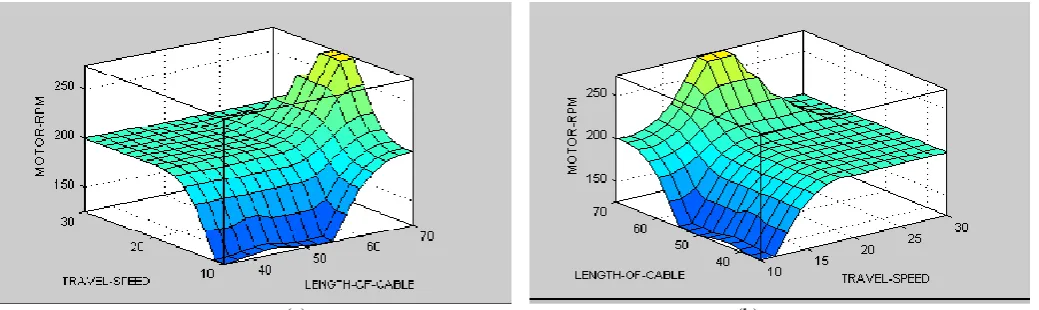
The graph itself shows the relation among different input and output, so we can have the basic prediction about the output required for particular range of input
(a)
Figure 8 Response Surfaces for teeth of gear showing effect of (a) Length of cable and diameter of cable
(a) (b)
IJEDR1501042
International Journal of Engineering Development and Research (www.ijedr.org)230
(a) (b)
Figure 10 Response Surfaces for motor RPM showing effect of (a) Length of cable and travel speed (b) travel speed and length of cable
COMPARISION BETWEEN MATHEMATICAL AND MATLAB PROGRAM
1. Inner Diameter of Drum Teeth Of Sprocket Motor Rpm
By Mathematical Formula 1500 130 225
By Matlab Programming 1503 132 228
% of Change 0.20 1.53 1.33
2, Inner Diameter of Drum Teeth Of Sprocket Motor Rpm
By Mathematical Formula 1500 130 225
By Matlab Programming 1496 133 222
% of Change 0.26 2.30 1.33
3, Inner Diameter of Drum Teeth Of Sprocket Motor Rpm
By Mathematical Formula 1500 105 225
By Matlab Programming 1505 107 222
% of Change 0.33 1.90 1.33
V.CONCLUSION
Fuzzy model for cable reeling drum using Mamdani type FIS with rules 3 fuzzy sets and 27 if-then rules for each input and output allows development of fuzzy predictive surfaces and captures the nature of variation of the variables. However, the accuracy is found to be less. Further tuning of fuzzy model by using different fuzzy membership function and different number of fuzzy sets is essential in order to achieve more accurate predictions.
REFERENCES
[1] MATLAB An introduction with applications By RAO V. DUKKIPATI [2] Fuzzy Logic With Engineering Applications By TIMOTHY J. ROSS
[3] Norgaard M., Network modeling and control of dynamic systems: a practitioner’s Handbook, Springer, london, 2000, pp. 1-34.
[4] Gill, S. S., and Singh, J., An Adaptive Neuro-Fuzzy Inference System modeling for material removal rate in stationary ultrasonic drilling of sillimanite ceramic, Expert Systems with Applications,Volume 37, Issue 8, August 2010, pp 5590– 5598
[5] Kumar, V., Khamba, J. S., Parametric optimization of ultrasonic machining of co-based super alloy using the Taguchi multi-objective approach, Production Engineering, Volume 3, Numbers 4-5, 2009, pp 417-425
[6] Zhong, G. Y., Wang, Y. Q., NC Ultrasonic Machining Efficiency: Neural Network-Based Modeling and Simulation, Advanced Materials Research, Vols. 291-294, 2011,Trans Tech Publications, Switzerland, pp 406-410
[7] Yilmaz, O., Eyercioglu, O., Gindy, N. N. Z., A user-friendly fuzzy-based system for the selection of electro discharge machining process parameters, Journal of Materials Processing Technology, Vol 172, 2006, pp 363–371
[8] MATLAB - A Practical Introduction to Programming and Problem Solving By STORMY ATTAWAY [9] P. SINGHALA, D. N. SHAH, B. PATEL. “Temperature Control using Fuzzy Logic”