Analysis of Real Time Driver Fatigue Detection
Based on Eye and Yawning
Narender Kuamr#1, Dr. N.C. Barwar*2 #
M.E. Scholar, Department of Computer Science & Engg., M.B.M. Engineering College, J.N.V. University, Jodhpur, India
*
Assoc. Prof., Department of Computer Science & Engg., M.B.M. Engineering College, J.N.V. University, Jodhpur, India
Abstract— Now a days the driver drowsiness is leading cause for major accidents. The regular monitoring of drivers drowsiness is one of the best solution in order to reduce the accidents caused by drowsiness. In order to detect and remove this cause of road accident many driver fatigue detection methods have been proposed.Consequently, it is very necessary to design a road accidents prevention system by detecting driver’s drowsiness, which determines the level of driver inattentiveness and give a warning when an impending danger exists. In this paper, a simulation and analysis of fusion method has done. This method of eye blinking and yawning detection is based on the changes in the mouth geometric features. The programming for this is done in OpenCV using the Haarcascade library for the detection of facial features and Active Contour Method for the activity of lips .
Keywords— Driver Face Detection, Driver Eye Blink
Detection, Driver Yawning Detection, Driver Drowsiness, Real time system, ROI, Viola Jones, Computer Vision.
I. INTRODUCTION
One of the major reasons of serious traffic accidents is driver drowsiness. As per the National Highway Traffic Safety Administration, there are about 56,000 crashes caused by drowsy drivers every year, which results in about 1,550 fatalities and 40,000 nonfatal injuries annually.In the last 10 years many countries all over the world have begun to avoid many accidents due to driver’s drowsiness. Driver drowsiness not only impacts the alertness and response time of the driver but it also increases the chances of being involved in vehicle accidents. National Highway Traffic Safety Administration (NHTSA) analysis data indicates that driving while drowsy is a contributing factor to 22 to 24 percent of vehicle crashes, and that driving while drowsy results in a four- to six times higher near-crash/crash risk relative to alert drivers [6].
As per RTI data, around half million accidents occur in a year, in India alone. As per the survey reports of Road Traffic Injuries (RTI) the road accident ranked fourth among the leading causes of death in the world. Nearly 1.3 million people [2] die every year on the world's roads and 20 to 50 million people suffer non-fatal injuries, with many sustaining a disability as a result of their injury. According to forecasting of statistics the number of road accident will increase to 5 million in 2020.This high accident rate is due to the fact that sleepy drivers fail to take correct actions prior to a collision. Therefore, improving driving (making driving safe) is an important issue in everyday life.
Recently many countries have felt the importance of improving driving safety. Developing vision based warning systems for drivers is an increasing area of interest. Computer vision has gained a lot of importance in the area of face detection, face tracking, eye detection, Yawning detection [1] for various applications like security, fatigue detection, biometrics. A common activity in most people’s life is driving; therefore, improving driving (making driving safe) is an important issue in everyday life.
In this paper a simulation and analysis of fusion method has done to increase drowsiness detection efficiency, merging the eye closure and yawn detection results for a more intelligent decision. The study is based on the facial features of the driver captured by a camera installed in front of the driver.
The paper is organized as follows. Related work is presented in section II. The proposed work for drowsiness detection is given in section III. Section IV contains the experimental results, where we apply our idea to driver fatigue monitoring. The paper is concluded in section V.
II. RELATED WORK
Many researchers have worked in recent years on systems for driver inattention detection, focused mainly in drowsiness, with a broad range of techniques. Sleep has a long history of research in the fields of psychology and medicine, where accurate measurements and indicators have been developed [3].
A. Physiological Measure
There are Different Methods for collecting and analyzing physiological data during real-world tasks to determine a stress level of persons. The different physiological parameters responsible for determining stress are Electrocardiogram, Electroencephalography, Electromyogram, skin conductance, respiration etc. One of the most prominently method is the Electro encephalography (EEG), the electrical activity of the brain. Experiments have been done earlier by different researchers taking different parameters like Electro-Oculogram (EOG), EEG, ECG, Electromyogram (EMG) and skin conductance. It has been established that the variations in the Heart Rate can detect different physical conditions including drowsiness.
at several frequencies, known as delta, theta, alpha, beta and gamma waves, which are linked to different cognitive and motor processes, including drowsiness and the different sleep stages. Brain studies couple EEG with electrooculography (EOG), which detects eye movements, and electromyogram (EMG) that monitors muscular tone. These measurements provide the best data for detection of drowsiness, and as such have been used by several drowsiness detection systems, usually in conjunction with heart rate and breathing rate. The Problem of these techniques is that they are intrusive to the subject. Wiring is problem for this approach. The electrode contacts and wires will annoy the drivers, and are difficult to be implemented on vehicles. They require electrodes and other sensors to be placed on the head, face and chest which may annoy the driver. They also need to be carefully placed: installing the electrodes to obtain an EEG requires external help and takes a few minutes, and medical equipment is always expensive.
B. Behavioural Measure
In order to detect drowsiness, studies on driver’s performance use lane tracking, distance between driver’s vehicle and the vehicle in front of it; place sensors on components of the vehicle such as steering wheel, gas pedal and analyse the data taken by these sensors. Pilutti and Ulsoy used vehicle lateral position as the input and steering wheel position as the output and they obtained a model which can be useful to detect drowsiness.
C. Visual Measure
An increasing research interest has focused on developing systems that detect the visual facial feature changes associated with fatigue with a video camera. These facial features include eyes, head position, face, or mouth. This approach is non intrusive and becomes more and more practical with the rapid development of camera and computer vision technology. People in fatigue exhibit certain visual behaviors that are easily observable from changes in facial features like the eyes, head, and face. Visual behaviors that typically reflect a person’s level of fatigue include eyelid movement, head movement, gaze, and facial expression.
III.PROPOSED WORK
The proposed work is based on the behavioral measures. In behavioral measuring or visual based approach different gestures of driver like eye blink, head movement and yawning are monitored to examine the state of the driver. The aim of this work is to detect closed eyes and open mouth simultaneously to observe yawning and alert the driver with a buzzer on positive detection. This is done with the help of mounting a camera in front of the driver and continuously capturing its real time video using OpenCv and Viola Jones Algorithm and Contour finding Algorithm.
A. System Tools
This system is designed for detecting drowsiness detection for in the real time. The application is implemented in C++ using OpenCV library in Windows environment with a single camera view i.e. iBall Face2Face C8. The
implementation of this approach runs at 25-30 frames per second.
Fig. 1 Block diagram of proposed system
This study gives a blend of yawning and eye blink detection altogether. This work is segregated into different steps given below:
1. Face and eye detection
2. Eye blinking detection(open/close) 3. Mouth detection(open)
1) Face and eye detection: In this phase, we apply the method 'Viola Jones' to help to detection face and eyes, with a training set of faces and eyes provided in OpenCV. After getting the center of the eye, we define the eye ROI in the following way. Since we already get face center, we can estimate the position of eyes based on the common fact that human's eyes are located in the top half of the face. Here we assume that both eyes always blink simultaneously, so we can detect the motion of single eye. According to the estimated position, We draw a small rectangle around the center of eye, and create a corresponding cv::Mat matrix as the eye ROI, for the use in step 2.
2) Eye blinking detection(open/close): Since people always blink both eyes at the same time, so in this phase, we only monitor the right eye. To detect eye blinking, we need to know the current state of the eye, either open or closed.
If the state of eye changes from closed to open, it indicates an eye blinking.
If the state of the eye keeps closed for a certain amount of time (2 seconds in our system), the eye will be detected as closed.
ii) Method to get the eye blinking rate: A ring buffer with a length of 100 is taken. In each frame, if eye blinking is detected,1 is to written into the buffer, otherwise 0. So, when the system warms up (after the very first 100 frames), it will calculate the eye blinking rate, and keeping update it every frame.
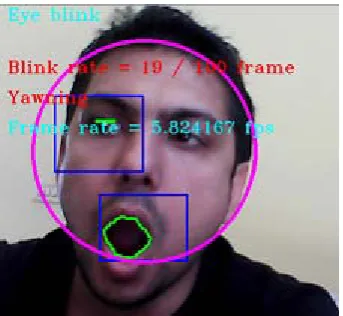
3) Mouth Detection: To detect the yawning motion by measuring the size of the mouth. To measure the size of the mouth, first compute the contour of the mouth by using contour finding algorithm. This process is divided into three steps.
i) Segmentaion and smoothing: When the mouth is
open, the area inside the mouth is dark, which creates a sharp change of the brightness inside mouth ROI. By using threshold value, we get a irregular segmentation of the dark area inside mouth. After that, by applying blur, erosion and dilation with a 4 by 4 matrix, we can significantly get rid of the noise, and smooth the shape of the segmentation.
ii) Getting the contour of the mouth: After the
segmentation, there are still some noise, for example the shade area near the chin. By applying the contour finding algorithm, we can get a vector of the contours of the object that appears in the segmentation, and we simply take the largest one, since the contour of the mouth is very likely to be bigger than any noise.
iii) Decision of yawning: With contour of the mouth, it is very easy to decide if a person is yawning of not by checking the size of the mouth, and this is a way we do it. We traverse all the points on the contour, can get the largest and smallest Y-coordinate values, then take the difference of them to get the height of the mouth. If the height is greater than a certain threshold, which means a person is taking yawning.
Fig. 2 Eye Blinking and Yawning Detection
IV.EXPERIMENTAL RESULT
The performance of Drowsiness detection of this system has been measured under different conditions for 20 days with male and female subjects of age group from 18 years to 60 years. Some subjects were using with eyeglasses and some without eyeglasses and Some subjects have moustache and some without moustache.
A. Subjects
The subjects are chosen to test the performance of driver drowsiness detection system. The subjects were asked to sit in the driver's seat and fasten their seat belt to make the scenario more realistic. The experiment was conducted for 70 males and 30 female volunteers of different ages and facial characteristics. People participated with and without glasses, men with and without beard, men with and without moustache, women with and without scarf, different hairstyles and different clothing. The experiments were conducted: a) Morning (6 AM to 11 AM). b) Afternoon (11 AM to 2 PM). c) Critical Time 1 (2 PM to 4 PM) d) Evening (5 PM to 8 PM) and e) Night (8 PM to Mid Night 3 AM ) f) Critical Time 2 (Mid night 3 AM to 6 AM) . We divide the subjects in different age groups are 18-25,25-40,40-50 and 50-60.
Fig 3 Subject Distribution
B. Driver Drowsiness Detection (Positive Alert without Eye Glasses):
The data collected for every subject without eyeglasses using this experiment setup(Positive Alert) is given in Table I.
TABLE I Driver Statistics Without Eye Glasses
Age
Driver Drowsiness Detection Without eye glasses (positive alert)
Morning Afternoon Critical
time 1 Evening Night Critical
time 2 18-25 89 91.5 92 90 85 83
25-40 85.5 89 91 85 83 80
40-50 83 86.5 88 84 80 77
50-60 82 84 86.5 82.5 77 73
Fig 3 Driver Drowsiness Detection (Without EyeGlasses)
C. Driver Drowsiness Detection (Error without Eye Glasses)
The data collected for every subject without eyeglasses using this experiment setup (Error) is given in Table II.
TABLE III Driver Statistics Without Eye Glasses
Age
Driver Drowsiness Detection Without eye glasses (Error)
Morning Afternoon Critical
time 1 Evening Night Critical
time 2
18-25 11 8.5 8 10 15 17
25-40 14.5 11 9 15 17 20
40-50 17 13.5 12 16 20 23
50-60 18 16 13.5 17.5 23 27
Fig 4 Driver Drowsiness Detection (Without EyeGlasses Error)
As shown in Fig 4 It is clear that The bad performance was recorded for without eye glass (27%) in critical time 2 from 50-60 age group.
D. Driver Drowsiness Detection (Positive Alert with Eye Glasses)
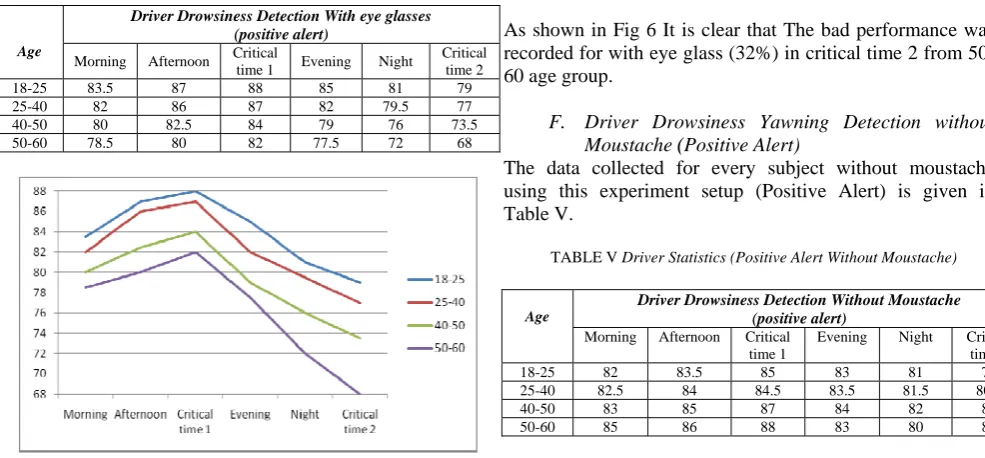
The data collected for every subject with eyeglasses using this experiment setup (Positive Alert) is given in Table III.
TABLE IIIII Driver Statistics With Eye Glasses
Age
Driver Drowsiness Detection With eye glasses (positive alert)
Morning Afternoon Critical
time 1 Evening Night Critical
time 2
18-25 83.5 87 88 85 81 79
25-40 82 86 87 82 79.5 77
40-50 80 82.5 84 79 76 73.5
50-60 78.5 80 82 77.5 72 68
Fig 5 Driver Drowsiness Detection (With EyeGlasses)
As shown in Fig 5 It is clear that The best performance was recorded for with eye glass (88%) in critical time 1 from 18-25 age group and the worst performance was detected in critical time 2 for without eye glasses from 50-60 age group (68%).
E. Driver Drowsiness Detection (Error with Eye Glasses)
The data collected for every subject with eyeglasses using this experiment setup (Error) is given in Table IV.
TABLE IVV Driver Statistics Without Eye Glasses
Age
Driver Drowsiness Detection With eye glasses (Error)
Morning Afternoon Critical
time 1 Evening Night Critical
time 2
18-25 16.5 13 12 15 19 21
25-40 18 14 13 18 20.5 23
40-50 20 17.5 16 21 24 26.5
50-60 21.5 20 18 22.5 28 32
Fig 6 Driver Drowsiness Detection (With EyeGlasses Error)
As shown in Fig 6 It is clear that The bad performance was recorded for with eye glass (32%) in critical time 2 from 50-60 age group.
F. Driver Drowsiness Yawning Detection without
Moustache (Positive Alert)
The data collected for every subject without moustache using this experiment setup (Positive Alert) is given in Table V.
TABLE V Driver Statistics (Positive Alert Without Moustache)
Age
Driver Drowsiness Detection Without Moustache (positive alert)
Morning Afternoon Critical time 1
Evening Night Critical time 2 18-25 82 83.5 85 83 81 79
25-40 82.5 84 84.5 83.5 81.5 80.5
40-50 83 85 87 84 82 81
Fig 7 Driver Drowsiness Detection (Without Moustache)
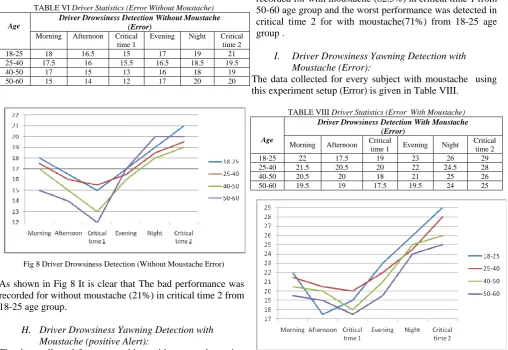
As shown in Fig 7 It is clear that The best performance was recorded for without moustache (88%) in critical time 1 from 50-60 age group and the worst performance was detected in critical time 2 for without moustache(79%) from 18-25 age group .
G. Driver Drowsiness Yawning Detection without
Moustache (Error)
The data collected for every subject without moustache using this experiment setup (Error) is given in Table VI.
TABLE VI Driver Statistics (Error Without Moustache)
Age
Driver Drowsiness Detection Without Moustache (Error)
Morning Afternoon Critical time 1
Evening Night Critical time 2
18-25 18 16.5 15 17 19 21
25-40 17.5 16 15.5 16.5 18.5 19.5
40-50 17 15 13 16 18 19
50-60 15 14 12 17 20 20
Fig 8 Driver Drowsiness Detection (Without Moustache Error)
As shown in Fig 8 It is clear that The bad performance was recorded for without moustache (21%) in critical time 2 from 18-25 age group.
H. Driver Drowsiness Yawning Detection with Moustache (positive Alert):
The data collected for every subject with moustache using this experiment setup (Positive Alert) is given in Table VII.
TABLE VII Driver Statistics (Positive alert With Moustache)
Age
Driver Drowsiness Detection With Moustache (positive alert)
Morning Afternoon Critical
time 1 Evening Night Critical
time 2 18-25 78 82.5 81 77 74 71
25-40 78.5 79.5 80 78 75.5 72
40-50 79.5 80 82 79 75 74
50-60 80.5 81 82.5 80.5 76 75
Fig 9 Driver Drowsiness Detection (With Moustache)
As shown in Fig 9 It is clear that The best performance was recorded for with moustache (82.5%) in critical time 1 from 50-60 age group and the worst performance was detected in critical time 2 for with moustache(71%) from 18-25 age group .
I. Driver Drowsiness Yawning Detection with Moustache (Error):
The data collected for every subject with moustache using this experiment setup (Error) is given in Table VIII.
TABLE VIII Driver Statistics (Error With Moustache)
Age
Driver Drowsiness Detection With Moustache (Error)
Morning Afternoon Critical
time 1 Evening Night Critical
time 2 18-25 22 17.5 19 23 26 29
25-40 21.5 20.5 20 22 24.5 28
40-50 20.5 20 18 21 25 26
50-60 19.5 19 17.5 19.5 24 25
As shown in Fig 10 It is clear that The bad performance was recorded for with moustache (29%) in critical time 2 from 18-25 age group.
J. Driver Drowsiness Detection (Eye + Yawning
Detection):
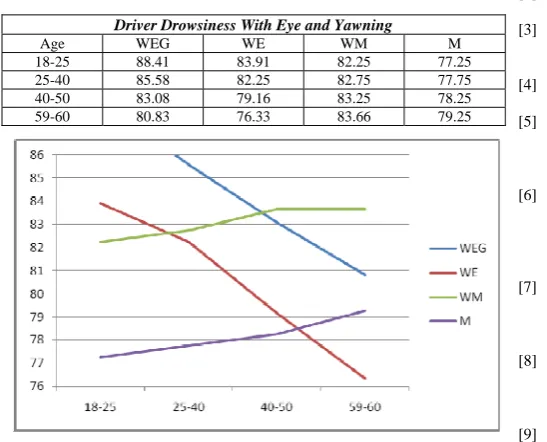
The average data collected for every subject for both eye and yawning detection is given in Table IX.
TABLE IX Driver Statistics (Eye and Yawning)
Driver Drowsiness With Eye and Yawning
Age WEG WE WM M 18-25 88.41 83.91 82.25 77.25 25-40 85.58 82.25 82.75 77.75 40-50 83.08 79.16 83.25 78.25 59-60 80.83 76.33 83.66 79.25
Fig 11 Driver Drowsiness Detection (Eye and Yawning)
As shown in Fig 11 that The best performance was recorded for with eye detection is (88.41%) without eye glasses from 18-25 age group and with yawn detection is (83.66%) without Moustache 50-60 age group.
V. CONCLUSIONS
The system detect real time eye blink using Viola Jones object detection technique and Mouth detection for yawning with Active Contour Method. The performance of this method was measured in different light conditions. The experiment was implemented on female and male participants; some were prescribed with eye glasses and without eye glasses and for yawning some have moustaches and some not. This system easily detects the face and eye and mouth of a driver.
The experiment was conducted for 20 days. The whole day was divided into 6 section (morning, afternoon, critical time 1,evening, night and critical time2). The female participants were given the same setups, webcams and programs for night and late night experiments. The eyes blinks were detected more accurate for the driver without eye glasses. The positive alert without eye glasses was best recorded in critical time 1 (92%) for 18-25 age driver and the error was
more for the with eye glasses in critical time 2 (32%) for 50-60 age driver. In Mouth detection The positive alert without moustache was best recorded in critical time 1 (88%) for 50-60 age driver and the error was more for the with moustache in critical time 2(29%) for 18-25 age driver.
REFERENCES
[1] Patrick K. Sullivan et al, “Systems and methods for intelligent medical vigilance with alert cause indication”,U.S. Patent Publication number: US 2010/0052917 A1, Pub Date 4 march 2010. [2] Ruikar M. National statistics of road traffic accidents in India. J
Orthop Traumatol Rehabil 2013.
[3] A. Rechtschaffen, “Current perspectives on the function of sleep,” Perspectives in Biology and Medicine, vol. 41, no. 3, pp.359– 390,1998.
[4] S. B. Klein and B. M. Thorne, Biological Psychology, Worth Pub, 2007.
[5] Benoit, A.; Caplier, A., "Hypovigilence analysis: open or closed eye or mouth? Blinking or yawning frequency?," Advanced Video and Signal Based Surveillance, 2005. AVSS 2005. IEEE Conference on , vol., no., pp.207,212, 15-16 Sept. 2005
[6] S.G. Klauer , T. A. Dingus, Neale, V. L., Sudweeks, J.D., and Ramsey, DJ,”The Impact of Driver Inattention on Near-Crash/Crash Risk: An Analysis Using the 100-Car Naturalistic Driving Study Data,” Virginia Tech Transportation Institute, Technical Report # DOT HS 810 594
[7] Vikash and Dr. N.C. Barwar,” Fatigue Detection for Vehicle Monitoring Using Computer Vision” in International Journal of Application or Innovation in Engineering & Management (IJAIEM) in Volume 3, Issue 7, July 2014.
[8] Vikash and Dr. N.C. Barwar,” Monitoring of Driver Vigilance Using Viola-Jones Technique” in International Journal of Application or Innovation in Engineering & Management (IJAIEM) in Volume 3, Issue 5, May 2014.
[9] P. Viola and M. J. Jones, “Robust real-time face detection,” Int. J.Comput. Vision, vol. 57, no. 2, pp. 137–154, 2001.
[10] Shabnam Abtahi et al, “Driver Drowsiness Monitoring Based on Yawning Detection”, 978-1-4244-7935-/11 IEEE 2011.
[11] M. Omidyeganeh1 et all ,” Intelligent Driver Drowsiness Detection through Fusion of Yawning and Eye Closure” , 978-1-61284-890-7/11 IEEE 2011.
[12] Ankita Shah et all, “Yawning Detection of Driver Drowsiness”, International Journal of Recent Development in Engineering and Technology Volume 2, Issue 3, March 2014.
[13] Er. Garima et all, “Road Accident Prevention System Using Driver’s Drowsiness Detection by Combining Eye Closure and Yawning”, International Journal of Research (IJR) Vol-1, Issue-6, July 2014.
[14] Shabnam Abtahi et all, “YawDD: A Yawning Detection Dataset”, in ACM 978-1-4503-2705-3 , March 19,2011.
[15] Kusuma Kumari BM ,” A Real Time Driver Drowsiness Detection System”, in International Conference on Information and Communication Technologies.
[16] Lu Yufeng et all, “Detecting Driver Yawning in Successive Images”, 1-4244-1120-3/07/$25.00 IEEE in 2007.
[17] Weiwei Liu et all, “Driver Fatigue Detection through Pupil Detection and Yawing Analysis”, 978-1-4244-6775-4/10/$26 IEEE in 2010.