Dependency Parsing with Second-Order Feature Maps and Annotated
Semantic Information
Massimiliano Ciaramita
Yahoo! Research Ocata 1, S-08003 Barcelona, Spain [email protected]
Giuseppe Attardi
Dipartimento di Informatica Universit`a di Pisa L. B. Pontecorvo 3, I-56127
Pisa, Italy
Abstract
This paper investigates new design options for the feature space of a dependency parser. We focus on one of the simplest and most efficient architectures, based on a determin-istic shift-reduce algorithm, trained with the perceptron. By adopting second-order fea-ture maps, the primal form of the perceptron produces models with comparable accuracy to more complex architectures, with no need for approximations. Further gains in accu-racy are obtained by designing features for parsing extracted from semantic annotations generated by a tagger. We provide experi-mental evaluations on the Penn Treebank.
1 Introduction
A dependency tree represents a sentence as a labeled directed graph encoding syntactic and semantic in-formation. The labels on the arcs can represent ba-sic grammatical relations such as “subject” and “ob-ject”. Dependency trees capture grammatical struc-tures that can be useful in several language process-ing tasks such as information extraction (Culotta & Sorensen, 2004) and machine translation (Ding & Palmer, 2005). Dependency treebanks are becoming available in many languages, and several approaches to dependency parsing on multiple languages have been evaluated in the CoNLL 2006 and 2007 shared tasks (Buchholz & Marsi, 2006; Nivre et al., 2007).
Dependency parsing is simpler than constituency parsing, since dependency trees do not have extra non-terminal nodes and there is no need for a gram-mar to generate them. Approaches to dependency
parsing either generate such trees by considering all possible spanning trees (McDonald et al., 2005), or build a single tree by means of shift-reduce parsing actions (Yamada & Matsumoto, 2003). Determinis-tic dependency parsers which run in linear time have also been developed (Nivre & Scholz, 2004; Attardi, 2006). These parsers process the sentence sequen-tially, hence their efficiency makes them suitable for processing large amounts of text, as required, for ex-ample, in information retrieval applications.
Recent work on dependency parsing has high-lighted the benefits of using rich feature sets and high-order modeling. Yamada and Mat-sumoto (2003) showed that learning an SVM model in the dual space with higher-degree polynomial ker-nel functions improves significantly the parser’s ac-curacy. McDonald and Pereira (2006) have shown that incorporating second order features relating to adjacent edge pairs improves the accuracy of max-imum spanning tree parsers (MST). In the SVM-based approach, if the training data is large, it is not feasible to train a single model. Rather, Yamada and Matsumoto (see also (Hall et al., 2006)) partition the training data in different sets, on the basis of Part-of-Speech, then train one dual SVM model per set. While this approach simplifies the learning task it makes the parser more sensitive to the error rate of the POS tagger. The second-order MST algorithm has cubic time complexity. For non-projective lan-guages the algorithm is NP-hard and McDonald and Pereira (2006) introduce an approximate algorithm to handle such cases.
In this paper we extend shift reduce parsing with second-order feature maps which explicitly
sent all feature pairs. Also the augmented fea-ture sets impose additional computational costs. However, excellent efficiency/accuracy trade-off is achieved by using the perceptron algorithm, with-out the need to resort to approximations, producing high-accuracy classifiers based on a single model.
We also evaluate a novel set of features for pars-ing. Recently various forms of shallow semantic processing have been investigated such as named-entity recognition (NER), semantic role labeling (SRL) and relation extraction. Syntactic parsing can provide useful features for these tasks; e.g., Pun-yakanok et al. (2005) show that full parsing is effec-tive for semantic role labeling (see also related ap-proaches evaluated within the CoNNL 2005 shared task (Carreras et al., 2005)). However, no evidence has been provided so far that annotated semantic information can be leveraged for improving parser performance. We report experiments showing that adding features extracted by an entity tagger im-proves the accuracy of a dependency parser.
2 Dependency parsing
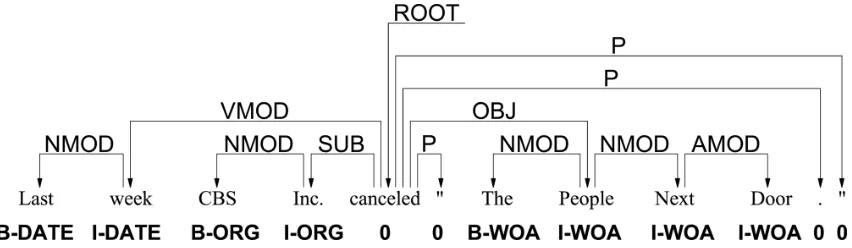
A dependency parser takes as input a sentencesand returns a dependency graphd. Figure 1 shows a de-pendency tree for the sentence “Last week CBS Inc. canceled ’The People Next Door’.”1. Dependencies are represented as labeled arrows from thehead of the relation to themodifierword; thus, in the exam-ple, “Inc.” is the modifier of a dependency labeled “SUB” (subject) to the main verb, the head, “can-celed”.
In statistical syntactic parsing a generator (e.g., a PCFG) is used to produce a number of candi-date trees (Collins, 2000) with associated proba-bility scores. This approach has been used also for dependency parsing, generating spanning trees as candidates and computing the maximum span-ning tree (MST) using discriminative learspan-ning algo-rithms (McDonald et al., 2005). Second-order MST dependency parsers currently represent the state of the art in terms of accuracy. Yamada and Mat-sumoto (2003) proposed a deterministic classifier-based parser. Instead of learning directly which tree to assign to a sentence, the parser learns which
1
The figure also contains entity annotations which will be explained below in Section 4.1.
Shift/Reduceactions to use in building the tree. Pars-ing is cast as a classification problem: at each step the parser applies a classifier to the features rep-resenting its current state to predict which action to perform on the tree. Similar deterministic ap-proaches to parsing have been investigated also in the context of constituent parsing (Wong & Wu, 1999; Kalt, 2004).
Nivre and Scholz (2004) proposed a variant of the model of Yamada and Matsumoto that reduces the complexity, from the worst case quadratic to linear. Attardi (2006) proposed a variant of the rules that handle non-projective relations while parsing deter-ministically in a single pass. Shift-reduce algorithms are simple and efficient, yet competitive in terms of accuracy: in the CoNLL-X shared task, for sev-eral languages, there was no statistically significant difference between second-order MST parsers and shift-reduce parsers.
3 A shift-reduce parser
We build upon DeSR, the shift-reduce parser de-scribed in (Attardi, 2006). This and Nivre and Scholz’s (2004) provide among the simplest and most efficient methods. This parser constructs de-pendency trees by scanning input sentences in a single left-to-right pass and performing shift/reduce parsing actions. The parsing algorithm is fully de-terministic and has linear complexity. The parser’s behavior can be described as repeatedly selecting and applying a parsing rule to transform its state, while advancing through the sentence. Each to-ken is analyzed once and a decision is made lo-cally concerning the action to take, that is, without considering global properties of the tree being built. Nivre (2004) investigated the issue of (strict) incre-mentality for this type of parsers; i.e., if at any point of the analysis the processed input forms one con-nected structure. Nivre found that strict incremen-tality is not guaranteed within this parsing frame-work, although for correctly parsed trees the prop-erty holds in almost 90% of the cases.
3.1 Parsing algorithm
The state of the parser is represented by a triple
Figure 1.A dependency tree from the Penn Treebank, with additional entity annotation from the BBN corpus.
relation for the dependency graph, which consists of a set of labeled arcs(wi, r, wj), wherewi, wj ∈W (the set of tokens),d∈D(the set of dependencies). Given an input sentence s, the parser is initialized toh∅, s,∅i, and terminates at configurationhs,∅, Ai. There are three parsing schemata:
Shift hhS,nn|S,I,A|I,Aii
(1)
Rightr hS,nh|I,As|S,n∪{|I,A(s,r,n)i }i
(2)
Leftr
hs|S,n|I,Ai hS,s|I,A∪{(n,r,s)}i
(3)
TheShiftrule advances on the input; eachLeftrand
Rightr rule creates a linkr between the next input tokennand the top token on the stacks. For produc-ing labeled dependencies the rulesLeftrandRightr are instantiated several times once for each depen-dency label.
Additional parsing actions (cf. (Attardi, 2006)) have been introduced for handling non-projective dependency trees: i.e., trees that cannot be drawn in the plane without crossing edges. However, they are not needed in the experiments reported here, because in the Penn Treebank used in our experi-ments dependencies are extracted without consider-ing empty nodes and the resultconsider-ing trees are all pro-jective2.
The pseudo code in Algorithm 1 reproduces schematically the parsing process.
The function getContext() extracts a vector of features x relative to the structure built up to that point from the context of the current token, i.e., from a subset ofI,SandA. The stepestimateAction()
predicts a parsing actiony, given a trained modelα
2
Instead, the version of the Penn Treebank used for the CoNLL 2007 shared task includes also non-projective represen-tations.
Algorithm 1: DeSR: Dependency Shift Reduce parser.
input:s=w1, w2, ..., wn begin
S ← hi
I ← hw1, w2, ..., wni A← hi
whileI 6=hido
x←getContext(S, I, A)
y ←estimateAction(x, α) performAction(y, S, I, A)
end
andx. The final stepperformAction()updates the state according to the predicted parsing rule.
3.2 Features
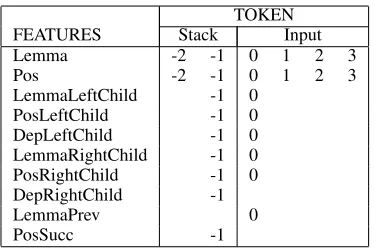
TOKEN
FEATURES Stack Input
Lemma -2 -1 0 1 2 3
Pos -2 -1 0 1 2 3
LemmaLeftChild -1 0
PosLeftChild -1 0
DepLeftChild -1 0
LemmaRightChild -1 0
PosRightChild -1 0
DepRightChild -1
LemmaPrev 0
[image:4.612.93.281.55.179.2]PosSucc -1
Table 1. Configuration of the feature parameters used in the experiments.
3.3 Learning a parsing model with the perceptron
The problem of learning a parsing model can be framed as a classification task where each class yi ∈ Yrepresents one ofkpossible parsing actions. Each of such actions is associated with a weight vec-tor αk ∈ IRd. Given a datapoint x ∈ X, a d -dimensional vector of binary features in the input space X, a parsing action is chosen with a winner-take-all discriminant function:
estimateAction(x, α) = arg max
k
f(x, αk) (4)
when using a linear classifier, such as the perceptron or SVM,f(u,v) = hu,vi is the inner product be-tween vectorsuandv.
We learn the parametersαfrom the training data with the perceptron (Rosemblatt, 1958), in the on-line multiclass formulation of the algorithm (Cram-mer & Singer, 2003) with uniform negative updates. The perceptron has been used in previous work on dependency parsing by Carreras et al. (2006), with a parser based on Eisner’s algorithm (Eisner, 2000), and also on incremental constituent parsing (Collins & Roark, 2006). Also the MST parser of McDonald uses a variant of the perceptron algorithm (McDon-ald, 2006). The choice is motivated by the simplicity and performance of perceptrons, which have proved competitive on a number of tasks; e.g., in shallow parsing, where perceptron’s performance is com-parable to that of Conditional Random Field mod-els (Sha & Pereira, 2003).
The only adjustable parameter of the model is the number of instancesT to use for training. We fixed T using the development portion of the data. In
our experiments, the best value is between 20 and 30 times the size of the training data. To regularize the model we take as the final model the average of all weight vectors posited during training (Collins, 2002). Algorithm 2 illustrates the perceptron learn-ing procedure. The final average model can be com-puted efficiently during training without storing the individualαvectors (e.g., see (Ciaramita & Johnson, 2003)).
Algorithm 2: Average multiclass perceptron
input :S = (xi, yi)N;α0k=~0, ∀k∈ Y fort= 1to Tdo
choosej
Et={r∈ Y :hx
j, αtri ≥ hxj, αtyji}
if|Et|>0then αt+1r =αtr− xj
|Et|, ∀r∈Et
αt+1yj =αtyj+xj
output:αk= T1 P
tαtk, ∀k∈ Y
3.4 Higher-order feature spaces
Yamada and Matsumoto (2003) and McDonald and Pereira (2006) have shown that higher-order fea-ture representations and modeling can improve pars-ing accuracy, although at significant computational costs. To make SVM training feasible in the dual model with polynomial kernels, Yamada and Mat-sumoto split the training data into several sets, based on POS tags, and train a parsing model for each set. McDonald and Pereira’s second-order MST parser has O(n3) complexity, while for handling non-projective trees, otherwise an NP-hard problem, the parser resorts to an approximate algorithm. Here we discuss how the feature representation can be enriched to improve parsing while maintaining the simplicity of the shift-reduce architecture, and per-forming discriminative learning without partitioning the training data.
map the input vectorsx ∈ X into some higherh -dimensional representation Φ(X) ⊂ IRh, the fea-ture space. The feafea-ture space can represent, for ex-ample, all combinations of individual features in the input space. We define a feature map which ex-tracts all second order features of the form xixj; i.e.,Φ(x) = (xi, xj|i = 1, ..., d, j =i, ..., d). The linear perceptron working in Φ(X) effectively im-plements a non-linear classifier in the original in-put spaceX. One shortcoming of this approach is that it inflates considerably the feature representa-tion and might not scale. In general, the number of features of degreeg over an input space of dimen-sion dis d+gg−1. In practice, a second-order fea-ture map can be handled with reasonable efficiency by the perceptron. We call this the 2nd-order model, which uses a modified scoring function:
g(x, αk) =f(Φ(x), αk) (5)
where alsoαk ish-dimensional. The proposed fea-ture map is equivalent to a polynomial kernel func-tion of degree two. Yamada and Matsumoto (2003) have shown that the degree two polynomial ker-nel has superior accuracy than the linear model and polynomial kernels of higher degrees. However, us-ing the dual model is not always practical for depen-dency parsing. The discriminant function of the dual model is defined as:
f0(x, α) = arg max
k N X
i=1
αk,ihx,xiig (6)
where the weights α are associated with class-instance pairs rather than class-feature pairs. With respect to the discriminant function of equation (4) there is an additional summation. In principle, the inner products can be cached in a Kernel matrix to speed up training.
There are two shortcomings to using such a model in dependency parsing. First, if the amount of train-ing data is large it might not be feasible to store the Kernel matrix; which for a dataset of sizeNrequires O(N3) computations andO(N2)space. As an ex-ample, the number of training instances N in the Penn Treebank is over 1.8 million, caching the Ker-nel matrix would require several Terabytes of space. The second shortcoming is independent of training. In predicting a tree for unseen sentences the model
will have to recompute the inner products between the observation and all the support vectors; i.e., all class-instance pairs withαk,i>0. The second-order feature map with the perceptron is more efficient and allows faster training and prediction. Training a sin-gle parsing model avoids a potential loss of accuracy that occurs when using the technique of partitioning the training data according to the POS. Inaccurate predictions of the POS can affect significantly the accuracy of the actions predicted, while the single model is more robust, since the POS is just one of the many features used in prediction.
4 Semantic features
Semantic information is used implicitly in parsing. For example, conditioning on lexical heads pro-vides a source of semantic information. There have been a few attempts at using semantic information more explicitly. Charniak’s 1997 parser (1997), de-fined probability estimates backed off to word clus-ters. Collins and Koo (Collins & Koo, 2005) in-troduced an improved reranking model for parsing which includes a hidden layer of semantic features. Yi and Palmer (2005) retrained a constituent parser in which phrases were annotated with argument in-formation to improve SRL, however this didn’t im-prove over the output of the basic parser.
In recent years there has been a significant amount of work on semantic annotation tasks such as named-entity recognition, semantic role labeling and relation extraction. There is evidence that de-pendency and constituent parsing can be helpful in these and other tasks; e.g., by means of tree ker-nels in question classification and semantic role la-beling (Zhang & Lee, 2003; Moschitti, 2006).
adding entity tags as features of our parser.
4.1 BBN Entity corpus
The BBN corpus (BBN, 2005) supplements the Wall Street Journal Penn Treebank with annotation of a large set of entity types. The corpus includes an-notation of 12 named entity types (Person, Facility, Organization, GPE, Location, Nationality, Product, Event, Work of Art, Law, Language, and Contact-Info), nine nominal entity types (Person, Facility, Organization, GPE, Product, Plant, Animal, Sub-stance, Disease and Game), and seven numeric types (Date, Time, Percent, Money, Quantity, Ordinal and Cardinal). Several of these types are further divided into subtypes3. This corpus provides adequate sup-port for experimenting semantic features for parsing. Figure 1 illustrates the annotation layer provided by the BBN corpus4. It is interesting to notice one apparent property of the combination of semantic tags and dependencies. When we consider segments composed of several words there is exactly one de-pendency connecting a token outside the segment with a token inside the segment; e.g., “CBS Inc.” is connected outside only through the token “Inc.”, the subject of the main verb. With respect to the rest of the tree, segments tend to form units, with their own internal structure. Intuitively, this information seems relevant for parsing. This locally-structured patterns could help particularly simple algorithms like ours, which have limited knowledge of the global struc-ture being built.
Table 2 lists the 40 most frequent categories in sections 2 to 21 of the BBN corpus, and the per-centage of all entities they represent – together more than 97%. Sections 2-21 are comprised of 949,853 tokens, 23.5% of the tokens have a non-null BBN entity tag, on average there is one tagged token every four. The total number of entities is 139,029, 70.5% of which are named entities and nominal concepts, 17% are numerical types and the remaining 12.5% describe time entities.
We designed three new features which extract simple properties of entities from the semantic an-notation information:
3BBN Corpus documentation. 4
The full label for “ORG” is “ORG:Corporation”, and “WOA” stands for “WorkOfArt:Other”.
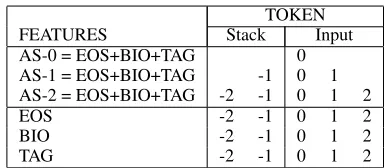
TOKEN
FEATURES Stack Input
AS-0 = EOS+BIO+TAG 0
AS-1 = EOS+BIO+TAG -1 0 1 AS-2 = EOS+BIO+TAG -2 -1 0 1 2
EOS -2 -1 0 1 2
BIO -2 -1 0 1 2
[image:6.612.329.524.55.139.2]TAG -2 -1 0 1 2
Table 3. Additional configurations for the models with BBN entity features.
• EOS: Distance to the end of the segment; e.g., EOS(“Last”) = 1, EOS(“canceled”) = 0;
• BIO: The first character of the BBN label for a token; e.g., BIO(“CBS”) = “B”, and BIO(“canceled”) = 0;
• TAG: Full BBN tag for the token; e.g., TAG(“CBS”) = “B-ORG:Corporation”, TAG(“week”) = “I-DATE”.
The feature EOS provides information about the rel-ative position of the token within a segment with re-spect to the end of the segment. The feature BIO dis-criminates tokens with no semantic annotation as-sociated, from tokens within a segment and token which start a segment. Finally the feature TAG iden-tifies the full semantic tag associated with the token. With respect to the former two features this bears the most fine-grained semantics. Table 3 summa-rizes six additional models we implemented. The first three use all additional features together, ap-plied to different sets of tokens, while the last three apply only one feature, on top of the base model, relative to the next token in the input, the following two tokens in the input, and the previous two tokens on the stack.
4.2 Corpus pre-processing
WSJ-BBN Corpus Categories
Tag % Tag % Tag % Tag %
PER DESC 15.5 ORG:CORP 13.7 DATE:DATE 9.2 ORG DESC:CORP 8.9
PERSON 8.13 MONEY 6.5 CARDINAL 6.0 PERCENT 3.5
GPE:CITY 3.12 GPE:COUNTRY 2.9 ORG:GOV 2.6 NORP:NATION-TY 1.9
DATE:DURATION 1.8 GPE:PROVINCE 1.5 ORG DESC:GOV 1.4 FAC DESC:BLDG 1.1
ORG:OTHER 0.7 PROD DESC:VEHICLE 0.7 ORG DESC:OTHER 0.6 ORDINAL 0.6
TIME 0.5 GPE DESC:COUNTRY 0.5 SUBST:OTHER 0.5 SUBST:FOOD 0.5
DATE:OTHER 0.4 NORP:POLITICAL 0.4 DATE:AGE 0.4 LOC:REGION 0.3
SUBST:CHEM 0.3 WOA:OTHER 0.3 FAC DESC:OTHER 0.3 SUBST:DRUG 0.3
ANIMAL 0.3 GPE DESC:PROVINCE 0.2 PROD:VEHICLE 0.2 GPE DESC:CITY 0.2
[image:7.612.74.541.56.180.2]PRODUCT:OTHER 0.2 LAW 0.2 ORG:POLITICAL 0.2 ORG:EDU 0.2
Table 2.The 40 most frequent labels in sections 2 to 21 of the Wall Street Journal BBN Corpus and the percentage of tags occurrences.
the whole original Treebank token, thus obtaining “third-highestORDIN AL” in the example above.
4.3 Semantic tagger
We treated semantic tags as POS tags. A tagger was trained on the BBN gold standard annotation and used it to annotate development and evaluation data. We briefly describe the tagger (see (Ciaramita & Altun, 2006) for more details), a Hidden Markov Model trained with the perceptron algorithm intro-duced in (Collins, 2002). The tagger uses Viterbi decoding. Label to label dependencies are limited to the previous tag (first order HMM). A generic fea-ture set for NER based on words, lemmas, POS tags, and word shape features was used.
The tagger is trained on sections 2-21 of the BBN corpus. As before, section 22 of the BBN corpus is used for choosing the perceptron’s parameterT. The tagger’s model is regularized as described for Algorithm 2. The full BBN tagset is comprised of 105 classes organized hierarchically, we ignored the hierarchical organization and treated each tag as an independent class in the standard BIO encoding. The tagger evaluated on section 23 achieves an F-score of 86.8%. The part of speech for the evalua-tion/development sections was produced with Tree-Tagger. As a final remark we notice that the tagger’s complexity, linear in the length of the sentence, pre-serves the parser’s complexity.
5 Parsing experiments
5.1 Data and setup
We used the standard partitions of the Wall Street Journal Penn Treebank (Marcus et al., 1993); i.e., sections 2-21 for training, section 22 for
develop-ment and section 23 for evaluation. The constituent trees were transformed into dependency trees by means of a program created by Joakim Nivre that implements the rules proposed by Yamada and Mat-sumoto, which in turn are based on the head rules of Collins’ parser (Collins, 1999)5. The lemma for each token was produced using the “morph” func-tion of the WordNet (Fellbaum, 1998) library6. The data in the WSJ sections 22 and 23, both for the parser and for the semantic tagger, was POS-tagged using TreeTagger7, which has an accuracy of 97.0% on section 23.
Training a parsing model on the Wall Street Jour-nal requires a set of 22 classes: 10 of the 11 labels in the dependency corpus generated from the Penn Treebank (e.g., subj, obj, sbar, vmod, nmod, root, etc.) are paired with both a Left and Right actions. In addition, there is in one rule for the “root” label and one for the Shift action. The total number of features found in training ranges from two hundred thousand for the 1st-order model to approximately 20 million of the 2nd-order models.
We evaluated several models, each trained with 1st-order and 2nd-order features. The base model (BASE) only uses the traditional set of features (cf. Table 1). Models EOS, BIO and TAG each use only one type of semantic feature with the configuration described in Table 3. Models AS-0, AS-1, and AS-2 use all three semantic features for the token on the stack in AS-0, plus the previous token on the stack and the new token in the input in AS-1, plus an
addi-5The script is available from
http://w3.msi.vxu.se/%7enivre/research/Penn2Malt.html
6http://wordnet.princeton.edu 7
1st-order scores 2nd-order scores
DeSR MODEL LAS UAS Imp LAC LAS UAS Imp LAC
BASE 84.01 85.56 - 88.24 89.20 90.55 - 92.22
[image:8.612.125.487.55.182.2]EOS 84.89 86.37 +5.6 88.94 89.36 90.64 +1.0 92.37 BIO 84.95 86.37 +6.6 89.06 89.63 90.89 +3.6 92.55 TAG 84.76 86.26 +4.8 88.80 89.54 90.81 +2.8 92.55 AS-0 84.40 85.95 +2.7 88.38 89.41 90.72 +1.8 92.38 AS-1 85.13 86.52 +6.6 89.11 89.57 90.77 +2.3 92.49 AS-2 85.32 86.71 +8.0 89.25 89.87 91.10 +5.8 92.68
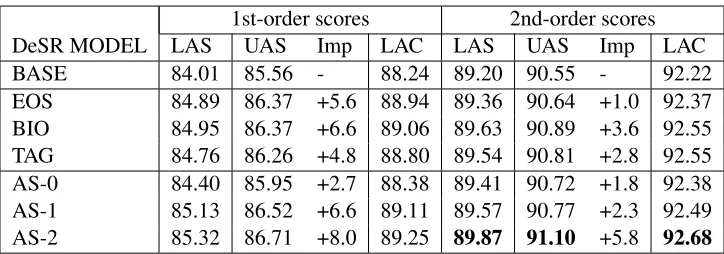
Table 4.Results of the different models on WSJ section 23 using the CoNLL scores Labeled attachment score (LAS), Unlabeled attachment score (UAS), and Label accuracy score (LAC). The column labeled “Imp” reports the improve-ment in terms of relative error reduction with respect to the BASE model for the UAS score. In bold the best results.
tional token from the stack and an additional token from the input for AS-2 (cf. Table 3).
5.2 Results of 2nd-order models
Table 4 summarizes the results of all experiments. We report the following scores, obtained with the CoNLL-X scoring script: labeled attachment score (LAS), unlabeled attachment score (UAS) and label accuracy score (LAC). For the UAS score, the most frequently reported, we include the improvement in relative error reduction.
The 2nd-order base model improves on all mea-sures over the 1st-order model by approximately 5%. The UAS score is 90.55%, with an improve-ment of 4.9%. The magnitude of the ment is remarkable and reflects the 4.6% improve-ment that Yamada and Matsumoto (Yamada & Mat-sumoto, 2003) report going from the linear SVM to the polynomial of degree two. Our base model’s curacy (90.55% UAS) compares well with the ac-curacy of the parsers based on the polynomial ker-nel trained with SVM of Yamada and Matsumoto (UAS 90.3%), and Hall et al. (2006) (UAS 89.4%). We notice in particular that, given the lack of non-projective cases/rules, the parser of Hall et al. (2006) is almost identical to our parser, hence the differ-ence in accuracy (+1.1%) might effectively be due to a better classifier. Yamada & Matsumoto’s parser is slightly more complex than our parser, and has quadratic worst-case complexity. Overall, the accu-racy of the 2nd-order parser is comparable to that of the 1st-order MST parser (90.7%).
There is no direct evidence that our perceptron produces better classifiers than SVM. Rather, the
pattern of results produced by the perceptron seems comparable to that of SVM (Yamada & Matsumoto, 2003). This is a useful finding in itself, given that the former is more efficient: perceptron’s update is linear while SVM solves a quadratic problem at each update. However, one major difference between the two approaches lies in the fact that learning with the primal model does not require splitting the model by Part-of-Speech, or other means. As a conse-quence, beyond the greater simplicity, our method might benefit from not depending so strongly on the quality of POS tagging. POS information is encoded as a feature and contributes its weight to the selec-tion of the parsing acselec-tion, together with all addi-tionally available information. In the SVM-trained methods the model that makes the prediction for the parsing rule is essentially chosen by an oracle, the prediction of the POS tagger. Furthermore, it might be argued that learning a single model makes a bet-ter use of the training data by exploiting the cor-relations between all datapoints, while in the dual split-training case the interaction is limited to dat-apoints in the same partition. In any case, second-order feature maps could be used also with SVM or other classifiers. The advantage of using the per-ceptron lies in the unchallenged accuracy/efficiency trade-off. Finally, we recall that training in the pri-mal model can be performed fully on-line without affecting the resulting model nor the complexity of the algorithm.
5.3 Results of models with semantic features
configura-Parser UAS
Hall et al. ’06 89.4
Yamada & Matsumoto ’03 90.3
DeSR 90.55
McDonald & Pereira 1st-order MST 90.7
DeSR AS-2 91.1
[image:9.612.80.295.55.169.2]McDonald & Pereira 2nd-order MST 91.5 Sagae & Lavie ’06 92.7
Table 5. Comparison of main results on the Penn Tree-bank dataset.
tion is that of model AS-2 which extracts all seman-tic features from the widest context. In the 1st-order AS-2 model the improvement, 86.71% UAS (+8% relative error reduction) is more marked than in the 2nd-order AS-2 model, 91.1% UAS (+5.8% error reduction). A possible simple exaplanation is that some information captured by the semantic features is correlated with other higher-order features which do not occur in the 1st-order encoding. Overall the accuracy of the DeSR parser with semantic informa-tion is slightly inferior to that of the second-order MST parser (McDonald & Pereira, 2006) (91.5% UAS). The best result on this dataset to date (92.7% UAS) is that of Sagae and Lavie (Sagae & Lavie, 2006) who use a parser which combines the predic-tions of several pre-existing parsers, including Mc-Donald’s and Nivre’s parsers. Table 5 lists the main results to date on the version of the Penn Treebank for dependency parsing task used in this paper.
In Table 4 we also evaluate the gain obtained by adding one semantic feature type at a time (cf. rows EOS/BIO/TAG). These results show that all seman-tic features provide some improvement (with the du-bious case of EOS in the 2nd-order model). The BIO encoding seems to produce the most accurate features. This could be promising because it sug-gests that the benefit does not depend only on the specific tags, but that the segmentation in itself is important. Hence tagging could improve the adapta-tion of parsers to new domains even if only generic tagging methods are available.
5.4 Remarks on efficiency
All experiments were performed on a 2.4GHz AMD Opteron CPU machine with 32GB RAM. The 2nd-order parser uses almost 3GB of memory. While
Parsing time/sec Parser English Chinese MST 2n-order 97.52 59.05 MST 1st-order 76.62 49.13
DeSR 36.90 21.22
Table 6. Parsing times for the CoNNL 2007 English and Chinese datasets for MST and DeSR.
it is several times slower and larger than the 1st-order model8 the 2nd-order model performance is still competitive. It takes 3 minutes (user time) to parse section 23, POS tagging included. In train-ing, the model takes about 1 hour to process the full dataset once. As a comparison, Hall et al. (2006) reports 1.5 hours for training the partitioned SVM model and 10 minutes for parsing the evaluation set on the same Penn Treebank data. We also compared directly the parsing time of our parser with that of the MST parser using the version 0.4.3 of MST-Parser9. For these experiments we used two datasets from the CoNLL 2007 shared task for English and Chinese. Table 6 reports the times, in seconds, to parse the test sets for these languages on a 3.3GHz Xeon machine with 4 GB Ram, of the MST 1st and 2nd-order parser and DeSR parser (without semantic features).
The architecture of the model presented here of-fers several options for optimization. For exam-ple, implementing the α models with full vectors rather than hash tables speeds up parsing by a factor of three, at the expense of memory. Alternatively, memory load in training can be reduced, at the ex-pense of time, by using on-line training. However, the most valuable option for space need reduction might be to filter out low-frequency second-order features. Since the frequency of such features seems to follow a power law distribution, this reduces sig-nificantly the feature space size even for low thresh-olds at small accuracy expense. In this paper how-ever we focused on the full model, no approxima-tions were required to run the experiments.
8The 1st-order parser takes 7 seconds (user time) to process
Section 23.
9
[image:9.612.340.514.56.127.2]6 Conclusion
We explored the design space of a dependency parser by modeling and extending the feature repre-sentation, while adopting one of the simplest parsing architecture: a single-pass deterministic shift-reduce algorithm trained with a regularized multiclass per-ceptron. We showed that with the perceptron it is possible to adopt higher-order feature maps equiva-lent to polynomial kernels without need of approx-imating the model (although this remains an option for optimization). The resulting models achieve ac-curacies comparable (or better) to more complex ar-chitectures based on dual SVM training, and faster parsing on unseen data. With respect to learning, it is possible that more sophisticated formulations of the perceptron (e.g. MIRA (Crammer & Singer, 2003)) could provide further gains in accuracy, as shown with the MST parser (McDonald et al., 2005).
We also experimented with novel types of se-mantic features, extracted from the annotations pro-duced by an entity tagger trained on the BBN cor-pus. This model further improves over the standard model yielding an additional 5.8% relative error re-duction. Although the magnitude of the improve-ment is not striking, to the best of our knowledge this is the first encouraging evidence that annotated semantic information can improve parsing and sug-gests several options for further research. For exam-ple, this finding might indicate that this type of ap-proach, which combines semantic tagging and pars-ing, is viable for the adaptation of parsing to new domains for which semantic taggers exist. Seman-tic features could be also easily included in other types of dependency parsing algorithms, e.g., MST, and in current methods for constituent parse rerank-ing (Collins, 2000; Charniak & Johnson, 2005).
For future research several issues concerning the semantic features could be tackled. We notice that more complex semantic features can be designed and evaluated. For example, it might be useful to guess the “head” of segments with simple heuris-tics, i.e., the guess the node which is more likely to connect the segment with the rest of the tree, which all internal components of the entity depend upon. It would be also interesting to extract semantic fea-tures from taggers trained on different datasets and based on different tagsets.
Acknowledgments
The first author would like to thank Thomas Hof-mann for useful inputs concerning the presentation of the issue of higher-order feature representations of Section 3.4. We would also like to thank Brian Roark and the anonymous reviewers for useful com-ments and pointers to related work.
References
G. Attardi. 2006. Experiments with a Multilanguage Non-Projective Dependency Parser. InProceedings of CoNNL-X 2006.
BBN. 2005. BBN Pronoun Coreference and Entity Type Corpus. Linguistic Data Consortium (LDC) catalog number LDC2005T33.
S. Buchholz and E. Marsi. 2006. Introduction to CoNNL-X Shared Task on Multilingual Dependency Parsing. InProceedings of CoNNL-X 2006.
X. Carreras and L. M`arquez. 2005. Introduction to the CoNLL-2005 Shared Task: Semantic Role Labeling. InProceedings of CoNLL 2005.
X. Carreras, M. Surdeanu, and L. M`arquez. 2006 Pro-jective Dependency Parsing with Perceptron. In Pro-ceedings of CoNLL-X.
E. Charniak. 1997. Statistical Parsing with a Context-Free Grammar and Word Statistics. InProceedings of the Fourteenth National Conference on Artificial Intel-ligence AAAI.
E. Charniak and M. Johnson. 2005. Coarse-to-Fine n-Best Parsing and MaxEnt Discriminative Reranking. InProceedings of ACL 2005.
M. Ciaramita and Y. Altun. 2006. Broad-Coverage Sense Disambiguation and Information Extraction with a Su-persense Sequence Tagger. InProceedings of EMNLP 2006.
M. Ciaramita and M. Johnson. 2003. Supersense Tag-ging of Unknown Nouns in WordNet. InProceedings of EMNLP 2003.
M. Collins. 1999. Head-Driven Statistical Models for Natural Language Parsing. Ph.D. Thesis, University of Pennsylvania.
M. Collins. 2000. Discriminative Reranking for Natural Language Parsing. InProceedings of ICML 2000.
M. Collins and T. Koo. 2005. Hidden-Variable Mod-els for Discriminative Reranking. In Proceedings of EMNLP 2005.
M. Collins and B. Roark. 2004. Incremental Parsing with the Perceptron Algorithm. InProceedings of ACL 2004.
K. Crammer and Y. Singer. 2003. Ultraconservative On-line Algorithms for Multiclass Problems. Journal of Machine Learning Research 3: pp.951-991.
A. Culotta and J. Sorensen. 2004. Dependency Tree Ker-nels for Relation Extraction. InProceedings of ACL 2004.
Y. Ding and M. Palmer. 2005. Machine Translation us-ing Probabilistic Synchronous Dependency Insertion Grammars. InProceedings of ACL 2005.
J. Eisner. 2000. Bilexical Grammars and their Cubic-Time Parsing Algorithms. In H.C. Bunt and A. Ni-jholt, eds. New Developments in Natural Language Parsing, pp. 29-62. Kluwer Academic Publishers.
C. Fellbaum. 1998. WordNet: An Electronic Lexical Database MIT Press, Cambridge, MA. 1969.
J. Hall, J. Nivre and J. Nilsson. 2006. Discriminative Classifiers for Deterministic Dependency Parsing. In Proceedings of the COLING/ACL 2006.
T. Kalt. 2004. Induction of Greedy Controllers for Deter-ministic Treebank Parsers. InProceedings of EMNLP 2004.
M. Marcus, B. Santorini and M. Marcinkiewicz. 1993. Building a Large Annotated Corpus of English: The Penn Treebank. Computational Linguistics, 19(2): pp. 313-330.
R. McDonald. 2006. Discriminative Training and Span-ning Tree Algorithms for Dependency Parsing. Ph.D. Thesis, University of Pennsylvania.
R. McDonald, F. Pereira, K. Ribarov and J. Haji˘c. 2005. Non-projective Dependency Parsing using Spanning Tree Algorithms. In Proceedings of HLT-EMNLP 2005.
R. McDonald and F. Pereira. 2006. Online Learning of Approximate Dependency Parsing Algorithms. In Proceedings of EACL 2006.
M.L. Minsky and S.A. Papert. 1969. Perceptrons: An Introduction to Computational Geometry. MIT Press, Cambridge, MA. 1969.
A. Moschitti. 2006. Efficient Convolution Kernels for Dependency and Constituent Syntactic Trees. In Pro-ceedings of ECML 2006.
J. Nivre. 2004. Incrementality in Deterministic Depen-dency Parsing. InIncremental Parsing: Bringing En-gineering and Cognition Together. Workshop at ACL-2004.Spain, 50-57.
J. Nivre, J. Hall, S. K¨ubler, R. McDonald, J. Nilsson, S. Riedel and D. Yuret. 2007. The CoNLL 2007 Shared Task on Dependency Parsing, In Proceedings of EMNLP-CoNLL 2007.
J. Nivre and M. Scholz. 2004. Deterministic Depen-dency Parsing of English Text. In Proceedings of COLING 2004.
V. Punyakanok, D. Roth, and W. Yih. 2005. The Neces-sity of Syntactic Parsing for Semantic Role Labeling. InProceedings of IJCAI 2005.
F. Rosemblatt. 1958. The Perceptron: A Probabilistic Model for Information Storage and Organization in the Brain.Psych. Rev., 68: pp. 386-407.
K. Sagae and A. Lavie. 2005. Parser Combination by Reparsing. InProceedings of HLT-NAACL 2006.
F. Sha and F. Pereira. 2003. Shallow Parsing with Condi-tional Random Fields. InProceedings of HLT-NAACL 2003.
H. Yamada and Y. Matsumoto. 2003. Statistical De-pendency Analysis with Support Vector Machines. In Proceedings of the Eighth International Workshop on Parsing Technologies. Nancy, France.
S. Yi and M. Palmer. 2005. The Integration of Syntactic Parsing and Semantic Role Labeling. InProceedings of CoNLL 2005.
A. Wong and D. Wu. 1999. Learning a Lightweight De-terministic Parser. InProceedings of EUROSPEECH 1999.