A Conceptual Framework for Agent Definition and
Development
Michael Luck Mark d’Inverno
Department of Computer Science Cavendish School of Computer Science
University of Warwick University of Westminster
Coventry, CV4 7AL London, W1M 8JS
United Kingdom United Kingdom
EMAIL [email protected] EMAIL [email protected]
TEL +44 24 7652 3364 TEL +44 20 7911 5131
FAX +44 24 7657 3024 FAX +44 20 7911 5089
Abstract
The use of agents of many different kinds in a variety of fields of computer science and artificial intelligence is increasing rapidly and is due, in part, to their wide applicability. The richness of the agent metaphor that leads to many different uses of the term is, however, both a strength and a weakness: its strength lies in the fact that it can be applied in very many different ways in many situations for different purposes; the weakness is that the term agent is now used so frequently that there is no commonly accepted notion of what it is that constitutes an agent. This paper addresses this issue by applying formal methods to provide a defining framework for agent systems. The Z specification language is used to provide an accessible and unified formal account of agent systems, allowing us to escape from the terminological chaos that surrounds agents. In particular, the framework precisely and unambiguously provides meanings for common concepts and terms, enables alternative models of particular classes of system to be described within it, and provides a foundation for subsequent development of increasingly more refined concepts.
1
Introduction
Over the last five to ten years, the notions underlying agent-based systems have become almost com-monplace, yet were virtually unknown in earlier years. Not only have agent-based systems moved into the mainstream, they have spread beyond a niche area of interest in artificial intelligence, and have come to be a significant and generic computing technology. The dramatic and sustained growth of interest is demonstrated by the increasing number of major conferences and workshops in this very dynamic field, covering a depth and breadth of research that testifies to an impressive level of maturity for such a relatively young area.
provided an infrastructure without which the development of large-scale agent systems would become much more difficult and less effective. For example, the CORBA distributed computing platform [2], to handle low-level interoperation of heterogeneous distributed components, is a valuable piece of technology that can underpin the development of agent systems without the need for re-invention of fundamental techniques.
The contradiction of agent-based systems is that there is still an effort to provide a sound concep-tual foundation despite the onward march of applications development. Indeed, while there are still disagreements over the nature of agents themselves, significant commercial and industrial research and development efforts have been underway for some time [3, 4, 5, 6], and are set to grow further.
A recurrent theme that is raised in one form or another at many agent conferences and workshops is the lack of agreement over what it is that actually constitutes an agent. It is difficult to know if this is a help or hindrance, but the truth is that it is probably both. On the one hand, the immediately engaging concepts and images that spring to mind when the term is mentioned are a prime reason for the popularisation of agent systems in the broader (and even public) community, and for the extremely rapid growth and development of the field. Indeed the elasticity in terminology and definition of agent concepts has led to the adoption of common terms for a broad range of research activity, providing an inclusive and encompassing set of interacting and cross-fertilising sub-fields. This is partly respon-sible for the richness of the area, and for the variety of approaches and applications. On the other hand, however, the lack of a common understanding leads to difficulties in communication, a lack of precision (and sometimes even confusion) in nomenclature, vast overuse and abuse of the terminol-ogy, and a proliferation of systems adopting the agent label without obvious justification for doing so. The discussion is valuable and important, for without a common language, there can be significant barriers to solid progress, but it is problematic to find a way to converge on such a language without constraining or excluding areas in the current spectrum of activity.
In this paper we seek to address the aforementioned problems by providing a sound concep-tual framework with which to understand and organise the landscape of agent-based systems. Our approach is not to constrain the use of terminology through rigid definition, but to provide an encom-passing infrastructure that may be used to understand the nature of different systems. The benefit of this is that the richness of the agent metaphor is preserved throughout its diverse uses, while the distinct identities of different perspectives are highlighted and used to direct and focus research and development according to the particular objectives of a sub-area.
The paper begins with a brief review and overview of agents, and then argues for the use of formal methods in providing a foundational framework for them, and describes the notation used here. Section 4 introduces the agent framework, and Section 5 describes the key agent components in detail. The paper ends with a discussion of the implications of this view of agents and how it enables the field to be organised and understood, and with a consideration of the ways in which the framework can be extended to describe more specific agent architectures.
2
The Agent Landscape
2.1 Terminology
real-world situations. In response, agents have been proposed as situated and embodied problem-solvers that are capable of functioning effectively and efficiently in complex environments. This means that the agent receives input from its environment through some sensory device, and acts so as to affect that environment in some way through effectors. Such a simple but powerful concept has been adopted with remarkable speed and vigour by many branches of computer science because of its usefulness and broad applicability.
Indeed, there is now a plethora of different labels for agents ranging from the generic autonomous agents [7], software agents [8], and intelligent agents [9] to the more specific interface agents [10], virtual agents [11], information agents [12], mobile agents [13, 14], and so on. The diverse range of applications for which agents are being touted include operating systems interfaces [15], processing satellite imaging data [16], electricity distribution management [17], air-traffic control [18] business process management [19], electronic commerce [20] and computer games [21], to name a few.
The richness of the agent metaphor that leads to such different uses of the term is both a strength and a weakness. Its strength lies in the fact that it can be applied in very many different ways in many situations for different purposes. The weakness, however, is that the term agent is now used so frequently that there is no commonly accepted notion of what it is that constitutes an agent. Given the range of areas in which the notions and terms are applied, this lack of consensus over meaning is not surprising. As Shoham [22] points out, the number of diverse uses of the term agent are so many that it is almost meaningless without reference to a particular concept of agent.
That there is no agreement on what it is that makes something an agent is now generally recog-nised, and it is standard, therefore, for many researchers to provide their own definition. In a relatively early collection of papers, for example, several different views emerge. Smith [23] takes an agent to be a “persistent software entity dedicated to a specific purpose.” Selker [24] views agents as “com-puter programs that simulate a human relationship by doing something that another person could do for you.” More loosely, Riecken [25] refers to “integrated reasoning processes” as agents. Others take agents to be computer programs that behave in a manner analogous to human agents, such as travel agents or insurance agents [26] or software entities capable of autonomous goal-oriented behaviour in a heterogeneous computing environment [27], while some avoid the issue completely and leave the interpretation of their agents to the reader. Many such other agent definitions can be found in the excellent review by Franklin and Graesser [28], in advance of proposing their own definition.
Typically, however, agents are characterised along certain dimensions, rather than defined pre-cisely. For example, in the now foundational survey of the field by Wooldridge and Jennings [9], a weak notion of agency is identified that involves autonomy or the ability to function without interven-tion, social ability by which agents interact with other agents, reactivity allowing agents to perceive and respond to a changing environment, and pro-activeness through which agents behave in a goal-directed fashion. To some extent, these characteristics are broadly accepted by many as representative of the key qualities that can be used to assess ‘agentness’.
im-plicitly and exim-plicitly, with regard to notions of agency including, for example, veracity, benevolence and rationality.
Wooldridge and Jennings recognise that many such qualities have been proposed by others as be-ing necessary for agenthood but, in a joint paper with Sycara [29], suggest that the four characteristics enumerated in their weak notion above are the “essence” of agenthood. Despite some broad accep-tance of this view, there are still many problems. For example, in a more recent paper, M¨uller [30] seeks to survey autonomous agent architectures by considering the three strands of reactive agents, deliberative (or pro-active) agents and interacting (or social) agents. The properties here correspond perfectly to three of these four key characteristics, but instead of being used to represent all agents, they are used to break down the classes of agents into three distinct streams of research.
The difficulty with this approach of characterising agents through identifying their properties is exemplified by considering mobile agents [13, 14], which are quite distinct and identifiable in the focus on movement of code between host machines. Here, the key characteristic is precisely this mobility, and indeed mobility has been regarded by some as an intrinsic agent property as noted earlier. A critical analysis of the area of mobile agents would, however, unearth a recognition that this mobility augments other, more central agent characteristics in mobile agents, so that mobility is valuable in identifying the kind of agent, rather than understanding all agents. Similarly, some of the more specific labels for agents describe other characteristics that do not impact on agents as a whole, but relate to a particular domain or capability.
This area is fraught with difficulty, yet there have been several efforts to address these issues. For example, in attempting to distinguish agents from programs, Franklin and Graesser constructed an agent taxonomy [28] aimed at identifying the key features of agent systems in relation to different branches of the field. Their aim, amply described by the title of the paper, “Is it an agent or just a program?”, highlights what might be regarded as the problem of the Emperor’s clothes, as to whether there is any value to the notion of agents. The definition provided, that an “autonomous agent is a system situated within and a part of an environment that senses that environment and acts on it, over time, in pursuit of its own agenda and so as to affect what it sense in the future,” serves to distinguish some non-agent programs from agents through the introduction of temporal continuity, for example, but still suffers from simply providing a characterisation. Using this, Franklin and Graesser then move to classify existing notions of agents within a taxonomic hierarchy. While interesting and valuable, it still does not provide a solution to the problem of identifying agentness. As Petrie points out, for example, autonomy remains unelaborated, yet it is a key part of the definition [31].
In somewhat similar fashion, M¨uller [30] also provides a taxonomy of intelligent agents that reflects different application areas, and which can be used to identify classes of agent architectures that are suited to particular problems. While this is also a valuable aid to understanding the range of work done in this area, it does not help in clarifying the issues discussed above. Nwana [32], too, offers an interesting typology of agent systems in his review of the field, but importantly warns against the dangers associated with the “rampant’ use of the agent buzzword, its overselling and the possibility of it becoming a “passing fad” as a result.
3
Formalising Agents
3.1 The Need for Formality
There are many threads of research in artificial intelligence but, to a greater or lesser extent, they can be grouped under the banner either of experimental work, or of formal, theoretical work. This distinction, sometimes characterised as scruffy and neat styles, has led to a gap that has arisen between the formal logics used to describe theories and systems on the one hand, and the less formal language of those involved in the construction of software.
Recently, however, some efforts have been made to provide a greater harmony between these two camps, and to integrate the complementary aspects. For example, Wooldridge and Jennings have developed a model of cooperative problem solving (CPS) [35] that attempts to capture relevant properties of CPS in a mathematical framework while serving as a top-level specification of a CPS system. In another strand of work, Rao has attempted to unite theory and practice in two ways. First, he provided an abstract agent architecture that serves as an idealization of an implemented system and as a means for investigating theoretical properties [36]. A second effort developed an alternative formalization by starting with an implemented system and then formalizing the semantics in an agent language which can be viewed as an abstraction of the implemented system, and which allows agent programs to be written and interpreted [37]. Goodwin has also attempted to bridge the gap by providing a formal description of agents, tasks and environments, and then defining agent properties in these terms [38].
Similar concerns have arisen in software engineering. As computer systems become more so-phisticated and complex, the associated difficulties of effectively managing the development process increase dramatically [39]. The combination of large systems, in many cases with hundreds of thou-sands of lines of code, with complex concurrent, distributed and real-time applications, leads to serious concerns over the quality and correctness of the software product. When there are critical safety and security issues involved, informal analyses can prove inadequate in assuring the quality of the soft-ware. Testing can lead to improved quality, but is limited in its effectiveness. In order to address this software crisis, a vast array of tools and techniques has arisen, including those described under the banner of formal methods.
Formal specification, in particular, has been concerned with the description of a software design and its properties in a mathematical logic or some other formal notation. Instead of using natural language with all its inherent vagueness and ambiguity, such formal notations provide a means for precise specification.
3.2 Requirements of Formal Frameworks
As argued by Garlan and Notkin [48], software systems are not typically conceived in isolation, but are related to a variety of other systems with which they share common design features. These com-monalities, however, are rarely exploited, and only in typically unstructured ways. Thus there is, in software engineering in general as in agent research and development, a proliferation of designs and implementations which are seemingly unrelated, or related in vague and uncertain terms, despite many such common features. Two reasons are given for this: first, different designs reflect different requirements; second, the common properties of the designs are poorly understood.
The claim is then made that formal specification can address these issues by defining a framework through which common properties of a family of systems can be identified. As a result of such a specification, it becomes possible to see how different systems can be considered as instances of one design, and how new designs can be constructed out of an existing design framework [49, 50, 51].
Similarly, our intention in this paper is to provide a formal framework in which to situate agent research and so facilitate fruitful discussion and effective communication. We argue that such a formal framework must satisfy three distinct requirements, as follows.
1. A formal framework must precisely and unambiguously provide meanings for common con-cepts and terms and do so in a readable and understandable manner. The availability of readable explicit notations allows a movement from vague and conflicting informal understandings of a class of models towards a common conceptual framework. A common conceptual framework exists if there is a generally held understanding of the salient features and issues involved in the class of models relevant to the problem.
2. The framework should be sufficiently well-structured to provide a foundation for subsequent development of new and increasingly more refined concepts. In particular, it is important for a practitioner to be in a position in which to choose the level of abstraction suitable for their current purpose or task.
3. Alternative designs of particular models and systems should be able to be explicitly presented, compared and evaluated with relative ease within the framework. The framework must therefore provide a description of the common abstractions found within that class of models as well as a means of refining these descriptions further to detail particular models and systems.
By constructing such a framework, we also aim to achieve the benefits suggested by Garlan [52] in discussing formal reusable frameworks. Framework development costs can be offset by a family of products rather than just one, different products can display an element of desirable uniformity and reusable software components can be employed. Of particular interest, given our earlier discussion regarding agent definitions, is that the act of constructing a generic framework for many products can lead to especially elegant abstractions, and to cleaner definitions of fundamental concepts behind applications.
3.3 The Z Notation
with system complexity being added at successively lower levels. Second, we view our enterprise as that of building programs. Z schemas are particularly suitable in squaring the demands of formal modelling with the need for implementation by allowing transition between specification and pro-gram. Thus our approach to formal specification is pragmatic — we need to be formal to be precise about the concepts we discuss, yet we want to remain directly connected to issues of implementation and program development.
The Z language is increasingly being used both in industry and academia, as a strong and elegant means of formal specification, and is supported by a large array of books (e.g. [54, 55, 56]), articles (e.g. [57, 58, 59, 60]) and development tools. Furthermore, Z is gaining increasing acceptance as a tool within the artificial intelligence community (e.g. [34, 38, 41, 44]) and is therefore appropriate in terms of standards and dissemination capabilities.
3.4 Syntax
The formal specification language, Z, is based on set theory and first order predicate calculus. It extends the use of these languages by allowing an additional mathematical type known as the schema type. Z schemas have two parts: the upper declarative part, which declares variables and their types, and the lower predicate part, which relates and constrains those variables. The type of any schema can be considered as the Cartesian product of the types of each of its variables, without any notion of order, but constrained by the schema’s predicates. Modularity is facilitated in Z by allowing schemas to be included within other schemas. We can select a state variable, var, of a schema, schema, by writing schema var.
To introduce a type in Z, where we wish to abstract away from the actual content of elements of the type, we use the notion of a given set. We write
NODE to represent the set of all nodes. If we wish to state that a variable takes on some set of values or an ordered pair of values we write x NODE and x NODE NODE, respectively.
A relation type expresses some relationship between two existing types, known as the source and target types. The type of a relation with source X and target Y isX Y . A relation is therefore a set of ordered pairs. When no element from the source type can be related to two or more elements from the target type, the relation is a function. A total function ( ) is one for which every element in the source set is related, while a partial function ( ) is one for which not every element in the source is related. A sequence (seq) is a special type of function where the domain is the contiguous set of numbers from 1 up to the number of elements in the sequence. For example, the first relation below defines a function between nodes, while the second defines a sequence of nodes.
Reln n nn n n
Rel n n n
The domain (dom) of a relation or function comprises those elements in the source set that are related, and the range (ran) comprises those elements in the target set that are related. In the exam-ples above, dom Rel ! n nn , ran Rel"! nn , dom Rel#$%% and ran Rel&
n nn' .
Sets of elements can be defined using set comprehension. For example, the following expression denotes the set of squares of natural numbers greater than)(*+ x -,/. x 01)(+2 x3 x .
Definitions and declarations a4 b Identifiers
p4 q Predicates
s4 t Sequences
x4 y Expressions
A4B Sets
R4S Relations
d5 e Declarations
a676 x Abbreviated definition
8
a9 Given set
A:;:<6 b==B>>
?
c==C>> Free type declaration
Logic
p@ q Logical conjunction
pA q Logical implication
B
X C q Universal quantification
Sets
xD A Set membership
E
Empty set
AF B Set inclusion
G
x4y4%H%HIHKJ Set of elements
L
x4 yM Ordered pair
AN B Cartesian product
O
A Power set
OQP
A Non-empty power set
AR B Set intersection
AS B Set union
T
A Generalized union
U
A Size of a finite set
G
d5 eHIH%H
?
pC xJ Set comprehension
Relations
AV B Relation
dom R Domain of a relation ran R Range of a relation
RW Transitive Closure
Functions A X
Y
B Partial function
AY
B Total function
Sequences
seq A Set of finite sequences
Schema notation S d p Vertical schema d p Axiomatic definition S T d p Schema inclusion Z S S S[ Operation schema Conventions
a State component before operation
a[ State component after operation
S State schema before operation
S[ State schema after operation
Z
S Change of state (S@ S[)
\
[image:8.612.100.503.124.597.2]S No change of state
Environment Objects
Agents Autonomous
[image:9.612.153.447.53.206.2]Agents
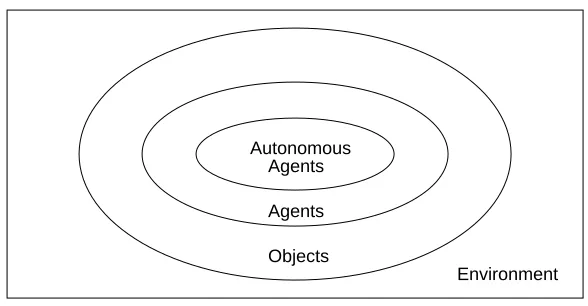
Figure 2: The Agent Hierarchy
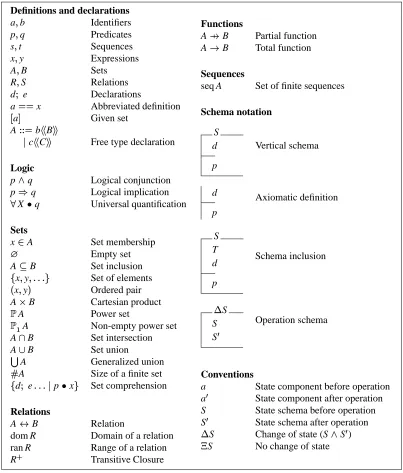
to be used is given in Figure 1. For a more complete treatment of the Z language, the interested reader is referred to one of the numerous texts, such as [54, 61, 53]. Details of the formal semantics of Z are given in [56]. We will not consider such issues further in this paper.
4
An Agent Framework
As discussed in some detail above, there exist many diverse notions of agency, and there is a distinct lack of consensus over the meaning of the term. This is just the sort of problem that the construction of a formal framework of the kind considered in the previous section can address. In this section, we in-troduce the terms and concepts that are used to explicate our understanding of agents and autonomous agents and then developed into formal definitions.
According to Shoham [22], an agent is any entity to which mental state can be ascribed. Such mental state consists of components such as beliefs, capabilities and commitments, but there is no unique correct selection of them. This is sensible, and we too do not demand that all agents neces-sarily have the same set of mental components. Indeed, we recognise the limitations associated with assuming an environment comprising homogeneous agents and consequently deliberately direct this discussion at heterogeneous agents with varying capabilities. However, in our framework we do spec-ify what is minimally required of an entity for it to be considered an agent. This approach is intended to be encompassing and inclusive in providing a way of relating different classes of agent, rather than an attempt to exclude through rigid definition.
Initially, we must describe the environment and then, through increasingly detailed description, define objects, agents and autonomous agents to provide an account of a general agent-oriented sys-tem. The definition of agency that follows is intended to subsume existing concepts as far as possible. In short, we propose a four-tiered hierarchy comprising entities, objects, agents and autonomous agents. The basic idea underlying this hierarchy is that an environment consists of entities, some of which are objects. Of this set of objects, some are agents, and of these agents, some are autonomous agents.
foundational in its significance, and serves as a platform on which other properties can be imposed, just as agency.
The specification is structured so that it reflects our view of the world as shown in the Venn diagram of Figure 2. It must be built up in such a way that, starting from a basic description of an entity, each succeeding definition can be a refinement of that previously described. In this way, an object is a refinement of an entity, an agent is a refinement of an object, and an autonomous agent is a refinement of an agent. Accordingly, the specification is thus structured into four parts.
Entity and Environment The most abstract description we provide is of an entity, which is simply a
collection of attributes. An environment can then be defined as a collection of entities.
Object We can also consider objects in the environment as collections of attributes, but we may also
give a more detailed description of these entities by describing their capabilities. The capabili-ties of an object are defined by a set of action primitives which can theoretically be performed by the object in some environment and, consequently, change the state of that environment.
Agent If we consider objects more closely, we can distinguish some objects which are serving some
purpose or, equally, can be attributed some set of goals. This then becomes our definition of an agent, namely, an object with goals. With this increased level of detail in our description, we can define the greater functionality of agents over objects.
Autonomous Agent Refining this description further enables us to distinguish a subclass of the
pre-viously defined class of agents as those agents that are autonomous. These autonomous agents are self-motivated agents in the sense that they pursue their own agendas as opposed to func-tioning under the control of another agent. We thus define an autonomous agent as an agent with motivations and, in turn, show how these agents behave in a more sophisticated manner than non-autonomous agents.
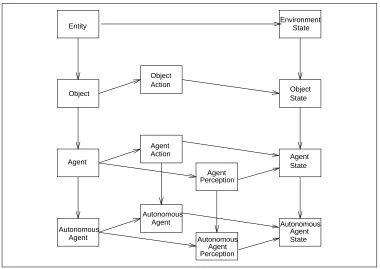
Just such a structured specification is facilitated in the Z specification language by describing a system at its highest level of abstraction with further complexity being added at each successive lower level of abstraction. An overview of the structure of our framework is given in Figure 3, where the boxes represent schemas, and the arrows represent schema inclusion. Definitions of entity, object, agent and autonomous agent are given by Entity, Object, Agent and AutonomousAgent respectively. This shows how we construct the most detailed entity description in the framework (of an autonomous agent situated in an environment) from the least detailed description (of an entity). Moving from the top of the figure to the bottom shows how decreasing levels of abstraction are achieved in the specification.
We define how objects, agents and autonomous agents act in an environment in the schemas ObjectAction, AgentAction and AutonomousAgentAction respectively, and we detail how agents and autonomous agents perceive in an environment in AgentPerception and AutonomousAgentPerception. In a similar fashion, ObjectState, AgentState and AutonomousAgentState define the state of objects, agents and autonomous agents when situated in an environment as defined by EnvironmentState.
5
The Framework Specification
5.1 Entities and Environment
Agent Environment
Autonomous Autonomous
Agent Agent Action
Agent Autonomous
Agent Object Entity
PerceptionAgent
Agent Perception
Autonomous State
Agent State State Object
State Object
[image:11.612.112.492.57.326.2]Action
Figure 3: Schema Inclusion in the Agent Framework
First, we need to define the attribute primitive. Attributes are simply features of the world, and are the only characteristics that are manifest. They need not be perceived by any particular entity, but must be potentially perceivable in an omniscient sense. This notion of a feature allows anything to be included such as, for example, the fact that a tree is green, or is in a park, or is twenty feet tall. In this sense, attributes correspond to propositional fluents rather than function fluents such as the colour of the tree.
Definition: An attribute is a perceivable feature.
In Z, the set of all attributes, or the attribute type, is defined as follows.
Attribute
An entity is any component described at the very highest level of abstraction; just as a collections of attributes. We do not care which attributes are grouped together to describe a given entity, or how that is achieved. We are only concerned with being able to describe a collection of attributes as a single component.
Now, a state schema can be constructed that defines an entity. Very simply, an entity is a set of attributes with the constraint that the set is non-empty. (Making the constraint explicit in this way enables the difference between levels of the hierarchy to be highlighted as clearly as possible.)
Entity
attributes ] Attribute attributes 1_^
An environment is simply a set of attributes that describe all the features within that environment that are currently true. For the purposes of readability, we define a new type, Env, to be a (non-empty) set of attributes.
Env`acb Attribute
Now, an entity must be situated in an environment. Conversely, an environment will include all the entities within it, and this is formalised in the EnvironmentState schema below. The environment state is represented by the env variable of type Env, which must consist of a non-empty set of attributes, and the entities variable, which refers to the set of entities in the environment. The last predicate formalises the requirement that the sum of the attributes of the entities in an environment is a subset of all the attributes of that environment.
EnvironmentState env Env
entities ] Entity
T
e entities2 e attributesed env
While it may be possible to envisage scenarios where entities share attributes, for simplicity we take it to be the norm that entities are distinct elements with distinct attributes.
5.2 Objects
An object can be defined at a basic level in terms of its abilities as well as its attributes. In this sense, an object is just an entity with the capacity to interact with its environment. This notion provides us with the basic building block with which to develop our notion of agency.
5.2.1 Object Specification
In order to define objects, we need to introduce another primitive, for an action. Actions can change environments by adding or removing attributes. For example the action of a robot, responsible for attaching tyres to cars in a factory, moving from one wheel to the next, will delete the attribute that the robot is at the first wheel and add the attribute that it is at the second. This is not dissimilar to the notions of add and delete list used in STRIPS; this work is not intended to address the semantic difficulties of modelling actions in this way, but to provide a simple and inclusive representation.
Definition: An action is a discrete event that can change the state of the environment when
per-formed.
Action
Again for the purposes of readability we define a new type, Actions, to be a set of Actions.
Actions `a Action
Definition: An object comprises a set of actions and a set of attributes.
a refinement of an entity and is defined by its ability in terms of its actions, and its configuration in terms of its attributes, which includes references to the body of the object, and is similar to the notion used by Goodwin [38]. The attributes of an object are accessible from the environment (in the sense that they can be perceived), while the capabilities of an object are not.
The schema below formalises the definition of an object. It has a declarative part containing the Entity schema and the capabilities variable, as well as a predicate part that specifies that capabilities is non-empty.
Object Entity
capabilities Actions capabilities 1_^
As an example of an object, consider again the tyre-attaching robot, and assume that it does not have a power supply. Since the robot has no power, its capabilities are severely limited and include just those which rely on its physical presence, such as supporting things, weighing things down, and so on. Similarly, the capabilities of the tea-cup include that it can support things and that it can contain liquid. Once the robot is connected to a power supply it becomes a new object with increased capabilities, including being able to fix tyres to a car and reporting defective ones.
Since an object has actions, these may be performed in certain environments that will be deter-mined by the state of that environment. The behaviour of an object can therefore be modelled as a mapping from the environment to a set of actions that are a subset of its capabilities. This mapping is known as the action-selection function, which is defined in the ObjectAction schema but applied in the ObjectState schema. In this respect, the information included in the Object and ObjectAction definitions relate to the intrinsic object properties and not to its state which is only defined once it is placed in an environment, as below.
Thus, ObjectAction schema below formalises this view and refines the Object schema, which is included in it. The action-selection function, objectact, determines which set of actions are performed next in a given environment and is defined as a total function. That is, given an environment, it returns a (possibly empty) set of actions. The assertion in the predicate part of the schema constrains the next actions to be taken by the object (determined by applying objectact) to be within the object’s capabilities.
ObjectAction Object
objectact Env Actions
f
env Env2gobjectact env hd capabilities
5.2.2 Object State
An object must be situated in an environment, which can be used to determine those actions that it is to perform next. Different states will give different actions as determined by application of the action-selection function.
declarations and predicates from both schemas. The variable, willdo, specifies the next actions that the object will perform. It is redundant since it is recoverable in exactly the way in which it is specified by applying the objectact function from the ObjectAction schema to the current environment, env, and is a subset of the capabilities of the object.
ObjectState EnvironmentState ObjectAction willdo Actions willdo objectact env willdo d capabilities
For example, the tyre-attaching robot, in a situation that includes holding a tyre, may now have willdo as a set of actions to attach the tyre to the car.
5.2.3 Object Operation
So far, we have described an object and the way in which its actions are selected. Next, we describe how the performance of these actions affects the environment in which the object is situated. Those variables that relate to the state of the object (in particular, its next actions) can change, while the other variables that are not concerned with state but with the nature of the object itself (namely, its attributes, capabilities and action-selection function) remain unchanged. If these latter variables ever did change, then a new object would be instantiated. In this view a robot without a power supply is a different object from a robot with a power supply.
Thei ObjectState schema shows how these constraints are formalised. It specifies that a change to the ObjectState schema will leave the ObjectAction schema unchanged by ‘j ObjectAction’, which states that none of the variables in it (and in schemas included in it such as Object) are affected by a change of state, so that attributes, capabilities and the action-selection function do not change.
i ObjectState ObjectState ObjectStatek
j ObjectAction
Now, when actions are performed in an environment, we say that an interaction takes place. An interaction changes the state of the environment by adding and removing attributes. In our model, all actions result in the same change to an environment whether taken by an object, agent or autonomous agent. The function that formalises how the environment is affected by actions performed within it can therefore be defined axiomatically. It maps the current environment and the performed actions to the resulting environment.
inteffect Env Actions Env
determined by applying inteffect to the current state of the environment and the current set of actions. In turn, this environment then determines the next set of actions to be performed by applying objectact again.
ObjectInteracts
i ObjectState
envk inteffect env willdo willdok objectact envk
5.3 Agents
5.3.1 Introduction
There are many dictionary definitions for an agent. Wooldridge and Jennings [9] quote the definition of an agent as “one who, or that which, exerts power or produces an effect.”1 However, they omit the second sense of agent, which is given as “one who acts for another . . . ”. This is important, for it is not the acting alone that defines agency, but the acting for someone or something that is defining. Indeed, Wooldridge and Jennings acknowledge the difficulties in a purely action-based analysis of agency.
In our view agents are just objects with certain dispositions. Specifically, we regard an object as an agent if it is serving some purpose2. They may always be agents, or they may revert to being objects in certain circumstances. For the moment, we concentrate on the nature of the disposition that characterises an agent. An object is an agent if it serves a useful purpose either to a different agent, or to itself, in which latter case the agent is autonomous. Specifically, an agent is something that satisfies a goal or set of goals (often of another). Thus if I want to use some object for my purpose, then that object becomes my agent. In some cases, goals are actually adopted by computational agents that have explicit goal representation. However, when dealing with non-computational entities, and entities that cannot represent goals explicitly, we can ascribe a goal to an entity, or we can anthropomorphise and state that the entity has adopted the goal.
5.3.2 Agent Specification
Before defining agents, we must first define goals. A goal describes a state of affairs that is desirable in some way. For example, a robot may have the goal of attaching a tyre to a car.
Definition: A goal is a state of affairs to be achieved in the environment.
We can define goals to be just (non-empty) sets of attributes that describe a state of affairs in the world.
Goal`a b Attribute
An agent can then be defined in terms of an object as follows.
Definition: An agent is an object with a non-empty set of goals.
The formal description of an agent is specified by the Agent schema. This refines the object schema and constrains the set of goals to be non-empty.
1The Concise Oxford Dictionary of Current English (7th edition), Oxford University Press, 1988.
Agent Object
goals Goal
goals l^
Thus an agent has, or is ascribed, a set of goals that it retains over any instantiation (or lifetime). One object may give rise to different instantiations of agents. An agent is instantiated from an object in response to another agent. Thus agency is transient, and an object that becomes an agent at some time may subsequently revert to being an object.
Note, that this definition means that in the limiting case, very simple non-computational entities without perception can be agents. For example, a cup is an object. We can regard it as an agent and ascribe to it mental state, but it serves no useful purpose to do so without considering the circum-stances. A cup is an agent if it is containing liquid and it is doing so to some end. In other words, if I fill a cup with tea, then the cup is my agent; it serves my purpose. Alternatively, the cup would also be an agent if it were placed upside down on a stack of papers and used as a paperweight. It would not be an agent if it were just sitting on a table without serving any purpose to any one. In this case it would be an object. As this example shows, we do not require an entity to be intelligent for it to be an agent. Clearly, the example of the cup is counter-intuitive and it is much more intuitive to talk about robots, but it is important to realise that any object, computational or otherwise, can be an agent once it is serving a purpose.
Considering the robot example, suppose now that the robot has a power supply. If the robot has no goal, then it cannot use its actuators in any sensible way but only, perhaps, in a random way, and must be considered an object. Alternatively, if the robot has some goal or set of goals that allow it to employ its actuators in some directed way, such as picking up a cup, or fixing a tyre onto a car, then it is an agent. The goal need not be explicitly represented, but can instead be implicit in the hardware or software design of the robot. It is merely necessary for there to be a goal of some kind. Note that it is nevertheless possible that random actions of a robot may satisfy some goal of entertainment or distraction, in which case the robot is considered to be an agent.
Returning to the example of the cup as my agent, it is clear that not everyone will know about this agency. If, for example, I am in a caf´e and there is a half-full cup of tea on my table, there are several views that can be taken. It can be regarded by the waiter as an agent for me, storing my tea, or it can be regarded as an object serving no purpose if the waiter thinks it is not mine or that I have finished. The waiter’s view of the cup either as an object or agent is relevant to whether he will remove the cup or leave it at the table. Note that we are not suggesting that the cup actually possesses a goal, just that there is a goal that it is satisfying.
These examples highlight the range of behaviour that is available from agents. The tea-cup is pas-sive and has goals imposed upon and ascribed to it, while the robot is capable of actively manipulating the environment by performing actions designed to satisfy its goals.
5.3.3 Agent Perception
In the case of a cup, for example, the set of possible percepts will be empty and consequently the set of actual percepts will also be empty. The robot, however, may have several sensors that allow it to perceive. Thus it is not a requirement of an agent that it is able to perceive.
To distinguish between representations of mental models and representations of the actual en-vironment, we define a type, View, to be the perception of an environment by an agent. This has an equivalent type to that of Environment, but now we can distinguish between physical and mental components of the same type.
View `m b Attribute
It is also important to note that it is only meaningful for us to consider perceptual abilities in the context of goals. Thus when considering objects without goals, perceptual abilities are not relevant. Objects respond directly to their environments and make no use of percepts even if they are available. We say that perceptual capabilities are inert in the context of objects.
An agent has a (possibly empty) set of actions that enable it to perceive its world, and which we call its perceiving actions. The set of percepts that an agent is potentially capable of perceiving is a function of the current environment and the agent’s perceiving actions. Since agents are typically resource-bounded, they may not be able to perceive the entire set of attributes and select a subset based on their current goals. For example, the distributed Multi-Agent Reasoning System (dMARS) [62], may have a set of events that it has to process, where events correspond to environmental change. Each of these percepts is available to the agent but because of its limited resources it may only be able to process one event, and must make a selection based on its goals.
The perception capabilities of an agent are defined in the AgentPerception schema, which includes the Agent schema and refines it by introducing three variables. The set of perceiving actions is denoted by peractions, a subset of the capabilities of an agent, while the canperceive function determines the attributes that are potentially available to an agent through its perception capabilities. Notice that this function is applied to a physical environment (in which it is situated) and returns a mental environment. The second argument of this schema is constrained to be equal to peractions. Finally, the function, agperceives, describes those attributes actually perceived by an agent to deal with the problem of resource-bounds by which an agent cannot necessarily perceive everything and must focus on some subset according to its current goals, as mentioned above. This function is always applied to the goals of the agent and, in contrast to the previous function, takes a mental environment and returns another mental environment.
AgentPerception Agent
peractions Actions
canperceive Env Actions View
agperceives Goal View View
peractions d capabilities
f
env Envn as Actions2
as o domcanperceive env qp as peractions dom agperceives goals
5.3.4 Agent Action
Now, any agent can be viewed as an agent, object or entity. For example, I may view a robot as an entity if I am solely interested in its colour; this provides all the information that I require and at the same time takes less modelling effort. If, on the other hand, I want the robot to perform a task for me, then I must model it at the agent level with goals included. At the agent level of abstraction, goals and perceptions as well as the environment can be viewed as directing behaviour. This is specified by the agentact function in the AgentAction schema below, which is dependent on the goals, the actual perceptions of the agent and the current environment itself. Since the objectact function is still applicable for modelling the agent solely at the object level, the ObjectAction schema is included. The first predicate requires that agentact returns a set of actions within the agent’s capabilities, while the last predicate constrains its application to the agent’s goals. If there are no perceptions, then the action-selection function is dependent only on the environment, as it is with objectact.
AgentAction Agent ObjectAction
agentact Goal View Env! Action
f
g Goaln v Viewn env Env2
agentact g v env rd capabilities dom agentact goals
5.3.5 Agent State
Now, to describe an agent with capabilities and behaviours for perception and action situated in an environment, we include the two schemas previously defined for action and perception as well as the schema defining the agent as a situated object. The AgentState schema, which formalises an agent situated in an environment, therefore includes the schemas AgentAction, AgentPerception and ObjectState. In addition, since the attributes of the environment are now accessible, it is possible to specify the possible percepts and actual percepts of the agent. These are denoted by the variables, posspercepts and percepts, which are calculated using the canperceive and agperceives functions re-spectively.
AgentState AgentPerception AgentAction ObjectState
posspercepts percepts View percepts d posspercepts
posspercepts canperceive env peractions percepts agperceives goals posspercepts
peractions lsp posspercepts t
willdo agentact goals percepts env
in its environment. Potentially, as a consequence of its current environment the robot may be able to perceive a multitude of attributes including that the car is red, a tyre is flat, the car door is open, and so on. Again, however, due to limited perceptual and processing abilities, and to the goal of attaching tyres, the actual percepts of the robot may only include that the tyre is flat and not the rela-tively insignificant attribute of the car being red. The cup agent, on the other hand, has no perceiving capabilities and consequently no possible or actual percepts.
Since goals are fixed for any agent, changes to the actual percepts of an agent affect its selection of actions. An agent without perceptions does not therefore have any increased functionality as a result of having goals, but the behaviour of an agent without perceptions can still be viewed and modelled in terms of goals affecting its action selection.
5.3.6 Agent Operation
Operations characterising agent behaviour are constrained to affect only certain aspects. The at-tributes, capabilities, goals, perceptual capabilities, and action and perception selection functions are unchanged by any operation. If any of these variables change, a new agent is instantiated. The only variables that may change are necessarily associated with the state of the agent such as its situation and possible and actual percepts. These constraints are formalised in the i Agent schema, which defines a change in agent state. It includesi ObjectState to ensure that only the state properties of objects change and, in addition, that variables included in the AgentAction and AgentPerception schemas are unaltered.
i AgentState AgentState AgentStatek
i ObjectState j AgentAction j AgentPerception
When an agent acts in an environment, the environment changes according to the specific actions performed. This does not depend on whether the entity is an object or an agent. Thus the schema describing object interaction is still directly applicable. Formally, the AgentInteracts schema includes ObjectInteracts and affects the state of an agent as specified byi AgentState. The three predicates of this schema show explicitly how the schema variables are updated.
AgentInteracts
i AgentState ObjectInteracts
possperceptsku canperceive envk peractions perceptsk agperceives goals possperceptsk willdok agentact goals perceptsk envk
5.4 Autonomy
5.4.1 Introduction
escape what could be an infinite regress, and also to bring out the notion of autonomy, we introduce motivation.
Grounding the hierarchies of goal adoption demands that we have some agents that can generate their own goals. These agents are autonomous since they are not dependent on the goals of others, and possess goals that are generated within rather than adopted from other agents. Such goals are generated from motivations, higher-level non-derivative components characterising the nature of the agent, but which are related to goals. Motivations are, however, qualitatively different from goals in that they are not describable states of affairs in the environment. For example, consider the motivation greed. This does not specify a state of affairs to be achieved, nor is it describable in terms of the environment, but it may (if other motivations permit) give rise to the generation of a goal to rob a bank. The distinction between the motivation of greed and the goal of robbing a bank is clear, with the former providing a reason to do the latter, and the latter specifying what must be done3.
A motivated agent is thus an agent that pursues its own agenda for reasoning and behaviour in accordance with its internal motivation. Since motivations ground the goal-generation regress, we claim that motivation is critical in achieving autonomy. An autonomous agent must be a motivated agent.
Although it draws on Kunda’s work on motivation in psychology [63], the definition used for motivation above expresses its role but does not tie us to any particular implementation. Indeed, there are several views as to exactly how the role of motivation as defined here can be fulfilled. Simon, for example, takes motivation to be “that which controls attention at any given time,” and explores the relation of motivation to information-processing behaviour, but from a cognitive perspective [64]. More recently, Sloman has elaborated on Simon’s work, showing how motivations are relevant to emotions and the development of a computational theory of mind [65, 66]. Some have used motivation and related notions such as motives [67], and concerns [68], in developing computational architectures for autonomous agents while others have argued for an approach based on rationality that relies on utility theory [69].
In this framework, we take a neutral stance on such detail by specifying motivation as a given set, omitting any further information. This allows us to use the concept of distinct and possibly conflicting motivations influencing the behaviour of the agent, but also defers the choice of the actual mechanism to a subsequent point of refinement or implementation. Moreover, whilst others have been concerned with modelling motivation [68, 67], our work is concerned with its use in defining autonomy.
5.4.2 Autonomous Agent Specification
We begin our specification of autonomous agents by introducing motivations.
Definition: A motivation is any desire or preference that can lead to the generation and adoption
of goals and that affects the outcome of the reasoning or behavioural task intended to satisfy those goals.
As with actions and attributes, the type of all motivations is defined as a given set.
Motivation
3
Table 1: Example: Descriptions of a Robot and Cup in the Agent Framework
Schema Variable Teav Cup Robot
Entity attributes stable hard
))
red large heavy )
Object capabilities support store
))
lift carry hold )
Agent goals store tea fix tyres charge
))
AutonomousAgent motivations l achievement hunger
))
An autonomous agent may now be defined.
Definition: An autonomous agent is an agent with a non-empty set of motivations.
It is specified simply as an agent with motivations.
AutonomousAgent Agent
mots ] Motivation
mots ^w
In illustration of these ideas, note that the cup cannot be considered autonomous because, while it can have goals ascribed to it, it cannot generate its own goals. In this respect it relies on other entities for purposeful existence. The robot, however, is potentially autonomous in the sense that it may have a mechanism for internal goal generation. Suppose the robot has motivations of achievement, hunger and self-preservation, where achievement is related to attaching tyres onto a car on a production line, hunger is related to maintaining power levels, and self-preservation is related to avoiding system breakdowns. In normal operation, the robot will generate goals to attach tyres to cars through a series of subgoals. If its power levels are low, however, it may replace the goal of attaching tyres with a newly-generated goal of recharging its batteries. A third possibility is that in satisfying its achievement motivation, it works for too long and is in danger of overheating. In this case, the robot can generate a goal of pausing for an appropriate period in order to avoid any damage to its components. Such a robot is autonomous because its goals are not imposed, but are generated in response to its environment. The views of the cup and robot in terms of the agent hierarchy are shown in Table 1, which provides example instantiations of the different requirements for each level.4
5.4.3 Autonomous Agent Perception
With autonomous agents, therefore, it is both goals and motivations that are relevant to determining what is perceived in an environment. The schema below thus specifies a modified version of the non-autonomous agent’s agperceives function as perceives. That which an non-autonomous agent is potentially capable of perceiving at any time is independent of its motivations. Indeed, it will always be inde-pendent of goals and motivations, and there is consequently no equivalent increase in functionality to canperceive.
4
AutonomousAgentPerception AutonomousAgent
AgentPerception
perceives Motivation! Goal
Env View dom perceives mots
5.4.4 Autonomous Agent Action
An autonomous agent will have some potential means of evaluating behaviour in terms of the environ-ment and its motivations. In other words, the behaviour of the agent is determined by both external and internal factors. This is qualitatively different from an agent that merely has goals because motivations are non-derivative and governed by internal inaccessible rules, while goals are derivative but relate to motivations. Specifically, the action-selection function for an autonomous agent is produced at every instance by the motivations of the agent. The next schema defines the action-selection function, act and includes the AgentAction and AutonomousAgent schemas. The domain of the act function is equal to the motivations of the agent.
AutonomousAgentAction AutonomousAgent AgentAction
act ] Motivationx Goal
View Env Actions
dom act mots
5.4.5 Autonomous Agent State
In exactly the same way that the state of an agent is defined by refining the definition of the state of an object, the state of an autonomous agent is defined using the state of an agent. The actions performed by an autonomous agent are a function of its motivations, goals, percepts and environment.
AutonomousAgentState AgentState
AutonomousAgentPerception AutonomousAgentAction
willdo act mots goals percepts env
5.4.6 Autonomous Agent Operations
be regarded as a continually re-instantiated non-autonomous agent. In this sense, autonomous agents are permanently agents as opposed to transient non-autonomous agents, which may revert to being objects.
i AutonomousAgentState AutonomousAgentState AutonomousAgentStatek
i AgentState
perceivesk perceives actky act
Finally, we specify the operation of an autonomous agent performing its next set of actions, a refinement of the AgentInteracts schema.
AutonomousAgentInteracts
i AutonomousAgentState AgentInteracts
possperceptsku canperceive envk peractions perceptsk perceives motsk goalsk possperceptsk willdok act motsk goalsk perceptsk envk
6
Consequences of the Agent Hierarchy
The agent hierarchy specified above is sufficient for satisfying the first requirement of formal frame-works identified earlier. It provides unambiguous definitions and descriptions of different classes of entity in an elegant and readable way, making clear the particular identifying features of each class. Within this framework, we can further refine our concepts to develop more concrete instances of dif-ferent types of agent, corresponding both to existing agent categories, and to new categories that may be useful and interesting. We can thus consider how the framework impacts on existing notions and classes of agent, and what consequences arise from the definitions. This section addresses such issues, focusing in particular on the agent class descriptions provided by [70] and [71].
6.1 Reflexive Agents
An agent is said to be reflexive [70] or tropistic [71] if it responds only to an immediate stimulus. Thus a particular perception of the environment dictates which next action the agent will choose to perform. This kind of agent is often viewed as an agent without goals, but that is an over-simplification. Any agent will be designed with some overall goal, even if the goal itself is not explicitly encoded. This is important, for it underlies our definition of agency. The relevant feature of reflexivity is that it has no internal state representing any prior information about the environment. As such, this fits in well with the definition provided above and specified in the Agent and AgentAct schemas.
6.2 Store Agents
and store information as internal state. To specify an agent with such internal state, or store, we can simply refine the Agent schema by adding a collection of attributes as memory. The schema below defines agents with the ability to access such an internal store of attributes or memory as a store agent. Notice that the type of a store is Env which, when accessed, produces perceptions of type View.
StoreAgent Agent store Env store ^]
Now, since there is both an external environment and a memory, it is necessary to distinguish between internal and external perceiving actions, where internal actions can access the store, and external perceiving actions access the external environment. We therefore refine the definition of the canperceive function at the agent level into two distinct functions at the store-agent level.
In defining perception, StoreAgentPerception includes AgentPerception and StoreAgent, with intperactions and extperactions referring to the external and internal perceiving actions, respectively. The storecanperceive function determines the set of perceptions that can be currently generated from its internal store, while extcanperceive determines those percepts possible from the external environment. The internal per-ceiving actions must be non-empty since otherwise the store cannot be accessed, and the internal and external perceiving actions are disjoint and together comprise the set of all perceiving actions. Note that the percepts that the agent actually selects make up a subset of the available attributes and are dependent on the goals of the agent as defined previously. Thus the perceive function from the AgentPerception schema is still applicable, since the store is carried through possible percepts and actual percepts to the action-selection function, agentact.
StoreAgentPerception StoreAgent
AgentPerception
intactions extactions Action storeperceive Env Actions View extperceive Env Actions View intactionsw^
intactionsz extactions peractions intactions{ extactions
dom storeperceive | store
StoreAgentAction StoreAgent AgentAction
In this way, we specify agents that are similar in spirit to the hysteretic agents of Genesereth and Nilsson [71], and the reflex agents with internal state of Russell and Norvig [70].
6.3 Agent Properties
Property Agent Type
reactivity Agent
pro-activeness (Planning) Agent
autonomy Autonomous Agent
rationality Autonomous Agent
benevolence Non-autonomous Agent
veracity Non-autonomous Agent
temporal continuity Not required
personality Not required
adaptability Not required
mobility Not required
[image:25.612.172.434.57.229.2]communication, social ability Not required
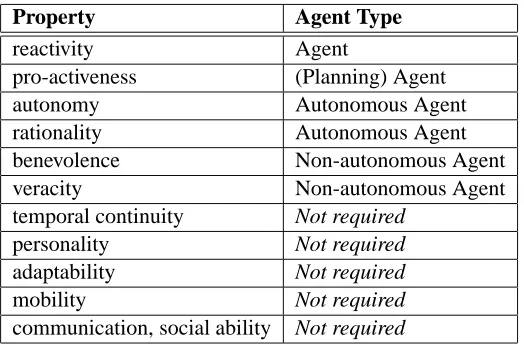
Table 2: Characteristic agent properties.
Table 2, and each will be addressed in turn. Note that each is a specialisation of our basic agent. First, reactivity has been defined as the ability to perceive and to respond to a changing environment. This is always true, since action-selection in all of our entities is a function of the environment at every point. Reactivity is a less pure version of reflexivity [38], but the two are often taken to be the same, and we will not pursue further a discussion of the relative qualities of them here. Pro-activeness, by which an agent behaves in a goal-directed fashion, is a direct consequence of the framework, but is more usually considered in relation to planning, and is strengthened with autonomy, discussed next, in allowing an agent to generate its own goals.
The third property, autonomy, is relatively straightforward in that it is defined explicitly as one level in the agent hierarchy. An autonomous agent is defined by its motivations which provide a means for self generation of goals. Rationality is a little less explicit, but arises out of the motivations of the agent. Remember that the details of the motivations are not specified, and that a motivational mechanism can be constructed in any suitable way. Whatever mechanism is adopted, however, goals are generated to mitigate motivations in an essentially rational manner. For example, motivation might amount to a measure of utility, in which case rationality can be defined in terms of maximising utility. The key point is that this notion of motivation provides constraints that guarantee rational behaviour. (For further discussion of this issue, see [67] or [72], for example.)
au-tonomous agent. That is to say that they do not impact, or relate to, the hierarchy in any signif-icant ways, but can be added on to the basic entities described therein through refinement. Other such refinements are also possible, leading to specifications of knowledge-level agents and stepped knowledge-level agents [71], for example. These can be constructed in a similar fashion, and we will not consider them further here. The next section does, however address the particular case of deliberative or planning agents which are especially significant in artificial intelligence for achiev-ing the successful completion of complicated tasks, as well as considerachiev-ing sociological agents which construct models of others, and showing how relationship definitions can be constructed.
7
A Foundation for Further Work
As a result of this specification, we have formal definitions for agents and autonomous agents that are clear, precise and unambiguous, but which do not specify a prescribed internal architecture for agency and autonomy. This is exactly right, since it allows a variety of different architectural and design views to be accommodated within a single unifying structure. All that is required by our specification is a minimal adherence to features of, and relationships between, the entities described therein. Thus we allow a cup to be viewed as an object or an agent depending on the manner in which it functions or is used. Similarly, we allow a robot to be viewed as an object, an agent or an autonomous agent depending on the nature of its control structures. We do not specify here how those control structures should function, but instead how the control is directed.
Moreover, the framework described and specified here is not only intended to stand by itself, but also to provide a base for further development of agent architectures and agent theory in an incremental fashion through refinement and schema inclusion. In this context, the framework has been further developed to incorporate, for example, notions of planning, agent modelling and cooperation. A very brief description of each follows.
7.1 Planning
We can easily refine the components within the framework to provide, for example, a high level specification of a planning agent, which deliberates over sequences of actions that can achieve a desired goal.
As a simple example of the way types can be constructed using only the four given sets as pre-sented in the framework, we can build a definition of a plan from our Action type as follows.
First, we define a complete plan to be a sequence of actions.
TotalPlan ` seq Action
If the actions in a plan are not completely ordered, then that plan is a partial plan. A partial plan thus consists of some partial ordering on a set of actions as shown below. However, an action cannot occur before itself in a partial plan, and if an action a occurs before action b, then b cannot be before a. The notation, R} , denotes the irreflexive-transitive closure of R.
PartialPlan `
ps Action ~ Action .
f
a b Action2g a a l^o ps}
a b ho ps} pb a w^o ps} 2 ps