EVOLUTION OF DAMAGE IN CONCRETE THROUGH AN ENERGETIC
APPROACH
Pervaiz Fathima K.M. 1, J.M. Chandra Kishen2 1
Research Scholar, Dept. of Civil Engineering, Indian Institute of Science, Bangalore, INDIA-560012 2
Associate Professor, Dept. of Civil Engineering, Indian Institute of Science, Bangalore, INDIA-560012 E-mail of corresponding author: [email protected]
ABSTRACT
Concrete structures undergo damage when they are subjected to adverse loading conditions. It is important to mathematically model the process of damage, in order to predict the residual strength of structures. The process of damage in concrete is complex, which occurs simultaneously at micro, meso and macro levels. The complexity further increases as the processes at different levels interact. The energy method is one the simplest means of handling a complex system. In this study, the framework of irreversible thermodynamics is used to model damage. An expression for dissipation potential is derived, from which a damage evolution equation is obtained. Further, an energy equivalence approach is used to correlate the fracture mechanics and the damage mechanics theories such that the equivalence is thermodynamically admissible. The objective of this exercise is to pass smoothly from one theory to another.
INTRODUCTION
Concrete is a heterogeneous quasi-brittle material, weak in tension. Internal flaws and cracks exist in concrete even before the structure is subjected to external loading. These are actually the microcracks due to the physical and chemical processes taking place in concrete like shrinkage, hydration, carbonation etc. Initially, these microcracks are isolated and somewhat uniformly distributed. When the concrete structure is subjected to loading of increasing intensity, the microcracks coalesce to form a narrow band, i.e., damage starts to localize. This narrow band of microcracks can be physically simulated as the formation of a macrocrack. Upon further increase in load, the length of the band of microcracks increases, or in other words, the macrocrack propagates. Ahead of the crack tip is an inelastic zone called the fracture process zone (FPZ), wherein different toughening mechanisms like microcrack shielding, crack deflection, aggregate bridging, crack face friction, crack tip blunting by voids, crack branching etc take place. The effect of all these mechanisms is taken into account by a conceptual fracture process zone [1]. It can thus be stated that, the process of damage in concrete, starting from microcracking to the formation of macrocrack, until ultimate failure is a very complex process that proceeds simultaneously at micro, meso and macro levels. The complexity further increases as the processes at different levels interact. The simplest way to model a complex phenomenon is the energy balance method. In fact, the well known Griffith's theory of fracture is based on energy balance in crack growth. Since, we assert to deal complex processes through simple energy balance, it seems reasonable to use the framework of thermodynamics to develop a damage model for concrete. Damage and cracking are both irreversible processes and lead to significant dissipation; hence we use the framework of thermodynamics of irreversible processes. The advantage of the use of thermodynamics to study problems in mechanics is the simplicity of presentation, although not compromising agreement with experimental results.
In the framework of thermodynamics, all constitutive equations of dissipative phenomena derive from a potential of dissipation. The development of damage mechanics in a thermodynamic framework by using the internal state variable theory [2] was developed by Germain [3] and later improved by Lemaitre [4], Chaboche [5], Krajcinovic [6] and many others. The damage evolution laws available in literature are expressed in terms of a dissipation potential and the damage variable ([5], [7] – [10]). Most of these models are empirical in nature and are obtained by a regression fit of experimental data and are applicable to metals. In this work, an analytical expression for dissipation potential is proposed by using mathematical arguments and concepts of dimensional analysis, from which a damage evolution model for concrete is developed.
THERMODYNAMICS OF IRREVRSIBLE PROCESSES
thermodynamic quantities in a system out of equilibrium are the same as for a uniform system in equilibrium and the state at a given material point and time is completely defined by the knowledge of the values of a certain number of variables at that instant, which depend only upon the point considered. The state of equilibrium however, is different for different material points. These state variables include the observable variables and the internal variables. The observable variables are the usual macroscopic field quantities like temperature and total elastic strain. These variables are governed by conservation laws. The state depends uniquely on these variables for a reversible (elastic) phenomenon. For dissipative phenomena, the current state also depends on the past history which is represented by the values at each instant of the internal variables. The internal structure of the material is supposed to be described by internal variables which are not observable. They should compensate our lack of knowledge of the precise description of the microstructure. These variables represent the internal state (like microcracking) and there are no means of measuring them by direct observation. They do not appear explicitly either in the conservation laws or the second law of thermodynamics. But in fact these are the state variables and will be treated as observable ones. There is no objective way of choosing the nature of internal variables best suited to the study of a phenomenon. The formalism of internal variables involves construction of a dissipation potential.
Thermodynamic potentials are scalar functions used from which all the characteristics of the system can be deduced. It is defined as a function of a set of independent state variables. Associated with this set of independent state variables is a set of dependent state variables called the thermodynamic properties. These play a duality type role in that, each state variable has a thermodynamic property and it is occasionally desirable to reverse these roles [11]. The commonly used thermodynamic potentials are the Helmholtz free energy and Gibbs free energy.
Entropy and Dissipation
In non-equilibrium thermodynamics, the challenge lies in defining entropy. The rate of variation of entropy may be written as the sum of the rate of exchange with the exterior dSe/dt and the rate of internal entropy production dSi/dt. The quantity dSi/dt is called the uncompensated heat or the rate of dissipation and is greater than 0 for an irreversible process and equal to 0 for a reversible process. For a reversible process, the change in entropy is only due to the input of heat to the system. But, for an irreversible process, the change in entropy results from (pure) heat input and irreversibilities that occur like the intrinsic changes in the material structure. The Clausius inequality, which is a form of representation of second law can be written as,
.
⎡ ⎤≥ − ⎢ ⎥
⎣ ⎦
q T s r Tdiv
T (1)
where, r is an internal point heat source per unit volume, and q is the heat flux. To balance the above inequality equation, the dissipation term Di is added to the right-hand side, which leads to the thermal balance (or equilibrium) Eq. (2) below. This consists of mechanical and thermal dissipation, being heat like quantities lost from the system due to plasticity and damage, for example.
.
i
q
D T s r Tdiv
T
⎡ ⎤
= − + ⎢ ⎥
⎣ ⎦ (2)
Since dissipation balances the heat exchanged, it must be non-negative, and the resulting dissipation inequality governs the evolution of thermodynamic systems
There are several ways, in phenomenological theories, to account for the dissipative effects which, in addition to heat conduction accompany deformation. One approach is to postulate the existence of internal state variables which influence the free energy and whose rate of change is governed by differential equations in which the strain appears [2]. This approach has been a very successful framework for simple models, but has the disadvantage that the use of internal variables sometimes over-simplifies the response. In particular it is difficult to express smooth transitions of behaviour using internal variables [13].
Thermodynamic Potential and Dissipation Potential
allows the description of the dissipative part of the material behavior. Normality rules are necessary to derive the loading and flow functions by satisfying the second principle of thermodynamics. Different versions of the theory, widely presented in [14], exist depending on the material type: standard, standard generalized, rate-dependent (visco), rate-independent (plasticity). Generally, the free specific energy is chosen as the thermodynamic potential, it allows us to write relations between observable variables and associated variables. However, for internal variables it allows only the definition of their associated variables. In order to describe the dissipation process, mainly the evolution of the internal variables, a complementary formalism is needed. This is precisely the objective of dissipation potentials [14].
EXPRESSION FOR DISSIPATION POTENTIAL
In this work, an expression for dissipation potential is derived using mathematical arguments and dimensional analysis. The system here is a concrete structure which undergoes damage (irreversible process) in the form of microcracking. The dissipation potential is expressed as a continuous and convex scalar valued function of
the flux variables φ ε(
.
p, V q T.
k, / )r
with a zero value at the origin of the space of the flux variables, in order to automatically satisfy the second law of thermodynamics. The normality rule is sufficient to ensure the satisfaction of the second law of thermodynamics, but it is not a necessary condition [14]. The complementary laws are expressed by the normality property (or normal dissipativity):
k
A g ( / )
.
.
p Vk q T
φ φ φ
σ ε
∂ ∂ ∂
= = − = −
∂
∂ ∂
r
r (3)
where, gr uuuur = grad T and σ, Ak and g r
are the dual variables associated with flux variables
ε.
p,
V.
kand
( / )q TrThe thermodynamic forces are the components of the vector grad φ normal to the φ = constant surface in the space of the flux variables. The complementary laws are more easily expressed in the form of the evolution laws of flux variables as functions of dual variables (associated variables). The Legendre-Frenchel transform enables us to
define the corresponding potentialφ σ*( , Ak, gr), the dual of φ with respect to the variablesε
.
p, V q T.
k, /r
. If the
function φ* is differentiable, the normality property is preserved for the variablesε
.
p, V q T.
k, /r
. The complementary laws of evolution can be written as
* * *
( / )
.
.
p k
k
V q T
A g
φ φ φ
ε σ
∂ ∂ ∂
= = − = −
∂ ∂ ∂
r
r (4)
The whole problem of modelling a phenomenon lies in the determination of the analytical expressions for the thermodynamic potential and the dissipation potential φor its dual φ* and their identification in characteristic
experiments. In fact, the values of φ or φ* are almost impossible to measure in experiments as they represent energy usually dissipated as heat. The flux variables and the dual variables are quite easy to measure and it is on their values that the modelling and identification are based. The complementary laws are therefore directly identified but the dissipation potential is used as guideline for writing their analytical expression. The dissipation potentials can be generalized by including the state variables themselves as parameters. The dissipation potentials are then written as [14]:
*
( , , / ; , , )
( , , ; , , )
.
.
p k e k
k e k
V q T T V
A g T V
φ ε ε
φ σ ε
r r
(associated), parameters (state variables) and material constants. Associated variables include stress (σ), damage energy release rate (Y), gradient of temperature (gr). State variables that are included as parameters are elastic strain (εe), accumulated inelastic strain (p), temperature (T) and damage variable (D). The material constants considered are, the modulus of elasticity (E) and tensile strength (ft). The selection of variables is based on the assumption that dissipation occurs only through damage and irreversible inelastic strains, and the heat released during the process is negligible. Thus the internal variables Vk are the damage variable D and the accumulated inelastic strain p. The dual variable corresponding to D is Y, the damage energy release rate.
* *( , , ; , , , ; , )
e t
Y g p T D E f
φ =φ σ rε (5)
Consider the case of isothermal process, thereby reducing two arguments g and T. The dissipation potential is thus a function of:
φ*=φ σ*( , Y;εe, , ; , )p D E ft (6)
It is to be noted at this point that in dimensional analysis, the variables that describe the phenomenon must be complete and independent. Since Y, the damage energy release rate depends on stress, Young’s modulus of elasticity and the damage variable, three more arguments are reduced. Therefore
φ*=φ*( ;Y εe, , )p ft (7)
Since the elastic strain εe will not contribute to any dissipation we may ignore it and consider only the accumulated
plastic strain. The dissipation potential is a function of
φ*=φ*( ; ; )Y p ft (8)
Dimensions ofφ*, Y, ft is FL
-2
and p is dimensionless. Considering FL-2as the primary quantity, we have Y, ft as
the independent dimensions, therefore
φ*=CY fα βt φ1*( )p (9)
where, C is a constant. For dimensional homogeneity, α β+ =1. The function φ*is of a positive definite form in
terms of the dual variables. The constant C = ½, α=2 therefore, β= −1 and so, φ* takes the form
2
* *
1 1
( ) 2 t
Y p f
φ = φ (10)
The function φ1*( )p cannot be determined from dimensional analysis. To obtain this function we try to fit a regression curve from experimental data. Physically, the dissipation is nothing but the irreversible entropy gain. This entropy gain turns out to be the plastic work [12]. The relation between dissipation potential and the inelastic strain can be obtained using experimental data. The damage evolution equation is given by
*
.
DY
φ
∂ = −
∂ (11)
For the above case, it is given by
.
1*( )t Y
D p
fφ
Example
Experimental data from [15] was taken for concrete in tension. The dissipated energy was computed from the stress strain loading unloading curve given in Fig.1 for each cycle.
Fig.1: Stress strain curve for concrete in tension [15]
The relation between φ* and p was obtained. Thus the final expression for dissipation potential for concrete is 2
* 2
1 2 3
1
( )
2 t Y
c p c p c f
φ = + + (13)
where, c1, c2, c3 are constants to be obtained from experiments. And the damage evolution equation is given by
2
1 2 3
( )
.
t Y
D c p c p c
f
= − + + (14)
Damage at a particular strain level is obtained by integrating Eq. (18). Fig.2 shows the relation between the damage D with respect to strain.
2 4 6 8 10 12 x 10-5 0
0.1 0.2 0.3 0.4 0.5 0.6 0.7 0.8 0.9 1
Strain
Dam
age
Fig.2: Damage variation with respect to strain
Thus, a damage value of zero indicates no damage and damage value of unity indicates the formation of a localised band or the formation of a major crack. In the above example, it can be observed that, initially, upto 20% of the peak load there is no initiation of microcracking and hence the value of damage is 0. The increment in damage is slow upto 80% of the peak load. This implies that microcracks are still isolated. Damage starts increasing considerably after reaching 80% of the peak load. This stage is the coalescence of microcracks in a narrow band. At approximately 95% of the peak load, the damage becomes equal to 1. This implies the formation of major crack. After this, the damage value exceeds 1, which means the propagation of major crack. This is in accordance to the experimental findings [1]. The continuum damage mechanics seizes to work after this, i.e., the formation of major crack. The theory of fracture mechanics is well suited to study failure of members due to propagation of cracks.
CORRELATION BETWEEN FRACTURE MECHANICS AND DAMAGE MECHANICS THEORIES
Computational approaches to failure use either of the two theories; fracture mechanics or damage mechanics.According to fracture mechanics theory, energy (G) is required for an existing crack to propagate by an amount δa. Similarly, in case of damage based analysis, the strain energy loss per unit volume of the material due to increase in damage by an amount dD is referred to as damage strain energy release rate Y. The idea of energy based equivalence is based on equating the energy loss due to damage, with the energy required for equivalent crack propagation within the member. Energy based equivalence correlates two structures having the same geometry and loading condition, but different damage definitions. In a global sense they behave in the same manner when the energy dissipation corresponding to two different damage conditions become equal for the two structures [17]. In
case of fracture mechanics the flux variable is the rate of increase in crack area A
.
and the corresponding thermodynamic force is G. On the other hand, for damage mechanics the flux variable is the rate of increase indamage D
.
and the corresponding thermodynamic force is Y. The first and second laws of thermodynamics are completely satisfied if the Clausius Duhem inequality is verified. For the two cases considered, we obtain0 and 0
.
.
Y D G A
− ≥ − ≥ (15)
The two theories can be related and a given damage zone can be transformed into an equivalent crack and vice versa. This is done by
dV = ‐GA
.
.
Y D −
∫
(16)A crack propagates only when the energy release rate reaches its critical value Gc, therefore the equivalent crack area is given by
( )
0
c
G
D x
V e
Y dD dx A
−
=
∫ ∫
(17)Alternatively, for a given crack length, equivalent damage zone can be obtained.
Example
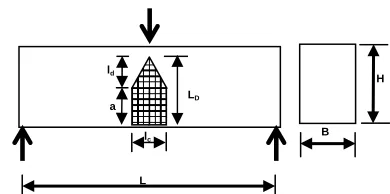
The case of a three point bend beam with a crack at its midspan is considered. Three different sized beams are considered. The details of geometry and loading conditions are given in Table 1. Energy release per unit crack extension is computed using
2 2
2 2
0
9 1
( ) ( ) where ( ) ( )
4 P L
U F F Y d
E BH
= =
∫
α
α α α α α α
(18)
α is the relative crack depth and Y(α) is the geometry factor and is different for different span to depth ratios
2
1.5
1.99 (1 )(2.15 3.93 2.7 ) L
( ) for 2.5
H (1 2 )(1 )
Y α α α α α
α α
⎡ − − − + ⎤
⎣ ⎦
= =
Using Eq. (18), the strain energy as a function of relative crack depth α can be evaluated. The crack is replaced with an equivalent damage zone of width lc, depth LD and thickness B. LD = a + ld, where a is the crack length and ld is the length of process zone. The damage zone corresponding to the process zone length is assumed to be an equilateral triangle of side lc. as shown inFig. 3. In three-dimensional form, the energy dissipated through damage is expressed as
( )
( )
=
∫ ∫
−D V D y
U Y dDdV (20)
The energy dissipated due to progressive damage near the location of the crack results in the gradual change of damage variable D from 0 → 1 and is given by,
( )
( )
( )
( )
1 1
2 0 0
1
− −
+ +
= ∫ ∫ − + + ∫ ∫ −
−
⎛
⎞
⎧
⎫
⎧
⎫
⎜
⎟
⎪
⎪
⎪
⎪
⎝
⎠
⎪
⎪
⎪
⎪
⎨
⎬
⎨
⎬
⎪
⎪
⎪
⎪
⎪
⎪
⎪
⎪
⎩
⎭
⎩
⎭
d d
d d
c
D c
y y
a l a l
a a Bl
U Bl YdD dy YdD dy
y a
a
(21)
Equating the two energy terms in Eqs.(18) and (21), we can solve for the unknown dimension of the damage zone, LD through a trial and error procedure, after defining LD in terms of lc.
Fig.3: Schematic showing the equivalent damage zone
Table 1: Geometry and loading conditions of plain concrete beams
Specimen Width (mm) Depth (mm) Span (mm) Peak Load (N)
Small 38.1 38.1 95 1815.6
Medium 38.1 76.2 191 2986
Large 38.1 152.4 381 5184
Fig.4: Equivalent damage zone length versus relative crack depth
P
lc
a ld
LD
L
CONCLUSION
An analytical expression for dissipation potential is derived for concrete using mathematical arguments and assuring dimensional homogeneity. The expression is derived under the assumption that dissipation in concrete structure is due to damage caused by microcracking and due to irreversible strains. Heat released during the process of damage is ignored and isothermal conditions are assumed. The damage model obtained from this dissipation potential captures damage well within the continuum damage mechanics framework. Further, damage mechanics and fracture mechanics theories are correlated through an energy equivalence such that the equivalence is thermodynamically acceptable. Using this equivalence, a damage zone can be transformed into an equivalent crack and vice versa.
REFERENCES
[1] Shah, S. P., Swartz, S. E. and Ouyang,C., “Fracture Mechanics of concrete: Applications of fracture mechanics to concrete, rock and other quasi-brittle materials”, John Wiley and Sons, Inc, USA, 1995 [2] Coleman,B.D., Gurtin,M.E., “Thermodynamics with internal state variables”, Journal of Chemical Physics
Vol. 47, 1967, pp: 597-613.
[3] Germain, P., “The method of virtual power in continuum mechanics. Part 2: Microstructure”, SIAM Journal on Applied Mathematics, Vol. 25 (3), 1973, pp. 556-575.
[4] Lemaitre, J., “ A continuum damage mechanics model for ductile fracture”, Journal of engineering materials and technology, Vol. 107, 1985, pp. 83-89.
[5] Chaboche, J.L., “Constitutive equations for cyclic plasticity and cyclic viscoplasticity”, International Journal of Plasticity, Vol. 5, 1989, pp. 247-302.
[6] Krajcinovic, D., “Damage mechanics”, Mechanics of Materials, Vol. 8, 1989, pp. 117-197.
[7] Tai, W., “Plastic damage and ductile fracture in mild steels”, Engineering Fracture Mechanics Vol. 37, 1990, pp. 853-880.
[8] Wang, T., “Unified cdm model and local criterion for ductile fracture”, Engineering Fracture Mechanics, Vol. 42, 1992, pp. 177-183.
[9] Chandrakanth, S., Pandey, An isotropic damage model for ductile material., Engineering Fracture Mechanics Vol. 50, 1995, pp. 457-465.
[10] Bonora, N, “A nonlinear cdm model for ductile failure”, Engineering Fracture Mechanics, Vol. 58, 1997, pp. 11-28.
[11] Baker, G., “Thermodynamics in solid mechanics: a commentary”, Philosophical Transactions of the Royal Society A, Vol. 363, 2005, pp. 2465-2477.
[12] Naderi, M., Amiri, M., Khonsari, M. M., “On the thermodynamic entropy of fatigue fracture”, Proceedings of the Royal Society A, Vol. 466, 2009, pp. 423-438.
[13] Houlsby, G., Puzrin, A., “A thermomechanical framework for constitutive models for rate-independent dissipative materials”, International Journal of Plasticity, Vol. 16, 2000, pp. 1017-1047.
[14] Lemaitre, J., Chaboche, J., “Mechanics of solid materials”, Cambridge University Press, Cambridge, 1990. [15] Gopalaratnam, V. S., Shah, S. P., “Softening response of plain concrete in direct tension”, Journal
Proceedings of ACI , Vol.82 (3), 1985, pp. 310-323.
[16] Lemaitre, J., “A Course on Damage Mechanics”, Springer-Verlag, Berlin, 1992.