Electronic Theses and Dissertations Theses, Dissertations, and Major Papers
4-14-2017
Social Network Analysis using Cultural Algorithms and its
Social Network Analysis using Cultural Algorithms and its
Variants
Variants
Pooya Moradian Zadeh
University of Windsor
Follow this and additional works at: https://scholar.uwindsor.ca/etd
Recommended Citation Recommended Citation
Moradian Zadeh, Pooya, "Social Network Analysis using Cultural Algorithms and its Variants" (2017). Electronic Theses and Dissertations. 5948.
https://scholar.uwindsor.ca/etd/5948
This online database contains the full-text of PhD dissertations and Masters’ theses of University of Windsor students from 1954 forward. These documents are made available for personal study and research purposes only, in accordance with the Canadian Copyright Act and the Creative Commons license—CC BY-NC-ND (Attribution, Non-Commercial, No Derivative Works). Under this license, works must always be attributed to the copyright holder (original author), cannot be used for any commercial purposes, and may not be altered. Any other use would require the permission of the copyright holder. Students may inquire about withdrawing their dissertation and/or thesis from this database. For additional inquiries, please contact the repository administrator via email
by
Pooya Moradian Zadeh
A Dissertation
Submitted to the Faculty of Graduate Studies
through the School of Computer Science
in Partial Fulfillment of the Requirements for
the Degree of Doctor of Philosophy
at the University of Windsor
Windsor, Ontario, Canada
2017
c
by
Pooya Moradian Zadeh
APPROVED BY
B. Ombuki-Berman, External Examiner
Brock University
A. Hussein
Department of Mathematics and Statistics
R. Frost
School of Computer Science
J. Lu
School of Computer Science
Z. Kobti, Advisor
School of Computer Science
Declaration of Co-Authorship/Previous
Publication
1- Co-Authorship Declaration
I hereby declare that this dissertation incorporates material that is the result of
re-search conducted under the supervision of Dr. Ziad Kobti (my supervisor). This
dissertation also incorporates the outcome of a joint research undertaken in
collab-oration with Mr. Mukund Pandey under the supervision of Dr. Ziad Kobti. The
collaboration is covered in Chapters 3 of the thesis. In all cases, the key ideas,
primary contributions, experimental designs, data analysis and interpretation, were
performed by the author, and the contribution of co-authors was primarily through
the proofreading of the published manuscripts. In Chapter 3, Mr. Pandey also
con-tributed in collecting data and explaining the materials.
I am aware of the University of Windsor Senate Policy on Authorship and I certify
that I have properly acknowledged the contribution of other researchers to my thesis,
and have obtained written permission from each of the co-author(s) to include the
above material(s) in my thesis.
I certify that, with the above qualification, this thesis, and the research to which it
refers, is the product of my own work.
2- Declaration of Previous Publication
This thesis includes 5 original papers that have been previously published/submitted
Section Full Citation
Publication
Status
2
Zadeh, P. M., & Kobti, Z. (2015). A multi-population
cultural algorithm for community detection in social
networks. Procedia Computer Science, 52, 342-349.
Elsevier.
Published
2
Zadeh, P. M., & Kobti, Z. (2015). Community detection in
social networks by cultural algorithm. In Collaboration
Technologies and Systems (CTS), 2015 International
Conference on (pp. 319-325). IEEE.
Published
4
Zadeh, P. M., & Kobti, Z. (2016, March). A Knowledge
Based Framework for Link Prediction in Social Networks.
In International Symposium on Foundations of Information
and Knowledge Systems (pp. 255-268). Springer
International Publishing.
Published
4
Zadeh, P. M., & Kobti, Z. A Knowledge Based Framework
for Link Prediction in Social Networks.(extended version)
Annals of Mathematics and Artificial Intelligence(AMAI).
Springer International Publishing.
Under
Review
3
Zadeh, P.M., Pandey, M. and Kobti, Z., 2016, November.
A study on population adaptation in social networks based
on knowledge migration in cultural algorithm. In
Evolutionary Computation (CEC), 2016 IEEE Congress on
(pp. 4405-4412). IEEE.
Published
I certify that I have obtained a written permission from the copyright owner(s)
to include the above published material(s) in my thesis. I certify that the above
material describes work completed during my registration as graduate student at the
I declare that, to the best of my knowledge, my thesis does not infringe upon
any-ones copyright nor violate any proprietary rights and that any ideas, techniques,
quotations, or any other material from the work of other people included in my
the-sis, published or otherwise, are fully acknowledged in accordance with the standard
referencing practices. Furthermore, to the extent that I have included copyrighted
material that surpasses the bounds of fair dealing within the meaning of the Canada
Copyright Act, I certify that I have obtained a written permission from the copyright
owner(s) to include such material(s) in my thesis.
I declare that this is a true copy of my thesis, including any final revisions, as
ap-proved by my thesis committee and the Graduate Studies office, and that this thesis
Abstract
Finding relationships between social entities and discovering the underlying structures
of networks are fundamental tasks for analyzing social networks. In recent years,
var-ious methods have been suggested to study these networks efficiently, however, due
to the dynamic and complex nature that these networks have, a lot of open problems
still exist in the field. The aim of this research is to propose an integrated
computa-tional model to study the structure and behavior of the complex social network.
The focus of this research work is on two major classic problems in the field which are
called community detection and link prediction. Moreover, a problem of population
adaptation through knowledge migration in real-life social systems has been identified
to model and study through the proposed method. To the best of our knowledge, this
is the first work in the field which is exploring this concept through this approach.
In this research, a new adaptive knowledge-based evolutionary framework is defined
to investigate the structure of social networks by adopting a multi-population cultural
algorithm. The core of the model is designed based on a unique community-oriented
approach to estimate the existence of a relationship between social entities in the
network. In each evolutionary cycle, the normative knowledge is shaped through
the extraction of the topological knowledge from the structure of the network. This
source of knowledge is utilized for the various network analysis tasks such as
estimat-ing the quality of relation between social entities, related studies regardestimat-ing the link
prediction, population adaption, and knowledge formation.
The main contributions of this work can be summarized in introducing a novel method
to define, extract and represent different sources of knowledge from a snapshot of a
given network to determine the range of the optimal solution, and building a
proba-bility matrix to show the quality of relations between pairs of actors in the system.
Introducing a new similarity metric, utilizing the prior knowledge in dynamic social
migra-tion are another major contribumigra-tions of this work.
According to the obtained results, utilizing the proposed approach in community
de-tection problem can reduce the search space size by 80%. It also can improve the
accuracy of the search process in high dense networks by up to 30% compared with
the other well-known methods. Addressing the link prediction problem through the
proposed approach also can reach the comparable results with other methods and
predict the next state of the system with a notably high accuracy. In addition, the
obtained results from the study of population adaption through knowledge migration
indicate that population with prior knowledge about an environment can adapt
them-selves to the new environment faster than the ones who do not have this knowledge
if the level of changes between the two environments is less than 25%. Therefore,
utilizing this approach in dynamic social network analysis can reduce the search time
and space significantly (up to above 90%), if the snapshots of the system are taken
when the level of changes in the network structure is within 25%.
In summary, the experimental results indicate that this knowledge-based approach
is capable of exploring the evolution and structure of the network with the high
level of accuracy while it improves the performance by reducing the search space and
Dedication
This dissertation is dedicated to my parents, Mohammad and Manijeh, and to my
Acknowledgments
First and foremost, I want to thank my parents for their love and support
through-out my life.
I would like to express my deepest appreciation to my supervisor, Dr. Ziad Kobti,
for his guidance, advice, and support, throughout this study. Without his guidance
and persistent help, this dissertation would not have been possible.
I would also like to thank my committee members, Dr. Richard Frost, Dr. Jianguo
Lu and Dr. Abdulkadir Hussein for their encouragement, insightful comments, and
Table of Contents
Declaration of Co-Authorship/Previous Publication iii
Abstract vi
Dedication viii
Acknowledgments ix
List of Tables xiii
List of Figures xiv
1 Introduction 1
1.1 Social Networks: Basic Concepts . . . 2
1.1.1 Characteristics of Social Networks . . . 4
1.2 Research Problems and Objectives . . . 5
1.3 Research Contributions . . . 7
1.4 Dissertation Outline . . . 10
References . . . 11
2 Community Detection in Social Networks 18 2.1 Introduction . . . 19
2.2 Related Works . . . 21
2.3.1 Individual Representation . . . 23
2.3.2 Initialization . . . 25
2.3.3 Fitness Function . . . 25
2.3.4 Belief Space . . . 26
2.3.5 Crossover and Mutation . . . 29
2.3.6 Our proposed algorithm . . . 30
2.4 Evaluation . . . 31
2.5 Discussion and Conclusion . . . 34
2.5.1 Demonstration of the Evolution Process . . . 35
2.5.2 The Role of Knowledge in Search Space Reduction . . . 42
2.5.3 The Structure of Belief Space . . . 44
2.5.4 Run-Time Analysis . . . 47
2.5.5 More Evaluations . . . 55
2.5.6 Conclusion . . . 61
References . . . 63
3 Population Adaptation in Social Networks based on Knowledge Migration 67 3.1 Introduction . . . 68
3.2 Literature Review . . . 70
3.3 Problem Statement . . . 74
3.3.1 Community Detection in Social Networks . . . 75
3.4 Population Adaptation Based on Knowledge Migration . . . 79
3.4.1 Scenario 1: Population and knowledge migration . . . 82
3.4.2 Scenario 2: Knowledge migration . . . 83
3.4.3 Scenario 3: Population migration . . . 84
3.4.4 Scenario 4: Migration of the best individuals . . . 85
3.5.1 Scenario 1 . . . 87
3.5.2 Scenario 2 . . . 88
3.5.3 Scenario 3 . . . 90
3.5.4 Scenario 4 . . . 91
3.6 Conclusion and Future Work . . . 92
References . . . 94
4 Link Prediction in Social Networks 97 4.1 Introduction . . . 98
4.2 Problem Definition and Related Works . . . 102
4.3 Proposed Evolutionary Model . . . 110
4.3.1 Making the Weighted Graph . . . 111
4.3.2 Computing the Probabilities . . . 115
4.3.3 Ranking the Probabilities . . . 117
4.4 Evaluation . . . 118
4.5 Conclusion and Future Work . . . 128
References . . . 130
5 Conclusions 136
List of Tables
Table 2.1 NMI values of the algorithms on real datasets . . . 34
Table 4.1 Description of the generated synthetic networks based on Girvan
benchmark . . . 118
Table 4.2 Description of the synthetic networks generated based on LFR
benchmark . . . 120
List of Figures
Figure 2.1 Cultural Algorithm Process . . . 20
Figure 2.2 Multi-Population Cultural Algorithm Process . . . 21
Figure 2.3 A network graph . . . 24
Figure 2.4 The network state space . . . 25
Figure 2.5 Two random representations of the network . . . 25
Figure 2.6 Sample Belief space- N=8 nodes SP=4 individuals . . . 29
Figure 2.7 Average NMI rate for Zout ranges from 1 to 6 . . . 33
Figure 2.8 Evolution of individuals in a network with Zout = 5 . . . 35
Figure 2.9 Identified communities at iteration 1 . . . 36
Figure 2.10Identified communities at iteration 10 . . . 37
Figure 2.11Identified communities at iteration 18 . . . 37
Figure 2.12Identified communities at iteration 20 . . . 38
Figure 2.13Identified communities at iteration 23 . . . 38
Figure 2.14Identified communities at iteration 24 . . . 39
Figure 2.15Identified communities at iteration 25 . . . 39
Figure 2.16Evolution of individuals on a synthetic network with Zout = 5 . 40 Figure 2.17Evolution of individuals-MPCA- Zout = 5 - r=1.7 . . . 41
Figure 2.18Evolution of individuals-GA- Zout = 5 - r=1.7 . . . 42
Figure 2.21A sample belief space with the fixed-size structure . . . 45
Figure 2.22The number of generations to obtain the optimal solution . . . 47
Figure 2.23Runtime analysis on variable population size and iterations . . 51
Figure 2.24Runtime analysis- Population size = 50 . . . 52
Figure 2.25Runtime analysis- Population size = 100 . . . 53
Figure 2.26Runtime analysis- Population size = 200 . . . 53
Figure 2.27Runtime analysis- Population size = 300 . . . 54
Figure 2.28Runtime analysis- Population size = 400 . . . 54
Figure 2.29Runtime- Network size from 128 to 10000 nodes . . . 55
Figure 2.30PDF of Degree- N=1000, µ= 6 . . . 56
Figure 2.31MPCA vs. GA, N=128 to 1000, µ= 0.1 to 0.6 . . . 57
Figure 2.32MPCA- N=128 to 10000 . . . 58
Figure 2.33Social Graph from twitter data . . . 59
Figure 2.34Identified Communities in the social graph . . . 60
Figure 3.1 Classic schema of a Cultural Algorithm . . . 71
Figure 3.2 Architecture of an MPCA . . . 73
Figure 3.3 Knowledge migration on an MPCA without global belief space 74 Figure 3.4 Population adaptation process by knowledge migration . . . 75
Figure 3.5 Components of the proposed cultural algorithm in [17] . . . 77
Figure 3.6 A sample network and two random individuals . . . 77
Figure 3.7 Normative knowledge extracted from the three accepted individuals 79 Figure 3.8 Training process . . . 81
Figure 3.9 Migrating trained population and its knowledge to the new network 83 Figure 3.10Migrating knowledge from trained population to another network 84 Figure 3.11Migrating the trained population to new network . . . 85
Figure 3.12Migrating the best-trained individuals to new network . . . 86
Figure 3.14The average values of the results obtained from the second scenario 89
Figure 3.15The average values of the results obtained from the third scenario 90
Figure 3.16The average values of the results obtained from the fourth
sce-nario . . . 91
Figure 4.1 A cultural algorithm process . . . 100
Figure 4.2 Predicting the state of a network at time t+ 1, given a snapshot of it at time t . . . 102
Figure 4.3 Inferring the missing links in a graph with 5 nodes . . . 103
Figure 4.4 Components of the proposed model . . . 111
Figure 4.5 A sample network . . . 112
Figure 4.6 A random individual . . . 112
Figure 4.7 Illustration of the individual in Fig. 4.6 - shows two separate communities (1,5,6,7) and (2,3,4) . . . 112
Figure 4.8 The structure of the belief space . . . 114
Figure 4.9 Belief space formed by 5 selected individuals . . . 114
Figure 4.10Illustration of the belief space in Fig. 4.9 . . . 115
Figure 4.11Comparison of the algorithms based on AUC over Girvan bench-mark . . . 121
Figure 4.12Comparison of the algorithms based on AUC and Precision over Girvan benchmark . . . 122
Figure 4.13Synthetic networks (Generated based on LFR benchmark (net-work#1 to 3)) . . . 124
Figure 4.14Synthetic networks (Generated based on LFR benchmark (net-work#4 to 6)) . . . 125
Figure 4.17Obtained results from the Orkut Dataset (range of training set
Introduction
In recent years, the role of social networks in the evolution of societies has been at
the center of attention which is mainly because of the extensive growth of Internet
usage and digital connectivity. In general, the social network consists of social actors
who are linked together through some kind of relations. Having complex
interdepen-dent structures with enormous influences on other systems makes them an attractive
and critical research topic for a broad range of scientific fields including sociology,
computer, physics, business, medical, and management sciences. Indeed, because of
the mutual influence of the network and people, exploring the behavior and
struc-ture of these networks have been reviewed by a vast variety of business-oriented,
socio-economic, and political approaches. [41, 14, 42, 21, 45]
Consequently, social network analysis (SNA) as an interdisciplinary field has many
applications ranging from the study of information propagation and its cascades
ef-fects [5, 11, 17, 19, 26] to spread of disease and viruses [13, 10, 6, 37, 18] and from
events and disasters detection [47, 57, 40, 38, 25] to prediction of future activities
and interactions [48, 23, 4]. Enhancing the marketing and impact maximization
tech-niques [44, 20, 27, 22, 35, 32, 24, 36, 51, 55], identification of high-risk groups and
[28, 8] are other emerging applications of these studies.
Even though various methods have been already proposed to study these networks
efficiently, due to the dynamic and complex nature of these networks, a lot of open
challenges still exist. In this research work, a novel knowledge-based evolutionary
approach is introduced for the investigation of the structure and evolution of complex
social networks. Three main research problems in the field have been identified and
addressed through this approach. An introduction to this research study is presented
in this chapter with the following structure. Basic concepts and characteristics of the
social networks are reviewed in the next section. The research problems are defined in
section 1.2. The contributions are listed in section 1.3 and the dissertation structure
are discussed in section 1.4.
1.1
Social Networks: Basic Concepts
As mentioned before, social networks are social structures made up of a set of actors
which are connected to each other through some kind of relations. The common
method to represent these networks is mapping them to a graph structure. Therefore,
the set of actors forms the set of nodes, and the relations are mapped to a set of links.
Consequently, G(V, E) represents a social network graph where V = {v1, . . . , vn} is
a set of nodes and E is a set of edges that connect the vertices, e = (vi, vj) ∈
E where vi, vj ∈V.
Hence, the graph with n nodes can be described by its adjacency matrix denoted
by A which is an n by n matrix where Aij is 1 if there is a link between vi and vj
and it is 0 if the link does not exist. Furthermore, in a case that the direction of
relations is necessary for the analysis a directed graph is used to model the network.
The weighted graph also can be utilized in a case that the quality of relationships
between a pair of nodes.
Weights can be assigned to the edges by using various techniques but in principle
three main criteria are considered for this issue:
• Similarity between the nodes,
• Distance between the nodes,
• The frequency of relations between two nodes.
In the first case, the level of similarity between a pair of nodes can be considered
to calculate the weight of links between them. Different metrics such as the number
of shared features, common neighbor nodes or similar attributes can be employed
for this process. The second case is focusing on the length of the path between two
nodes. Usually, the shorter length leads to have a higher edge-weight. The last one
is counting the number of paths between a pair of nodes. Having more paths means
stronger connections between the nodes. Combinational methods also can be utilized
to make a weighted graph.
On the other hand, in recent years, an emerging concept of multi-layer social
network analysis is receiving close review. The main assumption is that the actors
are linked to each other through different kind of relations simultaneously and can
be members of multiple networks at the same time. In other words, due to the
social nature of humans, each actor accepts different social roles (e.g. friend, teacher,
manager, mother, child, girl) in the society. Each role has its own particular type of
relationship and social etiquette. The fact is, the actor must take some of these roles
concurrently which requires multi-membership in societies. The aim of the multi-layer
approach is to model these relationships in a realistic manner.
In online social networks also the concept is very critical because users can have
than one network at once which highlights the need for multi-layer social network
analysis.
In this approach, each layer corresponds to a particular network. Thus, each
of them has its own members and relations. Due to the multi-membership effect,
these layers are connected to each other through their common members. As this
is an emerging field, a standard method for representation has not been defined yet.
Nevertheless, if m different layers exist in the system, Gi(V, E) represents a social
graph of the layer iwhere 1≤i≤m. The graph can be weighted or unweighted, and directed or undirected.
Consequently, a multi-layer structure system can be represented by a multi-graph
denoted by M as M ={G1, G2, . . . , Gm}. Hence, the set of nodes in M denoted by
V(M) is defined as Sm
i=1V(Gi) where V(Gi) represents the set of nodes in the layer
i. Meanwhile, V(Gi)∩V(Gj) 6= ø, 1≤ i, j ≤ m, i 6= j which means that each layer
has two sets of members, the independent and the shared ones. The shared members
act as a bridge between the societies and have a substantial role in the co-evolution
of the layers. As a result, many studies focus on their effects and characteristics in
the network.
1.1.1
Characteristics of Social Networks
Social Networks as a subset of complex networks have the community structure which
is indicated by a high level of clustering coefficient value. Clustering coefficient index
in a graph measures the tendency of nodes to cluster together. It is defined as the
fraction of node’s neighbors that are neighbors of each other. Meanwhile, social actors
are willing to join the communities through their circle of friends and link to similar
others which is referred to the homophily effect in social science. [31, 46, 34, 33, 30]
Moreover, social networks demonstrate the small-world phenomenon which means
In other words, any two random nodes in the network can be linked by a short path
in the graph. In addition, the degree distribution in these networks follow the
power-law distribution. In fact, there exist relatively few nodes in the network with a high
degree of connectivity and many nodes with low degree. [3, 1]
1.2
Research Problems and Objectives
This research focuses on the evolution of social networks with emphasis on the role
of underlying knowledge in the evolution process. The ultimate goal of this research
study is to employ graph theories, network science, and optimization methods to
make a computational intelligence framework for describing the functionality of the
complex dynamic social systems with the capability of exploring behaviors of these
networks.
Utilizing different sources of knowledge extracted from the structure of the network
in the analysis process is the main concept that distinguishes this work from the other
existing approaches in the field of social network analysis.
Although the scope of social network analysis is very vast, finding relationships
between social actors and discovering the underlying structures of the network are its
fundamental tasks [7, 43, 21]. Therefore, community detection and link prediction
problems which are two classic critical issues in the field are extensively studied in
this work. In addition, a real-life problem is introduced and explored which is called
population adaption through knowledge migration. To the best of our knowledge,
this is the first work in the field that addresses this problem with this approach.
Consequently, the following research problems are addressed in this work through
the proposed approach.
Community Detection
of interconnected communities. Having knowledge about these communities can shed
light on understanding the nature of these social systems which is essential for decision
and policy making processes.
Briefly, community detection in social network is an NP-hard problem which deals
with finding groups of actors who are more similar or close to each other than other
ones in the other groups [50]. In other words, the goal is to find groups of people
who have more relations and interactions with each other in the network. Each of
this group is called a community. The issue can be seen as an optimization problem
where the goal is to maximize the number of relations inside the group and minimize
the links to the outside.
The central concept that distinguishes this problem from the classic graph
clus-tering problems is that the number of communities is unknown in advanced while it
must be known in the classic clustering problem.
Link Prediction
The problem of link prediction in social networks refers to exploring the dynamic
nature of the network and its evolution. The link prediction problem can be defined
as predicting the structure of a network in the near future by having a snapshot of it
at the current time. In other words, given a state of a network at time t, the target is to estimate the likelihood of a connection between pairs of unconnected actors at
time t+ 1.
The problem has a broad range of application in recommendation systems,
e-commerce, bioinformatic, politics, and security related issues. It can also be used to
monitor the evolution of the system and identify the missing links between pairs of
identities in the network [29, 2]. Identification of the missing links can be interpreted
as finding the hidden connections between pairs of actors which are present in reality
Population Adaptation
Investigating the role of knowledge in the process of individual adaptation is the
next goal of this research topic. The key question here is to find out how a population
can perform in different environments when it has a prior knowledge about the similar
environment? In other words, the question is how a population with prior knowledge
about a problem can solve a similar problem and adapt itself to the new situation.
Moreover, to what level of similarity between two situations, migrated population
can be adapted efficiently? We define this concept as the adaptation process. The
result of this research can lead to a remarkable reduction in the search time and space
throughout the multiple steps of dynamic social network analysis.
1.3
Research Contributions
To address the research problems, a novel adaptive knowledge-based evolutionary
computational model is proposed to study the structure and evolution of social
net-works by adopting a multi-population cultural algorithm (MPCA). This framework
is capable of modeling the above three problems and their associated effects properly.
In order to estimate the existence of a relationship between social entities in the
net-work, a unique community oriented approach is defined which forms the core of the
framework.
Briefly, the proposed model is designed based on the topological knowledge which
is extracted from the structure of the network in each evolution cycle to form the
nor-mative knowledge. The knowledge is used to direct and enhance the search process
to identify the proper sub-populations (Communities). The extracted knowledge can
be employed in various network analysis tasks such as estimating the quality of
rela-tion between social entities, related studies regarding the link predicrela-tion, popularela-tion
To address the problem of community detection, we have proposed a novel
knowledge-based evolutionary algorithm using a variant of MPCA [53]. Our first contribution
is to propose a novel method to define, extract, and represent normative and domain
knowledge sources from a snapshot of the network to determine the range of the
op-timal solution. The obtained knowledge is stored in a knowledge repository called
belief space to guide the search direction and reduce the size of the required search
space for finding the optimal/near optimal solution. As our second contribution, a
unique data structure has been defined which is based on a probability matrix to form
the belief space.
The results of comparison between our approach and other well-known related
algorithms clearly show that our algorithm is capable of finding near optimal
solu-tion identifying the correct communities faster and more accurately than the others.
Meanwhile, the evaluation results show that the search space can be reduced
dramat-ically by 80% as a result of using our approach.
To deal with the link prediction problem in social network, we have proposed a
community-oriented knowledge-based computational model which can estimate the
next state of a given network with a notably high accuracy in [54]. By identifying
the existing communities of the current state of a given network and make use of the
belief space in [53], our proposed algorithm calculates the probability of a relationship
between each unconnected pair of individuals and estimates the chance of being
con-nected at the next time slot. A unique mapping function and a novel computational
model based on the weighted graph have been introduced in this research to estimate
the interdependency of each pair of individuals in the network.
We have tested and compared the model on synthetic networks and a big real
standard data set from the Stanford large network dataset collection [50]. AUC
(Area under the curve) and Precision measurements have been used to evaluate the
that our method is able to predict the next state of the network with approximately
80% accuracy.
To cope the problem of population adaptation, the behavior and status of a
dy-namic social network have analyzed in a case where a population from one network
migrates to another similar network and transfers its knowledge to it [56]. In effect,
we have attempted to find how a migrated population will adapt itself to a new
envi-ronment with similar characteristics based on the knowledge that it has learned from
the previous network and what the role of this prior knowledge is in its evolution. As
a case study we chose the problem of community detection in social networks.
To make a research framework we have adopted our previously proposed MPCA
based community detection algorithm [53] for four different knowledge migration
sce-narios. For each scenario, two cases were examined: one case with individuals with
prior knowledge about the similar networks, and another case with individuals
with-out prior knowledge. The results show that when the changes in the structure of
networks are less than 25%, trained population can adapt itself to the new network
very fast; but when the difference is higher, in the best case they perform like a
random population without any training.
As mentioned before, the significance of this contribution in dynamic social
net-works is that it allows us to use the extracted knowledge from a previous step, stored
in the belief space, to detect new communities by eliminating the need for a new
search if the similarity of two consecutive network snapshots is within 85%. This
method can be generalized to accelerate the search performance in complex dynamic
1.4
Dissertation Outline
The rest of this dissertation is organized as follows.
In chapter 2, the problem of community detection in social networks as a
funda-mental task in social network analysis is extensively reviewed. Our proposed approach
to deal with this issue is also described in the same chapter which forms the core of
our research work.
In chapter 3, to extend the functionality of the community detection algorithm
into a dynamic environment the problem of population adaption through knowledge
migration are discussed.
In chapter 4, the problem of link prediction in social networks is reviewed. Our
unique community-based approach which utilizes the extracted belief space to tackle
the issue of link prediction is discussed in this chapter.
References
[1] Lada A Adamic and Bernardo A Huberman. Power-law distribution of the world
wide web. Science, 287(5461):2115–2115, 2000.
[2] Mohammad Al Hasan and Mohammed J Zaki. A survey of link prediction in
social networks. InSocial network data analytics, pages 243–275. Springer, 2011.
[3] Luıs A Nunes Amaral, Antonio Scala, Marc Barthelemy, and H Eugene Stanley.
Classes of small-world networks. Proceedings of the national academy of sciences,
97(21):11149–11152, 2000.
[4] Sitaram Asur and Bernardo A Huberman. Predicting the future with social
media. In Web Intelligence and Intelligent Agent Technology (WI-IAT), 2010
IEEE/WIC/ACM International Conference on, volume 1, pages 492–499. IEEE,
2010.
[5] Eytan Bakshy, Itamar Rosenn, Cameron Marlow, and Lada Adamic. The role of
social networks in information diffusion. InProceedings of the 21st international
conference on World Wide Web, pages 519–528. ACM, 2012.
[6] Christopher L Barrett, Keith R Bisset, Stephen G Eubank, Xizhou Feng, and
Madhav V Marathe. Episimdemics: an efficient algorithm for simulating the
spread of infectious disease over large realistic social networks. InProceedings of
[7] Punam Bedi and Chhavi Sharma. Community detection in social networks.Wiley
Interdisciplinary Reviews: Data Mining and Knowledge Discovery, 6(3):115–135,
2016.
[8] Freimut Bodendorf and Carolin Kaiser. Detecting opinion leaders and trends in
online social networks. In Proceedings of the 2nd ACM workshop on Social web
search and mining, pages 65–68. ACM, 2009.
[9] Pete Burnap, Matthew L Williams, Luke Sloan, Omer Rana, William Housley,
Adam Edwards, Vincent Knight, Rob Procter, and Alex Voss. Tweeting the
terror: modelling the social media reaction to the woolwich terrorist attack.
Social Network Analysis and Mining, 4(1):1–14, 2014.
[10] Damon Centola. The spread of behavior in an online social network experiment.
science, 329(5996):1194–1197, 2010.
[11] Meeyoung Cha, Alan Mislove, and Krishna P Gummadi. A measurement-driven
analysis of information propagation in the flickr social network. In Proceedings
of the 18th international conference on World wide web, pages 721–730. ACM,
2009.
[12] Rafa l Dre˙zewski, Jan Sepielak, and Wojciech Filipkowski. The application of
social network analysis algorithms in a system supporting money laundering
detection. Information Sciences, 295:18–32, 2015.
[13] Stephen Eubank, Hasan Guclu, VS Anil Kumar, Madhav V Marathe, Aravind
Srinivasan, Zoltan Toroczkai, and Nan Wang. Modelling disease outbreaks in
realistic urban social networks. Nature, 429(6988):180–184, 2004.
[14] Weiguo Fan and Michael D Gordon. The power of social media analytics.
[15] Philip Vos Fellman and Roxana Wright. Modeling terrorist networks, complex
systems at the mid-range. arXiv preprint arXiv:1405.6989, 2014.
[16] Emilio Ferrara, Pasquale De Meo, Salvatore Catanese, and Giacomo Fiumara.
Detecting criminal organizations in mobile phone networks. Expert Systems with
Applications, 41(13):5733–5750, 2014.
[17] Amit Goyal, Francesco Bonchi, and Laks VS Lakshmanan. Learning influence
probabilities in social networks. In Proceedings of the third ACM international
conference on Web search and data mining, pages 241–250. ACM, 2010.
[18] Randi H Griffin and Charles L Nunn. Community structure and the spread of
infectious disease in primate social networks. Evolutionary Ecology, 26(4):779–
800, 2012.
[19] Daniel Gruhl, Ramanathan Guha, David Liben-Nowell, and Andrew Tomkins.
Information diffusion through blogspace. InProceedings of the 13th international
conference on World Wide Web, pages 491–501. ACM, 2004.
[20] Stephanie Hays, Stephen John Page, and Dimitrios Buhalis. Social media as a
destination marketing tool: its use by national tourism organisations. Current
issues in Tourism, 16(3):211–239, 2013.
[21] Mohsen Jamali and Hassan Abolhassani. Different aspects of social network
anal-ysis. In 2006 IEEE/WIC/ACM International Conference on Web Intelligence
(WI 2006 Main Conference Proceedings)(WI’06), pages 66–72. IEEE, 2006.
[22] Kyomin Jung, Wooram Heo, and Wei Chen. Irie: Scalable and robust influence
maximization in social networks. In 2012 IEEE 12th International Conference
[23] David Jurgens, Tyler Finethy, James McCorriston, Yi Tian Xu, and Derek
Ruths. Geolocation prediction in twitter using social networks: A critical
analy-sis and review of current practice. In Proceedings of the 9th International AAAI
Conference on Weblogs and Social Media (ICWSM), 2015.
[24] David Kempe, Jon Kleinberg, and ´Eva Tardos. Maximizing the spread of
influ-ence through a social network. Theory of Computing, 11(4):105–147, 2015.
[25] Hady W Lauw, Ee-Peng Lim, Hweehwa Pang, and Teck-Tim Tan. Social network
discovery by mining spatio-temporal events. Computational & Mathematical
Organization Theory, 11(2):97–118, 2005.
[26] Kristina Lerman and Rumi Ghosh. Information contagion: An empirical study
of the spread of news on digg and twitter social networks. ICWSM, 10:90–97,
2010.
[27] Yanhua Li, Wei Chen, Yajun Wang, and Zhi-Li Zhang. Influence diffusion
dy-namics and influence maximization in social networks with friend and foe
re-lationships. In Proceedings of the sixth ACM international conference on Web
search and data mining, pages 657–666. ACM, 2013.
[28] Bing Liu. Sentiment analysis and opinion mining. Synthesis lectures on human
language technologies, 5(1):1–167, 2012.
[29] Linyuan L¨u and Tao Zhou. Link prediction in complex networks: A survey.
Physica A: Statistical Mechanics and its Applications, 390(6):1150–1170, 2011.
[30] Miller McPherson, Lynn Smith-Lovin, and James M Cook. Birds of a feather:
Homophily in social networks. Annual review of sociology, pages 415–444, 2001.
[31] Alan Mislove, Massimiliano Marcon, Krishna P Gummadi, Peter Druschel, and
Proceedings of the 7th ACM SIGCOMM conference on Internet measurement,
pages 29–42. ACM, 2007.
[32] Flaviano Morone and Hern´an A Makse. Influence maximization in complex
networks through optimal percolation. Nature, 2015.
[33] Mark EJ Newman and Juyong Park. Why social networks are different from
other types of networks. Physical Review E, 68(3):036122, 2003.
[34] Mark EJ Newman, Duncan J Watts, and Steven H Strogatz. Random graph
models of social networks. Proceedings of the National Academy of Sciences,
99(suppl 1):2566–2572, 2002.
[35] Florian Probst, Dipl-Kffr Laura Grosswiele, and Dipl-Kffr Regina Pfleger. Who
will lead and who will follow: Identifying influential users in online social
net-works. Business & Information Systems Engineering, 5(3):179–193, 2013.
[36] Matthew Richardson and Pedro Domingos. Mining knowledge-sharing sites for
viral marketing. In Proceedings of the eighth ACM SIGKDD international
con-ference on Knowledge discovery and data mining, pages 61–70. ACM, 2002.
[37] Adam Sadilek, Henry A Kautz, and Vincent Silenzio. Modeling spread of disease
from social interactions. In ICWSM, 2012.
[38] Takeshi Sakaki, Makoto Okazaki, and Yutaka Matsuo. Earthquake shakes twitter
users: real-time event detection by social sensors. In Proceedings of the 19th
international conference on World wide web, pages 851–860. ACM, 2010.
[39] David Savage, Xiuzhen Zhang, Xinghuo Yu, Pauline Chou, and Qingmai Wang.
Anomaly detection in online social networks. Social Networks, 39:62–70, 2014.
[40] Hassan Sayyadi, Matthew Hurst, and Alexey Maykov. Event detection and
[41] John Scott. Social network analysis. Sage, 2012.
[42] Steffen Staab, Pedro Domingos, P Mike, Jennifer Golbeck, Li Ding, Tim Finin,
Anupam Joshi, Andrzej Nowak, and Robin R Vallacher. Social networks applied.
IEEE Intelligent systems, 20(1):80–93, 2005.
[43] Lei Tang and Huan Liu. Community detection and mining in social media.
Synthesis Lectures on Data Mining and Knowledge Discovery, 2(1):1–137, 2010.
[44] Tracy L Tuten and Michael R Solomon. Social media marketing. Sage, 2014.
[45] Stanley Wasserman and Katherine Faust. Social network analysis: Methods and
applications, volume 8. Cambridge university press, 1994.
[46] Duncan J Watts and Steven H Strogatz. Collective dynamics of
small-worldnetworks. nature, 393(6684):440–442, 1998.
[47] Jianshu Weng and Bu-Sung Lee. Event detection in twitter. ICWSM, 11:401–
408, 2011.
[48] Lilian Weng, Filippo Menczer, and Yong-Yeol Ahn. Virality prediction and
community structure in social networks. Scientific reports, 3, 2013.
[49] Christopher C Yang and Tobun D Ng. Terrorism and crime related weblog social
network: Link, content analysis and information visualization. In Intelligence
and Security Informatics, 2007 IEEE, pages 55–58. IEEE, 2007.
[50] Jaewon Yang and Jure Leskovec. Defining and evaluating network communities
based on ground-truth. Knowledge and Information Systems, 42(1):181–213,
2015.
[51] Wan-Shiou Yang, Jia-Ben Dia, Hung-Chi Cheng, and Hsing-Tzu Lin. Mining
International Conference on System Sciences (HICSS’06), volume 6, pages 137a–
137a. IEEE, 2006.
[52] Rose Yu, Xinran He, and Yan Liu. Glad: group anomaly detection in social
media analysis. ACM Transactions on Knowledge Discovery from Data (TKDD),
10(2):18, 2015.
[53] Pooya Moradian Zadeh and Ziad Kobti. A multi-population cultural algorithm
for community detection in social networks. Procedia Computer Science, 52:342–
349, 2015.
[54] Pooya Moradian Zadeh and Ziad Kobti. A knowledge based framework for link
prediction in social networks. In International Symposium on Foundations of
Information and Knowledge Systems, pages 255–268. Springer, 2016.
[55] Pooya Moradian Zadeh and Mohsen Sadighi Moshkenani. Mining social network
for semantic advertisement. InConvergence and Hybrid Information Technology,
2008. ICCIT’08. Third International Conference on, volume 1, pages 611–618.
IEEE, 2008.
[56] Pooya Moradian Zadeh, Mukund Pandey, and Ziad Kobti. A study on
popu-lation adaptation in social networks based on knowledge migration in cultural
algorithm. InEvolutionary Computation (CEC), 2016 IEEE Congress on, pages
4405–4412. IEEE, 2016.
[57] Qiankun Zhao, Prasenjit Mitra, and Bi Chen. Temporal and information flow
based event detection from social text streams. InAAAI, volume 7, pages 1501–
Chapter 2
Community Detection in Social
Networks
Social networks can be viewed as a reflection of the real world which can be studied to
gain insight into the real life societies and events. During the last decade, community
detection as a fundamental part of social network analysis has been explored widely,
however, because of the complex nature of the network, it is still an open problem.
In this chapter, we propose a knowledge-based evolutionary algorithm to solve this
problem by using a multi-population cultural algorithm. In our algorithm, knowledge
is extracted from the network to guide the search direction and find the optimal/near
optimal solution. Meanwhile, in each step, the knowledge is updated based on the
current state of the network. The results of comparison between our method and
other well-known algorithms show that our algorithm is capable of finding the true
2.1
Introduction
Nowadays, more than 1 billion people around the world use online social networks
to transfer and share their ideas, thoughts, experiments and willingness. Extracting
knowledge from these networks can reveal their structure which has a lot of real-life
applications such as marketing, group analysis, and decision making.
Generally, social networks consist of connected communities formed by individuals
who communicate with each other. Finding these communities is a fundamental task
in social network analysis. However, because of the complex and dynamic nature of
these networks, identifying these communities is still an open challenging problem.
The first step to analyze a network is mapping it into a graph, G(V, E), where
V is a set of nodes or agents and E is a set of edges or links between agents. Let A
be an adjacency matrix for this graph. The entry of A(i,j) is 1 if there is a direct
link between nodes i and j otherwise it is 0 if no link exists. Accordingly, community
detection in a social network can be seen as an optimization problem where the goal is
to find groups of nodes that have more interconnections between each other and fewer
intra-links with other nodes. The target is to find the best solution among all possible
solutions to the problem [8, 18]. As the highlighted problem can be categorized as
an NP-Hard problem, many researchers have proposed various methods based on
evolutionary algorithms to solve it.
While most of the research are based on genetic algorithms, in this paper we use a
different group of evolutionary algorithms which is known as cultural algorithms. The
main feature of cultural algorithms that distinguish them from others is employing
knowledge [3, 21]. In other words, it is a knowledge-based evolutionary algorithm.
The cultural algorithm as shown in Fig. 2.1 is a dual inheritance model which consists
of two main spaces, population, and culture or belief space. According to the model,
in each generation, a group of individuals is selected to update the belief space and
belief space. The belief space in this model acts as a global knowledge repository
which is made of information about the individuals and can be used to guide the
search direction.
Figure 2.1: Cultural Algorithm Process
Our proposed algorithm is based on the multi-population cultural algorithm[10]
which is illustrated in Fig. 2.2. To make the population spaces, a specific number of
individuals are generated randomly based on the state space of the network. As the
individual(a candidate solution) is composed of a combination of different elements,
the state space of the network contains the possible states for each element. After the
initial generation, in each population, a group of individuals that have better fitness
values is selected to make a belief space. The belief space has a vital role in this
algorithm and guides the search direction by determining a range of possible states
for each element of the individuals. Hence, the belief space can be seen as a new
state space for the network. Consequently, the new individuals in each population
are generated based on this belief space. Meanwhile, in each step, the belief space is
Figure 2.2: Multi-Population Cultural Algorithm Process
The rest of the paper is organized as follows. In the next section, we review major
methods in this area. Section 3 contains the proposed algorithm. Evaluation and
results are reviewed in Section 4, and conclusions are represented in section 5.
2.2
Related Works
In recent years, different methods have been proposed to solve the community
detec-tion problem. One of the most important method which became the base for further
research in this field was proposed by Girvan and Newman [6]. In this paper, the
con-cept of modularity was defined, and a divisive method was proposed for the problem.
Many researchers proposed different algorithms based on the concept of modularity
with various approaches. However, some of these algorithms need prior knowledge
of the network, and some others have poor performance on large complex networks
[2, 7, 18]. To cope with these drawbacks, researchers have employed evolutionary
algorithms by different approaches and techniques. However, the common goal is to
detect unknown numbers of communities in the network with a high level of internal
connections and low level of external links [1, 2, 6, 7, 8, 9].
Some research focuses particularly on enhancing the fitness function. A fitness
the solution is to the final solution and consequently guides the algorithm direction
directly or indirectly. For this purpose, some recent studies have addressed the
prob-lem as a multi-objective probprob-lem. The first objective aims at maximizing the internal
links and the second is minimizing the external connections [1, 2, 4, 6, 9, 13, 14].
Pizzuti [18] proposed a new algorithm to solve the problem by using a genetic
algo-rithm. The author has used the density measure and has defined the new concept of
community score as a global measure to partition a given network into clusters. The
goal of the algorithm is to maximize this score.
In Facetnet [13], the authors have proposed a new framework to solve the problem
by using a multi-objective evolutionary algorithm. In their model, an individual can
be a member of more than one community at the same time. They have defined the
snapshot quality function and the temporal cost function and an iterative algorithm
which uses a function to update rules in order to decrease the value of the cost
function uniformly. On the other hand, they have introduced concepts of community
membership, community net and evolution net in their framework. Meanwhile, they
have proposed a mechanism for adding and removing individuals from communities to
cope with the dynamic aspect of the network. A soft modularity function to measure
the effectiveness of a community was also employed.
Some recent research uses the NSGA-II (Non-dominated Sorting Genetic
Algo-rithm) as the core of their algorithm [2, 9, 19]. Kim, Mckey, and Moon [9] proposed
HIGA (hybrid immigrants GA) to cope with the dynamic aspect of the network. The
authors have defined an algorithm called Adaptive Immigrants NSGA-II (AI-NSGA
II) to give their method dynamic adaptability. The min-max cut and global silhouette
index defined as the two objectives of the fitness function. On the other hand, Chen,
Wang, and Wei [2] have employed the modularity function and NMI as similarity
measures for the first and second objectives. They have also used community score
Many studies have also been carried out based on other techniques [1, 6, 7, 20, 15].
Gong et al.[6] proposed a multi-objective algorithm based on the non-dominated
neighbor immune algorithm (NNIA). For the first objective they used the modularity
function [5] and for the second, they used NMI as a similarity measure. Amiri,
Hos-sain, and Crawford [1] have suggested a multi-objective evolutionary algorithm based
on the harmony search algorithm. Jia et al. [7] proposed a Differential Evolution
(DE) approach to solving the problem. Modularity function was employed to obtain
the fitness function while for the initialization step a particular biased process was
used in order to prevent making unreasonable results. Furthermore, for the mutation
they used ”rand/1” strategy. Qiu and Lin [20] proposed a new algorithm to solve the
problem by using a hierarchical structure model. Random walk approach was
imple-mented and the Gaussian Mixture Model (GMM) was used to generate the transition
probability matrix to calculate the likelihood of relation between a node and each
community.
2.3
Proposed Model for Community Detection
In this section, we describe the proposed algorithm which is a multi-population
cul-tural algorithm for community detection in social networks. The individual
represen-tation method and mechanism for crossover and murepresen-tation are described in detail in
the next part. After that, the structure of belief space will be defined and discussed.
2.3.1
Individual Representation
The representation of an individual in our algorithm is based on a particular
locus-based adjacency representation method [17]. The individual or a candidate solution
is represented by an array of nodes. The length of the array is equal to the number of
to the number of nodes in the graph. For example, cell#5 refers to the node #5. The
value of each cell is chosen randomly from the state space of the network denoted by
NS, which is formed based on the adjacency matrix of the network graph. Therefore,
for each node in the graph, a set of neighbor nodes is defined as follows:
Algorithm 1Network state 1: procedure Main(Adjacency)
2: for i←1 :n do
3: for j ←i+ 1 :n do
4: if A(i, j) = 1 then
5: N S(i, j)←j
6: N S(j, i)←i
7: end if
8: end for
9: end for
10: end procedure
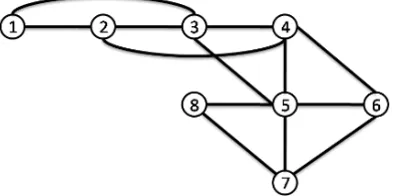
As an example, Fig. 2.4 illustrates the network state space of a network graph
which has been shown in Fig. 2.3. In addition, Fig. 2.5 illustrates two different
random representations of the network based on the network state.
Figure 2.4: The network state space
Figure 2.5: Two random representations of the network
2.3.2
Initialization
A specific number of individuals are generated randomly based on the individual
representation method to form the population spaces. One common problem that
usually occurs in the other algorithms in the initialization phase is that some of the
individuals are not valid. It means that the individual contains some links which
do not exist in the original graph. However in our algorithm, as individuals are
generated based on the network state space, existence of the links can be assured
because elements of each individual are selected randomly from valid neighbors nodes.
2.3.3
Fitness Function
The objective function is another important factor in the evolutionary algorithms.
algorithm is independent of it and can work with any form of objective function
if it is adaptable with our representation method. Nevertheless, we have employed
community score, one of the best-known fitness function which has been defined by
Pizzuti [18]. This function can work without prior knowledge of the number and size
of the communities, and its goal is to maximize the community score. In this paper,
the same fitness function is used for all populations, but it is possible to have different
fitness functions in each population.
Let N ={C1, C2, ..., Ck}, denotes the network which consists of different
commu-nities. The score of each community is calculated as shown in the following equation,
Eq. 2.1.
Q(Ck) =
P
i
P
jai,j
|J|
r
|I| × X
i,j
ai,j (2.1)
Where i, j ∈ Ck and ai,j denotes a value of the position (i,j) of the adjacency
matrix. In addition,|J|,|I|denote the number of j and i in the C respectively. Finally, the community score is the summation of all communities’ scores in the graph then:
CS =
k
X
1
Q(Ck) (2.2)
2.3.4
Belief Space
The core of our algorithm is the belief space which is formed by the selected individuals
of each population in every generation to guide the direction of the evolution. We
consider that the best solution can be represented by combining elements of the
best-selected individuals. In fact, the idea is, instead of searching all possible states
and combinations, the search space must be limited to the elements of the selected
population. Therefore, in each generation, the belief space defines a range of the best
has been defined in the belief space. It is expected that in each generation, better
solutions are being generated by the algorithm.
We define two different sources of knowledge in the belief space. The first is called
BS average and stores the best ever average fitness value of the previously selected
populations. In each generation, a selected individual can change the belief space
if its fitness value is higher than the average value of the previous individuals which
influenced the belief space (BS average). As shown in Alg. 2, if BS average is less than
the average fitness value of the currently selected population it must be replaced with
the new one. As mentioned before, each individual is represented by an array with
the length of n which is the number of nodes. Therefore the selected population can
be presented by an s by n matrix where each row of the matrix shows an individual
and s is the size of the selected population and n is the number of nodes in the graph.
As shown in Eq. 2.4, let SP denotes the selected population which consists of selected
individuals (SI) in Eq. 2.3 then the average is computed by calculating the average
of fitness values of the selected individuals. It has been represented in Eq. 2.5.
SI = [si1, si2, ..., sin] (2.3)
SP = SI1 .. . SIs
− −> SP =
si1,1 . . . si1,n
..
. . . . ...
sis,1 . . . sis,n
(2.4) Average= Ps
j=1F itness(Sij)
s (2.5)
The second source of knowledge is the normative knowledge, BSN, which is
rep-resented by an n by n matrix. In each generation, for all individuals of the selected
population, the relative frequency of values of all cells are calculated and added into
the corresponding entry in the matrix. In fact, as shown in Alg. 2 for all the selected
the cell#j where j is the cell number.
Algorithm 2Update Beleif Space
1: function Update(SP) . Selected Population 2: s← |SP|
3: n ← |SI|
4: for i←1 to s do
5: if F itness(SIi)> BS average then
6: for j ←1 to n do
7: BSN(j, value(j))←relative f requency value(j)in rowj 8: end for
9: end if
10: end for
11: if BS average < Averagethen
12: BS average=Average
13: end if
14: end function
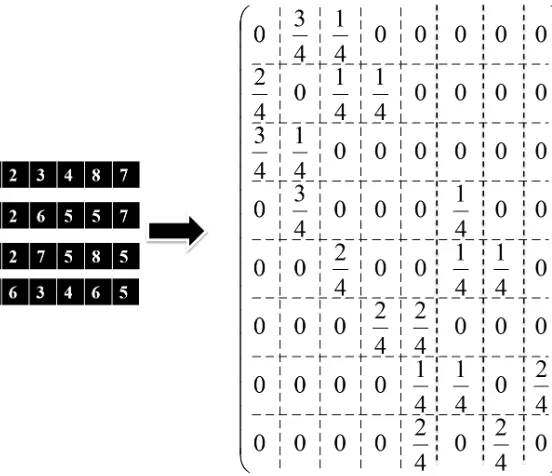
For example, in Fig. 3.6, the BSN is formed based on the network with eight nodes
and four selected individuals. The first row shows neighbors of the node 1. According
to the matrix, the probability of connection between node 1 and node 2 in the final
solution is 75% while it is 25% for node 3. It means that in the next generation, node
2 will be presented in the first cell of the individuals with a probability of 75% while
Figure 2.6: Sample Belief space- N=8 nodes SP=4 individuals
2.3.5
Crossover and Mutation
As populations are generated based on the belief space, the role of Crossover and
Mutation operators is completely different in comparison with Genetic algorithms.
In fact, these operators help the algorithm to escape from the local maxima.
The algorithm presented in this paper is based on the multi-population spaces.
Therefore, each population can have its own crossover and mutation operators.
How-ever, to choose a parent for the crossover in the first population, the first individual
is selected randomly among all individuals and the second one is randomly chosen
among individuals who are not in the selected population. Given these two
individ-uals, a new individual will be generated by combining the parent’s elements. As the
parents in these operators are selected among all individuals, the chance of having
children with entirely different elements is very high. For the mutation operator, an
individual is generated based on the network state space similar to the first
some solutions outside the current domain by using crossover and mutation
2.3.6
Our proposed algorithm
Our proposed algorithm is started by generating the initial population, after
evalu-ating the fitness of individuals and sorting them, the best groups of individuals of
each population are selected based on their fitness function. These groups update the
belief space. The new generation of individuals is generated based on the probability
matrix of the belief space. Meanwhile, in each iteration with a small probability some
individuals are generated by crossover or mutation operators. Each population space
in this algorithm can have their own fitness function or operators. The algorithm
continues until the last iteration, and the individual with the best fitness function
Algorithm 3MPCA-CD
1: procedure Main(Adjacency)
2: N S ←M akeN S(Adjacency) .Initialize the network State 3: l ← |Selected Individuals| . Define the number of selected individuals 4: el ← |Elite Individuals| . Define the number of elite individuals 5: P op←Represent(N S) . Initialize the populations 6: F ←F itness(P op) .Evaluate the individuals’ fitness values 7: P op←Sort(P op, F) . Sort the individuals by their fitness values 8: SP ←Select(P op, l) .Select individuals to update the belief space 9: Belief =U pdate(SP) .Select individuals to update the belief space
10: loop . Start the Loop
11: P op(el :end)←Represent(Belief) . generate the populations based on the Belief space
12: F ←F itness(P op) 13: P op←Sort(P op, F) 14: SP ←Select(P op, l) 15: Belief =U pdate(SP) 16: if < stopcriteria > then
17: Break
18: end if
19: end loop
20: end procedure
2.4
Evaluation
To evaluate the effectiveness of the model, we compare it with four well-known
the second one is the Girvan-Newman algorithm(GN), DECD [7] is the third one
which is based on Differential Evolution and the last one is MOGA-Net [19]. We also
compare it with variable-CA [24]. To measure the similarity level between the true
communities and the detected ones we used Normalized Mutual Information (NMI)
[5, 18].
We made 60 artificial networks based on the Newman benchmark [5, 17]. Each
network was generated randomly and has 128 nodes which are categorized in 4
same-sized communities with 32 nodes while the degree of each node was 16. Meanwhile,
each node is connected to other nodes in its community by internal degree, Zin, and
to other nodes by external degree, Zout (Zin +Zout = 16). The range of Zout of our
artificial networks in this experiment is from 1 to 6 where six implies that each node
is connected to 6 nodes outside of its community which means that the network is
very noisy and fuzzy.
Our proposed algorithm has been implemented in Matlab, and all tests have been
performed on a Pentium dual core 2.1GHz with 2.5 GB RAM. In addition, for the
first population, crossover and mutation rate were set to 0.8 and 0.2 respectively. The
population size was 200, and the number of generations is set to 50 while roulette
selection function was used. For the second population, the size was set to 100, and
the selection rate was 20% similar to the first one, but the rate of mutation increased
to 50% while the roulette wheel selection was used.
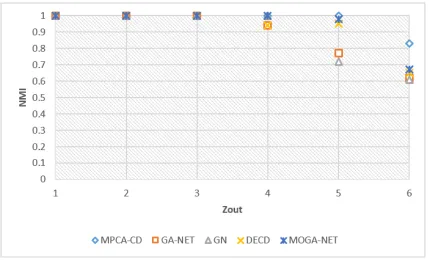
As demonstrated in Fig. 2.7, the proposed algorithm can detect actual
commu-nities with 100% success when Zout is less than or equal to 5 while none of other
algorithms can achieve this rate. For Zout of 5, the average NMI of our algorithm
is 1 while the value for GN, GA, DECD, and MOGA-Net are 0.72, 0.77, 0.95 and
0.98 respectively. Even when Zout becomes 6, our algorithm has better performance
when compared to the others, and its value was 0.83 while the best value of other
the variable-CA was 0.69.
Figure 2.7: Average NMI rate for Zout ranges from 1 to 6
For the real datasets, we have employed Zachary Karate club [23], Dolphin
net-works [16] and American Football [23]. Zachary Karate Club dataset was made by
Zachary as a result of a study on the friendship of 34 members of a karate club during
two years. The group was split into two groups because of some disagreements, and
it has 34 nodes in two groups. Our algorithm detected two communities on just three
generations on this dataset. The average NMI value for our algorithm in this dataset
as shown in Table. 2.1 was 1 which is same as MOGA-NET. The value was 0.82 and
0.69 for the GA and GN algorithms respectively.
For the dolphin dataset which has 62 nodes and was generated based on statistics
obtained from seven years of dolphins’ behavior, the average NMI over ten different
attempts was 1 for the MOGA-Net and 0.956 for our algorithm and was 0.935 for the
GA.
information and has 115 nodes and 616 edges which were grouped into 12 teams. Our
algorithm achieved the highest NMI value among other algorithms in this dataset
whose value is 0.923.
Table 2.1: NMI values of the algorithms on real datasets
Dataset/Algorithm GN MOGA-NET GA MPCA
Zakhary 0.692 1.000 0.818 1.000
Dolphin 0.574 1.000 0.935 0.956
American Football 0.760 0.796 0.805 0.923
These results clearly highlight that the method presented in this paper gives a
better performance than other algorithms and can detect the true communities in
noisy networks as well. Another important point is that, as the method is based on
belief space, it is expected that the algorithm provides better performance with an
increase in the size of the network since more nodes can create a rich belief space to
guide the search direction while the search domain narrows down at each step.
2.5
Discussion and Conclusion
In this section, the results obtained during the process of community detection are
extensively reviewed and discussed. At the first step, we would like to show how the
algorithm identifies the optimal/ near optimal solution during the evolution cycles.
After that, the role of knowledge in the reduction of search space are discussed.
Moreover, two more structures are reviewed to form the belief space. Runtime analysis
and the results of running the algorithm on large networks are reported at the end of
2.5.1
Demonstration of the Evolution Process
To demonstrate how the individuals (candidate solutions) are evolved during the
process, we ran the algorithm on a random benchmark graph, and we have selected
the best individual of each generation. The graph has been generated based on the
Newman benchmark with 128 nodes andZout of 5 which means that it has a complex
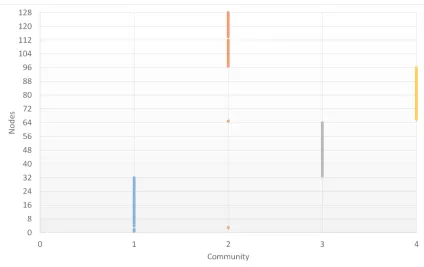
structure. Therefore, it has four communities where the nodes 1 to 32 are placed in
the first community, nodes 33 to 64 forms the second, nodes 65 to 96 shapes the third
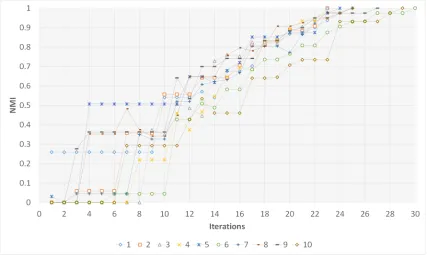
one and 97 to 128 are placed in the fourth community. The test has been repeated 10
times independently, and the NMI value of each individual has been calculated and
illustrated in Fig. 2.8 (the experiments are named 1 to 10). As shown in the figure,
the first results of all experiments are very far from the optimal solution, but during
the process, they are evolved to reach the optimal point. In fact, the rate of evolution
is increased after the 10th iteration. Therefore, this interval can be interpreted as the
learning period for the algorithm.