Reactive Routing Protocols under V2V
Communication in VANETs
Sneha Awasthi1, Prof. Shivendu Dubey2
Research Scholar, Department of Computer Science Engineering, Gyan Ganga Institute of Technology and Science, Jabalpur [M.P] India1
Assistant Professor, Department of Computer Science Engineering, Gyan Ganga Institute of Technology and Science, Jabalpur [M.P] India2
ABSTRACT: Vehicular networks are emerging class of wireless networks that have emerged because of recent advances in wireless technology. Vehicular Ad-hoc Network (VANET) is an enhanced form of Mobile Ad-hoc Network (MANET). In VANET communicating nodes are replaced by moving vehicles. VANETs promises many improvements in terms of accident avoidance and in better utilization of roads and resources such as fuel and time. Because of many applications, VANETs have fascinated many research authorities and automotive industries. An enhanced version of IEEE 802.11p standard is developed for VANET, which is suitable for high speed vehicular communication. Many researches are being carried out to better understand the functioning of various routing protocols in VANET. Being motivated from these researches on VANET, in this dissertation two reactive routing protocol AODV and DSR are examined to satisfy various properties, like: average throughput, Packet Delivery Ratio, Routing Overhead, Number of Drop Packets and Normalized Routing Load with increasing speed of vehicles and send rate of packets. This work is an attempt to analyze the performance of these VANET routing protocols on the basis of IEEE 802.11p standard.
KEYWORDS: MANET, VANET, AODV, DSR, PDR, NRL.
I. INTRODUCTION
Vehicular Ad Hoc Network [14] is an enhanced class of MANETs that has emerged because of recent growth in wireless technology and sensors. Vehicular Ad Hoc Network is also known as VANET. VANET is one of ad-hoc network real applications, where communication among vehicles and nearby fixed equipment is possible. The introduction of VANET will significantly reduce both traffic congestion and vehicles accidents, which are serious issues throughout the world.
In VANET, Vehicle [13] can communicate with each other by directly forming vehicle to vehicle communication (V2V) or communicate with fixed equipment next to the road, referred to as road side unit (RSU) forming vehicle to infrastructure communication (V2I).
II. DESCRIPTION OF VANET ROUTING PROTOCOLS
Ad Hoc Based Routing Protocols
Location Based Routing Protocols
Cluster Based Routing Protocols
Broadcast Routing Protocols
Geocast Routing Protocols
2.2. AODV (Ad-hoc On demand Distance Vector)
The Ad hoc on demand Distance Vector routing protocol (AODV) co mbines the mechanis ms of DSR and DSDV. The periodic beacons, hop -by-hop routing and sequence numbers (guarantee of loop -freedo m) of DSDV and the pure on demand mechanis m of Route Discovery and Route Maintenance from DSR are combined [5][6]. Route Discovery: If there is already a valid route between the two communication peers, then AODV will not initiate any route discovery process. But if the route has become invalid or missing between the two communicating partners or nodes, e.g. whenever a new route to a destination is needed, a link is broken, or the route has expired , then source node will broadcast a RREQ message in order to discover a route to the destination.
2.2. DSR (Dynamic Source Routing)
The Dynamic Source Routing Protocol (DSR) [7] is a reactive routing protocol. Using this protocol each node can discover dynamically a source route to any destination in the network over multiple hops. It provides a loop free route from source to destination by providing an ordered list of the nodes (i.e stored in the packet header) through which the packet must pass. The two main mechanisms of DSR are Route Discovery and Route Maintenance, which work together to discover and maintain source routes to arbitrary destinations in the network.
ROUTE DISCOVERY
Route discovery process takes place by flooding the network with route request (RREQ) packets . Each node receiving an RREQ packet rebroadcasts it, unless it is the destination or it has a route to the destination in its route cache. Such a node replies or responds to the RREQ with a route reply (RREP) packet that is routed back to the original sou rce. RREQ and RREP packets are also source routed. The RREQ builds up the path traversed across the network. The RREP routes itself backward to the source by traversing in this path backward. The route carried back by the RREP packet is cached at the source for future use.
ROUTE MAINTENANCE
If any link on a source route is broken or down, the source node is informed by a route error (RERR) packet. The source node removes all those routes which are using this link from its cache. A new route discovery p rocess must be initiated by the source node if this route is still needed.
III. PERFORMANCE METRICS
The following performance metrics [8] are used to compare the performance of routing protocols. These performance metrics are given by VANET working group for evaluation of routing protocol performance. The parameters considered are important in terms of measuring the performance of any routing protocol.
Average Throughput: The total number of the data packets generated by each source, counted by k bit/s. Normalized Routing Load: This includes the number of packets such as RREQ, RREP
and RERR involve during routing process.
CBR source and the number of data packets received by the CBR sink at the destination.
Routing Overhead: The ratio of total number of routing packets received and total number of data packets received Number of Drop Packets: The number of the data packets generated by the sources failure to reach at the destination.
IV. SIMULATION AND RESULT
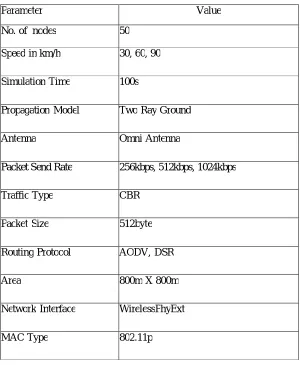
The V2V communication network is created with 50 vehicles or nodes, which are distributed in a square area of 800m X 800m road map created with the help of Manhattan model.
Table 6.1: Basic Simulation Scenario
Parameter Value No. of nodes 50
Speed in km/h 30, 60, 90 Simulation Time 100s
Propagation Model Two Ray Ground Antenna Omni Antenna
Packet Send Rate 256kbps, 512kbps, 1024kbps Traffic Type CBR
6.2. Results
The following evaluation has been measured with 50 vehicles or nodes with in cr easing mobility speed of 30 km/h, 60 km/h and 90 km/h:
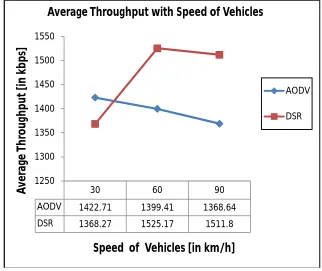
The Average Throughput in AODV and DSR protocols with increasing speed of vehicles under 802.11p standard is shown in the following figure:
Figure 6.1: Average Throughput in AODV and DSR with increasing speed of vehicles
Figure 6.1 show that the Average Throughput decreases in AODV and increases in DSR protocol with increasing speed of vehicles. The Average Throughput of AODV protocol is better than the DSR protocol under slower speed, while Average Throughput of DSR protocol is better than the AODV protocol under medium and high speed. The Average Throughput of AODV protocol decreases from slow to high speed, where as Average Throughput of DSR protocol increases from slow to high speed.
Figure 6.2 shows the performance of Packet Delivery Ratio (PDR) parameter in AODV and DSR protocols with increasing speed of vehicles under 802.11p standard. The PDR in AODV protocol is better than the DSR protocol under slower speed, while PDR in DSR protocol is better than the AODV protocol under medium and high speed. The PDR in AODV protocol decreases from slow to high speed, whereas PDR in DSR protocol increases from slow to high speed.
30 60 90
AODV 1422.71 1399.41 1368.64
DSR 1368.27 1525.17 1511.8
1250 1300 1350 1400 1450 1500 1550
A
ve
ra
ge
T
h
ro
u
gh
p
u
t
[i
n
kb
p
s]
Speed of Vehicles [in km/h]
Average Throughput with Speed of Vehicles
AODV
Figure 6.2: PDR in AODV and DSR with increasing speed of vehicles
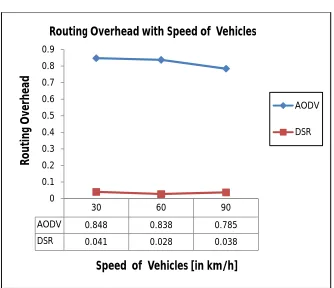
Figure 6.3: Routing Overhead in AODV and DSR with increasing speed of vehicles
Figure 6.3 shows the Routing Overhead in AODV and DSR protocols with increasing speed of vehicles under 802.11p standard. In both AODV and DSR protocol, Routing Overhead decreases from slow to high speed. In all cases,
30 60 90
AODV 12.78 12.57 12.29
DSR 12.3 13.7 13.59
11.5 12 12.5 13 13.5 14
P
D
R
[
in
%
]
Speed of Vehicles [in km/h]
PDR with Speed of Vehicles
AODV
DSR
30 60 90
AODV 0.848 0.838 0.785
DSR 0.041 0.028 0.038
0 0.1 0.2 0.3 0.4 0.5 0.6 0.7 0.8 0.9
R
o
u
ti
n
g
O
ve
rh
e
a
d
Speed of Vehicles [in km/h]
Routing Overhead with Speed of Vehicles
AODV
Routing Overhead in DSR protocol is much better than the AODV protocol.
The following figure 6.4 shows number of Drop Packets in AODV and DSR protocols with increasing speed of vehicles under 802.11p standard. The number of Drop Packets increases in AODV protocol, while in DSR protocol, number of Drop Packets decreases with increasing speed of vehicle. The number of Drop Packets is higher in DSR protocol in comparison of AODV protocol under slow speed, whereas number of Drop Packets is less in DSR protocol in comparison of AODV protocol under medium and high speed.
Figure 6.4: Number of Drop Packets in AODV and DSR with increasing speed of vehicles
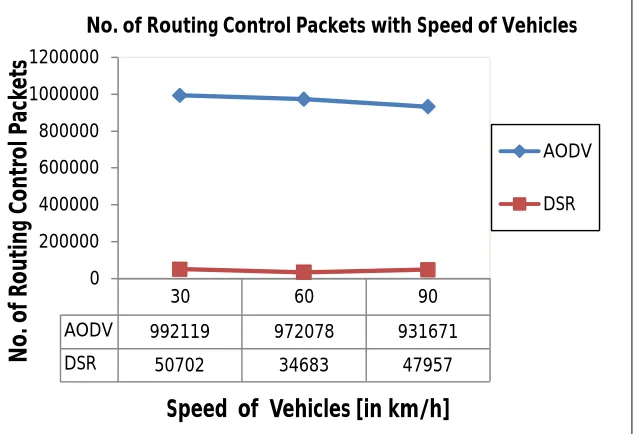
Figure 6.5: Number of Routing Control Packets in AODV and DSR with increasing speed of vehicles
30 60 90
AODV 233630 234488 235242
DSR 234987 231169 231513
229000 230000 231000 232000 233000 234000 235000 236000
N
o
. o
f
D
ro
p
P
a
ck
et
s
Speed of Vehicles [in km/h]
No. of Drop Packets with Speed of Vehicles
AODV
DSR
30 60 90
AODV 992119 972078 931671
DSR 50702 34683 47957
0 200000 400000 600000 800000 1000000 1200000
No
. o
f
R
o
u
ti
n
g
C
o
n
tr
o
l P
a
ck
e
ts
Speed of Vehicles [in km/h]
No. of Routing Control Packets with Speed of Vehicles
AODV
Figure 6.5 shows the number of Routing Control Packets in AODV and DSR protocols with increasing speed of vehicles under 802.11p standard. In both AODV and DSR protocol, the number of Routing control packets decreases from slow to high speed. In all cases, in terms of number of Routing control packets, DSR protocol per for ms much better than the AODV protocol.
The following evaluation has been measured with increasing send rate of packets 256 kbps, 512 kbps and 1024 kbps at 30 km/h speed of vehicles or nodes with 50 vehicles:
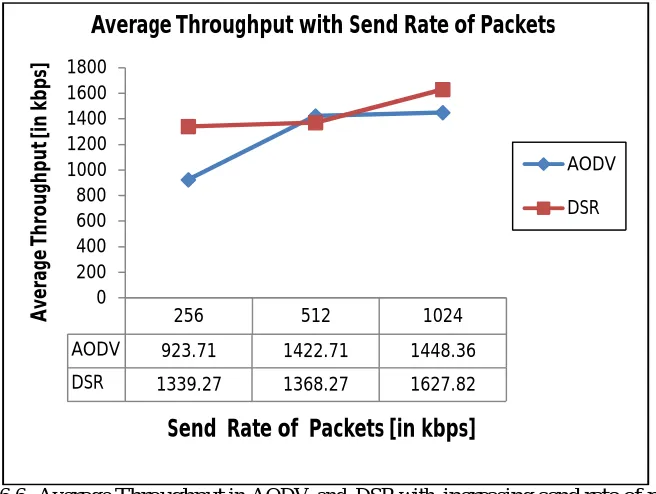
The Average Throughput in AODV and DSR protocols with increasing send rate of packets under 802.11p standard is shown in the following figure:
Figure 6.6: Average Throughput in AODV and DSR with increasing send rate of packets
Figure 6.6 show that the Average Throughput increases in both AODV and DSR protocols with increasing send rate of packets. The Average Throughput of AODV protocol is better than the DSR protocol under medium send rate, while Average Throughput of DSR protocol is better than the AODV protocol under low and high send rates.
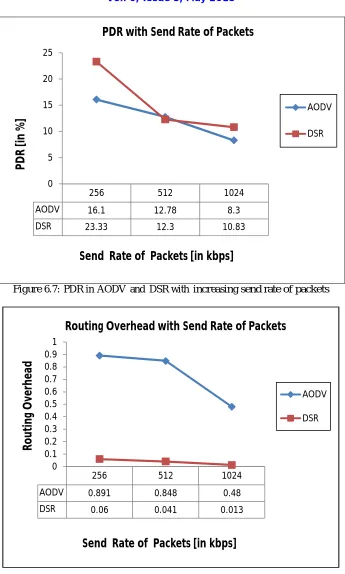
The following figure 6.7 shows the performance of Packet Delivery Ratio (PDR) parameter in AODV and DSR protocols with increasing send rate of packets under 802.11p standard. The PDR in DSR protocol is better than the AODV protocol under low and high packet send rate, while PDR in DSR protocol is less than the AODV protocol under medium send rate of packets. The PDR in both AODV and DSR protocols decreases from low to high send rate of packets.
256 512 1024
AODV 923.71 1422.71 1448.36
DSR 1339.27 1368.27 1627.82
0 200 400 600 800 1000 1200 1400 1600 1800
A
ve
ra
ge
T
h
ro
u
gh
p
u
t [
in
k
b
p
s]
Send Rate of Packets [in kbps]
Average Throughput with Send Rate of Packets
AODV
Figure 6.7: PDR in AODV and DSR with increasing send rate of packets
Figure 6.8: Routing Overhead in AODV and DSR with increasing send rate of packets
Figure 6.8 shows the Routing Overhead in AODV and DSR protocols with increasing send rate of packets under
256 512 1024
AODV 16.1 12.78 8.3
DSR 23.33 12.3 10.83
0 5 10 15 20 25
P
D
R
[
in
%
]
Send Rate of Packets [in kbps]
PDR with Send Rate of Packets
AODV
DSR
256 512 1024
AODV 0.891 0.848 0.48
DSR 0.06 0.041 0.013
0 0.1 0.2 0.3 0.4 0.5 0.6 0.7 0.8 0.9 1
R
o
u
ti
n
g
O
ve
rh
e
a
d
Send Rate of Packets [in kbps]
Routing Overhead with Send Rate of Packets
AODV
802.11p standard. In both AODV and DSR protocol, Routing Overhead decreases from low to high send rate of packets. In all cases, Routing Overhead in DSR protocol is much better than the AODV protocol.
The following figure 6.9 shows number of Drop Packets in AODV and DSR protocols with increasing send rate of packets under 802.11p standard. The number of Drop Packets increases in both AODV and DSR protocols with increasing send rate of packets. The number of Drop Packets is higher in DSR protocol in comparison of AODV protocol under medium send rate of packets, whereas number of Drop Packets is less in DSR protocol in comparison of AODV protocol under low and high send rate of packets.
Figure 6.9: Number of Drop Packets in AODV and DSR with increasing send rate of packets
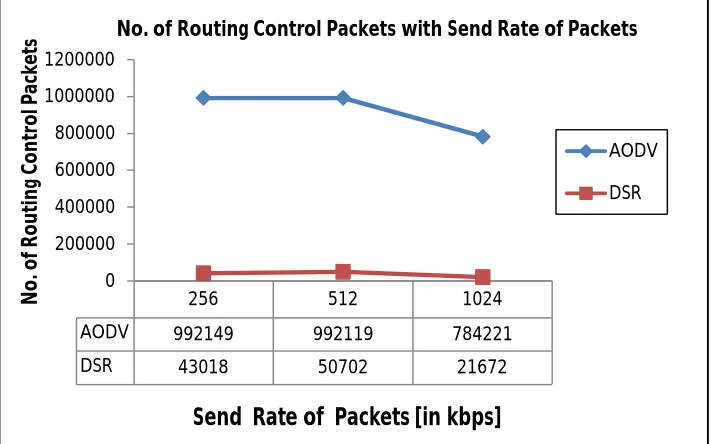
Figure 6.10: Number of Routing Control Packets in AODV and DSR with increasing send rate of packets
256 512 1024
AODV 115982 233630 332149
DSR 106146 234987 322827
0 50000 100000 150000 200000 250000 300000 350000
N
o
. o
f
Dr
o
p
P
ac
ke
ts
Send Rate of Packets [in kbps]
No. of Drop Packets with Send Rate of Packets
AODV
DSR
256 512 1024
AODV 992149 992119 784221
DSR 43018 50702 21672
0 200000 400000 600000 800000 1000000 1200000
No
. o
f
R
o
u
ti
n
g
C
o
n
tr
o
l P
ac
ke
ts
Send Rate of Packets [in kbps]
No. of Routing Control Packets with Send Rate of Packets
AODV
The figure 6.10 shows the number of Routing Control Packets in AODV and DSR protocols with increasing send rate of packets under 802.11p standard. In both AODV and DSR protocol, the number of Routing control packets decreases from low to high send rate of packets. In all cases, in terms of number of Routing control packets, DSR protocol per forms much better than the AODV protocol.
VI. CONCLUSION
The simulation results indicate that DSR protocol perform well over AODV protocol in terms of parameter Average Throughput, PDR, Routing Overhead, number of Drop Packets and NRL with increasing speed of vehicles as well as increasing send rate of packets.
These results state that the DSR routing protocol perform well over the AODV routing under V2V type of VANET with increasing speed of vehicles and increasing send rate of packets. In future attempt will be made to analyze and evaluate the other routing protocols performance for various scenarios under V2V as well as V2I type of VANET.
REFERENCES
[1] Memon et. al., “Performance Evaluation of Routing Protocols in VANET on Highway: Police Cars Communication Scenario”, Engineering Science and Technology International Research Journal, Volume 1, No. 3, Sep 2017, pp. 16 -22.
[2] Alowish et. al., “Performance Evaluation of a Cluster Based Routing Protocol for VANETs”, Journal of Communications, Volume 12, No. 2, Feb 2017, pp. 137-144.
[3] Husain and Sharma, “Simulated Analysis of Location and Distance Based Routing in VANET with IEEE802.11p”, Third International Conference on Recent Trends in Computing, Procedia Computer Science (ELSEVIER) 57, 2015, pp. 323–331.
[4] Kaur and Malhotra, “On the Selection Of Qos Provisioned Routing Protocol Through Realistic Channel For Vanet”, International Journal of Scientific & Technology Research, Volume 4, Issue 07, July 2015, pp. 191-196.
[5] Choudhury et. al., “Simulation and Analysis of Ad-hoc routing protocols under varying density and mobility in VANET”, International Journal of Engineering And Computer Science, Volume 4, Issue 6, June 2015, pp. 12731-12734.
[6] Jamra et. al., “Review of Reactive & Proactive Routing Protocols for Vehicular Ad hoc Networks”, International Journal of Emerging Engineering Research and Technology, Volume 3, Issue 4, April 2015, pp. 10-15.
[7] Usop et. al., “Performance Evaluation of AODV, DSDV & DSR Routing Protocol in Grid Environment”, International Journal of Computer Science and Network Security, Volume 9, No. 7, 2009, pp. 261–268.
[8] Tracy Camp, Jeff Boleng and Vanessa Davies, “A Survey of Mobility Models for Ad Hoc Network Research”, special issue on Mobile Adhoc Networking: Resources, Trends and Applications, Vol. 2, No. 5, 2008, pp 483-502.