ENERGY-EFFICIENT DUAL-SINK ALGORITHMS FOR SINK MOBILITY IN EVENT-DRIVEN WIRELESS SENSOR NETWORKS
MOHAMMADREZA ESLAMINEJAD
ENERGY-EFFICIENT DUAL-SINK ALGORITHMS FOR SINK MOBILITY IN EVENT-DRIVEN WIRELESS SENSOR NETWORKS
MOHAMMADREZA ESLAMINEJAD
A thesis submitted in fulfilment of the requirements for the award of the degree of
Doctor of Philosophy (Computer Science)
Faculty of Computing Universiti Teknologi Malaysia
ACKNOWLEDGMENT
All praises to Allah for the strengths and His blessing in completing this thesis. Special appreciation goes to my supervisor, Dr. Shukor Bin Abd Razak, for his supervision and constant support. His invaluable help of constructive comments and suggestions throughout the experimental and thesis works have contributed to the success of this research. Not forgotten, my appreciation to my co-supervisor, Professor Dr. Abdul Samad Haji Ismail for his support and knowledge regarding this topic.
I would like to express my deepest appreciation to my evaluators, Professor Dr. Abdul Hanan Abdullah from Universiti Teknologi Malaysia and Associate Professor Dr. Abdullah Bin Gani from University of Malaya whose valuable comments improved the quality of this thesis. Furthermore, special thank goes to Dr. Hassan Chizari from Universiti Teknologi Malaysia for providing technical support on different parts of NS2 simulator.
My deepest gratitude goes to my beloved parents, Mr. Keramat Eslaminejad and Mrs. Farangis Hemmati, which their support and encouragement create such great possibility to finish my PhD. I would like to give my special thanks to my wife Maryam and my lovely daughter Dorsan who are the strength and support for me in all these years with their devotion.
ABSTRACT
ABSTRAK
TABLE OF CONTENTS
CHAPTER TITLE PAGE
DECLARATION ii
DEDICATION iii
ACKNOWLEDGMENT iv
ABSTRACT v
ABSTRAK vi
TABLE OF CONTENTS vii
LIST OF TABLES xiii
LIST OF FIGURES xiv
LIST OF ABBREVIATIONS xvii
LIST OF APPENDICES xx
1 INTRODUCTION 1
1.1 Overview 1
1.2 Background of Study 4
1.2.1 Finding the Nearest Sink in Multi-sink Mechanism 5
1.2.2 Mobile Sink Localization and Optimum Position for Sink Movement 6
1.2.3 Selecting the Best Next-hop Node in Single Path Geographic Routing 8
1.3 Problem Description 10
1.4 Statement of Objectives 11 1.5 Research Questions 12
1.9 Organization of Thesis 16
2 LITERATURE REVIEW 17
2.1 Introduction 17
2.2 Background and Preliminaries 19
2.2.1 Wireless Sensor Network Architecture 19
2.2.2 Sources of Energy Consumption in WSNs 20
2.3 Classification of Routing Protocols Based on Network Structure in WSNs 21
2.3.1 Flat Routing Protocols 21
2.3.2 Hierarchical Routing Protocols 22
2.3.3 Geographic Routing Protocols 22
2.3.3.1 Merely Greedy Forwarding Scheme 23
2.3.3.2 Optimized Greedy Forwarding Scheme 27
2.4 Classification of Routing Mechanisms Based on Protocol Operation in WSNs 31
2.4.1 Multi-path Routing 32
2.4.2 QoS-based Routing 33
2.4.3 Bio-inspired Routing 33
2.4.4 Query-based Routing 34
2.4.5 Multi-sink Routing 35
2.4.5.1 Multiple Static Sinks Strategy 35
2.4.5.2 Multiple Mobile Sinks Strategy 39
2.4.5.3 Hybrid Strategy 41
2.4.6 Mobile Sink Routing 44
2.4.6.1 Random/Stochastic Sink Mobility 44
2.4.6.2 Fixed Path/PredictableSink Mobility 47
2.4.6.3 Controlled Sink Mobility 48
2.5 Discussion on Limitations of Existing Routing Mechanisms 53
3 RESEARCH METHODOLOGY 65
3.1 Introduction 65
3.2 Operational Framework 67
3.2.1 Phase 1: Investigation in WSNs 67
3.2.2 Phase 2: Algorithm Design and Development 67
3.2.2.1 Sink Selection Method 68
3.2.2.2 Sink Mobility Pattern 69
3.2.2.3 Forwarding Scheme 70
3.2.3 Phase 3: Evaluation 71
3.2.3.1 Comparison with Baseline Approaches 72
3.2.3.2 Metric of Comparison 73
3.2.3.3 Simulation Setup and Network Configuration 73
3.2.3.4 Reliability of the Simulation 74
3.2.4 Phase 4: Revision 76 3.3 Chapter Summary 79
4 ENERGY-EFFICIENT DUAL-SINK ALGORITHM WITH ROLE SWITCHING MECHANISM (EEDARS) 80
4.1 Introduction 80
4.2 Network Model and Preliminaries 80
4.2.1 Topology and Data Routing 81
4.2.2 Event Occurrence in Proposed Model 82 4.2.3 Modeling the Energy Consumption and Delay 83 4.3 The EEDARS Algorithm 88
4.3.1 Network Initialization 88
4.3.2 Network Functionality 89
4.3.3 The Role Switching Mechanism 90 4.3.4 Joint Routing Strategy and Sink Mobility 93 4.3.5 Analytical Analysis of Residual Energy and Delay for EEDARS 95
4.3.5.1 Evaluation of Residual Energy 95 4.3.5.2 Evaluation of Delay 98
4.5 Simulation Results 100
4.5.1 Network Lifetime Evaluation for EEDARS 101
4.5.2 Residual Energy Evaluation for EEDARS 103
4.5.3 Number of Nodes Alive Evaluation for EEDARS 103 4.5.4 Delay Evaluation for EEDARS 104
4.5.5 Delivery Ratio Evaluation for EEDARS 107
4.5.6 Network Load Evaluation for EEDARS 109
4.5.7 Energy Consumption Evaluation for EEDARS 110
4.6 Chapter Summary 112
5 ENERGY-EFFICIENT DUAL-SINK ALGORITHM WITH FUZZY-BASED SINK MOBILITY PATTERN (EDAFSM) 113
5.1 Introduction 113
5.2 Fuzzy Logic Based Optimization 114
5.3 Model of Network 114
5.4 The EDAFSM algorithm 115
5.4.1 Initialization Phase of Network 115
5.4.2 Fuzzy Sink Mobility Scheme 116
5.4.2.1 System Inputs 117
5.4.2.2 Fuzzification 117
5.4.2.3 Fuzzy Inference 119
5.4.2.4 Defuzzification 120
5.4.2.5 Determination of Sink Destination 120
5.5 Experimental Results 123
5.5.1 EDAFSM Network Lifetime Evaluation 123
5.5.2 EDAFSM Number of Nodes Alive Evaluation 125
5.5.3 EDAFSM Packet Loss Evaluation 127
5.5.4 EDAFSM End-to-end Delay Evaluation 128
5.5.5 EDAFSM Delivery Ratio Evaluation 130
5.5.6 EDAFSM Network Load Evaluation 131
5.5.7 EDAFSM Energy Consumption Evaluation 132
5.6 EEDARS versus EDAFSM 134
6 JOINT DUAL-SINK AND FUZZY-BASED GEOGRAPHIC
ROUTING (JDFGR) 138
6.1 Introduction 138
6.2 JDFGR-S and JDFGR-M Algorithms 139
6.2.1 Fuzzy-based Greedy Forwarding (FGF) Scheme 139
6.2.1.1 Fuzzy Inputs for FGF 140
6.2.1.2 Normalization Phase in FGF 141
6.2.1.3 Fuzzy Rules for FGF 142
6.2.1.4 Fuzzy Output for FGF 143
6.2.1.5 Determination of Next Hop by FGF 144
6.3 Integration of Dual-sink and FGF Scheme 146
6.4 Performance Evaluation 146
6.4.1 Evaluation the Network Lifetime for JDFGR-S and JDFGR-M 147
6.4.2 Evaluation the Average Residual Energy for JDFGR-S and JDFGR-M 149
6.4.3 Evaluation the Number of Nodes Alive for JDFGR-S and JDFGR-M 151
6.4.4 Evaluation the Packet Loss for JDFGR-S and JDFGR-M 153
6.4.5 Evaluation the End-to-end Delay for JDFGR-S and JDFGR-M 155
6.4.6 Evaluation the Delivery Ratio for JDFGR-S and JDFGR-M 157
6.4.7 Evaluation the Network Load for JDFGR-S and JDFGR-M 159
6.5 Chapter Summary 161
7 CONCLUSION AND FUTURE WORKS 163
7.1 Objective Achievement 163
7.2 Discussion on Contributions 167
7.3 Limitations of the Research 169
7.4 Future Work 170
7.4.2 Cross-layer Mechanism 170 7.4.3 Obstacle Avoidance Method 171
REFERENCES 172
LIST OF TABLES
TABLE NO. TITLE PAGE
1.1 Research questions related to the study 13 2.1 Comparison of greedy forwarding mechanisms in
geographic routings 56
2.2 Comparison of sink selection mechanisms in multi-sink
routings 58
2.3 Comparison of sink movement mechanisms in mobile
sink routings 60
3.1 Simulation parameters and related values 75 3.2 Simulation results for two baselines in different researches 75 3.3 Research framework for proposed energy-efficient
joint dual-sink and geographic routing 77 4.1 Energy saving through hop reduction for 10 packets
on a path with 9 hops 97
4.2 The delay minimization through hop reduction for 10
LIST OF FIGURES
FIGURE NO. TITLE PAGE
2.1 Taxonomy of energy-efficient routing protocols in
wireless sensor networks 18
2.2 The structure of a typical wireless sensor node 20 2.3 The node x in greedy forwarding scheme is S’s nearest
neighbor to D 23
2.4 Delaunay triangulation (DT) structure and data forwarding
path on the edges of DTs 26
2.5 Path selection with minimum hop count 37 2.6 Different number of sojourn points and covered area by the
sinks 43
2.7 Joint routing mechanism and sink mobility 48 2.8 Grid strategy to support sink mobility 51 3.1 The steps of research methodology (operational framework) 66 4.1 The sensor field and the source nodes (five dark gray nodes
on the circle) involved in an event 81
4.2 Path selection in EEDARS 82
4.3 Past events (event 1 & 2) and new event (event 3)
accompany with sensors involved in routing 84
4.4 Rthreshold as maximum range for sink movement from the
center of field based on the sink speed 91 4.5 Two scenarios for role switching mechanism in EEDARS 92 4.6 Sink movement pattern towards the source nodes. a-d) The
sink moves three hops diagonally. e) The sink moves one
4.7 The number of diagonal and horizontal hops between the mobile sink and the center of event region in an example
with 9 hops and 10 packets 95
4.8 The Multi-event scenario 100
4.9 Average lifetime and related standard deviation value
(source nodes produce 10 packets) 101 4.10 Average lifetime and related standard deviation value
(source nodes produce 30 packets) 102
4.11 Average residual energy 104
4.12 Average number of nodes alive 105
4.13 Average end-to-end delay and related standard deviation
value for all six strategies (source nodes produce 10 packets) 106 4.14 Average end-to-end delay and related standard deviation
value for all six strategies (source nodes produce 30 packets) 107
4.15 Average delivery ratio 108
4.16 Network load at the end of simulation for all six strategies 109 4.17 Energy consumption for all strategies 111 5.1 Three simultaneous events accompany with sensors
involved in routing 115
5.2 Membership functions for the fuzzy input variables cost
and E 118
5.3 Membership functions for the output variable “priority” 120 5.4 Determining next destination by fuzzy-based sink
mobility scheme. 122
5.5 Average network lifetime and standard deviation value
(source nodes report 10 packets) 124 5.6 Average network lifetime and standard deviation value
(source nodes report 30 packets) 125 5.7 Average number of nodes alive 126 5.8 Average packet loss 127 5.9 Average delay and standard deviation values for all
strategies (sources produce 30 packets) 129
5.11 Average delivery ratio 130
5.12 Network load for all six strategies at the end of simulation 132
5.13 Energy consumption diagrams for all mobile sink strategies 133
5.14 Average network lifetime for single-event scenario 134
5.15 Average residual energy for single-event scenario 135
5.16 Average number of nodes alive for single-event scenario. a) Source nodes report 10 packets. b) Source nodes report 30 packets 135
5.17 Average packet loss for single-event scenario. a) Source nodes report 10 packets. b) Source nodes report 30 packets 136
5.18 Average end-to-end delay for single-event scenario 136
5.19 Average delivery ratio for single-event scenario. a) Source nodes report 10 packets. b) Source nodes report 30 packets 137
6.1 Number of source neighbors closer to the sink 140
6.2 Membership functions for the fuzzy input variables Hop, E and Radius 142
6.3 Membership functions for the output variable “priority” 143
6.4 Average network lifetime for single-event scenario 148
6.5 Average network lifetime for multi-event scenario 149
6.6 Average residual energy for single-event scenario 150
6.7 Average residual energy for multi-event scenario 151
6.8 Average number of nodes alive for single-event scenario 152
6.9 Average number of nodes alive for multi-event scenario 153
6.10 Average packet loss for single-event scenario 154
6.11 Average packet loss for multi-event scenario 155
6.12 Average delay for single-event scenario 156
6.13 Average delay for multi-event scenario 157
6.14 Average delivery ratio for single-event scenario 158
6.15 Average delivery ratio for multi-event scenario 159
6.16 Network load for single-event scenario 160
LIST OF ABBREVIATIONS
ACO - Ant Colony Optimization
ADV - Advertisement
AGEM - Adaptive Greedy-Compass Energy-Aware Multi-path AODV - Ad hoc On-demand Distance Vector
APTEEN - Adaptive Periodic Threshold-sensitive Energy-Efficient sensor Network protocol
CAGIF - Channel-Aware Geographic-Informed Forwarding
CD - Critical Degree
CDMA - Code Division Multiple Access
CHs - Cluster Heads
CPL - Cumulative Path Load CPU - Central Processing Unit CTS - Clear To Send
DD - Directed Diffusion D-MPR - Disjoint Multi-path Routing DSA - Dynamic Sampling Algorithm DSR - Dynamic Source Routing DT - Delaunay Triangulation
DT-MSM - Delay-Tolerant Mobile Sink Model EAM - Efficient Advancement Metric EAR - Energy-Aware Routing
EEABR - Energy-Efficient Ant Based Routing
EEDARS - Energy-Efficient Dual-sink Algorithm with Role Switching Mechanism
ED - Exploratory Data
ELBR - Energy Level Based Routing
EM-GMR - Energy and Mobility-aware Geographical Multipath Routing FEEM - Fault-tolerant and Energy-Efficient Multi-path routing FGF - Fuzzy-based Greedy Forwarding
GAF - Geographic Adaptive Fidelity
GEAR - Geographic and Energy Aware Routing
GLOBAL - Gradient-based routing protocol for LOad BALancing GMR - Geographical Multipath Routing
GPS - Global Positioning System
GPSR - Greedy Perimeter Stateless Routing ID - Identifier
IEEE - Institute of Electrical and Electronics Engineers ILP - Integer Linear Programming
JDFGR-M - Joint Dual-sink and Fuzzy-based Geographic Routing for enhancing lifetime in Mingle-event
JDFGR-S - Joint Dual-sink and Fuzzy-based Geographic Routing for enhancing lifetime in Single-event
LEAN - Local Event ANnouncer
LEACH - Low-Energy Adaptive Clustering Hierarchy MAC - Media Access Control
MCFA - Minimum Cost Forwarding Algorithm MFR - Most Forwarding Routing
MGF - Merely Greedy Forwarding
MLBRF - Multi-Sink Load Balanced Reliable Forwarding protocol M-MPR - Mesh Multi-path Routing
MS - Mobile Sink
MSDD - Multi-Sink Directed Diffusion
MSLBR - Multi-Sink and Load-Balance Routing MSRP - Mobile Sink Based Routing Protocol NS2 - Network Simulator 2
OBGR - Online-Battery aware Geographic Routing algorithm PBR - Primary Based Routing
QoS - Quality of Service
REDR - Residual Energy Depletion Rate REM - Rule Evaluation Method
RFID - Radio Frequency Identification RTS - Request To Send
RWP - Random Way Point SF - Selective Forwarding
SPIN - Sensor Protocols for Information via Negotiation SPR - Shortest Path Routing
SS - Static Sink
TDMA - Time Division Multi Access
TEEN - Threshold-sensitive Energy-Efficient sensor Network protocol TTDD - Two Tier Data Dissemination
TTL - Time To Live
WLDT - Weighted Localized Delaunay Triangulation-based data forwarding
WLDT w/c - Weighted Localized Delaunay Triangulation-based data forwarding without checkpoints
LIST OF APPENDICES
APPENDICES TITLE PAGE
CHAPTER 1
INTRODUCTION
1.1 Overview
Wireless sensor networks (WSNs) are formed by hundreds even thousands small, low cost sensor nodes communicating together to measure a variety of the environmental parameters and send the data to the end users through one or several sinks (Anastasi et al., 2009). These kinds of networks have a wide range of uses in industry, medical, military, and metropolitan venues. WSNs are engaged in many applications such as target tracking, intrusion detection, habitat and battlefield monitoring, and surveillance purposes (Rathnayaka and Potdar, 2013; Yick et al., 2008).
Although small-sized wireless sensor nodes are always improved by new technologies, these tiny devices still suffer from limited power supply. In some situations, the sensor nodes are deployed in geographically constrained environments such as battlefields or oceans to work for a long period of time. Since battery replacement of dead nodes in such areas is very challenging, they may become nonfunctional in a short time; hence negatively affect the network lifetime, fault tolerance, and connectivity. Therefore, optimizing the current methods for energy conservation is an important issue, especially to prolong the sensors lifetime in WSNs (Basagni et al., 2008). Since the energy utilization for send and receive data is much higher than the power needed for computations, designing an energy efficient routing scheme is one of the main concerns in this area (Anastasi et al., 2009).
The routing protocols are classified into three categories based on the network structure i.e. flat, hierarchical, and geographic routings. The energy-efficient mechanisms applied in these schemes are different from each other, since they are very application dependent. Generally the applications in WSNs are divided into three categories: time-driven, query-driven and event-driven. In time-driven scenarios, the data are sent to the sink continuously by all or special groups of sensor nodes. This causes a rapid depletion of energy throughout the network. In event-driven applications, on the other hand, only the data about an interested event is forwarded to the sink while in the query-based method, the data has to be transmitted according to the sinks’ requests. For example, in flat protocols (Al-Karaki and Kamal, 2004; Akkaya and Younis, 2005) which consist of many wireless sensor nodes with the same role and functionality, a query-based mechanism is employed to prevent continuous data reporting, hence save power by reducing the total number of packets in the network. Hierarchical routing algorithms proposed by many researchers (Awwad et al., 2011; Karaboga et al., 2012; Jeon et al., 2009; Kumar et al., 2009) are one of the main solutions for mitigating the redundant data sent to the sink nodes in WSNs. In this manner, the cluster heads (CHs) collect data from cluster members and send it to the sink directly or through multi-hop routing after they eliminate the extra packets. Nevertheless, this kind of routings are mostly employed for time-driven applications in which, sensor nodes have to periodically report all of their sensed data to the sink. Finally, the location information is used in geographic routing to forward the data to the desired areas rather than the entire network. It can limit the flooding phenomenon (Akkaya and Younis, 2005). Developing the GPS-free approaches makes the implementation of geographic routing very cheap (Khalaf-Allah, 2008). Small sized routing table in each node (Medjiah et al., 2010) and using minimum hops to sink (Karp and Kung, 2000) are the other advantages of geographic routing. This kind of routing is better fitted to event-driven scenarios.
path. This can threaten the network lifetime. This is known as the forwarding problem. Optimizing the next-hop selection methods by using several factors in greedy forwarding is a state-of-the-art solution for this problem (Manjunatha et al., 2010). QoS-based (Li and Kim, 2012) and fuzzy logic based (Isik et al., 2012) forwarding are two optimization techniques in this area. However, fuzzy logic based forwarding method is very simple to implement. It is also a powerful tool for decision making in real-time applications with a low cost computational complexity (Torghabeh et al., 2010).
In WSNs, the network lifetime is threatened by network partitioning phenomenon that disconnects the sink node from some sources in the field. Unbalanced energy consumption due to multi-hop routing is one of the main reasons behind the network partitioning. Although many methods based on protocol operation are employed in routing algorithm for more energy-efficiency, multi-sink and mobile sink mechanisms directly address the network partitioning problem.
The network partitioning caused by unbalanced energy consumption around the sink is called sink neighbor problem (Yang et al., 2010). Due to multi-hop forwarding, the sink neighbors have to tolerate a huge amount of traffic load from all over the network. Employing only one static sink increases the risk of fast energy depletion in sink neighbors (Basagni et al., 2008; Li and Mohapatra, 2007). Thus, applying a multi-sink scheme can mitigate this problem. However, increasing the number of sinks is economically costly and application dependant (Oyman and Ersoy, 2004). Therefore, minimizing the number of sinks is a key point in algorithm design. Nevertheless, there is an unsolved problem in multi-sink approaches. In fact, it is finding the nearest sink node to shorten the path for more energy efficiency. This is known as sink selection problem (Nazi et al. 2013; Hou et al., 2006; Mitton et al., 2011).
still unsolved. Firstly, the mobile sink has to inform its position to all sensor nodes after each repositioning. It imposes a large amount of sink localization overhead on the network (Kim et al., 2010a; Chen et al., 2010). Based on this problem, the simulation results performed by Wu andChen (2007) prove that the network lifetime in algorithms which use a single mobile sink is not higher than the one with a single static sink in some cases. Some researchers (Park et al., 2013; Wang et al., 2009) proposed a restricted flooding for sink location update instead of broadcasting to whole network. The second problem is finding an optimum position for mobile sink
across the network. Predefined (Luo and Hubaux, 2005) and stochastic (Chatzigiannakis et al., 2006) mobility are two kinds of uncontrolled sink mobility patterns. However, they impose a high latency for packet delivery. It seems the controlled sink mobility is a better choice in which the sink autonomously determines the next destination. Nevertheless, the main problem is the unlimited possible locations where the sink can be moved that known as NP-hard problem. Most of the optimization approaches in this area that use linear programming are involved in complex mathematical modeling (Yun and Xia, 2010; Zhao et al., 2011; Luo et al., 2006). Centroid-based sink mobility (Akkaya et al., 2005; Hanoun and Nahavandi, 2009) is also involved in high computations to find a position among sink neighbors as polygon vertices. On the other hand, fuzzy logic sink mobility (Torghabeh et al., 2010; Porshokooh et al., 2011) presents a low cost scheme for controlled mobility pattern with desired input factors. Based on the discussion above, it is necessary to address the sink selection problem, the optimum position for mobile sink, and forwarding problem to have more energy-efficient routing.
1.2 Background of Study
this issue affects the network lifetime negatively. By using multiple static/mobile sinks, it is possible to solve the sink neighbor problem (Kim et al., 2008). Optimized greedy forwarding in geographic routing is a smart choice to change the next-hop periodically and balance the energy consumption in the field. However, to have an energy-efficient routing, some unsolved problems in these areas have to be addressed properly. This thesis addresses the three common problems which include looking for the nearest sink in multi-sink mechanism (sink selection problem), finding the
optimum position of mobile sink among multiple events while mitigating the sink localization overhead, and selecting the best next-hop node in geographic routing (forwarding problem). The next sub-sections discuss these problems in details.
1.2.1 Finding the Nearest Sink in Multi-sink Mechanism
One problem which affects the data delivery from all the sensor nodes to the sink is caused by communication to nodes near the sink. It imposes a high traffic on this kind of nodes. This problem is more complicated if the sink is static. In this state, the energy consumption in sink’s neighbors is much faster than the rest of the network. The reason is that the sink’s neighbors with only one hop distance not only are involved in sending their own data, but also have to forward the generated packets from all over the network to the sink. After a while, they stop working so that the sink is isolated from other sensor nodes in the network. However, there is still a huge potential for most of the sensor nodes to continue performing their tasks normally. This problem that leads to premature network disconnection is known as “sink neighborhood problem,” (Akkaya et al., 2007; Basagni et al., 2008; Torghabeh
et al., 2010; Keskin et al., 2011) causes the network disconnection prematurely.
energy efficiency and less delay is one of the main problems in this area. It is known as sink selection problem (Hou et al., 2006; Mitton et al., 2011; Lászka et al., 2012).
Some of the existing approaches in the literature (Alsalih et al., 2010; Gao et al., 2011; Turgut and Bölöni, 2011) engage multiple mobile sinks to tackle with sink selection problem. However, these mechanisms mostly divide the sensor field into several equal-sized partitions and assign each mobile sink to one individual sub-region. Therefore, the condition of multiple mobile sink is restricted to the state of single mobile sink to simplify the problem. However, those researches have the following drawbacks. First of all, each mobile sink may suffer from imbalanced assigned work load if the sensor field is irregular. Secondly, none of the algorithms guarantees that at least one of the mobile sinks succeeds to collect the data produced by each sensor node at each period of time. Although Lászka et al. (2011) proposed a heuristic method to address the above problem, they did not consider the end-to-end delay caused by sink mobility.
1.2.2 Mobile Sink Localization and Optimum Position for Sink Movement
Mobility capability for some of the network elements is another solution for the sink neighborhood problem. It seems replacing the sink neighbors periodically is a good strategy to balance energy consumption due to data transmission across the network. However, the remaining energy of nodes equipped with a mobilizer unit is consumed much faster than static conditions. Moving the sink node to the parts of the network with sufficient energy periodically while keeping the sensors stationary is the key idea for more energy saving. It can avoid network partitioning phenomenon and consequently increase the network lifetime (Basagni et al., 2008).
(Luo and Hubaux, 2005) scheme is applied to the algorithms. It means that the network is not capable to control the sink movement by determining an efficient trajectory based on the traffic load at each sensor node or their remaining energy (Basagni et al., 2008). Controlled sink mobility, on the other hand, (Basagni et al., 2009; Nazir and Hasbullah, 2010) can efficiently prolong the network lifetime with much less negative effect on the end-to-end delay.
Although the mobile sink approaches aim to conserve nodes power and improve the network lifetime, the overhead caused by topological changes wastes unnecessary energy all over the sensor field. In fact, the sensor nodes have to be aware about the sink location after each sink repositioning. Therefore, flooding the sink position information all over the field can cancel out the lifetime gain from the sink mobility. Some researches (Park et al., 2013; Wang et al., 2009) address this problem by using a limited flooding for distributing the sink position after each movement. Dual-sink algorithms that presented by Wu and Chen, (2007) and Chen et al., (2010) use the advantageous of both mobile and static sink approaches efficiently. In fact, this model is a hybrid method in which one of the sinks is placed at the center of field permanently while the other one is moving across the network for data collection from one-hop or k-hop neighbors. In this way, the flooding mechanism for disseminating the sink location information is limited to a small part of the network for more energy conservation rather than whole network. The main idea of dual-sink algorithms is that the source nodes which are not aware about the location of mobile sink send their data to the static sink while the source nodes that sense the mobile sink in one-hop or k-hop neighbors report the data to this sink. Furthermore, the traffic flow can be distributed on two sinks based on distance or energy factors. Nevertheless, flooding restricted mechanisms for sink position propagation is mostly developed for time-driven application while there is a huge potential to improve these paradigm for event-driven scenarios.
NP-hard problem, the mathematical analyzes involved with many input parameters such as localizing all of the sensor nodes in the field, their remaining energy, radio range and determining which one is producing the data at the time. In WSNs with a large amount of sensor nodes, it is impossible to pursue an exact search to find a suitable location for sink node. Additionally, wireless sensor networks are dynamic in nature. The reason is that the sources of data and the sensors condition are variable and may be changed time by time. Therefore, a periodic optimization scheme is required; each time the sink decides to change its position (Lee et al., 2013; Akkaya et al., 2005). It seems improving the current algorithms with lower complexity and control overhead is necessary for efficient sink repositioning.
1.2.3 Selecting the Best Next-hop Node in Single Path Geographic Routing
One of the issues of multi-hop routing is fast energy depletion along the path. In fact, the sensor nodes which are located on a path lose their energy quickly due to high traffic imposed on this series of nodes. It results in network partitioning and link failures. Applying multi-path routing (Medjiah et al., 2010; Murthy et al., 2013) in WSNs leads to traffic distribution all over the sensor field. However, using multiple paths has some problems such as flooding the path request across the network and possibility of interference and collision between the nodes on each path (Sutagundara and Manvi, 2013). Furthermore, using multi-path and mobile sink mechanisms simultaneously can cancel out the lifetime gain from sink mobility. This is due to high overhead caused by continual link breakage that known as offset problem (Chen
et al., 2010).
originally use a merely greedy algorithm to shorten the path between the source and destination. Based on this algorithm, forwarding decision is bound to information about the current position of forwarding node, its one hop neighbors, and the sink node as the final destination. In this way, a source node compares the location of the sink to itself and also to its neighbors. Then, the neighbor which is closer to the sink node is selected in order to propagate data messages. This greedy scheme is repeated by each relay node until the sink is reached eventually (Villalba et al., 2009).
The geographic routings presented by Liang and Ren (2005), Liang (2005), and Manjunatha et al. (2010) use some efficient metrics in greedy algorithm to dynamically find the next-hop based on fuzzy logic. Since EM-GMR (Liang, 2005) is an energy-efficient multi-path algorithm proposed for mobile environments, the authors considered the mobility, remaining battery capacity, and distance to the destination node. These parameters are given to the fuzzy logic as input arguments so that the output is calculated as optimum next-hop node. The method presented in (Manjunatha et al., 2010) employs three parameters such as distance from the sink, distance from the node, and remaining energy as the inputs of fuzzy logic for determining the next-hop. In algorithm proposed by Li and Kim (2012), instead of applying a merely greedy forwarding, the next hop is selected in such a way to satisfy the QoS metrics like energy-efficiency and delay.
1.3 Statement of the Problem
This thesis addresses three problems in the scope of routing algorithms i.e. efficient sink selection mechanism, optimized controlled sink mobility pattern, and geographical forwarding scheme in dual-sink algorithm for maximizing the energy-efficiency in event-driven based WSNs. WSNs show a great capability in various applications. However, their success is extremely dependent on power management in different layers of protocol stack to satisfy the network metrics especially higher network lifetime and end-to-end delay of scenarios deployed on these networks.
In protocol stack, routing paradigms in network layer are recently more taken into consideration from energy saving point of view. Although these paradigms are different based on the application and network architecture, they have a large potential to be optimized for more energy-efficiency. For example, to have an energy-aware strategy for minimizing the number of produced packet in query-driven and time-query-driven applications, a flat or hierarchical method is a reasonable choice. However, the geographic routing can support event-driven scenarios as well. Nevertheless, distance-based greedy forwarding mechanism used for selecting the next relay node in geographic routing has to be optimized by considering the efficient metrics for more energy saving along the path. It can avoid partitioning phenomenon across the sensor field, hence prolong the network lifetime.
Sink mobility is another strategy to solve the sink neighbor problem. Although predefined and stochastic sink mobility patterns can balance the energy consumption and traffic load all over the network, these patterns impose a high latency for data delivery. Controlled sink mobility, on the other hand, is an appropriate method in which the sink autonomously visits the sensor nodes or specific sites to collect data based on the efficient metrics (such as energy, traffic load, and distance). However, the sink localization overhead can cancel out the lifetime gain from the controlled sink mobility. Furthermore, one of the main problems which has to addressed in this area is finding the next destination of mobile sink among unlimited positions in the field. Most of the recent solutions are involved in sophisticated mathematical computations like linear programming (LP) which is not suitable for resource-constrained sensor nodes with low memory, energy, and processing unit. Therefore, optimizing the current approaches to find the optimum position of mobile sink at the time of sink movement is a big problem need to be solved.
1.4 Statement of Objectives
The aim of this research is to propose and evaluate three energy-efficient routing algorithms through an effective sink selection mechanism, an optimized controlled sink mobility pattern with minimized sink localization overhead, and optimized geographical forwarding scheme for event-driven based wireless sensor networks. The objectives of this research are as follows:
i. To study the existing solution for three of the issues i.e. sink selection problem, sink movement optimization and forwarding problem to specify the limitation of current solutions.
ii. To propose:
b. A controlled sink mobility pattern in dual-sink algorithm based on fuzzy logic for finding the optimum position of mobile sink among multiple events in event-driven based WSNs.
c. An efficient forwarding scheme to select the best next-hop node in geographic routing in order to balance energy consumption on the path and incorporate the proposed routing into dual-sink algorithm.
iii. To evaluate the performance of three mechanisms with most widely used approaches in terms of network lifetime, number of nodes alive, residual energy, end-to-end delay, packet delivery ratio, and network load.
1.5 Research Questions
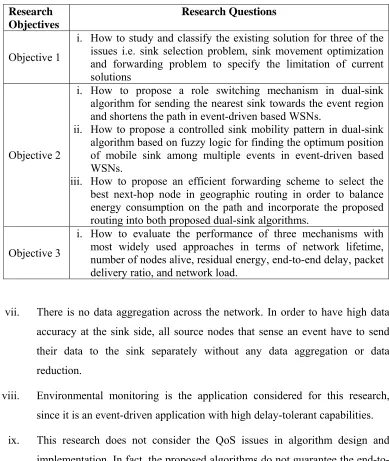
Based on the research objectives, several research questions needed to be answered as in Table 1.1.
1.6 Research Scope
The aim of this research is to propose and evaluate a joint dual-sink and geographic routing in wireless sensor network which cover the following matters:
i. The sensor nodes are all homogeneous.
ii. In all scenarios, an event-driven application is taken into consideration. iii. The network consists of a series of sensor nodes deployed in two-dimensional
dense environment with grid topology. iv. There is no obstacle in the sensor field.
v. All sensor nodes are considered to be aware about their location information. vi. There are two sink nodes with high resources in the field. They can
Table 1.1: Research questions related to the study Research
Objectives
Research Questions
Objective 1
i. How to study and classify the existing solution for three of the issues i.e. sink selection problem, sink movement optimization and forwarding problem to specify the limitation of current solutions
Objective 2
i. How to propose a role switching mechanism in dual-sink algorithm for sending the nearest sink towards the event region and shortens the path in event-driven based WSNs.
ii. How to propose a controlled sink mobility pattern in dual-sink algorithm based on fuzzy logic for finding the optimum position of mobile sink among multiple events in event-driven based WSNs.
iii. How to propose an efficient forwarding scheme to select the best next-hop node in geographic routing in order to balance energy consumption on the path and incorporate the proposed routing into both proposed dual-sink algorithms.
Objective 3
i. How to evaluate the performance of three mechanisms with most widely used approaches in terms of network lifetime, number of nodes alive, residual energy, end-to-end delay, packet delivery ratio, and network load.
vii. There is no data aggregation across the network. In order to have high data accuracy at the sink side, all source nodes that sense an event have to send their data to the sink separately without any data aggregation or data reduction.
viii. Environmental monitoring is the application considered for this research, since it is an event-driven application with high delay-tolerant capabilities. ix. This research does not consider the QoS issues in algorithm design and
implementation. In fact, the proposed algorithms do not guarantee the end-to-end delay for specific period of time, since it is not important for considered delay-tolerant application (non-real time application).
1.7 Research Contributions
other issues are sink movement optimization and forwarding problem in dual-sink algorithm. A fuzzy-based solution is proposed for these two problems. The main contributions of this research are summarized as follow:
i. A novel taxonomy of routing protocols for wireless sensor networks in terms of energy-efficiency is presented in this thesis. The algorithms are classified into two category based on network structure and protocol operation. In this taxonomy, special attention has been devoted to the energy-aware multi-sink, mobile sink and bio-inspired routing algorithms which have not yet obtained much consideration in the literature.
ii. A role switching mechanism is proposed to address the sink selection problem in dual-sink algorithm. The energy efficient dual-sink algorithm with role switching mechanism (EEDARS) uses one static and one mobile sink. The periodic flooding for sink location update is avoided by engaging the static sink, while the mobile sink moves adaptively towards the event region to collect data. The scheme employs a role switching mechanism to send the nearest sink to the recent event area, hence shorten the path by minimizing the number of hops. The role switching mechanism also guarantees to locate one of the sinks at the center of field to avoid any packet loss for the first messages reported by new events. It also decreases the traffic load on the static sink to significantly mitigate the effect of sink neighbor problem. However, this algorithm can be employed in single event scenarios where there are no simultaneous events.
to each neighboring node based on the calculated cost and residual energy of sink neighbors. The position of node with minimum residual energy is chosen, if two neighbors have the same priority degree. Furthermore, the periodic flooding for mobile sink localization is avoided by utilizing the static sink at the center of field. The proposed algorithm can be engaged in multi-hop and multi-event scenarios for wireless sensor networks.
iv. A fuzzy-based greedy forwarding (FGF) scheme for routing optimization is proposed for more energy-efficiency of EEDARS and EDAFSM. The aforementioned proposed algorithms are named joint dual-sink and fuzzy-based geographic routing for single-event (JDFGR-S) and multi-event (JDFGR-M) WSNs, respectively. FGF uses efficient parameters i.e. number of hops to sink, residual energy, and distance from the center of field as fuzzy inputs for determining the next-hop. According to the literature, the optimum next-hop node generally has to be nearest to the sink, and have higher residual energy. However, none of the previous works considered a parameter to decrease the load on the center part of the network. The proposed fuzzy-based scheme uses a new membership function that called radius. Based on this fuzzy input, at the same condition, the node which is nearest to the boundary of sensor field has higher priority to forward the packet.
v. To evaluate the performance of three proposed algorithms, a new model in NS2 framework is developed based on C++ and TCL languages. This model includes several procedures to implement system functions and calculate network metrics such as network lifetime, number of nodes alive, residual energy, end-to-end delay, delivery ratio, energy consumption, packet loss and network load. Moreover, by considering the selected energy parameters, a new energy model is designed for the simulation.
1.8 Significance of Research
geographic routing for wireless sensor networks. Dual-sink algorithm is a state-of-the-art technique to restrict flooding needed for the sink location update in mobile sink approaches. It is mostly proposed and employed in time-driven scenarios. Little efforts use this novel mechanism for event-driven applications. Moreover, none of them investigates an efficient controlled sink mobility pattern for data collection from event region. This research not only proposes an energy-efficient dual-sink algorithm with fuzzy sink mobility (EDAFSM) scheme for optimizing sink movement pattern, but also presents a role switching mechanism (EEDARS) for sink selection problem in event-driven wireless sensor networks. Furthermore, to achieve more energy efficiency, an optimized greedy forwarding method based on fuzzy logic is proposed to apply in EDAFSM and EEDARS. In this thesis, the optimized solutions are known as joint dual-sink and fuzzy-based geographic routing for more energy-efficiency in single-event (JDFGR-S) and multi-event (JDFGR-M) WSNs, respectively.
1.9 Organization of Thesis
REFERENCES
Ahmed, A.A. (2013). An enhanced real-time routing protocol with load distribution for mobile wireless sensor networks. Computer Networks. 57(6), 1459-1473. Ahvar, E., Pourmoslemi, A., Piran, M.J. (2011). FEAR: A Fuzzy-based
Energy-Aware Routing Protocol for Wireless Sensor Networks. International Journal of Grid Computing & Applications (IJGCA). 2(2), 32-45.
Akkaya, K. and Younis, M. (2005). A survey on routing protocols for wireless sensor networks. Ad Hoc Networks. 3, 325-349.
Akkaya, K., Younis, M. and Bangad, M. (2005). Sink Repositioning for Enhanced Performance in Wireless Sensor Networks. Computer Networks. 49(4), 512-534.
Akkaya, K., Younis, M. and Youssef, W. (2007). Positioning of base stations in wireless sensor networks. IEEE Communications Magazine. 45(4), 96-102. Al-Karaki, J.N. and Kamal, A.E. (2004). Routing techniques in wireless sensor
networks: A survey. IEEE Wireless Communications. 11(6), 6-27.
Alsalih, W., Hassanein, H. and Akl, S. (2010). Placement of multiple mobile data collectors in wireless sensor networks. Ad Hoc Networks. 8(4), 378-390. Ammari, H.M. and Das, S.K. (2010). Forwarding via checkpoints: Geographic
routing on always-on sensors. J. Parallel Distrib. Comput. 70, 719–731. Anastasi, G., Conti, M., Francesco, M.D. and Passarella, A. (2009). Energy
conservation in wireless sensor networks: a Survey. Ad Hoc Networks. 7(3), 537-568.
Basagni, S., Carosi, A., Melachrinoudis, E., Petrioli, C. and Wang, Z.M. (2008). Controlled sink mobility for prolonging wireless sensor networks lifetime.
Wireless Networks. 14(6), 831-858.
Basagni, S., Carosi, A., Petrioli, C. and Phillips, C.A. (2009). Heuristics for Lifetime Maximization in Wireless Sensor Networks with Multiple Mobile Sinks.
Proceedings of the IEEE International Conference on Communications (ICC ’09). June 14–18. Dresden, Germany: IEEE, 1–6.
Basagni, S., Carosi, A., Petrioli, C. and Phillips, C.A. (2011). Coordinated and controlled mobility of multiple sinks for maximizing the lifetime of wireless sensor networks. Wireless Networks. 17(3), 759-778.
Bhattacharyya, D., Kim, T. and Pal, S. (2010). A Comparative Study of Wireless Sensor Networks and Their Routing Protocols. Sensors, mdpi. 10, 10506-10523.
Camilo, T., Carreto, C., Silva, J. and Boavida, F. (2006). An Energy-Efficient Ant Base Routing Algorithm for Wireless Sensor Networks. Springer. 4150, 49-59.
Chang, C.Y., Chang, C.T., Chen, Y.C. and Chang, H.R. (2009). Obstacle-resistant deployment algorithms for wireless sensor networks. IEEE Transactions on Vehicular Technology. 58(6), 2925-2941.
Chatzigiannakis, I., Kinalis, A. and Nikoletseas, S. (2006). Sink Mobility Protocols for Data Collection in Wireless Sensor Networks. Proceedings of the international Workshop on Mobility Management and Wireless Access (MobiWac ’06). October 2-6. Terromolinos, Spain: ACM, 52-59.
Chen, J., Salim, M.B. and Matsumoto, M. (2010). Modeling the Energy Performance of Event-Driven Wireless Sensor Network by Using Static Sink and Mobile Sink. Sensors. 10(12), 10876-10895.
Collotta, M., Pau, G., Salerno, V.M., Scatà, G. (2011). A fuzzy based algorithm to Manage Power Consumption in Industrial Wireless Sensor Networks.
De, S., Qiao, C. and Wu, H. (2003). Meshed Multipath Routing with Selective Forwarding: an Efficient Strategy in Wireless Sensor Networks. Computer Networks. 43(4), 481-497.
Eghbali, A.N., Javan, N.T., Dareshoorzadeh, A. and Dehghan, M. (2009). An Energy Efficient Load-Balanced Multi-Sink Routing Protocol for Wireless Sensor Networks. Proceedings of the 10th International Conference on Telecommunications (ConTEL ’09). June 8-10. Zagreb, Croatia, 229–234. Francesco, M.D., Das, S.K. and Anastasi, G. (2011). Data Collection in Wireless
Sensor Networks with Mobile Elements: A Survey. ACM Transactions on Sensor Networks (TOSN). 8(1), 1-31.
Gao, s., Zhang, H. and Das, S.K. (2011).Efficient Data Collection in Wireless Sensor Networks with Path-Constrained Mobile Sinks. Transactions on Mobile Computing, IEEE. 10(4), 592-608.
Gelenbe, E. and Ngai, E. (2009). Adaptive Random Re-Routing for Differentiated QoS in Sensor Networks. The Computer Journal. 53(7), 1052-1061.
Hamida, E.B. and Chelius, G. (2008). Strategies for Data Dissemination to Mobile Sinks in Wireless Sensor Networks. Wireless Communications, IEEE. 15(6), 31-37.
Hanoun, S. and Nahavandi, S. (2009). Effective Heuristics for Route Construction of Mobile Data Collectors, Mobile Robots - State of the Art in Land, Sea, Air, and Collaborative Missions. Shanghai, China: InTech publisher.
Hey, L. (2008). Power Aware Smart Routing in Wireless Sensor Networks.
Proceedings of theNGI 2008: Next Generation Internet Networks. April 28-30. Krakow: IEEE, 195-202.
Hogg, R.V. and Tanis, E.A. (2006). Probability and Statistical Inference. New Jersey: Prentice Hall.
Hou, Y.T., Shi, Y., and Sherali, H.D. (2006). Optimal Base Station Selection for Anycast Routing in Wireless Sensor Networks. IEEE Transactions on Vehicular Technology. 55(3), 813-821.
Isik, S., Donmez, M.Y. and Ersoy, C. (2012). Multi-sink load balanced forwarding with a multi-criteria fuzzy sink selection for video sensor networks. Computer Networks. 56 (2012), 615-627.
Jeon, H., Park, K., Hwang, D.J. and Choo, H. (2009). Sink-oriented Dynamic Location Service Protocol for Mobile Sinks with an Energy Efficient Grid-Based Approach. Sensors, MDPI. 9(3), 1433-1453.
Jeong, Y., Han, Y., Park, J.J. and Lee, S.Y. (2012). MSNS: mobile sensor network simulator for area coverage and obstacle avoidance based on GML. EURASIP Journal on Wireless Communications and Networking. 2012(95), 1-15. Jin, Z., Jian-Ping, Y., Si-Wang, Z., Ya-Ping, L. and Guang, L. (2009). A Survey on
Position-Based Routing Algorithms in Wireless Sensor Networks.
Algorithms, MDPI. 2, 158-182.
Karaboga, D., Okdem, S. and Ozturk, C. (2012). Cluster based wireless sensor network routing using artificial bee colony algorithm. Wireless Networks. 18(7), 847-860.
Karl, H. and Willig, A. (2005). Protocols and Architectures for Wireless Sensor Networks. Chichester, West Sussex, UK: John Wiley & Sons.
Karp, B. and Kung, H.T. (2000). GPSR: Greedy perimeter stateless routing for wireless networks. Proceedings of the 6th Annual International Conference on Mobile Computing and Networking, (MOBICOM ’00). August 6-11. Boston, MA, USA: ACM, 243-254.
Keskin, M.E., Altinel, I.K., Aras, N. and Ersoy, C. (2011). Lifetime Maximization in Wireless Sensor Networks Using a Mobile Sink with Nonzero Traveling Time. The Computer Journal. 54(12), 1987-1999.
Khalaf-Allah, M. (2008). A Novel GPS-free Method for Mobile Unit Global Positioning in Outdoor Wireless Environments. Wireless Pers Commun., Springer. 44, 311-322.
Kim, H., Kwon, T. and Mah, P. (2008). Multiple Sink Positioning and Routing to Maximize the Lifetime of Sensor Networks. IEICE TRANSACTIONS on Communications. 91(11), 3499-3506.
Kim, C., Kim, Y., Lim, H. and Han, Y. (2010b). A Self-deployment Scheme for Mobile Sensor Network with Obstacle Avoidance. Communications in Computer and Information Science, Springer. 78, 345-354.
Kumar, D., Aseri, T.C. and Patel, R.B. (2009). EEHC: Energy efficient heterogeneous clustered scheme for wireless sensor networks. Computer Communications. 32(4), 662-667.
Kumar, M.S. and Gopinath, M. (2013). Routing Issues in Wireless Sensor Networks: A Survey. International Journal of Advanced Research in Computer Science and Software Engineering. 3(4), 452-457.
Konstantopoulos, C., Pantziou, G., Gavalas, D., Mpitziopoulos, A. and Mamalis, B. (2012). A Rendezvous-Based Approach Enabling Energy-Efficient Sensory Data Collection with Mobile Sinks. IEEE Transactions on Parallel and Distributed Systems. 23(5), 809-817.
Lászka, Á., Buttyán, L. and Szeszlér, D. (2012). Designing robust network topologies for wireless sensor networks in adversarial environments.
Pervasive and Mobile Computing. 9(4), 546-563.
Lee, K., Kim, Y.H., Kim, H.J. and Han, S. (2013). A myopic mobile sink migration strategy for maximizing lifetime of wireless sensor networks. Wireless Networks. 1-16.
Lee, T., Qiao, C., Demirbas, M. and Xu, J. (2010). ABC: A simple geographic forwarding scheme capable of bypassing routing holes in sensor networks.
Ad Hoc Networks. 8(4), 361-377.
Li, S. and Kim, J.G. (2012). A Geographic Routing Protocol for Wireless Multimedia Sensor Networks. Communications in Computer and Information Science, Springer. 310, 17-22.
Liang, Q. (2005). Fault-Tolerant and Energy Efficient Wireless Sensor Networks: A Cross-Layer Approach. Proceedings of the Military Communications Conference, 2005, (MILCOM ‘05). Oct. 17-20. Atlantic City, NJ: IEEE, 1862-1868.
Liang, Q. and Ren, Q. (2005). Energy and Mobility Aware Geographical Multipath Routing for Wireless Sensor Networks. Proceedings of the Wireless Communications and Networking Conference. March 13-17. IEEE, 1867-1871.
Liu X. (2012). A Survey on Clustering Routing Protocols in Wireless Sensor Networks. Sensors. 12(8), 11113-11153.
Luo, J. and Hubaux, J.P. (2005). Joint mobility and routing for lifetime elongation in wireless sensor networks. Proceedings of the 24th Annual joint Conference of the IEEE Computer and Communications Societies, (INFOCOM ’05). March 13-17. Miami, FL, USA: IEEE, 1735-1746.
Luo, J., Panchard, J., Piorkowski, M., Hubaux, J.P. and Grossglauser, M. (2006). MobiRoute: routing towards a mobile sink for improving lifetime in sensor networks. Distributed Computing in Sensor Systems, Springer. 4026, 480-497.
Manjunatha, P., Verma, A.K. and Srividya, A. (2010). Fuzzy Based Optimized Routing Protocol for Wireless Sensor Networks. Advances in Wireless Sensors and Sensor Networks, Springer. 64, 273-282.
Marta, M. and Cardei, M. (2009). Improved sensor network lifetime with multiple mobile sinks. Elsevier Journal of Pervasive and Mobile Computing. 5(5), 542-555.
Medjiah, S., Ahmed, T. and Krief, F. (2010). AGEM: Adaptive Greedy-Compass Energy-aware Multipath Routing Protocol for WMSNs. Proceedings of the 7th IEEE Consumer Communications and Networking Conference (CCNC ‘10). January 9-12. Las Vegas, NV, USA: IEEE, 1–6.
Monowar, M.M., Rahman, M.D.O. and Hong, C.S. (2008). Multipath Congestion Control for Heterogeneous Traffic in Wireless Sensor Network. Proceedings of the 10th International Conference on Advanced Communication Technology (ICACT ‘08). February 17-20. Gangwon-Do, China, 1711-1715. Murthy, S.G., Souza, R.J.D. and Varaprasad, G. (2013). Network lifetime analytical
model for node–disjoint multipath routing in wireless sensor networks.
International journal of communication networks and distributed systems, inderscience. 10(2), 163-175.
Nazi, A., Raj, M., Francesco, M.D. and Ghosh, P. (2013). Robust Deployment of Wireless Sensor Networks Using Gene Regulatory Networks. Distributed Computing and Networking. 7730, 192-207.
Nazir, B. and Hasbullah, H. (2010). Mobile Sink Based Routing Protocol (MSRP) for Prolonging Network Lifetime in Clustered Wireless Sensor Network.
Proceedings of the 2010 International Conference on Computer Applications and Industrial Electronics (ICCAIE ‘10). December 5-8. Kuala Lumpur, Malaysia, 624-629.
Nikravan, M., Jameii, S.M. and Kashani, M.H. (2011).An Intelligent Energy Efficient QoS- Routing Scheme for WSN. International Journal of advanced Engineering sciences and Technologies. 8(1), 121-124.
Popa, D.O. and Lewis, F.L. (2008). Algorithms for Robotic Deployment of WSN in Adaptive Sampling Applications. Wireless Sensor Networks and Applications: Signals and Communication Technology. New York, NY, USA: Springer US.
Oyman, E.I., and Ersoy, C. (2004). Multiple Sink Network Design Problem in Large Scale Wireless Sensor Networks. Proceedings of the 2004 IEEE International Conference on Communications. June 20-24. 3663-3667.
Park, S., Oh, S., Kim, J., Lee, E. and Kim, S.H. (2013). Band-based geocasting for mobile sink groups in wireless sensor networks. Wireless Networks. Published online.
Porshokooh, V.R., Haghighat, A.T., and Tashtarian, F. (2011). Maximizing the Lifetime of Daley-Tolerant Wireless Sensor Networks Using Fuzzy System.
Web Information Systems and Mining, Springer. 6987, 208–215.
Rathnayaka, A.J., and Potdar, V.M. (2013). Wireless Sensor Network transport protocol: A critical review. Journal of Network and Computer Applications. 36(1), 134-146.
Raghunathan, V., Schurghers, C., Park, S. and Srivastava, M. (2002). Energy-aware wireless microsensor networks. IEEE Signal Process. Mag. 19, 40-50.
Saad, E.M., Awadalla, M.H. and Darwish, R.R. (2009). Adaptive Energy-Aware Gathering Strategy for Wireless Sensor Networks. International Journal of Distributed Sensor Networks. 5(6), 834-849.
Sabbineni, H. and Chakrabarty, K. (2010). Datacollection in Event-Driven Wireless Sensor Networks with Mobile Sinks. International Journal of Distributed Sensor Networks. 2010(2010), 1-12.
Sanchez, J.A. and Ruiz, P.M. (2009). Locally Optimal Source Routing for energy-efficient geographic routing. Wireless Networks. 15(4), 513-523.
Singh, S.K., Singh, M.P. and Singh, D.K. (2010). Routing Protocols in Wireless Sensor Networks - A Survey. International Journal of Computer Science & Engineering Survey (IJCSES). 1(2), 63-83.
Sutagundara, A.V. and Manvi, S.S. (2013).Location aware event driven multipath routing in Wireless Sensor Networks: Agent based approach. Egyptian Informatics Journal, Elsevier. 14(1), 55-65.
Toledo, A. and Wang, X. (2010). Efficient multipath in wireless networks using network coding over braided meshes. International Journal of Sensor Networks, Inderscience. 7(3), 176-188.
Torghabeh, N.A., Totonchi, M.R.A. and Moghaddam, M.H.Y. (2010). Mobile Base Station Management using Fuzzy Logic in Wireless Sensor Networks.
Proceedings of the 2010 2nd International Conference on Computer Engineering and Technology (ICCET ‘10), April 16-18. Chengdu, 352-356. Torres, B., Pang, Q., Skelton, G., Bridges, S., Meghanathan, N. (2010). Integration of
Individual Carrying RFID Tags. International Journal of Ad hoc, Sensor and Ubiquitous Computing. 1(4), 1-15.
Tufail, A., Qamar, A., Khan, A.M., Baig, W.A. and Kim, K.H. (2013). WEAMR — A Weighted Energy Aware Multipath Reliable Routing Mechanism for Hotline-Based WSNs. Sensors, mdpi. 13, 6295-6318.
Turgut, D. and Bölöni, L. (2011). Heuristic approaches for transmission scheduling in sensor networks with multiple mobile sinks. The Computer Journal. 54(3), 332-344.
Vergados, D.J., Pantazis, N.A. and Vergados, D.D. (2008). Energy-Efficient Route Selection Strategies for Wireless Sensor Networks. Mobile Networks and Applications, Springer. 13, 285-296.
Villalba, L.J.G, Orozco, A.L.S., Cabrera, A.T. and Abbas, C.J.B. (2009). Routing Protocols in Wireless Sensor Networks. Sensors. 9(11), 8399-8421.
Vincze, Z., Vass, D., Vida, R., Vidács, A. and Telcs, A. (2007). Adaptive Sink Mobility in Event-Driven Densely Deployed Wireless Sensor Networks. Ad Hoc & Sensor Wireless Networks. 3(2-3), 285-315.
Vlajic, N. and Stevanovic, D. (2009). Sink Mobility in Wireless Sensor Networks: When Theory Meets Reality. Proceedings of the 2009 IEEE Sarnoff Symposium, (SARNOFF ‘09). March 30 - April 1. Princeton, NJ, USA: IEEE, 1-8.
Wang, B., Xie, D., Chen, C., Ma, J. and Cheng, S. (2008). Deploying Multiple Mobile Sinks in Event-Driven WSNs. Proceedings of theIEEE International Conference on Communications, May 19-23. Beijing: IEEE, 2293-2297. Wang, G., Wang, T., Jia, W., Guo, M. and Li, J. (2009). Adaptive location updates
for mobile sinks in wireless sensor networks. The Journal of Supercomputing, Springer. 47(2), 127-145.
Watfa, M. and Yaghi, L. (2010). An efficient online-battery aware geographic routing algorithm for wireless sensor networks. International Journal of Communication Systems. 23(1), 41-61.
Weng, Y., Jia, W. and Wang, G. (2009). A Hybrid Moving Strategy in Wireless Sensor Networks. Proceedings of the International Conference on Wireless Communications & Signal Processing, (WCSP ’09). Nov. 13-15. Nanjing: IEEE, 1-5.
Wu, X. and Chen, G. (2007). Dual-Sink: Using Mobile and Static Sinks for Lifetime Improvement in Wireless Sensor Networks. Proceedings of the 16th International Conference on Computer Communications and Networks (ICCCN ‘07), August 13-16. Honolulu, HI: IEEE, 1297-1302.
Yang, Y., Fonoage, M.I., Cardei, M. (2010). Improving network lifetime with mobile wireless sensor networks. Computer Communications. 33, 409-419.
Yick, J., Mukherjee, B. and Ghosal, D. (2008). Wireless sensor network survey.
Computer networks. 52(12), 2292-2330.
Yoo, H., Shim, M., Kim, D. and Kim, K.H. (2010). GLOBAL: A Gradient-Based Routing Protocol for Load-Balancing in Large-Scale Wireless Sensor Networks with Multiple Sinks. Proceedings of the 2010 IEEE Symposium on Computers and Communications (ISCC ’10). June 22–25. Riccione, Italy: IEEE, 556-562.
Yun, Y.S. and Xia, Y. (2010). Maximizing the Lifetime of Wireless Sensor Networks with Mobile Sink in Delay-Tolerant Applications. IEEE Transactions on Mobile Computing, 9(9), 1308-1318.
Zadeh, L.A. (1965). Fuzzy sets. Inform. Control. 8, 338-353.
Zhang, L. and Zhang, Y. (2009). Energy-Efficient Cross-Layer Protocol of Channel-Aware Geographic-Informed Forwarding in Wireless Sensor Networks. IEEE Transactions on Vehicular Technology. 58(6), 3041-3052.