18th International Conference on Structural Mechanics in Reactor Technology (SMiRT 18) Beijing, China, August 7-12, 2005 SMiRT18-K17-2
DEVELOPMENT OF A SEISMIC EVALUATION SYSTEM (SES)
FOR HANARO
Jeong-Soo Ryu*, Doo-Byung Yoon, Jong-Sup Wu, Cheol Park
HANARO Management Division, KAERI,
150 Deokjin, Yuseong, Daejeon, 305-353, Korea
Phone: 82-42-868-8479, Fax: 82-42-862-1763
E-mail: [email protected]
Sang-Hoon Lee
Civil Engineering Department, KOPEC, Korea
Phone: 82-31-899-2102, Fax: 82-31-899-2091
E-mail:
[email protected]
ABSTRACT
HANARO is a multi-purpose research reactor with a thermal power of 30MW. Systems and structures related to the safety of the HANARO are classified as a seismic category I. When an earthquake occurs, it is necessary to take prompt action to obtain the seismic response information of the reactor building and the safety related systems of the HANARO. A Seismic Evaluation System(SES) has been newly developed to evaluate promptly the seismic safety of the reactor building and the safety related systems of the HANARO. After an earthquake, using the seismic signal obtained from the field sensors, the SES can perform a 3-D seismic analysis of the reactor building and a local analysis of the safety related systems in the HANARO building. In addition, the SES has the capability of a graphical monitoring and document reporting of these seismic analysis and safety evaluation results. The SES is used in the HANARO for the safety evaluation and analysis of an earthquake.
Keywords: HANARO, Seismic Evaluation System, Seismic Safety, Seismic Response Analysis
1. INTRODUCTION
HANARO(Hi-flux Advanced Neutron Application Reactor) is a multi-purpose research reactor with a thermal power of 30MW. Many systems and structures related to the safety of the HANARO are classified as a seismic category I. It is required that suitable instrumentation is provided so that the seismic response can be evaluated after an earthquake. Since the start of the reactor operations, the seismic monitoring system has been utilized for monitoring an earthquake at the HANARO site[1-4].
When an earthquake occurs, it is necessary to take prompt action to access the effects of the earthquake at the reactor building and the safety related system of the HANARO. If the vibratory ground motion exceeding that of the trigger level(0.01g) is perceived by the field sensor, it is necessary to determine whether a reactor shutdown is required. Prompt reaction to access the effects of the earthquake at the reactor building and the safety related systems of the HANARO helps the determination of the reactor shutdown.
dimensional(3-D) structural model of the HANARO reactor building is developed. The database of the DRS(Design Response Spectrum) of the HANARO reactor building is provided as a criterion for the seismic safety assessment. The structural dynamic analysis program and floor response analysis program calculating the seismic response and the FRS(Floor Response Spectra) of the reactor building are newly developed. To perform rapid evaluations of the seismic safety of the HANARO reactor building, a MMI program that can manage the operation of the structural dynamic analysis program and floor response analysis program is developed. The functional capability of the SES operated by a MMI program is verified by a site acceptance test, the accuracy of the analysis results for the developed analysis program is also verified through the comparisons with the valid results.
2. METHOD FOR SESMIC SAFETY EVALUATON
The structural analysis, floor response analysis and seismic safety evaluation methods used in the SES are described in the following subsections 2.1~2.3, respectively.
2.1 Modeling of the Reactor Building and Structural Analysis
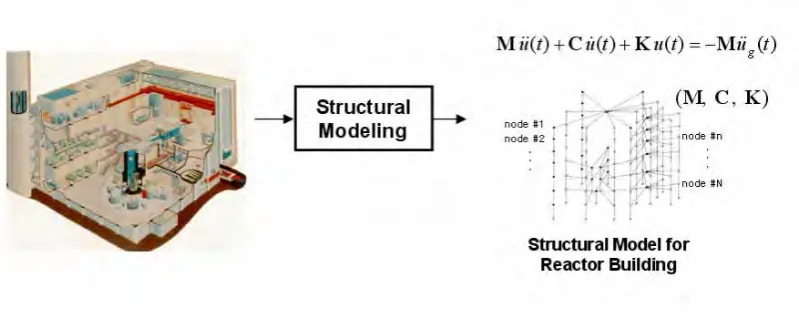
The reactor building and safety related structures of the HANARO can be modeled using 3-D beam elements and masses as shown in Fig. 1. The seismic responses due to an earthquake can be represented as Eq. 1,
Mu+ Cu+ Ku = -Mug , (1)
where M, C, K represent the mass matrix, damping matrix, stiffness matrix of the reactor building model, respectively.The u, u, u represent the acceleration, velocity, and displacement response at the nodes of the structural model of the reactor building, respectively. The ugdenotes the matrix of the seismic input that is
measured at the base slab of the reactor building.
Fig. 1 Model of HANARO reactor building for structural analysis
Fig. 2 Structural analysis of the SES
2.2 Floor Response Analysis
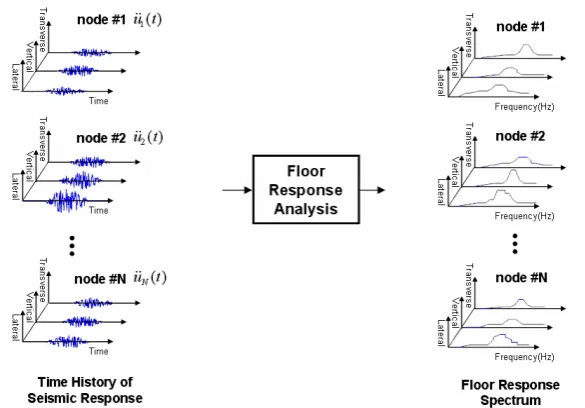
The floor response analysis of the SES provides the seismic response spectrum at the nodal points of the reactor building required for the assessment of the seismic safety of the HANARO building. As shown in Fig. 3, the time history data obtained from the structural analysis is used as the input to the floor response analysis. The floor response spectrum can be obtained by various numerical methods such as the piece-wise exact method, or Newmark-β method, etc.[7]. The floor response spectra generated from piece-wise exact method are automatically converted into the enveloped, broadened, and increased spectra in order to compare with the corresponding DRS at each location of the reactor building model.
2.3 Evaluation of Seismic Safety
Fig. 4 shows a schematic diagram on the seismic safety evaluation procedure of the SES. The database of the Design Response Spectra(DRS) of the HANARO reactor building is provided as a criterion for the seismic safety assessment. After an earthquake, the SES performs the evaluation of the seismic safety for the reactor building and the safety-related systems by comparing spectral amplitudes of the generated floor response spectra with that of the design response spectra.
Fig. 4 Seismic safety evaluation of the SES
Fig. 5 illustrates the seismic safety evaluation procedure for the n-th node of the structural model of the reactor building. If the level of the floor response spectrum due to an earthquake is lower than that of the design response spectrum, then the SES decides that the system is safe. If the level of the floor response spectrum is higher than that of the design response spectrum, then the SES compares the floor response spectral value at the natural frequency of the system with that of the design response spectrum. If the floor response spectral value at the natural frequency of the system is larger than that of the design response spectrum, the SES decides that the system located at the n-th nodal point is required for an inspection.
3. DEVELOPMENT OF SOFTWARE FOR THE SES
The software for the SES consists of a structural dynamic analysis program, floor response analysis program, and the MMI program[8]. The following subsections describe the capability of the developed programs briefly.
3.1 Development of the Structural Analysis Program
The structural analysis program is designed to perform a 3-D seismic response analysis of the HANARO reactor building using the earthquake signal obtained from the tri-axial accelerometer located at the base slab of the building and free field. The structural dynamic analysis program calculates a response time history, force and moment at each nodal point of the structural model. Fig. 6 represents the execution window of the structural analysis program.
(a) Execution window of the structural analysis (b) Results of structural analysis
Fig. 6 Structural analysis program for SES
3.2 Development of the Floor Response Analysis Program
The floor response analysis program is designed to calculate the floor response spectra at the nodal points of the reactor building. The time history data of the seismic response at each nodal point is used as the input to the floor response analysis program. Fig. 7 shows the execution window of the floor response analysis program. The program calculates the response spectra for four different damping values required for the seismic safety evaluation.
(a) Execution window of the FRS analysis (b) Results of FRS analysis
3.3 Development of the MMI Program
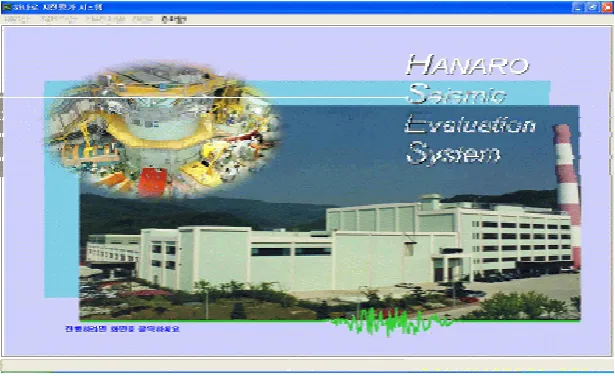
Fig. 8 represents the initial window of the MMI(Man-Machine Interface) program. The MMI program of the
SES is implemented using a Visual Basic language under Microsoft windows XP. The program is designed to provide a user-friendly GUI(Graphic User Interface) environment, making the system setup and data display quick and easy.
Fig. 8 Initial window of the MMI program for SES
The newly developed SES is equipped with a seismic response analysis capability needed to process the seismic data after an earthquake. Fig. 9 (a) represents the seismic analysis window displaying results of the seismic events. The program calculates and displays the response time history and the response spectra required for the seismic assessments at the HANARO site as shown in Fig. 9 (b).
(a) Seismic input at the base slab of the building (b) Seismic response analysis
Fig. 9 Seismic response analysis capability of the SES
(a) Safety evaluation of the reactor building (b) Safety evaluation of the reactor structure
Fig. 10 Main window displaying seismic safety evaluation results of the SES
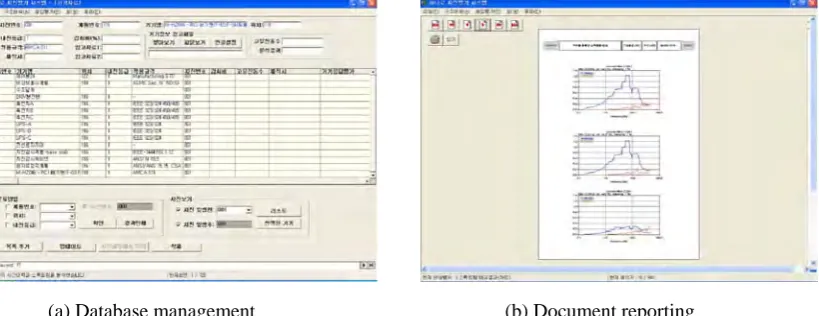
The MMI program is designed to provide a simple database menu for searching the information of the safety related systems and the recorded data of the earthquake events as shown in Fig. 11 (a). In addition, the MMI program displays and prints the analysis and evaluation results in report form as shown in Fig. 11 (b).
(a) Database management (b) Document reporting
Fig. 11 Database management and document reporting capability of the SES
4. SITE ACCEPTANCE TEST AND OPERATION
For the verification of the functional capability of the SES, a Site Acceptance Test (SAT) was carried out. The software capability such as a seismic data display, seismic response analysis(e.g., structural analysis, FRS analysis, etc.), the document reporting capability, and the data management capability of the MMI program have been fully tested. In addition, the accuracy of the analysis results of the developed structural dynamic analysis program and floor response analysis program are verified by comparing analysis results with those of a commercial analysis program. Based on the results of the SAT, the requirements of the fabrication technical specifications are satisfied.
5. CONCLUSIONS
The SES (Seismic Evaluation System) performing rapid evaluation on the seismic safety of a reactor building has been developed. After an earthquake, using the seismic signal obtained from the field sensors of the seismic monitoring system, the SES performs 3-D seismic analyses for the reactor building and the safety related systems required for the assessment of the seismic safety of the HANARO building. In addition, the SES has the post processing capability of displaying the analysis results graphically or in report form. It is expected that the SES can be utilized for the evaluation of the seismic safety of the HANARO reactor building and the safety related structures after an earthquake. Moreover, the seismic safety analysis technology developed in this work may be utilized as a base technology for the design and development of the seismic safety evaluation system for other research reactors or nuclear power plants.
REFERENCES
1. Ryu, J.-S., Yoon, D.-B., Kim, H.-K., and Wu, J. S., (2003), “Development of a Seismic Monitoring Analysis System for HANARO,” Proceeding of Condition Monitoring 2003, BINDT.
2. Ryu, J.-S., Kim, H.-K., Yoon, D.-B., and Wu, J. S., (2003), “Development and Seismic Evaluation of the Seismic Monitoring Analysis System for HANARO,” Proceeding of Korean Nuclear Society 2003 Fall Meeting.
3. Ryu, J.-S., Yoon, D.-B., and Kim, H.-K., (2003), “A Guidebook for the Operation and Maintenance of HANARO Seismic Monitoring Analysis System,” Technical Report, KAERI/TR-2568/2003, KAERI.
4. Ryu, J.-S. et. al., (2003), “Development of HANARO Seismic Analysis and Evaluation System,” Research Report, KAERI/TR-2394/2003, KAERI.
5. Ryu, J.-S. and Yoon, D.-B., (2003), “Technical Specification for Development of HANARO Seismic Evaluation System,” Technical Report, KAERI/TR- 2592/2003, KAERI.
6. Paz, Mario, (1985), “Structural Dynamics(2nd Edition),” Van Nostrand Reinhold, New York. 7. Clough, R.W. and Penzien, J., (1993), “Dynamics of Structures(2nd Edition),” McGraw-Hill.