Robust QR Code Video Watermarking
Siddhi S. Kasabe, Rituja S. Darandale, Tripti D. Chikhale, Prof. Nitesh S. Jadhav
Dept. of Computer Engineering, JCEI’s Jaihind College of Engineering, Kuran, India
ABSTRACT: Nowadays, on the internet digital video is popular multimedia data exchanged. To improve security media required the protection as it was commercial activity on internet. Hence in the security field 2D barcode is more interesting research on the internet. In these studies we proposed video watermarking with text massage (Verification Massage) by using Quick response Code (QR Code) technique. The QR Code is prepared to be watermarked via a robust video watermarking scheme based on the (singular value decomposition) SVD and (Discrete Wavelet Transform) DWT. With help with watermarking we can gives copyrights of these video document. For watermarking applications SVD is an attractive algebraic transform. SVD is applied to the cover I-frame. The extracted diagonal value is fused with logo (or) watermark. DWT is applied on SVD cover image and QR code image. The invers transform of watermarking image and add the frame into video with logo and QR code image send these video file to authorized user. In the reverse process check the logo and QR code for authorized ownership. It can be achieved acceptable imperceptibility and certain robustness in video processing.
KEYWORDS: 2D Barcode; Quick Response (QR) Code; singular value decomposition (SVD); Discrete Wavelet Transform (DWT).
I.INTRODUCTION
The work of this steganography is access private information into data under the assumption of others users not aware of this private information. The main work of watermarking to check the logo will be embedded in data or not. Based on the type of document to be watermarked.
A. Text Watermarking: Word shift coding, feature coding, Line shift coding.
B. Visible Watermark: In this watermark information can be visible in the video.
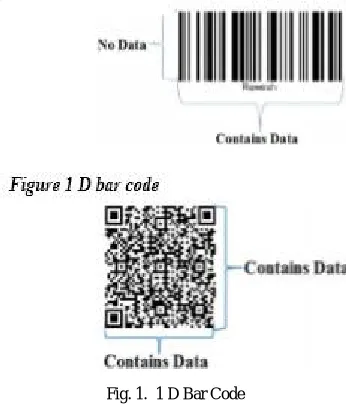
A quick response (QR) code is a two dimensional barcode invented by the Japanese corporation Denso Wave. In QR code store the information vertically and horizontally direction hence it will be stored hundred time more data as compare to traditional bar code. In QR Codes contain a large amount of information than 1D barcode. QR Code can encode in many types of characters such as numeric, alphabetic character, Kanji, Kana, Hiragana, symbols, binary, and control codes.
II.RELATED WORK
III.PROPOSED ALGORITHM
A .Embedding Process:
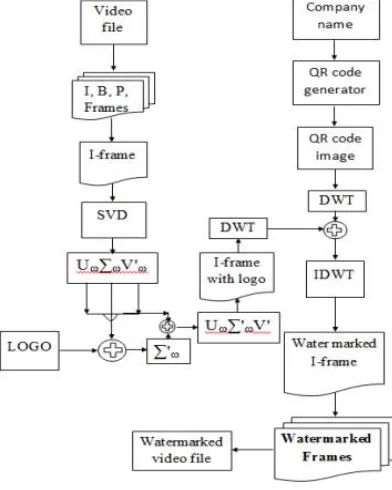
In the embedded process video file we have taken the frame I and apply SVD. Insert a logo and take DWT on both I-frame with logo and QR code image was composite with DWT co-efficient.to access watermark image we can apply IDWT. Finally watermarked I-frame add in a video file. The schematic representation of extracting process.
Fig. 2proposed embedded process.
B. Algorithm for Embedding Process:
Step 1: Read the video file and extract RGB P-frame, B-frame, and I-frame. Step 2: Read the I-frame image as a cover image.
Step 3: Generate a QR code image with company name.
Step 4: Apply SVD to I frame and get three singular coefficients as u, ∑, v’ Step
5: Add logo with components of an SVD image to get an SVD cover image
Step 6: Apply DWT on both SVD cover image and QR code image to get combined image Step 7: Take the inverse DWT on the combined image to get Watermarked I frame Step 8: Finally watermarked I frame image to get the watermarked video files.
C.Algorithm for Extracting Process:
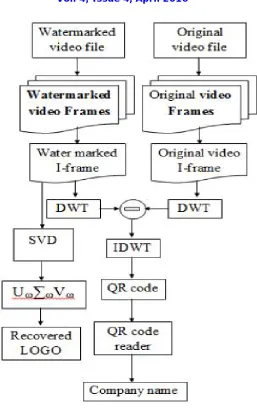
Fig. 3 proposed extracting process.
D. Algorithm for Decoding Process:
Step 1: access the watermark video file and extract from watermark I Frame. Step 2: Read the original video file and extract original Video I frame. Step 3: Apply DWT on both videos I frame.
Step 4: Subtract watermarked video I frame coefficient with original video I frame coefficient and take Inverse DWT to get a QR code image.
Step 5: By using QR code reader extract company name From QR code image.
IV.EXPERIMENTAL RESULTS
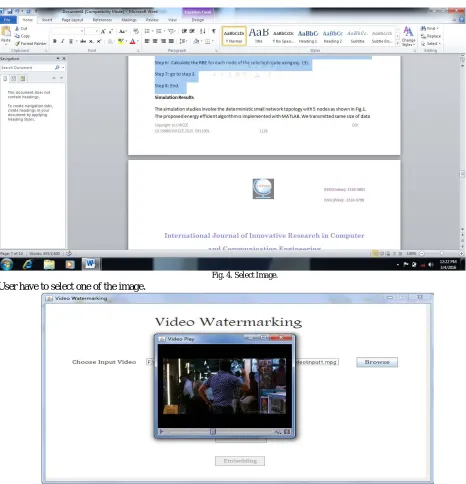
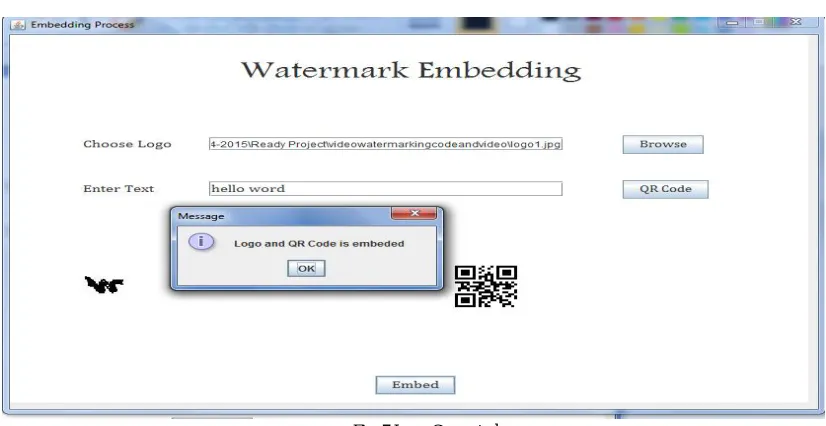
Fig. 4. Select Image.
User have to select one of the image.
Fig. 6 . Apply Watermarking .
Extract frames for the watermarking.
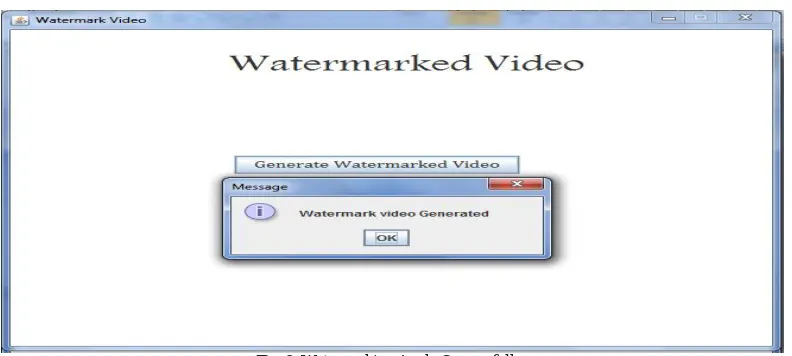
Fig. 8. Watermarking Apply Successfully.
Watermarking applying for the video successfully.
V. CONCLUSION AND FUTURE WORK
This method has achieved the improved reliable and secure watermarking. In this QR code encoding process and achieved best performances. In the first method watermark was in build in the dimensional element. And the other side text messages in the QR code image. So, the dual process given two authentication detail. The logo is located very safely in the QR code image. This method is convenient, feasible and practically used for providing copyright protection. Experimental results show that our method can achieve acceptable certain robustness to video processing.
REFERENCES
1. Suppat Rungraungsilp, Mahasak Ketcham, Tanee Wiputtikul, Kanchana Phonphak, and Sartid Vongpradhip,”Data Hiding Method for QR Code Based on Watermark by comparing DFT with DWT Domain” ICCCT', May 26-27, 2012.
2. Thitapa Poomvichid, Pantida Patirupanusara and Mahasak Ketcham, ” The QR Code for Audio Watermarking using Genetic Algorithm”, IMLCS'2012, pp 11-12, 2012.
3. Shanjun, Zhang; Kazuyoshi, Yoshino,”DWT-Based Watermarking Using QR Code” Science Journal of Kanagawa University, pp3-6, 2008.
4. Ray-Shine Run,Shi-Jinn Horng,Jui-Lin Lai,Tzong-Wang Kao, Rong-Jian Chen,” An improved SVD-based watermarking technique for copyright protection”, Expert Systems with Applications 39,2012,pp-673–689.
5. Ahmad A. Mohammad, Ali Alhaj, Sameer Shaltaf,” An improved SVD-based watermarking scheme for protecting rightful ownership” Signal Processing , Vol-88, 2008, pp: 2158– 2180.
6. Bai Ying Lei n, IngYannSoon, ZhenLi,“ Blind and robust audio watermarking schemes based on SVD–DCT” Signal Processing, Vol-91, 2011, pp-1973– 1984.
7. Veysel Aslantas.” An optimal robust digital image watermarking based on SVD using the differential evolution algorithm” Optics Communications, Vol-282, 2009, pp-769–777.
8. Chin-Chen Chang a, Piyu Tsai b, Chia-Chen Lin, 2008”. SVD-based digital image watermarking scheme.” Patter Recognition Letters, Vol-26, 2005, pp-1577–1586.
9. Fangjun Huang, Zhi-Hong Guan “A hybrid SVD-DCT watermarking method based on LPSNR “Pattern Recognition Letters Vol-25, 2004, pp-1769–1775. 10. Ming Jianga, b, Zhao-Feng Mao, b, Xin-xin Niua, Yi-Xian Yang,” Video Watermarking Scheme Based on MPEG-2 for Copyright Protection“ in
International Conference on Environmental Science and Information Application Technology ESIAT 2011, Procedia Environmental Sciences, Vol-10, 2011, pp-843 – 848.
11. Min-Jeong Lee,Dong-Hyuck Im, Hae-Yeoun Lee,KyungSuKim,Heung-Kyu Lee “Real-time video watermarking system on the compressed domain for high-definition video contents: Practical issues” Digital Signal Processing,vol-22, 2012,pp-190–198.
12. He Yingliang, Yang Gaobo, Zhu Ningbo” A real-time dual watermarking algorithm of H.264/AVC video stream for Video-onDemand service “Int. J. Electron. Commune. (AEÜ), Vol-66, 2012, pp-305–312.
13. Dooseop Choi, HoseokDo, HyukChoi, TaejeongKim,“A blind MPEG-2 video watermarking robust to camcorder recording”, Signal Processing , Vol-90, 2010, pp-1327–1332.