Scholarship at UWindsor
Scholarship at UWindsor
Electronic Theses and Dissertations Theses, Dissertations, and Major Papers
2010
Viscosities and Densities of Some Multi-Component Regular
Viscosities and Densities of Some Multi-Component Regular
Liquid Solutions at Different Temperature Levels
Liquid Solutions at Different Temperature Levels
Hanan El-Sayed Moussa El-Sayed
University of Windsor
Follow this and additional works at: https://scholar.uwindsor.ca/etd
Recommended Citation Recommended Citation
El-Sayed, Hanan El-Sayed Moussa, "Viscosities and Densities of Some Multi-Component Regular Liquid Solutions at Different Temperature Levels" (2010). Electronic Theses and Dissertations. 406.
https://scholar.uwindsor.ca/etd/406
This online database contains the full-text of PhD dissertations and Masters’ theses of University of Windsor students from 1954 forward. These documents are made available for personal study and research purposes only, in accordance with the Canadian Copyright Act and the Creative Commons license—CC BY-NC-ND (Attribution, Non-Commercial, No Derivative Works). Under this license, works must always be attributed to the copyright holder (original author), cannot be used for any commercial purposes, and may not be altered. Any other use would require the permission of the copyright holder. Students may inquire about withdrawing their dissertation and/or thesis from this database. For additional inquiries, please contact the repository administrator via email
Liquid Solutions at Different Temperature Levels
By
Hanan El-Sayed Moussa El-Sayed
A Dissertation
Submitted to the Faculty of Graduate Studies
through the Environmental Engineering Program
in Partial Fulfillment of the Requirements for
the Degree of Doctor of Philosophy at the
University of Windsor
Windsor, Ontario, Canada
2009
Different Temperature Levels
By
Hanan El-Sayed Moussa El-Sayed
APPROVED BY:
_______________________________ _______________________
Dr. Abdul-Fattah A. Asfour, Advisor Dr. Ali ElKamel, External Examiner Department of Civil and Environmental Engineering. Department of Chemical Engineering
University of Waterloo.
_______________________________ _________________________
Dr. Tirupati Bolisetti Dr. Ahmed Tawfik, Co-advisor
Department of Civil and Environmental Engineering. School of Computer Science
_______________________________
Dr. Rupp Carriveau Dr. Nader Zamani
Department of Civil and Environmental Engineering Department of Mechanical, Automotive, and Materials Engineering
_____________________ Dr. S. Chowdhury, Chair of Defence
iii
Author’s Declaration of Originality
I hereby certify that I am the sole author of this thesis and that no part of this
thesis has been published or submitted for publication.
I certify that, to the best of my knowledge, my thesis does not infringe upon
anyone’s copyright nor violate any proprietary rights and that any ideas, techniques,
quotations, or any other material from the work of other people included in my thesis,
published or otherwise, are fully acknowledged in accordance with the standard
referencing practices. Furthermore, to the extent that I have included copyrighted
material that surpasses the bounds of fair dealing within the meaning of the Canada
Copyright Act, I certify that I have obtained a written permission from the copyright
owner(s) to include such material(s) in my thesis and have included copies of such
copyright clearances to my appendix.
I declare that this is a true copy of my thesis, including any final revisions, as
approved by my thesis committee and the Graduate Studies office, and that this thesis has
iv
ABSTRACT
The densities and kinematic viscosities of the quinary regular system: benzene (1)
+ toluene (2) + ethylbenzene (3) + heptane (4) + cyclooctane (5) and all its corresponding
quaternary, ternary, and binary sub-systems have been measured at 293.15 K, 298.15 K,
308.15 K, and 313.15 K over the entire composition range. The experimental data
reported herein are considered valuable additions to the literature.
The experimental data gathered in the present study were utilized in testing the
predictive capabilities of some well know viscosity models available in the literature. In
addition, a new multi-layer artificial neural network (ANN) has been developed for the
prediction of the kinematic viscosities of multi-component regular liquid mixtures. The
concept of modular neural networks has been successfully applied to the design of the
current network. Only a part of the experimental binary data was required for the training
of the developed network. The remaining data on the binary systems were used for
testing the ANN-based model.
The developed neural network resulted in excellent viscosity predictions for the
cyclooctane-containing systems. The predictive capability of the ANN in the case of the
cyclooctane-containing systems was superior to the predictive capabilities of the other
tested models for all systems.
The predictive version of the McAllister three-body interaction model was the
best to predict the kinematic viscosities of non-cyclooctane-containing systems. The
predictive version of the McAllister three-body model worked very well when the
v
The reliable and accurate data resulting from the present study helped in both
critically testing existing viscosity models and in developing a new model that is based
on the ANN. Results of the present study are promising for continued work in the same
vi
DEDICATION
This thesis is dedicated to my parents who have given and are still giving me
unlimited help and support. To them I shall always be grateful. Thank you for your
vii
ACKNOWLEDGEMENTS
I would like to, first and always, express all praise and thanks to HIS
ALMIGHTY, ALLAH, who gave me the strength and energy to start and complete the
present study.
I shall be forever grateful to my supervisor Dr. Abdul-Fattah Asfour, for
suggesting the topic of this work. I will never forget his continuous support,
encouragement, and valuable guidance throughout the course of the present study.
I would like to express my sincere appreciation to Dr. Ahmed Tawfik for his
valuable assistance during the development of the neural network. His patience and
expertise in the field have resulted in a successful model.
My deep appreciation goes to the National Research Center in Egypt for the
financial support. To all my professors in the Mechanical Engineering Department for
nominating me to an Egyptian Government Scholarship and for their continuous support
all these years.
My thanks also go to Mr. Bill Middleton for his help and cooperation during the
experimental phase of my work.
I would like also to thank all my colleagues in the Environmental Engineering
viii
I would like to thank all my friends here in Windsor, Ontario who were always
present at the time of need. They helped me a lot to adapt to life abroad.
At last, but by no means least; I am deeply indebted to my beloved kids Yomna
and Mostafa who showed great patience and understanding during the years of the
present study. I would also like to thank my husband khaled for his support and
sacrifices. Finally, the motivations and wishes of all my family members played an
ix
TABLE OF CONTENTS
Author’s Declaration of Originality……….. iii
ABSTRACT………... iv
DEDICATION……… vi
ACKNOWLEDGEMENTS……….. vii
TABLE OF CONTENTS………ix
LIST OF TABLES……… xii
LIST OF FIGURES……….. xx
CHAPTER 1 1 INTRODUCTION ... 1
1.1 General ... 1
1.2 Objectives ... 6
1.3 Contributions and Significance ... 7
CHAPTER 2 8 LITERATURE SURVEY ... 8
2.1 General ... 8
2.2 Density, Viscosity, and Related Properties ... 9
2.2.1 Density ... 9
2.2.2 Excess volume of mixing ... 10
2.2.3 Excess free energy of viscous flow ... 10
2.3 Classes of Liquid Mixtures ... 12
2.4 Semi-Theoretical Models of Viscosity of Liquid Mixtures ... 12
2.4.1 The absolute rate theory based models ... 12
2.4.1.1 McAllister’s model……….. 15
A. Binary mixtures……… 15
2.4.1.2 The Asfour et al (1991) technique………23
B. Ternary systems………29
C. Multi-component systems……… 31
2.4.2 Models based on the principle of corresponding states ... 38
x
2.4.4 Models based on local composition ... 57
2.4.5 Models based on molecular thermodynamic ... 60
2.5 Empirical Equations for Viscosity of Liquid Mixtures ... 66
2.5.1 The Allan and Teja correlation ... 66
2.5.2 The Heric and Brewer model ... 67
2.5.3 The Grunberg-Nissan equation ... 68
2.6 The Artificial Neural Networks (ANNs) Based Models ... 69
2.6.1 General ... 69
2.6.2 Neural network architectures ... 71
2.6.3 Back-propagation training algorithm... 75
2.6.4 Application of the neural networks in the prediction of the physical properties of pure components and liquid mixtures ... 77
CHAPTER 3 80 EXPERIMENTAL EQUIPMENT AND PROCEDURES ... 80
3.1 General ... 80
3.2 Materials ... 80
3.3 Preparation of Solutions ... 81
3.4 Density Measurement ... 83
3.4.1 Equipment ... 83
3.4.2 Procedures ... 85
3.4.3 Density meter equation ... 86
3.5 Viscosity Measurement ... 87
3.5.1 Equipment ... 87
3.5.2 Procedures ... 89
3.5.3 Viscosity equation ... 91
CHAPTER 4 92 EXPERIMENTAL RESULTS ... 92
4.1 General ... 92
4.2 Density Meter Calibration Data ... 94
4.3 Viscometers Calibration Data ... 94
xi
4.5 Kinematic Viscosity-Composition Data ... 101
CHAPTER 5 206 DISCUSSION ... 206
5.1 General ... 206
5.2 Accuracy and Precision of Pure Component Properties ... 207
5.3 Testing the Predictive Capabilities of Some Viscosity Models ... 209
5.3.1 The predictive version of the McAllister three-body interaction model ... 214
5.3.2 The generalized corresponding states principle (GCSP) ... 232
5.3.3 The GC-UNIMOD Model ... 242
5.3.4 The Allan and Teja correlation ... 246
5.3.5 The artificial neural network based model ... 261
5.3.5.1 ANN methodology 261 5.3.5.2 Network design and results 266 5.4 Summary of the Comparison Between the Predictive Capabilities of the Different Viscosity Models ... 282
CHAPTER 6 296 CONCLUSIONS AND RECOMMENDATIONS ... 296
6.1 Conclusions ... 296
6.2 Recommendations ... 298
NOMENCLATURE……… 300
REFRENCES……….. 306
APPENDICES………. 321
Appendix A 322 Density and Kinematic Viscosity Raw Data………322
Appendix B 373 Estimated Experimental Errors……… 373
xii
LIST OF TABLES
Table 2.1: Different Types of interactions in a binary mixture of molecules 1 and 2, their
corresponding free energy of activation and their total of fractional occurrences
(Three-Body Interaction Model) ... 17
Table 2.2: Different Types of interactions in a binary mixture of molecules 1 and 2, their corresponding free energy of activation and their total of fractional occurrences (Four-Body Interaction Model) ... 22
Table 3.1: Specifications of the Chemicals used in the Present Study ... 82
Table 4.1: List of Systems Investigated in the Present Study ... 93
Table 4.2: Density Meter Calibration Data ... 95
Table 4.3: Viscometers Calibration Data ... 97
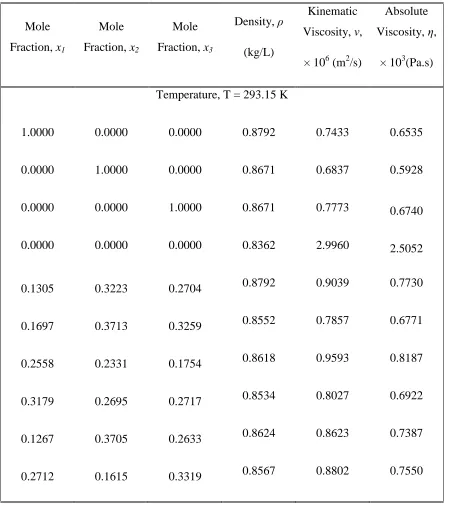
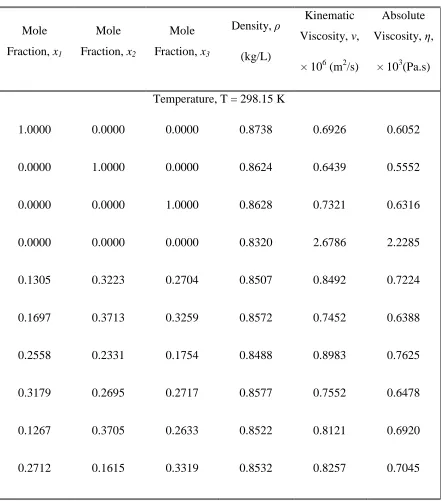
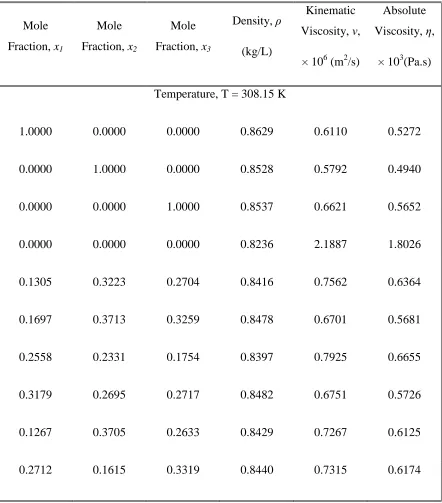
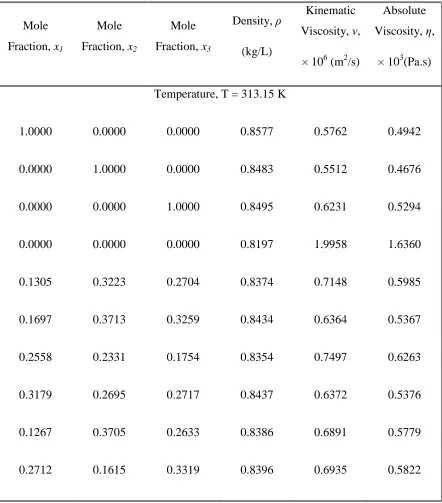
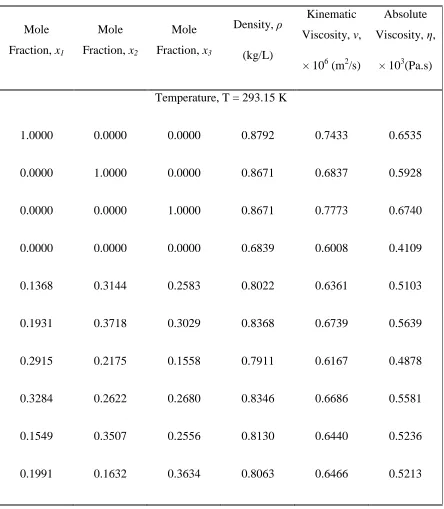
Table 4.4: Density, Kinematic Viscosity, and Absolute Viscosity-Composition Data for the Quinary System; Benzene (1) + Toluene (2) + Ethylbenzene (3) + Heptane (4) + Cyclooctane (5). ... 102
Table 4.5: Density, Kinematic Viscosity, and Absolute Viscosity-Composition Data for the Quaternary System: Benzene (1) + Toluene (2) + Ethylbenzene (3) + Cyclooctane (4). ... 106
Table 4.6: Density, Kinematic Viscosity, and Absolute Viscosity-Composition Data for the Quaternary System: Benzene (1) + Toluene (2) + Ethylbenzene (3) + Heptane (4)... 110
xiii
Table 4.8: Density, Kinematic Viscosity, and Absolute Viscosity-Composition Data for
the Quaternary System: Benzene (1) + Ethylbenzene (2) + Heptane (3) +
Cyclooctane (4). ... 118
Table 4.9: Density, Kinematic Viscosity, and Absolute Viscosity-Composition Data for
the Quaternary System: Benzene (1) + Toluene (2) + Heptane (3) + Cyclooctane (4).
... 122
Table 4.10: Density, Kinematic Viscosity, and Absolute Viscosity-Composition Data for
the Ternary System: Benzene (1) + Toluene (2) + Heptane (3). ... 126
Table 4.11: Density, Kinematic Viscosity, and Absolute Viscosity-Composition Data
for the Ternary System: Benzene (1) + Ethylbenzene (2) + Heptane (3). ... 130
Table 4.12: Density, Kinematic Viscosity, and Absolute Viscosity-Composition Data
for the Ternary System: Toluene (1) + Ethylbenzene (2) + Heptane (3). ... 134
Table 4.13: Density, Kinematic Viscosity, and Absolute Viscosity-Composition Data
for the Ternary System: Benzene (1) + Toluene (2) + Ethylbenzene (3). ... 138
Table 4.14: Density, Kinematic Viscosity, and Absolute Viscosity-Composition Data for
the Ternary System: Benzene (1) + Toluene (2) + Cyclooctane (3). ... 142
Table 4.15: Density, Kinematic Viscosity, and Absolute Viscosity-Composition Data
for the Ternary System: Toluene (1) + Ethylbenzene (2) + Cyclooctane (3). ... 146
Table 4.16: Density, Kinematic Viscosity, and Absolute Viscosity-Composition Data
for the Ternary System: Benzene (1) + Ethylbenzene (2) + Cyclooctane (3). ... 150
Table 4.17: Density, Kinematic Viscosity, and Absolute Viscosity-Composition Data
xiv
Table 4. 18: Density, Kinematic Viscosity, and Absolute Viscosity-Composition Data
for the Ternary System: Toluene (1) + Heptane (2) + Cyclooctane (3). ... 158
Table 4.19: Density, Kinematic Viscosity, and Absolute Viscosity-Composition Data
for the Ternary System: Ethylbenzene (1) + Heptane (2) + Cyclooctane (3). ... 162
Table 4.20: Density, Kinematic Viscosity, and Absolute Viscosity-Composition Data
for the Binary System: Benzene (1) + Toluene (2). ... 166
Table 4.21: Density, Kinematic Viscosity, and Absolute Viscosity-Composition Data
for the Binary System: Toluene (1) + Ethylbenzene (2). ... 170
Table 4.22: Density, Kinematic Viscosity, and Absolute Viscosity-Composition Data
for the Binary System: Heptane (1) + Toluene (2). ... 174
Table 4.23: Density, Kinematic Viscosity, and Absolute Viscosity-Composition Data
for the Binary System: Heptane (1) + Ethylbenzene (2). ... 178
Table 4.24: Density, Kinematic Viscosity, and Absolute Viscosity-Composition Data for
the Binary System: Benzene (1) + Ethylbenzene (2). ... 182
Table 4.25: Density, Kinematic Viscosity, and Absolute Viscosity-Composition Data for
the Binary System: Benzene (1) + Heptane (2). ... 186
Table 4.26: Density, Kinematic Viscosity, and Absolute Viscosity-Composition Data
for the Binary System: Benzene (1) + Cyclooctane (2)... 190
Table 4.27: Density, Kinematic Viscosity, and Absolute Viscosity-Composition Data
for the Binary System: Toluene (1) + Cyclooctane (2). ... 194
Table 4.28: Density, Kinematic Viscosity, and Absolute Viscosity-Composition Data
xv
Table 4.29: Density, Kinematic Viscosity, and Absolute Viscosity-Composition Data
for the Binary System: Heptane (1) + Cyclooctane (2). ... 202
Table 5.1: Physical Properties of Pure Components at 293.15 K. ... 210
Table 5.2: Effective Carbon Numbers of the Pure Components as Calculated From
Equation (5.10). ... 218
Table 5.3: Results of Testing the Predictive Version of McAllister’s Three-body
Interaction Model for the Binary Sub-Systems of the Quinary System: benzene +
toluene + ethylbenzene + heptane + cyclooctane. ... 221
Table 5.4: Effect of Cyclooctane Effective Carbon Number (ECN) Change on the
Predictive Capability of McAllister Model for Binary Systems. ... 223
Table 5.5: Results of Testing the Predictive Version of the McAllister’s three-body
Interaction Model for the Ternary Sub-Systems of the Quinary System: benzene +
toluene + ethylbenzene + heptane + cyclooctane. ... 224
Table 5.6: Effect of Cyclooctane Effective Carbon Number (ECN) Change on the
Predictive Capability of McAllister Model for Ternary Systems. ... 226
Table 5.7: Results of Testing the Predictive Version of the McAllister’s three-body
Interaction Model for the Quaternary Sub-Systems of the Quinary System: benzene
+ toluene + ethylbenzene + heptane + cyclooctane. ... 227
Table 5.8: Effect of Cyclooctane Effective Carbon Number (ECN) Change on the
Predictive Capability of McAllister’s Model for Quaternary Systems. ... 229
Table 5.9: Results of Testing the Predictive Version of the McAllister’s three-body
xvi
heptane + cyclooctane and the Effect of Cyclooctane Effective Carbon Number
(ECN) Change... 230
Table 5.10: Physical and Critical Properties of Pure Components of the Quinary System:
benzene + toluene + ethylbenzene + heptane + cyclooctane*. ... 233
Table 5.11: Results of Testing the Predictive Capability of the GCSP Model for the
Binary Sub-Systems of the Quinary System: benzene + toluene + ethylbenzene +
heptane + cyclooctane. ... 234
Table 5.12: Results of Testing the Predictive Capability of the GCSP Model for the
Ternary Sub-Systems of the Quinary System: benzene + toluene + ethylbenzene +
heptane + cyclooctane. ... 236
Table 5.13: Results of Testing the Predictive Capability of the GCSP Model for the
Quaternary Sub-Systems of the Quinary System: benzene + toluene + ethylbenzene
+ heptane + cyclooctane. ... 238
Table 5.14: Results of Testing the Predictive Capability of the GCSP Model for the
Quinary System: benzene + toluene + ethylbenzene + heptane + cyclooctane ... 240
Table 5.15: The contribution of the Different Chemical Groups Involved in the Pure
Components of the Quinary System; benzene + toluene + ethylbenzene + heptane +
cyclooctane for the GC-UNIMOD Method* ... 243
Table 5.16: Results of Testing the Predictive Capability of the GC-UNIMOD Model for
the Binary Sub-Systems of the Quinary System: benzene + toluene + ethylbenzene +
xvii
Table 5.17: Results of Testing the Predictive Capability of the GC-UNIMOD Model for
the Ternary Sub-Systems of the Quinary System: benzene + toluene + ethylbenzene
+ heptane + cyclooctane. ... 249
Table 5.18: Results of Testing the Predictive Capability of the GC-UNIMOD Model for
the Quaternary Sub-Systems of the Quinary System: benzene + toluene +
ethylbenzene + heptane + cyclooctane. ... 251
Table 5.19: Results of Testing the Predictive Capability of the GC-UNIMOD Model for
the Quinary System: benzene + toluene + ethylbenzene + heptane + cyclooctane.
... 253
Table 5.20: Results of Testing the Predictive Capability of the Allan and Teja
Correlation for the Binary Sub-Systems of the Quinary System: benzene + toluene +
ethylbenzene + heptane + cyclooctane. ... 254
Table 5.21: Results of Testing the Predictive Capability of the Allan and Teja
Correlation for the Ternary Sub-Systems of the Quinary System: benzene + toluene
+ ethylbenzene + heptane + cyclooctane. ... 257
Table 5.22: Results of Testing the Predictive Capability of the Allan and Teja
Correlation for the Quaternary Sub-Systems of the Quinary System: benzene +
toluene + ethylbenzene + heptane + cyclooctane. ... 259
Table 5.23: Results of Testing the Predictive Capability of the Allan and Teja
Correlation for the Quinary System: benzene + toluene + ethylbenzene + heptane +
xviii
Table 5.24: Results of Testing the Artificial Neural Network Model for the Binary
Sub-Systems of the Quinary System: benzene + toluene + ethylbenzene + heptane +
cyclooctane; (non-cyclooctane containing systems). ... 268
Table 5.25: Results of Testing the Artificial Neural Network Model for the Binary
Sub-Systems of the Quinary System: benzene + toluene + ethylbenzene + heptane +
cyclooctane; (cyclooctane containing systems). ... 269
Table 5.26: Results of Testing the Artificial Neural Network Model for the Ternary
non-cyclooctane containing Sub-Systems of the Quinary System: benzene + toluene
+ ethylbenzene + heptane + cyclooctane; Combination 1: AB C. ... 271
Table 5.27: Results of Testing the Artificial Neural Network Model for the Ternary
(non-cyclooctane containing) Sub-Systems of the Quinary System: benzene +
toluene + ethylbenzene + heptane + cyclooctane; average of the three combinations.
... 275
Table 5.28: Results of Testing the Artificial Neural Network Model for the Ternary
(cyclooctane containing) Sub-Systems of the Quinary System: benzene + toluene +
ethylbenzene + heptane + cyclooctane; Combination 1: AB C. ... 276
Table 5.29: Results of Testing the Artificial Neural Network Model for the Quaternary
(non-cyclooctane containing) Sub-System of the Quinary System: benzene + toluene
+ ethylbenzene + heptane + cyclooctane; Combination BC D A. ... 280
Table 5.30: Results of Testing the Artificial Neural Network Model for the Quaternary
(cyclooctane containing) Sub-System of the Quinary System: benzene + toluene +
xix
Table 5.31: Results of Testing the Artificial Neural Network Model for the Quinary
System: benzene + toluene + ethylbenzene + heptane + cyclooctane; Combination
xx
LIST OF FIGURES
Figure 2.1: The Eyring Molecular Model of Liquid Viscosity ... 13
Figure 2.2: Different Types of Molecular Interactions Involved in Binary Mixtures (Three-Body Interaction Model) ... 16
Figure 2.3: Lumped Parameters, 1/3 2 2 1 12 , Variation With (1/T) or n-alkane Systems (For which N2 N1 3, Asfour et al. (1991) ... 24
Figure 2.4: Lumped Parameter Variations, 1/3 2 2 1 12 , with 1/3 2 2 1 2 1 2 N N N N For n- alkane Systems (Asfour et al.(1991), Legends are the same as indicated in Figure 2.3) ... 25
Figure 2.5: Experimental Values of Kinematic Viscosities of n-alkane Systems at 308.15 K Versus Effective Carbon Number (Nhaesi and Asfour 1998). ... 28
Figure 2.6: Different Types of Molecular Interactions Encountered with Ternary Systems (Three-Body Interaction Model, Kalidas et al. (1964)) ... 30
Figure 2.7a: Single-Layer Feed-Forward Network ... 72
Figure 2.7b: Multi-Layer Feed-Forward Network with One Hidden Layer... 72
Figure 2.8: Single-Layer Recurrent Network………...74
Figure 2.9a: A schematic Diagram Showing the Forward Phase in the Back-propagation Neural Network. ... 76
Figure 2.9b: A schematic Diagram Showing the Backward Phase in the Back-propagation Neural Network. ... 76
xxi
Figure 3.2: The Cannon-Ubbelohde Viscometer ... 88
Figure 3.3: Pictorial View of the Constant Temperature Bath ... 90
Figure 5.1: The Architecture of One Modular Network for a Binary System ... 263
Figure 5.2: A Block Diagram for the Ternary Modular Network ... 265
Figure 5.3: Predictive Capabilities of the Various Viscosity Models for Binary
non-cyclooctane Containing Systems ... 284
Figure 5.4: Predictive Capabilities of the Various Viscosity Models for Binary
Cyclooctane Containing Systems. ... 285
Figure 5.5: Predictive Capabilities of the Various Viscosity Models for Ternary
non-cyclooctane Containing Systems. ... 286
Figure 5.6: Predictive Capabilities of the Various Viscosity Models for Ternary
Cyclooctane Containing Systems. ... 287
Figure 5.7: Predictive Capabilities of the Various Viscosity Models for Quaternary
non-cyclooctane Containing Systems. ... 288
Figure 5.8: Predictive Capabilities of the Various Viscosity Models for Quaternary
Cyclooctane Containing Systems. ... 289
Figure 5.9: Predictive Capabilities of the Various Viscosity Models for Quaternary
System; benzene + toluene + ethylbenzene + heptane + cyclooctane ... 290
Figure 5.10: Predictive Capabilities of the Various Viscosity Models for
non-cyclooctane Containing Systems. ... 294
Figure 5.11: Predictive Capabilities of the Various Viscosity Models for Cyclooctane
CHAPTER 1
INTRODUCTION
1.1 General
Viscosity is an important physical property which characterizes a simple fluid’s
resistance to flow. Fluids are classified either as Newtonian fluids or non-Newtonian
fluids. Newtonian fluids are defined as those fluids that obey Newton’s law of viscosity.
Obviously, non-Newtonian fluids do not obey that law. According to Newton’s law of
viscosity, the absolute viscosity is a proportionality constant in an equation that relates
the shear stress and the shear rate, or velocity gradient. Newton’s law is given by,
dy dv
- (1.1)
The shear stress, τ, appearing in equation (1.1) is the force applied to the fluid per unit
area.
Viscosities of liquid mixtures are required in many engineering applications
involving mass and heat transfer processes. Accurate viscosity data are needed for the
design of most of fluid flow equipment.
The almost complete lack of knowledge regarding the structure of liquids and the
complex nature of, and the little knowledge we currently have about the intermolecular
forces in liquid systems, immensely contribute to the current unsatisfactory
Asfour (1979), during his study of diffusion in liquid mixtures, suggested
breaking down liquid mixtures into three categories; viz., (i) n-alkane solutions, (ii)
regular mixtures, and (iii) associated solutions. Such a classification has led to success
by Asfour (1979), Asfour (1985), Asfour and Dullien (1981), Dullien and Asfour (1985),
Asfour and Dullien (1986) in dealing with the diffusion in liquids problem. Asfour et al.
(1991) proposed extending that classification to the study of viscosities of liquid systems.
Asfour and co-workers were met with a great deal of success when they extended the
Asfour (1979) classification of liquid systems to the study of viscosity of liquid mixtures;
e.g., Asfour et al. (1991), Wu and Asfour (1992), Nhaesi and Asfour (1998), Nhaesi and
Asfour (2000a and b), and Nhaesi, et al. (2005).
Models available in the literature for calculating the viscosities of liquid mixtures
may be divided into two categories; viz., correlative or predictive. Correlative models
contain adjustable parameters whose values are determined from fitting those models to
experimental mixture data. Predictive models employ molecular properties for the
prediction of the dependence of a physical property, e.g., viscosity on composition. The
predictive models can further be classified into either semi-theoretical or empirical. The
former are normally developed on some theoretical basis and require limited
experimental data; e.g., pure component properties for the prediction of the physical
property of interest on composition. The latter employ experimental data for developing
those models.
In the present study, four well known viscosity models were subjected to testing
of their predictive capability. The selected models cover both categories; i.e.
predictive version of the generalized McAllister’s three-body interaction model, (ii) a
generalized corresponding states principle GCSP, (iii) a group contribution
GC-UNIMOD model, and (iv) the Allan and Teja correlation. In addition, an artificial neural
network based model has been developed and used for predicting the kinematic viscosity
of the investigated systems. Results from the neural network are reported and compared
to the results obtained from the remaining models. Experimental data at different
temperature levels obtained during the current study were utilized in testing the
above-named models.
McAllister (1960) utilized Eyring’s absolute rate theory to develop a correlative
model for calculating the dependence of the kinematic viscosity of liquid binary mixtures
on composition. The McAllister model was extended by Chandramouli and Laddha
(1963) to ternary liquid systems. The McAllister equation contains adjustable parameters
that require costly and time consuming experimental data for determining their values.
The correlative nature of the McAllister model drastically limits its use.
In order to overcome this problem, Asfour et al. (1991) proposed a technique for
predicting the McAllister model parameters for the case of n-alkane binary mixtures
using pure component viscosities and molecular parameters. This in effect successfully
converted the McAllister model from being a correlative model to a predictive model.
This evidently makes the McAllister, in its new form, much more useful than before.
Nhaesi and Afour (1998) extended the Asfour et al. (1991) technique to include
binary and ternary regular solutions. Following that, Nhaesi and Asfour (2000b) reported
of multi-component liquid mixtures. The model has been tested by other researchers; e.g.
Giner et al. (2006) and Bandres et al. (2009) and proved to be successful.
The Generalized Corresponding States Principle (GCSP) was first developed by
Teja and Rice (1981) for the prediction of the viscosities of multi-component n-alkane
liquid systems.. Their method requires the knowledge of the critical properties of pure
components and the concept of the reference fluid. The problem encountered with the
application of the GCSP method for mixtures of more than two components is the proper
choice of the reference fluids. It was shown by Wu and Asfour (1992) in their study of n
-alkane mixtures that the results significantly depended on the different reference fluid
combinations. There was no optimum selection reported by Teja and Rice (1981) for the
choice of the best reference fluid combination. Wu and Asfour (1992) overcame the
problem of the reference fluid selection by proposing a “pseudo-binary” model that they
incorporated into the GCSP and called their method the modified GCSP (MGCSP). The
incorporation of the “pseudo-binary” model proposed by Wu and Asfour (1992) resulted
in a method, the MGCSP, where the results did not depend on the selection of the
reference fluids, especially for the case of multi-component liquid system (Wu et al.
1998). The MGCSP was successfully extended by Nhaesi and Asfour (2000a) to include
multi-component regular solutions.
A Group Contribution GC-UNIMOD was proposed by Cao et al. (1992), (1993a),
and (1993b) is a modified version of the original group contribution approach first
developed by Langmuir (1925). The theoretical basis for that method assumes that the
made by the different chemical groups contained in that compound. Moreover, the
contribution of one chemical group is independent of the contribution of other groups.
The GC-UNIMOD assumes that the contribution of one chemical group in one
component is the same as it is in all other components. Evidently, this is not a good
assumption and there are no theoretical or experimental evidence that supports such an
assumption. This, obviously, does not make that method very reliable.
Allan and Teja (1991) reported their Antoine-type equation for viscosity of liquid
mixtures. That equation mainly depends on the number of carbon atoms contained in the
pure components constituting a mixture. The trial and error procedure involved in the
calculation of the effective carbon number of any component in the mixture in the Allan
and Teja correlation is rather cumbersome and is time consuming. This dramatically
limited the applicability of that method.
The artificial neural network has been considered in the present study due to its
fast computation as well as for its ability to successfully represent the highly non-linear
relationships involved; i.e., the viscosity-composition relationship. In the present study,
an artificial neural network using back-propagation learning algorithm has been
developed. The network was trained on only half of the reported data on binary systems.
Then the network was tested and generalized to predict the kinematic viscosities of the
quinary regular system and all the corresponding quaternary, ternary, and binary
sub-systems involved in the present study. Results of the network are reported and compared
1.2 Objectives
The present study is part of an on-going research program in our laboratory
aiming at building up an extensive database for viscosity-composition data at different
temperatures of liquid systems containing components with different chemical structures
and molecular sizes.
The primary objective of the present work is to experimentally measure and
report: (i) the densities, kinematic viscosities, and absolute viscosities of the pure
components constituting the systems under investigation, and (ii) the dependence of the
densities and viscosities of the quinary regular system: benzene (1) + toluene (2) +
ethylbenzene (3) + heptanes (4) + cyclooctane (5), and its corresponding quaternary,
ternary, and binary sub-systems on concentration, over the entire composition range, at
the temperatures of 293.15 K, 298.15 K, 308.15 K, and 313.15 K. The present study also
aims at:
(a) Employing the experimental data gathered in the present investigation to
critically test some of the viscosity models available in the literature.
(b) Developing an artificial neural network for predicting the viscosities of
multi-component regular liquid systems using part of the reported
experimental data, and using the other part of the data for validating the
model.
1.3 Contributions and Significance
Viscosities of liquid mixtures are required in many engineering applications.
However, costly and time consuming experiments are required in order to collect such
data. In addition, data on the viscosities of multi-component liquid mixtures are very
scarce in the literature. Such data are also needed for the development and testing of
mathematical models that describe the dependence of viscosity on composition,
especially for the case of multi-component liquid systems .Therefore, the viscosity and
density-composition data reported herein are considered a valuable contribution to the
literature.
The following contributions have been made during the course of the present
study:
i. Kinematic viscosity, density, and absolute viscosity composition data of
multi-component liquid regular solutions have been accurately measured
and reported.
ii. Some viscosity models available in the literature were subjected to critical
testing using the experimental reported data.
iii. An artificial neural network has been developed for predicting the
viscosities of multi-component regular solutions.
iv. The predictive capability of the developed network has been tested and
CHAPTER 2
LITERATURE SURVEY
2.1 General
Viscosity is a transport property that is generally defined as the resistance of a
fluid to flow under applied shear stresses. It may be considered an important key
parameter in many engineering process design and development.
The prediction of viscosity of pure components as well as those of liquid mixtures
has attracted the attention of many researchers over the years. In spite of all the earlier
efforts, complete description of the viscosity of multi-component liquid mixtures remains
insufficient. This can be attributed to the difficulty of understanding the structure of the
liquids. That is why accurate and reliable viscosity data, especially for liquid mixtures are
needed.
Our laboratory has successfully continued to establish an extensive database that
contains accurate density and viscosity-composition data at different temperature levels.
Viscosity models for calculating the viscosities of pure components as well as
liquid systems have been reported in the literature. Reid et al. (1987), Monnery et al.
(1995), Mehrotra et al. (1996), and Poling et al. (2001) represent some examples of such
reviews.
Monnery et al. (1995) classified models that attempt to estimate the viscosity of
liquid mixtures as empirical or semi-theoretical models. The semi-theoretical models can
properties are employed in calculating the viscosities of mixtures and correlative, where
the experimental mixture data are used.
The semi-theoretical class of models results from a combination of theoretical
formulation of the model and determination of the values of the parameters contained in
those models by using experimental data. The McAllister model (1960) is an excellent
example of those models.
In the present chapter, some viscosity related properties used in the current study
are first quickly described, followed by an overview of different classes of liquids. Then,
an up-to-date review of the most important viscosity models in the literature from the
present author’s standpoint is presented.
2.2 Density, Viscosity, and Related Properties
2.2.1 Density
Density is considered a property of interest in the present study since the
kinematic viscosities of different fluids, ν, is the transport property to be measured. In
order to determine the value of the absolute viscosity, η, one employs the following
relationship which utilizes the value of the density, ρ,
η = ν ρ (2.1)
Densities in the present study were measured at the same conditions for each pure
component and for the mixtures. Densities have also been required for the calculation of
2.2.2 Excess volume of mixing
Excess volume is a term that accounts for the departure from ideality when two
liquids are mixed. If the liquids were ideal, then the sum of the molar volumes of the
liquids constituting a mixture, each multiplied by its respective mole fraction in the
solution, has to equal the molar volume of the mixture. Since the molecules of each
liquid are of different sizes and shapes, the difference between the molar volume of the
mixture will deviate, either positively or negatively, from the sum of the molar volumes
of the components of the liquid mixtures each multiplied by its respective mole fraction.
The following expression was utilized for calculating the excess volume of mixing, VE
i i i E
V x V
V (2.2)
where V is the mixture’s molar volume, xi, and Vi are the pure components’ mole fraction
and molar volume, respectively.
The above equation may be rewritten as
i i i i i
i i
E x M
M x
V (2.3)
where, Mi and ρi are the molecular weight and density of the pure component i and ρ is
the density of the mixture.
2.2.3 Excess free energy of viscous flow
The absolute rate theory developed by Eyring (1936) states that,
RT G Δ exp V
N h α
λ η
2
These terms will be explained in detail in the section dealing with the models
based on absolute rate theory.
Taking the logarithms of both sides of equation (2.4) and after rearrangement, the
above equation may be rewritten as follows:
N h n α λ n 2 V η n RT G Δ
(2.5)Heric and Brewer (1967) defined another excess free energy term, Δ*GE, to be
subtracted from the actual free energy, Δ*G, to account for the non-ideality in the solution
as follows:
i E
G G
G (2.6)
where Δ*Gi is defined as the excess molar free energy for ideal solutions and is
calculated with the help of the following simple mixing rule as suggested by Reed and
Taylor (1959), i i i i G x
G (2.7)
Substituting equations (2.5) and (2.7) into equation (2.6) yields,
i i
i i
i
i n hN
α λ n 2 V η n x -N h n α λ n 2 V η n RT G Δ
(2.8) But since i i i i α λ n x α λ n
Therefore, equation (2.8) can be simplified as
i
i i i n η V
x V
η n RT
G Δ
(2.10)
Equation (2.10) relates the excess molar free energy, Δ*GE, to the molar volumes.
2.3 Classes of Liquid Mixtures
Asfour (1979) classified liquid solutions into three categories; viz., n-alkane
systems, regular solutions, and associated mixtures. This classification helped Asfour
(1985), Dullien and Asfour (1985), and Asfour and Dullien (1986) to successfully deal
with diffusion in liquid diffusion problems. Extension of such a classification to the
viscosity of liquid mixture problems has led to promising results. Asfour and co-workers;
e.g. (Asfour et al. (1991), Wu and Asfour (1992), Nhaesi and Asfour (1998), Wu et al.
(1998), Nhaesi and Asfour (2000 a and b), and Nhaesi et al. (2005) successfully
employed that classification in the study of viscosities of liquid mixtures.
2.4 Semi-Theoretical Models of Viscosity of Liquid Mixtures
2.4.1 The absolute rate theory based models
Eyring (1936), Ewell and Eyring (1937), and Kincaid et al. (1941), developed one
of the most popular liquid theories; the absolute rate theory. Eyring suggested that a
single molecule requires a potential energy change of Δ*Go in order to move from one
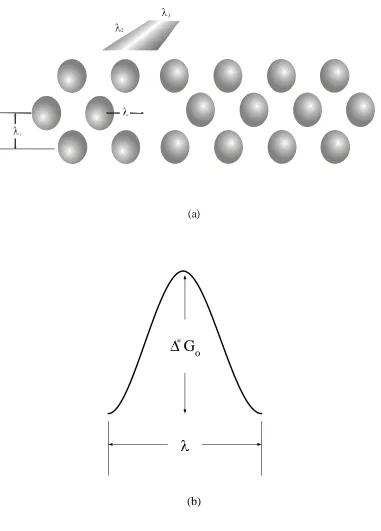
equilibrium position to another passing the energy barrier as shown in Figure 2.1a. Such
(a)
G
o *(b)
Figure 2.1b shows liquid molecules as described by Eyring (1936), in layers. A
distance λ1 between two adjacent layers experiencing shear forces and an average area
occupied by one molecule of λ2 λ3are assumed. Where λ2is the average distance between
neighboring molecules and λ3is the average distance between molecules normal to the
direction of motion.
A vacant site is required for the molecule to successively move from one position
to another. Eyring’s viscosity equation for liquids was derived as:
KT ΔG exp λ λ λ
hλ
η 0
2 3 2
1
(2.11)
where η is the absolute viscosity, h is Planck’s constant, K is Boltzman’s constant, and
λ is the average distance between equilibrium positions in the direction of motion.
Assuming that λ1= λ, and taking V0, the effective volume of a molecule, to be equal to λ1 λ2 λ3, equation (2.11) becomes
RT G Δ exp V
h
η 0
0
(2.12)
The above equation may be rewritten in the form of molar properties as
RT G Δ exp V hN η
m
(2.13)
where N is Avogadro’s number, Vm is the molar volume of the liquid, and
Δ*
2.4.1.1 McAllister’s model
A. Binary mixtures
McAllister (1960) developed his successful model, on the basis of Eyring’s
absolute rate theory, in terms of the kinematic viscosity of binary liquid mixtures as
follows:
RT G Δ exp M
hN ν
avg
(2.14)
where
i i i avg xM
M (2.15)
where the subscript i denotes component type 1 or 2, x is the mole fraction and M is the
molecular weight.
In a binary mixture of molecules of the type 1 and 2, McAllister assumed that
different possible types of interactions may occur in a solution with respect to the
molecule movement. McAllister (1960) assumed a three-body collision (or interaction).
Figure 2.2 depicts the different types of molecular interactions in a binary mixture
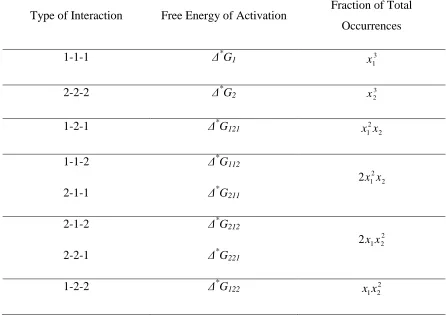
(occurs in one plane) and Table 2.1 shows the different types of molecular interactions
along with their corresponding free energies of activation and their fraction of total
(a) (b) (c) (d)
(e) (f) (g) (h)
Table 2.1: Different Types of interactions in a binary mixture of molecules 1 and 2, their corresponding free energy of activation and their total of fractional occurrences (Three-Body Interaction Model)
Type of Interaction Free Energy of Activation Fraction of Total Occurrences
1-1-1 Δ*G1 x13
2-2-2 Δ*G2 x23
1-2-1 Δ*G121 x12x2
1-1-2 Δ*G112
2 2 1 2x x
2-1-1 Δ*G211
2-1-2 Δ*G212
2 2 1 2x x
2-2-1 Δ*G221
According to McAllister (1960), the free energy of activation of the mixture is given by, 2 3 2 122 2 2 1 212 2 2 1 112 2 2 1 121 2 2 1 1 3 1 2 2 G x G x x G x x G x x G x x G x G (2.16)
Many assumptions were made by McAllister in order to derive his cubic equation.
These were,
(i) All types of interactions are only three bodied and are taking place in one
plane.
(ii) The ratio between the radii of the two types of molecules is taken arbitrarily to be 1.5; otherwise different additional interactions have to be considered (a
four-body interaction model).
(iii) The free energies of activation are additive, and the probability of
interaction is proportional to the mole fractions of the molecules involved.
(iv) Due to the difficulty in differentiating between Δ*G121 and Δ*G112 and similar
terms, it was assumed that
12 112
121 G G
G (2.17)
G212 G122 G21 (2.18)
On the basis of the above assumptions, equation (2.16) may be rewritten as
2 3 2 21 2 2 1 12 2 2 1 1 3
1 G 3x x G 3x x G x G
x
Applying equation (2.14) to each type of interaction involved in the mixture, i.e.
one can re-write an equation for the kinematic viscosity of the pure component 1 as
follows: RT G exp M hN 1 1
1 (2.20)
Similarly, for component 2
RT G exp M hN 2 2
2 (2.21)
For interactions of types 12 and 21,
RT G exp M hN 12 12
12 (2.22)
and RT G exp M hN 21 21
21 (2.23)
one also has the following relationship:
3
2 1 2
12
M M
M (2.24)
similarly,
3
2 2 1
21
M M
M (2.25)
3
2 112 121
12
G G
and
3
2 122 212
21
G G
G (2.27)
Substituting equation (2.19) into equation (2.14) one obtains:
RT G x G x x G x x G x exp M hN ave 2 3 2 21 2 2 1 12 2 2 1 1 3
1 3 3
(2.28)
Taking the logarithms of equations (2.20) through (2.23) and combining them in
order to eliminate the free energies, then substitute all of that along with equations (2.15),
(2.24), and (2.25) with some mathematical manipulations, one can obtain the final form
of the McAllister three-body model for binary mixtures as follows:
1 2 3 2 1 2 2 2 1 2 2 1 1 2 2 2 3 2 21 2 2 1 12 2 2 1 1 3 1 3 2 1 3 2 3 3 3 M / M n x M / M n x 3x M / M n x M M x x n -n x n x x n x x n x n 1 1 (2.29)
Equation (2.29) is a cubic equation which can have a maximum, a minimum,
neither or both for ν as a function of x. It should also be noted that the equation has only
two adjustable parameters; viz., ν12 and ν21 which can be determined by fitting the
McAllister (1960) suggested a four-body interaction model to be applied for the
case of mixtures having large differences in their molecular size. McAllister followed a
similar procedure to that he had followed in deriving his three-body interaction model.
The final form of his “quartic equation” is as follows:
4 3 1 4 2 1 4 3 4 4 6 4 1 2 3 2 1 1 2 2 2 1 2 2 3 1 1 2 2 2221 3 2 1 1122 2 2 2 1 1112 2 3 1 1 4 1 M / M n x x M / M n x 6x M / M n x x M M x x n -n x n x x n x x n x x n x n 2 1 1 2 4 2 (2.30)
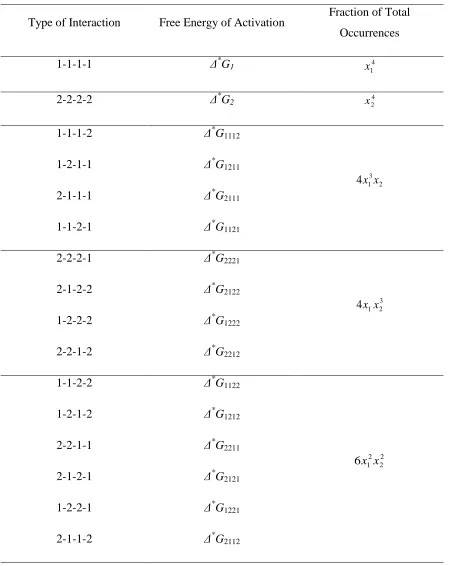
Table 2.2 shows the different types of interactions involved along with their
corresponding free energies and fractional occurrences.
The above equation, equation (2.30), contains three adjustable parameters;
namely, ν1112, ν1122, and ν2221 which again have to be determined from
viscosity-composition data.
The presence of the adjustable parameters in both the three-body and the
four-body models limits the use of the McAllister model because of the need for costly and
time consuming viscosity-composition data to determine the values of these parameters.
It should be pointed out here that the McAllister adjustable parameters are highly
temperature dependent which, again, is considered a major draw back of his models.
Table 2.2: Different Types of interactions in a binary mixture of molecules 1 and 2, their corresponding free energy of activation and their total of fractional occurrences (Four-Body Interaction Model)
Type of Interaction Free Energy of Activation Fraction of Total Occurrences
1-1-1-1 Δ*G1 x14
2-2-2-2 Δ*G2 x24
1-1-1-2 Δ*G1112
2 3 1 4x x
1-2-1-1 Δ*G1211
2-1-1-1 Δ*G2111
1-1-2-1 Δ*G1121
2-2-2-1 Δ*G2221
3 2 1 4x x
2-1-2-2 Δ*G2122
1-2-2-2 Δ*G1222
2-2-1-2 Δ*G2212
1-1-2-2 Δ*G1122
2 2 2 1 6x x
1-2-1-2 Δ*G1212
2-2-1-1 Δ*G2211
2-1-2-1 Δ*G2121
1-2-2-1 Δ*G1221
2.4.1.2 The Asfour et al (1991) technique
Realizing the importance of the McAllister model, Asfour et al. (1991) proposed
their technique which converts the McAllister model from a correlative model into a
predictive model. This was achieved by providing means for predicting the values of the
adjustable parameters from pure component and molecular properties. This obviously
eliminates the need for costly and time consuming experimental data.
Asfour et al. (1991) successfully applied their technique to n-alkane mixtures.
They employed kinematic viscosity-composition data reported by Cooper (1988) and Wu
(1992). They plotted the lumped parameter 1/3
2 2 1
12
versus the inverse of the absolute
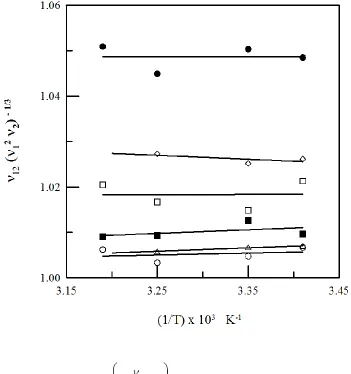
temperature, (1/T). From the plot shown in Figure 2.3, horizontal straight lines were
obtained which confirmed that the lumped parameter is independent of temperature.
Asfour et al. (1991) plotted the lumped parameter against a fraction of the number of
carbon atoms of the n-alkanes constituting a binary system as shown in Figure 2.4. A
straight line relationship resulted. They suggested the following equation:
3 / 1 2 2 1
2 1 2 3
/ 1 2 2 1
12
044 . 0 1
N N
N N
(2.31)
where N1 and N2 are the numbers of carbon atoms per molecule of components 1 and 2,
respectively.
Equation (2.31) permits the calculation of the value of the McAllister parameter,
ν12, by knowing the pure component kinematic viscosities and the number of carbon
Figure 2.3: Lumped Parameters, 1/3
2 2 1
12
, Variation With (1/T) or n-alkane Systems
Figure 2.4: Lumped Parameter Variations, 1/3
2 2 1
12
, with 1/3
2 2 1
2 1 2
N N
N N
For n-
the calculation of the second interaction parameter, ν21: 3 / 1 1 2 12
21 (2.32)
The above equation allows the calculation of the McAllister parameter, ν21, from the
value of ν12 obtained earlier from equation (2.31). Their results showed an absolute
average deviation in the range of 0.02 % to 1 % in predicting the kinematic viscosities of
binary n-alkane mixtures using the above technique compared to those calculated by the
correlative McAllister model.
As stated earlier by McAllister (1960), one should apply the four-body collision
model if the ratio between the molecular radii of the molecules in a binary mixture
exceeded 1.5. On that basis, Asfour et al. (1991) suggested a technique analogous to the
one reported for three-body interaction model to calculate the McAllister three adjustable
parameters mentioned earlier as follows:
4 / 1 2 2 2 1 2 1 2 4 / 1 2 2 2 1 1122 03 . 0 1 N N N N (2.33) 4 / 1 2 1 1122
1112 (2.34)
4 / 1 1 2 1122
Again, experimental data different than those used in developing the above
equations were used to validate the Asfour et al. (1991) proposed technique. The results
showed good agreement with published experimental data.
Nhaesi and Asfour (1998) extended the Asfour et al. (1991) technique to regular
binary mixtures. As a substitute for the number of carbon atoms in n-alkanes, they
suggested the use of the effective carbon number (ECN) concept in case of regular
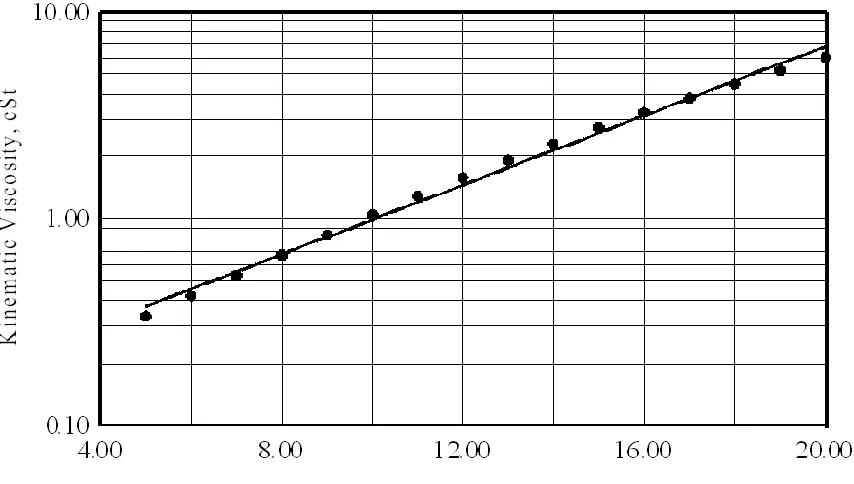
systems. Nhaesi and Asfour (1998) reported a semi-log plot of the kinematic viscosities
of pure n-alkanes (C5-C18) measured at 308.15 K versus the number of carbon atoms in
each molecule. The straight line relation obtained is shown in Figure 2.5 which is
represented by the following equation
) 193 . 0 943 . 1 ECN n
(2.36)
where, ν is the kinematic viscosity of the pure component at 308.15 K in cSt. Nhaesi
(1998) has reported values of the ECNs of some compounds calculated with the help of
equation (2.36).
The reported ECN values enabled Nhaesi and Asfour (1998) to develop a
technique for regular binary systems similar to equation (2.31) reported earlier for n
-alkane systems. The first binary adjustable parameter, ν12, for the case of regular
compounds may be calculated from
3 / 1 2 2 1 2 1 2 3 / 1 2 2 1 12 0715 . 0 8735 . 0 ECN ECN ECN ECN (2.37)
B. Ternary systems
Chandramouli and Laddha (1963) and Kalidas and Ladhha (1964) extended the
McAllister three-body model to ternary mixtures. Figure 2.6 represents the different types
of molecular interactions accompanied with the assumption of a three-body interaction
model. They obtained the following equation:
3 3 2 3 3 2 3 3 2 3 3 2 3 3 2 3 3 2 3 6 3 3 3 3 3 3 2 1 3 2 2 3 2 2 3 1 3 1 2 3 3 2 3 2 2 1 2 1 2 2 3 1 3 2 1 2 1 2 2 1 3 3 3 2 3 2 1 3 1 3 3 2 2 1 123 3 2 1 32 2 2 3 31 1 2 3 23 3 2 2 21 1 2 2 13 3 2 1 3 3 3 1 3 1 M M M n x x 6x M M n x x M M n x x M M n x x M M n x x M M n x x M M n x x nM x nM x nM x M x M x M x n n x x x n x x n x x n x x n x x 3 n x x n x x n x n x n x n 1 1 12 2 2 1 2 3 2 (2.38)
Again, Nhaesi and Asfour (2000b) followed the same procedure described in the
previous section to calculate the McAllister’s adjustable parameters. They plotted the
dimensionless lumped parameter, ν123/(ν1 ν2 ν3)1/3 against 1/T, they obtained horizontal
straight line was obtained when they plotted ν123/(ν1 ν2 ν3)1/3 versus (N3-N1)2/N2 , where N1, N2, and N3 are the carbon numbers of components 1, 2, and 3, respectively.
Using the least-square technique they were able to get the equation of the straight
line as follows:
2 2 1 3 3 1 3 2 1 123 0313 0 9637 0 N N N . .
/ (2.39)
The above equation can be used to predict the ternary interaction parameter if the
kinematic viscosities of pure components and their number of carbon atoms are known.
In case of regular solutions the numbers of carbon atoms in equation (2.39) are replaced
by the effective carbon numbers.
C. Multi-component systems
Dizechi and Marschall (1982) introduced the first modification to the generalized
McAllister three-body equation. Their modified equation included two constants; C and Z
suggested earlier by Goletz and Tassios (1977) to account for the dependence of the
adjustable parameters on temperature. They suggested the following equation
where
n
i i i avg x M
M (2.41)
3
/ M 2M
Mij i j (2.42)
3
/ M M M
Mijk i j k (2.43)
i , b
i Zt
C 239 (2.44)
n
i i i avg xC
C (2.45)
3
/ C 2C
Cij i j (2.46)
3
/ C C C
Cijk i j k (2.47)
Dizechi (1980) reported in a study an optimizing technique for the determination
of the value of Z. He found that Z is a weak function of temperature therefore, only one
Dizechi and Marschall (1982) tested their model using data on eight binary and
four ternary polar liquid mixtures at various temperatures. The results of the comparison
between their model and the original McAllister equation showed improvements in the
prediction of viscosity of the mixtures.
Soliman (1987) continued the earlier work of Dizechi and Marschall (1982) and
attempted to reduce the number of adjustable parameters and to improve the capabilities
of the McAllister equation. He made some modifications to the original McAllister
equation and introduced only one constant, B, as follows:
2 -n 1 i 1 -n 1 i j n 2 j k ijk k j i j i j i j i ij 1 -n 1 i n 1 i j j i 1 -n 1 i n 1 i j ij j i n 1 i i 3 i m n x x x 6 x x M M x x B x x n x x n x n
2 3 3 (2.48)For the above two modifications, equations (2.40) and (2.48), all the adjustable
parameters and the constants are to be determined from fitting experimental viscosity
data using the least square technique.
Soliman and Marschall (1990) reported a comparison on eight binary, five
ternary, and one quaternary liquid mixture containing strongly polar liquids including
water. As a result of the comparison made in their study amongest the three models, the
original McAllister equation, equation (2.40), and equation (2.48), Soliman’s (1987)
Although the two previous modifications to the original McAllister equation for
multi-component liquid mixtures showed a remarkable improvement in the liquid mixture
viscosities, it still did not change the correlative nature of the original McAllister model.
Extensivee databases are needed to calculate the introduced constants besides the
adjustable parameters which are not readily available in all cases.
Nhaesi and Asfour (2000b) were able to develop a generalized form of
McAllister’s three-body equation for multi-component liquid mixtures.
They suggested that the activation energy for n-component liquid systems can be
represented by the following general equation:
n 1 i n 1 j n 1 k ijk k j i ij j n 1 i n 1 j 2 i i n 1 i 3 i m G x x x 6 G x 3 G x
G x
(2.49)
Taking into consideration that the free energies of activation for kinematic
viscosities are additive. They also assumed the following:
ij iij
iji G G
G (2.50)
ji ijj
jij G G
G (2.51)
The kinematic viscosities for pure component, binary interaction, ternary
interaction, or a mixture may be expressed in the form of Arrhenius-type equation as