Secure Energy Efficient Route Discovery
Using Randomness Scheme in MANET
G.Satyavathy, S.Ananthi
Assistant Professor, Dept. of Computer Science, Affiliated to Bharathiar University, Coimbatore, India
M.Phil Research Scholar, Dept. of Computer Science, Affiliated to Bharathiar University, Coimbatore, India
ABSTRACT: MANET refers to a multi-hop packet based wireless network composed of a set of a mobile nodes that can communicate and move at a same time, without using any kind of fixed wired infrastructure. The goal of this research is to reduce the energy consumption and to improve the quality of service (QoS) of ad hoc and mobile networks. In general, the analytical evaluation shows the OKERMAN routing algorithm and it is used to improve the network connectivity. It is used to transfer both real time and non real traffic by providing energy efficient and less congested path between a source and destination. The main aim is to reduce the battery power consumption where Power is the most important criteria in ad-hoc networks. The aim of this research is to reduce the delay and energy consumption and also increases the throughput. By using efficient algorithm, it maximizes the network lifetime by minimizing the power consumption during the source to destination route establishment. The proposed technique is quite adaptive for energy efficient communication in MANET. It is typically proposed to increase the reliability of data transmission or to provide load balancing. The corresponding methodology can be used by the routing protocols to select the most stable route between a source and destination, in an environment where multiple paths are available, and to create a convenient performance measure to be used for the evaluation of the stability and connectivity in MANET.
KEYWORDS: Manet, Energy efficient algorithm, Power consumption, Network lifetime
I.INTRODUCTION
A mobile ad hoc network (MANET) is a collection of hundreds and thousands of low cost and low power mobile nodes connected by wireless links.[1] In operation, the nodes of a MANET do not have a centralized administration mechanism. It is known for its routable network properties where each node act as a “router” to forward the traffic to other specified node in the network. MANET is a self configuring network of mobile routers connected by wireless links with no access point. Every mobile device in a network is autonomous. The mobile devices are free to move and organize themselves arbitrarily. Nodes in the MANET share the wireless medium and the topology of the network changes erratically and dynamically.[2]
The advancements in wireless communication and the miniaturization of computers have led to a new concept called the mobile ad hoc network (MANET), where two or more mobile nodes can form a temporary network without need of any existing network infrastructure.[3]The proposed work helps to improve the throughput and to reduce the packet loss and packet delay. It also increases the packet delivery ratio. This research work proposes an Energy Entropy-based minimum Power cost Multipath routing algorithm in MANET. It is used to increase the reliability of data transmission. The multipath routing protocols are used to reduce the routing overhead, delay and to increase the data rate. The On-Demand routing protocols discover the paths only when it is required to communicate with other nodes. The minimum-hop maximum-power routing can significantly reduce the energy consumption time.
II. RELATED WORK
infrastructure or on symmetric encryption. It relies on the route discovery phase of an ad-hoc network employing the Dynamic Source Routing Protocol. It is lightweight and requires relatively little communication overhead.
The Communication networks are highly dynamic and largely unpredictable. The randomness is usually evident in easily accessible networking metadata such as traffic loads, packet delays or dropped- packet rates. It can be easily available to the devices that took part in the routing process, but it is usually unavailable to those devices that were not part on the route. It discuss about the routing protocol, where the routing information could be used for establishing secret common randomness between any two devices in a mobile ad-hoc network.
III.PROPOSEDALGORITHM
Mobile Ad hoc Networks are non infrastructure networks consisting of mobile nodes. Since the mobile nodes have limited battery power, they are very important for using the energy efficiently in MANETs. The proposed technique uses energy entropy based minimum power cost method and also the power consumption routing inorder to reduce the battery consumption level and to maximize the network lifetime.
A. ENERGY ENTROPY-BASED MINIMUM POWER COST
In MANET, since energy efficiency directly affects the network lifetime, it is as important as general performance measures such as delay, remaining energy and packet delivery ratio. An effective way for energy efficient consumption has been proposed through the Energy Entropy-based minimum Power cost Multipath routing algorithm in MANET (EEPMM), which in turn causes an increase in the networks lifetime, one of the most important parameters in this type of network. The goal of this proposed research is to develop a protocol to find out energy entropy-based multipath routing provisioning for load balancing, to reduce power consumption for packet transmission, and to prolong network lifetime in MANETs. [5]
B. OPTIMIZED POWER CONSUMPTION ROUTING
The selection of optimal paths to the destination node from the source node considers the shortest hop count. The selected paths for the data transmission are sorted. The minimum hop count path is selected as a primary route to the destination node. Other nodes act as the secondary paths to the destination node. The minimum hop maximum power routing can significantly reduce the energy consumption during the data transmission. In order to determine and save the node battery power, some modifications are introduced in the existing On-Demand protocols. Mostly the node power is increased with the network size and the network mobility. It maximizes the network lifetime by minimizing the power consumption during the source to destination route establishment to transfer both real time and non real traffic by providing energy efficient and less congested path between a source and destination pair.[6]
It focus on 3 parameters. They are as follows
1. Accumulated Energy of a path
j-1
Eij =∑ Ei
i=1
Ei is the residual energy of an intermediate node i and Eij is the total energy of a path from node i to node j.
2. Status of Battery Lifetime (B_S)
3. Type of Data to be transfer:
a. Non Real Time (NRT) b. Real time (RT).
A. Parameters on Each Node:
Each node has 3 variables: Node_ID, Battery Status (B_S) and Traffic Level (T_L) Battery status is further divided into 3 categories:
1) If (Battery Status < 20%) Then Set B_S = 1
B. Parameters to concern during Route Search
At the time of route discovery, a route request (RREQ) packet broadcasted by the source. The header of the RREQ packet includes source_id, destination_id, T_O_L (type of data to be transfer), T_B_S (Total Battery Status), T_T_L (Total Traffic Level), and Node_IDs.
C. Calculation of Total Battery Status (T_B_S)
Initially T_B_S = 0 at source node. As RREQ packet propagates along the path, T_B_S is updated at each intermediate node i as follows:
If (B_Si == 3)
Then T_B_S = T_B_S + 3 Else-if (B_Si == 2) Then T_B_S = T_B_S + 1 Else-if (B_Si == 1)
No updation is performed, and the node is not allowed to participate in the route discovery
D. Calculation of Total Traffic level (T_T_L)
1) At a source node, Initially T_T_L = 0.
2) At the time of route discovery, add traffic status of each intermediate node to TTL. Here traffic level (T_L) of a node is considered as number of packets buffered in the interface queue of the node.
E. Route Selection Criteria at Destination Side
The destination waits for a threshold time (Tth) after a RREQ packet arrives. During that time, the destination determines the link status ratio of the route for every arrived RREQ packet. Destination stores all possible route request for a certain amount of time. When the complete timer expires the destination node selects the route with the required link status ratio and replies for a path accordingly. Here link status ratio of a path is calculated by using equation
R= Eij/Hņ
Where Eij is the total energy of a path from node i to node j. Hņ is number of intermediate hops along the path.
C. ENERGY CONSUMPTION MODEL
In energy consumption model, it use the same radio model as Heinzelmen et al. assuming a simple model
where the radio dissipates (Eelec)=50nJ/bit to run the transmitter or receive circuit and (Eamp) =100pJ/bit/m2 for
transmitting amplifier. The electronics energy (Eelec) depends on many factors such as the digital coding, the
modulation, the filtering, and the spreading of the signal, whereas the amplifier energy, (Eamp)× d-α , depends on the
distance to the receiver and the acceptable bit-error rate.[7] It assumes that the attenuation in the signal strength is
inversely proportional to the square of the distance i.e., if Pt and Pr are transmitted and receiver powers respectively,
transmitting a k-bit message a distance d using the above model radio expends Pt = Eelec×k + Eamp×k
It assumes that the attenuation in the signal strength is inversely proportional to the square of the distance i.e., if Pt and Pr are the transmit and receiver powers respectively,
Pr=Pt × d -α
It lies between 2 and 6, α =2 for short distance and =6 for longer distance. d is the transmission distance.
i. Remaining Energy Capacity
The network lifetime is defined as the duration from the beginning of the network setup to the first depletion of a node in the network. If some nodes work on multiple minimum cost paths, the nodes will get depleted fast. Therefore, the network lifetime is not ensured.[8] To maximize the network lifetime, a number of power aware routing protocols which use the remaining energy capacity as the cost metric have been proposed. The remaining energy capacity cost function is defined as:
CR = ∑ (1/ Eir(t ))
where Eir(t ) is remaining energy capacity of node i at time t. Thus, routes containing nodes with little energy capacity
ii. Energy Consumption Model with OKERMAN
In route discovery procedure, the OKERMAN builds a route between source to destination using a route request and route reply query cycle. When a source node wants to send a packet to destination for which it does not already have a route, it broadcasts a route request (RREQ) packet to all the neighbors across the network, each node will update its neighboring node table with the forward node ID, mark the node n id as its parent and forward node energy information. Next, the node verifies if the node type is set to be source node. In such case, the sender ID is compared with the source list of the node.[9] A new entry is created in the source table if necessary, with the hop distance updated only when it is smaller than the value recorded. When RREQ receives at the destination node, it forwards a RREP packet back to the source. In OKERMAN the route is selected on the basis of energy entropy. In order to detect the path failure, the destination node also monitors the inter-arrival delay of data packets on each path. When the delay is above a pre-determined threshold, the destination node presumes that the path is broken. If the number of current working paths is equal to or lower than two, the destination node will send a RREP message to the source through the optimal path to re-initiate the paths search phase.[12]
IV. SIMULATIONRESULTS
First it need to specify the necessary input parameters in the TCL file. For the simulation procedure, it have been specific about certain parameters as mentioned below to enable hassle free simulation. These parameters were adhered to for the whole process of experimentation with the new protocol. Performance metrics are utilized in the simulations for performance comparison.It improves the quality of service in mobile networks. It presents an Energy Entropy-based minimum Power cost Multipath routing algorithm in MANET.[10] It constructs the new metric- entropy and to select the stability multipath with the help of entropy metric to reduce the number of route reconstruction so as to provide load balancing in MANET. It increases battery lifetime and reduces power consumption of packet transmission . It is quite adaptive for energy efficient communication in MANET.[11] It provides different routes for different type of data transfer and ultimately increases the network lifetime.
A. PACKET DELIVERY RATIO
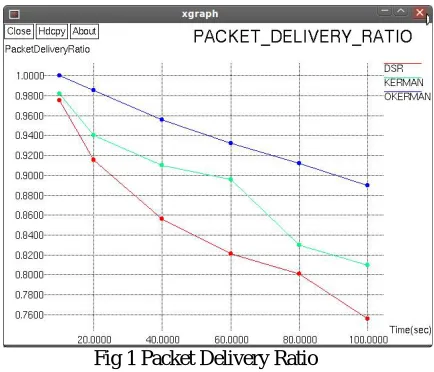
Packet Delivery Ratio is defined as the average of the ratio of the number of packets received by the receiver over the number of packets sent by the source. PDR is comparatively high when compared to the DSR and Kerman.
Delivery Ratio = (Total_packets_received) / (Total_packets_sent) *100
Fig 1 Packet Delivery Ratio
B. END-TO-END DELAY
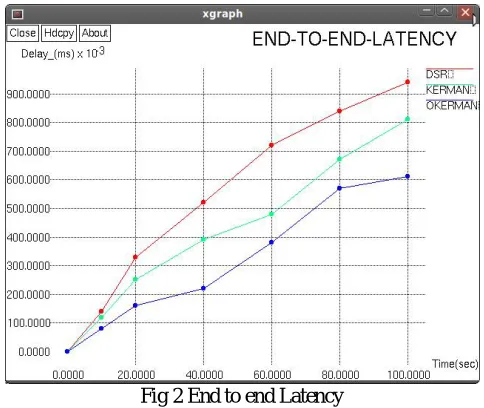
Latency denotes the time delay. It is calculated by dividing total packets delivered in time by the inter arrival of first and second packet. Units (sec or msec).
Fig 2 End to end Latency
C. PACKET RECEIVED
The graph compares the packet received used in OKERMAN transmission is very high compared to proposed method.
Fig 3 Packet Received
D. THROUGHPUT
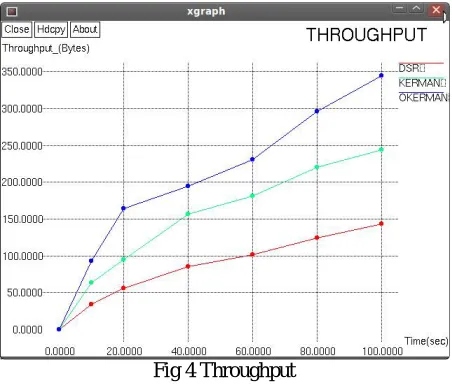
Throughput is the number of useful bits per unit of time forwarded by the network from a certain source address to a certain destination, excluding protocol overhead, and excluding retransmitted data packets. Throughput is the amount of digital data per time unit that is delivered over a physical or logical link, or that is passing through a certain network node.
Fig 4 Throughput
V. CONCLUSION AND FUTURE WORK
Mobile Ad Hoc Networks have the ability to setup networks in a difficult environment where it may not be possible to deploy a traditional network infrastructure. It reduces the number of route reconstruction so as to provide load balancing in the MANET whose topology changes continuously. As a result, by taking network lifetime, and energy consumed into account, the OKERMAN routing algorithm efficiently reduces power consumption of secure randomness packet transmission and prolongs network lifetime. The results of the performance indicate that the proposed scheme is quite adaptive for energy-efficient communication in MANETs. A simulation is done here with the parameters delay, routing energy consumption and throughput with respect to the time taken in the network.
In future, the threshold-based mechanism to assess and vindicate warned nodes as legitimate nodes or not, before recovering them. Certification is a prerequisite to secure network Communications. It is embodied as a data structure in which the public key is bound to an attribute by the digital signature of the issuer, and can be used to verify that a public key belongs to an individual and to prevent tampering and forging in mobile ad hoc networks. Certificate Revocation to consider three stages: accusing, verifying, and notifying. The revocation procedure begins at detecting the presence of attacks from the attacker node. Then, the neighboring node checks the local list BL to match whether this attacker has been found or not. If not, the neighboring node casts the Accusation Packet (AP) to the CA each legitimate neighbor promises to take part in the revocation request against the detected node.
REFERENCES
1. S. Singh, M. Woo, and C. Raghavendra, "Power-Aware Routing in Mobile Ad Hoc Networks," Proc. Mobicom '98 , Oct. 1998. 2. C.Siva Ram Murthy and B.S.Manoj, ‘Ad Hoc Wireless Networks Architectures and Protocols’, PRENTICE HALL, 2004.
3. Priyanka Goyal, Vinti Parmar and Rahul Rishi, “MANET: Vulnerabilities, Challenges, Attacks, Application”, IJCEM International Journal of Computational Engineering & Management, Vol. 11, January 2011.
4. W. Diffie and M. E. Hellman, “New directions in cryptography,” Information Theory, IEEE Transaction on vol. 22, no.6, pp.644-654,1976. 5. B. L. Sun, C.Gui and Y.Song, “Energy Entropy On-Demand Multipath Routing Protocol for Mobile Adhoc networks”, Journal of Network and
Computer Applications, vol.32, no.6, (2009),pp. 1125-1143.
6. Feng, Wei, Elmirghani, Jafar M.H, “Lifetime Evaluation in energy efficient rectangular adhoc wireless networks”, International Journal of Communication System, Vol.23, Issue 12, pp.1632-1650, Dec 2010.
7. Z.T. Chou, M/L. Wu, Lin and R.H. Jan, “Optimal Fully Adaptive Power Management Protocols for IEEE 802.11 Adhoc Wireless LAN’s”, IEEE Int’l Symp. Wireless Comm. Systems, Oct.2008.
8. Rong Zheng and Robin Karvats, “On-demand Power Management for Adhoc Networks”, Journal of Adhoc networks, vol.3, pg: 51-68, ELSEVIER, 2005.
9. Frederic. J. Block, Carl W. Baum, “Information for routing in energy constrained adhoc networks”, ELSEVIER, pp.499-508,2006.
10. Z.T. Chou, M/L. Wu, Lin and R.H. Jan, “Optimal Fully Adaptive Power Management Protocols for IEEE 802.11 Adhoc Wireless LAN’s”, IEEE Int’l Symp. Wireless Comm. Systems, Oct.2008.
12. J.Hakoda , H. Uehara and M.Yokoyama, “Performance study of node-disjoint multipath routing in vehicular MANETs Networks”, IEEE Transactions on Vehicular Technology, vol 58, pages 1942-1950, May 2009.
BIOGRAPHY