EXPRESSION AND STABILITY OF THE MARBLED ALLELE I N MAIZE1
WILLEM H. WEYERS
University of Natal, Pietermaritzburg, Natal, Union of South Africa
Received March 6, 1961
H E pigment-producing action of the R' allele (colored aleurone, red seedling) in maize regularly is reduced among the off spring of heterozygotes carrying an allele, R S t , conditioning stippled aleurone and green seedling (BRINK 1956). The modified forms of R' which arise through such intrachromosomal changes at or near the R locus are heritable. Genetic change of this kind has been termed paramutation (BRINK 1958a). The phenomenon has been demonstrated also in
R' heterozygotes in which another allele, Rmb (marbled aleurone, green seedling) was substituted for stippled (BRINK and WEYERS 1957).
The stippled and marbled factors are of considerable interest as sources of chromosomal determinants involved in these directed genetic changes at the R locus. An account of the stippled gene has been presented by ASHMAN (1960). The present study is concerned with the expression and stability of the marbled allele.
MATERIALS A N D METHODS
The marbled gene employed in these investigations was introduced from a stock originally obtained from R. A. EMERSON into a highly uniform inbred line known as W22. After outcrossing the original Rmb strain to W22, the marbled segregates were backcrossed four or more times to the W22 inbred line, prior to their isolation in homozygous form by selfing.
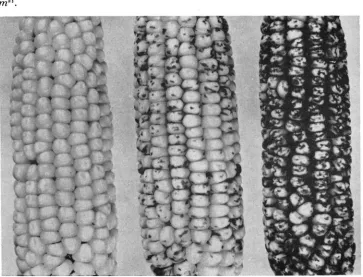
When homozygous, the Rmb allele frequently causes formation in the aleurone of large, irregularly shaped, solidly colored spots on a colorless background. The degree of spotting is proportional to dosage. The scutellum is colorless. Marbled does not produce appreciable amounts of pigment in the vegetative tissues. Seed- lings show traces of anthocyanin in the coleoptiles, but the roots remain colorless when exposed to light. The anthers and glumes on adult RmbRmb plants are green. The otherwise uniform marbled W22 stocks here employed were observed to vary strikingly in amount of aleurone spotting. To determine whether the ob- served variability was genetic, dark, intermediate, and colorless kernels were selected from homozygous marbled ears. Plants grown from these kernels were self-pollinated, and the progeny ears were evaluated for degree of spotting. Repe- tition of this procedure in successive generations resulted i n the isolation of marbled sublines with distinctly different but still variable phenotypes. The families ranged from very light, i n which five percent or less of the homozygous
1 Paper No. 773 from the Department of Genetics, College of Agriculture, University of Wisconsin, Madison, Wisconsin.
1062 W. H. WEYERS
marbled seed was spotted, to very dark, in which nearly all the kernels were extensively pigmented (Figure 1).
To ensure a uniform genetic background, the various W22 marbled sublines were again mated to the standard W22 inbred strain. Pollen from plants belong- ing to the homozygous marbled families was placed on the silks of W22 R'R' individuals. The resulting RmbRr off spring were pollinated by W22 r 9 - P (colorless
aleurone, green plant), and the RmbRmb@ seed was used to evaluate the marbled phenotype.
Aleurone spotting was scored by matching random samples of seed from the central portions of ears against a set of standard kernels. The latter comprised seven specimens, selected in such a way that the sample populations were distrib- uted among eight aleurone color classes. The classes ranged from class one, which was colorless, to class eight, which was almost completely pigmented. Classes between one and eight represent various degrees of marbling.
A test was made to determine whether M n t , a modifier of stippled aleurone, affects the expression of marbled also. According to ASHMAN (1960), the differ- ence between light stippled and standard stippled is due to a modifier located about 5.7 crossover units distal to the R locus. Rst strains carry the modifier ( M n t ) , whereas light stippled lines lack it, thereby representing the null condition ( m a t ) with respect to this locus. The standard W22 inbred line is homozygous met.
b
MARBLED I N MAIZE 1063 Several light and dark marbled families were pollinated with both light and standard stippled. The heterozygous RStRmb plants were pollinated with W22 IQrg
( mst )
,
and the resulting ears were examined for recombinants differing in grade of aleurone spotting.Marbled mutates characteristically to germinally transmissible self-colored aleurone. The mutants occur either as single kernels with self-colored aleurone or, less frequently, as single kernels with marbled o r colorless endosperm but colored scutellum. About one third of the former and all of the latter class of kernels represent germinal mutations to self-color.
Since preliminary observations had suggested that the frequency of self-colored mutants might be greater in dark than in light marbled lines, three very light families (1-5 percent pigmented kernels) and their dark relatives (80 percent or more kernels pigmented) were analysed separately with respect to mutation rate. Homozygous RmbRmb plants were pollinated with W22 rrrr (colorless aleurone, red seedling), and the putative mutants were selected from the resulting Rmbrr
ears. Upon selfing the plants in question, presumed mutants were considered valid only if they segregated both the mutant and rr phenotypes. Loss of supposed mutants through failure of the seed to germinate, or death of the plants, was compensated for by a proportionate adjustment of the total kernel number in computing the mutation rate.
The Rmbrr seed on the ears bearing the mutant kernels was used to evaluate the
aleurone phenotype of each of the marbled lines by the procedure previously explained.
The mutation frequency for one of the sublines also was determined in hetero- zygotes with r r . Rmbrr progeny from the mating RnbRmb 0 x W22 rrrr 8 were polli- nated with W22 rgrg and the presumptive mutants were selected for further testing.
EXPERIMENTAL RESULTS
Variations in aleurone spotting pattern in W22 marbled sublines: The average
aleurone color scores of RmbRmbrg kernels from the mating RrRmb 9 X W22 rgrg 8
are assembled in Table 1. Each score represents a 50-kernel sample taken from the central portion of each ear. Family W189 was obtained by placing pollen of a medium marbled subline on W22 RrRr plants. Its light marbled sib is repre- sented by family W201.
The data in Table 1 show that phenotypic differences between closely related marbled sublines tend to persist when these lines are again backcrossed to the W22 inbred strain. The two sib families are distinct with regard to aleurone phenotype.
Noneffect o n marbled of a modifier of the stippled aleurone pattern: The RmbRst
heterozygotes from the matings RmbRmb 9 x RStRSt 8 invariably yielded some light stippled progeny when pollinated with W22 rgrg. Thus both the light and dark marbled families tested must regularly have carried m s t . Moreover, the RmbMSt
1064 W. H . WEYERS
TABLE 1
Aleurone color scores of RmbRmbrg kernels fosllowing matings of W22 RrRmb 9
x
W22 r W 8Average aleurone Average aleurone
Female Darent color score Female Darent color s c m e
W189- 1 - 2 - 3 - 4 - 5 - 6 - 9 -1 2 -1 3 -14 -16 Mean
1.82 W201- 1 0.48
2.31 - 2 0.14
5.16 - 3 0.87
3.78 - 4 0.22
3.50 - 5 0.74
4.40 - 7 0.06
1.26 - 8 0.16
1.86 - 9 0.30
3.42 -1 1 0.22
3.16 -1 2 0.12
3.44 -13 0.78
3.1 0.37
phenotypically from the Rmhmst segregates on the same ear. These results show that the stippled modifier is not responsible for the phenotypic differences be- tween the various marbled sublines.
Mutation of marbled to self-colored aleurone: The frequencies of mutation to self-color of the Rmh alleles associated with different aleurone phenotypes are presented in Table 2. As can be seen from the table, the light marbled families failed to produce any self-color mutants among 24543 gametes tested. The aver- age mutation frequency to self-color for the corresponding medium and dark marbled lines was 11.0 per IO4 gametes. Thus marbled lines which exhibit exten- sive aleurone spotting also show relatively high frequencies of germinally trans- missible mutations to self-color.
The mutation frequency for one of the sublines (W200) in heterozygotes with r' is given in Table 3. The data show a marked increase in the mutation rate of Rmh when the particular marbled line was made heterozygous with r' ( x 2 = 10.18, P <.01,1 d.f.). This finding is the reverse of that reported for stippled, in which the frequency of RSc (self-color) mutations is greater in homozygotes than in heterozygotes with r' (ASHMAN 1960).
TABLE 2
Frequency of mutation of Rmb to R s c m (self-color) in various W 2 2 RmbRmb sublines
~~ ~ ~ ~ ~ ~~~ ~~
Mean aleurone color No of R'Cm
Subline parent Strain gametes tested mutations 1 0 4 gametes
per
score of marbled No. of
MARBLED I N M A I Z E 1065
TABLE 3
Frequency of mutation to self-colored aleurone in a light marbled family when homozygous and heterozygous with r r
Number
R m b gametes R a C R Number of R S C " mutations
Genotype tested mutants per lo* gametes tested
RmbRmb 14,967 0 0.0
Rmbrr 11,751 8 6.8
DISCUSSION
The main question raised by the present findings concerns the source of the genetic variability in the marbled pattern in W22 stocks. Following the initial outcross of marbled to the standard W22 stock, the marbled segregates were backcrossed four times to the foundation inbred line, prior to recovery of the Rmb factor by self-pollination. During this period, there was no selection for particular marbled phenotypes. Consequently, the W22 marbled line so obtained and the
W22 inbred strain would be expected to be closely similar, except at and in the vicinity of the R locus. Nevertheless, the aleurone spotting density in the re- covered W22 marbled stock subsequently was readily shifted by selection. More- over, the resulting marbled sublines, although distinct with regard to aleurone phenotype, continue to exhibit considerable dispersion for aleurone color index (data of Table 1) when further backcrossed to the W22 inbred strain. Whether the striking diversity of ear phenotypes within the two sublines represents a continuance of genetic variation in the marbled allele itself is a question to which further experiments should provide a n answer.
The data show also that an increase in the amount of aleurone spotting is accompanied by an increase in the rate of mutation to self-color. Conceivably, the formation of a self-colored sector in the aleurone and the production of a transmissible self-colored mutant reflect the same kind of event, namely, the mutation of a colorless allele to a colored form. Differences between the various marbled sublines might then reside in a modifying gene closely linked to the R locus. This modifier could alter the stability of the Rmb allele, or else could change the time during development, when mutations to self-color occur. It is necessary, on this hypothesis, to assume a high rate of mutability of the modifier postulated. An alternative interpretation which excludes the participation of a modifying gene of the conventional kind is more likely. The observed diversity might be due to occurrence of the marbled allele itself in a number of states of unlike stability. Frequent shifts between the various states in germinal and somatic tissues would account for the persistent heterogeneity in Rmb stocks.
1066 W. H. WEYERS
be supposed that Rscm mutants arise through crossing over and that heterozygosity enhances the frequency of this process, such an assumption is clearly incom- patible with the observation that germinal and endosperm mutants occur inde- pendently of each other. Instead, the increased incidence of germinal mutations in Rmbrl' heterozygotes may represent a specific response on the part of the
Rmb
allele to the presence of a particular genetic element in the homologous rr-carry- ing chromosome, or it may reflect a n interaction between a component of the Rmb allele in RmhRmb homozygotes. An operational model of the latter kind is afforded by the variegated pericarp allele in maize. WOOD and BRINK (1956) obtained cogent evidence in this case that the increased frequency of mutation of varie- gated to self-red pericarp in heterozygotes, as compared with homozygotes, was a function of dosage of Modulator, a transposable element which, when present at the P locus, but not elsewhere, suppressed the action of the gene for self-red pericarp.The marbled allele, similarly, may comprise a gene for self-colored aleurone plus an inhibitor at the R locus. The occurrence of stable mutations to self-color is compatible with this idea. Proof is lacking, however, that such mutations and the heritable variations in the marbled allele itself involve shifts in position of a pigmentation inhibitor relative to the gene for self-color.
SUMMARY
The paramutagenic Rmb allele which, by itself, conditions spotted aleurone and green plant in maize fails to give a constant aleurone phenotype when incorpo- rated in a highly uniform inbred strain of corn known as W22.
Attempts to modify the amount of aleurone spotting in W22 marbled (RmhRmh)
plants by selection resulted in the recovery of various marbled sublines differing in degree of aleurone pigmentation. In addition, the rate of mutation to germi- nally transmissible self-colored (Rscm) aleurone was found to be much higher in heavily pigmented marbled sublines than in their lightly spotted and near-color- less relatives. Presumably the formation of a colored spot in the aleurone is due to mutation of a relatively unstable colorless allele to a stable colored form in an endosperm cell. When such a mutation occurs in a cell lineage that includes the egg, then the self-colored allele is transmitted to the off spring.
Since the diversity observed between marbled sublines has its basis at, or in the vicinity of, the R locus, it is suggested that the various marbled phenotypes are controlled by an allele which regularly varies between several states of unlike stability.
LITERATURE CITED
ASHMAN, R. B., 1960 BRINK, R. A., 1956
Stippled aleurone in maize. Genetics 45: 19-34.
A genetic change associated with the R locus in maize which is directed
Paramutation at the R locus in maize. Cold Spring Harbor Symposia Quant. Biol. and potentially reversible. Genetics 41 : 872-889.
MARBLED I N MAIZE 1067
1958b A stable somatic mutation to colorless from variegated pericarp i n maize. Genetics
The relation between light variegated and medium
Invariable genetic change in maize plants heterozy-
Chromosome organization and genic expression. Cold Spring
Controlling elements and the gene. Cold Spring Harbor Symposia Quant. Biol. 21:
Frequency of somatic mutation to self-color in maize plants homozygous and heterozygous for variegated pericarp. Proc. Natl. Acad. Sci. U.S. 42: 514-519.
43: 4 3 5 4 7 .
variegated pericarp i n maize. Genetics 37: 519-544.
gous for marbled aleurone. Proc. Natl. Acad. Sci. U.S. 43: 1053-1060.
Harbor Symposia Quant. Biol. 16: 1 3 4 7 . BRINK, R. A., and R. A. NILAN, 1952
BRINK, R. A., and W. H. WEYERS, 1957
MCCLINTOCK, BARBARA, 1951
1956 197-216.