ANALYSIS OF CENSORED DATA COLLECTED FROM SCREENING EXPERIMENTS PART I - CONSTRUCTION OF BAYESIAN HIGHEST PROBABILITY DENSITY INTERVALS
BAYESIAN ANALYSIS OF CENSORED DATA FROM INDUSTRIAL EXPERIMENTS PART II - PROCESS CHARACTERIZATION AND OPTIMIZATION
by Jye-Chyi Lu
Institute of Statistics Mimeo Series Number 2212 K January, 1992
Jye-Chyi Lv
DATA ANALYSIS OF CENSORED DATA COLLECTED FROM SCREENING EXPERIMENTS
PARTI
BAYESIAN ANALYSIS OF CENSORED FROM INDUSTRIAL EXPERIMENTS
PART 2
MIlYIEO
SERIES #2212R
Analysis of Censored Data Collected From Screening Experiments Part I - Constmetion of Bayesian Highest Probability Density Intervals
Jye-Chyi Lu Department of Statistics North Carolina State University
Raleigh, NC 27695-8203
Key Words - Reliability improvement; Censored data; Data augmentation; Bayesian Inference; Taguchi's method.
Reader Aids
-Purpose: Advance state of the art
Special math needed for explanation: Least squares estimation Special math needed to use results: None
Results useful to: Reliability analysts and statisticians
Summary and Conclusions - Censored data coupled with complexity of the design
1. INTRODUCTION
Modern quality/reliability improvement requires effective application of experimental design methodology to build good quality into products and processes so that repair cost can be minimized and customer satisfaction can be enhanced. Without improving of life-testing procedures to reduce occurrences of censored data, increasing product durability usually makes the data collection more difficult and produces many incomplete observations. See data taken from Specht's [18] heat exchanger experiments listed in Table 1 for an example. Together with the structure of screening experiments commonly used in industries, the incomplete data collected in life tests are difficult to analyze. Most of the analyses, e.g., Hahn, Morgan and Schemee [6] and Hamada and Wu [11] (denoted as HW), rely on the ML method to perform parameter estimation. Hamada and Tse [12] pointed out that there are estimability problems in the maximum likelihood (ML) procedures, where the likelihood surface might be flat in the neighborhood of unbounded ML estimates (MLE) (c.f. HW). In such cases, a Bayesian procedure can be used to analyze such complicated censored data.
[Please place Table 1 here]
Almost all procedures published in quality/reliability improvement studies compare point predictions to select the best combination of factor levels. With such a small sample, e.g. data listed in Table 1, collected from a screening experiment, experimental errors can be so large that the difference of mean predictions at various factor levels becomes s-insignificant. Large sample inference procedures based on asymptotic theory of the MLE might not be valid in this situation. This is particularly important in the case of censoring of which asymptotic confidence intervals are difficult to compute. See Section 4 for details. With Bayesian highest probability density (HPD) intervals developed, one can check the s-significance of model parameters in small sample case and, more importantly, compare various mean responses to select the best combination of process variables which costs the least and is the easiest in
..
implementation and maintenance.
The problem regarding the non-existence of the MLE and the need of small sample inference results motivate the development of Bayesian model selection and parameter estimation proced.ures. However, due to the censoring problem, the joint posterior distribution has no closed form expression and the construction of the marginal posteriors poses a high dimensional integration problem. Recently, Wei and Tanner [21] (denoted as WT) and Gelfand [5] present various applications of the data augmentation (DA) and of the Gibbs sampling procedures to handle difficult statistical problems. The data augmentation algorithm is very easy to use. It imputes censored data to complete sample and utilizes the least squares estimates (LSE) and their normal distributional results to construct posterior densities. The objective of this article is to illustrate the use of WT's procedure to obtain marginal posterior distributions and HPD intervals of model parameters and mean responses with censored data collected from screening experiments. Specht's [18] lifetimes to developing tube wall cracks and the the model (Intercept, E, EG, EH) selected in HW are utilized to illustrate this procedure. Bayesian model-selection procedures will be introduced in a subsequent paper, in which Specht's [18] lifetimes to developing tube corner cracks are analyzed.
Section 2 briefly reviews a few difficulties in the ML estimation and the data augmentation algorithm. Some background of the problem such as Specht's heat exchanger data, the model assumption and other notations are introduced. In Section 3, the DA algorithm is exercised to produce Bayesian HPD intervals of model parameters and mean responses. In Section 4, some difficulties of using the asymptotic theory to formulate confidence intervals are presented along with several proposals of reasonable solutions. The construction of Bayesian prediction intervals and the comparison of mean responses are studied in Section 5.
Notation & Definitions
4
...
(a, b)
f3
'"
X
'"
¢>(z), <p(z)
giC! )
p(!
Ii,)
p(!
I
J!!(i),1,)
x ~f3 .
' " I " , I
interval censored data
a vector of parameters for important effects design matrix of selected variables
the standard s-normal pdf and cdf, respectively prior probability density
posterior probability density
posterior density constructed from pseudo-complete samples mean response at the ith run
least squares estimates of f3 , (72respectively
'"
maximum likelihood estimates of f3 , (72respectively
'"
Other standard notations are given in "Information for Readers & Authors" at the rear of each issue.
2. BACKGROUND OF THE PROBLEM AND LITERATURE REVIEW
Silvapulle and Burridge [17] and Hamada and Tse [7, 12] gave details about the estimability problems in the MLE addressed in Section 1. Hamada andTse [10] developed a MLECHK program based on a linear programming algorithm to check whether the MLE exists. Our experience (c.f. Lu and Unal [14]) indicates that even when the MLE exists, in some situations, the likelihood can be the same for many combinations of parameter values, which makes the search for the MLE very difficult. Thus LIFEREG shows an unconvergence message.
5
methods, C, E, and four product design variables, B, D, G, and H are considered in Specht's [18] experiment of heat exchangers.
Following Hama'da and Wu's [11] study, the censored "wall" data is transformed (c.f. Box and Cox [1]) with A= -1, and the random sample h(y) is assumed to have a linear model with normal error:
h(y)
=
X{3+
(1'f. with f. -- N(O, 1),----
(1)where {3 is the vector of important factor-effects and X is the corresponding matrix of
--
--explanatory variables, including the main effects and interactions. Interval data is represented by (a, b) and b is equal to 00 ifthe data is right-censored. See Lu and Unal
[14] for details about transformation and the associated likelihood. The MLE exists in the model with all ten main effects and the model (Intercept, E, EG, EH) selected by HW. However, the MLE's do not exist in some models such as (Intercept, E, D, CD, J, CJ) constructed based on censored contrasts (c.f. Lu and Unal [14]).
In Bayesian approach, with a slight abuse of the notation, the parameters ({3, (1'2)
--are all random variables. In the case of no censoring, the posterior density of ({3 , (1'2)
--can be factored into a product of the marginal posterior density of (1'2 and the
conditional marginal density of {3 given (1'2. For complete normal sample, under the
--noninformative prior, it is well known (c.f. Box and Tiao [2]) that the marginal posterior distribution of (1'2 is that of the random variable (n - p)q
2/
x
(n_p)' whereq 2 isthe least squares (LS) estimator of (1'2 and x~ is a chi-square random variable with 1.1 degree of freedom (d.f.), and p = number of regression parameters including the intercept. The conditional marginal posterior distribution of {3 is a conditional
p-
--variate normal distribution Np
{£
I
(1'2). In the case of censoring, the joint posteriordistribution has no closed form expression and the construction of the marginal posteriors poses a high dimensional integration problem.
The idea of solving the incomplete data problem by imputing pseudo-complete
".
samples is commonly used in reliability (c.f. Wei and Tanner [21]) and biostatistics studies (c.f. Dempster, Laird and Rubin [3]). Define fL
=
(! '
002),1
=
(t1, t2, ..., tn ),and ti = h(yJ Wei and Tanner's [21] data augmentation procedure is introduced in details as follows:
Given the current approximation 9i(JL) to the posterior p(fL
11),
A. Generate a fL from 9i(JL) by
1. generating a random sample of00
2
from the distribution of (n - p)u2/
x7n_
p)'2. generating a corresponding random sample off3 with the conditional
""
p-variate normal distribution
NP(!
1002),B. Generate the latent data (imputation) '!!J(j) = [w{i),
u/J), ...,
whi)] fromp('!!J
Ii, 1),
by drawing random samples from the truncated normal distribution,6
(1.2)
I
where
e
IS the value generated in part A, (ai, bi) is the transformed""
censored/grouped datum. We repeat the steps A and B for j
=
1, 2, ..., m times to obtain a set of latent data'!!J(1), '!!1(2), ..., '!!J(m), and m = 100 is the usual selectedsimulation size.
c.
The current approximation to p(fL11)
is updated to be the mixture of augmented posteriors offL; that is 9i+l(!) = (l/m)i~lP(fLI
'!!J(i),1),
where p(fL
I
J!J(j),1)
is the normal posterior constructed from the pseudo-complete samples.D. Iterate Steps A, B and C until the convergence of posterior distribution, for which various percentiles of marginal posterior distributions are monitored to check the convergence.
as described in Lu and Unal [14] to do a better imputation of the censored data. With a good initial approximation, the data augmentation procedure will converge faster,
7
especially in cases which require a lot of computation time.
3. AN EXAMPLE FOR THE DATA AUGMENTATION PROCEDURE
o
'c.
Fixing the model as (Intercept, E, EG, EH) suggested by HW, we run 30 iterations of the aforementioned data augmentation procedure (Steps A to C) to study posterior distributions of the model parameters and the mean responses. The convergence is monitored by the 5th, 10th, 25th, 50th, 75th, 90th, 95th, mean and standard deviation (s.d.) of the posterior distributions. All simulations are done in Sun Spare station SLC with various S-PLUS [19] programs. The computing time needed in this example is 30 minutes in one iteration. In Figure 1, we plot the 5th, mean and 95th percentiles of the marginal posterior distributions across iterations to show the convergence of the parameter estimation. The s.d. of the simulated random variables of
u2 is also included and shows that it is fluctuated between 3.2e-09 and 5.ge-09 after the 5th iteration.
[ Please place Figure 1 here]
To see the shape of the marginal posterior distributions, we plot their histograms in Figure 1 by pooling the estimates in iterations 26 - 30 together as suggested in WT and impose smoothed densities on the top of histograms. All these plots are done in S-PLUS programs. Some of the histograms of regression parameters
P
are slightly"'"
skewed. The summary statistics such as mean, s.d., coefficients of skewness (c.s.),
7f.
3/(s.d.)3, and kurtosis (c.k.),7f.
4/(s.d.)4 - 3, where7f.
r is the sample rth centralmoments, of these random samples of (Po,
PE' PEG' PEH, (
2) are calculated, respectively,
..
-HPD intervals are obtained by picking up the shortest intervals from all intervals around (2.5th-tile, 97.5th-tile), which contains 95% of posterior parameter estimates in the interval. The results are listed in the bottom of Table 2. Since none of the 95% HPD intervals of regression parameters include zero, the regression coefficients are all different to zero statistically at the 5% s-significance level. The ML estimates of 130 and
13E are larger than the corresponding upper bound of 95% HPD intervals. The MLE of
13EG' 13EHand q2 are inside the HPD intervals.
[ Please place Table 2 here]
Hamada and Wu's concluded that E
=
-1, G=
-1, H=
+1 are the optimal levels ~ ~Pt of the s-significant factors. To obtain the forecasting posterior distribution, we generate totally 2500 random samples with 5 observations each from N(~ ~pt ~ pi' q;i)and plot its histogram in Figure 1, where ~ pi' q;i' j
=
1, 2, ..., 500 are the parameters in the posterior distribution pooled from the last five iterations as described above. The corresponding summary statistics are computed as (0.99315, 9.88642e-05, 0.041, 0.679). The simulation error is studied by repeating the routine 5 times. The s.d. of summary statistics from these simulations are calculated as follows: s.d.(mean) = 1.6e-06, s.d.(s.d.)=
6.8e-07, s.d.(c.s.)=
0.091, s.d.(c.k.)=
0.250. The forecasting posterior density is rather symmetric and is a little bit more peaked around its center than the normal density. Because the forecasting density can be approximated well by the normal density, testing the difference of predictions at various design points becomes much easier.The Bayes estimator of the lifetime at the E.1G.1HH is 0.99315 and 146.03 in the transformed and original scales, respectively, which is very close to the ML estimates 146.28 (.99316 in the transformed scale). The 95% HPD interval of the mean response at ~ ~pt is found to be (0.99296, 0.99335)
[=
(142.04, 150.42) in the original scale]. The same routine was repeated 5 times to investigate the s.d. (in the original scale) of the calculated Bayes estimates and end-points of HPD intervals. The results are given ast.
follows: s.d.(mean response at~ ~Pt)
=
0.03, s.d.(lower bound of HPD intervals) = 0.24,s.d.(upper bound)
=
0.27.4. CONSTRUCTION OF THE CLASSICAL CONFIDENCE INTERVALS
In this section, confidence intervals based on the asymptotic theory of the MLE
are constructed to compare with the Bayesian HPD intervals. The asymptotic
normality of n1/2
(e -
~), where ~ = (Po, PE' PEG' PEH' 0'2) can be established by"" "" ""
modifying the asymptotics given in Lawless (1982, page 314-316) for the
interval-censored data case. Its estimated variance-covariance matrix}5 can be obtained from
'"
inverting the observed information matrix
1
= [ -82IogL/(8f3,of3J:)]e ' where j, k=
0, E, EG, EH, and
e
is the MLE of~.
The components of1
""are of the form"" ""
n
(J'-2i"!21 XijXi.0(Zi) , where A(zD = v.e(zD - W(zD and V(z) = [<P(ZR) - <P(ZL)]/[<I>(ZR)
- <I>(ZL)] , W(z)
=
[ZR<P(ZR) - ZL<P(ZL)]/[<I>(ZR) - <I>(zL)]' and Ziw=
~ ~f3 )/(J' for w ='"
aor bin the transformed censored data (a, b). The observed information matrix
1
isprovided in Table 3. Note that because the contribution from the censored data, the
off-diagonal terms are not equal to zero, which is different to the case of complete
sample with orthogonal design matrices.. Moreover, since the sizes of the elements lO(EH)
and lE(EG) are equal to the diagonal terms, the matrix
1
is a singular matrix. To getthe variance-covariance matrix ~ , one needs to compute the generalized-inverse matrix
off"'tt.,Jj , e.g.,/"'oJj }5 j = j. Our matrix}5 is obtained from applying the command "ginv"
f"'oJf"'oJ f"."J f"'oJ
in SAS (1991) to the information matrix. Table 3 shows an example of the g-inverse of
14
x4
matrix for regression coefficientsP/s.
Note that the diagonal elements can benegative, which introduces difficulty in using them to construct large sample confidence
intervals. The g-inverse of the
15
x5
matrix forP
/s and 0'2 does not give a reasonableresult as well. This demonstrates the difficulty and possible inadequacy for using
inference procedures based on the asymptotic theory of the MLE with the censored data
collected from screening experiments.
01.
[ Please place Table 3 here]
To get a reasonable solution for this problem, we first ignore the off-diagonal elements (just like the case in the complete sample) and get the estimated variance of [3/s as
up
=
(1.02e-04)2/2.54655=
4.08553e-09. Hence, 95% large sample confidence intervals of regression coefficients are given as?ii
± 1.96 x (4.08553e-09)1/2 and the results are listed in the bottom of Table 2. We call this procedure Method A for ease of reference. Compared to the 95% HPD intervals, these large sample· intervals are slightly wider. Using the delta method (transformation), we obtain the limiting distribution of n1/t(Y
z - yz) for the mean response yz at ~ ~pt = E_1G_1H+l as normalwith mean zero and (estimated) variance 1.27836e-04. A 95% confidence interval is then constructed as (0.99291, 0.99341) and (141.11, 151.85) in the transformed and original scales, respectively. This confidence interval is slighter wider compared to the 95% HPD interval (142.03, 150.42).
The confidence intervals constructed above ignored the off-diagonal elements in the observed Fisher information matrix entirely. In Method B, if one takes the variances of the
?ii's
from the diagonal of the g-inverse of the information matrix15
x5
(see the last matrix in Table 3) and constructed their 95% large sample confidence intervals. The intervals (.89255, 1.07680), ( - 4.39505e-03, - 4.10895e-03); (2.16195e-03, 2.44805e-03) and ( - 9.40501e-02, 9.01961e-02) will be much wider than the corresponding HPD intervals, especially the last interval for [3EH' which shows the s-insignificance of [3EH at 5% level. The 95% confidence interval of mean response at~ ~Ptis computed as (.80891,1.17741), which leads to a very wide interval (5.23321, 00) in the original scale. The other consideration (Method C) is to take the absolute values of the diagonal elements of the g-inverse matrix of
14
x4
(only [3's) and construct large sample confidence intervals as follows: (0.98446,0.98490), (-4.47515e-03, -4.02885e-03), ( - 2.15015e-03, -1.70385e-03) and (2.08185e-03, 2.52815e-03) for ([30' [3E' [3EG' [3EH)' respectively, and (137.66, 156.06) for mean response at the process recipe.,..
Finally, in Method D, based on HW's ML estimates, the censored data can be imputed at its conditional mean,
E[h(y) lYE (a, b)] = ~ ~!!.j
+
O'[¢(za) - ¢(Zb)]f[~(Zb) - ~(za)]'to formulate complete samples for using t-distribution to make (finite sample) inferences. The data imputed are given as follows:
94.2175, 52.0861, 146.1775, 65.1673, 65.3381, 41.8573, 65.1678, 50.1128, 87.3286, 87.3286, 92.7945, 42.1444.
Based on this imputed data, the least squares estimates of f3o, f3E' f3EG' f3EH and (J"2 are
given as 0.98468, - 4.252e-03, 2.305e-03, -1.927e-03 and 3.6e-09, respectively, with R-square = 0.9627. Note that the estimate of variance is compatible. to its Bayes estimate 7.09693e-09. The mean response Y:c at E_1G.1H+l is estimated as 146.18 (.99315 in the transformed scale), which is very close to the ML and is exactly the same as Bayes estimate given in Section 3. Using the estimated s.d. of prediction 4.24264e-05 and the
t
distribution with 8 degrees of freedom, we obtain a 95% confidence interval ofY:c as (144.22, 148.41). This interval is slightly shorter than the Bayesian HPD interval. In summary, because the difficulty of inverting the observed Fisher Information matrix to get the covariance matrix of model parameters, three solutions of large sample confidence. intervals are constructed along with the t-interval established from imputed pseudo-complete samples. The sizes of the intervals constructed from these methods are ordered as follows:
Method B > > Method C > Method A > Bayesian HPD > Method D.
In the construction of large sample confidence intervals, Method A gives compatible results compared to Bayesian HPD intervals and it is more reasonable to ignore the off-diagonal elements in information matrix than changing the signs of variances in the g-inverse matrix
f:
in Method B or C. In next section, intervals constructed from bothf'J
the Bayesian HPD method and Method A are used to compare mean responses at
'"
various different design points to see if the optimal factor-level is really the best under the consideration of experimental errors.
5. COMPARISON OF MEAN RESPONSES
In this section, prediction intervals of 8 combinations of controllable variables E, G, and H are reported first. Comparisons of differences of mean responses are conducted. Table 4 reports the point and interval estimation of these mean responses along with their simulation errors given in parentheses. Note that these predictions are all well inside the intervals of the original grouped data. For example, in No.2, the Bayes and ML estimates, 49.75 and 50.13, are inside the data interval (42.0, 56.5). There are two design points in No. 1 and the original data are (82.0, 93.5) and (93.5, 105). Our predictions 93.23 and 93.55 are well located in the boundary of these two data intervals.
[ Please place Table 4 here]
The longest two lifetimes in this experiment are the (93.5, 105) and (128, 00)
given in No. 1 and No.5 of Table 4. The point and interval estimates of mean responses at these two design points are very far apart. Hence, one expects that the process recipe, E( -1), G( -1) and H(
+
1) (in No.5), will be the best considering the experimental errors. However, what about the second and third longest lifetimes given in No.1 and No. 7? The data are coincided and their predictions are close, too. In practice, it is possible that in some circumstances, the data intervals are close (or the same) for two of the best design considerations. In that case, one does like to check if there is a real (statistical) difference between them. If there is no difference of using either one of these two design combinations statistically, one can choose the one which costs less and is easier to be implemented and maintained. Next, procedures of using Bayesian forecasting densities and large sample distributions to compare difference of mean response are presented. Several examples are given from comparisons of the".
second (No.1) to the third (No.7), and the forth (No.3) to the fifth (No.4) best lifetime predictions. They all have the same data intervals in pairs.
Note that the interval estimates of No.1 and No.7 are not overlapped, but the intervals of No.3 and No.4 are touched. Testing hypothesis procedure based on the Bayesian forecasting densities is presented first. Since the forecasting density is a mixture of many, say m
=
500, normal distributions, one can expect that it could be approximated well by the normal distribution. The empirical moments of the forecasting density given in Section 3 verifies this conjecture. The mean and s.d. of the empirical moments of the forecasting densities at all 8 combinations of controllable variables are provided in Table 5 for checking. From Table 5, one can see that the normal distribution serve as a good approximation to the forecasting densities. The kurtosis might be a little bit bigger than normal's, which indicates that, around the center of the distribution, the density is more peak than the one in normal.[ Please place Table 5 here]
Since the mean responses such as Pl and P7 are computed from the same model parameters, they are not independent. To study if there is a statistical difference between Pl and P7' one can construct a.95% HPD interval of 017= Pl - P7 from the posterior density of 017, If the 95% HPD interval does not include zero, one concludes that the mean responses Pl and P7 are different s-significantly at 5% level. The posterior density of 0ij= Pi - Pj can be generated from the augmented joint posterior
density of model parameters. In our study, we generate 2500 samples of each 0ij for
three pair differences (i = 1, j = 7), (3, 4) and (1, 5). Their corresponding 95% HPD intervals are found as (4.197e-04, 9.577e-04), (-6.855e-05, 5.283e-04) and (-4.114e-03, - 3.617e-03), respectively. Hence, we conclude that P3 and P./. are the same statistically at 5% level and others are different s-significantly. Transforming the simulated mean responses to the original scales and considering their differences, the 95% HPD intervals of the aforementioned mean differences are computed as (3.571, 7.939), (- 0.283, 2.175)
...
and (-57.273, -48.766), respectively. Same conclusions are reached here and the size of these intervals match the paired-difference of the mean responses given in Table 4 and 5.
In the classical ML approach, the variance of the estimated mean responses is ~Gov(p )Xi and the estimated covariance matrix of the regression coefficients are
""
provided in Table 3 (see discussions in Section 4). Similarly, the covariance of two estimated mean responses 'Oi and 'OJ is ~ Gov(~ )Xj. Since the sizes of confidence intervals (C.l.) of mean prediction in Method A of Section 4 are more comparable to the corresponding Bayesian HPD intervals, the following C.l. 's of mean differences are constructed by using Method A. The 95% C.I.'s of mean differences (1, 7), (3, 4), (1, 5) are obtained from normal approximation as (4.017e-04, 1.110e-03), ( - 3.922e-04, 4.720e-04) and (-4.104e-03, - 3.603e-03), respectively. Compared to the 95% HPD intervals given above, the C.l. of 917 is slightly wider than the corresponding Bayesian HPD interval. The other two intervals are comparable to HPD intervals but are shifted to the left (smaller values).
REFERENCES
[1] Box, G. E. P.,. and Cox, D. R. (1964), "An analysis of Transformations" (with discussion), Journal of the Royal Statistical Society, Ser. B, 26, 211-252.
[2] Box, G. E. P., and Tiao, G. C. (1973), Bayesian Inference For Statistical Analysis, Addison-Wesley, Reading, MA.
[3] Dempster, A. P., Laird, N. M., and Rubin, D. B. (1977), "Maximum Likelihood From Incomplete Data Via the EM Algorithm" (with discussion), Journal of the Royal Statistical Society, Series B, 39, 1-38.
[4] Geisser, S. (1975), "The Predictive Sample Reuse Method with Applications," Journal of the American Statistical Association, 70, 320-328.
[5] Gelfand, A. E. and Smith, A. F. M. (1990), "Sampling Based Approaches to Calculating Marginal Densities," Journal of the American Statistical Association, 85, 398-409.
[6] Hahn, G. J., Morgan, G. B., and Schemee, J. (1981), "The Analysis of A Fractional Factorial Experiment With Censored Data Using Iterative Least Squares,"
Technometrics, 23, 33-36.
[7] Hamada, M., and Tse, S. K. (1988), "A Note on the Existence of Maximum Likelihood Estimates in Linear Regression Models Using Interval-Censored Data," Journal of the Royal Statistical Society, Ser. B, 50, 293-296.
[8] Hamada, M., and Tse, S. K. (1989), "When Do Estimates Exist From Censored Data in Industrial Experiments?" Research Report 89-03, University of Waterloo, Institute for Improvement in Quality and Productivity.
[10] Hamada, M., and Tse, S. K. (1989), "MLECHK: A FORTRAN Program for Checking The Existence of Maximum Likelihood Estimates From Censored, Grouped, Ordinal and Binary data from Designed Experiments," Research Report 89-09, University of Waterloo, Institute for Improvement in Quality and
Productivity.
[11] Hamada, M., and Wu, C. F. J. (1991), "Analysis of Censored Data From Highly Fractionated Experiments," Technometrics, 33, 25-38.
[12] Hamada, M., and Tse, S. K. (1992), "On Estimability Problems In Industrial Experiments With Censored Data," Statistical Sinica, 2(2), 381-392.
[13] Lawless, J. F. (1982), Statistical Models and Methods for Lifetime Data, NY: Wiley.
[14] Lu, J. C. and Unal C. (1992), "Process Characterization and Optimization Based On Censored Data From Highly Fractionated Experiments," manuscript revised for IEEE Trans. on Reliability.
..
[15] Powell, M. J. D. (1964), "An Efficient Method for Finding the Minimum of a Function of Several Variables Without Calculating Derivatives," Computer Journal, 7, 155-162.
[16] SAS (1991), a statistical software package marketed by SAS Institute Inc., SAS Campus Drive, Cary, NC 27513 (version 6).
[17] Silvapulle, M. J. and Burridge, J. (1984), "Existence of Maximum Likelihood Estimates in Regression Models for Grouped and Ungrouped Data," Journal of the Royal Statistical Society, Ser. B, 46, 100-106.
[18] Specht, N. (1985), "Heat Exchanger Product Design via Taguchi Methods," in Third Symposium on Taguchi Methods, Romulus, MI: American Supplier Institute, Inc., pp. 302-318.
[19] S-PLUS (1991), a software developed originally by AT&T and now marketed by Statistical Sciences, Inc., Seattle, WA, USA.
[20] Taguchi, G. (1987), System of Experimental Design, White Plains, NY: Unipub/Kraus International.
[21] Wei, G. C. F., and Tanner, M. A. (1990), "Posterior Computations for Censored Regression Data," Journal of the American Statistical Association, 85; 829-839.
/'
,.
..
./". \' 'v'/ '\ :lv
J .I ~ : .. ~:
.
• I I I I :t: ~, ~ a; q.
....~
IIII
s' 0 .z. : .. 'O.
"
!
!
lU,
!
i
qf
d :
0, .
1lI ~ •
~ I ~ o •
!
i\
~i
i
o.
o 5 10 15 20
llorallona
25 5 10 15 20
IloraUons
25 5 10 15 20 ltora~
25 5 10 15 20 25
ItoraUono .0.0044 .0.0043 801a_E .0.0044 o i !il f! ~ 8
0.98450 0.98455 0.98460 0.98465 0.98470 80"_0 o i !il l! ~ 8 25 10 15 20
ItoraUons 5 o ::l ~ -~ ~ '" .... '" ~..t
i
t/) ..~:a.-t/) on
oj
25 10 15 20
IteraUons 5 o
·
..·
·
'".
-
;/"/, ."J' ,
.
\1
"
.
_ .
r'\
f'''
\
!\ :
~
.
.
~ .~'.
~
. I • • \"l-II
~
, \ ••..
'.
.
.
.s. : '/ :
t/):~:
"'.·
·
.
.
.
...
'".
"~
, • • • i
0.9928 0.9930 0.9932 0.9934 0.9938
Proclcdon o ~ §
I
§ o ~ ~,-- • • , I
o 10 20 30 40
SllJIIll2"(10"9) ~ o & ~ ~ ~
I
g o lilI ---.- I I I
00.0020 -0.0020 00.0019 -0.0019 00.0019
BOla_EH §! !il o g g
I
o ~ 0.00230 0.00235 BOll\...EG g g !il II § ~ oTable 1. Design and Data for the Heat Exchanger Experiment
Factor
Run F B A C D E G H J K Time to Failure
1 1 1 1 1 1 1 1 1 1 1 93.5,105)
2 1 1 1 1 1 2 2 2 2 2 42,56.5)
3 1 1 2 2 2 1 1 2 2 2 128,00)
4 1 2 1 2 2 2 2 1 1 2 56.5,71~
5 1 2 2 1 2 1 2 1 2 1 56.5,71
6 1 2 2 2 1 2 1 2 1 1 0,42)
". 7 2 1 2 2 1 2 2 1 2 1 56.5,71
8 2 1 2 1 2 2 1 1 1 2 42,56.6
9 2 1 1 2 2 1 2 2 1 1 82,93.5
10 2 2 2 1 1 1 2 2 1 2 82,93.5
11 2 2 1 2 1 1 1 1 2 2 82,93.5
Table 2. Summary Statistics of the Posterior Parameter Estimates
130
f3E
13EG
13EH
()"2MLE# 0.98468 -4.252e-03 2.305e-03 -1.927e-03 1.040e-08 mean 0.98459 -4.34008e-03 2.2856ge-03 -1.93731e-03 7.09693e-09 s.d. 3.043e-05 2.707e-05 2.506e-05 2.527e-05 4.215e-09
skewness 6.4e-02 -7.6e-02 8.6e-02 1.8e-02
kurtosis 9.0e-02 1.2e-01 2.4e-01 1.1
95%HPDL* 0.98453 -4.38710e-03 2.24054e-03 -1.97916e-03 2.05107e-09
".
95%HPDU 0.98465 -4.28186e-03 2.33528e-03 -1.88171e-03 1.46568e-08 95%LS1L$ 0.98455 -4.37728e-03 2.17972e-03 -2.05228e-03
95%LS1U 0.98480 -4.12672e-03 2.43028e-03 -1.80172e-03 *: lower and upper bounds of the 95% highest probability density intervals. #: maximum likelihood estimates given by Hamada and Wu (1991).
Table 3. Observed Fisher Information Matrix and Its Generalized Inverse
Fisher Information Matrix (multiplied by 172
=
1.0404e - 08):2.54655e
+
005.59418e - 05 - 5.59417e - 05
2.54655e
+
00-1.77498e - 02
5.59418e - 05
2.54655e
+
00- 2.54655e
+
005.59417e - 05 - 8.40445e - 03
- 5.59417e - 05
- 2.54655e
+
002.54655e
+
00- 5.59418e - 05 8.40445e - 03
2.54655e
+
005.59417e - 05 - 5.59417e - 05
2.54655e
+
00-1.77498e - 02
-1.77498e - 02 - 8.40445e - 03 8.40445e - 03 -1.77498e - 02 3.78647e - 05
Generalized Inverse Matrix (for
f3
's only):1.2962ge - 08
1.30050e
+
021.30050e
+
02- 1.09201e - 08
1.30050e
+
02- 1.09201e - 08 -1.29628e - 08
- 1.30050e
+
021.30050e
+
02- 1.29628e - 08 -1.09201e - 08
- 1.30050e
+
02- 1.09201e - 08
- 1.30050e
+
02- 1.30050e
+
021.2962ge - 08
Generalized Inverse Matrix (for
f3
's and (12):2.12167e - 03
1.30050e
+
021.30050e
+
02- 2.12167e - 03 - 3.19206e - 07
1.30050e
+
025.11608e - 09 3.57205e - 09
- 1.30050e
+
02-1.51137e - 07
1.30050e
+
023.57211e - 09 5.11606e - 09
- 1.30050e
+
021.51137e - 07
- 2.12167e - 03
- 1.30050e
+
02- 1.30050e
+
022.17167e - 03 - 3.19206e - 07
Table
4.
Bayes and ML Point and Interval Predictions for Various Combinations of E, G, H VariablesNo. E G H Bayes MLE HPDL* HPDU LSL# LSU Data
1 -1(0) -1 -1 93.23 93.55 91.58 94.94 91.40 95.79 (82.0 ,93.5)(1)
(0.02) (0.05) (0.04)
2 1 -1 -1 49.75 50.13 49.23 50.25 49.50 50.76 (42.0, 56.5)
.-
(0.002) (0.02) (0.03)3 -1 1 -1 65.39 65.36 64.53 66.19 64.31 66.45 (56.5, 71.0)
(0.01) (0.03) (0.03)
4 1 1 -1 64.41 65.19 63.60 65.26 64.14 66.27 (56.5, 71.0)(2) (0.004) (0.03) (0.05)
5 -1 -1 1 146.05 146.28 141.90 150.48 141.11 151.85 (128.0, 00)
(0.03) (0.24) (0.27)
6 1 -1 1 41.71 42.01 41.38 42.09 41.57 42.46 (0.0, 42.0)(3) (0.003) (0.02) (0.02)
7 -1 1 1 87.55 87.37 86.14 89.11 85.50 89.32 (82.0, 93.5)(4)
(0.01) (0.05) (0.08)
8 1 1 1 51.53 52.10 51.05 52.14 51.43 52.79 (42.0, 56.5) (0.005) (0.03) (0.04)
*: lower and upper bounds of the 95% highest probability density intervals.
#:
lower and upper bounds of the 95% large sample confidence intervals constructed from Method A.~o~: Level -1 and +1 are 1 and 2 in Table 1, respectively.
1 : There are two data, (93.5, 105) and (82.0, 93.5) given from Run 1 and 11 (see Table 1), respectively.
tl'
Both two data given from Run 4 and 7 are the same.Table 5. Empirical Moments of the Simulated Bayesian Forcasting Densities
No. E G H MEAN S.D. C.S.# C.K.*
1 -1 -1 -1 0.98928 9.746e-05 -0.0209 0.977
(1.76e-06)$ (1.282e-07) 0.0396 0.072
2 1 -1 -1 0.97990 10.022e-05 0.0116 0.902
(0.7ge-06) (22.235e-07) 0.0798 0.122
3 -1 1 -1 0.98471 9.646e-05 -0.0193 0.750
(2.75e-06) (6.352e-07) 0.0863 0.179
4 1 1 1 0.98447 1O.503e-05 -0.0283 0.523
(1.10e-06) (15.978e-07) 0.0505 0.239
5 -1 -1 1 0.99315 9.983e-05 0.0723 1.015
(1.56e-06) (6.806e-07) 0.0998 0.250
6 1 -1 1 0.97603 9.980e-05 0.0051 0.563
(1.58e-06) (8.194e-07) 0.0065 0.043
7 -1 1 1 0.98858 9.946e-05 0.1038 1.090
(1.18e-06) (8.267e-07) 0.0430 0.133
8 1 1 1 0.98060 10.107e-05 0.0371 0.712
(1.86e-06) (2.553e-07) 0.1178 0.125
#:
c.s. is the coefficient of skewness, 71. 3/(s.d.)3, where 71.r is the sample rth centralmoments.
*: c.k. is the coefficient of kurtosis,71. 4/ (s.d.)4 - 3.
.-Bayesian Analyses of Censored Data From Industrial Experiments Part II - Process Characterization and Optimization
Jye-Chyi Lu and Cemal Unal Department of Statistics North Carolina State University
Raleigh, NC 27695-8203
Key Words - Reliability Improvement; Censored data; Data augmentation;
Bayesian Inference; Model selection.
Reader Aids
-Purpose: Advance the state of the art
Special math needed for the explanations: Basic Statistics Special math needed to use the results: none
Results useful to: Reliability analysts and statisticians
aN
1.INTRODUCTION
Taguchi [29] promotes the use of experimentation to enhance product reliability. However, in dealing with the censored data resulted from highly fractionated industrial experiments, his minute accumulating analysis (MAA) can reverse the order of factor importance (c.f. Hamada [10]). Hahn, Morgan and Schmee [9], Hamada and Wu [15] (denoted as HW) and Lu and Unal [22] utilized the classical maximum likelihood estimation (MLE) and forward (or stepwise) model selection methods to analyze censored data from industrial experiments. Because the estimability problem (c.f. Hamada and Tse [11, 12]) in the maximum likelihood (ML) approach, the aforementioned methods do not work in the cases where the MLE does not exist. In such cases, Bayesian procedures serve as good alternatives to handle the complicated censored data.
If the data are not censored, there is a closed form Bayesian posterior distribution of the model parameter. Box and Meyer's [3] Bayes plot is an useful tool to identify important effects. For characterizing reliability measurements of production systems (see Section 3.4 for details), one can apply Bayesian model selection procedures, such as the predictive sample reuse (PSR) technique developed by Geisser [7], to compare different models. In the case of censoring, no closed form posterior density is available. One can use Wei and Tanner's [30] (denoted as WT) data augmentation (DA) or Gelfand's [8] Gibbs sampling procedures to by-pass the high dimensional integration problem to simulate posterior densities and obtain Bayes estimates.
However, Geisser's PSR is similar to an all-subset regression, which requires the Bayes estimates from all candidates models. In industrial experiments, such as the one listed in Table 1, the number of candidate models can be too many for using DA or Gibbs sampling procedures to compute all Bayes estimates. We propose to integrate a forward (or stepwise) model selection procedure together with the DA algorithm for
.-1I.
building characterization models and computing parameter estimates simultaneously.
Our method utilizes the existing software and is suitable for practitioners' use when the
ML approach does not work.
Since sample SIzes In industrial experiments are usually small, inference
procedures based on asymptotic theory of the MLE might not be meaningful. As
pointed out in Lu [20] that the decision of the best combination of process variables
should include the consideration of experimental errors. It is possible that the
difference between the best process recipe and some other good candidates might be
s-insignificant considering the estimation errors. In this case, a proce~s recipe with
cheaper cost can be selected instead. In this article; our objective is show that the
existing least squares and stepwise regression methods can be utilized to model such
complicated data as listed in Table 1. Moreover, marginal posterior distributions of
model parameters and mean responses are obtained for making finite sample inferences
and selecting process recipes. Our method is illustrated with analyses of Specht's [28]
heat exchanger lifetime data.
Section 2 briefly reviews the data, the model and our model selection procedure.
In Section 3, WT's DA algorithm is modified to accommodate the model selection
procedure. Section 4 presents several examples to illustrate the proposed Bayesian
process characterization and optimization procedure. Section 5 addresses sensitivities of
using different starting pseudo-complete samples and initial models in. our Bayesian
approach.
Notation
3
x
"""
w(j)
"""
vector of important factors
matrix of explanatory variables
Np p-variate normal distribution Pr(q2
U.)
marginal posterior density of q2Pr(.8,....
I
q2,,....t )
conditional marginal posterior density of .8 given,.... q2 Pr(~, q211)
joint posterior density of (.8 ,,.... (2)s.d. standard deviation
c.s. coefficients of skewness
=
7t
3/(s.d.)3.
-c.k. coefficients of kurtosis
=
7t
4/(s.d.)4 - 3 ,....the sample rth central moments
JJ r
Other standard notations are given in "Information for Readers & Authors" at the rear of each issue.
2. BACKGROUND OF THE PROBLEM AND LITERATURE REVIEW
Specht [28] conducted a life-testing experiment with a 12-run Plackett-Burman design to study how 10 factors (A-H, J, K) affect a heat exchanger's reliability. Lifetimes until the development of cracks on tube wall, tube corner and duct angle (DA) were inspected in several time intervals. The "wall" and the "corner" data are listed in Table 1. Hamada and Wu [14, 15] and Lu and Unal [22] utilized the ML approach to analyze the "wall" and "corner" data, respectively. Lu [20] followed the data augmentation approach to estimate the parameter of a pre-selected model with the "wall" data. In this article, we study model selection issues by focusing on the "corner" data, where 5 out of 12 samples are censored at 164. The study of the duct angle data is similar and thus skipped.
[ Please Place Table 1 here]
In this article, the datum y after some transformation h(y) is assumed to follow a linear model with a random normal error:
4
h(y) = X
f3
+
O"f. with f. rv N(O, 1),where
f3
is the vector of important effects and X is the corresponding matrix oft v t v
explanatory variables, i,ncluding main effects and interactions. The transformation
5
h(y)
=
(11 -
1)/>",
ifA :f:. 0; h(y)=
logeY, ifA=
0, (2.2).
-is usually used to make data be normally d-istributed (c.f. Box and Cox [2]). In our study, the transformation parameter A will be fixed at -1.0 for comparing with the results given in Hamada and Wu [14, 15], Lu [20] and Lu and Unal [22] .
In analyzing censored data from industrial experiments, there are estimability problems in the classical ML approach (See Silvapulle and Burridge [27]; Hamada and Tse [11]) because of the paucity of the data. Even with the existence of the MLE, in some cases, the likelihood can be the same for certain combinations of parameter values (c.f. Lu and Unal [22]), which makes the search of the MLE difficult and the popular software LIFEREG [18] does not converge.
The idea of solving the incomplete data problem by imputing them into pseudo-complete samples and applying traditionally used methods for pseudo-complete samples is commonly used in reliability and biostatistics studies. See examples given in Wei and Tanner [30] and Dempster, Laird and ,Rubin [6]. In WT's [30] data 'augmentation procedure, the censored data are imputed as pseudo-complete samples from truncated normal distributions. With the pseudo-complete normal sample, under the noninformative prior, it is well known (c.f. Box and Tiao [4]) that the marginal posterior distribution Pr((12 11) of (12 is that of the random variable (n - p)(12/
x(n_p)'
where (1 2 is the least squares (LS) estimator of (12 and x~ is a chi-square random
variable (r.v.) with II degree of freedom (d.f.), and p = number of regression parameters
including the intercept, and
1
is a vector of the transformed observations. The conditional marginal posterior distribution Pr(eI
(12,1) of e is a conditional p-variate/ normal distribution Np(!
I
(12). The posterior density function Pr(e ' (12 11) of(e,
(12)
density of(3 given qf. That is,
"""
Pr(~, (2 11)
=
Pr(~I
q2,1) x Pr(q211).
(2.3)With this imputation and estimation procedure, the posterior density of ((3 ,qf) can be
"""
established. See WT [30] or Lu [20] for details.
3. THE PROPOSED PROCEDURE
The objective of our procedure is not just estimating model parameters but to compare many models simultaneously and select the best model for reliability improvement. This section is divided into three sections of which procedures of the initial imputation, modified forward regression and data augmentation are addressed.
3.1 Initial Imputation
In the beginning of DA algorithm, Wei and Tanner [30] ignored the censoring information and treated the data as complete samples to proceed their procedure. The initial imputation plays an important role regarding the selected model terms and the speed of convergence of selected models ~d parameter estimates. See Section 4 and 5 for sensitivity studies of the use of different starting-up data. The models selected from censored contrasts, modified EMM (c.f. Lu and Unal [22]) or forward censored regression (c.f. Lu and Liu [21]) can be utilized to impute the incomplete data points into pseudo-complete samples. The imputation is done by drawing random samples from the truncated normal distribution,
6
(3.1) where
t
= h(y) is the transformed observation, zw=[h(y) - ~~~ i]/q, (a, b) is the interval datum and¢(z), ~(z) are standard normal pdf and cdf respectively.."
Our model selection method is based on the following procedure, where a "rank table" (c.f. Table 2) is constructed to see in what sequence the model terms entering into the model. First, one runs a forward (or stepwise) regression to know how main effects and interactions are selected into the model. Then, a rank table is constructed to identify the necessary "induced effects," which are introduced to satisfy the heredity requirement (c.f. Hamada and Wu [15]). The selection of the induced (main) effects depends on the frequency of the effects being used, the s-significance of the main effects, and the overall number of induced effects selected. One likes to keep the induced effects as few as possible to increase the R2 and the adjusted-R2• The R2
, adjusted-R2,
Akaike's [1] AIC and Schwarz's [26] SBC statistics can be used as the stopping criterion for model selection. See Lu and Unal [22] for more discussions and examples about the "mixed" model selection procedure. Next, one example is provided to show the use of the procedure.
Example 3.1. The Quick and Dirty (QD) method (c.f. HW [14]) imputes the interval data at their mid-point and treats the right censored data as complete samples. In this example, the censored "corner" data are imputed by the QD method for illustrating model selection procedure. Table 2 gives the contrasts of all main effects and the results obtained from a forward regression. Because the contrasts of A and K are much larger than the other main effects in the imputed data case (c.f. Table 2) and in the censored data case (c.f. Lu and Unal [22]), in our latter model selection with the corner data, A and K are fixed first and then other model terms are selected.
Under the requirement of heredity, if one selects the interaction BE, then it is necessary to keep either the main effect B or E, where E has a larger contrast than E. The factors B and E are called "induced" main effects. From all these main effects and interactions, one selects a model with the least number of induced main effects. In this case, our final model (with their R
2)
Intercept, A, K, E, BE (.7962), J (.9492), B (.9895), G, FG (.9965), DG (1.0) consists of one induced effect G and eight other terms suggested by a forward regression. In the selected model, the R-Squares jump from 0.7962 to 0.9492 and 0.9895 when J and B terms are added. The adjusted R-Squares keep increasing up to 1.0. 0
[ Please place Table 2 here]
3.3 Bayesian Model Selection and Parameter Estimation With Censored Data
Details of our algorithm is given below and illustrative examples of the analyses of Specht's [28] heat exchanger lifetime data are given in Section 4.
Step 0: (Get A Good Initial Imputation and Initial Model)
(a) Following the methods addressed in Section 3.1 to construct a set of starting-up pseudo-complete samples.
(b) Using the data generated in (a) to obtain the LS estimates of model
parameters. The model terms are decided according to the "mixed" model-selection procedure given in Section 3.2. Then, construct the initial
approximation go(e )of the posterior density of the model parameters
'"
e
=
(f3 ,0'2) based on Eq. (2.3).'" '"
Given a current approximation gi(i) to the posterior distribution Pr(i
11),
proceed with the following steps:8
Step l.
(a) (b)
Obtain a set of
e
by'"
random sampling a 0'2from the distribution of(n - p)(fIt/ x~n.p)'
generating a random sample off3 with the conditional p-variate normal
'"
Step 2. Generate the (imputed) latent data JE(j)
=
[uIj),u!i), ...,
~)] fromPr(JE
I
5. '1 )
by drawing n random samples from the truncated normal distribution (3.1), where1
is' the transformed censored data.Step 3. Repeat the Step 1 and 2 for j
=
1, 2, ..., mtimes to obtain a set of latent dataJE(1), JE(2), ..., JE(m), and m
=
100 is the usual selected simulation size.Step 4. Perform a "mixed" model selection on any set of the latent data JE(k),
k E (1, ...,m). See Section4.1 (Step 4) or Section 5for more discussion on
this step.
9
(3.2) Step 5. Fix the regression parameters{3 (i+1) as the ones associated with the model
~ .
terms selected in Step 4. The current approximation to the posterior
distribution Pr(5.
11)
is updated as the mixture of augmented posteriors of 5. . That is,m CJ
9i+1(e)
=
(l/m)'E Pr(e 1w J, t),'" J=l '" '" ~
where Pr({
I
JE(i), 1) is the posterior constructed according to Eq. (2.3) andthe LS estimate of
e
is computed from the jth set of the latent data w(i).~ ~
This completes one iteration.
For the latter iterations, one can simulate m sets of model parameters
e
by'"
using the next step, which will replace Step 1 given above. Step 6.
(a)
(b)
Following Step 1 to simulate m sets of LS estimates based on m different sets of the latent data JE(1), JE(2), ..•, JE(m) and taking an average of these m sets of
estimates, one thus gets a random sample of
e
from (3.2).~
Repeating Step 6 (a) m* times, we obtain a new set of random samples of
e
'"
from (3.2). Then, go to Step 2 to generate a new set of latent data from these
e.
The simulation size m* can be equal to m.Step 2 to Step 6 are then repeated many times until the convergence of the model terms and the. posterior distribution of the parameter estimates. In our experience, after a few, say 5, iterations, the model terms can be fixed and the posterior densities would be converged with more iterations. The convergence of the posterior distribution can be checked by simply monitoring their distributional percentiles (see WT [30] and Lu [20]). The final posterior distribution (3.2) can be simulated according to Step 6 with a larger size, e.g., m* = 2000, of simulations.
Remark:
(1) The reason that one needs to use the least squares estimates in Step O(a) is that the random variable W= (n - p)&f/ qf, based on the ML estimates computed from
the censored data, does not necessarily have a
x(n.p)
distribution (c.f. Lawless, [17]). In fact, for Type-I censored data, the statistic Wis not even a pivotal quantity.(2) From our studies of those different models selected from distinct latent data
J!1(1), J!1(f), ..., J!1(m), we found that the models are very close in the same iteration but
might be different between iterations. For simplicity, within one iteration, one can randomly select a model for constructing.the posterior density (3.2). Or, the model can include s-significant common terms suggested from models provided from different sets
10
of latent data. See Section 4 and 5 for details.
3.4 Optimization
o
.<
optimization, we suggest to collect a few data points for validating the representation of the model to the· real production system. This type of problem is called process characterization and optimization. Some case studies can be found in Logothetis and Haigh [19], Davis, Gyurcsik, Lu, Richard and Perkins [5], Mesenbrink and Lu, McKenzie and Taheri [23], and Koksal, Lu, Smith, Fathi and McGregor
[16]
in various scientific fields. In this article, the Bayesian procedure is employed to characterize the process. In Section 4.2, various predictions are obtained for all possible combinations of process variables in order to find the best process recipe. The Bayesian HPD intervals are used to check if the mean responses provided from different combinations of factor-levels are really distinct statistically.4. ANALYSES OF THE HEAT EXCHANGER LIFETIME DATA
Section 4.1 and 4.2 present studies of the "corner" data. A brief summary of analyses of the "wall" data is given in Section4.3.
4.1 Characterization
Step O. (a) Using the model and the ML estimates obtained in Lu and Unal [22], one can perform the initial imputation to the censored "corner" data. The results are given in Table 3. Note that the imputed data are well located inside the intervals of censormg. The last observation has the longest imputed lifetime. (b) With the "mixed" model selection procedure, our initial model is chosen and is listed in Table 4. The LS estimates of the model parameters are given in Table 5.
[ Please put Table 3, 4 and 5 here]
Step 1 to 3. Using the aforementioned initial LS estimates, we random sample m= 100 sets of parameter values
i
(j) (see Table 6) and their associated latent data J!1(j) for j =1, 2, ..., m. Note that the (T in the 5th samples is much different to the others. Table 7
lists 5 sets of the random sampled latent data for checking the selected models.
Step 4. Exercising our model selection method with the data sets given in Step 3, we obtain the models as listed in Table 8. One can see that all the models are matched very well. They have the same first 8 terms and the R2 there is above 0.999. Hence,
for simplicity one can just do a model selection in a set of latent data in the latter iterations. See Section 5 for more examples.
[ Please put Table 6, 7 and 8 here]
Step 5. The posterior distribution of the model parameters is a mixture of augmented posteriors of
e
as described in (3.2). The histograms of marginal posterior densities are""
similar to the ones given in Figure 2.
Step 6. With the posterior given in Step 5, one can simulate m*= m= 100 random samples of model parameters
e.
Details were addressed in Section 3.""
We then go back to Step 2 to continue the second and after iterations. Table 3, 4 and 5 summarize the results obtained from the first four iterations, where one set of the imputed data from one iteration is listed along with the selected model and its corresponding LS estimates. From Table 4 one can see that the selected model are very close. Thus, the model selected from the fourth iteration,
12
Intercept, A, K, E, BE, D, EH, JK, F, FC, (4.1)
.0
iterations with simulation size m
=
100 in the first 28 runs and m=
400 in the last run. It takes 240 minutes to complete the last iteration. From Figure 1 we feel that more iterations will not improve the estimates and these estimates are converged enough for us to study the posterior distributions. After the 5th iteration, the s.d. ofu2is fluctuated between 1.1e-07 and 6.8e-07, which is larger than the s.d. (u2) in analyzing the "wall" data. Histograms of the posteriors are plotted in Figure 2, and their summary statistics, 95% HPD intervals are presented in Table 9. Surprisingly, the parameters {3JK' {3F and (3FC in the last three terms of (4.1) cannot be concluded as 0
according to their 95% HPD intervals.
[ Please place Figure 1, 2 and Table 9 here]
4.2 Optimization
4.2.1 Optimization Based on Point Estimations
With the model selected in (4.1) and the Bayes estimates given in Table 8, the best combinations of the process variables, denoted as~ ~Pt, are found as
F(-1), B(-1), A(-1), C(+1), D(-1), E(+1), G(-1), H(-1), J(-1), K(-1), or
F(-1), B(-1), A(-1),C(+1), D(-1), E(+1), G(+1), H(-1), J(-1), K(-1), (4.2) where predictions of 1024 combinations of the main effects involved in our final model (4.1) are compared. Both combinations in (4.2) give the same predicted lifetime 1.0278 in the transformed scale and it is equal to infinity in the original scale. Note that the factor-levels given in (4.2) are quite similar to those given in the last row of Table 1, which has the longest imputed lifetime (see Table 3). To obtain the forecasting posterior distribution, we generate totally 2000 random samples with 5 observations each from N(~ ~pt!!.pi' u:i) and plot its histogram in Figure 2, where!!. pi' u:i' j = 1, 2, ..., 400 are the parameters in the posterior distribution in the last iterations. Its summary statistics such as mean, s.d., c.s. and c.k., are computed as 1.0278, 7.8521e-04,
-2.72 and 37.1, respectively. The forecasting density is more peaked than the normal density and is slightly skewed to the right. Its 95% HPD interval is computed as (1.0264, 1.0293).
Analyzing the "corner" data with Taguchi's minute accumulating analysis (MAA), Specht [28] suggests the following combination of the process variables:
.' F(+1), B(-1), A(-1), D(-1), J(+1), K(-1), (4.3)
which has opposite signs in F and J compared to (4.2) and does not set the levels of C, E, G, H. To compare this process recipe with (4.2), we need to find a model which can represent the heat exchanger system well. Considering the fitting of the censored corner data with the MLE, Specht's model with 6 main effects has a log-likelihood = - 9.87. According to the MLECHK program (c.f. Hamada and Tse [13]), the MLE in the model (4.2) exists up to the term D, i.e. the MLE does not exist in the model (Intercept, A, K, E, BE, D, EH). The log-likelihood of the model (4.2) including up to D is computed as 0.0 from running Powell's [24] program. Fitting the initially imputed data (c.f. Table 3) with Specht's model (4.3), we obtain its R2= 0.8660, adjusted-R2= 0.70q1 and the
estimate of iT is 0.382e-02. Our model fits the same data much better. For instance,
the R2 of the model (4.2) up to term D is 0.9926 and up to EH is 0.9997. The estimates of iT are 0.082e-02 and 0.017e-02, respectively, which are much smaller than 0.283e-02
given by Specht's model. Although we do not compare Bayes risk due to the reason of the required lengthy computation, we can see that our model (4.2) fit the "corner" data better than Specht's model (4.3) from both the ML and LS estimates given above. Hence, the model (4.3), including all terms, will be considered as the process model, which can be used to generate various predictions for comparing different process recIpes.
With the Bayes estimators given in Table 9, there are 16 predictions generated from (4.3), where the factors C, E, G and H are changed at their low and high levels.
".- .._•• ; • -:.~.< •
The maximum, minimum, mean, s.d., c.s. and c.k. of these predictions are computed as .1.0196, 0.9891, 1.0044,1.030ge-02, 7.40e-15, -1.5, respectively. Our prediction 1.0278 from (4.2) is much higher than these 16 predictions. Note that in Hamada and Wu's [14] study, they demonstrated that combination E(-l), G(-l) and H(+l) for "wall" data and is better than Specht's [28] choice E(-l) obtained from using Taguchi's MAA method.
4.2.2 Optimiza.tion Based on Interval Estima.tions
To examine if there is a statistical difference between the mean responses (or the forecasting data used in WT [30]) of two combinations of process variables, Bayesian HPD intervals are constructed here to check if 8ij
=
Pi - Pj is equal to zero, where Pi=
~ ~
£
is the mean response. Since the responses Pi and Pj are computed from the same regression parameters£ '
they are dependent and the random samples of (Pi' Pj) have to be generated from the augmented posteriors (3.2) of {3's jointly. In our study, five samples of Pi and Pi are generated together from the normal density with mean ~ ~£'
~j£) and variance (1'2, where the parameters
i
=
(£ '
(1'2) are given from the simulatedparameters from the last iteration (with m
=
400) of the data augmentation procedure. See Wei and Tanner [30] for reference on the forecasting density. The posterior density of the difference parameter 8ii is constructed from these 2000 (= 5 x 400) samples of 8ii=
Pi - Pi· Then, its 95% HPD interval is found. If there is a statistical differencebetween Pi and Pj' this HPD interval should not contain zero. The procedure described here does not require the large sample approximation, which is one of the usual tools used in make inferences with the classical maximum likelihood estimation, when censored data are involved.
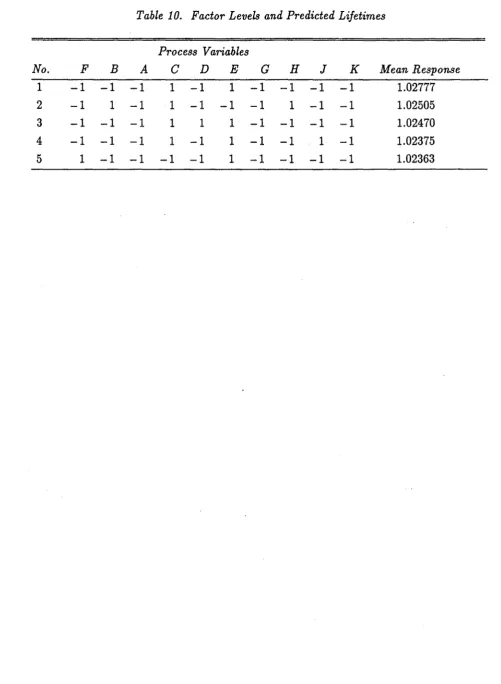
The top five combinations of process variables are compared with the aforementioned interval estimation approach. Table 10 gives the details of their
.'
assignments of factor-levels and predicted lifetimes in the transformed scale. Note that the best predicted lifetime (4.2) is much higher than the others. The top four combinations have the same assignments in factor F, A, C, Gand K. Other factors are not very different as well. The 95% HPD intervals of the differences Ott, 0t3'
°
3,4' 0,45 between the predicted lifetimes from the first and the second, (2nd, 3rd), (3rd, 4th) and (4th, 5th) combinations are obtained as (1.973e-03, 3.37ge-03), (- 3.43ge-04, 1.162e-03), (1.149e-04, 1.735e-03) and (- 6.67ge-04, 8.318e-04), respectively. Based on these intervals, one concludes that the combinations 2 and 3 (or 4 and 5) give the same predicted lifetime statistically at 5% s-significance level. The difference between the first and second combinations are s-significant at 5% level. The summary statistics (mean, s.d., c.s. and c.k.) of the differences in (1, 2), (2, 3) and (4, 5) are computed as (2.723e-03, 4.047e-04, 0.56, 30.3), (3.432e-04, 4.744e-04, -1.29, 51.1) and (1.275e-04, 4.23ge-04, 1.35, 20.1), respectively. The posterior density ofOtthas smaller c.s. than the other two. However, their c.k. are all very large. That is, they are more peaked in the center than the normal density.[ Please put Table 10 here]
4.3 Summm:y of the analysis of the "wall" data
Following Lu and Unal's [22] model, Intercept, E, EG, EH, D, DH, DJ, BD, the "wall" censored data is imputed randomly by drawing samples from the truncated normal distribution (3.1) as follows:
97.9497, 45.4915, 182.0030, 57.7316, 57.6354, 39.7718, 69.3635, 45.9762, 89.0581, 85.8178, 86.2884, 42.8416.
Then, the posterior density is approximated and latent data are generated for Bayesian model selections. After a few loops of imputation and model selection, the model is fixed at
..
Intercept, E, EG, EH, D, DH, DJ, CE, K, GK, (4.4)
for the rest of iterations to make the posteriors of the parameter values converge. The summary statistics of the posterior densities are reported in Table 11. . In Lu [20], we applied the data augmentation procedure to the "EGH" model, (Intercept, E, EG, EH), suggested by HW. Comparing the 95% HPD intervals of the regression parameters
130'
13E'
13EG' 13EH' we learn that the intervals given from (4.4) (see Table 11) are narrowerthan the intervals derived from the model EGH without extra regression terms D, DH. etc. Also our choice of the process recipe, C(+l), D(+1), E(-1), G(-1), H(+1), J(+1), K(-l) selected from (4.4), gives a predicted lifetime of 191.75, which is higher than the prediction 146.03 (see Lu [20]) resulted from the EGH model. Histograms of the posterior densities and their summary statistics are provided in Figure 3 and 4 for reference.
[ Please place Table 11 and Figure 3, 4 here]
5. SENSITMTY OF INITIAL SETUPS IN DATA AUGMENTATION
As described in Section 3 in the data augmentation procedure requires an initial imputation of the censored data. An initial model will be selected subsequently based on that pseudo-complete sample. In this section, the impact of using different initial imputed data sets and different models on the latter model selections are examined. Three examples are organized for this sensitivity study.
Example 5.1 (Impute The Censored "Corner" Data By The QD Method).
Imputation with the QD method does not depends on any initial model or any estimates of parameters, and is commonly used in industry. With the corner data imputed from the QD method, the model decided in step O(b) is
A, K, E, BE (.7962), J (.9462), B (.9895), G (.9897), FG (.9965), DG (1.0), (5.1) where the intercept is skipped in the writing of (5.1), G is the induced main effect and
•
the LS estimates of (T for the models up to FG and DG are 0.133e-02 and 0.7e-04,
respectively. Compared with the initial model used in Section 4 (c.f. Table 4), the first four terms are agreed in these two models. However, the R2 = 0.7962 here in BE is
much less than the corresponding R2
=
0.9488 given in Table 4. Let us proceed the DAprocedure by drawing random samples of the model parameters and use them to construct the latent data.
Five sets of latent data in the first iteration are listed in Table 12 to examine if
."
our suggestion of using the model selected from a latent data (out of m candidates) as described in Step 4 of Section 3 is supported. Similar to the results given in Table 8, all the models selected based on five different latent data sets are the same as the model (5.1) up to the last term DG. Noting that the latent data given in Table 12 are considerably different to the data given in Table 3, we continue our DA iterations. The next few models selected are given as follows:
A, K, E, BE, J, B, G, FG, DG, A, K, E, BE, J, B, D, C, CJ, A, K, E, BE, J, B, D, FB, GJ,
A, K, E, BE (.8067), J (.9613), B (.9918), D (.9962), HJ (.9997), AJ (1.0). (5.2) One can see that our final model (4.1) (c.f. Table 8) agrees to these models up to the
fourth term BE. 0
[ Please put Table 12 here]
Example 5.2 (The Case With A Very Different Initial Model). Because the initial model (5.1) is somewhat similar to our final model (4.1), in this example, we start with the ML-imputed data, which are given in the first column of Table 3, but with a totally different initial model:
Intercept, G, BG, CG, E, EH, K, BK, DK, D, DH. (5.3) The LS estimates and the approximation of the posterior distributions are obtained.
.-After generating 100 random samples of parameters from the approximated posterior distribution, we obtain. 100 sets of latent data. Treating these latent data as the initial imputed data, the model selected from a particular set of latent data is
Intercept, A, K, D, DJ, J, AJ, H, CH, BD, BH,
which is quite different to our models selected in Table 4 or (5.1). Repeating the same process, we select the next few models successively,
Intercept, A, K, E, BE, J, HJ, CJ, G, GH, Intercept, A, K, E, BE, G, FG, GK, CG, FK,
Intercept, A, K, E, BE, J, BJ, F, FG, EH, FJ, (5.4) which agree to our initial model (4.1) up to BE, for which the R-Square was .9447 in (4.1). Some of the terms, such as EH and GK, selected in Table 4 are also appeared in some of the models here. Models in (5.4) are also different to those models given in
Example 5.1 as well. 0
Example 5.3 ("Wall" Data Case). Turning to the "wall" data, we recall that the dominating terms in (4.4) are E, EG, EH, D, DH and DJ. For the demonstration purpose, we start with the main effect ~odel to get the ML estimates and impute the censored data. Then, we fit the main effect model to the imputed data for getting the LS estimates and constructing the approximated posterior density for the next imputation. Since the LS estimates do not fit the data well, the (initial) imputation here takes far more computing time than the other imputations. However, the model selected from these imputed data is similar to
Intercept, E, EG, EH, D, DG, BD, H, HK, FH,
which agrees to the model (4.4) up to the term D with a R-Square of .9629 in (4.4). 0
From these three examples, we learn that one can start with any initial imputed
data and any initial model for proceeding the