Applying Risk Based Testing Methodology in MasterCard Regression Testing Activity for MasterCard Project
NURSHAIDA BINTI NGALIM
A project report submitted in partial fulfilment of the requirements for the award
of the degree of Master of Software Engineering
Advanced Informatics School
Universiti Teknologi Malaysia
iv
ACKNOWLEDGEMENT
I would like to express my sincere appreciation to my thesis supervisor En Azri Hj. Azmi for his willingness to take me under his wing after the short notice given for Industrial Attachment 2. Not to forget to Dr. Suriayati Chuprat for her encouragement to make me proceed my industrial attachment even after I moved to United States. Her support and supervision online during Industrial Attachment 1 was highly appreciated. In addition I would also like to thank Dr. Nurulhuda Firdaus Mohd Azmi, the Master of Software Engineering program coordinator for her advice throughout my studies in the University.
I am also very thankful to Samir Sahu my industrial supervisor for guidance, advices and motivation throughout this period. I am also indebted to my beloved colleague Effa Anuar for her contribution in providing data for MDS Regression Testing. Without their continued support and interest, this thesis would not have been the same as presented here
ABSTRACT
vi
ABSTRAK
Tujuan projek ini adalah untuk mengaplikasikan teknik Risk Based Testing di MasterCard Regression Suite. Projek ini adalah untuk menangani permasalahan yang diutarakan oleh MasterCard mengenai kenaikan kos kekal dalam Regression Testing. Aplikasi Risk Based Testing Metholodogy adalah penyelesaian yang boleh digunakan untuk mengenal pasti regression test cases berdasarkan keutamaan. Regression Test Case testing akan dilakukan mengikut keutamaan yang telah ditetapkan. Risk Based Testing Methodology adalah salah satu teknik yang biasa digunakan di dalam industri pengujian perisian untuk mengoptimalkan Regression Suite. Pendekatan Risk Based Testing adalah dengan mengenal pasti test case mengikut keutamaan berdasarkan Risk Exposure Factor. Risk Based testing analisis dilaksanakan pada keseluruhan kitaran hayat software dengan mengenal pasti tahap kepentingan dan kekompleksan. Kemudian scenario akan di khususkan mengikut pemberat. Kriteria yang dia ambil kira dalam pengiraan Risk Exposure Factor adalah kekerapan test case gagal semasa ujian, kepentingan terhadap perniagaan dan fungsi yang di perkenalkan pada release tersebut. Regression Suite yang dihasilkan dari Risk Exposure Factor akan digunakan dalam pengujian Regression. Regression Suite yang dihasilkan dari teknik
TABLE OF CONTENTS
DECLARATION ii
DEDICATION iii
ACKNOWLEDGEMENTS iv
ABSTRACT v
ABSTRAK vi
TABLE OF CONTENTS vii
LIST OF TABLES x
LIST OF FIGURES xi
LIST OF ABBREVIATIONS xii
CHAPTER 1 1
INTRODUCTION 1
1.1 Company Background 2
1.1.1 Customer Background 3
1.1.2 MasterCard Project Background 4
1.2 Background of Problem 6
1.3 Project Objectives 9
1.4 Project Scopes 9
1.5 Importance of the Project 10
1.6 Chapter Summary 11
CHAPTER 2 12
LITERATURE REVIEW 12
2.1 State of the Art of Software Testing 12
2.1.1 Software Testing in Software Development
Lifecycle (SDLC) 14
viii
2.1.3 Software Testing Spectrum 18
2.2 Problem in Regression Testing 19
2.3 Risk Based Testing: Technique for Risk-based Test Case
Generation and Prioritization 20
2.3.1 Risk Based Testing Approach 21 2.3.2 Risk Based Testing Evaluation 22 2.4 Specification-based Regression Test Selection with Risk Analysis 23
2.4.1 Risk Based Selection 24
2.4.2 Safety Tests selection method 25
2.4.3 Safety Tests Conclusion 26
2.5 Optimization Approach towards Test Suite Minimization
using Bi-Objective Greedy (BOG) Algorithm 27
2.6 Effectiveness of Test Case Prioritization Techniques Based On
Regression Testing 29
2.6.1 Prioritization Weight Factors 29 2.6.2 Proposed Prioritization Technique 31 2.6.3 Test Case Prioritization Techniques Evaluation 31 2.7 Comparison on Regression Testing Optimization Technique 32
2.7.1 IEEE Standard for Software and System Test
Documentation 37
2.7.2 Risk Based Testing Adopted by Tech Mahindra
CFNA-IST project 38
2.7.3 Advantages and Disadvantages of Risk Based
Testing 40
2.8 Chapter Summary 42
CHAPTER 3 43
PROJECT METHODOLOGY 43
3.1 Introduction 43
3.2 Project Methodology 44
3.2.1 Software Testing Process 44
3.2.3 Software Tools 50
3.3 Software Documentation Standard 52
3.4 Chapter Summary 52
CHAPTER 4 54
PROJECT DISCUSSION 54
4.1 Output Analysis 54
4.1.1 Data Collection for Risk Based Testing
Analysis 54
4.1.2 Risk Based Factor Identification 58
4.1.3 R.E.F Calculation 61
4.1.4 Experiment Results 63
CHAPTER 5 66
CONCLUSION 66
5.1 Constraints 67
5.2 Recommendations 68
5.3 Future Works 68
REFERENCES 69
x
LIST OF TABLES
TABLE NO. TITLE PAGE
2.1 Advantage And Disadvantages Of White Box And Black
Box testing (Sawant & Bari, 2010) 16
2.2 Steps In Deriving The Safety Test Cases (Yanping Et Al, 2002) 25 2.3 Comparison On Risk Based And Manual Regression Test Suite 27
2.4 Fault Detected By Test Suites In Bank Project 32
2.5 Summary Of Comparison Between Software Regression
Techniques 36
4.1 Risk Exposure Factor (R.E.F) Parameters 59
4.2 Percentage Of Transactions Divided To Each Priority Level 61
4.3 High Priority Test Cases 62
4.4 Total Defects Found By Targeted Test Cases 64
4.5 Summarize On The Rbt Saving Compared To Normal
LIST OF FIGURES
FIGURE NO. TITLE PAGE
1.1 Mastercard Core Application Systems 5 1.2 Mastercard Regression Release 2014 Dates 6 1.3 The Percentage Of Mds Regression Growth 7 1.4 The Percentage Of Regression Suite Run Manually Or
Unattended 8
2.1 Software Testing In Software Development Lifecycle 15 2.2 The MDS Transaction Testing Flow 18 2.3 Percentage Suite Size Reduction And Percentage Fault
Detection Loss 29
2.4 IEEE 829 – 1998 Level Test Plan Outline 38 2.5 IEEE 829-1998 Standard Test Summary Report Template 38 3.1 Waterfall Model Focusing On Testing Area 45
3.2 MDS Regression Flow 47
3.3 MDS Regression Flow (Cont’) 48
4.1 Comparison Of Failing Groups And Passing Groups In MDS
Regression Suite 56
xii
LIST OF ABBREVIATIONS
ATM - Automated Teller Machine
BAU - Business as Usual
BOG - Bi-Objective Greedy
BPO - Business Support Services
BSS - Business Support Systems
CFNA-IST - Citi Finance North America
CMMI - Capability Maturity Model Integration
GCMS - Global Clearing Management System
HP - Hewlett Packard
IEEE - Institute of Electrical and Electronics Engineers
MDES - MasterCard Digital Enablement System
MDS - MasterCard Debit Switch
MHE - Member Host Emulator
NASDAQ - National Association of Securities Dealers Automated Quotations
OC - Onsite Co-ordinator
OSS - Operations Support Systems
POS - Point of Sale
RE - Risk Exposure
REF - Risk Exposure Factor
SDLC - Software Development Lifecycle
SEI - Software Engineering Institute
SME - Subject Matter Expert
SOW - Scope Of Work
Tech M - Tech Mahindra
UFT - Unified Functional Testing
UML - Unified Modelling Language
UTM - Universiti Teknologi Malaysia
xiv
L IS T O F APPPE ND I CES
APPE NDI X TITL E PAGE A Industrial Attachment 1 Timeline – Gantt Chart 75 B Industrial Attachment 2 Timeline – Gantt Chart 76 C Total REF Calculation For Mds Regression Suite Services 77
CHAPTER 1
INTRODUCTION
Regression testing is a vital part of an effective testing process for confirming software quality. It is the process of validating adapted software to provide confidence that the updated parts of the software perform as intended and that the untouched parts of the software have not been adversely affected by the modification described by Harrold et al. (2001). Regression testing is important in software maintenance. Tech Mahindra is responsible in providing regression testing service to MasterCard Core Application which is MasterCard Debit Switch (MDS) as part of their Scope of Work (SOW) contract. MDS Regression Suite is developed to test MasterCard DEBIT Switch which is one of the MasterCard applications that used to process card authorization and settlement activity. The regression testing is a critical activity because it is designed to ensure MDS existing functionality does not getting impact on the enhancement introduced for each release. The test cases in the regression are originating from the User Acceptance Test (UAT) test cases that were migrated to the Regression Suite at the end of the release. In each release specific UAT test cases are selected to be added in the regression suite.
2
Despite the automation method implemented in regression activity, yet effort is still not reduced significantly. It is because regression suite is not able to go 100% automated due to limitation constraint on the automation tool and some other activity is required human intervention to be realized. Through that we decided to implement testing optimization methodology which is called as Risk Based Testing in MDS Regression Suite. This method is used to identify the criticality of the test cases using Rick Exposure Factor (R.E.F) and MDS Regression Suite testing is planned based on the R.E.F decided. By implementing this methodology, we are expecting 20 – 20% regression effort reduction.
1.1 Company Background
Tech Mahindra Limited is an Indian multinational provider of information technology (IT), networking technology solutions and business support services (BPO) to the telecommunications industry. Tech Mahindra is a part of the Mahindra Group conglomerate which founded by Anand Mahindra. The headquarter location is at Pune, Maharashtra, India. In 2014, Tech Mahindra was able to put themselves ranked #5 in India's software services (IT) firms and overall #39 in Fortune India 500 lists published in Compendium (2014).
Tech Mahindra combined entity has 95,729 employees across 51 countries, servicing 632 customers globally. It has 15 overseas offices for business process outsourcing (BPO) operations and software development. Its revenue for 2012-13 was put at $2.7 billion (Rs. 162 billion) published in Tech Mahindra Press Release in January 2014.
1.1.1 Customer Background
MasterCard Incorporated (NYSE: MA) or MasterCard Worldwide is an American multinational financial services corporation headquartered in the MasterCard International Global Headquarters, Purchase, New York, United States. The Global Operations Headquarters is located in O'Fallon, Missouri, United States, a suburb of Saint Louis, Missouri. MasterCard principal business is to process payments between the banks of merchants and the card issuing banks or credit unions of the purchasers who use the "MasterCard" brand debit and credit cards to make purchases throughout the world,. MasterCard Worldwide has been a publicly traded company since 2006. MasterCard Worldwide was a cooperative owned by the 25,000+ financial institutions that issue its branded cards preceding to its initial public offering stated in NASDAQ (2012). MasterCard, originally known as Interbank/Master Charge, was formed by several California banks as a competitor to the BankAmericard issued by Bank of America, which later became the Visa credit card issued by Visa Inc. Since 1966 to 1979, MasterCard was called "Interbank" and "Master Charge"
4
1.1.2 MasterCard Project Background
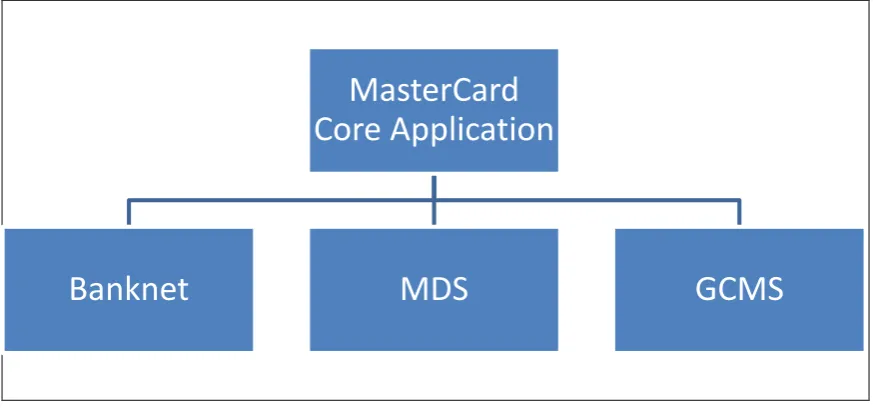
Figure 1.1 MasterCard Core Application Systems
MDS is a system that processing ATM, Pin based type of transaction for MasterCard card brand registered under MDS for example Maestro®, and Cirrus® (MasterCard, 2014). Tech Mahindra is responsible in two testing activity UAT and Regression for core application. MDS Regression executes regression testing in MasterCard Test Facility environment for MasterCard Debit Switch (MDS) application. This to ensure that there is no anomalies in the MasterCard system functionalities in processing the transactions after an enhancement implemented before it goes to production. MDS Regression suite test cases originated from User Acceptance Testing (UAT) test cases. There are about fifty six functionalities that what we called as Service in MDS. In every release the MDS Regression Suite is thoroughly tested to validate if all the MDS existing functionalities behaving as it should. The validation is also checking the behavior of MDS application when communicating with other core application.
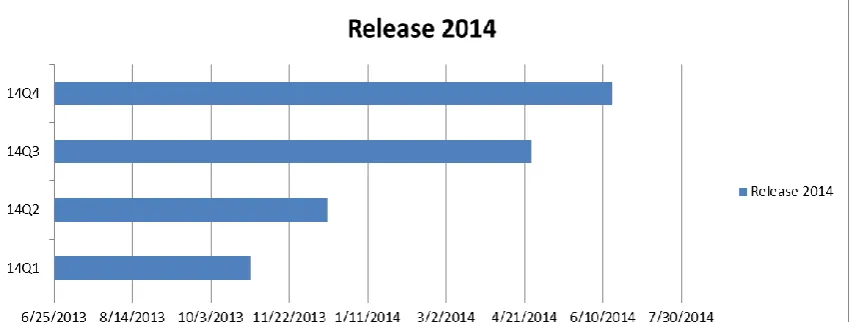
In MasterCard, there are four test execution releases scheduled per year which consist of two major and two minor. Major releases are covering product testing that will be release by MasterCard globally and minor releases are covering product testing for specific region or technology. The time line is set for the each release as shown in Figure 1.2 as for 2014 release example. The duration for major
MasterCard
Core Application
6
release is 12 weeks and minor release is 6 weeks. Every major release requires regression suites to be executed in 3 iterations which duration for iteration is 4 weeks. During minor release, regression requires executing regression suites in 2 iterations which duration for iteration is 3 weeks.
Figure 1.2 MasterCard Regression Release 2014 dates
1.2 Background of Problem
MasterCard Core Line Manager approached Tech Mahindra MasterCard TCOE Project Deliver Manager on her concern with the increased of the regression fixed cost. As the regression Suite is growing therefore more resources are involved in regression activity that contribute to the increased in the regression fixed cost. She was requesting Malaysian team to come up with any process improvement that can be implemented to reduce the fixed cost.
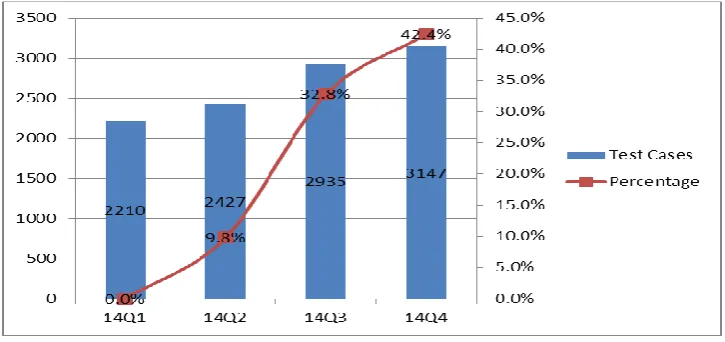
cases. We are expecting the continuation growth in the future. It would be difficult to engage less number of resources in MDS Regression Activities the fix time span.
Figure 1.3 The percentage of MDS regression growth
8
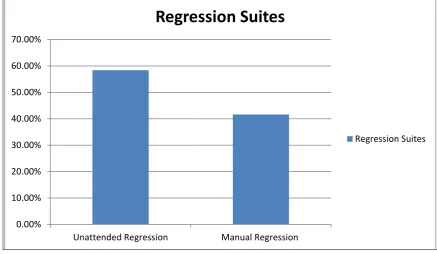
Figure 1.4 The Percentage of Regression Suite Run Manually or Unattended
The issue that hinder regression suite to go 100% automation, Tech M resource is working in a virtual environment run by Citrix. The virtual environment is not stable to make it difficult to use automation tool. Automation effectively works in stable environment. Automation tool has limitation in recognizing fields in other tool use for testing like Mainframe and Tandem.
To overcome this delivery challenge, MDS team introduced A Risk Based Testing Methodology to provide an approach to identify and prioritize the critical scenarios. The analysis on determining the criticality of the test cases reference stakeholders input, regression historical data and business criticality.
0.00% 10.00% 20.00% 30.00% 40.00% 50.00% 60.00% 70.00%
Unattended Regression Manual Regression
Regression Suites
1.3 Project Objectives
The objectives of this project are as follows:
i). To study the Risk Based Testing methodology.
ii). To analyze the MDS regression historical data, stakeholders inputs and the impact on business criticality.
iii).To develop appropriate Risk Based testing approach to be implemented in MDS Regression Suit.
iv).To evaluate the effectiveness of targeted test cases derived from this Risk Based Testing in detecting defects.
v). To produce Software Engineering Documents a) Software Test Plan
b) Software Test Summary Report
1.4 Project Scopes
10
Testing Methodology in Regression Suite, we are expecting 20% to 25% reduction in regression effort.
The scope does not include preparing requirement for the testing. It does not include preparing or designing the test cases for the regression suite as the plan is to optimize the existing test cases in regression suite. This project does not involve any other testing level including unit test, system test and integration testing.
1.5 Importance of the Project
REFERENCES
Aashish, W. (2015). Large Deals support Tech Mahindra’s growth momentum Q3 constant currency revenue growth at 4.9% QoQ 19.6%
YoY. Tech Mahindra.
Abhijit, A. S., Pranit H.B., Chawan P. M.. (2012) Software Testing Techniques and Strategies International Journal of Engineering Research and Applications Vol. 2, Issue 3, May-Jun 2012, pp.980-986
Adtha, L.,(2002). The Theory of Software Testing. Department of Information Technology, Faculty of Science and Technology Assumption University, Bangkok, Thailand 35-40 (Jul. 2012)
Alam, M.M and Khan, A.I (2008). Risk-based Testing Techniques: A Perspective Study. CMJ University, Shillong,Meghalaya, India
Bassil, Y. (2011). A Simulation Model for the Waterfall Software Development Life Cycle. LACSC – Lebanese Association for Computational Sciences Registered under No. 957.
70
Eldon, Y. L., (1990). Software Testing In A System Development Process: A Life Cycle Perspective. Journal of Systems Management, 41 (8), August 1990, 23-31
Fischer, K. (1977). A Test Case Selection Method For The Validation Of Software Maintenance Modifications. International Computer Software and Applications Conference (COMPSAC ’77). 421–426. IEEE Computer Society Press.
Gaurav, D. and Bharti, S. (2008), Understanding Regression Testing Techniques.
Glenford, L. M. (1979). The Art of Software Testing, Wiley-Interscience.
Harenton, K. N. L and Lee J. White. A Cost Model to Compare Regression Test, Strategies. Proceedings of the Conference on Software Maintenance. 201-208.
Harrold, M. J. and James, A. (2001). Regression Test Selection for Java Software, Proceedings of the ACM Conference on OO Programming, Systems, Languages, and Applications (OOPSLA ’01).
Humphrey, W. S. (1995). A Discipline for Software Engineering. Addison Wesley, New York, NY, USA.
Ian, S. (2010). Software Engineering. Addison Wesley, 9th ed. International Journal of Engineering & Technology (iJET) (2012). ISSN: 2049-3444, Vol. 2, No. 5.
James, B. (1998). Good Enough Quality: Beyond the Buzzword. IEEE Computer, August. 96-98.
Jovanovic and Irena (2008). Software Testing Methods and Techniques. May 26,2008.
Laurie, W. (2011). A (Partial) Introduction to Software Engineering Practices and Methods. NCSU CSC326 Course Pack 2010-2011 (Seventh) Edition.
Lu, L. (2007). Software Testing Techniques. Technology Maturation and Research Strategies School of Computer Science Carnegie Mellon University
McMaster, S., and Memon, A. (2008). Call-Stack Coverage for GUI Test Suite Reduction. IEEE Trans. Software Eng. 34. 99-115.
MasterCard (2007). MHE User Manual. MasterCard Publication.
MasterCard (2008). Execution Process. MasterCard Publication.
MasterCard (2009). MasterCard DEBIT Switch Overview. MasterCard Publication.
MasterCard (2013). MasterCard DEBIT Switch Execution Process. MasterCard Publication.
72
MasterCard (2014). Single Message System Specification. MasterCard Publication.
MasterCard (2015). Company Insight. MasterCard Publication. MasterCard (2007). Basic Authorization Concepts and Authorization Message Flow. MasterCard Publication.
Munassan, N.M.A and Govardhan, A. (2012). A Comparison Between Five Models Of Software Engineerin. Ph.D Student of Computer Science & Engineering Jawahrlal Nehru Technological University Kuktapally, Hyderabad- 500 085, Andhra Pradesh, India.
Muthusamy T. and Dr. Seetharaman.(2014). Effectiveness Of Test Case Prioritization Techniques Based On Regression Testing. International Journal of Software Engineering & Applications (IJSEA), Vol.5, No.6, November 2014
Nursimulu, K.; and Probert, R.L. (1995). Cause-effect graphing analysis and validation of requirements. Proc. Conf. of the Centre for Advanced Studies on Collaborative Research (CASCON), IBM Press, Toronto, Ontario, Canada, 7-9
Parsa, S. and Khalilian, A. (2010). On the Optimization Approach towards Test Suite Minimization. International Journal of Software Engineering and Its Applications.
Quadri, S.M.K and Farooq, S.U. (2011), Testing Technique Selection: A Systematic Approach. Proceeding of 5th National Conference; INDIACom -2011
Quadri, S.M.K. and Farooq, S.U. (2011). Evaluating Effectiveness of Software Testing Techniques With Emphasis on Enhancing Software
Reliability. Journal of Emerging Trends in Computing and Information Sciences VOL. 2, NO. 12, December 2011 ISSN 2079-8407
Rothermel, G. and Harrold, M. J. (1996). Analyzing Regression Test Selection Techniques. IEEE Transactions on Software Engineering, Vol. 22, No. 8, August. 529-551.
Rothermel, G., Harrold, M. J., Ostrin, C. Hong (1998). An Empirical Study of the Effects of Minimization on the Fault Detection Capabilities of
Test Suites. Proceedings of the International Conference on Software Maintenance, IEEE Computer Society.
Rothermel, G. and Harrold, M. J. (1994), Selecting Tests and identifying Test Coverage Requirements for Modified Software. In Proceeding of the ACM international Symp. On Software,pp-169-184, August 1994
Royce, W. (1970). Managing the Development of Large Software Systems. Proceedings of IEEE WESCON 26.1-9.
Sharma, P. (2014). Risk Based Testing: Technique for Risk-based Test Case Generation and Prioritization .International Journal of Software and Web Sciences (IJSWS)
74
Tech Mahindra (2015). Our Company. Tech Mahindra Limited
Unnati, B., (2012) Risk Based Testing 102
Yanping, C., Robert, L. Probert, D. Sims P. (2002). Specification-based Regression Test Selection with Risk Analysis. School of Information Technology and Engineering University of Ottawa, Canada.
Zhang X. Chen, Z., Xu, B., and Nie, C. (2008). A Novel Approach for Test Suite Reduction Based On Requirement Relation Contraction.