Possibility of Using Computational Fluid
Dynamics (CFD) for Urban Canyon Studies in
Tropical Climate
Then Jit Hiung 1, Mohd Hamdan Ahmad 2
1. MSc Candidate, Department of Architecture, Faculty of Built Environment, 81310 Skudai Johor, Universiti Teknologi Malaysia, Malaysia
2. Associate Professor, Department of Architecture, Faculty of Built Environment, 81310 Skudai, Johor, Universiti Teknologi Malaysia, Malaysia
ABSTRACT: This paper gives an overview of research methods for urban street
canyon studies, from the commonly used field experiments and scaled models methods to numerical simulation models. Review of field experiments and scaled models showed identical weaknesses in dealing with urban canyon studies i.e. cost, time consuming and data or information obtained is rather limited or specific and often do not yield all of the designers’ requirement. Numerical simulation on the other hand is an effective tool of understanding the complicated processes within the urban canopy layer. Numerical simulations using Computational Fluid Dynamics (CFD) is reviewed. CFD is well-known for its ability for evaluating either internal or external air flow and pollutant dispersion. In this paper instead, the possibility of using this model for urban canyon thermal environment studies in tropical climate is emphasized. Key word: CFD, Urban Canyon, Numerical Simulation
Introduction
In recent years, there is a growing interest in internal and external microclimate
performance analysis of the built environment. According to Alamdari (1994), due to
new design standards in either indoor or outdoor air quality, thermal comfort and
safety, and awareness of new technology, modeling or numerical simulation of indoor
and outdoor microclimate using high performance computer-aided system are even
more pronounced. In urban studies, field experiment (Yoshida et al, 1991; Arnfield,
1994) and scaled models (Pearlmutter, 2005; Gayev & Savory, 1999) has been
regarded to have performed more realistic predictions of the air movement,
containment concentration, temperature and pressure distribution in or around
buildings.
However, since 1970s a number of sophisticated dynamic thermal energy software
.\
models based on Computational Fluid Dynamics (CFD) which takes the advantage of
speed and power capabilities of new computers, are being used as an efficient tool
for air movement, thermal comfort, and smoke or other pollutant movement analysis.
In urban canyon studies however, CFD applications are mostly used in studying air
flow (Bonneaud et al, 2001), pollutant dispersion (Chan et al, 2001) and traffic
emission (Xie et al, 2005), and not so much on urban canyon thermal environment
e.g. air temperature distribution, mean radiant temperature, surface temperature etc.
The application of CFD in the context of thermal environment of the urban canyon in
the tropical climate is the aim of this study. Existing methods as well as CFD’s
application in urban canyon studies will also be reviewed.
Field Experiment
Field measurement has been regarded to provide the most direct evidence of the
canyon energy balance (Nunez & Oke, 1977). In finding the interaction between
urban canyon geometry and incident solar radiation, Bourbia and Awbi (2004)
performed a field measurement in the urban street canyon in El-Qued City, a hot and
arid climate city in Algeria. The measurements were conducted in summer
(July/August 1996 and 1997) and winter (December/January 1996 and 1997), a
duration of approximately two years to complete, whereas the measurement
instruments required include double-shielded and aspirated type-T thermometers,
thermometers type Pro 7010/9070 and thermistor temperature sensors case type
TEMP-02-2-T02-016 enclosed in an aluminium casing.
For Santanouris et al (1999), measurements of airflow inside and outside canyon and
air and surface temperature inside canyon of a deep pedestrian in Athens, Greece,
took him 7 continuous days (day and night period). And the instruments used include
miniature ambient air thermistor sensors, infrared thermometer equipped with a laser
beam, and 3-propellor (nrg) axis anemometer. In the case of Pearlmutter et al (1999),
the parameters monitored are even more, including air temperature, relative humidity,
wind speed and direction, global radiation, net radiation and radiant surface
temperature. Pearlmutter’s microclimate analysis is performed at several low rise
urban street canyon of the Negev region of Israel, which is also an arid climate.
. winter (December till February) over a one year period. In this particular study alone,
the instruments used include PT-100 sensors, Campbell RH probe, Met One
Sensors, Kipp and Zonen pyranometer, Siemann-Ersking net radiometers and
Teletemp IR thermometer.
The above review shows that although field measurement has the advantage of
portraying accurate results, it is however very time-consuming and costly. Moreover,
it can only be applied for specific range of geometries, orientation, Height to Width
ratio and Sky view Factor. Besides, the huge number of urban variables and
processes (Ali-Toudert, 2005) and the complexity of actual cities (Pearlmutter, 2005)
makes it impractical to directly measure the effects of systematic variations i.e. street
canyon geometry.
Scaled Model
Urban canyon airflow and pollutant dispersion studies utilizing scaled model are quite
common. Most researchers (Wang, 1996; Pitts and Wards, 1983) suggested it is the
best way in studying ventilation. These are done using Wind Tunnel in Laboratories:
physical model and its surroundings were constructed and placed in the wind tunnel
where they are subjected to a controlled wind flow. Pressure sensor taps are installed
at various points on the model. In modeling of the motion of air within the urban
environment, Gayev and Savory (1999) utilized an idealized two dimensional street
canyon in which the internal roughness is represented by an array of vertical
cylinders. The results provide a deeper understanding of pollutant dispersion of an
urban canyon. Although wind tunnel can provide controlled dispersion conditions, it is
an expensive research tool and difficult to set up, often used in the development t
and validation of mathematical models. According to Alamdari (1994), data and
information obtained using wind tunnel is also rather limited and often does not yield
the designer’s entire requirement.
Urban canyon thermal studies using scaled models, however, are not that popular
among the researchers. This may be due to the comprehensive procedure, time
factor as well as the limitations in available equipment and budget, although the
.\
since it is carried out under actual climatic conditions, it reduces uncertainty faced by
other forms of modeling, besides offering a wide range of configuration. One of the
example is performed by Pearlmutter et al (2005) in a desert region in the arid region
of Southern Israel, in order to evaluate the influence of street canyon geometry on
microclimatic conditions and pedestrian energy exchange within the urban canopy.
The model is composed of ‘scaled schematic’ buildings arranged in linear rows.
These buildings are made of 200mm x 200mm x 400mm hollow concrete masonry
blocks set on a finely leveled and compacted bare loess soil that stretches 250m in
prevailing wind direction.
Numerical Simulation
In recent years, numerical simulation has been the favorable method among
researchers in studying urban canyon microclimate. Besides being an effective
method of understanding the many complicated causal mechanisms of urban heat
island (Sakakibara, 1996), it is a method ‘perfectly suited to dealing with the
complexities and non-linearities of urban climate systems’ (Arnfield, 2003). Bornstein
(1986) has classified heat-island numerical models into two categories: the urban
canopy layer (UCL) models and urban boundary layer (UBL) models. This paper will
concentrate only at the UCL models.
3D model ENVI-met developed by Bruse (1998) has been utilized by Ali-Toudert
(2005) to simulate the microclimatic changes within urban environments in a high and
temporal resolution. ENVI-met is one of the first models that seeks to reproduce
major processes in the atmosphere that affect the microclimate, including simulation
of wind flows, turbulence. Radiation fluxes, temperature and humidity. This model is
also free and downloadable through the internet.
Another popular UCL model is the Street Cluster Thermal Time Constant (CTTC)
model. CTTC model is suitable to predict UCL diurnal climatic variations (Swaid and
Hoffman, 1990/1991; Sharlin and Hoffman, 1984), impacts of anthropogenic factors
(Swaid, 1993; Elnahas, 1997) and urban design alternatives (Bar-El, 1989; Moseri,
1990). Shashua-Bar and Hoffman (2003) uses CTTC to assess thermal effects of
. case, the CTTC model is able to incorporate several parameters related directly to
the physical structure of building forms (building density, shade areas, the cluster
geometry etc.). A modified CTTC model, the Green CTTC Model has been used by
Shashua-Bar, Hoffman and Tzamir (2005). This modified model is a tool for
quantifying the integrated thermal effects of built forms and vegetation on UCL
climate ion design built-up alternatives. In Shashua-Bar’s study, the built form and the
vegetation effects were estimated for 86 cases of street and closed courtyards, with
and without colonnade, at 1500 hours in summer near the Mediterranean Sea Coast.
Another extension of CTTC model has been created by Elnahas and Williamson
(1997) to operate at hourly time intervals and to include the dependence of total solar
radiation absorption, instead of direct radiation modification of outgoing long-wave
radiation loss by the inclusion of cloud cover, thermal effects of vegetation in the
urban site; and the contribution of anthropogenic heat. URBANm, created by
Williamson and Erell (2001) retain this extension of CTTC calculation technique but
incorporated better data handling and improved algorithms for shading, long-wave
radiation and wind effects. This model is still under development but will enable the
transformation of reference site climate data to site-specific climate data.
Herbert (2002) uses a combination of interlinked sub-models including the wind field,
dispersion and energy models to simulate diurnal temperature distribution in and
around a dry urban canyon. This study aims to show the effects of changing canyon
geometries on the model output. The advantage of this simulation allows Herbert to
locate his model at any position on the Earth’s lands mass, to specify thermal
properties of the objects or surfaces comprising the canyon, besides being a powerful
tool in city planning and for urban canyon research generally. However, this model is
limited to dry canyons and cloudless skies (Herbert, 2002).
In Malaysia, Salleh (1994) uses the URBAN3 model which is an example of UCL
model that simulated energy exchanges in urban canyon. Salleh approximates the
physical structure of a city by a finite number of rectangular blocks intermixed with
streets, parking lots and parks. The blocks are translated into 3D coordinates which
are used in a separate program called ‘OBSTRUCT’ to generate the distances and
.\
CFD Application in Urban Canyon Studies
Computational Fluid Dynamics or CFD is a general term used to describe the
analysis of systems including fluid flow, heat transfer and associated phenomena by
means of computer-based numerical methods (Xie et al, 2005). CFD is a numerical
simulation method, based on the Navier-Stokes equations established by Claude
Navier and then George Stoke. According to Xie (2005), CFD is increasingly applied
to the simulation of atmospheric problems, due to its suitability for use in passive
energy design (because of many variables involved), and its ability to model various
parameters that affect thermal comfort.
During early adaptation of CFD to the building Services industry, many models were
set up for internal environments and verified experimentally (MacLeod and Waskett,
1996). However, there is a certain amount of skepticism on CFD’s application in the
external environment due to problems associated with setting up the boundary
conditions i.e. the ever-changing ambient conditions, which also exist when physical
modeling the environment e.g. in a wind tunnel. Though, due to CFD’s many benefits
including reducing or eliminating the need for physical modeling, quick and easy
investigation of alternative designs and instilling confidence in the proposed design
(MacLeod and Waskett, 1996), CFD is still a popular tool among researchers even in
external microclimate, especially usage of Reynolds averaged Navier-Stokes (RANS)
flow equation model in simulating airflow and pollutant dispersion in street canyon
(Xie et al, 2005).
Bonneaud et al (2001) performed CFD simulation with N3S code to evaluate the
natural ventilation potential of different shapes of the dense housing in Cayenne,
French Guyana; Xie et al (2005) simulates emission from vehicle exhaust in a street
canyon within an urban environment using standard k-e turbulence model (also
considered RANS model); and similar model is used by Chan et al (2001) to find out
various critical canyon configurations to avoid the contamination by pollutants.
There are many CFD software available such as COMIS, CONTAM96, PHEONICS,
FLUENT and FLOVENT. In this paper, only FLOVENT will be discussed due to its
. a commercially developed code, specially designed and developed for the building
industry. It calculates the resultant temperature index recommended in CIBSE, using
predicted field values of air velocity and temperature, and mean radiant temperature
(Alamdari, 1994). Studies using this application are very limited, and mostly
emphasize on indoor climatic conditions such as air movement and thermal comfort
assessment, smoke and pollutant movement analysis. Hence this paper attempts to
use CFD FLOVENT for urban canyon thermal study. Following is a discussion of a
pilot testing using this particular software application.
Pilot Testing Using CFD Flovent
The pilot testing is based on a field experiment carried out by Salleh (1994) in Kuala
Lumpur, Malaysia. The aim of Salleh’s study was to investigate whether deeper or
shallower urban street canyon provides better comfort enhancement for the
pedestrian in the tropics. This is done by comparing the Urban Canyon Height to
Width Ratio (H/W) or two urban street canyon which is the Damansara urban canyon
and Melawati urban canyon. And in this paper, the pilot testing is aimed at comparing
the air temperature of CFD FLOVENT simulation and the air temperature provided by
Salleh’s field experiment in Damansara Urban Canyon on 29/06/1987 and Melawati
Urban Canyon on 02/07/1987.
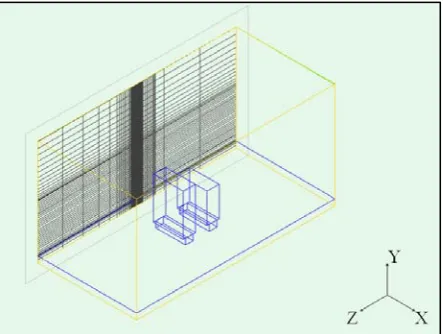
Models of the two canyons are created directly using the drawing board window
provided with the software using 1:1 scale. The Damansara Urban Canyon (H/W ratio
3:1) and Melawati Urban Canyon (H/W ratio 1:1) models together with their position
in the overall Domain Solution is shown in Figure 1 and 2 respectively. Both models
Figure 1: The position of Damansara Urban Canyon Model (29/06/1987) within the Flovent’s overall Domain Solution.
Figure 2: The position of Melawati Urban Canyon Model (02/07/1987) within the Flovent’s overall Domain Solution.
Monitor points for both the models are positioned 1.5m (human height) above
ground at the center of the canyon. This is the air temperature measuring point, as
in the case of the field measurement by Salleh. In FLOVENT, Cartesian type of grid
system is utilized. The grid distribution will eventually affects the numerical
accuracy of the simulation. See Figure 3 and 4 for the detailed grid constraints
applied in both the models.
Plan View East View North View
Figure 3: Grid distributions for Damansara Urban Canyon Model (29/06/1987) Figure 3: Grid distributions for Damansara Urban Canyon Model (29/06/1987)
Plan View
East View North View
Figure 4: Grid distributions for Melawati Urban Canyon Model (02/07/1987) Figure 4: Grid distributions for Melawati Urban Canyon Model (02/07/1987)
The simulation conditions including material properties (wall=brick; ground=gravel;
roof=concrete) and climatic conditions (Figure 5), are based on Salleh’s field
experiment and data collected.
The simulation conditions including material properties (wall=brick; ground=gravel;
roof=concrete) and climatic conditions (Figure 5), are based on Salleh’s field
experiment and data collected.
.\
Damansara Melawati
Figure 5: Part of ‘Damansara’ and ‘Melawati’ Urban Canyon Model’s boundary condition setting up.
Air Temperature for Damansara Urban Canyon Center (29/06/1987)
0 5 10 15 20 25 30 35 40
8 9 10 11 12 13 14 15 16 17 18 19
Time
A
ir
T
e
mper
at
ur
e
Ambient Air Field Measurement Simulation
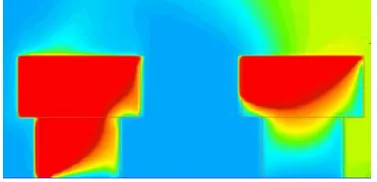
Figure 7: Graphical output of FLOVENT simulation for Damansara Urban Canyon Center at 1300h (29/06/1987)
Figure 7: Graphical output of FLOVENT simulation for Damansara Urban Canyon Center at 1300h (29/06/1987)
Air Temperature for Melaw ati Urban Canyon Center (02/07/1987)
0 5 10 15 20 25 30 35
8 9 10 11 12 13 14 15 16 17 18 19
Time
A
ir
T
e
mper
at
ur
e
Ambient Air Field Measurement Simulation
Figure 8: Air temperature from Petaling Jaya metereological station, field measurement and simulation for Melawati Urban Canyon Center (02/07/1987)
Figure 9: Graphical output of FLOVENT simulation for Melawati Urban Canyon Center at 0800h (02/07/1987)
.\
The results from both simulations (Figure 6 & 8) showed that the average
differences between the results of measurement and simulation for air temperature
at 1.5m above ground was only 1%. The results suggest that CFD FLOVENT is not
only capable of simulating air flow or pollutant dispersion, but also the thermal
environment (in this case air temperature) in the external environment i.e. urban
street canyon in the tropics.
Conclusion
Review of various methodologies above revealed that field measurements and
scaled models are beneficial in terms of site-specific evaluation of urban canyon
microclimate. However, in terms of evaluation of various canyon configurations,
numerical simulations are more reliable. Computational Fluid Dynamics (CFD) has
been used in numerous air flow and pollutant dispersion in urban canyon studies,
but none on thermal i.e. temperature distribution studies. However, when the
results of air temperature from CFD FLOVENT simulation was compared with the
measured results of Salleh’s previous study, a satisfactory correspondence was
found.
A more holistic evaluation of the thermal environment using CFD should include
heat flux and distribution of air temperature and humidity of urban canyon. Besides
heat conduction of building walls and grounds and the radiation heat exchange
between them should also be simulated. On the other hand, various canyon
configurations in a tropical climate should also be studied due to scarcity of such
studies in these areas, in order to achieve an optimum urban street canyon
configuration that is thermally comfortable for users.
References
Alamdari, F. (1994). Applications of CFD in the Built Environment. Flovent User Meeting. The Bramley Grange Hotel. 17-18 May.
. Arnfield, A.J. and Mills, G. M. (1994). An analysis of the circulation characteristics and energy budget of a dry, asymmetric, east-west urban canyon. I. Circulation characteristics. International Journal of Climatology 14, 119-134
Arnfield, J. (2003). Two Decades of Urban Climate Research: A Review of Turbulence, Exchanges of Energy and Water, and the Urban Heat Island.
International Journal Of Climatology. pp 1-26.
Bar-El, M. (1989). Analysis of the Conditions to Obtain a Pleasuring Urban Microclimate by Geometric Relations in the Urban Design. M. Sc. Thesis (in Hebrew, English Summary), Technion, Haifa, Israel.
Bonneaud, F. and Musy, M. and Depecker, P. (2001). Simulation of the Wind in Hot and Humid Climate Cities: Evaluation of the Natural Ventilation Potential of the Housing in Urban Blocks. 7th International IBPSA Conference, Riode Janeiro, Brazil. Aug 13-15. pp 109-116.
Bornstein, R. D. (1986). Urban Climate Models. Nature, Limitations and Applications in Proc. Echnical Conf. Mexico. WMO No. 652. pp 237-276.
Bourbia, F., Awbi, H. B. (2004). Building Cluster and Shading in Urban Canyon for Hot Dry Climate. Part 1: Air and Surface Temperature Measurements. Renewable Energy 29. pp 249-262.
Bruse, M. (1998). Simulating Surface –Plant-Air Interactions inside Urban Environments with a Three Dimensional Numerical Model. Environmental Software and Modeling, 13. pp 1-12.
Chan, A. T. and So. ESP and Samad, S.C. (2001). Strategic Guidelines for Street Canyon Geometry to Achieve Sustainable Street Air Quality. Atmospheric Environment 35. pp 5681-5691.
Elnahas, M. M. and Williamson, T.J. (1997). An Improvement of the CTTC Model for Predicting Urban Air Temperatures. Journal of Energy and Buildings 25. pp 41-49.
Gayer, Y. A. and Savory, E. (1999). Influence of Street Obstructions on Flow Processes within Urban Canyons. Journal of Wind Engineering and Industrial Aerodynamics 82. Pp 89-103.
Herbert, J. M., Herbert, R. D. (2002). Simulation of the Effects of Canyon Geometry on Thermal Climate in City Canyons. Mathematics and Computers in Simulation 59: pp 243-253.
MacLeod K. G. and Waskett, P. R. (1996). Computational Fluid Dynamics (CFD) - A Timely Concept? Cibse/ Ashrae Joint National Conference.
.\
Nunez, M., Oke, T. (1977) The Energy Balance of an Urban Canyon. Journal of Applied Meteorology 16:11-9.
Pearlmutter D, Berliner P, Shaviv E. (2005) Evaluation of urban surface energy .uxes using an open-air scale model. Journal of Applied Meteorology. pp 44:532– 45.
Pitts, A. C. and Ward, I. C. (1983). A Review of The Prediction And Investigation of Air Movement in Buildings. Faculty of Architectural Studies. University of Sheffield.
Sakakibara, Y. (1996). Numerical Study of the Effect of Urban Geometry upon the Surface Energy Budget. Atmospheric Environment 30. pp 487-496.
Santamouris, M., Papanikolaou, N., Livada, I., Koronakis, I., Georgakis, C., Assimakopoulos, D.N. (1999). Thermal and Airflow in Deep Pedestrian Canyon under Hot Weather Condition. Atmospheric Environment 33: pp 4503-4521.
Sharlin, N. and Hoffman, M. E. (1984). The Urban Complex as a Factor in the Air Temperature Pattern an a Mediterranean Coastal Region. Journal of Energy and Building. pp 149-158.
Shashua-Bar, L., Hoffman, M. E., Tzamir, Y. (2005). Integrated Thermal Effects of Generic Built Forms and Vegetation on the UCL Microclimate. Building and Environment
Shashua-Bar, L., Hoffman, M. (2003). Geometry and Orientation Aspects in Passive Cooling of Canyon Streets with Trees. Energy and Buildings 35: pp 61-68.
Swaid, H. and Hoffman, M. E. (1990/1991). Climate Impacts of Urban Design Features for High and Mid- Latitude Cities. Journal of Energy and Buildings 14. pp 325-336.
Swaid, H. (1993). Urban Climate Effects of Artificial Heat Sources and Ground Shadowing by Buildings. International Journal of Climatology 13. pp 797-812.
Wang, Z. (1996). Controlling Indoor Climate: Passive Cooling Of Residential Buildings in Hot- Humid Climate in China. Sweden. Lund University.
Williamson, T. J. and Erell, E. (2001). Thermal Performance Simulation and the Urban Microclimate: Measurements and Prediction. 7th International IBPSA Conference, Riode Janeiro, Brazil. Aug 13-15.
Xie, X. M. and Huang, Z. and Wang, J. S. (2005). Impact of Building Configuration on Air Quality in Street Canyon. Atmospheric Environment 39. pp 4519-4530.
Yoshida, A., Tominaga, K., Watatani, S. (1991). Field measurements on energy balance of an urban canyon in the summer season. Energy and Buildings 15-16.