A Study on Surgery Planning and Scheduling Using
Queuing Models and Simulation
K.L. Muruganantha Prasad
1, D.Saraswathi
2Assistant Professor1, Research Scholar2
Department of Mathematics, H.H.The Rajah’s College, Pudukkottai Department of Mathematics, SureyaCollege of Engineering,Trichy
[email protected]1 ,[email protected]2
Abstract- Surgery scheduling is very difficult because there are a number of competing performance criteria, the
efficiency and effectiveness of a surgery schedule may be judged differently depending on the individual’s perspective. On the other hand are more concerned with waiting time. In this paper we provide a general overview of the most important parts of the surgery delivery system that affects surgery scheduling. We focus on the surgical suite itself since it comprises the most expensive resources in the delivery of surgical care. Our review focuses on the literature related to surgery scheduling that has appeared in both the operations research and the healthcare literature. We particularly emphasize recent studies that consider now and important aspects of surgery scheduling system.1. INTRODUCTION
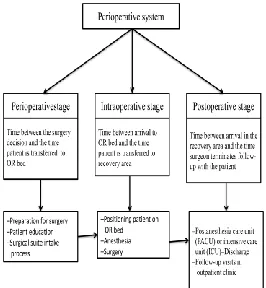
Surgery may be based on two types (i) an inpatient and (ii) an outpatient. In the hospital outpatient setting, patients are admitted to the hospital and leave the hospital on the same day of surgery. In such cases the patient gets recovery from home. In the inpatient setting, patients may come on the day of surgery or they are assigned to a hospital bed before the day of surgery. Inpatients stay in the hospital to get recover one or more days following surgery. In spite of to increasing volume, many outpatient surgeries are now performed in ambulatory service centers (ASCs), which are distinct from hospitals. ASCs include an intake area, often several Operating Rooms (ORs), and a recovery area. Unlike hospitals, ASCs are not best for emergencies or overnight stays and most of them are open 8-10 h a day. The overall surgery process involves in three activities (1) before, (2) during, and(3)after namely preoperative, intraoperative and postoperative stages. Fig 1 represents these stages of system. The Preoperative care starts with the patients and surgeons decision to have surgery. It may involve a visit to a preoperative clinic where an examination and follow up tests may be completed. The patients should come at the hospital or ASC at a reassignedtime. A number of administrative activities may be required, and the patient may require a health check-up or medical tests (e.g., blood test) before surgery. Intraoperative care represents the activities performed in the operating room(OR). After surgery, the postoperative
stage starts the patients are admitted to a recovery area such as a PACU or ICU relatedon the nature of the surgery. In the case of inpatient surgery, the patient may come back directly to their hospital bed. The complete surgery process ends when a patient has fully recovered. Then health check-up may take each weeks, months or even years. In this process , we focus on activities performed in the surgical suite on the day of surgery., this is often a bottleneck in the overall process.
Many characteristics of the OR environment are the same whether the surgery is performed in a hospital or in an ASC. A typical surgical suite is composed of several individual ORs sharing resources such as an equipment storage area, sterilization resources,
196 Preoperative intake, and postoperative recovery
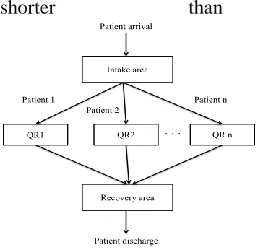
rooms. Depending on the type of surgery, some operating rooms might have different technological resources. For instance, some types of cardiac surgery require cardiopulmonary bypass equipment. In some cases, these special resources may be dedicated to the ORs, while in others they may be mobile and transferred between ORs as needed. The design and layout of a surgical suite can influence surgery scheduling. Traditional surgical suites have separate intake, surgery, and recovery areas. The patients enter the intake area, progress to surgery, and then eventually transition to a separate recovery areas. Figure 2 illustrates the patient flow through this type of a surgical suite. More modern designs have experimented with a common intake and recovery area. The patient is allocated to a room, referred to as a pre/post room, where the intake process is carried out. The patient is subsequently taken to surgery, and then returned to their pre/post room after surgery (GulS,Denton BT, Fowler Jet al).The process for scheduling surgeries may differ from one hospital or ASC to another. One common system used by many hospitals is known as block-booking. In a block-booking system, blocks of uninterrupted OR time are reserved for individual surgeons or surgical specialties in a periodic (often weekly or monthly) schedule. Surgeons book cases in to their allotted block time only if the surgery can be completed within the assigned time (or if an administrative exception is granted. The amount of block time is based on the surgeon’s historical Operating Room usage or some other performance criteria. Surgeries are scheduled on a first - come –first-serve basis until either a maximum number of cases is reached or a predetermined Operating Room capacity (planned available time) is
reached (Ozkarahan.I).
In both block-booking and open-booking systems, a detailed schedule of surgeries is generated which includes surgery to Operating Room assignments and estimated start times. On the day of surgery, the schedule (whether based on block-booking or open-booking) is revised by the Operating Room manager (often an anesthesiologist or the head nurse) throughout the day to accommodate additional add-on cases, and to compensate for cases ladd-onger or
shorter than expected.
Fig. 2.Patient flow through a surgical suite.
Furthermore, within the same surgical suite, some ORs may strictly follow a block-booking system, whereas others may follow an open-booking system. Managing a surgical suite is difficult because it involves many levels of decision making that affect or the affected by surgery scheduling systems (Dexter F,Trub RD). Strategic decisions take place over long time periods (e.g., one year) and include decisions such as whether to use an open-booking or block-blocking system, major capacity decisions such as the number of ORs to utilize, investment in new technology, and the number and type of staff to employ. Tactical level decision making involves reserving OR time and capacity for surgical specialties, finding an efficient surgery mix, and determining how much time to plan for each type of surgery. These decisions involve balancing the cost of allocating too much time which causes idle time both for the OR and the staff with the cost of allocating too little time which may result in overtime. Operational decisions involve continuous surgeries in a particular OR, estimating start times for individual surgeries (Strum DP), and setting appointment times for patents to arrive for surgery so as to minimize on-site waiting and achieve high patient satisfaction. In addition, decisions about how to manage add-on cases, and whether to cancel scheduled cases must be made on the day of surgery (Dexter F, Epstein RH).
2. COMPLICATING FACTORS IN SURGERY SCHEDULING
surgical procedures themselves and has also been reported for preoperative and postoperative time in ASCs (Gul S, Denton BT). Preoperative time, for instance, can depend on many factors including whether the patient requires some prescreening (e.g., a patient with diabetes might require a blood test before surgery) or if the patient requires a translator. The surgery itself can be highly uncertain in duration. Factors affecting surgery include the type of procedure, physical characteristics of the patient such as body-mass-index, age, gender, and the surgical environment (e.g., academic vs. nonacademic medical center or hospital vs.outpatient procedure center) (Strum DP ,May JH). Uncertainty in postoperative time can result from the outcome of surgery and the patient’s response to anesthesia. Previous research indicates that surgery duration and anesthesia duration often fit a lognormal distribution(Strum DP). Although perfect prediction of surgery durations is impossible, improved estimates can have a positive impact on costs associated with underutilization and overutilization of
the surgery suite.
Another complicating factor in surgery scheduling is the uncertainty in the number of patients to be scheduled on a particular day. Surgery at hospitals can be divided into two major categories such as elective and nonelective cases (Cardoen B, Belien J). For elective cases, surgery may be planned well in advance (e.g., months) to be performed on a future date. For nonelective cases, on the other hand, the surgery is unanticipated. These cases must be worked into the existing schedule, either by using intentionally reserved or otherwise available space in the schedule, or by creating space by canceling elective cases. Some hospitals allocate separate ORs for emergencies and add-ons, whereas others allow slack time in the schedule (Gerchak Y, Klassen KJ). Other causes of uncertainty in the number of surgeries on a particular day include patient punctuality, no-shows, or cancellations (Basson MD). Outpatient settings are more affected by patient punctuality and no-shows. In inpatient settings, due to the greater complexity and risk of surgery, cancellations are a significant source of uncertainty. For instance, a cancellation may occur due to unexpected changes in the patient’s medical status. Variation and uncertainty in daily surgery mix is another complicating factor due to the varying resource requirements for different types of surgery. Hospitals often control the mix by allocating OR capacity to specific surgical groups (e.g., thoracic, orthopedic, and colorectal). Such allocation, often called block-booking, is done based on historical
utilization by surgical groups. Surgical suites have high fixed costs, the large proportion of which are and other critical resources. The recovery are can also be the bottleneck for the surgical suite at certain times of the day. Therefore, resources such as PACU, ICU, and other hospital beds required after surgery and staff should be considered during the scheduling process (Marcon E).High fixed costs encourage scheduling a sufficient number of cases to fully utilize capacity on the day of surgery. This pressure combined with complex interdependency between activities, and the need to schedule a large number of activities with uncertain duration within a fixed time during the day makes for a very challenging scheduling problem. Not surprisingly, much of the literature has focused on stochastic models (e.g., discrete-event simulation, queuing, stochastic programming, and Markov decision processes). In the next section, we provide a detailed review of the relevant literature on surgery scheduling.
3. LITERATURE REVIEW
Surgery scheduling has been a widely studied topic in the medical and operations research fields. There are a number of previous literature reviews related to surgery scheduling. An early review (Blake JT) focuses on classifying the previous research based on various stages of decision making, performance measures such as OR utilization and costs, and the scheduling process. A more recent review article provides detailed classifications based on surgery durations (deterministic or stochastic), patient arrivals (effective and nonelective), and operations research methodology (Cardeon B). Previous reviews of literature on general health care appointment scheduling (e.g., primary care clinics (Cayirli T) are also relevant to surgery scheduling. In our review, we emphasize recent studies that consider new and important aspects of surgery scheduling systems. We categorize the literature based on the type of OR methodology used, and use our literature review to identify opportunities for future research which we summarize in the section titled ―Open Challenges and
198 There have been numerous queuing-based studies
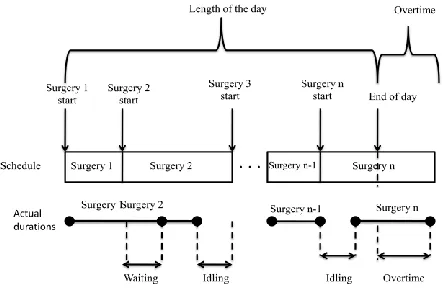
presented over the past several decades on the problem of scheduling patients for surgeries and outpatient clinic appointments (Weich J). Queuing research has focused on single server problems for which appointment decisions are economically significant. Although not directly applicable, scheduling problems from other contexts (e.g., manufacturing lines and other service systems) are also relevant to surgery scheduling. Much of this research is relevant to single-OR scheduling with open-booking systems. The aim of the single-OR scheduling problem is to assign start times for a certain number of surgeries to be scheduled on a particular OR on a given day. The scheduler must consider the variability in surgery durations. Clearly, the amount of waiting and idling between surgeries will be impacted by the choice of start times. Also, depending on the planned OR time, some overtime may occur at the end of the day. Fig. 3.demonstratesthe situations when these conditions occur in an OR. The section titled ―Example‖ provides a specific example in this context.
Fig. 3.Single OR scheduling problem. The scheduler selects surgery start times. The solid line depicts one possible scenario which includes some waiting, idling, and overtime.
In the above referenced queuing literature, the authors assume an infinite horizon and stationary service and arrival processes which are not typical in surgery scheduling environments. Some researchers propose more realistic queuing models with a finite horizon. For instance, (Brahimi and Worthington) develop a queuing system with a time-dependent Markovian arrival rate and discrete service time distributions (M(t)/G/s queue) where the number of customers at any time is assumed to be finite.(Wang) studies the scheduling problem both as a static scheduling problem in which a finite number of
customers are scheduled at once, and as a dynamic scheduling problem in which an additional number of customers are scheduled one at a time after an initial batch of customers have been scheduled. He uses phase-type distributions to investigate the transient solution of a Markovian server with general arrival distribution (S(n)/M/1 queue) to determine optimal start times for each customer.Vanden Bosch and Diets present a queuing model with phase-type service durations and deterministic arrivals where patient no-shows are also considered. In their study, patients are classified into different groups depending on their service durations. Analyzing the special structure of the model, they propose an algorithm which is guaranteed to find the optimal schedule along with the optimal sequence efficiently. Although not directly applicable to surgery scheduling, it is worth mentioning the recent study by (Zend et a)l. on over-booking in clinical appointment schedules to reduce the negative impact of no-shows. The authors develop a queuing model with patients having different no-show probabilities. They propose that overbooking is beneficial for open-booking systems, and they demonstrate that clustering patients according to their no-show probabilities will produce
better schedules.
Queuing models offer valuable general insights about the effect of uncertainty on scheduling decisions. They also have several shortcomings in the context of surgery scheduling. Some of the queuing articles referred above assume that the system reaches steady state. However, surgical suites typically operate for some specific period of time during the day (e.g., 8-12h) after which a small number of ORs are available for emergencies. Thus, the system is terminating, and the steady-state assumptions is a significant approximation that has not been carefully validated. Queuing models also often require string assumptions such as exponentially distributed surgery durations, which is not reasonable for most types of surgery that tend to better fit a lognormal distribution(Strum DP).
3.1. Simulation Model
in a single server system. They propose that the performance of the scheduling rules are affected by the environmental conditions of the operating environment such as the probability of no-shows, 50 different rules with several different combinations of the three environmental conditions. They present the Pareto set of scheduling rules with respect to expected idle time of the server and expected patient waiting time. Many researchers have used simulation methods to analyze more complex multi-OR surgical environments with recovery areas. (Schmitz and Kwak), for example, used simulation to analyze a multi-OR surgical suite with recovery rooms to determine the n bed of ORs to open on a day given that the number of surgeries to be performed is known. They also study the impact of an increase in the number of ORs on recovery room usage and determine the need for recovery room capacity given that some of the surgeries are done in the outpatient setting.( Lowery) simulates patient flow through a hospital's critical care units including ORs, ICU,and PACU beds to determine the bed requirements for
these recovery units.
Simulation methods have been widely used for testing the performance of scheduling heuristics. In (Gul S), a discrete event simulation model is developed for a newly designed outpatient surgical suite to study the impact of scheduling and start time heuristics and the daily surgical mix on the expected patient waiting time and overtime. The authors tested the performance of seven combinations of OR allocation heuristics and sequencing rules such as scheduling surgeries according to longest processing time first (LPT), shortest processing time first (SPT), increasing variance (VAR), and increasing covariance (COV), and found that in general LPT and combination of LPT and VAR rules (LPT— VAR) perform better than other rules. The authors also found that arrival time schedules and daily surgery mix have significant effects on the performance measures while scheduling rules have smaller effects on the performance measures. The authors also compare the performances of the heuristics with a bi-criteria genetic algorithm which finds near optimal solutions.Examining a surgery planning from a strategic perspective, (Everett) developed a decision
support system based on a discrete event simulation model to analyze the waiting times of surgery patients in a public health-care system with multiple hospitals in Australia. His model includes a single list for all surgical patients categorized by urgency and surgery type and can be used to match availability of the hospitals' and patients' needs. This simulation model considers each hospital as an entity in a large health-care system which may reflect the publicly funded health systems, such as in Canada, United Kingdom, and Australia, where there is more centralized control over the assignment of patients to health providers. The article provides evidence that the health-care policies used in different countries may influence the process as well as the efficiency in surgery scheduling.Simulation models have generally found wide usage in the area of surgery planning and scheduling. Their flexibility allows them to consider many important factors relevant to complex surgical suites. Furthermore, they are descriptive models, meaning that they can be used to compare alternative policies or rules for planning and scheduling. However, there are also some shortcomings. First, they are computationally intensive. Secondly, gen-erating results can be time-consuming compared to queuing models for which analytic solutions are available. A third important shortcoming of simulation models is that they do not provide optimal solutions.
3.2. Optimization models
200 procedures. They propose that add-on and
emergency surgeries can be scheduled by adding new constraints using job insertion. Job insertion inserts new surgeries into the established schedule and bumps some elective surgeries to the following day, if necessary, to perform emergent surgeries (Fei et al) 25 have developed an integer programming (IP) model to assign elective surgeries with deterministic durations into multiple ORs. The objective is to minimize the weighted sum of overutilization and underutilization of ORs. They solve instances optimally with a branch and price algorithm.There are also a number of stochastic opti-mization models for surgery scheduling. The majority assume a single OR, and determine optimal start times for surgeries (see Fig 3).( Weiss) provides the optimal start times for a simple two-surgery problem with uncertain two-surgery durations in a single OR. Balancing surgeon's idle time and scheduling surgeries that have distributions with ―fatter‖ tails first results in higher total expected costs of waiting and idling due to the impact on the followingsurgery.(Denton and Gupta) study a general two-stage stochastic linear programming formulation of the single server appointment scheduling problem. They determine the optimal start time for surgeries. The criteria in their model are expected patient waiting time, expected OR idle time, and expected overtime with respect to a defined length of day. They develop an iterative approximate method based on upper and lower bounds on the optimal solution to the problem with continuously distributed surgery durations. More recently, (Begen and Queyranne) studied the same problem with random service durations given by a joint discrete probability distribution. They prove that there exits an optimal appointment schedule which is integer and can be found in polynomial time. (Gerchaks et al) use a stochastic dynamic programming model for a multi period surgery scheduling problem. In particular, they use a Markov decision process to investigate the optimality of using cut-off policies in an open-booking system. Cut-off policies suggest rejecting future elective cases in order to be able to accept
possible emergent surgeries if a certain number of ORs are already occupied by elective cases. The authors show that these cut-off policies are not necessarily optimal; however, they are typically close to optimal. (Lamiri et al) propose a stochastic model for scheduling elective surgeries over a planning horizon, however, they consider OR capacity for both elective and add-on patients. They use simulation to generate samples for emergency surgeries. The samples are used to estimate deter-ministic capacity requirements for an MIP model that minimizes total overtime costs and other costs associated with hospitalization, and penalties for waiting time of the patients, violating patient's and surgeon's preferences and deadlines. Their model is solved via branch-and-bound algorithm and then compared to the solution of a simulation optimization approach. The authors conclude that simulation optimization offers improvements even
for small sample sizes.
computationally harder and sometimes impossible for large-scale realistic scheduling problems. Developing efficient stochastic optimization methods to solve larger and more realistic problems, which consider multiple ORs and other critical resources in the surgical suite, remains as an open challenge for researchers.
3.3. Heuristic Methods
As described in the previous section, the stochastic and combinatorial nature of surgery scheduling problems gives rise to computationally challenging optimization models. Many researchers have addressed this problem by proposing fast heuristics. This enables consideration of more complex and more realistic systems such as a multi-OR surgical suite with recovery rooms.
(Belien and Demeulemeester) propose a simulated annealing approach as well as several different MIP heuristics to create a master surgery schedule for a block-booking system with the objective of minimizing the expected shortage of beds. Their MIP heuristics involve solving a number of MIPs, which aim to minimize the maximum expected duration, maximum expected bed occupancy, and maximum weighted sum of mean and variance of the daily bed occupancy respectively. Their simulated annealing approach, on the other hand, starts with a random surgery block and does pairwise exchanges of blocks to find an improved schedule with respect to bed shortage. Bin-packing algorithms have been widely used to find the mix of surgical cases for multi-OR surgical environments this context, the ORs are available for a fixed time during the day, and represent the bins. The surgeries, which have an estimated duration, are the items to be packed in the bins.There are two types of bin-packing problems that have been studied: on-line and off-line. In the on-line bin-packing problem, urgent surgeries are scheduled sequentially one at a time. Many heuristics have been proposed for this problem. One well-known heuristic, called best fit, schedules surgeries into the OR which has the least amount of remaining time that is sufficient to fit the case. Another heuristic, called worst fit, schedules the surgery into the emptiest OR which has enough time to fit the case.
In the off-line version of the bin-packing problem, surgeries are batched and simultaneously assigned to ORs. LPT is the best-known heuristic for off-line bin packing. To apply LPT, surgeries are sorted based on their mean durations and then assigned sequentially to the ORs.They found that
off-line algorithms are able to fit more add-on surgeries and in particular best fit descending with special constraints is more likely to maximize OR utilization. (Hans et al) study the bin-packing heuristics with the portfolio effect to consider the uncertainty in surgery durations. Portfolio management is used to reduce the risk (minimize variance) or increase the profitability (maximize expected return) by distributing the investments into various different projects instead of investing in a single project. They propose both constructive and local search heuristics to minimize the total planned slack time between surgeries depending on the variances of different surgery durations. They found that, as a result of the portfolio effect, surgeries with similar duration variability are often scheduled on the same day for each specialty. In general, heuristics provide a powerful trade-off between descriptive models, such as simulation and queuing models, and prescriptive (optimization) models for problems that are very computationally challenging. The main shortcoming of heuristics is that they do not necessarily provide an optimal solution and it is often difficult to develop good bounds on their performance.
4. EXAMPLE
In this section, we provide a small stochastic programming example on surgery scheduling. In this example, we consider a problem similar to the one illustrated in Fig. 3 with five surgeries to be scheduled on a given day. Surgery durations are distributed uniformly between 60 and 120 min. The length of the day is assumed to be 450 min. The optimal start times for the surgeries can be found by solving the following minimization problem:
{ [ ∑ ]} (1)
Eq. (1)
202 The optimal solution to this two-stage stochastic
programming problem is
X1 = 95.11,x2 = 99.73,x3 = 99.40,x4 = 96.01 which means that after first surgery is scheduled at time zero, second one will be scheduled at time 95.11, third one at time 194.84, fourth one at time 294.24, and the last one at time 390.25. The total expected waiting time plus overtime cost of this solution is 65.39.A common practice is to set xi equal to the mean of the duration distribution estimated based on historical data. Stochastic programming takes this uncertainty into account by sampling surgery duration scenarios to find a near-optimal solution which works well on average across all the possible scenarios. For this particular example, 10, 000 different duration scenarios were used to find the optimal solution. If the mean value solution was used for this example, the total expected waiting time plus overtime cost would be 79.93, which is 22% higher than the total cost of the stochastic programming solution. Note that the optimal solution trades off expected waiting time cost and idle time cost, which are competing performance measures. For instance, short allowances tend to result in longer waiting time but shorter idle time. Alternatively, long allowances tend to result in shorter waiting times and longer idle times.
5. OPEN CHALLENGES AND FUTURE WORK
In this article, we have so far provided an overview of important aspects related to surgery scheduling and a discussion of some of the most significant complicating factors. Surgery scheduling has been a topic of investigation for several decades. However, there are many open research areas and opportunities still to be explored. We describe some of these below.Most of the above referenced literature focuses on the design of daily schedules prior to the day of surgery. Little effort has been spent on developing rules for real time scheduling on the day of surgery. This is a common problem that OR managers have to face every day to manage the deviations caused by the surgeries that run longer or shorter than anticipated. In addition to the daily operational level scheduling problem, there are also aspects of long range surgery planning and scheduling that need more attention. Despite the rich literature considering the uncertainty in surgery durations, demand uncertainty is still largely unexplored. For instance, uncertainty in patient no-shows, case cancellations, and the addition of add-on cases to schedules on short notice can all have significant impact on surgery
schedules.
Most research has assumed that a fixed number of elective cases are to be scheduled. Uncertainty in demand from day to day can have a significant impact on surgery schedules resulting in substantial delays or cancellations on the day of surgery. Other causes of uncertainty such as unpredictable internal demand on recovery room resources on the day of surgery (e.g., ICU beds) are also in need of study. Another research area that needs further attention is the design of surgical suites and processes within and around the OR. This has emerged as a way to increase OR utilization by reducing nonoperative time and increasing throughput. For example, (Sandberg et al.) proposed a new OR suite design called OR of the future (ORF) for technologically intensive surgeries with an intake room and early recovery room attached to the OR. They are motivated by the goal of performing some of the preoperative and postoperative processes in parallel to increase throughput overtime. With this new structure, the goal is to perform anesthesia induction in the induction room while the OR is prepared for surgery. Early recovery is provided by an additional preoperative nurse, while the anesthesia personnel can move to the intake of the next patient. Further study is needed to analyze the impact of new designs, which will likely lead to opportunities to improve the efficiency of surgery scheduling. In this article, we have discussed the basic concepts related to surgery planning and scheduling as well as the surgical environment and the resources. Though this is a very well-studied subject, there are still significant opportunities to improve.
REFERENCES
[1] Gul S, Denton BT, Fowler J, et al. Bi-criteria scheduling of surgical services for an outpatient procedure center. Working Paper.
[2] Askrahan I.(2000): Allocation of surgeries to operating rooms by goal programming. J Med Syst ;24(6):339-378.
[3] Dexter F, Epstein RH, Traub RD, et al(2004): Making management decisions on the day of surgery based on operating room efficiency and patient waiting time. Anesthesiology ;101(6):1444-1452.
times: comparison of log-normal and normal models. Anesthesiology ;92(4):1160-1167.
[5] Strum DP, Sampson AR, May JH, et al.(2000): Sur-geon and type of anesthesia predict variability in surgical procedure times. Anesthesiology ;92:1454-1466.
[6] Gerchak Y, Gupta D, Henig M.(1996): Reservation planning for elective surgery under uncertain demand for emergency surgery. Manage Sci ;42(3):321-334.
[7] Klassen KJ, Rohieder TR.(2003): Outpatient appointment scheduling with urgent clients in a dynamic, multi period environment. Int J SeryInd Manage ;15(2):167 -186.
[8] Beason MD, Butler TW, Venue H.(2006) Predicting patient nonappearance for surgery as a scheduling to optimize operating room utilization in a veterans' administration hospital. Anesthesiology ;104(4):826-834.
[9] Marcon E, Dexter F.(2006) Impact of surgical sequencing on post anesthesia care unit staffing. Health Care Manage Sci;9: 87-98.
[10]Blake JT, Carter MW.(1997): Surgical process scheduling: a structured review. J Health Syst;5(3):17-30.
[11]Cayirli T, Veral E.(1964): Outpatient scheduling in health care: a review of literature. Prod Oper Manage 2003;12(4):519-549.
[12]Welch J. Appointment systems in hospital outpatient departments. Oper Res Q ;15:224-237.
[13]Mercer A.(1960): A queuing problem in which the arrival times of the customers are scheduled. J R Stet SocSer B ;22(1):108-113.