SRINIVASA, GOPAL RANGANATHA. Abstraction-Based Static Analysis of Buffer Over-runs in C Programs. (Under the direction of Associate Professor Dr. S. Purushothaman Iyer).
Bounds violations or buffer overruns have historically been a major source of de-fects in software systems, making bounds checking a key component in practical automatic verification methods. With the advent of the Internet, buffer overruns have been exploited by attackers to break into secure systems as well. Many security violations ranging from the 1988 Internet worm incident to the AnalogX Proxy server vulnerability have been at-tributed to buffer overruns. Programs written in the C language, which comprise most of the systems software available today, are particularly vulnerable because of the lack of array bounds checking in the C compiler, presence of pointers that can be used to write anywhere in memory, and the weak type system of the C language.
Many methods have been proposed to detect these errors. Runtime methods that detect buffer overruns suffer from significant overhead and incomplete coverage, while com-pile time methods could suffer from low accuracy and poor scalability.
In this thesis, we propose a new technique for bounds checking based on data abstraction that is more accurate, more scalable, and suffers from no runtime overhead. Enhancements have been made to C Wolf, a suite of model generation tools, to handle buffer overflow analysis.
by
Gopal Ranganatha Srinivasa
A thesis submitted to the Graduate Faculty of North Carolina State University
in partial satisfaction of the requirements for the Degree of
Master of Science
Department of Computer Science
Raleigh
2003
Approved By:
Dr. Matthias F M Stallmann Dr. Daniel C DuVarney
Biography
Acknowledgements
This thesis wouldn’t have been possible without the support and guidance of my advisor, Dr. Purushothaman Iyer, who with a great deal of patience and kindness helped me through out the duration of this work. Many thanks are due to Dr. Dan DuVarney, for his help with ML, the C Wolf system, and almost everything else I asked him for. I am also grateful to Dr. Peng Ning and Dr. Matt Stallmann for their advice on some key aspects of this thesis. I take this opportunity to thank the faculty and staff at NCSU, particularly in the Computer Science department, for their help, advice and support.
Contents
List of Figures vii
List of Tables viii
1 Introduction 1
1.1 Buffer Overrun Vulnerabilities in C . . . 4
1.2 Research Goals and Contributions . . . 7
1.3 Conventions . . . 7
1.4 Thesis Outline . . . 7
2 Related Work 9 2.1 Runtime Bounds Analysis . . . 9
2.2 Static Bounds Analysis . . . 10
2.2.1 Syntax-Based Analysis Techniques . . . 11
2.2.2 Constraint Solving Techniques . . . 12
2.2.3 Annotation-based Techniques . . . 14
2.3 The Case for Abstract Interpretation . . . 15
3 Principle 17 3.1 The Abstraction Map . . . 18
3.2 Model Generation . . . 20
3.3 Buffer overflow detection . . . 21
3.4 Dynamically allocated arrays . . . 24
3.5 Partial order analysis . . . 26
4 Theory 35 4.1 The char and char array abstractions . . . 35
4.2 The Dynamic Range Abstraction . . . 36
4.3 Dynamic Range Conversions . . . 37
4.4 Dynamic Range Operators . . . 38
5 Implementation 39
5.1 Partial Order Table . . . 39
5.2 Dynamic Range Abstraction . . . 40
5.3 Design of the char array abstraction . . . 40
5.4 Structures . . . 43
6 Results 45 6.1 Analysis of Web2c . . . 46
6.2 Analysis of the Pico Server . . . 48
6.3 Analysis of the FTP daemon . . . 49
7 Conclusions and Future Work 51 7.1 Enhancements . . . 52
7.2 Summary . . . 53
List of Figures
1.1 Possible stack layout after a function call . . . 2
1.2 Overwriting the return address with an attacker’s return address . . . 3
1.3 Subverting a kernel process to get root access . . . 3
1.4 Possible buffer overflow in strcpy as implemented in C . . . 5
1.5 A security violation caused by a buffer overflow in a string operation . . . 6
2.1 Program for which metacompilation reports false positives . . . 12
2.2 Code fragment for which metacompilation reports false negatives . . . 13
2.3 Undetected buffer overflow while using BOON . . . 13
3.1 Schematic diagram of the C Wolf system . . . 17
3.2 Determining array sizes in C Wolf . . . 19
3.3 For loop that results in redundant bounds checks . . . 22
3.4 Model generated for the for loop withintabstraction . . . 23
3.5 Model generated for the for loop with the dynamic range abstraction . . . . 25
3.6 Program fragment with a complexexpression . . . 29
3.7 Partial order table for program in Figure 3.6 . . . 29
3.8 Partial order table of Figure 3.7 after transitive closure . . . 30
3.9 Partial order table of Figure 3.8 after the temporaries are removed . . . 30
3.10 Function call that updates the partial order table . . . 31
3.11 Partial order table for the code in Figure 3.10 before the function call . . . 32
3.12 Partial order table for the code in Figure 3.10 at the start of the function . 32 3.13 Partial order table for the code in Figure 3.10 before the function return . 33 4.1 Application of the abstraction and concretization functions . . . 37
List of Tables
3.1 C Wolf Abstractions . . . 18
3.2 Relational operators and dynamic range variables . . . 24
3.3 Rules for partial order arithmetic . . . 27
4.1 Mathematical notation used in this thesis . . . 35
4.2 Dynamic range operations . . . 38
6.1 Results of some C Wolf runs . . . 45
6.2 Comparison between cleanness checking and data abstraction . . . 48
Chapter 1
Introduction
Buffer overruns, also known asbounds violations, have been a major source of soft-ware errors and security holes for many years, making bounds checking an important aspect of practical software verification techniques. Buffer overruns are caused by unintentional accesses to memory outside of the storage allocated to hold the buffer contents. Typically, these errors are caused by programmer mistakes and insufficient language support to detect such mistakes. While earlier these errors were an annoyance, the advent of the Internet has metamorphosed buffer overruns from a nuisance into a major security threat. The Internet worm that infected thousands of computers in November 1998 used a buffer overrun vulner-ability in thefingerddaemon to replicate itself [39]. Data extracted from CERT advisories show that buffer overruns account for 27% of the entries in one vulnerability database [37] and for 23% in another [22]. Even thepassword disclosureerror in SQLBase 8.1.0 has been attributed to a buffer overflow [34]. A random sample of the vulnerabilities posted in the Security focus website [34] revealed that in four days, of the twenty security violations re-ported for UNIX systems, six were caused by buffer overruns. Many security holes in the popular wu-ftpd server, including some that even allowed attackers to start a shell on the server, have been traced to buffer overruns in the FTP daemon [34]. Even though the vul-nerabilities were found on all major platforms and operating systems, they are commonly caused by the reliance on non-typesafe languages, such as C and C++.
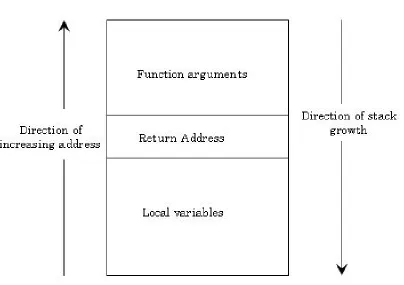
Figure 1.1: Possible stack layout after a function call
along with the local variables of the callee and the arguments passed to it (Figure 1.1). In order to gain control over the system, an attacker can use buffers to traverse down the stack and overwrite the return address. This is accomplished by supplying a buffer with more data than the buffer is allocated to hold. The extra data overwrites memory beyond the end of the buffer, obliterating the contents of the other local variables and then the saved return address. This is called stack smashing [29], and it allows an attacker to replace the return address on the stack with the address of a malicious function that can compromise system security. Thus, when the callee finishes execution, it returns control to the malicious function, allowing the attacker to take control of the system. For example, the code shown in Figure 1.2 is susceptible to stack smashing, particularly since the data requested from the user is not sanity-checked before using it in the program. An attacker could gain control over the system by passing a string large enough to overflow the buffer
buff and overwrite the saved return address.
void main ( ) {
char buff[MAXLEN];
char* ptr = get_data_from_network(); copy_into(buff, ptr);
}
Figure 1.2: Overwriting the return address with an attacker’s return address
- a combination of programmer error and lack of runtime bounds checking. In the example, while the programmer has failed to check the data supplied by the user, the language (in this case C), exacerbates the problem by not detecting the buffer overrun when it occurs.
Buffer overruns can be also be used to gain root access in operating systems like UNIX and Windows NT as they support root-privilege processes. A normal user can subvert these processes by causing a buffer overflow and gain root access to the system. Figure 1.3, taken from [2], shows a function in one such process. The function reads an integer from user space through the copy from user function and uses the integer as an index into an array of frames, without sanitizing it first. A malicious user can pass an illegal index to the function causing a buffer overflow. The process then aborts, exiting into the root shell, giving root access to the user.
if (!copy_from_user(&frame, arg, sizeof(int))) return -EFAULT;
ret = se401_newframe(se401, frame);
se401->frame[frame].grabstate=FRAME_UNUSED; /* unsanitized
array index */ return ret;
Figure 1.3: Subverting a kernel process to get root access
un-predictable behavior. In networked systems, buffer overruns can be used by malicious users to write to any file or to run any command on the compromised system.
1.1
Buffer Overrun Vulnerabilities in C
The C language [6, 20] is a popular language used for a variety of programming tasks - from the development of the UNIX operating system to the development of real-time software that controls flight-guidance systems. C is popular because of its efficiency, porta-bility, closeness to the hardware and the presence of many features that give programmers more control over the system than most other languages. The efficiency and control however, come at the expense of type-safety and memory-safety, which is not ensured. Furthermore, the control provided is much more than most programmers can handle, as evidenced by all the memory-related programming errors, including buffer overflows, memory leaks and dangling pointers. To provide for efficient runtime behavior and a small memory footprint C provides minimal runtime support, which excludes checking for memory-related errors. This makes memory errors go undetected by the compiler and the runtime environment, allowing attackers to write into the program stack ,heap or static storage areas. For exam-ple, in a language like Pascal the code of Figure 1.2 would cause a runtime exception when a string longer than MAXLENis encountered, whereas the runtime environment of C would let it through, allowing the attacker to take control of the system.
The treatment of strings in C allows for many more exploits. C does not provide users with a standard, bounded string data type. Programmers have to create strings by treating them as arrays of characters. These arrays, like arrays of other types in C, are not bounds checked making the program unsafe. Further problems are caused by the strings being bound not by the length of their buffers, but by a specialnullcharacter. As a result, string manipulation functions in the standard C library manipulate strings by checking for this character, presenting many opportunities for buffer overruns when the arguments to these functions do not have the null character. For example, the C string library function
char* strcpy (char*d, char*s) {
while ( (*d++)=(*s++) ) ; return d;
}
Figure 1.4: Possible buffer overflow in strcpy as implemented in C
poses the threat of multiple buffer overruns that may be caused either by the destination string being allocated lesser memory than the source or by the source string lacking the terminating null character. In fact, in the second case, it would be possible to completely overwrite the contents of the entire available memory if the operating system does not employ protection mechanisms.
Strings are therefore a primary culprit responsible for many of the buffer overruns in C programs. A study done on UNIX systems [26] traced nearly 30% of buffer overruns to errors in string manipulation functions. Even though strings and string manipulation functions are inherently unsafe, every practical C program has to use strings as strings are required to store user data, read from pipes, ports, and files, and to interact with the operating system. Even though some string functions like strncat and strncpy are safe, the return values of these functions can be non-null terminated, leading to overruns in subsequent sections of the program.
Another example of a security violation caused by a buffer overflow in a string manipulation function, taken from the RSA website [31], is shown in Figure 1.5. If the password passed to the program is larger thanMAXPWDLEN characters, the strcpyfunction could overwrite thepasswd okvariable with one of the characters in the entered password, thus allowing the user access to the system even when the password is incorrect.
int main(int argc, char *argv[]) {
char passwd_ok = 0; char passwd[MAXPWDLEN];
strcpy(passwd, argv[1]);
if ( check_passwd(passwd) == PASSWD_OK ) passwd_ok = 1;
if (passwd_ok) { ...
} }
Figure 1.5: A security violation caused by a buffer overflow in a string operation
new vulnerabilities. In order to conserve memory, the implementation allows two of these pointers to overlap user data. The pointers are erased if a block is freed twice, and when the doubly linked list is updated during the second free, an arbitrary memory location gets overwritten. This is called the double free attack [1]. A similar attack, called the heap overflow attack, can be used to change the pointers in the allocation list used by
malloc [23]. The strategy used here is to overflow the allocated buffer so that the extra data overwrites the pointers of the next entry in the list. Another class of attacks, called theinteger overflowattacks, utilize the weak-type system of the C language to cause buffer overflow. Such attacks are effective in programs that allow users to decide the size of the buffers. Even if the program sanitizes the values before allocating the buffers, it is possible to bypass these checks by choosing the right values. For example, if a program typecasts a size to a short before passing it to malloc, choosing 65536 as the size makes the system cast it to zero, resulting in the program thinking that the buffer is 64Kbytes in size while in reality, it is much smaller [4].
viola-tions in C programs must offer the ability to check statically allocated buffers, dynamically allocated buffers, string manipulation functions, and pointer arithmetic.
1.2
Research Goals and Contributions
The primary goal of this thesis is to develop scalable tools and techniques for detecting buffer overruns at compile time. We have enhanced an abstraction-based model generation toolset called C Wolf for this purpose and achieved the following:
• Developed a technique for detecting buffer overruns using data abstraction • Enhanced the C Wolf toolset to detect buffer overruns using the above technique
• Added abstractions to minimize the increase in the number of states due to bounds analysis
• Performed experiments to validate the approach, and
• Compared our technique with the work of others and identified the trade-offs involved in each approach.
1.3
Conventions
Three basic fonts are used in this thesis. The first is the regular font, in which most of the text including this one is typeset. Computer programs, C expressions, and statements appear in theteletype font. Finally,italics are used to emphasize words, and are used when a term is introduced for the first time in the document.
Comments that explain important aspects of a figure are enclosed in (* *). Mathematical notations used in the document will be introduced in the relevant sections.
1.4
Thesis Outline
Chapter 3 outlines some of the guiding principles of the thesis,
Chapter 4 explains the theory behind the abstractions used,
Chapter 5 describes the implementation of the ideas proposed,
Chapter 6 details some of the results, and
Chapter 2
Related Work
Bounds checking or Buffer overflow analysis has been widely researched because of its implications for enhancing program reliability and security. Most of the work done in this field can be categorized into:
• Runtime analysis
• Static (compile-time) analysis
• Runtime analysis with compile-time support
2.1
Runtime Bounds Analysis
tested with the instrumentations and released without the instrumented code, while the instrumentation code introduced by StackGuard is retained even in the release versions.
Runtime tools have the advantage of being extremely accurate, detecting bounds violations exactly when they occur. They are programmer-friendly, and require little or no effort on the part of the developers who use them. Usually, the tools are activated by means of a compiler switch that lets them instrument the program and include the relevant libraries in the executable.
The tools however, are not without their drawbacks. The primary problem with tools like Purify and BoundsChecker is the lack of complete code coverage. While Purify and BoundsChecker do detect all the errors on the paths that have been covered by testing, errors on paths that are not covered go undetected. Furthermore, since Purify and BoundsChecker are essentially testing tools, their performance is dependent on the data being used to test the software. Thus, there is no guarantee of complete code coverage, nor is there a guarantee that the program has been tested with all possible inputs. In essence, these tools suffer from all the drawbacks of conventional software testing techniques. Undetected buffer overflows therefore remain in the program to be exploited by an attacker. The problems mentioned above can be avoided by releasing the instrumented versions of the source, but that comes with a very large penalty in terms of runtime overhead making the technique unsuitable for most systems.
Another problem with runtime checking is the little scope available for recovery. StackGuard simply terminates the program when it detects a stack smash attack. Pro-grams instrumented with Purify or BoundsChecker, if released with the instrumentations, terminate when the tool-inserted assertion statements fail. Clearly, this is not an option for operating system modules, servers, and software designed to run round-the-clock. In such systems, bounds analysis must be done earlier, preferably at compile time itself.
2.2
Static Bounds Analysis
compile time, they offer programmers the opportunity to insert checks that can handle overflow errors when they occur, thus avoiding the ungraceful termination problem endemic to runtime techniques.
Static analysis techniques that detect buffer overflows can be classified into: • Syntax-based analysis techniques. These techniques typically operate by
per-forming a syntax-based analysis of the program to detect buffer overruns. Syntax-based methods can be as simple as methods that simply report calls made to unsafe functions, or as complex as metacompilation, a technique that checks among other things, whether array subscript variables are sanitized before use [2].
• Constraint solving techniques. These techniques convert the bounds checking problem into a set of integer constraint problems for analysis. This category includes among others, the work on Cleanness Checkingby Nurit Dor et.al.[12], David Wag-ner’s work on developing BOON [39], and the work done by Radu Rugina and Martin Renard [32].
• Annotation-based techniques. These techniques use annotations supplied by the programmer to verify bounds safety. These include theSplinttool developed by David Evans et.al.[17] and CQual, developed by Foster et.al. [38]. Both use some form of programmer-annotations to check safety properties of C programs.
2.2.1 Syntax-Based Analysis Techniques
#define N 3 int arr[N]; int i = 0 ;
for ( i = 0; i < N; i++ ) {
arr[i] = 0; }
Figure 2.1: Program for which metacompilation reports false positives
The process is repeated every time the subscript is assigned a value, as a new assignment rolls back the variable from any of theuntainted,needs lborneeds ub states to thetaintedstate.
This technique, proposed by Dawson Engler, is simple, fast, and does not have any runtime overhead. A tool called xgcc developed using this principle, was successfully used to find many security problems in Linux and OpenBSD sources. However, the method has a potential problem in that there is no guarantee that the subscript has been checked against the right bounds. The method also does not take into account aliasing, nor does it handle difficult-to-find string manipulation errors. Further, many false alarms are also possible as some subscript variables might be within bounds, even if their bounds are not explicitly checked using conditionals. An example is given in Figure 2.1. Here, xgcc would report a bounds violation, stating that the lower bound is not checked, even though the lower bound for the array subscript is well within the array bounds. Also, a program like the one in Figure 2.2 would be reported as being safe, because the method is incapable of detecting that the subscript is being compared with the wrong bounds. Thus, metacompilation is not sound, though it scales well to large programs.
2.2.2 Constraint Solving Techniques
Constraint solving techniques typically convert the problem of analyzing buffer overruns into integer constraint problems that can be solved to verify bounds safety of programs.
#define N 3 int arr[N]; int i;
if ( i <= N && i >= 0 ) arr[i] = 0;
Figure 2.2: Code fragment for which metacompilation reports false negatives
abstract data type that has standard C functions likestrcpyandstrstras its operations. Furthermore, the technique uses the fact that for the purpose of buffer overflow detection, only the length and the size of a string need to be known. Strings are therefore modeled as integer pairs: one element of the pair representing the current length of the buffer and the other representing the number of bytes allocated to it(its size). A system of integer equations is generated from the code, and the system solved to determine bounds violations. Wagneret al. also developed a tool called BOON [5] to check C programs for buffer overflow vulnerabilities. The tool found many buffer overflow errors in the UNIXsendmailprogram and thenettoolspackage.
While this method is more accurate than metacompilation, it still suffers from many false positives and is also incapable of dealing with constructs like pointer aliasing. For example, the buffer overflow that occurs when a 13-byte string is copied into the 10-byte buffer t in the code of Figure 2.3 goes undetected by BOON. This happens because the analyzer is unable to detect that the pointerpaliases a location in the array s.
char s[20], *p, t[10]; strcpy (s, "Hello"); p = s + 5;
strcpy (p, "world!"); strcpy (t,s);
Figure 2.3: Undetected buffer overflow while using BOON
et al. [12], works by treating strings as an abstract data type. However, the method is more accurate and reports fewer false alarms. By performing pointer analysis, the technique is able to detect bounds errors in programs like the one in Figure 2.3. The analysis procedure can also be used to instrument the C program withassertstatements that detect bounds violations at runtime, though the ability comes at the cost of a larger memory footprint and increased execution time. Cleanness Checking has been tested on sources that were part of theweb2c software package with good results.
A serious drawback of this method, however, is the lack of inter-procedural anal-ysis. Large programs are analyzed using user-provided pre- and post- conditions for every procedure. Errors in the pre- and post-conditions may severely affect the static analysis procedure. Furthermore, the technique is incapable of analyzing structures and is slow and unscalable, with the static analysis of a 403-line program taking nearly 310 seconds and 99.5MB of RAM [12]. Results reported in [12] also suggest that the runtime overhead remains significantly high for many applications.
2.2.3 Annotation-based Techniques
Annotation-based techniques rely on programmer-provided annotations to verify bounds safety of programs. Annotations are similar to pre- and post-conditions, describing the intentions and assumptions of a programmer [17, 25]. Annotations can be applied to variables, function parameters and return values, indicating their properties.
David Evanset al. have implemented a tool called Splint [35] for detecting buffer overruns using such annotations. The tool provides standard annotations to describe the properties of variables, parameters to functions and return values from functions. For example, the annotation@notnull@when applied to a variablevindicates thatvcannot be null. Similarly, the @null@annotation applied to a variable vindicates that vcan be null. The annotations@requiresand@ensuresreflect the assumptions and intents of a function, while the annotations @maxSet and @minSet bind the range of values that can be used to index an array. Standard C library functions are provided with the correct annotations by the developers of Splint, while programmers are expected to provide annotations for their functions.
/*@requires maxSet(s1) >= maxRead(s2)@*/
/*@ensures maxRead(s1) == maxRead (s2) /\ result == s1@*/wheremaxRead repre-sents the length of the string. If any of the arguments passed to the function violate the
@requires constraint, an error is reported. Similarly, ifs1 ors2 are null, the tool reports a constraint violation.
While the tool found considerable success with wu-ftpd and BIND [17], the tech-nique suffers from the inability to incorporate control-flow information into the bounds analysis procedure, and uses standard programming idioms and heuristics to analyze the same. Furthermore, annotation-based techniques are cumbersome and error-prone, as wrong annotations can lead to misleading analysis results.
2.3
The Case for Abstract Interpretation
The preceding discussions indicate that a purely syntactic approach though scal-able, is not effective in solving the problem of identifying potential buffer overflows. Con-straint solving has the drawback that it is not scalable. Annotation-based methods are vulnerable to user errors and also lack sufficient information to handle many program con-structs. Furthermore, the above methods lack sufficient information at compile-time to correctly identify many kinds of buffer overflows. Clearly, the runtime value of data needs to be taken into account while performing static analysis. It is here that abstract inter-pretation can play a major role. Abstract Interpretation is the process of executing the statements of a program in an abstract domain. A mapping of values from the concrete domainto theabstract domain is provided, as is a mapping of the operations. These map-pings define the semantics of the program statements in the context of the abstract domain. Abstract Interpretation is used by model generation tools to generate models of programs. A model of the program thus obtained, can be checked for temporal and safety properties. Practical systems [3, 9, 15, 21] that use abstract interpretation to extract models from pro-grams have been built. Since the process of abstract interpretation is sound, properties that hold in the abstract domain hold in the concrete domain as well(provided the abstractions are correct). Bounds safety is one such property. It is therefore possible to identify potential buffer overflows by reasoning with the model; an approach we take in this thesis.
be-cause of size of the models involved. Many techniques have been used to reduce model size, which include predicate abstraction [3, 21, 33] and data abstraction [10, 7, 14].
Predicate abstraction, first proposed by Graf and Saidi [33], provides a means of combining theorem proving and model checking techniques by automatically mapping an unbounded system (called the concrete system) onto a finite state system (called the ab-stract system), which can then be verified using model-checking tools. Predicate abab-straction works by representing the values of a systems’ variables as assignments to a set of boolean predicates. The resulting program can be model-checked using specializedtools that are based on predicate abstraction [3].
Data abstraction [7], on the other hand, works by mapping the values of the systems’ variables onto a much smaller set of values based on how each variable is used in the system. A good example is the return value from the standard C string library function
strcmp. Thestrcmpfunction takes two strings as arguments and returns the difference of the first differing characters in them [20]. However, in most situations, programmers are only interested in knowing if the return value is negative(str1 < str2), positive(str1 >
str2)or zero(str1 == str2). The return value can therefore be abstracted to just three values, down from a possible 511 (assuming that the strings are in ASCII representation), effectively reducing the size of the state machine by 508 states. Techniques that use data abstraction to extract models from source code usually employ an abstract virtual machine (AVM) to interpret the given program in the abstract domain. The process requires that the user specify anabstraction mapthat maps values from the concrete domain to the abstract domain [14, 9].
Chapter 3
Principle
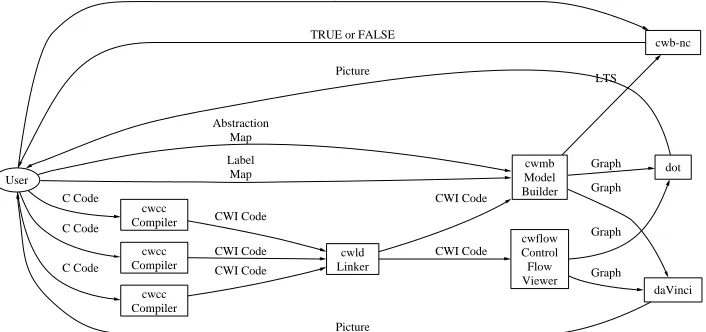
C Wolf is a suite of tools that takes a C program as input and generates a model for the program. The model is a labeled transition system and can be in one of text, graphical, or CCS formats. Figure 3.1, reproduced from [14], shows a schematic diagram of C Wolf.
User cwcc Compiler C Code cwcc Compiler C Code cwcc Compiler C Code cwmb Model Builder Abstraction Map Label Map cwb-nc Query about LTS
cwld Linker CWI Code CWI Code CWI Code LTS dot Graph daVinci Graph
TRUE or FALSE
CWI Code cwflow Control Flow Viewer CWI Code Graph Graph Picture Picture
Figure 3.1: Schematic diagram of the C Wolf system
cwi file for the entire program.
The model builder,cwmb, then reads the.cwifile and the user- specifiedabstraction mapandlabel-mapfiles to generate the model.The abstraction map contains the abstractions that are to be applied to the variables in the program; the label map specifies rules that are to be applied for labeling the transitions in the generated FSM.
3.1
The Abstraction Map
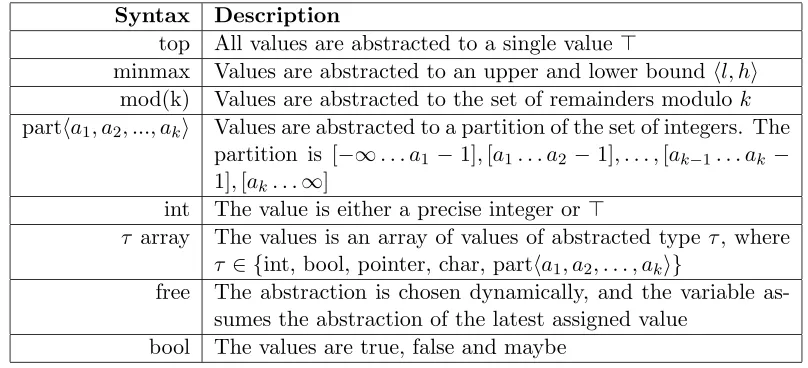
C Wolf allows its users to abstract integers, integer arrays and character arrays (strings). Abstractions are specified in an input file to the model builder, called the ab-straction map or the.amfile. Currently, C Wolf supports the abstractions shown in Table 3.1, replicated here from [14].
Syntax Description
top All values are abstracted to a single value>
minmax Values are abstracted to an upper and lower boundhl, hi mod(k) Values are abstracted to the set of remainders modulok partha1, a2, ..., aki Values are abstracted to a partition of the set of integers. The
partition is [−∞. . . a1 −1],[a1. . . a2 −1], . . . ,[ak−1. . . ak− 1],[ak. . .∞]
int The value is either a precise integer or>
τ array The values is an array of values of abstracted type τ, where τ ∈ {int, bool, pointer, char, partha1, a2, . . . , aki}
free The abstraction is chosen dynamically, and the variable as-sumes the abstraction of the latest assigned value
bool The values are true, false and maybe
Table 3.1: C Wolf Abstractions
a variable may take. The int abstraction tells the system to compute a precise value, or if it is not possible, set the variable to >. Variables that use the free abstraction con-tinuously take on the abstraction of the value that is being assigned to them. The part
abstraction partitions the set of integers into a set of disjoint intervals. This abstraction is the workhorse abstraction, and can be used to track both individual values and ranges of values. For example, to track the values 4,7 and 8, we can specify a partition of the form part (4,5,7,8,9). The concrete values are partitioned into the sets denoted by [−∞,3],[4,4],[5,6],[7,7],[8,8],[9,∞].
Theτ arrayabstractions tell the system to treat the variable as a single-dimensional array with the elements having theτ abstraction. In the C source file, the array being ab-stracted must either be statically allocated or should be allocated using a heap allocation function like malloc or calloc. It is important to note that the system must be able to evaluate the arguments passed to the heap allocation function while building the model. For example, in the program segment of Figure 3.2, the variablesarrand pArr1are abstracted as arrays of 20 integers while the variable pArr2 is abstracted as an array of 30 integers. However, pArr3 is abstracted to > as the model-builder cannot determine its size during abstract interpretation.
int arr[20]; int *pArr1; int *pArr2; int *pArr3;
void main ( ) {
int v = 30; int k;
scanf("%d",&k);
pArr1 = (int *) malloc (20 * sizeof(int)); pArr2 = (int *) malloc (v * sizeof(int)); pArr3 = (int *) malloc (k * sizeof(int)); }
Pointers that alias array locations must be abstracted using the freeabstraction. During abstract interpretation, if the model-builder is unable to determine the array being aliased, the pointer is abstracted to>.
The abstractions to be applied to the program variables are specified in the abstrac-tion map file. The abstracabstrac-tion map has three important declaraabstrac-tions. Thefiledeclaration declares the beginning of a new scope, and all the declarations following it are assumed to originate from the source file mentioned in the file declaration. The fun declaration declares a new function scope, allowing the abstractions for local variables to be specified in it. Finally, the var declaration is used to specify abstractions for individual variables, using the syntax described in Table 3.1.
3.2
Model Generation
Given a set of C source files, an abstraction map and a label map, model generation is done in two steps. First, the sources have to be compiled using cwcc and linked using
cwld to create a cwi file for the entire program. The cwi file is a high level intermediate code in which the program is organized into basic blocks and each statement in the program can be either an assignment to a variable/register, or a control-flow statement (conditional goto, unconditional goto, function call/return). Model generation is done by cwmb and is directed by the abstraction and the label map files.
Model generation is done by abstract interpretation - essentially, executing state-ments of the program in the context of the abstract domain. Two environstate-ments, a static environment and a local environment, store information about the bindings of the abstracted variables. Changes to the bindings in the environments trigger state changes. These state changes are tracked, and a model for the program generated from them. The process of abstract interpretation is semantically sound with respect to 2’s complement arithmetic, as is the symbolic evaluation of each cwiinstruction.
As the states are generated, transitions are inserted between the current state and the generated states. The transitions are labeled as per the rules specified in the label map file, or labeled τ, if none of the rules specified in the label map are triggered.
compatible with the Concurrency WorkBench.
3.3
Buffer overflow detection
While C Wolf allowed its users to abstract arrays, bounds checking was done if the subscript was abstracted using the integer abstraction or if it was abstracted using a carefully chosen part abstraction1. Since C Wolf was not originally intended to support bounds checking, it lacks the ability to perform bounds checking efficiently. In particular, to enable bounds checking, users had to manually specify that every variable used in the program as an array subscript was to be abstracted using an integer or apartabstraction. If the indices were abstracted using the integer abstraction, there was a strong possibility that a state space explosion would occur. On the other hand, indices abstracted using the
partabstraction were only capable of handling fixed-size arrays. Also, thepartabstraction was error-prone, because the partitions specified for an array are incompatible with arrays of a different size. As a result, if a subscript variable was abstracted using the part(0,N)
abstraction, the variable could only be used to index arrays of sizeN.
In order to remove the above deficiencies, we have enhanced C Wolf to automat-ically abstract all variables that appear in array subscript expressions using the Dynamic Rangeabstraction, unless the variable has been abstracted using astrongerabstraction. We define a stronger abstraction as one that reflects more closely, the values of the concrete domain. Integer (int) and Interval (part) abstractions are treated as abstractionsstronger than the dynamic range abstraction.
This step involves a static check on the block code, during which the basic blocks are checked for subscript expressions, and the variables in the expressions isolated. The (user-specified) abstraction of each variable is now obtained from the abstraction map; if the variable has a weaker abstraction than the dynamic range abstraction, it is abstracted using the dynamic range abstraction. When an array access involving a dynamic range variable is encountered during abstract interpretation, the index expression is evaluated using the semantics of the dynamic range abstraction (see Chapter 4 for more details). If the resulting abstract value has either the upper or the lower bound outside the range
1If the size of an array isN, we can choose a part abstraction of the form part(0,N)to abstract the
[0. . . N], whereN is the size of the array, the array access is flagged as unsafe and a message given to the user.
An interesting aspect of the bounds checking procedure is the optimizations that can be applied to it. Some of the popular methods of optimizing runtime bounds checks are those proposed by Rajiv Gupta [19] and those proposed by Micheal Wolfe and Priyadarshan Kolte [24]. Both methods use some form of compile-time optimization in the form of bounds-check elimination, bounds-check propagation, and partial redundancy elimination to reduce the overhead of bounds checking at runtime.
In C Wolf however, the size of the generated model is of greater importance than the speed of model generation (even though the time lag should be reasonable). In fact, the time taken by the model-builder is proportional to the number of states in the model. Hence, the optimizations we introduce focus less on speed and more on keeping the model size down to manageable proportions. Typically, bounds check optimization is used to eliminate bounds checks that are redundant because of some control structures. To illustrate the concept, we present an example in Figure 3.3.
#define N 3 int arr[N]; int i = 0 ;
for ( i = 0; i < N; i++ ) {
arr[i] = 0; }
Figure 3.3: For loop that results in redundant bounds checks
In the example of Figure 3.3, if the variable i is abstracted using the int or the
minmaxabstractions, the model-builder will performN bounds-checks while interpreting the for loop. In reality, no checks need to be performed because the values that the subscripti can assume are limited to the range [0. . . N −1] by the loop construct itself. Further, ab-stracting the array subscript using the integer or range abstraction results in the generation of thirteen states, of which six states are redundant (states 4 to 10 in Figure 3.4).
daVinci
V2.1
State 6 Stack: block_3 i −> 1 arr −> [0,0,0]
State 9 Stack: block_3 i −> 2 arr −> [0,0,0] State 1 Stack: block_1 i −> 0 arr −> [0,0,0]
State 5 Stack: block_2 i −> 1 arr −> [0,0,0] State 4 Stack: block_1 i −> 1 arr −> [0,0,0]
State 8 Stack: block_2 i −> 2 arr −> [0,0,0] State 7 Stack: block_1 i −> 2 arr −> [0,0,0]
State 11 Stack: block_4 i −> 3 arr −> [0,0,0] State 10 Stack: block_1 i −> 3 arr −> [0,0,0] State 2 Stack: block_2 i −> 0 arr −> [0,0,0] State 0 Stack: block_0 arr −> [0,0,0]
State 12 Halted R#0 −> 0 arr −> [0,0,0] State 3 Stack: block_3 i −> 0 arr −> [0,0,0]
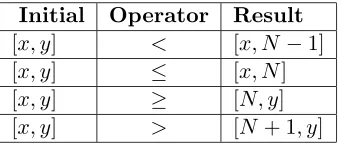
bounds check operations, we add a property to the dynamic range abstraction. Consider a variable v that is abstracted using the dynamic range abstraction. If v is compared with a variable/constantk and the result istrue, we widen the range of vto an amount that is defined by the abstract value ofk. By widening the range of v, we avoid the generation of the redundant states. This is possible because the information represented by the redundant states is now incorporated in the widened range. We also note that the relational operator used for the comparison should be an inequality operator and the variablekshould not be abstracted using the dynamic range abstraction.
Specifically, in the previous case, the variable i has an initial value of [0,0]. Ex-ecution of the statement < (i, 3) now sets i to the value [0,2], reflecting the range of values that the variable ican assume such that the conditioni <3 is still satisfied. When the index iis incremented inside the body of the loop, its value now becomes [1,3]. The entry condition for the loop no longer holds and the loop terminates after just one iteration, needing just one bounds-check operation. The generated state diagram is also smaller, with just 7 states (Figure 3.5), illustrating the efficacy of our method. This compares favorably with 3 bounds checks operations and 13 generated states in the “normal” case.
Table 3.2 outlines the rules used when a dynamic range variable is compared with a variable whose abstract value is N.
Initial Operator Result
[x, y] < [x, N−1]
[x, y] ≤ [x, N]
[x, y] ≥ [N, y]
[x, y] > [N + 1, y]
Table 3.2: Relational operators and dynamic range variables
3.4
Dynamically allocated arrays
daVinci
V2.1
State 6 Halted R#0 −> 0
arr −> [Top,Top,Top] State 2
Stack: block_2 i −> [0, 2] arr −> [0,0,0] (arr)[i] = 0 goto block_3
State 5 Stack: block_4 i −> [3, 3]
arr −> [Top,Top,Top] return (0)
State 4 Stack: block_1 i −> [1, 3]
arr −> [Top,Top,Top]
if (<(i, 3)) then goto block_2 else goto block_4 State 1
Stack: block_1 i −> [0, 0] arr −> [0,0,0]
if (<(i, 3)) then goto block_2 else goto block_4 State 0
Stack: block_0 arr −> [0,0,0] i = 0 i = 0 goto block_1
State 3 Stack: block_3 i −> [0, 2]
arr −> [Top,Top,Top] i = ++(i)
goto block_1
for heap-based arrays by utilizing the existing mechanism for handling static arrays. Heap-allocated arrays are dealt with in a two step process:
First, we evaluate the parameter/expression passed to themallocorcalloc func-tion to determine the total storage that needs to be allocated. Then, we find the abstract type of the pointer that refers to the allocated memory. Based on the type of the pointer we determine the actual size of the array. If the parameter passed to malloc or calloc
evaluates to >, or cannot be converted into an integral value, a storage of zero elements is allocated, and the variable is set to >.
The “actual” array is stored in the global environment [14]. Subscript operations using this pointer (or any other pointer aliasing this one) directly work with the stored array. The pointer pointing to the array is represented by a pair with an integer representing the size of the array and an integer or character array representing the contents. Since C Wolf only deals with integral data types, such a representation is sufficient.
It must be noted that storing the array in the global environment reduces the scalability of C Wolf. However, since many string operations depend on the contents of the string, and programs that check for specific values within an array are common, we are constrained to store the contents of the array instead of abstracting them away.
Bounds checking for dynamically allocated arrays is done in the same manner as for statically allocated arrays.
3.5
Partial order analysis
C Wolf uses constraint analysis to improve the accuracy of evaluation of relational expressions [14]. To further enhance the accuracy of the process, we introduce a partial order analysis technique that stores additional information about the relationship between the variables of a program. Specifically, we intend to facilitate:
• the accurate deduction of ordering relationships between variables,
• the process of making inferences about the relationship between the value of an index and the bounds of the array being indexed, and
The relationships between the variables in the program are stored in the form of a graph, called the partial order table. Relationships between variables are determined by comparing their values, while the relationships between arrays and variables are determined by comparing the abstract value of the variable with the size of the array. Relationships between two arrays are determined by comparing their sizes. Two partial order tables are used throughout the analysis, one which stores the <= relationships, and the other which stores the>= relationships. Both the tables are complementary and are actually the inverse of each other. If two variables have both a <= relationship as well as a >= relationship, they are equal. An equivalence table is also used to split the set of program variables into partitions of equal elements. The tables are modified when assignment statements, conditional goto statements, call statements and return statements are encountered.
When an assignment statement is encountered, the current relationships of the variable on the lhs of the statement are discarded. The relationships between the assignee variable and those on the rhsof the assignment statement are then determined and stored. If the rhs of the assignment statement has an arithmetic expression, the relationships are determined by the rules specified in Table 3.3. Currently, logical and relational expressions that constitute therhs of an assignment statement are ignored.
Operation ->Range
r = x + y
r = x * y
r = x - y
r = x / y
r = x mod y
Values
|x| < |y| x > 0 y > 0 |x| = |y|
|x| > |y| r <= x r <= x
x > 0 y = 0 x <= r, y <=r r <= x, r <=y r <= x, y <= r Undefined Undefined |x| = |y| r <= x, y <= r
x > 0 y < 0 |x| < |y| r <= x, y <= r
|x| > |y| r <= x
x = 0 y > 0 x <= r, r <= y r <= x, r <=y r <= x, r <=y r <= x, r <= y r <= x, r <= y x = 0 y = 0 x <=r, y <= r r <= x, r <=y r <= x, r <=y Undefined Undefined x = 0 y < 0 r <= x, y <= r r <=x, r <= y x <= r, y <= r r <= x, y <= r r <= x, y <= r
|x| = |y| x < 0 y > 0 |x| < |y| |x| > |y|
x < 0 y = 0 r <= x, r <= y x <= r, r <= y r <= x, r <= y Undefined Undefined |x| = |y|
x < 0 y < 0 |x| < |y|
|x| > |y| x <= r
x <= r, r <= y
r <= x, r <= y x <= r, y <= r x <= r, y <= r x <= r, y <= r x <= r, y <= r x <= r, r <= y r <=x, r <= y r <= x, r <= y x <= r, r <= y
r <= x, r <= y
r <= x, y <= r r <=x, r <= y x <= r, y <= r r <= x, y <= r x <= r, y <=r x <=r, y <=r r <= x, r <=y r <= x, r <= y
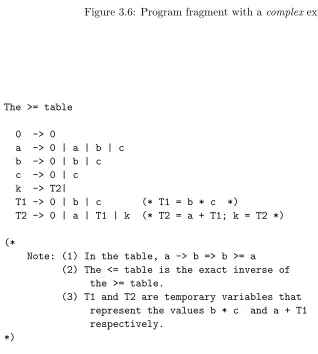
Table 3.3 specifies the rules for updating the partial order tables when a single binary expression is encountered. Assignment statements that have complex expressions on therhs are handled in a two-step process:2
First, when a subexpression that constitutes the complex expression is evaluated, a temporary symbol representing the value of the subexpression is introduced in the par-tial order tables. The relationships of the result of the subexpression with the terms that constitute the subexpression are determined by the rules of Table 3.3. These relations con-stitute the relationships of the temporary symbol in the partial order tables. For example, if the subexpression encountered is a + b, witha >0, b >0, and the temporary symbol representing the value of the expression ist, then the entries fortin the partial order tables will indicate that tis greater than both a and b. The process is repeated until the entire expression is evaluated, at the end of which, the partial order tables contain a temporary symbol that represents the value of the complex expression. When the value of the expres-sion is assigned to the variable on thelhs, the relationships of the final temporary symbol replace those of the assignee variable in the partial order tables.
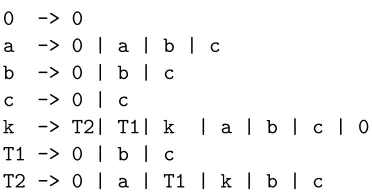
At this point, the partial order relationships of the assignee variable with the final temporary symbol is known. In order to determine the relationships of the assignee with the variables that constitute the rhs, we perform a transitive closure operation on the partial order tables. Since the ≤and≥operators are transitive, the closure operation successfully determines the required relationships. The temporary symbols, having served their purpose are discarded from the tables. It is important to note that if the evaluation of any of the subexpressions results in an overflow, the process of determining partial order relations is stopped and the ordering relations of the concerned variables are discarded from the tables. Figure 3.6 shows a program with a complex expression, Figure 3.7 shows the resulting partial order table after the expression is evaluated, Figure 3.8 shows the table after the transitive closure is performed, and finally, Figure 3.9 shows the table after the temporary symbols are discarded.
When a conditional goto statement is encountered, the result of the evaluation of the conditional expression is used to update the partial order tables. However, only those expressions that evaluate to true orfalse are considered for this purpose. For example, if a conditional expression likeminX >= minY evaluates totrue, then the partial order tables
2We define a complex expression to be an expression that has more than one binary operator connecting
void main ( void ) {
int a = 6, b = 5, c = 2; int k;
k = a + b * c ; }
Figure 3.6: Program fragment with acomplexexpression
The >= table
0 -> 0
a -> 0 | a | b | c b -> 0 | b | c c -> 0 | c k -> T2|
T1 -> 0 | b | c (* T1 = b * c *)
T2 -> 0 | a | T1 | k (* T2 = a + T1; k = T2 *)
(*
Note: (1) In the table, a -> b => b >= a
(2) The <= table is the exact inverse of the >= table.
(3) T1 and T2 are temporary variables that represent the values b * c and a + T1 respectively.
*)
The >= table
0 -> 0
a -> 0 | a | b | c b -> 0 | b | c c -> 0 | c
k -> T2| T1| k | a | b | c | 0 T1 -> 0 | b | c
T2 -> 0 | a | T1 | k | b | c
Figure 3.8: Partial order table of Figure 3.7 after transitive closure
The >= table
0 -> 0
a -> 0 | a | b | c b -> 0 | b | c c -> 0 | c
k -> k | a | b | c | 0
are updated with entries indicating thatminX ≥minY.
Calls to mallocupdate the table by treating the size of the allocated space as the value of the array and recalculating the relationships of the other variables with the array variable.
In order to keep the tables consistent across procedure calls, C Wolf uses a simple interprocedural analysis technique. First, the arguments passed to the function are eval-uated and the partial order tables updated using the procedure described earlier in this chapter. As a result, the abstract value of the expression that is passed to each formal pa-rameter is represented by a unique temporary symbol in the partial order tables. Next, the relationships of the temporary symbols are copied onto those of the corresponding formal parameters. Finally, a transitive closure is performed on the tables and the relationships between the formal parameters obtained. As an example, for the program fragment of Fig-ure 3.10, the original partial order table is shown in FigFig-ure 3.11 and the partial order table at the start of the functionfunc shown in Figure 3.12.
void func( int p, int q, int r ) {
p = q + r; r = q * p; return r; }
void main ( void ) {
int a = 1, b = 5, c = 7;
a = func (a - b, b + c, c + a); }
Figure 3.10: Function call that updates the partial order table
The >= partial order table
0 -> 0
a -> a | 0 (* a >= 0, a *) b -> b | a | 0 (* b >= b, a, 0 *) c -> c | b | a | 0 (* c >= c, b, a, 0 *) p ->
q -> r ->
The <= partial order table is the exact inverse of the >= table and is not shown here. Typically if the >= table has a path from p to q, the <= table has a path from q to p and vice versa.
Figure 3.11: Partial order table for the code in Figure 3.10 before the function call
The >= partial order table
0 -> 0 | p (* p is negative *)
a -> a | 0 | p (* a >= p because p = a - b && (a, b >= 0, and b >= a) *)
b -> b | a | 0 c -> c | b | a | 0 p -> p |
q -> q | b | c | 0 | p (* q >= 0, 0 >= p, => q >= p *) r -> r | c | a | 0 | p (* r >= a, a >= p, => r >= p *)
transitively closed, we deduce that r >= p, accounting for the pentry in the >= list of r. Return values are handled in a similar fashion. The return expression is evaluated and its relationships with the other variables determined using transitive closure. When the return value is assigned to a variable, the relationships of the temporary symbol representing the return value are copied onto those of the variable and transitive closure performed to update the tables. For example, for the program fragment shown in Figure 3.10, Figure 3.13 shows the partial order table just before the function returns.
The >= partial order table
0 -> 0 (* p = q + r, and is >= 0 *) a -> a | 0 | p (* a is not updated yet *) b -> b | a | 0
c -> c | b | a | 0
p -> p | q | 0 (* because p = q + r, r = q * p *) q -> q | b | c | 0
r -> r | c | a | b | q | p | 0 (* transitivity, r = q * p *)
R#0 -> r | c | a | 0 | q | p | 0 (* Return value of the function = r *)
Figure 3.13: Partial order table for the code in Figure 3.10 before the function return
To handle recursive functions C Wolf performs another step. Before updating the relationships of the formal parameters C Wolf stores the “current” relationships by means of a simple mechanism. The relationships of variable i are stored as that of the symbol i+k·N where N is the number of variables in the environment, and k is determined by the formulad(L/N)ewhere Lis the largest identifier in the partial order table.
While returning from such functions, the partial order tables are restored to their original state by simply copying the stored relationships back to those of the variables.
Partial order tables are consulted when the model-builder is unable to determine if the result of a conditional expression is true or false. Usually, this occurs because of the abstract values involved. For example, in the expression a > b, if a has an abstract value [1,3] and b has an abstract value [2,4], and both a and b are abstracted using the
if it can determine the result of the conditional based on the relationships stored in them. Branching now occurs based on the entries in the tables. The tables are also used to compare the lengths of arrays and to determine whether the range of an array index is within the bounds of the array being indexed.
In conclusion, we note that buffer overflow detection in C Wolf was cumbersome and error-prone earlier. We have made many enhancements to C Wolf to support bounds checking and to make the bounds checking process efficient and less tedious for the user. We have introduced a new abstraction, called the dynamic range abstraction that is auto-matically used to abstract array indices. We have modified the semantics of the dynamic range abstraction to minimize the increase in model size. Keeping in mind the prevalence of heap-allocated arrays, we have provided support for heap- allocation functions calloc
Chapter 4
Theory
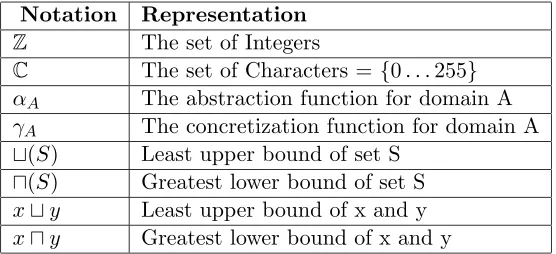
In this chapter, we present some of the principles behind the abstractions presented in this work. We begin by introducing in Table 4.1, the mathematical notations used in this chapter.
Notation Representation
Z The set of Integers
C The set of Characters = {0. . .255} αA The abstraction function for domain A γA The concretization function for domain A t(S) Least upper bound of set S
u(S) Greatest lower bound of set S xty Least upper bound of x and y xuy Greatest lower bound of x and y
Table 4.1: Mathematical notation used in this thesis
4.1
The char and char array abstractions
in order to reduce the concrete domain from the set of all integers to the set {0. . .255}. This also reduces the size of the model generated, as any value outside the above specified range is automatically abstracted to>.
As with theintegerabstraction [14], the abstraction and the concretization func-tions for characters are trivial and are given as:
γC(c) =
{c}, if c∈ {0. . .255}
{minint . . .−1} ∪ {256. . . maxint}, otherwise.
αC(a) =
a, if a∈ {0. . .255} >, otherwise
where αC and γC are the abstraction and concretization functions respectively. The abstract domain of thechar abstraction is the set {0. . .255} ∪ >.
The standard arithmetic operators, +,−,÷,∗ as well as the relational operators ≤,≥,=, <, > are supported for the abstraction. The semantics of the operators are the same as that of the integer abstraction with the added restriction that any value not in the set {0. . .255} is abstracted to>.
4.2
The Dynamic Range Abstraction
TheDynamic Rangeabstraction is used to reduce the state size of the model when array indices are automatically abstracted. The Dynamic Range abstraction is similar to theRangeabstraction which abstracts concrete values to an upper and a lower bound [14], with some additional constraints on the operation of relational operators.
The concrete domain for the Dynamic Rangeabstraction is the set of integers, Z, while the abstract domain can be specified as the set {>} ∪ {hx, yi ∈Z×Z|x ≤y}. The abstraction function is given by the formula:
αD(S) =
htS,uSi if S6=φ >, otherwise
αD(8) =h8,8i αC(48) ={48} αC(257) =>
γD(αD(8)) ={8} γC(αC(48)) ={48}
γC(αC(257)) ={minint, minint+ 1, . . . ,0,1,2, . . . , maxint}
Figure 4.1: Application of the abstraction and concretization functions
4.3
Dynamic Range Conversions
The result of converting a value to the Dynamic Range abstraction is a pair, specifying an upper and lower limit on the possible values. In a manner similar to that of theRangeabstraction [14], we specify two utility functions for each domain D: A function dxeD that computes an upper bound on x, and a function bxcD that computes a lower bound. dxeD always returns a value greater than or equal to tγD(x) and bxcD returns a value less than or equal touγD(x). These bounds will be as tight as possible. The formal definitions of these functions was given in [14] as follows:
dxeU =maxint bxcU =minint dhx, yieR=y bhx, yicR=x dSeMk =
maxintif tS ≥0 tS if tS <0
bScMk =
uSif tS≥0 minintif tS <0 dTeIS =t{y| hx, yi ∈T} bTcIS =u{x| hx, yi ∈T}
Operation Result
hx, yi+hp, qi hx+p, y+qi
hx, yi − hp, qi hmin(x−p, y−q), max(x−p, y−q)i hx, yi ∗ hp, qi hx∗p, y∗qi
hx, yi/hp, qi hmin(x/p, y/q), max(x/p, y/q)i hx, yi+ + hx+ 1, y+ 1i
hx, yi − − hx−1, y−1i neghx, yi hy, xi
poshx, yi hx, yi
hx, yi modhp, qi hmin(x mod p, ymod q), max(x mod p, ymod q)i hx, yi<hp, qi true, ify < p;f alseifx≥q; otherwise, maybe. hx, yi>hp, qi true, ifx > q;f alse ify≤p; otherwise, maybe. hx, yi==hp, qi true, ifx=p and y=q;f alse otherwise. hx, yi ≤ hp, qi true, ify≤p;f alseifx > q; otherwise, maybe. hx, yi ≥ hp, qi true, ify≥p;f alseifx < q; otherwise, maybe.
Table 4.2: Dynamic range operations
4.4
Dynamic Range Operators
The semantics of the arithmetic and relational operators for the Dynamic Range abstraction are presented in Table 4.2.
Since the Dynamic Rangeabstraction supports range-widening, the relational op-erators that operate on a Dynamic Range-abstracted variable also bind the variable to a new value, the new value being defined by the rules given in Table 3.2.
4.5
Array abstractions
Chapter 5
Implementation
This chapter describes some details of the implementation. An overview of the important data structures, algorithms, and the C Wolf string API are presented here.
Since the thesis was an enhancement to an existing toolset, most of the data structures used in this implementation were already present in the toolset [14]. Minor modifications were done to many data structures in the model builder - notably the Ab-stractValue, AbstractArrayValue and AbstractIntValue structures, which were modified to handle characters, char arrays and dynamic range integers.
5.1
Partial Order Table
An interesting structure is the “graph” used to store the partial-order-tables. The graph is implemented using an adjacency list structure, and stores variable identifiers for efficient access and manipulation. The graph is defined as a list of vertices or nodes, each node containing a variable identifier and a list of neighbors, which are also nodes. In ML, the declarations are:
datatype node = Node of {
identifier : int,
datatype graph = (* The graph *) Graph of {
vertices : node list ref (* Nodes in the graph *) }
In addition to the usual graph manipulation functions like adding vertices and neighbours, and query functions like getting the neighbors of a node, the API also allows the user to check if a path exists between two nodes and construct transitive closure of a given graph.
The partial order table merely serves as a wrapper for the graph, and most of its functions use functions of the graph API to accomplish their operations. In addition to the wrapper functions, the partial order table structure offers functions to clear a variable completely from the table and to delete temporary symbols.
Since the graph is sparse, the partial order table is stored using the adjacency list representation. The implementation uses DFS to compute the transitive closure of the tables and the time taken is in the order ofO(n(n+m)).
5.2
Dynamic Range Abstraction
The next important data structure is theIntDynamicRangestructure. Essentially, the IntDynamicRange type is a pair of integers, denoting the upper and lower bounds of the abstraction. The functions supported are
1. Arithmetic functions, +,−,∗,/,mod,inc,dec 2. Comparison functions,>, =, <=, >=,<,6= and
3. functions to hash, sort, input and output Dynamic Range integers.
5.3
Design of the char array abstraction
(as opposed to ArrayPtrs that only access a single element in an array), it is necessary to convert the ArrayPtr back to a character array. This also allows the intermixing of string constants and string variables in the source. ArrayPtrs are converted into a pair, the first element being a character array and the second, an index pointing somewhere in the array. A string constant is converted into a character array and a zero index. If the strings passed to the C Wolf String API do not follow pointer/array safety rules, then an ArrayBoundsVi-olatedException is thrown, indicating the variable that was at fault, the line in the source file where the erroneous call was made, and the type of the error.
The string “API” supported by C Wolf is a subset of the string library in C and includes the following functions:
1. int strlen ( const char* str ) Returns the length of the string pointed to by
str. Return>if the length of strcannot be determined.
Throws ArrayBoundsViolatedException ifstrdoes not have a trailingnullcharacter. This is easily determined by checking if the null character is not present within the allocated size of the string. Also throws the ArrayBoundsViolatedException if str
evaluates to>.
2. char* strcpy ( char* dst, const char* src )Copies the contents of stringsrc
into string dst.
Throws ArrayBoundsViolatedException if: • length (src) >= size(dst)
• src=> ordst=>
• srcdoes not have a trailing nullcharacter.
Note: lengthis the length of the string as returned by the strlen function andsize is the number of bytes allocated to the string.
3. char* strcat ( char* dst, const char* src )Concatenates the contents ofsrc
with that ofdst and places the resulting string indst. Throws ArrayBoundsViolatedException if:
• srcordstdo not have a trailing null character.
4. int strcmp ( const char* str1, const char* str2 )Comparesstr1and str2
and returns:
• 0 if str1and str2 have the same contents • −1 ifstr1 <str2
• +1 ifstr1 >str2
The < and > relations are defined by the ordering of the characters in the ASCII system.
Throws ArrayBoundsViolatedException if either string does not have a trailing null character. Also throws the ArrayBoundsViolatedException if either string evaluates to>.
5. int strncmp ( const char* str1, const char* str2, int N )Compares the first
N characters ofstr1 and str2 and returns: • 0 if str1and str2 have the same characters
• −1 if str1[i] < str2[i]for some isuch that 0<= i <N && ∀j|0<=j < i, str1[j] =str2[j]
• 1 if str1[i] > str2[i] for some isuch that 0 <= i < N && ∀j |0 <=j < i, str1[j] =str2[j]
6. char* strncpy ( char* dst, const char* src, int N ) Copies the firstN char-acters of the string srcinto the string dst.
Throws ArrayBoundsViolatedException if: • min ( length (src),N) >= size(dst) • src=> ordst=>
• srcordstdo not have a trailing null character.
7. char* strncat ( char* dst, const char* src, int N ) Concatenates the first
Ncharacters of srcwith those of dstand places the resulting string indst. IfN <