72:5 (2015) 133–139 | www.jurnalteknologi.utm.my | eISSN 2180–3722 |
Full paper
Jurnal
Teknologi
Towards the Development of a Framework for Sustainable Marine Space
Governance: A Proposal for Collaborative Design Approach
Nazirah Mohamad Abdullah, Abdullah Hisam Omar*, Ghazali Desa, Shuib Rambat
Faculty of Geoinformation, Science and Engineering, Universiti Teknologi Malaysia, 81310, UTM Johor Bahru, Johor, Malaysia
*Corresponding author:[email protected]
Article history
Received : 15 August 2014 Received in revised form : 15 October 2014
Accepted :15 November 20
Graphical abstract
Abstract
Malaysia is surrounded by ocean, approximately, 515,000 square kilometers covered by maritime realm and 4,576 km in length by coastline. The country has terrestrial borders with Thailand, Brunei Darussalam and Indonesia and has maritime borders with Thailand, Brunei Darussalam, Singapore, Indonesia, Vietnam and the Philippines. In addition Malaysia has many institutions for managing the marine environment. Hence the development of the institution and the scope still has some ambiguity, conflict and overlapping marine because organizations exist on the basis of a resolution of the Parliament. While on the physical condition, especially in the marine environment is difficult to determine the resolution authority area to an area of true governance. This paper addresses the need on collaborative design approach that fits into Malaysian marine space governance scenario, in particular with respect to stakeholder management. This paper first reviews several international collaborative designs. An exemplary model of collaborative has been developed, which constitutes the key factors that determine the success of collaborative implementation. This model is pending for experimentation to examine its effectiveness on Malaysia marine space governance.
Keywords: Sustainable marine space governance; marine space administrative issues; collaborative design
© 2015 Penerbit UTM Press. All rights reserved.
1.0 INTRODUCTION
Marine administration has been defined as governing surrounding of the marine space. Governing the surrounding marine space tasks may include sustaining the natural environment, maintaining conservation and managing the resources. In Malaysia, governing such activities involves various departments at government stage as well as the stakeholder. Governing is not only about managing but it also regarding the decision making and distribution of knowledge which influenced the government, jurisdiction, stakeholder and others parties who have interest in those activities and specifically in marine space activities it shared in various ways amongst the state government, stakeholders and United Nations Convention on the Law of the Sea (UNCLOS), which is the overarching law governing the use of the ocean [1], [2].
The relationship between all parties together with the use of spatial-temporal sources could achieve many economic goals, social, politic, and environment blocked [3]. The spatial-temporal sources can provide higher usability and interactivity that can facilitate exchange and dissemination of spatial information among stakeholders and government agencies. The higher usability and interactivity of the spatial information sharing can be achieved by using the Geographical Information System (GIS). The GIS system
has been used to manage land information system since 1967. The upgraded and improved version of GIS system has been used to manage the land. Thus, it is possible to adapt the GIS system in marine administration environment in order to provide better marine governance and simultaneously improves the information systems on the ground [3]. The GIS system used spatial data together with the textual information which should covering accurate, up-to-date, complete and helpful information about the resources that currently exist, the nature of the environment, and also the consumers contact about the resources [4], for an effective management which can be referred as good governance. Specifically, good governance can be defined as the effectiveness on how the public institutions conduct and manage public resources such as marine spaces.
things depending on one’s perspective or goals [5] though the foundation is the recognition of what is excluded, and also what is given priority in certain circumstances.
To manage a marine space with approximately, 515,000 kilometres square area covered by maritime realm and 4,576 km in length by coastline is a tedious task. Indeed, the maritime borders with Thailand, Brunei Darussalam, Singapore, Indonesia, Vietnam and the Philippines [6] as show in Figure 1 mean proper standard of governing the marine space is needed. As part of the South East Asian Region and a founding member of the Association of South East Asian Nations (ASEAN) the relationships with these nations should be importance as they are one of the stakeholders in Malaysia marine spaces.
Figure 1 Malaysia and its South East Asian Neighbors [1]
In this paper we used collaboration design in order to view the relationships of the stakeholder. Based on the relationships a framework will developed. This framework is dedicatedly for Malaysia which suitable for Malaysia marine environment and able to adopted for global used since there are no accepted methodologies or frameworks at the international level, which facilitate the marine space governance systems. It will be an opportunity to not make the same mistakes we have made in land resource management and land information systems [3].
2.0 SUSTAINABLE MARINE SPACE GOVERNANCE
The management of good governance of marine space administrative has been debated since at least the 2000s. The extensive literature and research reports found that it is hardly surprising; the marine space is under serious threat from a myriad of overlapping and conflicting interests. It is therefore imperative to manage, administer and govern the coastal zone in a considered, sustainable and structured manner; to protect and nurture the environment we live in. Failure to do so may have disastrous consequences for future generations [2]. This includes refining the management system, particularly the governance of marine space administrative. This unresolved problem has led to the lack of a concerted effort in the existing management in the marine space and the quality of sustainable marine space governance is indirectly being affected.
Sustainable marine space governance is spatial data management of the marine environment. Spatial data management of the marine space is divided into three major issues, namely legal,
technical, and stakeholders. Legal issues involving approach is the allocation of resource ownership, control, stewardship and use within society; regulation of resources and resource use (e.g., environmental protection, development and exploitation, rights to economic and social benefits); monitoring and enforcement of the various interests; adjudication of disputes, including inclusive processes; management of spatial (geographically referenced) and other types of information to support all of the above functions analysis is the way to see marine governance linked at law and information [3]. The role of the legal framework of each country in managing marine space is taken into account. There are multi-layered framework consisting of laws of the United Nations Convention of the Sea (UNCLOS), customary international law, and international treaties, the laws of the national, state and local laws that are derived from the traditions, laws, and the courts. Historically, considering at the information about resources which currently exist, the nature of the environment where the resources exist, and also the users and uses of resources is always a need for the assessment and monitoring of marine areas which effectively is an important technical component governance of marine spaces. Information about living and non-living resources, bathymetry, spatial extent (boundaries), coastal change, marine pollutants, the characteristics of the sea floor, water quality, and all property rights can contribute to sustainable development and good governance of coastal and marine source is all this type of information has important spatial component of good governance of marine spaces [4], [5].
Complementary to the two issues discussed above is a strong contributing factor to the existence of a new solution called marine cadaster. Marine cadastre can be defined as an information system that enables the visualization of the effect of a jurisdiction’s private and public laws on the marine environment (e.g. spatial extents and their associated rights, responsibilities, restrictions, and administration). Other relevant information such as that regarding the physical and biological natures of the environment may be connected to the cadastre using spatial referencing to give the cadastre a multipurpose function [6].
However, researchers are trying to see why marine cadastre cannot be adapted to a marine governance while marine cadastre has long voiced by the geomatics community since 2001. String researchers tried to look from the point of management with more advanced. Through literature studies researchers have identified one of the key factors of marine cadastre is difficult adapted due to the diversity of usage, different departments and agencies in the sea and conflict of interest [5]–[17]. These interests can be expressed in a variety of ways, for example: sovereignty, jurisdiction, administration, ownership (title), lease, license, permit, quota, customary rights, aboriginal rights, collective rights, community rights, littoral rights, public rights, rights of use, and public good. One feature of being a coastal state is that there is a multidimensional tapestry of these interests (and perhaps others) in the coast and offshore. Marine administrators are challenged with trying to understand and communicate this to the various decision makers and stakeholders.
Furthermore, decision-makers in both the land and marine environments will need access to this information to make effective and reliable decisions supporting marine administration. Then again, complex relationships and interactions between overlapping and often competing rights, restrictions and responsibilities, both in the marine environment and at the land-sea interface remain referring to the stakeholder management.
frameworks be in place. Collaborative, cooperative, and integrative governance are improved frameworks for dealing with stakeholder issues [5]. Therefore to ensure the governance of marine space is at the maximum patch the effective management of stakeholder activities in marine space much be carefully consider. Furthermore there are no accepted methodologies or frameworks at the international level, which facilitate the marine space administration systems. Marine space administration is necessary for national development. This condition will make the governance of marine space become more difficult and more complicated because lack of comprehensive coastal zone management programs due to uncertainty and fragmentation in jurisdiction, administration, ownership, and use of coastal resources: There are not well established arrangements for collaboration among all of the government agencies at the several levels involved and each activity causes a new process of stakeholder identification and consultation. From an information perspective this has led to a lack of consistent data about interests and boundaries along the coast [5].
There are various problems and issues occurring in the marine environment even though most of the country had its own marine environment management system. Currently, many countries have a land administration system and some kind of marine management system, but these generally operate as separate entities [18]. This can cause conflict within the coastal zone or land-sea interface. According to the researchers again there is the need to effectively manage the coastal zone as well as the need for integration of data between the land, coast and marine environment requires a management system that incorporates them all. As what had reported by local researchers, most countries have a land administration system that operated as separate entities from their marine administration system [1]. This causes management gaps at the coastal zone.
Case explosion on the review of the need for the management of the marine environment is due to increasing pressure on the oceans, and the resulting tension between economic and environmental interests [19]. As competition for and scarcity of ocean resources and usage rights increases, so too do the tensions between the desire to retain the sea as a pristine environment, the desire to harvest economic resources and the desire to use it as a waste disposal site. There is increasing concern over access and usage of the ocean as a result of a number of factors such as technological advances in mining and fishing, and the many harmful environmental impacts associated with these activities. There are continual incidents of pollution. Poaching and over fishing have endangered certain biological species. Moreover, certain species are being exploited commercially, even though we have insufficient scientific knowledge to estimate what are sustainable levels of exploitation [19].
Marine environment management is much more complicated than in land management. Hence, ocean governance about the accuracy, up-to-date, complete and useful information regarding the resources that currently exist, the nature of the environment within which those resources exist, as well as users’ relationships to those resources is therefore always a requirement for effective governance of marine areas. Information on (but not limited to) living and non-living resources, marine contaminants, water quality, shoreline changes, seabed characteristics, bathymetry, spatial extents, and property rights, responsibilities and restrictions all contribute to the sustainable development and good governance of marine environments [6].
From the perspective of management, Malaysia have many of institutional to manage and administering the marine environment. However, the developing of institutional area and scope was still
have some ambiguity, conflict and overlapping on marine because the organizational was establish base on act from Parliament resolution. On that physical especially on marine environments it is quite difficult to define the fix and accurately the authority area for true governance area. Keeping in mind that Malaysia is a country covered by water more than land, it is necessary to develop a governance framework for stakeholder management towards sustainable marine space administrations. This framework will take into account the indicators in the success of a sustainable management in various aspects of management.
3.0 STAKEHOLDER ISSUES AND LEGAL ASPECTS
The decision about how to define stakeholders is consequential, as it affects who and what counts [20]. For example Eden and Ackermann define stakeholders as 'People or small groups with the power to respond to, negotiate with, and change the strategic future of the organization' [21]. Stakeholder as 'any group or individual who can affect or is affected by the achievement of the organization's objectives [22]. Choosing Eden and Ackermann's definition would focus an organizations’ attention only on people who have the power to respond to or negotiate whereas using Freeman's definition would result in a longer list of stakeholders including those without any obvious power to impact the organization.
In Malaysia, there are various stakeholders and activities in the marine environment such as in land development, coastal activities, agriculture, tourism related activities, native title or indigenous issues, marine parks or protected area, aquaculture, oil and gas exploration, shipping the international boat or local, waste management from industry, cable and pipelines for the water supply or electricity and heritage area such as shipwreck. There are many different activities occurring on the ocean surface as shown in Figure 2.
Figure 2 Illustration of multiple interests in the coastal zone [23]
There has been international recognition of the need to improve administration of the marine environment, in particular focusing on managing the different and overlapping maritime boundaries and the need for access to marine related spatial data. Decision-makers in both the land and marine environments will need access to this information to make effective and reliable decisions supporting marine administration. There are complex relationships and interactions between overlapping and often competing rights, restrictions and responsibilities, both in the marine environment and at the land-sea interface. In recent years there has been an increasing awareness of the importance of spatial data relating to the marine environment and the need for a structured and consistent approach to the definition, maintenance and management of offshore legal boundaries. It is within this context that the concepts of a marine spatial data infrastructure (Marine SDI) and a national marine cadastre have gained increasing prominence.
In recent years there has been growing awareness of the importance of spatial data related to the marine environment and the need for a structured and consistent approach to the definition, maintenance and management of the legal boundary offshore. Therefore this paper tries to see the potential for adaptation of existing collaboration design in the governance of the marine environment as a way to avoid conflict and overlapping use of marine space environment.
4.0 COLLABORATIVE DESIGN
Collaboration is defined as a form of participation where stakeholders are jointly involved in priority setting and in the planning, implementation and evaluation stages of the process, thus allowing diverse stakeholders to work together to develop a more comprehensive understanding of the situation, to attempt to resolve a conflict or to develop solutions [25]. It incorporates the notion of pooling resources and sharing responsibility to address issues that no party can solve individually [26]–[28].
From various research findings, it can be summarized that the issue of marine space governance success as complex. It is a multifaceted problem with solutions depending on the research context. There are a large number of factors that may affect marine space governance, especially in terms of collaboration.
The seminar work of Jamal and Getz was the first platform to introduce theory of cooperation in the context of tourism management [29]. After that, several theoretical and empirical studies investigated various aspects of stakeholder collaboration in the context of tourism planning, addressing three broad areas: (i) early identification and involvement of key stakeholders [30]– [33],(ii) the maintenance of cooperation [31], [33]–[35], and (iii) the implementation of long-term outcomes of collaboration [31], [34].
Three main issues of collaboration is the early identification and involvement of key stakeholders; maintenance of the collaborative process; and (long-term) implementation of the collaboration. Table 1.0 summarizes the main issues reviewed in the available literatures. These issues will be the basis of this research in understanding the collaboration issues.
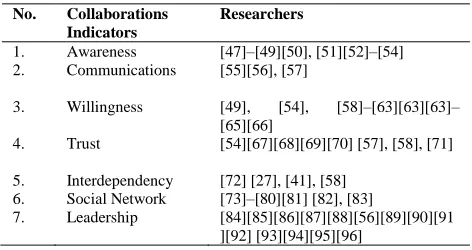
Table 1.0 Summary of literature reviews on collaboration issues
No. Collaborations Issues Researchers
1. The identification and involvement of key stakeholders
[27], [29]–[31], [33], [36]–[44]
2. Maintenance of the collaborative process
[33], [34], [37], [45], [46]
3. (long-term)
Implementation of the collaboration
[31], [32], [34]
The concept of collaborations through the three issues mentioned above will be used when building a model of a sustainable marine environment administration. Research illustrates that from a theoretical viewpoint it is possible to develop an collaborative design approach towards the development of a framework for sustainable marine space governance founded on seven indicators of collaborations. Table 2.0 presents the citations in the available literature reviewed on the collaboration indicators. It seems clear to suggest that collaborative design has already been well defined and dimensioned into seven indicators, i.e. Coordinating bodies, willingness, trust, management communication, visions and network structures/Social network and communication.
Table 2.0 Citations in the available literature reviewed on the collaboration indicators
No. Collaborations Indicators
Researchers
1. Awareness [47]–[49][50], [51][52]–[54] 2. Communications [55][56], [57]
3. Willingness [49], [54], [58]–[63][63][63]– [65][66]
4. Trust [54][67][68][69][70] [57], [58], [71]
5. Interdependency [72] [27], [41], [58] 6. Social Network [73]–[80][81] [82], [83]
7. Leadership [84][85][86][87][88][56][89][90][91 ][92] [93][94][95][96]
Successful collaborations would lead to success the decision making in a multi stakeholder administration. Decision making is a process of identifying and selecting several possibilities actions which normally based on values and preference of the decision maker. In land and marine environments, the decision maker has to make effective and reliable decisions to ensure that the development of the particular land and marine spaces are well coordinated and able to create highly secure social environment standards. In order to realise such decision, the land and marine spaces have to be managed by good governance. The collaborative design approach towards the development of a framework for sustainable marine space governance will be discussed in the next section.
5.0 CONCLUSION AND RECOMMENDATIONS
on three main issues outlined that identification and involvement of key stakeholders, maintenance of the collaborative process, and (long-term) implementation of the collaboration. Cooperation prototype model developed specifically for governance in understanding the basic concepts of a sustainable environment. There are seven indicators provided by the collaboration model which is awareness, communications, willingness, trust, social network, interdependency and leadership. However, the model has to be balanced with the role of Co-operation and administrative limits of the stakeholders in the marine environment. This is because the information presented by modeling collaboration indicator will help stakeholders build a sustainable collaboration. Therefore, the development model and role-based collaboration administrative limits are important stakeholders in this study to ensure effective cooperation model in the governance of a sustainable marine environment. Through seven indicators aided by collaboration model, it is hoped that it will help to develop sustainable governing in marine space administration. There is still a thin layer of lining in the cloud and we may expect to see the light at the end of the tunnel.
Figure 3 Conceptual framework for stakeholder management towards sustainable marine space administration
References
[1] C. H. Teo and A. Fauzi. 2006. A National Geocentric Datum and the Administration of Marine Spaces in Malaysia 2. In Fig Publication No 36. [2] F. C. 4 & 7 W. G. 4. . I. F. of S. 2006. Administering Marine Spaces:
International Issues. In Fig Publication No 36.
[3] M. D. Nichols, S., Monahan, D., & Sutherland. 2000. Good Governance.
Geomatica. 54(4): 415–424.
[4] W. and N. Sutherland, Sutherland, Wilkins and Nichols. 2002.
[5] M. Sutherland and S. Nichols. 2006. Issues in the Governance of Marine Spaces. In Administering Marine Spaces: International Issues. 6–20. [6] S. Ng’ang'a, M. Sutherland, S. Cockburn, and S. Nichols. 2004. Toward a
3D Marine Cadastre in Support of Good Ocean Governance: A Review of the Technical Framework Requirements. Comput. Environ. Urban Syst.
28(5): 443–470.
[7] I. Boateng. 2006. Institutional Frameworks in the Administration of CoastInstitutionalal and Marine Space in Africa. Adm. Mar. Spaces Int. Issues. Frederiksb. Int. Fed. Surv. (publication No. 36).
[8] A. Borja, M. Elliott, J. Carstensen, A.-S. Heiskanen, and W. van de Bund. 2010. Marine Management Towards an Integrated Implementation of the European Marine Strategy Framework and the Water Framework Directives. Mar. Pollut. Bull. 60(12): 2175–86.
[9] S.-M. Cheong. 2008. A New Direction in Coastal Management. Mar. Policy. 32(6): 1090–1093.
[10] F. Douvere, “The importance of marine spatial planning in advancing ecosystem-based sea use management,” Mar. Policy, vol. 32, pp. 762–771, 2008.
[11] J. Horwood. 2010. Marine Ecosystem Management: Fish Abundance and Size Under Exploitation. Mar. Policy. 34(6): 1203–1206.
[12] I. Williamson. 1999. Land Administration and Cadastral Trends–A
Framework for Re-Engineering. 1–22.
[13] M. K. McCall and C. E. Dunn. 2012. Geo-information Tools for Participatory Spatial Planning: Fulfilling the Criteria For ‘Good’ Governance? Geoforum. 43(1): 81–94.
[14] C. Ojeda-Martínez, F. Giménez Casalduero, J. T. Bayle-Sempere, C. Barbera Cebrián, C. Valle, J. Luis Sanchez-Lizaso, A. Forcada, P. Sanchez-Jerez, P. Martín-Sosa, J. M. Falcón, F. Salas, M. Graziano, R. Chemello, B. Stobart, P. Cartagena, A. Pérez-Ruzafa, F. Vandeperre, E. Rochel, S. Planes, and A. Brito. 2009. A Conceptual Framework for the Integral Management of Marine Protected Areas. Ocean Coast. Manag.
52(2): 89–101.
[15] S. B. Olsen, J. G. Sutinen, L. Juda, T. M. Hennessey, and T. A. Grigalunas. 2006. A Handbook on Governance and Socioeconomics of Large Marine Ecosystems. University of Rhode Island.
[16] A. Rajabifard, P. Collier, and I. Williamson. Marine SDI and Cadastre Activities in Asia-Pacific. 1–6.
[17] M. Sutherland. 2011. Improving the Administration of Marine and Coastal Spaces. Coordinates.
[18] L. Strain, A. Rajabifard, and I. Williamson. 2006. Marine Administration and Spatial Data Infrastructure. Mar. Policy. 30(4): 431–441.
[19] I. E. and P. van der M. Barry, Michael. 2000. Ocean Governance And The Marine Cadastre: The Netherlands North Sea. 1–22, 2003.
[20] R. K. Mitchell, B. R. Agle, and D. J. Wood. 1997. Toward A Theory Of Stakeholder Identification and Salience: Defining the Principle of Who and What Really Counts. Academy of Management Review. 22: 853–886. [21] F. Ackermann and C. Eden. 2011. Strategic Management of Stakeholders:
Theory and Practice. Long Range Plann. 44: 179–196.
[22] T. Donaldson, L. E. Preston, and L. E. E. E. Preston. 1995. Theory the Stakeholder of the Concepts, Evidence , Corporation: and Implications.
Management. 20: 65–91.
[23] A. Binns, A. Rajabifard, P. A. Collier, and I. Williamson. 2003. Issues in Defining the Concept of a Marine Cadastre for Australia. In FIG/UNB
Seminar/Meeting On Marine Cadastre. 1–14.
[24] W.-H. Liu, C.-C. Wu, H.-T. Jhan, and C.-H. Ho. 2011. The Role of Local Government in Marine Spatial Planning and Management in Taiwan.
Marine Policy. 35: 105–115.
[25] T. M. . Koontz. 2006. Collaboration for Sustainability ? A Framework for Analyzing Government Impacts in Collaborative-environmental Management. Environ. Manage. 2: 15–24.
[26] F. Berkes. 2009. Evolution of Co-management: Role of Knowledge Generation, Bridging Organizations and Social Learning. Journal of
Environmental Management. 90: 1692–1702.
[27] B. Gray. 1985. Conditions Facilitating Interorganizational Collaboration.
Human Relations. 38: 911–936.
[28] S. L. Yaffee and J. M. Wondolleck. 2000. Making Collaboration Work.
Conserv. Biol. Pract. 1: 17–25.
[29] T. B. Jamal and D. Getz. 1995. Collaboration Theory and Community Tourism Planning. Annals of Tourism Research. 22: 186–204. [30] C. Aas, A. Ladkin, and J. Fletcher. 2005. Stakeholder Collaboration and
Heritage Management. Ann. Tour. Res. 32: 28–48.
[32] T. Jamal. 2004. Conflict in Natural Area Destinations: A Critique of Representation and ‘Interest’ in Participatory Processes. Tourism Geographies. 6: 352–379.
[33] J. Vernon, S. Essex, D. Pinder, and K. Curry. 2005. Collaborative Policymaking. Annals of Tourism Research. 32: 325–345.
[34] T. Jamal and A. Stronza. 2009. Collaboration Theory and Tourism Practice in Protected Areas: Stakeholders, Structuring and Sustainability. Journal of Sustainable Tourism. 17: 169–189.
[35] L. M. De Araujo and B. Bramwell. 2002. Partnership and Regional Tourism in Brazil. Ann. Tour. Res. 29: 1138–1164.
[36] R. Kramer. 1990. Collaborating: Finding Common Ground for Multiparty Problems. Academy of Management Review. 15: 545–547.
[37] B. Gray. 1986. Political Limits to Interorganizational Consensus and Change. The Journal of Applied Behavioral Science. 22: 95–112. [38] K. M. Haywood. 1988. Responsible and Responsive Tourism Planning in
the Community. Tourism Management. 9: 105–118.
[39] J. R. B. Ritchie. 1993. Crafting a Destination Vision: Putting the Concept of Resident Responsive Tourism Into Practice. Tour. Manag. 14: 379–389. [40] L. R. Sheehan and J. R. B. Ritchie. 2005. Destination Stakeholders:
Exploring Identity and Salience. Annals of Tourism Research. 32: 711– 734.
[41] C. M. Hall. 1999. Rethinking Collaboration and Partnership: A Public Policy Perspective. Journal of Sustainable Tourism. 7: 274–289. [42] C. Tosun. 1998. Roots of Unsustainable Tourism Development at the
Local Level: The Case of Urgup In Turkey. Tourism Management. 19: 595–610.
[43] C. Tosun. 2000. Limits to Community Participation in the Tourism Development Process in Developing Countries. Tour. Manag. 21: 613– 633.
[44] P. Sloan. 2009. Redefining Stakeholder Engagement-From Control to Collaboration. J. Corp. Citizsh. 36: 25–40.
[45] J. R. B. Ritchie. 1988. Consensus Policy Formulation in Tourism: Measuring Resident Views Via Survey Research. Tour. Manag. 9: 199– 212.
[46] B. H. Farrell and L. Twining-Ward. 2004. Reconceptualizing Tourism.
Ann. Tour. Res. 31: 274–295.
[47] B. van Loenen. 2009. Developing Geographic Information Infrastructures: the Role of Access Policies. International Journal of Geographical Information Science. 23: 195–212.
[48] W. J. Craig. 1995 Why We Can’t Share Data: Institutional Inertia. New Brunswick, New Jersey: Centre for Urban Policy Research. 107–118. [49] I. Masser. 1998. Governments and geographic information. In
Governments and Geographic Information. 121.
[50] P. Dale and A. L. Allan. 2004. Developing Spatial Data Infrastructures-from concept to reality. Survey Review. 37: 498–499.
[51] P. V. Hall, T. O’Brien, and C. Woudsma. 2013. Environmental Innovation and the Role of Stakeholder Collaboration in West Coast Port Gateways.
Res. Transp. Econ. 42(1): 87–96.
[52] S. A. Presenter. 1996. Organizational Learning and Learning Organizations: Trigger Events, Processes, and Structures. Acad. Manag. Meet. 1–15.
[53] J. L. Price, A. H. Van De Ven, and D. L. Ferry. 1980. Measuring and Assessing Organizations. Adm. Sci. Q. 26: 324.
[54] C. and J. hage. Alter. 1993. Organizations Working Together. Sage Publications, London,
[55] D. Steudler. 2004. A Framework for the Evaluation of Land Administration Systems.
[56] S. Bamberg and G. Möser. 2007. Twenty Years After Hines, Hungerford, and Tomera: A New Meta-analysis of Psycho-social Determinants of Pro-environmental Behaviour. J. Environ. Psychol. 27: 14–25.
[57] S. Daniels and G. Walker. 2001. Working through Environmental Conflict: The Collaborative Learning Approach. Working Through Environmental Conflict. 1–299.
[58] Z. Nedović-budić and J. Pinto. 1999. Understanding Interorganizational GIS Activities : A Conceptual Framework. URISA J. 11: 53–64. [59] U. W. de Montalvo. 2000. Access To Spatial Data-What Determines The
Willingness of Organisations To Share It.
[60] U. W. De Montalvo. 2003. Mapping the Determinants of Spatial Data Sharing. 304.
[61] A. Walter. 2003. Relationship-specific Factors Influencing Supplier Involvement in Customer New Product Development. J. Bus. Res. 56: 721–733.
[62] B. Fynes, C. Voss, and S. De Búrca. 2005. The Impact Of Supply Chain Relationship Quality on Quality Performance. Int. J. Prod. Econ. 96: 339– 354.
[63] J. V. Chen, D. C. Yen, T. M. Rajkumar, and N. A. Tomochko. 2011. The Antecedent Factors on Trust and Commitment in Supply Chain Relationships. Comput. Stand. Interfaces. 33: 262–270.
[64] G. N. Nyaga, J. M. Whipple, and D. F. Lynch. 2010. Examining Supply Chain Relationships: Do Buyer and Supplier Perspectives on Collaborative Relationships Differ? J. Oper. Manag. 28: 101–114.
[65] Z. G. Zacharia, N. W. Nix, and R. F. Lusch. 2009. An Analysis of Supply Chain Collaborations and their Effect on Performance Outcomes. J. Bus. Logist. 30: 101–123.
[66] K. Lowe and A. Moote. 2005. Collaboration as a Tool in Forest Restoration.
[67] L. Lopez Jimenez. 2010. Contracts, Trust and Information Systems Innovation. Cadernos EBAPE.BR. 8: 323–338.
[68] R. Butler. 2001. Trust Within and Between Organizations: Conceptual and Empirical Applications. 22: 367.
[69] D. J. Mancini. 2010. Building Organizational Trust In Virtual Teams. J. Behav. Stud. Bus. 2: 1–5.
[70] A. C. Inkpen. 2000. Strategies of Co-operation: Managing Alliances, Networks, and Joint Ventures. Adm. Sci. Q. 45: 404–406.
[71] M. Fichman and D. A. Levinthal. 1991. Honeymoons and The Liability of Adolescence: A New Perspective on Duration Dependence in Social and Organizational Relationships. Academy of Management Review. 16: 442– 468.
[72] D. H. Jonassen. 2000. Toward A Design Theory of Problem Solving.
Educational Technology Research and Development. 48(4): 63–85.
[73] J. I. Hukkinen. 2012. Social Networks and Natural Resource Management: Uncovering the Social Fabric of Environmental Governance. J. Integr. Environ. Sci. 9: 279–281.
[74] R. Q. Grafton. 2005. Social Capital and Fisheries Governance. Ocean
Coast. Manag. 48: 753–766.
[75] A. Marín and F. Berkes. 2010. Network Approach for Understanding Small-scale Fisheries Governance: The Case of the Chilean Coastal Co-Management System. Mar. Policy. 34: 851–858.
[76] J. Pretty and H. Ward. 2001. Social Capital and the Environment. 29(2). [77] Ö. Bodin and B. I. Crona. 2009. The Role of Social Networks in Natural
Resource Governance: What Relational Patterns Make a Difference?
Global Environmental Change. 19: 366–374.
[78] P. J. Cohen, L. S. Evans, and M. Mills. 2012. Social Networks Supporting Governance of Coastal Ecosystems In Solomon Islands. Conservation Letters. 5: 376–386.
[79] S. Ramirez-sanchez and E. Pinkerton. 2009. The Impact of Resource Scarcity on Bonding and Bridging Social Capital : the Case of Fishers’ Information-Sharing Networks in Loreto, BCS , Mexico. Ecol. Soc. 14: 22. [80] K. Weiss, M. Hamann, M. Kinney, and H. Marsh. 2012. Knowledge Exchange and Policy Influence in a Marine Resource Governance Network. Glob. Environ. Chang. 22: 178–188.
[81] A. Simmons, R. C. Reynolds, and B. Swinburn. 2011. Defining Community Capacity Building: Is It Possible? Preventive Medicine. 52: 193–199.
[82] P. G. Foster-Fishman, S. L. Berkowitz, D. W. Lounsbury, S. Jacobson, and N. A. Allen. 2001. Building Collaborative Capacity in Community Coalitions: A Review and Integrative Framework. Am. J. Community Psychol. 29: 241–261.
[83] M. P. Mandell. 2001. Collaboration Through Network Structures for Community Building Efforts. Natl. Civ. Rev. 90: 279–288.
[84] T. Heikkila and A. K. Gerlak. 2005. The Formation of Large-scale Collaborative Resource Management Institutions: Clarifying the Roles of Stakeholders, Science, and Institutions. Policy Studies Journal. 33: 583– 612.
[85] C. Folke, T. Hahn, P. Olsson, and J. Norberg. 2005. Adaptive Governance Of Social-Ecological Systems. Annual Review of Environment and Resources. 30: 441–473.
[86] H. L. Keough and D. J. Blahna. 2006. Achieving Integrative, Collaborative Ecosystem Management. Conservation Biology. 20: 1373–1382. [87] K. D. Genskow. 2009. Catalyzing Collaboration: Wisconsin’s
Agency-Initiated Basin Partnerships. Environ. Manage. 43: 411–424.
[88] M. Lamers, B. Ottow, G. Francois, and Y. von Korff. 2010. Beyond Dry Feet? Experiences from a Participatory Water-Management Planning Case in The Netherlands. Ecol. Soc. 15: 19.
[89] L. R. Belton and D. Jackson-Smith. 2010. Factors Influencing Success Among Collaborative Sage-Grouse Management Groups In The Western United States. Environmental Conservation. 37: 250–260.
[90] R. F. Brummel, K. C. Nelson, S. G. Souter, P. J. Jakes, and D. R. Williams. 2010. Social Learning in a Policy-mandated Collaboration: Community Wildfire Protection Planning in the Eastern United States. Journal of
[91] E. Mostert, C. Pahl-Wostl, Y. Rees, B. Searle, D. Tàbara, and J. Tippett. 2007. Social Learning in European River-Basin Management: Barriers and Fostering Mechanisms from 10 River Basins. Ecol. Soc. 12: 19. [92] D. B. Raik, D. J. Decker, and W. F. Siemer. 2003. Dimensions of Capacity
in Community-based Suburban Deer Management: The Managers’ Perspective. Wildl. Soc. Bull. 31: 854–864.
[93] F. Rauschmayer, H. Wittmer, and A. Berghöfer. 2008. Institutional Challenges for Resolving Conflicts Between Fisheries and Endangered Species Conservation. Mar. Policy. 32: 178–188.
[94] E. P. Weber, T. M. Leschine, and J. Brock. 2010. Civic Science and Salmon Recovery Planning in Puget Sound. Policy Stud. J. 38: 235–256. [95] R. Dodds. 2007. Sustainable Tourism and Policy Implementation: Lessons
from the Case of Calvia, Spain. Current Issues in Tourism. 10: 296–322. [96] S. Timur and D. Getz. 2009. Sustainable Tourism Development: How Do
Destination Stakeholders Perceive Sustainable Urban Tourism? Sustain. Dev. 17: 220–232.
![Figure 1 Malaysia and its South East Asian Neighbors [1]](https://thumb-us.123doks.com/thumbv2/123dok_us/1196358.1150245/2.612.57.292.201.377/figure-malaysia-south-east-asian-neighbors.webp)
![Figure 2 Illustration of multiple interests in the coastal zone [23]](https://thumb-us.123doks.com/thumbv2/123dok_us/1196358.1150245/3.612.321.555.422.588/figure-illustration-multiple-interests-coastal-zone.webp)