ABSTRACT
DIAZ, JOHN MICHAEL. Community Based Fire Management: Local Ecological Knowledge and Fire Management. (Under the direction of Dr. Toddi Steelman.)
Policy makers and natural resource managers have identified a relationship between declining forest health across the national landscape and the increasing risk of catastrophic wildfire, which threatens both landscapes and communities. Since 2000, national wildfire policy has encouraged federal, state, and local agencies responsible for wildland fire management to work collaboratively with communities to mitigate their fire risk. Previous research offers evidence that local understanding of ecological conditions can shape public perception and support of various fire management strategies. Multiple studies have also identified formal education and long-time residency as providing a foundation for understanding local ecological issues. My study used survey data and key informant interviews from four 2010 wildland fire events (Tecolote Fire in New Mexico, Schultz Fire in Arizona, Bull Fire in California, and Four Mile Canyon Fire in Colorado) to understand how local ecological knowledge, length of residency and education level affected local fire management perception and understanding. My findings primarily support qualitative
research on this topic, while bringing greater quantitative rigor to the claim. My study results indicated that local ecological knowledge was associated with local understanding of fire management strategies.Length of residency was not found to contribute to correct
identification of fire management strategies or influence opinions related to satisfaction with specific fire management strategies. Results also demonstrated no significant difference between rural and urban residents’ understanding and perception of fire management, which contradicts previous literature. Education levels were not significantly related to public perception of fire management but were related to higher proficiencies in accurately identifying local ecological conditions. Education may play a mediating role in
understanding complex environmental issues but does not predict better understanding of fire management. There is more room for investigating these questions from a research
Community Based Fire Management: Local Ecological Knowledge and Fire Management
by
John Michael Diaz
A thesis submitted to the Graduate Faculty of North Carolina State University
in partial fulfillment of the requirements for the Degree of
Master of Science
Natural Resources
Raleigh, NC 2013
APPROVED BY:
________________________ ________________________ Dr. Joseph Roise Dr. Branda Nowell
ii BIOGRAPHY
John started working on the wildland fire research in the spring of 2011 as a research assistant for Fire Chasers and is responsible for managing the coordination of field research efforts. John is also working as a research assistant with the Southern Fire Exchange
iii TABLE OF CONTENTS
LIST OF TABLES ... iv
INTRODUCTION ...1
LITERATURE REVIEW...1
METHODS AND CONCEPTUAL FRAMEWORK ...7
FINDINGS ... 11
DISCUSSION AND IMPLICATIONS ... 28
REFERENCES ... 32
APPENDIX ... 37
APPENDIX A- SURVEY QUESTIONS AND SCALES ... 38
iv LIST OF TABLES
Table 1: Variables utilized in research analysis including variable description. ...8
Table 2: Central Tendencies of fire management perception variables ... 12
Table 3: Frequencies of ecological needs in accepting fire management decisions ... 12
Table 4: Frequencies of Ecological Assessment Index ... 13
Table 5: Non-parametric correlation output for self-reported ecological assessment index ... 14
Table 6: Linear regression Model Summary ... 14
Table 7: Linear regression coefficient output ... 15
Table 8: Frequencies of resident response on fire management strategy identification ... 15
Table 9: Frequencies of aggregated Eco-knowledge Index of eco-match variable ... 16
Table 10: Probability of Identifying Correct Fire Management Strategy Based on Number of Correct Ecological Condition Match... 17
Table 11: Chi-Square Logistic Regression Output Eco-knowledge and Strategy Match ... 17
Table 12: Logistic Regression Output Predicting Relationship between Ecological Knowledge and Fire Management Understanding across Three Fires ... 18
Table 13: Comparison of local resident ecological assessment with District Forest Ranger response ... 19
Table 14: Comparison of local resident ecological assessment with District Forest Ranger response ... 20
Table 15: Comparison of local resident ecological assessment with District Forest Ranger response ... 21
Table 16: Non-parametric correlation output for length of residency ... 22
v
Table 18: Linear regression coefficients output ... 23
Table 19: Percentage Correct Ecological Condition Match across Residency Type ... 24
Table 20: Percentage Correct Fire Management Identification across Residency Type ... 24
Table 21: Chi-Square Output for Residency Type and Strategy Match ... 25
Table 22: Chi-Square Output for Residency Type and Eco-knowledge ... 25
Table 23: Non-parametric correlation output for education level... 26
Table 24: Linear regression model summary ... 27
Table 25: Linear regression coefficients output ... 27
Table 26: Chi-Square Output for Eco-knowledge >=4 and Education Level ... 28
Table 27: Percentage of Respondents That Identified <= 3 Conditions or >= 4 Conditions .. 28
Table 28: Survey questions used in study with associated response scales ... 38
Table 29: Frequencies associated with resident type ... 40
Table 30: Frequency statistics associated with residency type ... 40
Table 31: Frequencies associated with length of residency... 41
1 INTRODUCTION
Declining vegetative health and increasing human populations in the wildland urban interface have created significant challenges for wildland fire management in the United States (QFR, 2009). National policies continue to place a priority on more locally-based efforts to address the wildfire problem in the West (Steelman and Kunkel, 2004). “Relying on communities to identify and define their own alternatives as they build their capacity to respond to wildfire threats is the surest way to provide a long-term solution to the wildfire problem facing Western communities” (Steelman and Kunkel, 2004; p. 698). As fire management shifts towards increasing local resilience through community based efforts, studies have focused on gaining insight into what factors increase acceptance and
understanding of various strategies. Behavioral hazards research identifies the impact that awareness and perception of natural hazards have on the translation of knowledge into action (Burton et al., 1993; McCaffrey, 2004).
Community-based efforts such as Firewise and Fire-Adapted Communities depend on local residents to take an active role in efforts to address wildfire risk. These programs
depend on local communities to conduct risk assessments based on local ecology and fire history to create mitigation plans. They also encourage resident support of land management agencies by learning about wildfire risk reduction efforts, such as using prescribed fire to manage local landscapes (FAC, 2013). In this article I seek to identify how local ecological knowledge contributes to a community’s perception and understanding of appropriate fire management strategies. In the following sections I provide an overview of three relevant factors—local ecological knowledge, length of residency, and education level—that relate to understanding of management decisions on the ground. I develop a framework based on review of relevant literature and analyze survey data collected following four wildfires from the 2010 wildfire season to better understand how these factors are related to fire
management.
LITERATURE REVIEW
Local Ecological Knowledge and Fire Risk, Fire Ecology and Fire Management
The relationship between local ecological knowledge and wildland fire management in existing literature does not follow a clear logical route from understanding local ecological conditions to understanding how they relate to fire management strategies, but there is
2
Research suggests that knowledge about local ecological systems provides a
framework for interpreting and responding to feedback from the local environment to guide the direction of resource management (Berkes et al. 2000). Environmental policy makers have identified this relationship when implementing and administering natural resource policies (Ray et al. 2012). Research provides a continuum of how local ecological knowledge relates to wildland fire. It ranges from understanding that forest health
contributes to risk to a more sophisticated understanding of how exact ecological conditions contribute to specific risks and lead to specific management actions. What remains unclear is if this relationship between local ecological knowledge exists in the context of wildfire response, especially as it relates to perceptions of fire risk, fire ecology, and fire-mitigation practices.
The fire management community has identified the importance of local ecological knowledge in creating place-based solutions and increasing acceptance of appropriate practices for mitigating fire risk (McCaffrey and Olsen 2012, Brenkert-Smith 2011). Berkes et al. (2000: p. 1252) define local ecological knowledge as a “cumulative body of knowledge, practice and belief, evolving by adaptive processes and handed down through generations by cultural transmission, about the relationship of living beings (including humans) with one another and with their environment”. Natural resource policy has shifted its focus toward community based initiatives where management decisions integrate local and science based ecological knowledge in an attempt to adapt polices to various local contexts.
The first link in the chain is connecting local ecological knowledge to fire risk. According to some studies, residents in fire prone ecosystems have a good understanding of the relationship between forest health and fire risk. Burns and Cheng (2007) conducted key informant interviews to identify public perception of active forest management to mitigate wildland fire risk. Stakeholders believed that the current conditions of the region’s forests were unhealthy and overly dense. This local ecological knowledge contributed to the public perception that forests should be actively managed to improve forest health conditions and protect against large wildfires (Burns and Cheng 2007).
3
2012). McCaffrey (2008) conducted qualitative analysis of discussions that took place during 15 focus groups sessions in Arizona, Colorado, California, Montana and Nevada. A distinct pattern of wildfire risk perception emerged. First, participants generally thought about environmental conditions that would affect the odds of a fire breaking out and influence its behavior. Participants were also able to associate environmental factors with different levels of wildfire risk (McCaffrey 2008). Ray et al. (2012) used qualitative methods to document local observations of wildfire and place change within the Koyukun Forest in central Alaska.
Most residents related flammability not to fire history but to specific vegetative conditions caused by different factors (Ray et al. 2012). Dead or dry vegetation was seen as the primary cause of flammable conditions, followed by dense brush, grass, and pine spruce. Weisshaupt et al. (2007) also conducted qualitative analysis of focus groups that were held across Idaho, Montana and Washington to identify themes that emerged following
constructive stakeholder discussion. Participants recognized ecological conditions that
contributed to the region’s wildland fire risk and generally focused on the build-up of fuels in the local forest (Weisshaupt et al. 2007). Disagreement existed between the development and description of current conditions but residents agreed that their forests were too dense with undergrowth and deadfall. Respondents saw these conditions as contributing to the area’s recent fire history (Weisshaupt et al. 2007).
The third link begins to connect how fire management strategies fit into the appropriate response. Research demonstrates that local communities have intricate
knowledge of how forest related conditions contribute to fire risk and dictate appropriateness of management strategies. Ryan (2012) surveyed over 1,000 residents in the pine barren ecosystem of northeast United States and was able to identify a relationship between knowledge of natural areas and perceptions of fire management. Respondents who self-reported higher levels of ecological knowledge had a better understanding of the selection of specific fire management strategies (Ryan 2012). Brenkert-Smith (2011) interviewed
residents of two communities in Colorado to understand homeowner’s perspectives on the parcel approach to wildland fire management. Residents demonstrated disagreement with this management approach based on their understanding of local ecological conditions. Residents agreed that wildland fire did not follow property lines and therefore required management across the landscape to ensure a holistic approach toward mitigating risk (Brenkert-Smith 2011).
4
Shindler (2006) surveyed visitors of the Sequoia and King’s Canyon National Parks and the World Forestry Center in Portland Oregon to evaluate their understanding of fire
management objectives in reference to local ecological conditions. Respondents generally understood the relationship between the objectives of fire management strategies and local ecology (Toman and Shindler 2006). Cohn et al. (2008) used interview data from case studies of six communities affected by 2000 and 2002 wildfires in Arizona, Colorado, Idaho,
Montana and Utah to uncover individual, household, neighborhood, and community perspectives. Respondents identified existing forest conditions of dense, overstocked
understory and high fuel loads as contributing to the magnitude and intensity of the fires that affected their communities (Cohn et al. 2008).
In all sites, respondents demonstrated an understanding that extremely dry conditions accompanied by strong or erratic winds, along with inaccessible or steep terrain, contributed to the magnitude of the fire (Cohn et al. 2008). Public understanding of the local ecological conditions also contributed to criticism of wildfire response strategies. Several respondents believed that the fire threatening their community was controllable and could have been put out during its early stages. They attributed environmental conditions and a weak initial attack to the increased wildfire severity. Respondents in several sites also criticized the use of backfires claiming the absence of ideal environmental conditions, which contributed to escaped burns and unnecessary damage (Cohn et al. 2008).
My research sought to gain a better insight into the dynamics of local ecological understanding and fire management perception in the context of wildfire response. The main hypothesis was: local ecological knowledge will be positively related to fire management acceptance and understanding. Research shows that knowledge of local ecological systems contributes to a residents’ understanding of fire risk, fire ecology, and fire management specific to each study area. My study looks to expand on this body of research by conducting quantitative analysis of surveys disseminated to four communities affected by wildfire across the western United States to evaluate how public proficiency in identifying local ecological conditions contributes to the perception of fire management strategies.
Length of Residency and Residency Type
5
economic and cultural grounds, the resolutions are often social, not just environmental (Ericksen and Gill 2010). This scenario is especially important in the context of rural landscapes affected by the structural and environmental changes linked with amenity-led migration from urban centers into rural landscapes since the 1970s. Qualitative studies have identified that these structural and environmental changes have been linked to the
in-migration of new residents with values, life experiences, and interactional behaviors distinct from longtime residents (Ericksen and Gill 2010, Ericksen and Prior 2011, Graffey and Booth 2008, Gordon et al. 2010, Weber and Word 2001). Many new rural landowners have no history of wildland fire in their families. They also bring lifestyles and values more commonly associated with the urban areas into rural places (Gordon et al. 2010). Shindler et al. (2011) found that rural and urban residents identify different risk factors within the local context that contribute to their acceptance of specific management decisions. Urban and rural residents hold different value and belief systems usually associated with their lifestyle, which provide fire management agencies with diverse perspectives for communicating about wildfire as well as those strategies used in fire management.
Demographic differences related to length of residency have been identified as an important factor influencing wildland fire management perception. Gordon et al. (2010) conducted key informant interviews in areas where community change was influencing wildfire perception. Most new residents, defined as living less than 10 years in a community, were aware of fire ecosystems but few were familiar with fire as part of local ecology. The new residents predominantly came from communities where public services took care of environmental risk, resulting in reduced public engagement with wildland fire. These residents showed a concern for receiving notice when wildfire became an issue. New
residents put responsibility on public programs and did not expect to engage in fire planning. A predominant theme among new residents was the consideration that wildfire was irrelevant in the local context (Gordon et al. 2010). In contrast, longtime residents, defined as over 10 years of residency in a community, demonstrated a heightened awareness of fire risk that translated to increased engagement with pre-fire risk mitigation and better understanding of fire management strategies.
6
New residents, defined as residing in the community for less than 10 years, seemed to be unaware of the threat of wildfire resulting from previous experience in urban environments and lacked an understanding of fire history within their families. Long-term residents, defined as having over 10 years of residency in community, had a comprehensive
understanding of fire within local ecology as well as appropriate fire management strategies (Ericksen and Prior 2011). When wildland fire is conceptualized not just as a natural
phenomenon but simultaneously as a product of ongoing associations and negotiations in landholders’ everyday life, longer term residents better understood fire management strategies (Ericksen and Gill 2010).
My research takes a more quantitative approach to gain insight into the possible relationship between length of residency and perception of management strategies. My hypothesis states: the length of residency will be positively related to fire management acceptance and understanding. Research suggests that as an individual lives within fire prone communities they are continuously exposed to wildland fire risk communications and have more opportunities to engage with the local landscape. These residents develop a frame of reference that incorporates fire risk is a part of everyday life.
Education Level
Educational level has been speculated to be a key variable related to perceptions associated with wildland fire management. However, this speculation has not been wholly supported in research on the topic. Some local resident surveys have demonstrated no significant association between education level and fire management perception (Fried et al. 2006, Lim et al. 2009, Shindler and Toman 2003, Toman et al. 2011). These studies focused on fuels management and treatment programs using both quantitative and qualitative
methods to evaluate a possible relationship. Fried et al. (2006) evaluated focus group discussions and resident surveys from across the country but did not identify a significant relationship between educational attainment and acceptance of fuel management practices. Shindler and Toman (2003) disseminated surveys and “quiz like” questionnaires to residents in and around fire prone ecosystems to evaluate longitudinal demographic differences that contributed to fuel treatment acceptance and understanding. This study also did not find education level as a significant predictor of either understanding or acceptance.
7
2010, McCaffrey and Olsen 2012). Some scholars believe that the unclear relationship between education level and fire management perception is a result of the influence of community engagement and group membership (Gordon et al. 2010, McCaffrey 2008). Ericksen and Gill (2010) conducted local resident interviews in fire prone areas, identifying educational level as an important predictor for fire management perception related to sentimental attachment to wildlife. Residents who completed higher levels of education considered environmental impact as an important factor in accepting fire management strategies. Absher and Vask (2006) identified education level as a predictor for the acceptance of flexible fire management strategies, the assumption being that increased understanding of fire ecology and fuels accumulation is associated with increased education. Lim et al. (2009) discovered a significant positive relationship between education and concern for fire management outcomes. Residents with higher levels of education demonstrated a comprehensive understanding of fire management and how different strategies contribute to different management objectives. Other studies have identified a positive relationship between education level and engagement with restoration activities (Ostergen et al. 2006), behavioral change associated with climate change (Semenza et al. 2008), and agency trust (Winter and Cvetkovich 2008).
My research sought to understand the relationship between education level and fire management as it relates to four communities across the western United States. My
hypothesis states: education level will be positively related to both fire management acceptance and understanding. Existing research provides conflicting evidence of this relationship, which will be further investigated through quantitative methods.
METHODS AND CONCEPTUAL FRAMEWORK
This study used a mixed method research approach with key informant interviews during four 2010 wildland fire events (Tecolote Fire in New Mexico, Schultz Fire in Arizona, Bull Fire in California, and Four Mile Canyon Fire in Colorado) followed by mail surveys, using a survey based on Dillman’s methods (2007). The surveys were implemented during Fall/Winter 2010/11.
8
The relatively low response rates warranted a follow-up telephone survey to test for non-response bias. An abbreviated telephone survey was administered to 10 percent of the respondents. “No differences were found for education or employment, but
non-respondents were more likely to be younger, female, live in an urban area, and have lived in the community for less time” (McCaffrey et al 2013, p. 8).
We interviewed the district rangers of the Sante Fe National Forest (New Mexico), Coconino National Forest (Arizona) and the Sequoia National Forest (California) to gain insight on the prevalent ecological conditions present prior to each wildland fire event. These data provided a baseline of the local ecology in the context of each fire. These responses were analyzed with respect to multiple fire management perception variables to evaluate existing relationships. Information for how each wildfire was managed was extracted from its corresponding ICS-209 daily incident status fire reports.
Analysis Plan
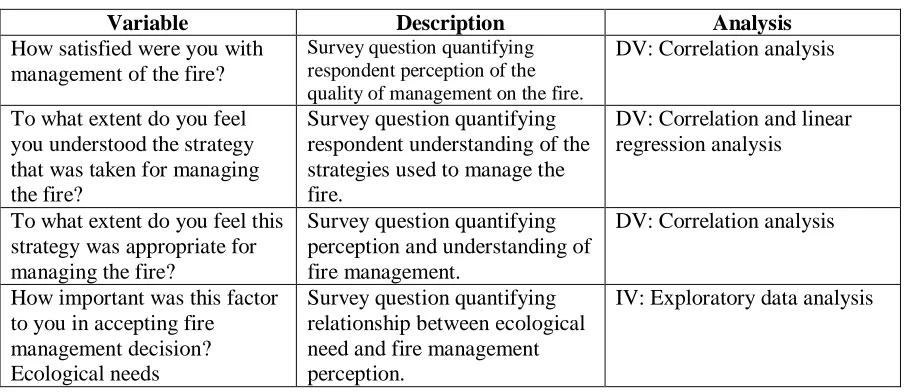
The survey data collected following the four wildland fire events are the focus of analysis in this study. The quantitative analysis approach employed in this study required the manipulation of raw data to create new and revised variables. Table 1 outlines the
composition of variables included in this study as well as their role in the analysis plan.
Table 1: Variables utilized in research analysis including variable description.
Variable Description Analysis
How satisfied were you with management of the fire?
Survey question quantifying respondent perception of the quality of management on the fire.
DV: Correlation analysis
To what extent do you feel you understood the strategy that was taken for managing the fire?
Survey question quantifying respondent understanding of the strategies used to manage the fire.
DV: Correlation and linear regression analysis
To what extent do you feel this strategy was appropriate for managing the fire?
Survey question quantifying perception and understanding of fire management.
DV: Correlation analysis
How important was this factor to you in accepting fire management decision? Ecological needs
Survey question quantifying relationship between ecological need and fire management perception.
9 Table 1: Continued.
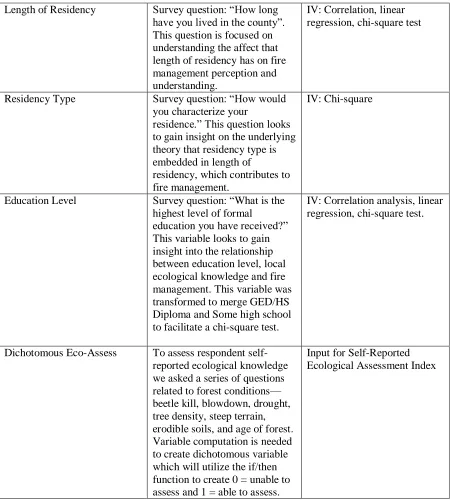
Length of Residency Survey question: “How long
have you lived in the county”. This question is focused on understanding the affect that length of residency has on fire management perception and understanding.
IV: Correlation, linear regression, chi-square test
Residency Type Survey question: “How would
you characterize your
residence.” This question looks to gain insight on the underlying theory that residency type is embedded in length of
residency, which contributes to fire management.
IV: Chi-square
Education Level Survey question: “What is the
highest level of formal
education you have received?” This variable looks to gain insight into the relationship between education level, local ecological knowledge and fire management. This variable was transformed to merge GED/HS Diploma and Some high school to facilitate a chi-square test.
IV: Correlation analysis, linear regression, chi-square test.
Dichotomous Eco-Assess To assess respondent
self-reported ecological knowledge we asked a series of questions related to forest conditions— beetle kill, blowdown, drought, tree density, steep terrain, erodible soils, and age of forest. Variable computation is needed to create dichotomous variable which will utilize the if/then function to create 0 = unable to assess and 1 = able to assess.
10 Table 1: Continued.
Self-Reported Ecological Assessment Index
These data are based on the response of a dichotomous variable (Dichotomous Eco-Assess) delineating the ability to assess the presence of the seven forest-related conditions. This index is an aggregate of respondents ability to assess seven conditions. This variable serves to gain preliminary understanding of the body of local ecological knowledge and how it relates to fire management.
IV: Correlation analysis and linear regression
Transformed Self-Reported Ecological Assessment Index
The non-normal distribution of the Self-Reported
Ecological Assessment Index exhibited a negative
skewness requiring
logarithmic transformation LOG 10 (K-X) (Howell 2007).
IV: Linear regression
Strategy match To assess respondent
understanding of the fire management strategy utilized, they were asked to identify the specific strategy from a survey list. To create a dichotomous match variable, computation utilizing the if/then function will create a 0= No match and 1= Match. This is the main dependent variable utilized to quantify respondent fire management understanding.
11 Table 1: Continued.
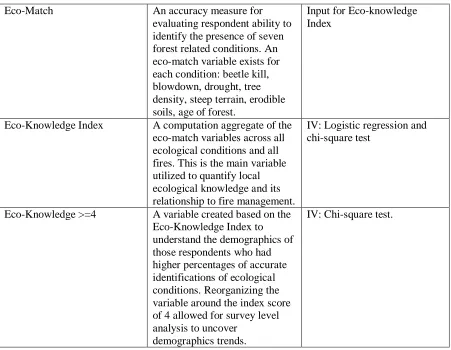
Eco-Match An accuracy measure for
evaluating respondent ability to identify the presence of seven forest related conditions. An eco-match variable exists for each condition: beetle kill, blowdown, drought, tree density, steep terrain, erodible soils, age of forest.
Input for Eco-knowledge Index
Eco-Knowledge Index A computation aggregate of the
eco-match variables across all ecological conditions and all fires. This is the main variable utilized to quantify local ecological knowledge and its relationship to fire management.
IV: Logistic regression and chi-square test
Eco-Knowledge >=4 A variable created based on the
Eco-Knowledge Index to understand the demographics of those respondents who had higher percentages of accurate identifications of ecological conditions. Reorganizing the variable around the index score of 4 allowed for survey level analysis to uncover
demographics trends.
IV: Chi-square test.
FINDINGS
Local Ecological Knowledge
12
“somewhat” or “very important” in the acceptance of fire management strategies with almost 49% (n=253) stating it was “very important”. Only 14.5% of respondents who answered this question saw ecological needs as “not very important” in accepting fire management
decisions (Table 3).
Table 2: Central Tendencies of fire management perception variables
How satisfied were you with management of the fire?
To what extent do you feel you understood the strategy that was taken for
managing the fire?
To what extent do you feel this strategy was appropriate for managing the fire?
How important was this factor to you in accepting fire
management decision? Ecological needs
Mean 3.28 (out of 4) 3.06 (out of 4) 3.80 (out of 4) 2.34 (out of 3)
Median 4 3 4 2.00
Mode 4 3 4 3
Table 3: Frequencies of ecological needs in accepting fire management decisions
Frequency Percent
Not very important 76 14.5
Somewhat important 195 37.2
Very important 253 48.3
N of Valid Cases 524 100.0
To assess respondent self-reported ecological knowledge we asked a series of questions related to forest conditions—beetle kill, blowdown, drought, tree density, steep terrain, erodible soils, and age of forest. Only 42% (n=261) of 628 respondents answered the ecological assessment questions (Table 4). The table below tells us that the survey
13
Table 4: Frequencies of Ecological Assessment Index
Self-Reported Ecological Assessment Index
Frequency Percent
.00 61 9.7
1.00 26 4.1
2.00 31 4.9
3.00 42 6.7
4.00 45 7.2
5.00 71 11.3
6.00 91 14.5
7.00 261 41.6
N of Valid Cases 628 100%
My results indicate that ecological knowledge plays a role in public perception of fire management (Table 3) but does not necessarily reflect an accurate understanding of which specific ecological processes are at work. A Spearman’s Rho non-parametric correlation was conducted (Table 5). Ecological knowledge (Self-Reported Ecological Assessment Index) was found to be weakly but positively related to the understanding of fire management strategies, r (570) = .087, p < .05. The coefficient of determination was r2=0.008.
Ecological knowledge (Self-Reported Ecological Assessment Index) was found to be negatively associated with the perceived appropriateness of the fire management strategy, r
14
Table 5: Non-parametric correlation output for self-reported ecological assessment index
Variables How satisfied
were you with management of the fire?
To what extent do you feel you understood the strategy that was taken for managing the fire?
To what extent do you feel this strategy was appropriate for managing the fire?
Self-Reported Ecological Assessment Index
Correlation Coefficient Significance (2-tailed) N
.027 .521 576
.087* .038
570
-.157** .000
617
* p= .05 ** p= .01
A linear regression was conducted to evaluate the relationship between length of residency, education level and ecological knowledge on respondents’ understanding of fire management strategies (Table 6 & 7). The regression was not significant: F (543) = 2.811, p = .053. The Self-Reported Ecological Assessment Index was the only significant variable (p= .016) (Table 7).
Table 6: Linear regression Model Summary
Model R B R Square Adjusted
R Square
Std. Error of the Estimate
Sig.
1 .119^a 3.107 .014 .009 .781 .053
15 Table 7: Linear regression coefficient output
Model B t Sig.
1 (Constant) 3.107 20.087 .000
Length of Residency
.052 1.185 .232
Education Level
-.008 -0282 .849
Self-Reported Ecological Assessment
Index
-.104 -2.418 .016
a. Dependent Variable: To what extent do you feel you understood the strategy that was taken in managing the fire?
b. Linear regression equation: Y = a + bx
c. Y= dependent variable; a = intercept when x is 0; b= slope of the line; X= explanatory variable
An insufficient understanding of fire management strategies by survey respondents provides further insight to this scenario. Direct suppression was utilized to manage each fire but only 50% of respondents correctly identified this as the strategy utilized (Table 8). The remaining respondents either identified incorrect strategies (28.9%) or designated that they did not know the fire management strategy (21.3%). There was no significant difference in strategy identification based on the Self-Reported Ecological Assessment Index.
Table 8: Frequencies of resident response on fire management strategy identification
Fire Management Strategy Frequency Percent
Direct suppression* 303 49.8%
Modified/limited suppression 142 23.3%
Area management/monitoring 34 5.6%
Don’t know 130 21.3%
N of Valid Cases 609 100%
16
These results bring to question the high designation given to appropriateness of strategy. Many respondents attributed ecological needs as “very important” in accepting management decisions but did not have the knowledge to make an assessment of forest related conditions. Yet most respondents rated the fire management strategy as “very appropriate” and claimed to be “very satisfied” with the strategies used. Based on these factors and the limited proficiency with fire management identification, one can identify disconnect between perception and understanding. A community level evaluation of fire management understanding and perception allows us to identify trends and/or variance within each fire. Communities affected by the Tecolote, Shultz and Bull Fire were evaluated to understand how residents’ ecological knowledge compared with identification of forest related conditions made by each district ranger (Table 9). The Four Mile Canyon fire was excluded from this analysis, as District Ranger data were not collected.
Table 9: Frequencies of aggregated Eco-knowledge Index of eco-match variable
Eco-knowledge Index Frequency (%) Cumulative Percent
.00 17.6 17.6
1.00 10.8 28.4
2.00 14.4 42.8
3.00 9.5 52.3
4.00 27.4 79.7
5.00 14.6 94.3
6.00 4.9 99.2
7.00 0.8 100
17
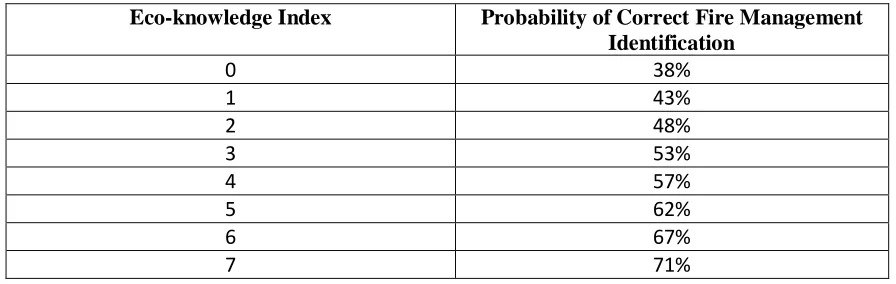
Table 10: Probability of Identifying Correct Fire Management Strategy Based on Number of Correct Ecological Condition Match
Eco-knowledge Index Probability of Correct Fire Management Identification
0 38%
1 43%
2 48%
3 53%
4 57%
5 62%
6 67%
7 71%
*Eco-knowledge index based on correct match of District Ranger Assessment of ecological conditions prevalence.
* Correct fire management identification based on strategy match variable.
A logistic regression analysis was conducted to predict fire management
understanding using the Eco-knowledge index across all fires as well as per fire. A test of the full model against a constant only model was statistically significant, indicating that the Eco-knowledge index serves as a predictor for fire management understanding (chi square = 31.696, p < .000 with df = 3).
Table 11: Chi-Square Logistic Regression Output Eco-knowledge and Strategy Match
Chi-Square df Sig Cox & Snell R
Square
Nagelkerke’s R Square
31.696 3 .000 .062 .083
18
understanding fire management strategies (p = .000). The Eco-knowledge index within the Tecolote and Schultz Fire also demonstrated that ecological knowledge within each fire made a significant contribution to understanding the specific fire management strategy utilized (p = .000; p = .003). The same index within the context of the Bull Fire was not a significant predictor (p = .793). EXP(B) value indicates that when the number of correct ecological condition identifications is raised by one unit (one condition) the odds ratio is 1.219 times as large and therefore respondents are 1.219 more times likely to identify the correct fire management strategy (Table 12).
Table 12: Logistic Regression Output Predicting Relationship between Ecological Knowledge and Fire Management Understanding across Three Fires
Predictor B Waldx^2 P Odds Ratio
Eco-knowledge .198 12.385 .000 1.219
Tecelote 15.527 .000
Shultz -.988 9.125 .003 .372
Bull .249 0.069 .793 1.068
Constant -.493 5.894 .015 .611
*Logistic Regression Equation: e^a + bx
**a= B (constant); b= B (Ecoknowledge, Tecelote, Shultz, Bull); x = eco-knowledge index
19
Table 13: Comparison of local resident ecological assessment with District Forest Ranger response
Forest Condition Match Management Strategy Identification Beetle Kill Tecolote (+) 57% incorrect 43% correct 70% incorrect 30% correct Blowdown Tecolote (-) 77% incorrect 23% correct 69% incorrect 31% correct Drought Tecolote (+) 27% incorrect 83% correct 64% incorrect 36% correct Tree Density Tecolote (+) 31% incorrect 69% correct 70% incorrect 30% correct Steep Terrain Tecolote (-) 95% incorrect 5% correct 70% incorrect 30% correct Erodible Soils Tecolote (+) 46% incorrect 54% correct 43% incorrect 57% correct Age of Forest
Tecolote (+)
58% incorrect 42% correct
70% incorrect 30% correct (+): Condition identified by District Ranger as prevalent.
(-): Condition not identified by District Ranger as prevalent.
The District Ranger identified five forest related conditions while a majority of
respondents believed only three conditions--drought, tree density, and erodible soils-- were at play prior to the fire. High percentages of residents inaccurately identified the prevalence of blowdown (77%) and steep terrain (95%) as being present on the forest (Table 13). A majority of respondents accurately identified the local ecological conditions to be drought, tree density and erodible soils (Table 13). Respondents had the highest success rate
identifying drought (83%) and tree density (69%) among the forest related conditions but did not accurately identify the appropriate management strategy in a majority of cases with 64% and 70% incorrect identification respectively (Table 13).
20
Table 14: Comparison of local resident ecological assessment with District Forest Ranger response
Forest Condition Match Fire Management Strategy Identification Beetle Kill Shultz (-) 86% incorrect 14% correct 50% incorrect 50 % correct
Blowdown Shultz (-) 72% incorrect 28% correct 44% incorrect 56% correct Drought Shultz (-) 92% incorrect 8% correct 44% incorrect 56% correct Tree Density Shultz (+) 18% incorrect 82% correct 44% incorrect 56% correct Steep Terrain Shultz (+) 15% incorrect 85% correct 44% incorrect 56% correct Erodible Soils Shultz (-) 86% incorrect 14% correct 74% incorrect 26% correct Age of Forest
Shultz (+)
39% incorrect 61% correct
44% incorrect 56% correct
(+): Condition identified by District Ranger as prevalent. (-): Condition not identified by District Ranger as prevalent.
The District Ranger identified three forest related conditions while a majority of respondents believed that all seven conditions were at play prior to the fire. High percentages of residents inaccurately identified the prevalence of beetle kill (86%), blowdown (72%), drought (92%) and erodible soils (86%) as being present on the forest (Table 14). A majority of respondents accurately identified the local ecological conditions to be tree density, steep terrain, and age of forest (Table 14). Respondents had the highest success rate identifying steep terrain (85%) and tree density (82%) among the forest related conditions but did not accurately identify the appropriate management strategy in a majority of cases with 56% incorrect identification respectively (Table 14).
21
Table 15: Comparison of local resident ecological assessment with District Forest Ranger response
Forest Condition Match Fire Management Strategy Identification
Beetle Kill Bull (-)
79% incorrect 21 % correct
54% incorrect 46% correct Blowdown Bull(-) 76% incorrect 24% correct 55% incorrect 45% correct Drought Bull (-) 87% incorrect 13% correct 55% incorrect 45% correct Tree Density Bull (+) 52% incorrect 48% correct 55% incorrect 45% correct Steep Terrain Bull (-) 90% incorrect 10% correct 75% incorrect 25% correct Erodible Soils Bull (-) 88% incorrect 12% correct 53% incorrect 47 correct Age of Forest
Bull (-)
88% incorrect 12% correct
56% incorrect 44% correct (+): Condition identified by District Ranger as prevalent.
(-): Condition not identified by District Ranger as prevalent.
The District Ranger identified one forest related condition while a majority of respondents believed all seven conditions were at play prior to the fire. High percentages of residents inaccurately identified the prevalence of beetle kill (79%), blowdown (76%), drought (87%), steep terrain (90%), erodible soils (88%), and age of forest (88%) as being present on the forest (Table 15). A minority of respondents (48%) accurately identified the local ecological conditions to be tree density (Table 15). Respondents had the highest success rate identifying tree density (48%) but did not accurately identify the appropriate
22 Length of Residency and Residency Type
Survey respondents were asked about different aspects of fire management strategies (Table 2) and “how long have you lived in the county?” A Spearman’s Rho non-parametric correlation was conducted (Table 16). There was no significant association between length of residency and the dependent variables of interest.
Table 16: Non-parametric correlation output for length of residency
Variable How satisfied were
you with
management of the fire?
To what extent do you feel you understood the strategy that was taken for
managing the fire?
To what extent do you feel this strategy was appropriate for managing the fire?
How long have you lived in the county?
Correlation
Coefficient .009 .062 . -.014
Significance (2-tailed) .829 .150 .736
N 554 546 589
* p= .05 **p= .01
A linear regression was also conducted to evaluate the relationship between length of residency, education level and ecological knowledge (Transformed Self-Reported Ecological Assessment Index) on respondents’ understanding of fire management strategies (Table 5). The regression was not significant: F (543) = 2.811, p = .053. Specifically, length of
23 Table 17: Linear regression Model Summary
Model R B R Square Adjusted
R Square
Std. Error of the Estimate
Sig.
1 .119^a 3.107 .014 .009 .781 .053
a. Predictors: (Constant), Transformed Self-Reported Ecological Assessment Index, How long have you lived in the county? What is the highest level of formal education you have completed?
Table 18: Linear regression coefficients output
Model B t Sig.
1 (Constant) 3.107 20.087 .000
Length of Residency
.052 1.185 .232
a. Dependent variable: “To what extent do you feel you understood the strategy that was taken for managing the fire?”
b. b. Linear regression equation: Y = a + bx
c. Y= dependent variable; a = intercept when x is 0; b= slope of the line; X= explanatory variable
24
Table 19: Percentage Correct Ecological Condition Match across Residency Type
Rural Suburban Urban
Beetle Kill 1. Tecolote 2. Shultz 3. Bull 1) 61% 2) 72% 3) 50% 1) 15% 2) 21% 3) 41% 1) 24% 2) 8% 3) 9% Blowdown 1. Tecolote 2. Shultz 3. Bull 1) 47% 2) 61% 3) 46% 1) 32% 2) 27% 3) 38% 1) 21% 2) 13% 3) 15% Drought 1. Tecolote 2. Shultz 3. Bull 1) 56% 2) 64% 3) 53% 1) 21% 2) 32% 3) 33% 1) 23% 2) 4% 3) 13% Tree Density 1. Tecolote 2. Shultz 3. Bull 1) 56% 2) 58% 3) 41% 1) 24% 2) 24% 3) 21% 1) 20% 2) 18% 3) 8% Steep Terrain 1. Tecolote 2. Shultz 3. Bull 1) 25% 2) 58% 3) 25% 1) 25% 2) 24% 3) 50% 1) 50% 2) 18% 3) 25% Erodible Soils 1. Tecolote 2. Shultz 3. Bull 1) 53% 2) 64% 3) 64% 1) 26% 2) 26% 3) 18% 1) 21% 2) 10% 3) 2% Age of Forest
1. Tecolote 2. Shultz 3. Bull 1) 54% 2) 57% 3) 43% 1) 29% 2) 27% 3) 43% 1) 17% 2) 15% 3) 14%
Table 20: Percentage Correct Fire Management Identification across Residency Type
Rural Suburban Urban
Tecolote 64% 12% 24%
Shultz 56% 24% 20%
25
Based on these results, a chi-square test was run to evaluate the relationship between residency type and fire management understanding (Table 21). The chi-square test was not statistically significant, indicating that residency type was not a significant predictor of fire management understanding. Another chi-square test was run to evaluate the relationship between residency type and local ecological knowledge (Table 22). The chi-square test was not statistically significant, indicating that residency type was not a significant predictor of local ecological knowledge.
Table 21: Chi-Square Output for Residency Type and Strategy Match
FireCode Value df Asymp Sig
(2-sided)
Tecolote Pearson Chi-Square
N
1.171^b
78 1
.279
Shultz Pearson Chi-Square
N
.437^b
282 1
.508
Bull Pearson Chi-Square
N
.393^b
109 1
.531
b: eco-knowledge >=4; strategy match
Table 22: Chi-Square Output for Residency Type and Eco-knowledge
FireCode Value df Asymp Sig
(2-sided)
Tecolote Pearson Chi-Square
N
.018^a
78 1
.893
Shultz Pearson Chi-Square
N
.002^a
282 1
.962
Bull Pearson Chi-Square
N
1.617^a
109 1
.204
a: eco-knowledge >=4; residency type (rural and suburban/urban)
The results from the Tecolote, Shultz and Bull Fires demonstrate no significant
26
of accurate identifications, residency type did not seem to be statistically associated with greater proficiency in identifying prevalent conditions and management strategies.
Education Level
Survey respondents were asked about different aspects of fire management strategies (Table 2) and “what is the highest level of formal education you have received”. A
Spearman’s Rho non-parametric correlation was conducted (Table 23). No significant association was found between education level and the dependent variables in this study. Education level was found to be negatively associated with length of residency, r (596) = -.134, p < .01, which is considered a weak relationship. The coefficient of determination was
r2=0.01
Table 23: Non-parametric correlation output for education level
Variable How satisfied
were you with management of the fire?
To what extent do you feel you understood the strategy that was taken for managing the fire?
To what extent do you feel this strategy was appropriate for managing the fire? How long have you lived in the county?
What is the highest level of formal education you have received? Correlation Coefficient
.010 -.040 .007 -.134**
Significance (2-tailed)
.822 .350 .865 .000
N 554 548 592 596
* p= .05 **p= .01
27
25). The regression was not significant: F (543) = 2.811, p = .053. Specifically, education level did not produce significant difference (p= .849) in fire management understanding (Table 24).
Table 24: Linear regression model summary
Model R B R Square Adjusted
R Square
Std. Error of the Estimate
Sig.
1 .119^a 3.107 .014 .009 .781 .053
a. Predictors: (Constant), Transformed Self-Reported Ecological Assessment Index, How long have you lived in the county? What is the highest level of formal education you have completed?
Table 25: Linear regression coefficients output
Model B t Sig.
1 (Constant) 3.107 20.087 .000
Education Level -.008 -0282 .849
a. Dependent Variable: To what extent do you feel you understood the strategy that was taken in managing the fire?
b. Linear regression equation: Y = a + bx
c. Y= dependent variable; a = intercept when x is 0; b= slope of the line; X= explanatory variable
28
Table 26: Chi-Square Output for Eco-knowledge >=4 and Education Level
Value Df Asymp Sig
(2-sided)
Pearson Chi-Square 22.180 3 .000
Likelihood Ratio 22.424 3 .000
Linear-by-Liner Association
16.368 1 .000
N of Valid Cases 471
Table 27: Percentage of Respondents That Identified <= 3 Conditions or >= 4 Conditions
Eco-knowledge >= 4
.00 1.00
What is the highest level of formal education you have
completed?
Some HS/HS graduate/GED
65% 35%
Some College 43% 57%
Bachelor’s Degree 46% 54%
Some graduate school
41% 59%
*.00: 3 or less conditions correctly identified **1.00: 4 or more conditions correctly identified
DISCUSSION AND IMPLICATIONS
29
residency as providing a foundation for understanding local environmental issues (Cheng and Daniels, 2003; Depoe et al, 2004; Gordon et al, 2010). The results from my research provide insight into how these variables affect public perception and understanding of fire
management strategies.
First, local ecological knowledge plays a role in fire management. The guiding hypothesis for this research was that a relationship exists between local ecological knowledge and a community’s perception and understanding of fire management
strategies. Evidence from the Tecolote, Shultz, Bull Run and Four Mile Canyon fires support this hypothesis. The majority of survey respondents identified the importance of ecological needs in accepting fire management decisions and were “very satisfied” with the
management of their fire. Also respondent accuracy in identifying local ecological conditions was associated with an increase in odds of understanding the specific fire management strategy utilized. Respondents who were able to make accurate identifications of seven forest related conditions had a 71% probability of identifying the appropriate fire management strategy, while respondents who were unable to make any correct identification had a probability of 38%.
My findings support other research on this topic, while bringing greater quantitative rigor to this claim. Some local communities have knowledge of how forest related
conditions contribute to fire risk and dictate appropriateness of management strategies (Ryan 2012). Burns and Cheng (2007) explained that local ecological knowledge contributed to the public perception that forests should be actively managed to improve forest health and protect against large wildfires. Local residents recognized that ecological conditions contributed to the region’s wildland fire risk and identified conditions such as tree density and age of forest in the buildup of dangerous forest fuels (Weisshaupt et al 2007). Toman and Shindler (2006) found that local residents in some cases appeared to be knowledgeable of the relationship between the objectives of fire management strategies and local ecological needs. They also identified that public understanding of the local ecological conditions may contribute to criticism of wildfire response strategies (Toman and Shindler 2006). In support of these more qualitatively oriented studies; my findings quantitatively demonstrate that as residents’ ecological understanding increases so does their understanding of appropriate fire management strategies.
30
My findings demonstrate that regardless of length of residency, there is a similar understanding of the relationship between fire management and local ecology. These findings contradict empirical research that identified demographic differences such as length of residency as an important factor influencing wildland fire management perception, as many new residents were unaware of wildfire in the local context. Qualitative studies identified that new residents were unaware of fire within local ecology while long-term residents had a heightened awareness of fire risk and a better understanding of fire management (Gordon et al 2010, Ericksen and Gill 2010, Ericksen and Prior 2010). The quantitative analysis of local residents’ survey responses in this study did not associate statistically significant variance in fire management understanding with length of residency. My findings provide additional insight into the diverse perspectives of fire management associated with length of residency demonstrating no significant difference between groups.
While rural residents accounted for the highest percentages of accurate forest related conditions and fire management strategy identifications, the relationship of fire management and residency type were not statistically significant. Previous qualitative studies provided some evidence suggesting there was an association between residency type and fire management perception and understanding. Local resident interviews identified that rural residents have developed a continuous relationship with the local context of management and hold different value and belief systems usually associated with their lifestyle (Gordon et al 2010). Shindler et al. (2011) found that rural and urban residents identified different factors for risk that ultimately dictated their acceptance of specific fire management strategies. My findings do not identify a significant difference in fire management understanding associated with residency type, which contradicts previous research identifying the influence of these diverse lifestyles.
Third, education level does not play a statistically significant role in public perception of fire management but does impact local ecological knowledge. My hypothesis stated: education level is positively related to both fire management acceptance and
31
assumption being that increased understanding of fire ecology and fuels accumulation is associated with increased education (Asher and Vask 2006). Lim et al. (2009) discovered a significant positive relationship between education and concern for fire management outcomes. Residents with higher levels of education demonstrated a comprehensive understanding of fire management and how different strategies contributed to different management objectives. The results of this study identified that education may play a mediating role in understanding complex environmental issues but does not demonstrate a direct association between ecological conditions and appropriate management decisions.
32 REFERENCES
Absher, J.D., Vaske, J.J. (2006). “An analysis of homeowner and agency wildland fire mitigation strategies.” In: Peden, J.G.; Schuster, R.M., eds. Proceedings of the 2005 northeastern recreation research symposium. Gen. Tech. Rep. NE-341. Newtown Square, PA: U.S. Department of Agriculture, Forest Service, Northeastern Research Station: 231-236.
Arno, S.F., and Allison-Bunnell, S. (2002). “Flames in our forest: Disaster or renewal?” Washington, DC: Island Press.
Berkes, F., J. Colding, and C. Folke. (2000). “Rediscovery of traditional ecological knowledge as adaptive management.” Ecological Applications, 10(5):1251-1262. Blanchard, B.P. (2003). “Community perceptions of wildland fire risk and fire hazard
reduction strategies at the wildland-urban interface in the Northeastern United States.” Thesis. University of Massachusetts, Amherst.
Brenkert-Smith, H. (2011). “Homeowners’ perspectives on parcel approach to wildland fire mitigation: the role of community context in two Colorado communities.” Journal of Forestry, 109(4): 193-200.
Burns M. and Cheng A. S. (2007). “Framing the Need for Active Management for Wildfire Mitigation and Forest Restoration.” Society & Natural Resources, 20:3, 245-259
Burton, I., Kates, R.W., White, G.E. (1993). “The Environment as Hazard, second ed.” Guildford Press, New York.
Cheng, A. S., and Daniels, S. E. (2003). “Examining the interaction between geographic scale and ways of knowing in ecosystem management: a case study of place-based collaborative planning.” Forest Science, 49(6), 841-854.
Cohn, P.J.; Williams, D.R.; Carroll, M.S. 2008. “Wildland-urban interface residents’ views on risk and attribution.” In: Martin, W.; Raish, C.; Kents, B., eds. Wildlfire risk: human perceptions and management implications. Washington, DC: Resources for the Future: 23-43.
33
Dillman, Don A. (2007). “Mail and Internet surveys: The Tailored Design Method.” Hoboken, NJ: Wiley.
Eriksen, C., and Prior, T. (2011) "The art of learning: wildfire, amenity migration and local environmental knowledge." International Journal of Wildland Fire 20, 612–624.
Eriksen, C., and Gill, N. (2010) "Bushfire and everyday life: examining the awareness-action ‘gap’in changing rural landscapes." Geoforum, 41.5: 814-825.
FIRE ADAPTED COMMUNITIES (FAC). (2013). Available online at
http://fireadapted.org/role/residents-and-homeowners.aspx. last accessed April 2, 2013. Fried, J.S.; Gatziolis, D.; Gilless, J.K.; Vogt, C.; Winter, G. (2006). “Changing the beliefs
and building trust at the wildland/urban interface.” Fire Management Today, 66(3): 51-54.
Gordon J.S., Matarrita-Cascante D, Stedman R.C., Luloff A.E. (2010). “Wildfire perception and community change.” Rural Sociology, 75, 455–477.
Graffy EA, Booth N.L. (2008). “Linking environmental risk assessment and communication: An experiment in co-evolving scientific and social knowledge.” International Journal of Global Environmental Issues, 8, 132–146.
Howell, D. C. (2007). “Statistical methods for psychology(6th ed.)”. Belmont, CA: Thomson
Wadsworth.
Lim, S.H.; Bowker, J.M., Johnson, C.Y., Cordell, H.K. (2009). “Perspectives on prescribed fire in the South: Does ethnicity matter?” Southern Journal of Applied Forestry, 33(1): 17-24.
Martin, I.M., Bender, H., Raish, C. (2007). “What motivates individuals to protect themselves from risks: the case of wildland fires?”Risk Analysis, 27(4): 887-900. Mason, L., White, G., Morishima, G., Alvarado, E., Andrew, L., Clark, F., Durglo M.,
Durglo, J. Eneas, J., Erickson, E., Friedlander, M., Hamel, K., Hardy, C., Harwood, T., Haven, F., Isaac, E., James, L., Kenning, R., Leighton, A., Pierre, P., Raish, C., Shaw, B., Smallsalmon, S., Stearns, V., Teasley, H., Weingart, M., and Wilder, S. (2012). Listening and learning from traditional knowledge and western science: A dialogue on
34
McCaffrey, S.M., Knox-Velez, A., Briefel, J. (2013). “Differences in Information Needs for Wildfire Evacuees and Non-Evacuees.” International Journal of Mass Emergencies and Disasters, 31(1), 4-24.
McCaffrey, S. M., Olsen, C.S. (2012).“Research perspectives on the public and fire management: a synthesis of current social science on eight essential questions.” Gen. Tech. Rep. NRS-104. Newtown Square, PA: U.S. Department of Agriculture, Forest Service, Northern Research Station. 40 p.
McCaffrey, S. (2008). “Understanding public perspectives of wildfire risk.” In: Martin, W.E.; Raish, C.; Kent, B., eds. Wildfire risk, human perceptions and management implications, Washington, DC: Resources for the Future: 11-22.
McCaffrey, S., (2004). “Thinking of wildfire as a natural hazard.” Society and Natural Resources 17 (6), 509–516.
McCaffrey, S. M. (2002). “For want of defensible space a forest is lost: Homeowners and the wildfire hazard and mitigation in the residential wildland intermix at Incline Village, Nevada” (Doctoral dissertation, University of California, Berkeley).
NATIONAL COHESIVE WILDLAND FIRE MANAGEMENT STRATEGY (NCWFMS). (2011). Available online at
http://www.fs.fed.us/rm/pubs_other/rmrs_2011_usda_fs001.pdf. Final. pdf; last accessed April 4, 2013.
Ostergren, D.M., Lowe, K.A., Abrams, J.B., Ruther, E.J. (2006). “Public perceptions of forest management in North Central Arizona: the paradox of demanding more
involvement but allowing limits to legal action.” Journal of Forestry, 104(7): 375-382. QUADRENNIAL FIRE REVIEW (QFR). (2009). Available online at
www.nifc.gov/QFR/QFR2009. Final.pdf; last accessed Mar. 17, 2011.
Ray, L. A., C. A. Kolden, and Chapin III, F. S.(2012). “A case for developing place-based fire management strategies from traditional ecological knowledge.” Ecology and Society,
17(3): 37.
Ryan, R. L. (2012). The influence of landscape preference and environmental education on public attitudes toward wildfire management in the Northeast pine barrens
35
Semenza, J. C., Hall, D. E., Wilson, D. J., Bontempo, B. D., Sailor, D. J., & George, L. A. (2008). Public perception of climate change: voluntary mitigation and barriers to behavior change. American journal of preventive medicine, 35(5), 479-487. Shindler, B.A.; Gordon, R.; Brunson, M.W.; Olsen, C. (2011). “Public perspectives of
sagebrush ecosystem management in the Great Basin.” Rangeland Ecology & Management, 64(4): 335-343.
Shindler, B.A.; Toman, E. (2003). “Fuel reduction strategies in forest communities: a longitudinal analysis of public support.”Journal of Forestry 101(6): 8-15.
Shindler, B.A., Leahy, J., Toman, E. (2003). “Public acceptance of forest conditions and fuel reduction practices: a survey of citizens in communities adjacent to national forests in Minnesota, Wisconsin, and Michigan.”Report to North Central Research Station, USDA Forest Service and the Joint Fire Science Program.
Steelman, T. A., & Kunkel, G. F. (2004). Effective community responses to wildfire threats: Lessons from New Mexico. Society & Natural Resources, 17(8), 679-699.
Toman, E., Stidham, M., Shindler, B., McCaffrey, S. (2011). “Reducing fuels in the wildland-urban interface: community perceptions of agency fuels treatments.”
International Journal of Wildland Fire 20(3): 340-349.
Toman, E.; Shindler, B.; Brunson, M. (2006). Fire and fuel management communication strategies: citizen evaluations of agency outreach activities. Society and Natural Resources. 19(4): 321-336.
Weber J.R., Word C.S. (2001). The communication process as evaluative context: what do non-scientists hear when scientists speak?” BioScience 51, 487–495.
Weisshaupt, B.R.; Jakes, P.J.; Carroll, M.S.; Blatner, K.A. (2007). “Northern Inland West land/homeowner perceptions of fire risk and responsibility in the wildland-urban interface.” Human Ecology Review. 14(2): 177-187.
Williams, D. R., Jakes, P. J., Burns, S., Cheng, A. S., Nelson, K. C., Sturtevant, V.,
Brummel, R.F., Staychock, E., and Souter, S. G. (2012). “Community Wildfire Protection Planning: The Importance of Framing, Scale, and Building Sustainable
36
Winter, P.L.; Cvetkovich, G.T. (2008). “Diversity of southwesterners’ views of Forest
38
APPENDIX A- SURVEY QUESTIONS AND SCALES
Table 28: Survey questions used in study with associated response scales
Survey Question Survey Scale
How satisfied were you with management of the fire?
1= Very dissatisfied 2= Somewhat dissatisfied 3= Somewhat satisfied 4= Very satisfied To what extent do you feel you understood
the strategy that was taken in managing the fire?
1= Not at all understood 2= Poorly understood 3= Somewhat understood 4= Fully understood 5= Don’t know To what extent do you feel this strategy was
appropriate for managing the fire?
1= Very inappropriate 2= Somewhat inappropriate 3= Somewhat appropriate 4= Very appropriate 5= Don’t know How important was this factor to you in
accepting the fire management decision? Ecological needs
1= Not very important 2= Somewhat important 3= Very important Which response reflects your understanding-
Which strategy was used to manage the fire?
1= Direct suppression
2= Modified/limited suppression 3= Area management/monitoring 4= Don’t know
Which of the following best describes the residence where you are currently living?
1= Rural residence 2= Suburban residence 3= Urban residence How long have you lived in the county? (Fill in the blank) What is the highest level of formal education
you have completed?
1= Some high school/HS graduate/GED 2= Some college
3= Bachelor’s degree 4= Some graduate school 5= Graduate degree How would you characterize the conditions
of the local national forest prior to the fire?- Beetle kill
39 Table 28: Continued.
How would you characterize the conditions of the local national forest prior to the fire?- Blowdown
1= None 2= Minimal 3= Moderate 4= Severe 5= Don’t know
How would you characterize the conditions of the local national forest prior to the fire?- Drought
1= None 2= Minimal 3= Moderate 4= Severe 5= Don’t know How would you characterize the conditions
of the local national forest prior to the fire?- Tree Density
1= None 2= Minimal 3= Moderate 4= Severe 5= Don’t know How would you characterize the conditions
of the local national forest prior to the fire?- Steep Terrain
1= None 2= Minimal 3= Moderate 4= Severe 5= Don’t know How would you characterize the conditions
of the local national forest prior to the fire?- Erodible Soils
1= None 2= Minimal 3= Moderate 4= Severe 5= Don’t know How would you characterize the conditions
of the local national forest prior to the fire?- Age of Forest
40
APPENDIX B- DEMOGRAPHIC STASTICS TABLES Table 29: Frequencies associated with resident type
Residency Type
Frequency Percent Valid Percent
Cumulative Percent
Rural Residence 271 55.0 57.8 57.8
Suburban/Urban Residence
198 40.2 42.2 100.0
Total 469 95.1 100.0
Table 30: Frequency statistics associated with residency type Statistics
N 469
Skewness .316
Std. Error of Skewness .113
Kurtosis -1.908
41
Table 31: Frequencies associated with length of residency Length of Residency
(years)
Frequency Percent
0 1 .2
1 7 1.1
2 1 .2
2 10 1.6
3 16 2.5
4 1 .2
4 13 2.1
5 3 .5
5 13 2.1
6 1 .2
6 13 2.1
7 2 .3
7 10 1.6
8 16 2.5
9 5 .8
10 36 5.7
11 12 1.9
12 17 2.7
13 9 1.4
14 6 1.0
15 21 3.3
16 14 2.2
17 9 1.4
18 1 .2
18 12 1.9
19 10 1.6
20 28 4.5
21 9 1.4
22 9 1.4
23 9 1.4
42 Table 31 : Continued.
25 20 3.2
26 5 .8
27 6 1.0
28 9 1.4
29 5 .8
30 26 4.1
31 7 1.1
32 15 2.4
33 7 1.1
34 1 .2
34 9 1.4
35 12 1.9
36 5 .8
37 9 1.4
38 5 .8
40 16 2.5
41 7 1.1
42 3 .5
43 12 1.9
44 4 .6
45 13 2.1
46 4 .6
47 5 .8
48 7 1.1
49 4 .6
50 13 2.1
51 1 .2
52 2 .3
53 3 .5
54 4 .6
55 1 .2
57 5 .8