78:12–2 (2016) 57–63 | www.jurnalteknologi.utm.my | eISSN 2180–3722 |
Jurnal
Teknologi
Full Paper
I
MPROVING
G
ENDER
C
LASSIFICATION
W
ITH
F
EATURE
S
ELECTION
I
N
F
ORENSIC
A
NTHROPOLOGY
Nurul Liyana Hairuddin, Lizawati Mi Yusuf
*, Mohd Shahizan
Othman, Hairudin Abdul Majid
Faculty of Computing, Universiti Teknologi Malaysia, 81310 UTM
Johor Bahru, Johor, Malaysia
Article history Received
4 November 2016
Received in revised form
13 November 2016
Accepted
8 November 2016
*Corresponding author
[email protected]
Graphical abstract
Problem Identification in Gender Classification
· Certain features does not contribute to gender classification in forensic anthropology · Affect to low accuracy of
gender classification
Feature Selection Process
· Applying feature selection algorithm
· Harmony Search and Particle Swarm Optimization
Classification Process
· Classification method · Back Propagation Neural
Network and Naïve Bayes
Result and Analysis
· Comparison of performance measures
Abstract
Gender classification has been one of the most vital tasks in a real world problem especially when it comes to death investigations. Developing a biological profile of an individual is a crucial step in forensic anthropology process as for the identification of gender. Forensic anthropologists employ the principle of skeleton remains to produce a biological profile. Different parts of skeleton contains different features that will contribute to gender classification. However, not all the features could contribute to gender classification and affect to a low accuracy of gender classification. Therefore, feature selection method is applied to identify the most significant features for gender classification. This paper presents the implementation of feature selection approaches which are Particle Swarm Optimization (PSO) and Harmony Search (HS) algorithm using three different dataset from Goldman Osteometric Dataset, Osteological Collection and George Murray Black Collection. All three dataset contains 4081 samples of metrics measurement and have gone through the process of classification by using Back Propagation Neural Network (BPNN) and Naïve Bayes classifier. The main scope of this paper is to identify the effect of feature selection towards gender classification. The result shows that the accuracy of gender classification for every dataset increased when feature selection is applied to the dataset. Among all the skeleton parts in this experiment, clavicle part achieved the highest increment of accuracy rate which is from 89.76% to 96.06% for PSO algorithm and 96.32% for HS.
Keywords: Forensic Anthropology, Gender classification, Feature Selection, Particle Swarm Optimization (PSO), Harmony Search (HS)
© 2016 Penerbit UTM Press. All rights reserved
1.0 INTRODUCTION
Forensic anthropologist plays an important role in a field of forensic science [1-2]. The anthropologist need to understand variations of various forms of skeletal properties and apply their understanding to their task, so that, a reasonable conclusion can be concluded. In forensic anthropology process, one of the important tasks is developing a biological profile of the decease and classifying gender is one of them. Here, gender classification is the main subject in forensic anthropology for a positive identification and skeletal remains is used as a medium to classify gender in order to develop a biological profile.
Different parts of skeleton contain different features that will contribute to gender classification. However not all features in a dataset could contribute in gender classification. Therefore, feature selection method has been used in this research to determine the most significant features
There are some studies already exist on gender classification from skeleton parts such as pelvic bones [2, 5-7], sternum [8-9] mandible [10-11], femur [12-13] and many other parts of the human skeleton show gender difference. Metric information from femur, humerus, radius, tibia and pelvic can be used to develop a biological profile especially gender and age with high degree of accuracy [14]. Although some parts of skeleton can give a high degree of accuracy, there are certain situation where the accuracy of gender classification produced is not good. The problem that can be identified is when the dataset comes in bulk and presented many features but some features cannot contribute to gender classification. Thus, with these unimportant and insignificants features, it will lead to a bad accuracy of gender classification. In order to remove the unimportant features in a dataset, feature selection method can be used to select only the most significant features which can lead into a good classification accuracy.
Based on previous work on feature selection, there are many algorithms which have been used to increase the performance of classification in many areas such as in biomedical, engineering and computer science. Table 1 shows a summary of some previous works which applied feature selection in classification process.
Table 1 Previous Work on Feature Selection
Author Data Algorithm Accuracy (%)
[15] Gene
Expression
KNN 77.16
KNN + Improved Binary PSO
92.29
[16] Vote Naïve Bayes 90.10
Naïve Bayes + ReliefF algorithm
91.70
[17] Spam ANN 91.76
ANN + ACO 92.55
ANN + PSO 97.38
As from Table 1, Chung et al. [15] used Improved Binary Particle Swarm Optimization (PSO) for feature selection on gene expression dataset together with K-Neural Network (KNN) as a classifier. The result shows classification accuracy increased from 77.16% to 92.29%. Other than that, according to Novakovic [16], when Naïve Bayes is used to the vote dataset, the accuracy of classification is 90.10% while when feature selection of ReliefF algorithm is applied, the accuracy increased to 91.70%. Same goes to the experiment made by Taha et al. [17], the accuracy of spam classification increased from 91.76% to 92.55% when Ant Colony Optimization (ACO) is applied and 97.38% when PSO is applied to the dataset.
All these results from previous works show that feature selection did help in increasing the accuracy of classification in certain area and this paper proposed to apply feature selection of PSO and HS to find out the effect of feature selection towards gender classification in forensic anthropology area by using skeleton dataset. The
overall process of gender classification and data used in this experiment has been discussed in Section 2.
This paper aims at identifying the effect of feature selections using Particle Swarm Optimization (PSO) and Harmony Search (HS) algorithm to the accuracy or performance of gender classification when applied to different type of dataset contained different parts of skeleton. These two feature selection algorithms will be discussed in detail in Section 2.
This paper is arranged as follows: current section gives an overall overview of this research and describe on the literature review of this research. Section 2 discusses on the methodology of overall experiment. Section 3 focuses on experimental results, followed with Section 4 which is conclusion and future works based on the previous section.
2.0 METHODOLOGY
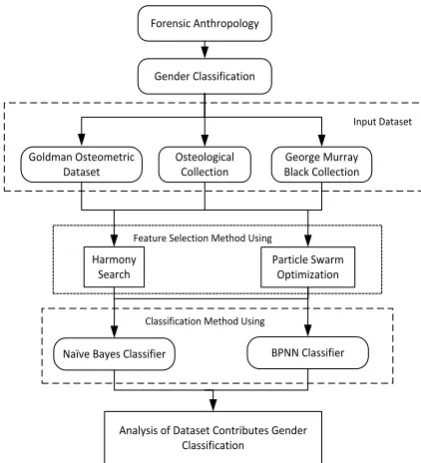
This section presents the methodology of gender classification process. The framework of this paper is shown in Figure 1.
Forensic Anthropology
Gender Classification
Goldman Osteometric Dataset
Osteological Collection
George Murray Black Collection
Feature Selection Method Using
Harmony Search
Particle Swarm Optimization
Analysis of Dataset Contributes Gender Classification
Input Dataset
Naïve Bayes Classifier BPNN Classifier
Classification Method Using
Figure 1 Framework of Paper
Initially, to investigate the effect of feature selection to the performance of gender classification, all the dataset are applied to the classification without any feature selection process. This step is needed to compare the performance of gender classification with full features dataset and selected features dataset.
Propagation Neural Network (BPNN) and Naïve Bayes (NB).
2.1 Dataset
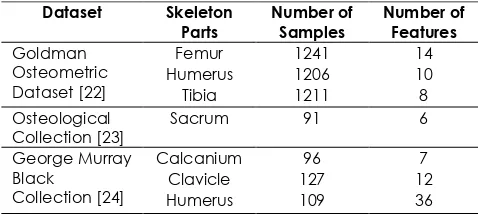
There are three types of dataset used which are Goldman Osteometric dataset [22], Osteological Collection [23] and George Murray Black Collection [24]. Generally, all three dataset contains metric measurement from different part of skeleton and all of them grouped into two gender classes which are male and female. Table 2 summarized the characteristics of all the dataset used in this research.
Table 2 Characteristics of Dataset
2.1.1 Goldman Dataset
The database used was taken from The Goldman Data Set consists of osteometric measurements taken from 1538 human skeletons origin or state in case of United States [22]. Generally individual aged above 20 years old are used in this study. Measurements were taken bilaterally from three long bones which are humerus, femur, and tibia and all these osteometric measurements are taken in millimeters. Femur consists of 14 features while humerus consists of 10 features and tibia consists of 8 features.
2.1.2 Osteological Collection
The 91 samples used are derived from Osteological Collection of the Anthropology Section, Department of Anatomy, School of Medicine, National Autonomous University of Mexico (UNAM) [23]. 42% females and 58% males ranging in age of 21 to 67 years old of human skeleton are examined. Six metrical parameters of sacrum bones were measured.
2.1.3 George Murray Black Collection
George Murray Black Collection consists of male and female adult of Australian Aboriginies from Murray River Valley, Swanport and South Australia [24]. The skeletons were collected in the course of controlled archeological excavation from University of Melbourne which was reburied in 1984. In this studied, three parts of skeleton are chosen which are calcanium, clavicle and humerus.
In the upcoming subsection, feature selection algorithm which focused on HS algorithm and PSO is briefly explained together with BPNN and Naïve
Bayes classifier which are used in classification process.
2.2 Feature Selection
In machine learning tasks, dimensionality is an important characteristic and existing learning methods are facing challenges in high dimensional data [18]. Unimportant and insignificants data available in the dataset need to be removed as it affect the learning process and reduce the classification accuracy. So, feature selection is applied to select the most significant features to give a better model performance. In this paper, PSO and HS are proposed to do feature selection for gender classification in forensic anthropology.
2.2.1 Particle Swarm Optimization (PSO)
Particle Swarm Optimization (PSO) is one of the optimization techniques and kind of evolutionary computation technique. The technique is derived from research on swarm such as bird flocking and fish schooling [19]. In the PSO algorithm, instead of using evolutionary operators such as mutation and crossover to manipulate algorithms, for a 𝑑-variable
optimization problem, a flock of particles are put into the 𝑑-dimensional search space with randomly
chosen velocities and positions knowing their best values [19]. The velocity of each particle, adjusted accordingly to its own flying experience and the other particles flying experience [19]. The 𝑖 th
particle is represented as 𝑥𝑖= (𝑥𝑖,1, 𝑥𝑖,2, … 𝑥𝑖,𝑑) in the 𝑑-dimensional space. The best previous position of
the 𝑖 th particle is recorded as,
𝑃𝑏𝑒𝑠𝑡𝑖= (𝑃𝑏𝑒𝑠𝑡𝑖,1𝑃𝑏𝑒𝑠𝑡𝑖,2… 𝑃𝑏𝑒𝑠𝑡𝑖,𝑑) (1)
The index of best particle among all of the particles in the group is 𝑔𝑏𝑒𝑠𝑡𝑑. The velocity for particle 𝑖 th particle is recorded as,
𝑣𝑖= (𝑣𝑖,1, 𝑣𝑖,2… 𝑣𝑖,𝑑) (2)
The modified velocity and position of each particle can be calculated using the current velocity and distance from 𝑃𝑏𝑒𝑠𝑡𝑖,𝑑 to 𝑔𝑏𝑒𝑠𝑡𝑖,𝑑as shown in the following formulas:
𝑉𝑖,𝑚(𝑡+1)= 𝑊. 𝑉𝑖,𝑚(𝑡)+ 𝑐1∗ 𝑟𝑎𝑛𝑑() ∗ (𝑃𝑏𝑒𝑠𝑡𝑖,𝑚 − 𝑥𝑖,𝑚
(𝑡) + 𝑐2) ∗ 𝑟𝑎𝑛𝑑() ∗ (𝑔𝑏𝑒𝑠𝑡𝑚− 𝑥𝑖,𝑚
(𝑡)
) (3)
𝑋𝑖,𝑚(𝑡+1)= 𝑋𝑖,𝑚(𝑡)+ 𝑉𝑖,𝑚(𝑡+1) (4)
𝑖 = 1,2, … , 𝑛 𝑚 = 1,2, . . , 𝑑
Where:
𝑛 = 𝑁𝑢𝑚𝑏𝑒𝑟 𝑜𝑓 𝑝𝑎𝑟𝑡𝑖𝑐𝑙𝑒𝑠 𝑖𝑛 𝑡ℎ𝑒 𝑔𝑟𝑜𝑢𝑝 𝑑 = 𝐷𝑖𝑚𝑒𝑛𝑠𝑖𝑜𝑛
𝑡 = 𝑃𝑜𝑖𝑛𝑡𝑒𝑟 𝑜𝑓 𝑖𝑡𝑒𝑟𝑎𝑡𝑖𝑜𝑛𝑠 (𝑔𝑒𝑛𝑒𝑟𝑎𝑡𝑖𝑜𝑛𝑠) 𝑉𝑖,𝑚(1)= 𝑉𝑒𝑙𝑜𝑐𝑖𝑡𝑦 𝑜𝑓 𝑝𝑎𝑟𝑡𝑖𝑐𝑙𝑒 𝑖 𝑎𝑡 𝑖𝑡𝑒𝑟𝑎𝑡𝑖𝑜𝑛 𝑡 𝑊 = 𝐼𝑛𝑒𝑟𝑡𝑖𝑎 𝑤𝑒𝑖𝑔ℎ𝑡 𝑓𝑎𝑐𝑡𝑜𝑟
𝐶1𝐶2= 𝐴𝑐𝑐𝑒𝑙𝑒𝑟𝑎𝑡𝑖𝑜𝑛 𝑐𝑜𝑛𝑠𝑡𝑎𝑛𝑡 Dataset Skeleton
Parts Number of Samples Number of Features
Goldman Osteometric Dataset [22]
Femur 1241 14
Humerus 1206 10
Tibia 1211 8
Osteological
Collection [23] Sacrum 91 6
George Murray Black
Collection [24]
Calcanium 96 7
Clavicle 127 12
2.2.2 Harmony Search (HS)
HS is a natural music-based optimization algorithm which musician’s goal is to search for a perfect state of harmony [20]. In music improvisation, in order to produce one harmony vector, every player will produce any pitch at the feasible range [20]. Once all the pitches produce a good solution, each variable’s memory will store that experience, and it will add up the possibility to produce a good solution for the next time [20-21]. Parameters used in HS are size of harmony memory (𝐻𝑀𝑆), harmony memory
(HM), harmony memory considering rate (𝐻𝑀𝐶𝑅),
and pitch adjusting rate (𝑃𝐴𝑅).
Procedure of harmony search started with initialization of problem and algorithm parameters. Optimization problem is specified as min{𝑓(𝑥)|𝑥 ∈ 𝑋}
subject to 𝑔 ≥ 0 and ℎ(𝑥) = 0 where 𝑓(𝑥) is the
objective function, 𝑔(𝑥) is the inequality constraint
function and ℎ(𝑥) is the equality constraints function.
HM matrix in HM is initialized randomly. A new harmony vector 𝑥𝑡= (𝑥
1𝑡, 𝑥2𝑡, . 𝑥𝑖𝑡) is generated based on three rules which are memory consideration, pitch adjustment and random selection:
𝑥𝑖𝑡[𝑥𝑖
𝑡∈ {𝑥
𝑖
1, 𝑥
𝑖2, . . 𝑥𝑖𝐻𝑀𝑆}𝑤𝑖𝑡ℎ 𝑝𝑟𝑜𝑏𝑎𝑏𝑖𝑙𝑖𝑡𝑦 𝐻𝑀𝐶𝑅 𝑥𝑖∈ 𝑋𝑖 𝑤𝑖𝑡ℎ 𝑝𝑟𝑜𝑏𝑎𝑏𝑖𝑙𝑖𝑡𝑦 (1 − 𝐻𝑀𝐶𝑅)
] (5)
Pitch adjusting for 𝑥𝑖𝑡 is given as:
𝑥𝑖𝑡 ← { 𝑌𝑒𝑠 𝑤𝑖𝑡ℎ 𝑝𝑟𝑜𝑏𝑎𝑏𝑖𝑙𝑖𝑡𝑦 𝑃𝐴𝑅
𝑁𝑜 𝑤𝑖𝑡ℎ 𝑝𝑟𝑜𝑏𝑎𝑏𝑖𝑙𝑖𝑡𝑦 (1 − 𝑃𝐴𝑅) (6)
If pitch adjustment decision for 𝑥𝑖𝑡is yes, 𝑥𝑖𝑡 is modified as:
𝑥𝑖𝑡= 𝑥𝑖𝑡+ 𝑟𝑎𝑛𝑑() ∗ 𝑏𝑤 (7)
Where 𝑏𝑤 is arbitrary distance and 𝑟𝑎𝑛𝑑() is random
number between 0 and 1. 𝑃𝐴𝑅 and 𝑏𝑤 are adjusted
as:
𝑃𝐴𝑅(𝑔𝑛) = 𝑃𝐴𝑅𝑚𝑖𝑛+ 𝑃𝐴𝑅𝑚𝑎𝑥𝑁𝐼− 𝑃𝐴𝑅𝑚𝑖𝑛 × 𝑔𝑛 (8)
Where 𝑔𝑛= 1,2,…, NI, 𝑃𝐴𝑅(𝑔𝑛) is the pitch adjusting
rate for generation or improvisation of 𝑔𝑛, NI is
number of improvisation, 𝑃𝐴𝑅𝑚𝑖𝑛 is the minimum pitch adjusting rate and 𝑃𝐴𝑅𝑚𝑎𝑥 is the maximum pitch adjusting rate. If the new memory is better than the previous memory in HM, the new harmony memory is included in the HM and the existing worst harmony is excluded from HM.
2.3 Classification
Back Propagation Neural Network and Naïve Bayes classifier have been employed in this experiment to classify gender into female and male.
2.3.1 Back Propagation Neural Network (BPNN)
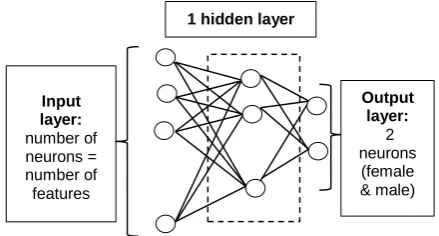
In NN, there are a set of nodes called neurons and connection between them and there is weight associated with the connections. Most of the neural network architecture contains three layers in its structure [25] which are input layer, hidden layer and output layer. Every node from input layer is
attached to a node from hidden layer and every node in hidden layer is attached to one output layer [26]. Figure 2 shows the BPNN architecture for this experiment.
In this experiment, the number of nodes in input layer is the number of features in the dataset. So, the number of neuron in the input layer will be varied according to the number of features for every dataset. According to Saurabh [27], by using rule-of-thumb, the number of hidden layer neurons are 2/3 number of the size of the input layer. The number of hidden layer in this experiment is fixed to one layer after trial and error process is done. From the trial and error process, the result produced is better with one number of hidden layer compared to two and three number of hidden layers. In the output layer, two neurons are used as the output of gender which is male or female.
Figure 2 Architecture of BPNN
2.3.2 Naïve Bayes
Naïve Bayes (NB) algorithm is a simple classifier where a set of probabilities are calculated by counting the frequency and combinations of values in a given dataset [28]. It is a practical classifier which has been applied in many applications. Bayes theorem is used and given the value of the class variable, all attributes are assumed to be independent. In a real world application, Naïve Bayes tends to perform well and learn quickly in various supervised classification problems. Thus, it has been used in many different fields for classification and decision making.
Since Naïve Bayes is relatively robust, easy to implement and accurate algorithm, it is used to compare the accuracy of gender classification with BPNN. This phase is to find out which type of classifier would produce a better performance in gender classification.
Section 3 has discussed the experimental result obtained from this experiment which focused on the selected features and accuracy of gender classification.
3.0 RESULTS AND DISCUSSION
Accuracy is used to measure performance in gender classification. The formula used are shown below:
Input layer:
number of neurons = number of features
1 hidden layer
Output layer:
𝐴𝑐𝑐𝑢𝑟𝑎𝑐𝑦 =𝑇𝑃+𝑇𝑁+𝐹𝑃+𝐹𝑁𝑇𝑃+𝑇𝑁 (9)
where:
𝑇𝑃 = True Positive 𝑇𝑁 = True Negative 𝐹𝑃= False Positive 𝐹𝑁 = False Negative
The performances of gender classification have been evaluated on the original dataset and the dataset that have gone through the process of feature section. The purpose of this step is to find out the effect of feature selection towards the performance of gender classification.
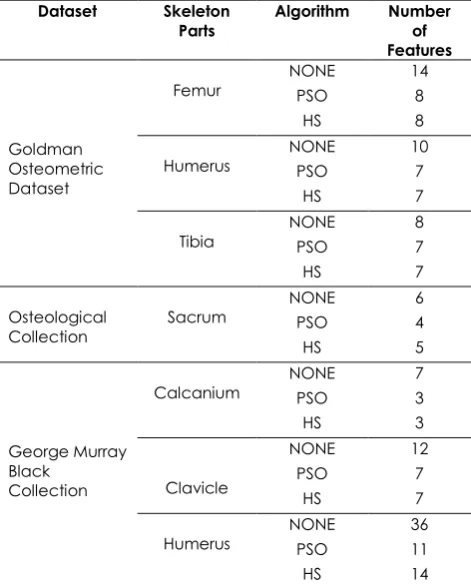
Table 3 shows the number of original features and the number of selected features after the process of feature selection is done. Figure 3, 4 and 5 shows the graph of features reduction for every dataset respectively.
Table 3 Performance of Feature Selection
Table 3 shows the performance of feature selection for every dataset. NONE is considered as the original dataset with complete features. Every dataset shows a reduction of features after feature selection is applied to the dataset. Certain dataset only reduced one features from original dataset and certain dataset reduced more than half of original dataset. This result is because of the algorithm and type of dataset used.
Based on Figure 3, it can be seen that among femur, humerus and tibia, femur reduced the highest number of features which are 42.86% for both PSO and HS. Figure 4shows PSO has reduced around 33.33% of features and HS reduced 16.67% of features. Figure 5 shows the highest percentage of reduction where calcanium reduced 57.14% for
both PSO and HS while clavicle reduced 41.67% for both PSO and HS. The highest reduction of features in George Murray Black Collection is humerus where it reduced to 69.44% for PSO and 61.11% for HS.
Figure 3 Features Selection for Goldman Osteometric Dataset
Figure 4 Features Selection for Osteological Dataset
Figure 5 Features Selection for George Murray Black Collection
Based on three figures shown above, it can be concluded that feature selection helps in reducing the number of features and it reduced the dimensionality of dataset. Once the dimensionality of the dataset has reduced, it can help to improve the performance of machine learning.
Table 4 presents the results for three dataset with two different classification algorithms which are BPNN and Naïve Bayes. Feature selection algorithm did affect the performance of gender classification. It can be seen that, the accuracy for both type of classifiers increase after feature selection is done for every parts of skeleton and dataset.
0 20 40 60 80 100
Femur Humerus Tibia
P
er
ce
nt
ag
e (
%)
None
PSO
HS
0 50 100
Sacrum
P
er
ce
nt
ag
e (
%) None
PSO
HS
0 20 40 60 80 100
Calcanium Clavicle Humerus
P
er
ce
nt
ag
e (
%)
None
PSO
HS
Dataset Skeleton
Parts Algorithm Number of Features
Goldman Osteometric Dataset
Femur NONE PSO 14 8
HS 8
Humerus NONE PSO 10 7
HS 7
Tibia NONE PSO 8 7
HS 7
Osteological
Collection Sacrum
NONE 6
PSO 4
HS 5
George Murray Black
Collection
Calcanium NONE PSO 7 3
HS 3
Clavicle
NONE 12
PSO 7
HS 7
Humerus NONE PSO 36 11
Table 4 Performance of Feature Selection (a) Goldman Osteometric Dataset
(b)George Murray Black Collection
Skeleton
Part Algorithm Accuracy BPNN (%)
Naïve Bayes Accuracy
(%)
Calcanium NONE PSO 95.83 97.92 93.75 94.79
HS 97.92 94.79
Clavicle NONE 89.76 86.61
PSO 96.06 88.19
HS 96.32 89.11
Humerus NONE 97.25 92.66
PSO 97.82 93.58
HS 98.17 95.21
(c)Osteological Collection
Skeleton
Part Algorithm Accuracy BPNN (%)
Naïve Bayes Accuracy (%)
Sacrum NONE PSO 91.21 92.38 84.62 86.81
HS 95.60 87.91
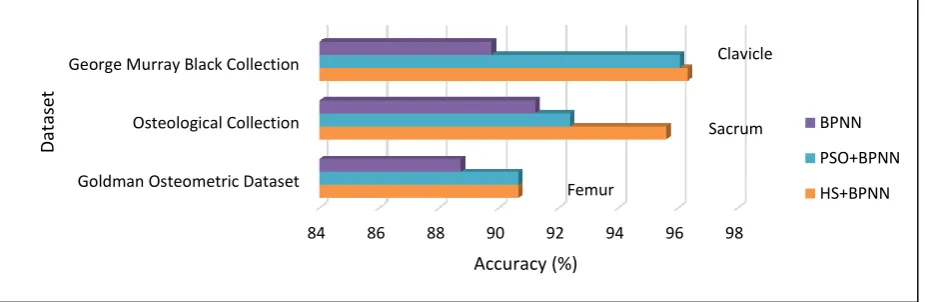
For Goldman dataset, gender classification for femur part increases from 88.72% (BPNN) and 85.74% (NB) to 90.65% (BPNN) and 87.35% (NB). The increment of accuracy is because of the PSO and HS algorithm where it only selects the most significant features which end up helped to increase the performance of both classifiers. The accuracy for clavicle part in George Murray Black Collection has the highest increment compared to other part of skeleton. The accuracy of BPNN classifier increased from 89.76% to 96.06% when PSO is applied and 89.76% to 96.32% when HS is applied to the dataset. Gender classification for Osteological Collection using BPNN has increased the classification accuracy from 91.21% to 92.38% when PSO is applied and HS algorithm increased the accuracy from 91.21% to 95.60%. From Table 4, it can be concluded that the performance of gender classification is better when only the most significant features involved in the process of classification for every dataset.
Figure 6 Performance of Gender Classification Based on Three Different Dataset
Based on Figure 6, since BPNN gave a higher accuracy compared to Naïve Bayes classifier for overall dataset, BPNN performance is visualized respectively to show the difference of accuracy based on different algorithm. In this part, comparison on feature selection technique and classification are explored. For Goldman Osteometric Dataset, Femur presented the highest increment of accuracy compared to other parts which is 1.93%. The accuracy before feature selection is applied is 88.72% while after feature selection is applied, accuracy increase to 90.65% for both algorithm. Next, for Osteological Collection, the performance of BPNN classifier for Sacrum part increase by 1.17% for PSO and 4.39% for HS
algorithm. Last but not least, for George Murray Black collection, Clavicle gave the best performance for gender classification. The original dataset without feature selection is 89.76% and increased to 96.06% for PSO and 96.32% for HS algorithm. Based on the performance of gender classification, it can be seen that feature selection gave a good impact on the accuracy of gender classification. Although the increment of accuracy is only in a small amount, it is important for gender classification especially in forensic anthropology. From all the comparison made, it can be conclude that feature selection has increased the accuracy of gender classification in forensic anthropology
84 86 88 90 92 94 96 98
Goldman Osteometric Dataset Osteological Collection George Murray Black Collection
Accuracy (%)
Dat
ase
t
BPNN
PSO+BPNN
HS+BPNN Clavicle
Sacrum
Femur Skeleton
Part Algorithm Accuracy BPNN (%)
Naïve Bayes Accuracy (%)
Femur NONE PSO 88.72 90.65 85.74 87.35
HS 90.65 87.35
Humerus NONE PSO 87.64 88.64 85.16 86.24
HS 88.64 86.24
Tibia NONE PSO 87.52 87.77 85.87 86.03
although different dataset and different classifier is used.
4.0 CONCLUSION AND FUTURE WORKS
This paper has presented the effect of feature selection techniques toward the performance of gender classification on different dataset. When feature selection PSO and HS algorithm are applied to the dataset, the performance of gender classification has increased as feature selection only select the most significant features which end up help to increase the accuracy of gender classification. So, it can be concluded that feature selection is important in order to increase the performance in gender classification especially in forensic anthropology area.
For future works, we can search how the performance changes when other different techniques of features selection are used. There might have increment of accuracy when using other feature selection techniques in gender classification area.
Acknowledgement
This material is based upon work supported by Research University Grant [RUG], Universiti Teknologi Malaysia under Vote No. 11J29 and Ministry of Higher Education [MOHE].
References
[1] Vanessa Stanojevich. 2012. The Role of Forensic Anthropologist in a Death Investigation. J Forensic Res. 3: 154.
[2] Iis Afrianty, Dewi Nasien, Mohammaed R. A Kadir, Habibollah Haron. 2013. Detemination of Gender from Pelvic Bone and Patella in Forensic Anthropology: A Comparison of Classification Techniques. 2013 First International Conference on Artificial Intelligence,
Modelling & Simulation, AIMS. 3-7.
[3] V. Alumni- Perret, P.Staccini, G. Quatrehomme. 2007. Sex Determination from the Distal Part of the Femu in a French Contemporary Population. Forensic Science
International. 175:113-117.
[4] Enas M. Mostafa, Azza H. Elemi, Mohamed A. El-Beblawy, Abd El-Wahab A. Dawood. 2012. Adult Sex Identification using Digital Radiographs of the Proximal Epiphysis of the Femur at Suez Canal University Hospital in Ismailia, Egypt. Egyptian Journal of Forensic Sciences.
2(3): 81-88.
[5] Ana Clavero, Miquel Salicru, Daniel Turbon. 2015. Sex Prediction from the Femur and Hip Bone Using a Sample of CT Images from a Spanish Population. Int J. Legal Med
129:373-383.
[6] Lauren Novak, John J. Schultz, Matthew McIntyre. 2012. Determining Sex of the Posterior Ilium from the Robert J. Terry and William M. Bass Collections. J. Forensic Sci.
57(5).
[7] P. James Macaluso Jr. 2010. Sex Determination from the Acetabulum: Test of Possible non-population-specific
Discriminant Function Equation. Journal of Forensic and
Legal Medicine. 17: 348-351.
[8] James Macaluso Jr. Joaquin Lucena 2014. Estimation of Sex from Sternal Dimensions Derived from Chest Plate Radiographs in Contemporary Spaniards. Int J Legal
Med. 128: 389-395.
[9] H. V. Chandrakanth, Tanuj Kanchan and Kewal Krishan. 2014. Osteometric Analysis for Sexing of Modern Sternum – An Autopsy Study from South India. Legal Medicine. 16: 350-356.
[10] Hu, K. S. et al. 2006. Sex Determination Using Nonmetric Characteristics Of The Mandible In Koreans. J Forensic Sci. 51(6): 1376-82.
[11] Saini, V., Srivastava, R., Shamal, S. N., Singh, T. B., Pandey, A. K. & Tripathi. S. K. 2011. Sex Determination using Mandibular Ramus Flexure: A Preliminary Study On Indian Population. J Forensic Leg Med. 18(5): 208-12.
[12] Du Jardin, P., Ponsaille, J., Alunni-Perret, V. & Quatrehomme, G. 2009. A Comparison Between Neural Network And Other Metric Methods To Determine Sex From The Upper Femur In A Modern French Population.
Forensic Sci Int. 192(1-3): 127 e 1-6.
[13] Harma, A., H. M. Karakas. 2007. Determination of sex from the femur in Anatolian Caucasians: A digital radiology study. J Forensic Leg Med. 14(4): 190-4.
[14] Tersigni-Tarrant M. A and Shirley N. R. 2013. Forensic
Anthropology. An Introduction. CRC Press.
[15] L. Y. Chung, H. W. Chang, C. J. Tu and C. H. Yang. 2008. Improved Binary PSO For Feature Selection Using Gene Expression Data. Computational Biology And Chemistry. 29-38.
[16] J. Novakovic. 2010. The Impact Of Feature Selection On The Accuracy Of Naïve Bayes Classifier. 18th
Telecommunications Forum TEFLOR 2010. 113-116.
[17] A. M. Taha, A. Mustapha and S. D. Chen. 2013. Naïve Bayes Guided Bat Algorithm For Feature Selection.
Scientific World Journal. 2013: 1-6.
[18] H. Liu and H. Motoda. 2007. Computational Methods Of
Feature Selection. Chapman and Hall, CRC Press.
[19] B. Nagaraj and N. Murugananth. 2010. A Comparative Study of PID Controller Tuning Using GA, EP, PSO and ACO. IEEE.
[20] Abdolalipour, A. and Alibabae, A. 2012. Harmony Search Algortihm. International Journal of Academic Research
in Applied Science. 1(3): 13-16.
[21] Manjarres, D., Landa-Torres, I. Gil-Lopez, S. Del Ser, J. Bilbao, M. N. Salcedo-Sanz and Geem. Z. W. 2013. A Survey on Applications of the Harmony Search Algorithm. Engineering Applications.
[22] Benjamin, M. Auerbach. Goldman Osteometric Dataset. http://web.utk.edu/~auerbach/GOLD.htm
[23] George Alfredo Gomez-Valdes, Guillermo Torres Ramirez, Socorro Baez Molgado, Patricia Herrera Sain-Leu, Jose Luis Castrejon Caballero, Gabriela Sanchez-Mejorada. 2011. Discriminant Function Analysis for Sex Assessment in Pelvic Girdle Bones: Sample from the contemporary Mexican Population. J Forensic Sci. March
56(2).
[24] George Murray Black Collection. http://www.peterbrownpalaeoanthropology.net/resour ce.html.
[25] Koushal Kumar and Abhishek. 2012. Artificial Neural Networks for Diagnosis of Kidney Stones Disease. I.J
Information Technology and Computer Science. 20-25.
[26] Simon Haykin. 1999. Neural Networks: A Comprehensive
Foundation. Pearson Education. 178-224.
[27] Saurabh KarKarsoliya. 2012. Approximating Number of Hidden layer neurons in Multiple Layer Hidden Layer BPNN Architecture. International Journal of Engineering
Trends and Technology. 3(6).
[28] Patil, T. R. & Sherekar, S. S. 2011. Performance Analysis of Naïve Bayes and J48 Classification Algorithm for Data Classification. International Journal of Computer Science