Bayesian Analysis of Circular Data Using Wrapped
Distributions
Palanikumar Ravindran† Roche Palo Alto, Palo Alto, USA.
Sujit K. Ghosh
North Carolina State University, Raleigh, USA.
Institute of Statistics Mimeo Series# 2564
Summary. Circular data arise in a number of different areas such as geological, meteoro-logical, biological and industrial sciences. Standard statistical techniques can not be used to model circular data due to the circular geometry of the sample space. One of the common methods to analyze circular data is known as thewrapping approach. This approach is based on a simple fact that a probability distribution on a circle can be obtained by wrapping a prob-ability distribution defined on the real line. A large class of probprob-ability distributions that are flexible to account for different features of circular data can be obtained by the aforementioned approach. However, the likelihood-based inference for wrapped distributions can be very com-plicated and computationally intensive. The EM algorithm to compute the MLE is feasible, but is computationally unsatisfactory. A data augmentation method using slice sampling is proposed to overcome such computational difficulties. The proposed method turns out to be flexible and computationally efficient to fit a wide class of wrapped distributions. In addition, a new model selection criteria for circular data is developed. Results from an extensive simulation study are presented to validate the performance of the proposed estimation method and the model selection criteria. Application to a real data set is also presented and parameter estimates are compared to those that are available in the literature.
Keywords: Bayesian inference; MCMC; Wrapped Cauchy; Wrapped Double Exponential; Wrapped Normal
†Address for correspondence: Palani Ravindran, Roche Palo Alto LLC, 3431 Hillview Ave, Palo Alto, CA 94304, USA.
2 P. Ravindran and S. K. Ghosh
1. Introduction
Circular data arise from a variety of sources in our daily lives, where we consider the circle to
be the sample space. Some common examples are the migration paths of birds and animals,
wind directions, ocean current directions and patients’ arrival times in an emergency ward
of a hospital. Many examples of circular data can be found in various scientific fields such
as earth sciences, meteorology, biology, physics, psychology and medicine. To motivate the
use of circular data, we present a brief description of couple of examples from these fields.
In the field of Physics, before the discovery of isotopes,? proposed testing the hypothesis
that atomic weights are integers subject to error. He converted the fractional parts of the
atomic weights to angles. He regarded these angles as a random sample from a circular
distribution with mean zero and tested for uniformity. This study resulted into the famous
Von Mises distribution on the circle.
A very good source of circular data is in the field of biology. Migration path of birds
and animals has been the subject of many studies. The objective of these studies is to
ascertain whether the direction of migration is uniform. An example of the migration of
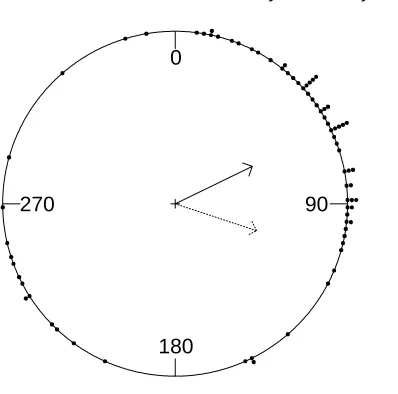
turtles is given in Figure??. In this figure, we present the circular histogram plot of the
data collected by Dr. E. Gould from John Hopkins University School of Hygiene and first
cited by ?. The data represents the directions taken by the sea turtles after laying their
eggs. The predominant direction is 64◦, which is the direction the turtles took to return to
the sea.
Standard statistical techniques cannot be used to analyze circular data. This is due to
the circular geometry of the sample space. For example, the sample mean of a data set on
the circle is not the usual sample mean. Lety1, y2, . . . , yn be independent observations on
the unit circle, such that 0≤yj <2π,j= 1,2, . . . , n. The mean direction ¯yis not given by
the usual definition, n1nj=1yj. This is illustrated in Figure??, where the dashed arrow is
the direction represented by n1nj=1yj and the solid arrow represents the mean obtained
by vector addition. To find the circular mean, we use vector addition techniques.
In general, the pth theoretical moment is defined as E(eipY) =α
p+iβp, i=
√ −1, for
p= 1,2, . . .. The mean direction is given by µ = arctan(β1/α1) and the mean resultant
is defined as ρ=α21+β12, so thatE(eiY) = ρeiµ. In most applications it is of interest
0
180
270 90
Fig. 1. Circular histogram plot of the turtle data. Solid line indicates circular mean and dashed line indicates the linear mean.
generally provides a consistent estimate of the theoreticalpthmoment (See p.21?). However
such a nonparametric method cannot be easily generalized to regression problems using
link function viaµ. Typically parametric circular distribution are used to model the error
part of the regression models (See?, ch.11). Also no finite sample standard errors of the
sample moments are available. As a first step towards regression models, we investigate the
performance of the estimation procedures for parametric models. Thus, in this article we
focus only on estimatingµandρfor a wide class of wrapped distributions.
In the literature several statistical approaches are available to model circular data. In
Section??, we use the wrapping method to generate a flexible class of circular distributions.
In Section 3, we discuss classical and Bayesian methods to obtain estimates of the parameters
of wrapped circular distributions. As the Bayesian methods have the advantage of obtaining
a finite sample estimate of the variability (for example, the posterior standard deviation),
we use slice sampling as proposed in? within a data augmentation method for parameter
estimation. We propose to use two model selection criteria in Section 4. In Section 5, we
present results from extensive simulation studies to validate the frequentist performance of
the methods developed in Sections 3 and 4. In Section 6, we apply our method to a real
data set involving the movement of ants. Finally we conclude with some discussions on
4 P. Ravindran and S. K. Ghosh
2. Statistical Approaches to model circular data
Many methods and statistical techniques have been developed to analyze and understand
circular data. The popular approaches have been embedding, wrapping and intrinsic
ap-proaches. A good overview of the embedding and intrinsic approaches can be found in?
and?. We describe only the wrapping approach in this article.
2.1. The Wrapping Approach
In the wrapping approach, given a known distribution on the real line, we wrap it around
the circumference of a circle with unit radius. Technically this means that ifU is a random
variable on the real line, then the corresponding random variableY on the circle is given
byY =U(mod 2π). Equivalently, the wrapped version ofU is obtained by defining
Y =U−2π2Uπ, (1)
where [u] = largest integer ≤ u. Let the distribution function of U on the real line be
denoted byF. Then the distribution function ofY denoted byFw can be obtained as,
Fw(y) = Pr(Y ≤y) =
∞
k=−∞
[F(y+ 2πk)−F(2πk)].
This implies that if the densityf ofU exists, then the wrapped densityfw is given by,
fw(y) =
∞
k=−∞
f(y+ 2πk), 0≤y <2π. (2)
An excellent overview of the properties of the wrapped distributions can be found in?. In
most cases the above series can not be written in closed form except in few cases such as
Cauchy distribution. The density of the wrapped Cauchy (WC) distribution is given by
fW C(y) = πσ1
∞
k=−∞
1 +
y+2πk−µ σ
2 −2
, 0≤y <2π, (3)
whereµ is the location parameter andσis the scale parameter. Using inversion theorem,
(??) can be simplified to
fW C(y) =21π1+ρ2−12−ρρcos(2 y−µ),
where ρ = e−σ. We consider two other wrapped distributions, for which no closed form
by,
fW N(y) = σ√12π
∞
k=−∞
e−(y+2πk−µ)2/(2σ2), 0≤y <2π. (4)
Another popular wrapped distribution, known as the wrapped double exponential (WDE)
is described by it density,
fW DE(y) = 21σ
∞
k=−∞
e−|y+2πk−µ|/σ, 0≤y <2π. (5)
In Section??, we describe a Monte Carlo method based on slice sampling to obtain estimate
ofµandρunder (??), (??) and (??).
It follows that, a rich class of distributions on the circle can be obtained using the
wrapping technique, as we can wrap any known distribution on the real line to the circle.
The main difficulty in working with this approach has been that in most cases, the form
of the densities and distribution functions are large sums (e.g. (??) and (??)) and can
not be simplified as closed forms except for few cases (e.g. (??)). Due to this complexity,
maximum likelihood techniques for point estimation and hypothesis testing can not be
easily implemented. The main contribution of this paper is to present a general approach
to obtain parameter estimates for a wide class of wrapped distributions. This can be
achieved as follows. For a given probability distribution on the circle, we make assumptions
that the original circular distribution was distributed on a line and was wrapped to a circle.
Therefore if we canunwrapthe distribution on the circle and obtain a distribution on the
real line, we can use all the standard statistical techniques for data on a real line. We
propose to perform this using the data augmentation approach. We use Bayesian methods,
so that we can easily obtain parameter uncertainty estimates based on the finite sample.
3. Parameter Estimation of Wrapped Distributions
It was shown by ? that the maximum likelihood estimate for wrapped Cauchy exists and
is unique for samples of size greater than two. They also gave a simple iterative algorithm
which would always converge to the maximum likelihood estimate (MLE). Calculating the
MLE for the wrapped Cauchy is possible because the density has a closed form
representa-tion. In general, wrapped distributions do not have closed form densities and consequently,
6 P. Ravindran and S. K. Ghosh
A different approach for fitting wrapped distributions was given by ? who used the
Expectation Maximization (EM) algorithm techniques to obtain parameter estimates from
the Wrapped Normal distribution. However, the E-step involves ratio of large infinite sums,
which needs to be approximated at each step. This makes the algorithm computationally
inefficient. In addition, the standard errors of the MLEs have to be evaluated based on
large-sample theory. We propose an alternative method that is more computationally efficient
and flexible to entertain a large class of wrapped distributions. Also, as a by-product, we
acquire finite sample interval estimates of the parameters of the wrapped distributions. This
is done using the data augmentation approach described in the following section.
3.1. The Data Augmentation Approach
The data augmentation approach was originally proposed by?. Extensions of this technique
can be found in the works of?,? and? and references therein. In the context of circular
data,? used it to study Von Mises distribution. ? used it to study the Wrapped Bivariate
Normal distribution and wrapped autoregressive process. We present a generic approach
based on slice sampling (see Neal, 2003) that can be used for a broad class of wrapped
distributions.
The main idea behind the data augmentation approach is to augment the original data
with some “additional data” that would simplify the original likelihood to a form that is
much easier to handle. In case of circular data, asY =U(mod 2π), the random variableU
on the real line, can be represented asU =Y + 2πK, whereY is the observed data on the
circle, andKis the number of timesU was wrapped to obtainY. Therefore, in this case if
we were able to “add” the information onK, and thusunwrapY, then we could observeU.
However, given Y, as the value of K is not unique, we obtain the conditional probability
distribution ofK givenY. To illustrate the unwrapping method, let us consider a location
scale family σ1f(y−σµ) on the real line. Then the corresponding wrapped density is obtained
from (??) as,
fw(y|µ, σ) =
∞
k=−∞
1
σf(
y+2πk−µ
σ ) (6)
In the above equation, we follow the convention that the location parameterµ=µ0(mod2π),
whereµ0 is the location parameter on the real line. In order to specify the full probability
direction, ρ (as defined in Section 1) can be expressed as a function of σ. In general, we
will writeρ=h(σ), e.g. for wrapped normal familyρ=e−σ2/2, for wrapped Cauchy family
ρ=e−σ and for wrapped double exponential family ρ= 1
1+σ2. Notice that by definition,
0< ρ <1.A class of non-informative prior for (µ, ρ) can be specified by a joint density of
(µ, ρ) as,
[µ, ρ] ∝ Iµ(0,2π)ρaρ−1(1−ρ)aρ−1,aρ>0, (7)
where Ix(A) denotes the indicator function, i.e., Ix(A) = 1 if x ∈ A and Ix(A) = 0,
otherwise. Viewing the wrapped numberKto be a random variable, from (??) we see that
the conditional density ofY givenK=kand the parametersµ, ρ is given by
fw(y|k, µ, σ) =
1
σ f(y
+2πk−µ
σ )Iy(0,2π) F(2π(k+1)σ −µ)−F(2πkσ−µ)
which is a truncated density of a location-scale family. It also follows that the marginal
density ofK given the parameters (µ, σ) can be obtained as,
Pr(K=k|µ, σ) = F(2π(k+1)σ −µ)−F(2πkσ−µ), k=. . . ,−1,0,1, . . .
Thus, we obtain a Bayesian hierarchical model by specifying the distribution ofygiven
k, µ, σ, then the conditional distribution of k given µ, σ and finally the prior distribution
for (µ, σ).
Given a random sample on the circle, y={y1, y2, y3, . . . , yn},0 ≤yj <2π, j = 1. . . n,
we unwrap the data by obtaining samples from the conditional distribution ofkgivenµ,σ
and the observed datay, where k={k1, k2, k3, . . . , kn}. This is will be referred to as the
data augmentation step. Then conditional on the augmented datay,k, we obtain samples
from the joint posterior distribution of (µ, σ) to complete the Gibbs cycle of the MCMC
method. From these samples, we obtain the marginal posterior distribution of µ and σ
given the observed datay, using the Ergodic Theorem of Markov Chain.
We provide a generic method to implement the MCMC method for a general class of
lo-cation scale family, whose density function is invertible. A functiony=f(x) is invertible if
f can be analytically or numerically inverted, or iff can be factorized into functions, which
can be analytically or numerically inverted. That is, we assume thatf(x) =Tt=1ft(x) and
{ft−1(y) : j = 1. . . T} are explicitly known functions or functions that can be computed
8 P. Ravindran and S. K. Ghosh
f(x) = e−xe−e−x does not have an explicitly known inverse, bute−x ande−e−x have
ex-plicitly known inverses. Alternatively, it is also possible to compute the inverse ofe−xe−e−x
using numerical methods such as bisection method. But for our proposed algorithm we
re-strict ourselves to the former method. It is assumed thatρ=h(σ) is a monotone decreasing
function ofσand can be inverted. This is a reasonable assumption because in general, as
σ↓0,ρ↑1 and as σ↑ ∞, ρ↓0. These assumptions are satisfied for most wrapped
distri-butions including Wrapped Normal (WN), Wrapped Cauchy (WC) and Wrapped Double
Exponential (WDE) distributions. The general method will work even if ρ=h(σ) is not
a monotone decreasing function ofσ. These wrapped distributions are all symmetric and
unimodal. However, this method is not restricted only to these distributions.
In order to specify the required conditional distributions, we use the notation [θ1, . . . , θn]
to represent the joint density ofθ1, θ2, . . . , θnand [θ1|θ2, . . . , θn] to represent the conditional
density of θ1 given θ2, . . . , θn. By the term full conditional density of θ1, we mean the
conditional density ofθ1, given rest of the parameters.
The general method is as follows. The joint prior density of (µ, σ) is given by
[µ, σ] ∝ Iµ(0,2π)h(σ)aρ−1(1−h(σ))aρ−1|h(σ)|, aρ>0, ρ=h(σ)
For each observed direction yj, we augment a random wrapping number kj. The joint
density ofy,k, µandσis given by,
[y,k, µ, σ] ∝ y|k, µ, σ2 k|µ, σ2 µ, σ2
∝ 1
σn+n0
n
j=1
f(yj−µ+2πkj
σ )h(σ)aρ−
1+n1(1−h(σ))aρ−1h1(σ)I
µ(0,2π),
where |h(σ)| can be factorized as σ1n0h(σ)n1h1(σ). The full conditional densities of k, µ
and σ are nonstandard densities. So we introduce auxiliary variables z and v. Let z =
{z0, z1, z2, z3}andv={v1, v2, v3, . . . , vn}, such that
[y,k, µ, σ] ∝
[y,k, µ,z,v, σ]dzdv
The joint density ofy,k, µ,z,v andσis given by,
[y,k, µ,z,v, σ] ∝ Iz0
0,σn1+n0
n j=1
Ivj
0, f(yj−µσ+2πkj)
Iz1
0, h(σ)aρ−1+n1
Iz3(0, h1(σ))Iµ(0,2π)
Iz2
0,(1−h(σ))aρ−1I(aρ= 1) +I(aρ= 1)
It follows from the above equation that all the full conditional densities are standard
distributions that can be easily sampled using subroutines available in SAS, Splus, R and
other statistical softwares. In particular, as an illustration, we provide the standard full
conditionals that are needed to fit a WDE model in the Appendix. The standard full
conditional densities that are needed to fit other distributions can be found in the thesis of
the first author.
4. Model selection
We now have a large class of parametric models that can be fitted to a given circular data.
In order to select the best fitting model, we use Deviance Information Criteria proposed by
? and a predictive loss approach developed by ?.
Deviance Information Criteria (DIC) is defined as
DIC = 2E(Dev(µ, σ)|y)−Dev(E(µ, σ|y))
Deviance (?) is defined as twice the negative of the log-likelihood. For example, for any
wrapped location-scale density,fw() the deviance (Dev) is given by,
Dev(µ, σ) = −2log(
n
i=1
fw(yi))
= −2
n i=1 log( ∞
k=−∞ 1
σf(
yi+2πk−µ σ ))
≈ −2
n i=1 log( L
k=−L
1
σf(
yi+2πk−µ σ )),
whereLis a very large positive number. Given a set of models, the model with the lowest
DIC is chosen as the “best” model. For justifications on the use of DIC as a model selection
criteria see?.
Next, we use the decision theoretic framework of ? to define a model selection criteria
based on minimizing a predictive loss. For circular data the usual loss functions on the real
line are not well defined. We propose a Circular Predictive Discrepancy (CPD) measure
based on posterior predictive distribution. Define yobs = (y1, ..., yn) as the observed data
and ypred = (y1pred, ..., ypredn ) as the predictive data obtained from the following posterior
predictive distribution,
10 P. Ravindran and S. K. Ghosh
where p(ypred|µ, ρ) denotes the sampling distribution of the data, which is the wrapped
density evaluated atypred givenµand ρ. p(µ, ρ|yobs) denotes the posterior distribution of
the parameters (µ, ρ) given the observed data yobs. In order to measure the discrepancy
between observed and predicted quantities we use the following loss function and call it an
Absolute Predicted Errors (APE) defined as,
AP E =
n
i=1
minypredi −yi,2π−yipred−yi
.
Based on the above loss function we define the CPD as,
CP D = E[AP E|yobs]
Note that as in the case of linear loss functions, we can not break up the CPD into two
terms involving a goodness-of-fit term and a penalty term. It is apparent that given a set
of models, we will prefer a model with the lowest CPD.
We use both of the above model selection methods to choose from a given set of wrapped
distributions. In order to see the performance of these model selection methods, we conduct
a simulation study and monitor the percentage of success. Details of such a simulation study
is presented in the next section.
5. Simulation studies
In this Section, we present couple of simulation studies to illustrate (i) the performance
of the parameter estimation method presented in Section 3 and (ii) the performance of
model selection criteria presented in Section 4. It is to be noted that we present only some
selected results of a much broader simulation study which can be found in the doctoral
thesis of the first author. In terms of parameter estimation, we found that when data are
generated from the true model that is being fitted, the parameter estimates obtained by the
data augmentation method (presented in Section 3) have very good frequentist properties
in terms of low bias and nominal standard errors. Also based on 95% posterior intervals,
we found that the coverage of such interval estimates are very close to the nominal level.
These results have been excluded in this article. However, we present results from the study
when the true model is misspecified. In order to study the sensitivity of the likelihood we
Von Mises distribution, we use the algorithm given by Best and Fisher (1978). For our
simulations we fixedµ=π/21.5708 andρ= 0.5. We generatedn= 50 observations from
theV M(π/2,0.5) and then fitted wrapped normal, wrapped Cauchy and wrapped double
exponential distribution to each of the data generated from the above mentioned Von Mises
distribution. We repeated the method 500 times to see the frequentist performance of the
Bayes method. In addition, to observe model selection issues, we computed model selection
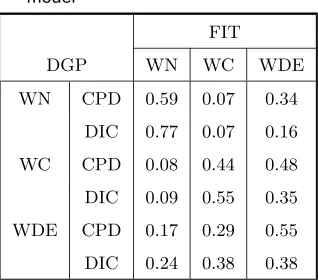
criteria DIC and CPD to select the best model. In Table??, the percentages each of the
fitted model chosen by the model selection criteria CPD and DIC are given. For model
fitting, we usedaρ = 0.5 for all priors. In our study (not shown here) we did not find the
posterior summary to be very sensitive to the choice ofaρ, providedaρ∈(0,2].
We computed the posterior mean, standard deviation (s.d), 2.5 percentile, median and
97.5 percentile forµandρfor each simulation. The percentiles are computed with 0 radians
as the reference point on the circle. Usually, the reference point on the circle is chosen
diametrically opposite to the sample mean, or where the samples are sparsely distributed.
Note that, changing the reference point does not affect the circular mean. The simulation
standard errors for each of these summary values are also computed. We also compute
the coverage probability (c.p) for the 95% posterior interval given by the 2.5th and 97.5th
percentile of the posterior distribution. After some preliminary studies, for all simulations,
we choose the burn-in period to be 2000 samples (i.e. throw away first 2000 samples from
the MCMC chain) and then keep 5000 samples after burn in, to obtain posterior summary
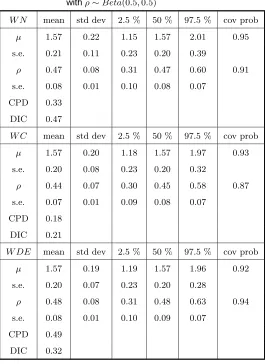
values. All of these summary values are based on these final 5000 samples. In Table??, we
present the empirical mean of the posterior summary values along with the standard error
(s.e.) of the posterior summary values. Notice that the empirical s.e.’s match well with the
estimated one given by the standard deviation of the posterior distribution. For instance,
the average posterior standard deviation ofµ under a WN model is 0.22, which matches
well with the Monte Carlo standard error of 0.21. Also the empirical coverage probability
for the estimation ofµusing a WN model is exactly same as the nominal level. However,
the results may not be that close for other models. For example, under a WDE model, the
empirical coverage probability is about 92% forµwhereas it is about 94% forρ. In general,
we see that the location parameterµis well estimated compared to the scale parameter ρ
even under model misspecification. One of the benefits of using a Bayesian method which
12 P. Ravindran and S. K. Ghosh
Table 1. Fitting WN, WC and WDE to VM(1.57, 0.5) distribution withρ∼Beta(0.5,0.5)
W N mean std dev 2.5 % 50 % 97.5 % cov prob µ 1.57 0.22 1.15 1.57 2.01 0.95 s.e. 0.21 0.11 0.23 0.20 0.39
ρ 0.47 0.08 0.31 0.47 0.60 0.91 s.e. 0.08 0.01 0.10 0.08 0.07
CPD 0.33
DIC 0.47
W C mean std dev 2.5 % 50 % 97.5 % cov prob µ 1.57 0.20 1.18 1.57 1.97 0.93 s.e. 0.20 0.08 0.23 0.20 0.32
ρ 0.44 0.07 0.30 0.45 0.58 0.87 s.e. 0.07 0.01 0.09 0.08 0.07
CPD 0.18
DIC 0.21
W DE mean std dev 2.5 % 50 % 97.5 % cov prob µ 1.57 0.19 1.19 1.57 1.96 0.92 s.e. 0.20 0.07 0.23 0.20 0.28
ρ 0.48 0.08 0.31 0.48 0.63 0.94 s.e. 0.08 0.01 0.10 0.09 0.07
CPD 0.49
Table 2. Performance of CPD and DIC in selecting the best model
FIT
DGP WN WC WDE
WN CPD 0.59 0.07 0.34
DIC 0.77 0.07 0.16
WC CPD 0.08 0.44 0.48
DIC 0.09 0.55 0.35
WDE CPD 0.17 0.29 0.55
DIC 0.24 0.38 0.38
performance of the estimates are quite good even from frequentist perspective. However,
it is noted that the proposed Bayesian method is computationally more intensive than the
comparable frequentist procedures. In SAS, on a Sparc 20 machine, on an average it took
about 50 minutes to perform the entire simulation for a given wrapped distribution.
In Table ??, we see that WN and WDE are performing well in estimating µ and ρ
when they come from a Von Mises distribution. It is expected that WN will perform
well because WN closely approximates the Von Mises distribution. WC model does not
perform well in estimating the mean resultant length. The lower than nominal coverage
probability of ρ indicates that WC is not robust in estimating the mean resultant length
of the distribution when the distribution is misspecified. However, the location parameter
is generally estimated very well. Using CPD, we find that the WDE model gets picked up
most of the time (49%) as the best fit to VM data. On the other hand, DIC picks WN more
often (47%) as the best fit to VM data.
In order to study the performance of the model selection criteria presented in Section
4, we generated data from Normal, Cauchy and Double Exponential distributions on the
real line and wrapped them onto the circle (0, 2π). For our simulations, we fixedµ=π/2
andρ= 0.5. We generatedn= 50 observations from theW N(π/2,0.5),W C(π/2,0.5) and
W DE(π/2,0.5). We then fitted Wrapped Normal, Wrapped Cauchy and Wrapped Double
Exponential distributions to each of the three datasets. We repeated the method 500 times
to see the frequentist performance of model selection methods. For model fitting we used
14 P. Ravindran and S. K. Ghosh
270
90
180 0
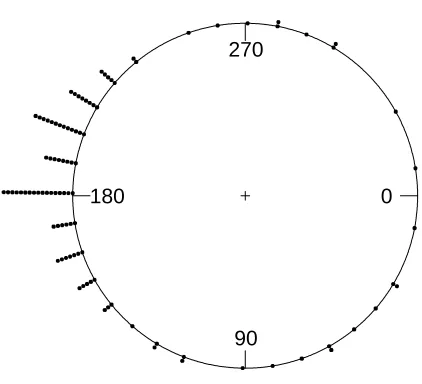
Fig. 2. Circular plot of the Jander’s Ant data
WN, WC and WDE. For each of the three DGP, we fit WN, WC and WDE and report
the percentages, each of the fitted model chosen by the model selection criteria DIC and
CPD. Notice that each row sums to unity. For instance, when we generate data from a
WN distribution and fit all three distributions, CPD picks up WN as the best model 59%
of the time as compared to picking up 7% and remaining 34% by WC and WDE as the
best model, respectively. On the other hand DIC in this case performs much better in the
sense that it picks up WN as the best model 77% of the time. But the performance of
DIC is not uniformly better than CPD, for instance when data are generated from WDE,
CPD picks up the true model more often than the DIC. It appears that both CPD and DIC
are performing reasonably well in picking the correct distribution, though more separation
of the models are required for better performance. Notice that we used the same µ and
ρ parameter values for each of the three distributions. Aside for the performance of the
model selection criteria, another feature to observe is that, in general WDE model fits well
even when the data is generated from other distributions like WN and WC. In this sense,
we conclude that the estimation ofµandρbased on a WDE model will be robust against
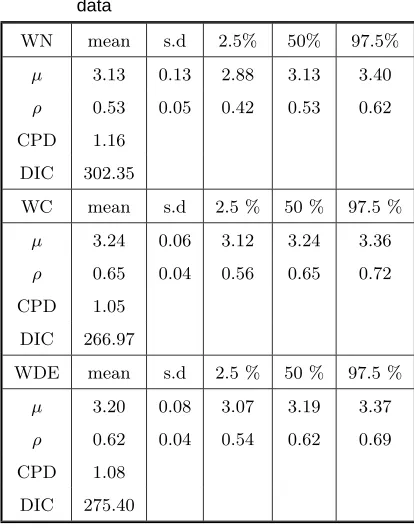
Table 3. Posterior summary val-ues of(µ, ρ)based on fitting WN, WC and WDE models to the Ant data
WN mean s.d 2.5% 50% 97.5% µ 3.13 0.13 2.88 3.13 3.40 ρ 0.53 0.05 0.42 0.53 0.62 CPD 1.16
DIC 302.35
WC mean s.d 2.5 % 50 % 97.5 % µ 3.24 0.06 3.12 3.24 3.36 ρ 0.65 0.04 0.56 0.65 0.72 CPD 1.05
DIC 266.97
WDE mean s.d 2.5 % 50 % 97.5 % µ 3.20 0.08 3.07 3.19 3.37 ρ 0.62 0.04 0.54 0.62 0.69 CPD 1.08
DIC 275.40
6. Application to real data sets
We analyze a data set that presents the orientation of the ants towards a black target
when released in a round arena. This experiment was originally conducted by? and later
mentioned in?. The data consists of 100 observations. For this data set, circular sample
mean and resultant direction are 3.20 radians (183◦) and 0.61 respectively.
We plot a circular histogram of this data in Figure ??. We fit WN, WC and WDE
distributions to this data. We compute the posterior mean, standard deviation (s.d), 2.5
percentile, median and 97.5 percentile forµandρ. We have used a class of non-informative
priors for (µ, ρ) which is given in equation (??), but present the results only foraρ = 0.5,
in Table??.
While fitting the data, initially we rejected the first 2000 samples (burn-in period) of
the MCMC chain and kept the next 5000 samples after burn-in to do posterior inference.
16 P. Ravindran and S. K. Ghosh
10000 15000 20000 25000 30000 35000 40000
3.0
3.1
3.2
3.3
3.4
Iterations
Trace of mu
3.0 3.1 3.2 3.3 3.4
0123456
N = 30000 Bandwidth = 0.0082
Density of mu
10000 15000 20000 25000 30000 35000 40000
0.50
0.55
0.60
0.65
0.70
0.75
Iterations
Trace of rho
0.50 0.55 0.60 0.65 0.70 0.75
02468
N = 30000 Bandwidth = 0.005484
Density of rho
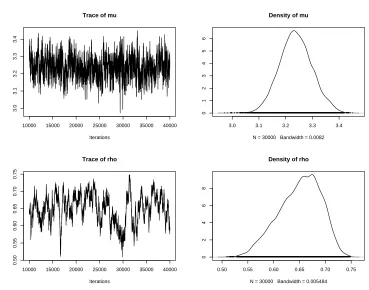
Fig. 3. MCMC output for parameters while fitting Wrapped Cauchy to ant data
burn-in time to 10000 samples and kept the next 30000 samples. We used multiple starting
values forµ and ρ, viz. µ = 3.2 and 0 andρ = 0.61 and 0.99. We find that after 3000
samples, the two chains overlap each other and achieves good mixing. Carefully monitoring
other diagnostics aspects of convergence, such as auto/cross correlations using CODA (not
presented here), we assert that there was no apparent problem with MCMC convergence.
Summary values of the parameters are given in Table??.
To compare the models we use CPD and DIC. A smaller value of the model selection
criteria indicates a better fit. From Table ??, we see that WC is performing best based
on CPD and DIC. WDE estimates are close to WC estimates. But the estimates from
WN are different from WC and WDE. Using CODA, we obtained the trace plots and the
kernel density estimates of the parametersµ and ρbased on the wrapped Cauchy (WC)
distribution, which are presented in Figure??.
that WN does not fit this data very well, which concurs with our finding as well. They
recommend a family of symmetric wrapped stable distributions (SWS, see?, p. 52) or a
mixture of SWS and circular uniform density for this data. Notice that WC belongs to
the SWS family and hence this conclusion agrees with the result obtained from the CPD
and DIC values. The test presented by? is based on a large-sample theory, whereas our
findings are based finite sample method.
7. Discussion
In this article, we provided a generic method to fit a wide class of continuous wrapped
densities on the circle using MCMC methodology. We showed that using this method, we
can easily obtain samples from the joint posterior distribution, and hence, compute the
posterior summary values such as the posterior mean, standard deviation, 2.5 percentile,
median and 97.5 percentile for µ and ρ. From simulation-based studies, we found that
parameter estimates based on WDE are robust to erroneous models. In addition, we found
that the posterior distribution is not sensitive to the class of non-informative priors that we
proposed. We also studied the performance of two model selection criteria viz., CPD and
DIC, and using simulation studies we showed that both criteria perform well in selecting
the correct model from a set of given models. As an extension to this work, we have
developed regression models based on wrapped distributions and will be reported elsewhere.
Another extension is to consider correlated circular observations such as time series model
by wrapping autoregressive model on the line to a circle.
Acknowledgments
The authors would like to thank Dr. Kaushik Ghosh at the George Washington University,
for providing the Splus code to plot the circular histograms.
References
Best, D. J. & Fisher, N. I. (1978) Efficient simulation of the Von Mises distribution.
18 P. Ravindran and S. K. Ghosh
Coles, S. (1998) Inference for circular distributions and processes.Statistics and Computing,
8, 105-113.
Damien, P., Wakefield, J. & Walker, S. (1999) Gibbs sampling for Bayesian non-conjugate
hierarchical models by using auxiliary variables.J. R. Statist. Soc. B,61, 331-344.
Damien, P. & Walker, S. (1999) A full Bayesian analysis of circular data using von Mises
distribution.The Canadian Journal of Statistics,27, 291-298.
Fisher, N. I. (1993)Statistical analysis of circular data., Cambridge Univ. Press, Cambridge.
Fisher, N. I. & Lee, A.J. (1994) Time series analysis of circular data.J. R. Statist. Soc. B,
56, 327-339.
Gelfand, A. E. & Ghosh, S. K. (1998) Model choice: A minimum posterior predictive loss
function.Biometrika,85, 1-11.
Higdon, D. M. (1998) Auxiliary variable methods for Markov Chain Monte Carlo with
applications.J. Am. Statist. Assoc.,93, 585-595.
Jander, R. (1957) Die optische Richtungsorientierung der roten Waldameise (Formica rufa
L.).Zeitschrift Fur Vergleichende Physiologie, 40, 162-238.
Kent, J. T. & Tyler, D. E. (1988) Maximum likelihood estimation for the wrapped Cauchy
distribution.Journal of Applied Statistics,15, 247-254.
Mardia, K. V. (1972)Statistics of directional data., Academic Press, London.
Mardia, K. V. & Jupp, P. E. (1999)Directional statistics., Wiley, Chichester.
McCullagh, P. & Nelder, J. A. (1989) Generalized Linear Models, 2nd ed., Chapman and
Hall, New York.
Neal, R.(2003) Slice sampling (with discussion).Annals of Statistics,31, 705-767.
Sengupta, A & Pal, C (2001) On optimal tests for isotropy against the symmetric wrapped
stable-circular uniform mixture family.Journal of Applied Statistics, 28, 129-143.
Spiegelhalter, D. J., Best, N. G., Carlin, B. P., & van der Linde, A. (2002) Bayesian
measures of model complexity and fit, (with discussion and rejoinder). Journal of the
Stephens, M. A. (1969)Techniques for directional data.Technical Report 150, Department
of Statistics, Stanford University.
Tanner, M. A. & Wong W. H. (1987) The calculation of posterior distributions by data
augmentation.J. Am. Statist. Assoc.,82, 528-540.
van Dyk, D. A. & Meng, X. L. (2001) The art of data augmentation.Journal of
Computa-tional and Graphical Statistics,10, 1-50.
Von Mises, R. (1918) ¨Uber die “Ganzzahligkeit” der Atomgewicht und verwandte Fragen.
20 P. Ravindran and S. K. Ghosh
Appendix: Full conditional densities for the WDE model
The full conditional densities ofk,v,z,µandσ2 are given by
[kj|y,k−j, µ,z,v, σ] ∝ Ivj
0, e−|yj−µ
+2πkj| σ
,
⇒kj|y,k−j, µ,z,v, σ ∼ DU21π(µ−yj+σlogvj)
,21π(µ−yj−σlogvj)
,
whereDU stands for Discrete Uniform.
vj|y,k, µ,z,v−j, σ ∼ U
0, e−|
yj−µ+2πkj|
σ ,
z0|y,k, µ,z−0,v, σ ∼ U0,σn−21aρ+1
,
z1|y,k, µ,z−1,v, σ ∼ U
0,(1+σ12)2aρ
,
µ|y,k,z,v, σ ∼ U[mµ, Mµ],
wheremµ =
n
max
j=1 [yj+ 2πkj+σlogvj]
0 and
Mµ = n
min
j=1[yj+ 2πkj−σlogvj]
(2π).
σ|y,k, µ,z,v ∼ U[mσ, Mσ],
wheremσ = maxn
j=1
|yj−µ+2πkj| −logvj
and
Mσ = 1
z
1
n−2aρ+1
0 1−z
1 2aρ
1
z
1 2aρ
1
,