_____________________________________________________________________________________________________
*Corresponding author: E-mail: [email protected];
(Past name: British Journal of Medicine and Medical Research, Past ISSN: 2231-0614, NLM ID: 101570965)
Estimation of Serum Lipid Profile and Its Correlation
with Alveolar Bone Height in Chronic Periodontitis
Avadhut Kamble
1, Mukta Motwani
2and Naman Shah
3*1
Department of Oral Medicine and Radiology, Yogita Dental College and Hospital, Khed, Ratnagiri, Maharashtra, India.
2
Department of Oral Medicine and Radiology, VSPM Dental College and Research Centre, Nagpur, Maharashtra, India.
3
Yogita Dental College and Hospital, Khed,Ratnagiri, Maharashtra, India.
Authors’ contributions
This work was carried out in collaboration among all authors. All authors read and approved the final manuscript.
Article Information
DOI: 10.9734/JAMMR/2019/v29i530087
Editor(s):
(1) Dr. Mohammed Osman, Oncology Consultant, General Organization of Teaching Hospitals and Institutes, Cairo, Egypt. (2)Prof. Nicolas Padilla-Raygoza, Department of Nursing and Obstetrics, Campus Celaya Salvatierra University of Guanajuato, Mexico.
Reviewers:
(1)Jammula Surya Prasanna, Institute of Dental Sciences and Research Center, Hyderabad, Telangana, India. (2)Alessandro Lanza, Campania University “Luigi Vanvitelli”, Italy. (3)Dr. Rucha Shah, Bapuji Dental College & Hospital, Davangere, Karnataka, India. (4)Abdullah Seckin Ertugrul, Izmir Katip Celebi University, Turkey. Complete Peer review History:http://www.sdiarticle3.com/review-history/35106
Received 25 May 2017 Accepted 26 August 2017 Published 04 April 2019
ABSTRACT
Aim: Numerous studies have been previously carried out to find out any correlation between lipid
profile and periodontitis but existence of an association does not establish whether periodontitis causes an elevation in serum lipid level or elevation in serum lipid profile predispose to periodontitis. The aim of the present study was to find any significant correlation between HDL, LDL, VLDL and cholesterol with periodontitis.
Material and Methods: 100 patients with chronic periodontitis (group I) and 50 healthy patients (group II) were selected. The levels of serum lipid, including HDL, LDL, VLDL, and TOTAL CHOLESTEROL along with fasting blood glucose were assessed. The relationship between severity of periodontitis based on clinical and radiographic finding with serum lipid correlated.
and VLDL among study and control group. Only HDL showed a highly significant difference (p< 0.00) between healthy and patient with chronic periodontitis.
Conclusion: Estimation of serum lipid profile, especially HDL levels in subjects with periodontitis can be considered as a screening method for early diagnosis of atherosclerosis to avoid further progression of cardiovascular changes in early age of the life.
Keywords: Chronic periodontitis; HDL; LDL; atherosclerosis.
1. INTRODUCTION
Coronary heart disease (CHD) is one of the leading factors of morbidity and mortality throughout the world being responsible for 16% of death in developing and 50% in developed countries. Atherosclerosis of coronary arterie is considered to be the leading cause of premature death among men. The pathological background of the atherosclerosis of coronary arteries is formation of atherosclerotic plaque, which
additionally induces other cardiovascular
diseases [1].
Several bacteria and virus have also been identified as potential etiological factors in cardiovascular diseases (CVD) [2]. Periodontitis is an inflammatory disease of the supporting
tissues of teeth caused by specific
microorganisms resulting in progressive
destruction of the periodontal ligament and alveolar bone with pocket formation, recession or both [3].
Perhaps one of the most helpful finding about periodontitis is that host response varies
between individuals and that either an
inadequate host immune response or
exaggerated response to bacterial pathogens leads to a more severe form of disease [4]. The majority of risk factors of cardiovascular diseases are also considered to be risk factors for periodontal diseases [1].
Thus, individuals with periodontitis are more likely to have increased in the level of free fatty acids in the form of cholesterol and triglycerides. These fatty acids are also involved in the athermatous plaque formation in blood vessels.
This increase in atheromas has been
associated with thrombotic events in the form of
various cardiovascular diseases. Recent
studies have also shown isolation of the periodontal pathogen from this atheromatous plaque [5].
Although numerous studies have been previously carried out to find out any correlation between lipid profile and periodontitis but existence of an
association does not establish whether
periodontitis causes an elevation in serum lipid level or elevation in serum lipid profile predispose to periodontitis. So the present study is carried out to find any significant correlation between HDL, LDL and cholesterol with periodontitis and also to assess whether periodontitis may be the
first step in the etiopathogenesis of
cardiovascular disorders in patients whom other obvious risk factors like smoking were absent.
2. MATERIALS AND METHODS
A hospital based cross sectional study was carried out in the Department of Oral Medicine and Radiology, VSPM Dental College and Research Centre, Nagpur. Subjects were apprised of the purpose of the study and written consent was taken prior to commencement of the study. Ethical clearance was obtained from the ethical committee of the institution.
This study consists of 100 patients with chronic periodontitis (group I) and 50 healthy patients (group II). Study consists of patients having age more than 20 yrs without any habits along with no systemic or medical illness like hypertension,
myocardial infarction, stroke, asthama,
endocrinal diseases.
Periodontal condition of the two groups were determined on basis of clinical examination of gingiva and its associated structures including color, contour, surface texture, consistency, bleeding on probing, presence of stippling and pus discharge through gingival crevices. The pocket depth was measured bilaterally in the region of premolar molar region of the mandible with the help of Williams graduated probe. Thus depending upon the attachment loss clinically we divided into three groups like, Mild periodontitis: - < 3 mm Moderate periodontitis:-3-6 mm ,severe periodontitis : > 6 mm.
from CEJ upto the bone level in premolar molar region of both the quadrant in mandible.
For estimation of lipid profile like total cholesterol, HDL, LDL and VLDL we advised patient to fast at least 8-12 hrs and collected 2 ml of blood sample from anticubital vein by venipuncture method and stored in collecting test tubes with anticoagulant and sent to pathology laboratory for enzyamatic analysis.
Statistical analysis was done to evaluate the correlation between serum lipid profile and periodontitis along with radiographic bone height secondary to periodontitis to find out the significant difference between these values with the help of chi square, annova and Z test.
3. RESULTS
The mean values of Total cholesterol was 171.26 mg/dl, while in control group it was 161.51 mg/ dl, (p=.127) and the mean triglyceride in study group was 115.20 mg/dl, while in control group it was 99.91 mg/dl, (p=0.075) the mean LDL cholesterol in study group was 106.40 mg/ dl, while in control group it was 98.59 mg/ dl.(p= 0.188) The mean of VLDL cholesterol in study group was 23.17 mg/ dl, while in control group it was 20.02 mg/ dl.(p=0.065) The mean fasting blood glucose level in study group was 99.90 mgm/ dl, while in control it was 92.27 mgm/
dl.(p=0.58). But there was no statistical
significant difference found in Total cholesterol,
triglycerides, LDL, VLDL & Fasting blood glucose.
Further mean total HDL in study group was 41.20 mg/ dl, while in control group it was 42.97 mg/dl which found to be statistically significant (P=0.04).
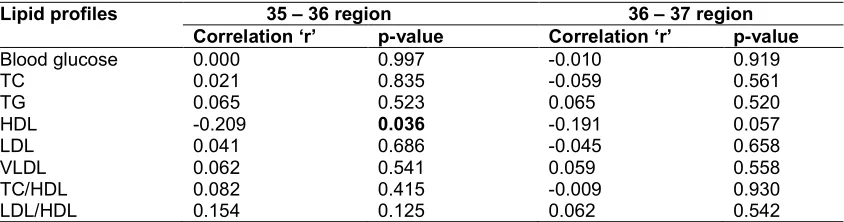
Further correlation was done for of Alveolar bone loss in mandibular left & right premolar molar region with Lipid parameters. Among all lipid parameters in mandibular left premolar region, HDL showed negative correlation (r = - 0.209) with statistical significant difference (P=0.036), whereas other parameters (LDL, VLDL & triglyceride) showed no significant difference.
Further alveolar bone loss relation with lipid parameters in mandibular right premolar region found to be negative and was not significant. In the present study we observed raised levels of lipid parameters in both the groups; among all parameters HDL showed highly significant differences (p-0.0001).
4. DISCUSSION
Periodontitis has been traditionally regarded as a chronic inflammatory oral infection which mainly consists of gram negative anaerobic microflora that leads to gingival inflammation, destruction of periodontal tissues, loss of alveolar bone and exfoliation of the teeth. It is generally accepted
Table 1. Prevalence of serum lipid level in study and control groups
TC TG HDL LDL VLDL TC:HDL LDL:HDL
Study 8 6 74 7 6 19 17
Control 2 1 31 1 1 3 3
א2-value 10.00 2.91 60.39 8.00 2.91 3.03 5.07
p-value 0.00 0.23 0.00 0.01 0.31 0.21 0.07
P<0.05= significant
Table 2. Correlation of radiographic bone loss (35, 36 & 37 region) with lipid parameters
Lipid profiles 35 – 36 region 36 – 37 region Correlation ‘r’ p-value Correlation ‘r’ p-value
Blood glucose 0.000 0.997 -0.010 0.919
TC 0.021 0.835 -0.059 0.561
TG 0.065 0.523 0.065 0.520
HDL -0.209 0.036 -0.191 0.057
LDL 0.041 0.686 -0.045 0.658
VLDL 0.062 0.541 0.059 0.558
TC/HDL 0.082 0.415 -0.009 0.930
LDL/HDL 0.154 0.125 0.062 0.542
that certain organisms within the microbial flora of dental plaque are major etiological agent in periodontitis. These microorganisms particularly P. Gingivalis produces endotoxins in the form of
lipopolysacchrides that generates a host
mediated tissue destructive immune response. Traditionally it is thought that periodontitis is an oral disease and that the tissue destructive
response remains localized within the
periodontium, limiting effects of the disease to oral tissues supporting teeth, however recent studies indicate that oral disease may have profound effect on systemic health [6].
A number of studies have reported association
between periodontitis and cardiovascular
diseases. Most of the risk factors for
cardiovascular diseases are also regarded as risk factor for periodontal diseases. Some studies have found no relationship or an inverse relationship between chronic infection and hyperlipidemia.
Chronic infections like periodontitis have been demonstrated to induce profound changes in plasma concentration of cytokines like TNF- alpha and IL- beta which can result into elevated levels of free fatty acids, LDL (low density lipoprotein) and triglycerides. These elevations in serum lipids are thought to arise from enhanced hepatic lipogenesis, increased adipose tissue
lipolysis, increased synthesis or reduced
clearance of LDL due to reduction in lipoprotein lipase activity [7].
Therefore the present study was carried to find out any correlation between chronic infection like periodontitis and increase in serum lipid level in form of cholesterol, triglyceride, HDL (high density lipoprotein), LDL (low density lipoprotein) in otherwise healthy subjects and who did not have any habits.
In the present study 8% subjects showed increased total cholesterol from study group whereas it was 4% among healthy subjects; this increased TC showed statically significant difference (p <0.05). Similar results were also seen by Loesche et al. (2000) [8] &Taleghani F (2005) [9].
These findings give evidence to the theory that periodontitis may be one of the factor that is responsible for increase in total cholesterol levels as in our study the patients did not have any other systemic disorders and no smoking habit, but at the same time other factors such as
physical activity, nutrition, stress, socioeconomic status and body mass index (BMI) might have some influence on total cholesterol level which should also be evaluated.
Increased triglyceride levels when assessed between study and control group we found three fold increase in subjects with periodontitis but stastically it was not significant, which was also seen with Taleghani F (2005) [9].
In contrast to our study and Taleghani F, Loesche et al. (2000) [8] found significant
correlation when triglyceride levels were
assessed. This increase in plasma triglyceride levels could be due to increase in pro-inflammatory cytokines in response to chronic periodontitis. Infection with Gram negative periodontal pathogen can cause rapid release of systemic IL-1 beta and TNF- alpha which are responsible for hyper-triglyceridaemia.
When decreased levels of HDL were assessed in both the groups; the frequency of low HDL was higher by 12% in chronic periodontitis as compared to control; with stastitical significant difference (p<0.0001).whereas Loesche et al (2000) [8], Taleghani F (2005) [9], Cristana A (2005) [10] did not find any statistic al significant difference for HDL.
The explanation for relationship between low HDL and periodontitis might be chronic infection in the periodontitis that leads to release
of lipopolysaccharide and proinflammatory
cytokines.
On the other hand HDL also has anti-inflammatory properties that can decrease the adhesion of endothelial cells, thus low plasma concentration of HDL in blood may be a contributory factor to inflammatory process in periodontitis. In this study no statically significant difference was found when for LDL & VLDL. Loesche et al. (2000) [8] found significantly raised LDL levels in subjects with periodontitis which is contradictory to present study. Thus a cause and effect relationship between HDL and periodontitis needs to be established.
with gram negative bacteria may be responsible for insulin resistance and subsequent poor glyceamic control in periodontitis patients.
In our study among all lipid parameters only HDL showed negative correlation with alveolar bone loss and severity of periodontitis which was statistically significant indicating that increase in amount of bone loss in severe periodontitis is associated with low serum level of HDL. Similar results are also seen with Saito T (2004) [14].
In the present study among all lipid parameters HDL was the most significantly associated with periodontitis. There was significant difference found in plasma levels of HDL in subjects with periodontitis as compared to subjects with healthy periodontium.
Unlike previous studies we did not find any
statistical difference in total cholesterol,
triglyceride and LDL levels in subjects with periodontitis and without it. In the previous studies it has been shown that abnormal levels of total cholesterol and LDL are indicators of atherosclerosis or coronary heart disorders, but HDL can be a better measure especially in individuals less than 60 yrs.
5. CONCLUSION
The present study mainly consisted of subjects in third and fourth decades with mean age of 39.2 yrs. Among all lipid parameters the mean value of HDL was low in subjects with periodontitis than without it, whereas the mean value of total cholesterol, triglycerides and LDL did not show any significant changes. The mean values of two
ratios thatTC /HDL and LDL / HDLwere found to
be significantly altered in subjects with
periodontitis but this could be due to low HDL values rather than total cholesterol and LDL.
Thus HDL can be considered as atherogenic lipid profile which is a better measure than total cholesterol or LDL as risk factor for developing coronary heart disease especially in individuals less than 60 years of age. Therefore estimation of serum lipid profile especially HDL levels in subjects with periodontitis can be considered as screening method for early diagnosis of atherosclerosis in early age of the life.
CONSENT
As per international standard or university standard, patient’s written consent has been collected and preserved by the authors.
ETHICAL APPROVAL
As per international standard or university standard, written approval of Ethics committee has been collected and preserved by the authors.
COMPETING INTERESTS
Authors have declared that no competing interests exist.
REFERENCES
1. Valentaviciene G, Paipaliene P,
Nedzelskiene I, et al. The relationship
between blood serum lipids and
periodontal condition. Stomatologia, Baltic Dental and Maxillofacial Journal. 2006; 8(3):96-100.
2. Saito T, Murakami M, Shimazaki Y.
Association between alveolar bone loss and elevated serum C reactive protein in Japanese men. J Periodontol. 2003;74: 1741-1746.
3. Newman M, Takei H, et al. Carranza
Clinical Periodontology 10th Edition,
Elsevier Saunders publication; 2007.
4. Sanz M, Deanfield J. European workshop
in periodontal health and cardiovascular disease- scientific evidence on association between periodontal and cardiovascular diseases: A review of literature. European
Heart Journal Supplement 2010;12
(supplement B):B3-B12.
5. Kauppinen- Makelin R, Nikkila E. Serum
lipoproteins in patients with myocardial infarction. Atherosclerosis 1998;74:665-674.
6. De Stefano F, Anda R, Khan H. Dental
disease and risk of coronary heart disease and mortality. Br Dent J. 1993;306:688-691.
7. Van der Poll T, Saurwein H. Tumor
necrosis factor- alpha: Its role in the metabolic response in sepsis. Clin Sci 1993;84:247-256.
8. Loesche W, Karapetow F, Pohl C. Plasma
lipid and blood glucose level in patients with destructive periodontal diseases. J Clin Periodontol. 2000;27:537-541.
9. Taleghani F, Shamaei M, Shamaei M.
Association between chronic periodontitis and serum lipid levels. Acta Medica Iranica. 2010;48(1):47-50.
10. Cristana A, Rozeli M, et al. Relation
plasmatic levels of triglycerides, total cholesterol and fractions. Braz Oral Res. 2005;19(4):284-289.
11. Liu L, Spelleken M, Röhrig H. Tumor
necrosis factor-alpha acutely inhibits
insulin signaling in human adipocytes: Implication of the p80 tumor necrosis factor receptor. Diabetes. 1998;47(4):515-522.
12. Reimers J. Interleukin-1 β induced
transient diabetes mellitus in rats. A model of the initial events in the
pathogenesis of insulin dependant
diabetes mellitus? Danish Medical Bulletin. 1998;45:157-180.
13. Shiba T, Higashi N. Hyperglycemia due to
insulin resistance caused by interferon γ.
Diabetic Medicine.1998;15:435-436.
14. Saito T, Murakami M, Shimazaki Y.
Association between alveolar bone loss and elevated serum c reactive protein in Japanese men. J Periodontol. 2003;74: 1741-1746.
_________________________________________________________________________________ © 2019 Kamble et al.; This is an Open Access article distributed under the terms of the Creative Commons Attribution License (http://creativecommons.org/licenses/by/4.0), which permits unrestricted use, distribution, and reproduction in any medium, provided the original work is properly cited.
Peer-review history: