Improved Cryptanalysis of Reduced RIPEMD-160
Florian Mendel1, Thomas Peyrin2, Martin Schl¨affer1,
Lei Wang2, and Shuang Wu2
1 IAIK, Graz University of Technology, Austria
[email protected] [email protected]
2
Nanyang Technological University, Singapore
[email protected] [email protected]
Abstract. In this article, we propose an improved cryptanalysis of the double-branch hash function standardRIPEMD-160. Using a carefully designed non-linear path search tool, we study the potential differential paths that can be constructed from a difference in a single message word and show that some of these message words can lead to very good differential path candidates. Leveraging the recent freedom degree utilization technique from Landelle and Peyrin to merge two branch instances, we eventually manage to obtain a semi-free-start collision attack for 42 steps of theRIPEMD-160 compres-sion function, while the previously best know result reached 36 steps. In addition, we also describe a 36-step semi-free-start collision attack which starts from the first step.
Keywords:RIPEMD-160, semi-free-start collision, compression function, hash function
1
Introduction
Due to their widespread use in many applications and protocols, hash functions are among the most
important primitives in cryptography. A hash function H is a function that takes an arbitrarily long
message M as input and outputs a fixed-length hash value of size n bits. Cryptographic hash functions
have the extra requirement that some security properties, such as collision resistance and (second)-preimage resistance, must be fulfilled. More precisely, it should be impossible for an adversary to find a collision (two
distinct messages that lead to the same hash value) in less than 2n/2 hash computations, or a
(second)-preimage (a message hashing to a given challenge) in less than 2n hash computations. Most standardized
hash functions are based upon the Merkle-Damg˚ard paradigm [13,3] and iterate a compression function
hwith fixed input size to handle arbitrarily long messages. The compression function itself should ensure
equivalent security properties in order for the hash function to inherit from them.
The cryptographic community have seen very impressive advances in hash functions cryptanalysis in the recent years [20,18,19,17], with weaknesses or even sometimes collisions exhibited for many standards
such as MD4, MD5, SHA-0and SHA-1. These functions have in common their design strategy, based on the
utilization of additions, rotations, xors and boolean functions in an unbalanced Feistel network. In order to diversify the panel of standardized hash functions and make a backup plan available in case the last
survivors of thisMD-SHAfamily gets broken as well, NIST organized a 4-yearSHA-3competition which led
to the selection of Keccak [1] as new standardized primitive. The move of the industry towards SHA-3
will take a lot of time and even broken functions such as MD5or SHA-1 remain widely used. Among the
MD-SHAfamily, only SHA-2 and RIPEMD-160 compression functions are still unbroken, although practical
collisions on theSHA-2compression function have been improved from 24 to 38 steps recently [11,12]. The
compression function used inRIPEMD-128 was recently shown not to be collision resistant [8].
RIPEMDcan be considered as a subfamily of the MD-SHA-family as its first representative,RIPEMD-0[2],
basically consists in twoMD4-like [15] functions computed in parallel (but with different constant additions
for the two branches), with 48 steps in total. Even though RIPEMD-0was recommended by the European
RACE Integrity Primitives Evaluation (RIPE) consortium, its security was put into question with the
early work from Dobbertin [5] and the practical collision attack from Wanget al.[17]. Meanwhile, in 1996,
Dobbertin, Bosselaers and Preneel [6] proposed two strengthened versions of the originalRIPEMD-0, called
RIPEMD-128 andRIPEMD-160, with 128/160-bit output and 64/80 steps respectively.RIPEMD-0main flaw
andRIPEMD-160by using not only different constants, but also different rotation values, boolean functions
and message insertion schedules in the two branches. This two-branch structure inRIPEMDfamily is a good
method to reduce the ability of the attacker to properly use the available freedom degrees and to find
good differential paths for the entire scheme. RIPEMD-160 is a worldwide ISO/IEC standards [7] that is
yet unbroken and is present in many implementations of security protocols.
As of today, the best results onRIPEMD-160 are a very costly 31-step preimage attack [14], a practical
36-step semi-free-start collision attack [10] on the compression function (not starting from the first step), and a distinguisher on up to 51 steps of the compression function with a very high complexity [16].
Our contributions. In this article, we improve the best know results onRIPEMD-160, proposing a
semi-free-start collision attack on 42 steps of its compression function and a semi-semi-free-start collision attack on 36 steps starting from the first step. Our differential paths were crafted thanks to a very efficient non-linear path search tool (Section 3) and by inserting a difference only in a single message word, in a hope for
a sparse difference trail. We then explain in Section 4 why we believe the 8th message input word (M
7)
is the best candidate for that matter. Once the differential paths settled, we leverage in Section 5 the
freedom degree utilization technique introduced by Landelle and Peyrin [8] for RIPEMD-128 that merges
two branch instances together in order to obtain a semi-free-start collision. It is to be noted that the step
function ofRIPEMD-160 makes it much more difficult to find a collision attack compared toRIPEMD-128.
This is mainly due to the fact that the diffusion is better, but also because even though differences might be absorbed in the boolean function, they will propagate anyway at least once through a free term (which
was not the case in RIPEMD-128). We give a description of RIPEMD-160 in Section 2 and summarize our
results in Section 6.
2
Description of
RIPEMD-160
RIPEMD-160[6] is a 160-bit hash function that uses the Merkle-Damg˚ard construction as domain extension
algorithm: the hash function is built by iterating a 160-bit compression functionhthat takes as input a
512-bit message blockmi and a 160-bit chaining variablecvi:
cvi+1=h(cvi, mi)
where the messagemto hash is padded beforehand to a multiple of 512 bits3and the first chaining variable
is set to a predetermined initial valuecv0=IV (given in Table 3 of Appendix A).
We refer to [6] for a complete description of RIPEMD-160. In the rest of this article, we denote by
[Z]i thei-th bit of a wordZ, starting the counting from 0.andrepresent the modular addition and
subtraction on 32 bits, and ⊕, ∨, ∧, the bitwise “exclusive or”, the bitwise “or”, and the bitwise “and”
function respectively.
2.1 RIPEMD-160 compression function
TheRIPEMD-160 compression function is a wider version of RIPEMD-128, which is in turn based onMD4, but with the particularity that it uses two parallel instances of it. We differentiate these two computation
branches by left and right branch and we denote byXi(resp.Yi) the 32-bit word of left branch (resp. right
branch) that will be updated during stepiof the compression function. The compression function process
is composed of 80 steps divided into 5 rounds of 16 steps each in both branches.
Initialization. The 160-bit input chaining variable cvi is divided into 5 words hi of 32 bits each, that
will be used to initialize the left and right branch 160-bit internal state:
X−4= (h0)>>>10 X−3= (h4)>>>10 X−2= (h3)>>>10 X−1=h2 X0=h1
Y−4= (h0)>>>10 Y−3= (h4)>>>10 Y−2= (h3)>>>10 Y−1=h2 Y0=h1 . 3
The message expansion. The 512-bit input message block is divided into 16 wordsMiof 32 bits each.
Each wordMi will be used once in every round in a permuted order (similarly to MD4and RIPEMD-128)
and for both branches. We denote byWl
i (resp.Wir) the 32-bit expanded message word that will be used
to update the left branch (resp. right branch) during stepi. We have for 0≤j≤4 and 0≤k≤15:
Wjl·16+k=Mπl
j(k) and W
r
j·16+k=Mπr j(k)
where permutationsπl
j andπjrare given in Table 4 of Appendix A.
The step function. At every stepi, the registersXi+1 andYi+1 are updated with functionsfjlandfjr
that depend on the roundj in whichibelongs:
Xi+1= (Xi−3)<<<10((Xi−4)<<<10Φlj(Xi, Xi−1,(Xi−2)<<<10)WilK l j)
<<<sl i,
Yi+1= (Yi−3)<<<10((Yi−4)<<<10Φrj(Yi, Yi−1,(Yi−2)<<<10)WirK r j)
<<<sr i,
whereKl
j, Kjrare 32-bit constants defined for every roundjand every branch,sli, sri are rotation constants
defined for every step i and every branch, Φlj, Φrj are 32-bit boolean functions defined for every round j
and every branch. All these constants and functions are given in Appendix A.
The finalization. A finalization and a feed-forward is applied when all 80 steps have been computed in
both branches. The four 32-bit wordsh0i composing the output chaining variable are finally obtained by:
h00= h1X79(Y78)<<<10 h01= h2(X78)<<<10(Y77)<<<10
h02= h3(X77)<<<10(Y76)<<<10 h03= h4(X76)<<<10Y80
h04= h0X80Y79
3
Non-linear path search
To find a non-linear differential path in RIPEMD-160, we use the techniques developed by Mendel et
al. [11,12]. This automated search algorithm can be used to find both, differential characteristics and conforming message pairs (note that we will use it only for the differential characteristics part in this article). We briefly describe the tool in Section 3.1, and the new improvements and specific configuration forRIPEMD-160and our attack in Section 3.2.
3.1 Automated search for differential characteristics
The basic idea of the search algorithm is to pick and guess previously unrestricted bits. After each guess, the information due to these restrictions is propagated to other bits. If an inconsistency occurs, the algorithm backtracks to an earlier state of the search and tries to correct it. Similar to [11,12], we denote these three parts of the search by decision (guessing), deduction (propagation), and backtracking (correction). Then, the search algorithm proceeds as follows:
Decision (Guessing)
1. Pick randomly (or according to some heuristic) an unrestricted decision bit. 2. Impose new constraints on this decision bit.
Deduction (Propagation)
3. Propagate the new information to other variables and equations as described in [11,12]. 4. If an inconsistency is detected start backtracking, else continue with step 1.
Backtracking (Correction)
5. Try a different choice for the decision bit.
6. If all choices result in an inconsistency, mark the bit as critical. 7. Jump back until the critical bit can be resolved.
During the search, we mainly use generalized conditions [4] to store, restrict and propagate information (see Table 7 of Appendix B). The decision of choosing which bits to guess depends strongly on the specific attack, hash function and preferred resulting path. E.g. if some parts of the non-linear path should be especially sparse, we guess the corresponding state words first.
Similar to [11,12], new restrictions are propagated using brute-force propagation within bitslices for each Boolean function and modular addition. In the backtracking, we remember a small set of critical bits and repeatedly check if all of them can be resolved. This way, we leave dead search branches faster. Additionally, we restart the search after a certain number of inconsistencies occur.
The main difficulty in finding a long differential characteristic lies in the fine-tuning of the search algorithm. There are a lot of variations possible which can decide whether the search eventually succeeds
or fails. We describe the specific improvements forRIPEMD-160 in the next section.
3.2 Improvements for RIPEMD-160
To efficiently find non-linear differential paths and message pairs for a larger number of steps than in previous attacks [10], we had to improve the search in several ways. Especially finding a non-linear path
for the XOR-round ofRIPEMD-160 was quite challenging.
In order to improve the propagation of information, we have combined the bitslices of the two modular
additions in each step ofRIPEMD-160into a single bitslice. The two carries of the first and second modular
addition are computed and stored together within a generalized 3-bit condition, which is defined similarly as the 2.5-bit condition of [9]. Without this combination, many contradictions would be detected very late during the search, and therefore reduce the overall performance.
To find sparser paths at the beginning or end of the non-linear path, we first propagate the single bit condition in the message word backward and forward more or less linearly and by hand. Then, the automatic search tool is used to connect the paths. Note that due to the additional modular addition in RIPEMD-160, we can stay sparse longer in forward direction than in backward direction. This can be observed when looking at our resulting differential paths in Appendix D.
Once we have found a candidate for a differential path, we immediately continue the search for partial confirming message pairs, similar as in [11,12]. We first pick decision bits ’-’ which are constraint by linear
two-bit conditions of the form (Xi,j=Xk,lorXi,j6=Xk,l). This ensures that those bits which influence a
lot of other bits are guessed first. This way, inconsistent characteristics are found faster and can also be corrected by the backtracking step of the path search.
4
Differential paths
The previous semi-free-start collision attacks on RIPEMDcompression functions usually start by spending
the available freedom degrees in the first steps in each branch, and then continue the computation in the forward direction, verifying the rest of the differential path in each branch probabilistically. With this attack strategy, the non-linear part of the differential paths for both branches should be located in the early steps. Indeed, the non-linear parts are usually the most costly part and therefore should be handle in priority by the attack with the available freedom degrees.
Since the compression functions belonging to the RIPEMD family use a two-branch parallel structure
sharing the same initial chaining value, the left and right branches can be regarded as somehow connected in the first steps. With this observation, in [8] Landelle and Peyrin proposed a new method to find
semi-free-start collisions forRIPEMD-128. Their method allows the attacker to use the message freedom degrees
not necessarily in the early steps of each branch, and therefore relax a bit the constraint that the most costly parts (the non-linear chunks) must be located in the early steps as well. Consequently, the space of possible differential paths is increased and likely to contain better candidates since the probabilistic part in each branch is reduced.
cvi cvi+1
Linear Non
Linear
1 2
Linear Non
Linear
1 2
cvi cvi+1
0 Non Linear Linear
1 3
2
0 Non Linear Linear
1 3
2
Fig. 1. The previous (left-hand side) and new (right-hand side) approach for collision search on double-branch compression functions introduced in [8].
4.1 On the choice of the message word
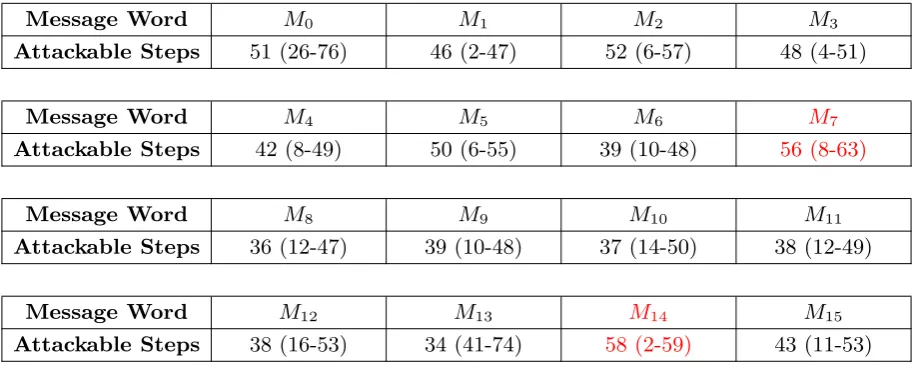
As in [8], in order to find a sparse differential path for a semi-free-start collision attack with the biggest number of steps, we chose to insert differences in only a single message word. Then, for all the 16 message words, we have analyzed how many steps can be potentially attacked. The results are summarized in Table 1. Note that the details of the attacks are not considered at this stage and the final complexity will highly depend on the merging process and the quality of the differential paths that can be found (both linear and non-linear parts). Yet, by guessing for each message insertion where would be the best location for the two non-linear parts, this preliminary analysis gives a rough estimation of how many steps can be reached potentially. The overall attack being quite complex and time consuming to settle, this will help us to focus directly on good candidates.
We found that message wordsM7andM14both seem to be rather good choices when trying to verify
the following criteria:
1. the non-linear part in both branches should be short, in order to consume less freedom degrees. 2. the early steps of the two non-linear parts should be rather close to each other, which will help the
merging.
3. the late steps of the non-linear parts should be as sparse as possible, since after the merging comes the probabilistic phase and ensuring a sparse incoming difference mask would guarantee a rather high differential probability when computing forward.
4. some message word difference injections allow the differences injected in very late steps in the two branches to cancel each other through the final feed-forward operation. If this trick is applicable, one can usually get 4 to 6 extra steps for the collision attack with a relatively low cost.
Once M7 and M14 identified as good candidates, we tried to design the entire differential path and
establish the merging phase. During our search for the linear part of the differential path, we found it
much harder to find good ones forRIPEMD-160compared toRIPEMD-128. The reason is that the diffusion
of the step function ofRIPEMD-160is much better thanRIPEMD-128as it prevents from fully and directly
absorbing all the differences. For example, a step in an IF round inRIPEMD-128can be fully controlled by
the attacker such that no difference diffusion occurs. However, inRIPEMD-160, one extra free term appears
in the addition of the step function formula and this forces at least a diffusion of a factor two (that cannot be absorbed by the IF function). As a consequence, we were not able to find differential paths as sparse as in [8] and the number of attacked steps is also much lower.
4.2 Difficulty of calculating the probability
Another important difference between RIPEMD-128 and RIPEMD-160 is the step differential probability
calculation. While it is easy to calculate the differential probability for each step of a given differential
path ofRIPEMD-128, it is not the case forRIPEMD-160. The reason is that the step function inRIPEMD-160
is no longer a S-function (a function for which the i-th output bit depends only on the ifirst lower bits
of all input words), and therefore the accurate calculation of the differential probability is very hard. Yet,
Table 1. Rough estimation of the number of attackable steps for various choices of message words differences injection (in parenthesis are given the steps window)
Message Word
M
0M
1M
2M
3Attackable Steps
51 (26-76)
46 (2-47)
52 (6-57)
48 (4-51)
Message Word
M
4M
5M
6M
7Attackable Steps
42 (8-49)
50 (6-55)
39 (10-48)
56 (8-63)
Message Word
M8
M9
M10
M11
Attackable Steps
36 (12-47)
39 (10-48)
37 (14-50)
38 (12-49)
Message Word
M12
M13
M
14M15
Attackable Steps
38 (16-53)
34 (41-74)
58 (2-59)
43 (11-53)
We use the step function of the left branch as an example:
Qi= (Xi−4)<<<10Φlj(Xi, Xi−1,(Xi−2)<<<10)WilK l j,
Xi+1= (Xi−3)<<<10Q≪ sli
i .
Now the probability of the sub-steps can be calculated precisely. One possible way to calculate the
proba-bility of the step function is to specify the conditions onQi and obtainP r[Xi→Qi]·P r[Qi→Xi+1] as
the step probability.
In fact, this estimation of the probability is not correct. First, there is no freedom degree injected in
the stepQi→Xi+1, which means it is not independent from the step ofXi→Qi. Thus their probability
can not be calculated as a simple multiplication. Even if this estimation is accurate, it will only represent a lower bound of the real probability, since there could be a lot of possible equivalent characteristics on
Qiand only one is taken in account here. We used experiments to estimate the real probability and found
that the probabilities obtained using the first method is much lower than the real probability observed when running the attack.
We then tried to come up with another way to calculate the step differential probability. We summed
the probabilities of the two sub-steps for all possible characteristics on Qi, i.e. we used ΣQi(P r[Xi →
Qi]·P r[Qi → Xi+1]) as differential probability for a step. The calculated probability turned out to be
much higher than the real one. This is explained by the fact that characteristics onQiin different steps will
sometimes introduce conditions onXi and there could be contradictions between some of the conditions.
In the calculation, we did not consider the compatibility between theQi in different steps. It is therefore
not surprising that the calculated probability is much higher.
In the following sections, all the probabilities given were obtained by experiments while testing random samples. We leave the problem of theoretically calculating the real step differential probability as an open problem.
4.3 48-step semi-free-start collision path
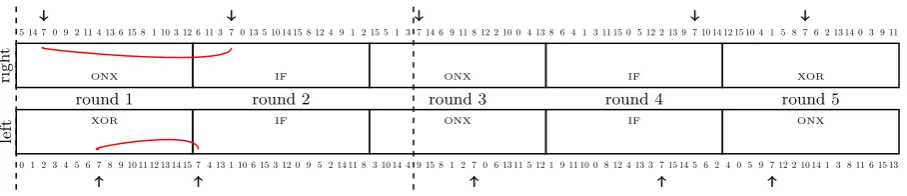
We eventually choseM7as message word for the single difference insertion and the shape of the differential
path that we will use can be found in Figure 2. The non-linear parts are located between steps 16-41 and 19-36 for left the right branch respectively. In steps 58-64, after a linear propagation of the difference
injected by M7, the differences in the output internal state are suitable to apply the feed-forward trick
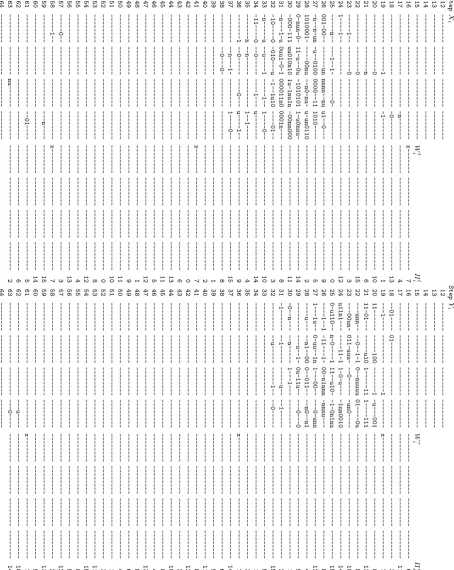
that allows us to get a collision on the output of the compression function (at the end of step 64). The complete differential path is displayed in Figure 6 in Appendix.
fromM7will be removed and no difference will be present in the internal states in both branches (therefore
leading directly to a collision, without even using the feed-forward trick). We did a measurement and found
that the collision probability for the feed-forward trick (from step 58 to 64) is about 2−11.3. However, our
attacks requiring already a lot of operations, we have to remove these extra 6 steps and aim for a 42-step semi-free-start collision attack instead. Yet, one should keep in mind that a rather small improvement with regards to the attack complexity would probably lead to the direct obtaining of a 48-step semi-free-start collision attack by putting back the 6 extra steps. The details of the attack will be given in the next section.
left
round 1 XOR
0 1 2 3 4 5 6 7 8 9 10 11 12 13 14 15
round 2 IF
7 4 13 1 10 6 15 3 12 0 9 5 2 14 11 8
round 3 ONX
3 10 14 4 9 15 8 1 2 7 0 6 13 11 5 12
round 4 IF
1 9 11 10 0 8 12 4 13 3 7 15 14 5 6 2
round 5 ONX
4 0 5 9 7 12 2 10 14 1 3 8 11 6 15 13
righ
t
ONX
5 14 7 0 9 2 11 4 13 6 15 8 1 10 3 12
IF
6 11 3 7 0 13 5 10 14 15 8 12 4 9 1 2
ONX
15 5 1 3 7 14 6 9 11 8 12 2 10 0 4 13
IF
8 6 4 1 3 11 15 0 5 12 2 13 9 7 10 14
XOR
12 15 10 4 1 5 8 7 6 2 13 14 0 3 9 11
Fig. 2.The shape of our 48-step differential path for the semi-free-start collision attack on theRIPEMD-160 com-pression function. The numbers represent the message words inserted at each step and the red curves represent the rough amount of differences in the internal state during each step. The arrows show where the bit differences are injected withM7. The dashed lines represent the limits of the steps attacked.
4.4 36-step semi-free-start collision path from the first step
Besides the 48-step path, we also exhibit a semi-free-start collision path starting from the first step, which
also use message wordM7to introduce differences. Since the boolean function in the first round of the left
branch is XOR, it is quite hard to find a non-linear differential path. As a consequence, the path we were
able to find turns out to have three bits of differences in M7 instead of a single one. The local collisions
are located between the first two injections ofM7in both branches, thus one can directly derive a 36-step
collision path starting from the very first step ofRIPEMD-160. Figure 3 shows the shape of this differential
path and the detailed path is given in Figure 7 in Appendix.
left
round 1
XOR
0 1 2 3 4 5 6 7 8 9 10 11 12 13 14 15
round 2
IF
7 4 13 1 10 6 15 3 12 0 9 5 2 14 11 8
round 3
ONX
3 10 14 4 9 15 8 1 2 7 0 6 13 11 5 12
round 4
IF
1 9 11 10 0 8 12 4 13 3 7 15 14 5 6 2
round 5
ONX
4 0 5 9 7 12 2 10 14 1 3 8 11 6 15 13
righ
t
ONX
5 14 7 0 9 2 11 4 13 6 15 8 1 10 3 12
IF
6 11 3 7 0 13 5 10 14 15 8 12 4 9 1 2
ONX
15 5 1 3 7 14 6 9 11 8 12 2 10 0 4 13
IF
8 6 4 1 3 11 15 0 5 12 2 13 9 7 10 14
XOR
12 15 10 4 1 5 8 7 6 2 13 14 0 3 9 11
Fig. 3.The shape of our differential path for the 36-step semi-free-start collision attack on theRIPEMD-160from the first step. The numbers are the message words inserted at each step and the red curves represent the rough amount differences in the internal state during each step. The arrows show where the bit differences are injected withM7. The dashed lines represent the limits of the steps attacked.
5
Merging the two branches
for both branches are the same and the attacker can actually choose this value freely. In contrary, for a hash collision, the attacker would have to merge both branches to the same chaining variable, fixed to a certain predefined value.
5.1 Semi-free-start collision
As explained in previous sections, even though a interesting 48-step differential path has been found
(Figure 6), we will only look for a 42-step semi-free-start collision attack onRIPEMD-160, since the
feed-forward collision trick would increase the attack complexity beyond the birthday bound. Our algorithm to find a semi-free-start collision is separated in three phases, which we quickly describe here as a high-level view:
• Phase 1: fix some bits of the message words and the internal states in both branches as preparation for
the next phases of the attack. This will allow us to fulfill in advance some conditions of the differential path.
• Phase 2: fix the internal state variablesX26, X27, X28, X29, X30of the left branch andY21, Y22, Y23, Y24, Y25
of the right branch. Then, iteratively fix message wordsM11,M15,M8,M3,M12,M14,M10,M2,M5,
M9, M0 andM6 in this particular order, so as to fulfill the conditions located inside or close to the
non-linear parts. Once these internal state variables or message words are successfully fixed, we call
this candidate at the end of phase 2 astarting point for the merging.
• Phase 3: use the remaining free message words M1, M4,M7 and M13 to merge the internal states of
both branches to the same input chaining value. Since every value is fixed at this point, check if the rest of the differential path is fulfilled as well (the uncontrolled part).
Phase 1: preparation. Before finding a starting point for the merging, we can prepare the differential
path by introducing certain conditions on the internal states in both branches in order to increase the probability of the uncontrolled part of the differential path.
The condition that we will force is that bits 16 to 25 ofX35must be equal to 0n00n00000. The effect
of this condition is that when a starting point will be generated, we will be able to directly deduce the 8
lowest bits of X37 only by fixing bits 16 to 25 ofM9. In order to explain this, note that calculatingX37
during the step function in the forward direction gives: X37=X33≪10(X≪
10
32 ONZ(X36, X35, X34)M9K36l )≪
14
SinceONZ(X36, X35, X34) = (X36∨X35)⊕X34, bits 16 to 25 ofX36will have no influence on the output of
the boolean functionONZif the corresponding X35 bits are set to zero (in a starting point,X32,X33,X34
andX35are already fully known). Then, we can choose M9 such that bit 16 ofX32≪10(((X36∨X35)⊕
X34)&3ff)(M9&3ff)K36 equals zero, which will stop the carry coming from the lower bits. As a
result, the 8 lowest bits ofX37will not depend onX36anymore (and thus neither onM4when computing
forward, sinceX36 directly depends onM4) .
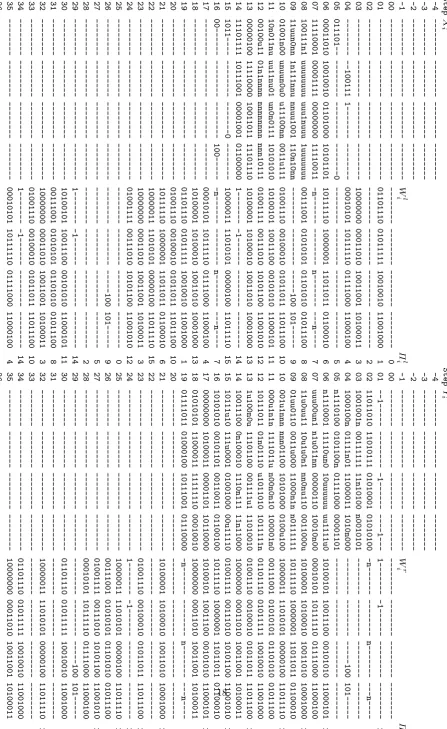
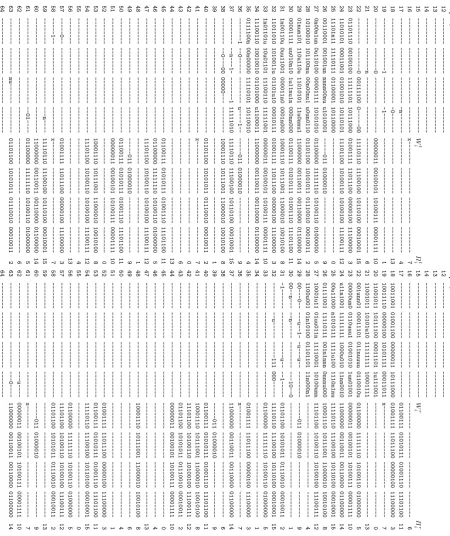
One example of our generated starting points is shown in Figure 4, in which we applied our preparation
trick. Before generating this starting point, we forced the additional conditions on X35, and once the
starting point found, fixing bits 16 to 25 ofM9to 01101000010will make sure that the last 8 bits ofX37
will be equal to11111010. Note that the 26-th bit ofM9and 9-th bit ofX37 are deduced from the known
conditions.
Applying this trick is interesting for the attacker because the uncontrolled probability (steps 35-58) of the left branch is increased.
Phase 2: finding a starting point. Given the differential path from Figure 6, we can use the freedom
degrees available in both left and right branches internal states (320 bits) and in the message words (512 bits) to fulfill as much differential conditions as possible. To make the attacker easier, we chose to fix first the
five consecutive internal states words that contain the most differential conditions (X26, X27, X28, X29, X30
in the left branch and Y21, Y22, Y23, Y24, Y25 in the right branch). Then, we fix a few message words one
by one in the given order and continue the computation of the internal states by computing forward and
Step X i Step Y i 12 ---12 - -13 ---13 - -14 ---14 - -15 ---W l i Π l i 15 ---W r i Π r i 16 --- x- -- -- --- -- ---7 16 -- - --- ---6 17 --- -n -- -- --- -- ---4 17 ---01 100111 0 1010111 01001110 11101100 11 18 --- -0 -- -- --- -- ---13 18 100110 01 01001 100 0000 0011 10 111000 01001111 11011100 00000100 11100000 3 19 ---1 --- -1 -- -- --- -- ---1 19 10011110 00000100 10101111 00011011 x- - --- ---7 20 ---0 ---000000 11 00100 101 1010 0111 00 001111 10 20 110010 11 10111 100 0001 1101 1u 111001 ---0 21 ---n -- -- -- --- -- ---6 21 11001011 10101u10 11111111 10001111 -- - --- ---13 22 ---0 00111100 0---00 111101 10 11100 100 1011 0100 00 010001 15 22 001unn 01 00011 101 011n uuuu 01 10010u 01100000 11111110 10100110 01000000 5 23 01101110 00100100 11111101 10111000 010011 11 11011 100 0000 0100 11 100000 3 23 00000un0 0110uuu1 01001010 1un01001 00 000011 0 0100101 10100111 00001111 10 24 11010101 00011001 01001010 10110101 111011 00 10100 110 1010 0100 11 100111 12 24 u11n10 01 11111 111 1000 u010 11 nn0010 11000000 00110011 00110000 01100000 14 25 11101n11 11110111 01100001 10110000 -- -- --- -- ---0 25 00u11000 n1010111 1111u100 1110n1nu 11 110110 1 1100100 10110100 00010001 15 26 00110001 001001un nnnn00nu u1010001 ---0 11 01000 010 -- ---9 26 01111001 11110111 001n1nnn 0nnnu000 10 001110 1 0111001 11000010 10010100 8 27 0n00n1un 0u110100 00001111 10101010 011000 00 11111 110 1010 0110 01 000000 5 27 10001u11 01uu011n 11110001 10100unn 11 101100 1 0100110 10100100 11100111 12 28 10100010 101100nu 00n00nu1 u0un0110 011011 00 10101 011 0111 0010 00 010011 2 28 1100u001 01n10100 01101101 11n000n1 -- - --- ---4 29 01nun101 110u110u 11010101 11u0nnu1 110000 00 00110 011 0011 0000 01 100000 14 29 00---0 -- ---u- -1- -u -- ---011 01000010 ---9 30 00001111 uu010n10 1u11nu1n 000nn000 011001 11 01010 111 0100 1110 11 101100 11 30 00n- -- --n-- --- ---10--0 ---1 31 1n00110u 0uu11001 000011n0 0001n000 100011 10 10111 001 1100 0010 10 010100 8 31 -1--- --- ---u-- --1---01 101100 1 0101011 01110010 00010011 2 32 11011010 1010011u 01101u10 00010111 010011 11 11011 100 0000 0100 11 100000 3 32 --- --u---111 000---11 110110 1 1100100 10110100 00010001 15 33 1n01101u 10u01101 11100110 11111001 000000 11 00100 101 1010 0111 00 001111 10 33 -- -- --- -- ---01100000 11111110 10100110 01000000 5 34 11100110 10010010 01101000 u1100011 110000 00 00110 011 0011 0000 01 100000 14 34 -- -- --- -- --- ---1 35 0111100n 00n00000 11110101 10110010 -- -- --- -- ---4 35 ---01 001111 1 1011100 00000100 11100000 3 36 ---1 --0--- --- u----1---0 11 01000 010 -- ---9 36 --- x- - --- ---7 37 --- --n---1---1 11111010 111101 10 11100 100 1011 0100 00 010001 15 37 -- -- --- -- ---11000000 00110011 00110000 01100000 14 38 ---0---00 00000--- ---100011 10 10111 001 1100 0010 10 010100 8 38 -- - --- ---6 39 -- -- -- --- -- ---1 39 ---011 0 1000010 ---9 40 ---011011 00 10101 011 0111 0010 00 010011 2 40 ---01 100111 0 1010111 01001110 11101100 11 41 --- x- -- -- --- -- ---7 41 ---10 001110 1 0111001 11000010 10010100 8 42 -- -- -- --- -- ---0 42 ---11 101100 1 0100110 10100100 11100111 12 43 -- -- -- --- -- ---6 43 ---01 101100 1 0101011 01110010 00010011 2 44 -- -- -- --- -- ---13 44 -- -- --- -- ---00000011 00100101 10100111 00001111 10 45 ---011001 11 01010 111 0100 1110 11 101100 11 45 -- -- --- -- --- ---0 46 ---011000 00 11111 110 1010 0110 01 000000 5 46 -- - --- ---4 47 ---111011 00 10100 110 1010 0100 11 100111 12 47 -- -- --- -- --- ---13 48 -- -- -- --- -- ---1 48 ---10 001110 1 0111001 11000010 10010100 8 49 ---0 11 01000 010 -- ---9 49 -- - --- ---6 50 ---011001 11 01010 111 0100 1110 11 101100 11 50 -- -- --- -- --- ---4 51 ---000000 11 00100 101 1010 0111 00 001111 10 51 -- -- --- -- --- ---1 52 -- -- -- --- -- ---0 52 ---01 001111 1 1011100 00000100 11100000 3 53 ---100011 10 10111 001 1100 0010 10 010100 8 53 ---01 100111 0 1010111 01001110 11101100 11 54 ---111011 00 10100 110 1010 0100 11 100111 12 54 -- -- --- -- ---11110110 11100100 10110100 00010001 15 55 -- -- -- --- -- ---4 55 -- - --- ---0 56 -- -- -- --- -- ---13 56 -- -- --- -- ---01100000 11111110 10100110 01000000 5 57 ---0-- ---010011 11 11011 100 0000 0100 11 100000 3 57 ---11 101100 1 0100110 10100100 11100111 12 58 ---1-- --- x- -- -- --- -- ---7 58 ---01 101100 1 0101011 01110010 00010011 2 59 --- ---n----111101 10 11100 100 1011 0100 00 010001 15 59 -- -- --- -- --- ---13 60 ---110000 00 00110 011 0011 0000 01 100000 14 60 -- -- --- -- ---011 01000010 ---9 61 --- --01----011000 00 11111 110 1010 0110 01 000000 5 61 --- x- - --- ---7 62 -- -- -- --- -- ---6 62 --- ---u----00 000011 0 0100101 10100111 00001111 10 63 --- nu--- ---011011 00 10101 011 0111 0010 00 010011 2 63 --- ---0----11 000000 0 0110011 00110000 01100000 14 64 ---64 -
-Fig. 4.Starting point for the 48-step differential path, on which the preparation trick was applied and the last 8 bits ofX37are fixed in advance by choosing several bits ofM9. At this point the remaining free message words are
M9,M0,M6,M13,M1,M7 andM4, which will be used during the merging phase.
Fixing the first 5 chaining values (X26, X27, X28, X29, X30of the left branch andY21, Y22, Y23, Y24, Y25of
the right branch) is quite an easy task. Note that the two branches can be fixed independently at this stage. We used algorithms similar to the ones searching for a differential path: we just guess the unrestricted bits
-from lower step to higher step, lower bit to higher bit and check if any inconsistency occurs. If both 0
level and guess the same bit again. The guessing continues until all bits are fixed. If after a predefined number of backtracking events (chosen according to the performance of the search) no solutions are found, we can restart the whole search in order to avoid being trapped in a bad subspace with no solution at all. Concerning the fixing of the message words, we used a different approach. Here, our search was applied
word by word. Following this message words orderingM11,M15, M8,M3,M12, M14,M10,M2, M5, M9,
M0andM6, we guess the free bits, and some internal states values will directly be deduced by computing
in both forward and backward directions from the already known internal state values in both branches. Note that the two branches are not independent anymore at this stage (since all message words are added several times in both branches), so it is important to check often for any inconsistency that could be detected. The backtracking and restarting options are also helpful here. We can use an extra trick to get a performance improvement of the search by pre-fixing the value of the word with the biggest number conditions in it (either message word or internal state word), and then deduce the value from all the words involved in this computation.
Our tool can find a starting point in a couple of minutes, with a program not really optimized. We will discuss about the complexity to generate the starting points in the next section.
Phase 3: merging both branches with M1, M4, M7 and M13. A starting point example is given
in Figure 4. Our target is to use the remaining free message words M1, M4, M7 and M13 to make sure
that we have a perfect match on the values of the five initial chaining words of both branches, i.e.Xi=Yi
fori∈ {12,13,14,15,16}(the indexes started at 12 because we are not attacking from the first step here).
The merging consists of four phases and in order to ease the reading we marked the free message words with colors in each phase. Once their values are fixed, we use black color for them.
• Step 1: Use M13 to ensureX16=Y16. As one can see, the value of X16 is already fixed at this point.
Now, observe the two backward step functions of Y17 andY16:
Y17≪10= (Y22Y18≪10)≫ 8
IFZ(Y21, Y20, Y19≪10)K r
21M13
Y16≪10= (Y21Y17≪10)≫ 12
IFZ(Y20, Y19, Y18≪10)K r
20M0
Incorporating the equationX16=Y16, we can direcly calculate the value ofM13from the known ones:
M13= (X16≪10IFZ(Y20, Y19, Y18≪10)K r
20M0)≪12
Y21(Y22Y18≪10)≫ 8
IFZ(Y21, Y20, Y19≪10)K r
21.
• Step 2: Similarly, use M1and M7 to ensure conditionsX15=Y15 andX14=Y14. Observing the step
functions:
X15≪10= (X20X16≪10)≫ 13
IFX(X19, X18, X17≪10)K l
19M1
=Y15≪10= (Y20Y16≪10)≫
7
IFZ(Y19, Y18, Y17≪10)K r
19M7
X14≪10= (X19X15≪10)≫ 8
IFX(X18, X17, X16≪10)K l
18M13
=Y14≪10= (Y19Y15≪10)≫
15
IFZ(Y18, Y17, Y16≪10)K r
18M3
and introducing notations for the constants, the equations above are simplified to AM1=BM7
(X19(AM1))≫8D= (Y19(BM7))≫15E
LetX = (X19(AM1))≫8, C0=ED andC1=Y19X19. The above equations become one:
XC0= (C1X≪8)≫15 (1)
where C0 and C1 are constants. The problem of finding the value of M1 and M7 is equivalent to
solving this equation. We claim that we can solve this equation with 29computations (see explanation
in Appendix): we can solve this equation for all 264possible values ofC
0andC1and store the solutions
• Step 3: Use M4 to ensure X13 = Y13. After step 2, Y13 is already fixed. Thus we can use a simple
calculation to get the value of M4:
M4= (X18X14≪10)≫ 6
IFX(X17, X16, X15≪10)Y13
• Step 4: The uncontrolled part of the merging. At this point, all freedom degrees have been used and
the last equation on the internal state X12=Y12will be fulfilled with a probability of 2−32.
Uncontrolled probability. After the merging, steps 36-58 of the left branch and steps 29-58 of the right
branch are still uncontrolled. Due to the difficulty of calculating the probability, we used experiments to evaluate these probabilities. Starting from a generated starting point, e.g. in Figure 4, we randomly choose
values of message wordsM5, M9, M0, M6, M13, M1, M7 andM4. Then we compute forward to check if the
differences are all canceled after the last injection ofM7. Note that if there are conditions on message words
M1,M4,M7andM13, they should be fulfilled probabilistically and included in the probability estimation,
since the freedom degrees of these message words are used to match the initial internal states values. For
the other free message words M5, M9, M0 and M6, we do not need to consider their conditions in the
probability, because we can freely choose their values to fulfill these conditions.
We measured the probability of both branches separately. After applying the preparation trick, the
uncontrolled probability of the left branch is 2−8.8. The uncontrolled probability of the right branch is
2−36.6. Moreover, during the merging phase, we could not control the value matching on the first IV word,
and this adds another factor of 2−32.
In total, the uncontrolled probability is 2−32·2−8.8·2−36.6 = 2−77.4. Since this probability is too low
and already close to the birthday bound forRIPEMD-160, we are not able to afford the feed-forward tricks
in steps 58-64.
Complexity evaluation. First we calculate the complexity to generate the starting points. Since the
uncontrolled probability is 2−77.4, we need to generate 277.4 starting points. However, we do not need
to restart the generation from the beginning. Indeed, every time we need a new starting point, we can
randomizeM6to get a new one. Once all possible choices of M6 have been used, we can still use freedom
degrees ofM0, M9andM5to generate all the required starting points. Though there are many constraints
on these four message words, luckily the number of conditions onM6is only two bits (one onX18and one
onX17). We can randomly choose value forX18 fulfilling the known conditions and check if the one-bit
condition onX17is fulfilled. Thus, we can find a new starting point from a known one with a complexity
of 4 step functions, which is equivalent to 4/(42∗2)≈2−4.4 calls of the 42-step compression function of
RIPEMD-160. For the other message words, we do not need to go into the details of the complexity, since the number of times we have to regenerate them is quite small and it is not the bottleneck of our attack complexity. From the reasoning above, we can conclude that the average complexity to generate a starting
point is 2−4.4. The complexity of generating all the required starting points is then 273.
Now, we need to consider the complexity of the merging phase. In order to evaluate this cost, we implemented the merging of the last four initial internal states. The table lookup in second phase is estimated using a RAM access (since the table will be very bog). In total, our implementation of the
merging takes about 145 cycles. The OPENSSL implementation of RIPEMD-160 compression function on
the same computer takes about 1040 cycles. Thus, 42 steps of the compression function takes about
1040∗42/80 = 546 cycles. Then we can say that our merging costs 145/546≈2−1.9 calls of the 42-step
compression function.
Finally, we can calculate the complexity of the semi-free start collision attack on 42-stepRIPEMD-160:
273+ 277.4−1.9≈275.5.
5.2 First step semi-free-start collision
This section discusses about the merging phase of the two branches to get a semi-free-start collision attack on the the first 36 steps. The idea of the merging is similar to the merging for the 42-step attack and we describe it briefly.
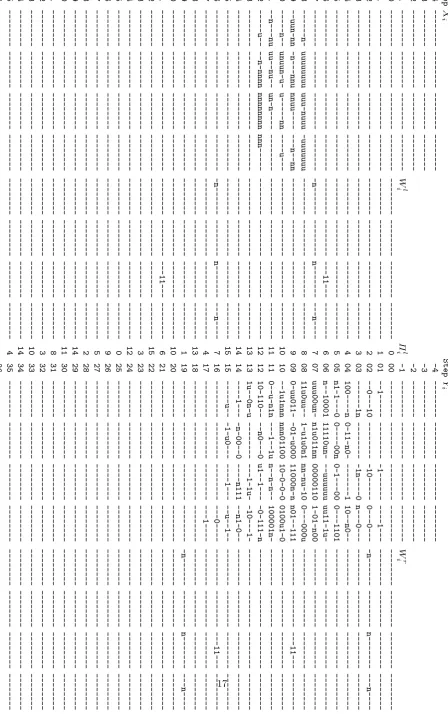
We start with generating a starting point, and one example is provided in Figure 8. The path in the left
branch has been satisfied until step 14, and the remaining uncontrolled probability amounts to 2−4.6. The
M2,M5,M7,M9andM14. Next, we show these free bits are enough to generate semi-free-start collisions,
and thus we only need to generate a single starting point. The procedure of merging is detailed as below.
1. Set random values to M9 and the free bits ofM7, and then compute untilX2 in the left branch.
2. Set M5 = M51 (initializeM5 as 0), and compute untilX−1 in the left branch. If M5 becomes 0
again, goto Step 1.
3. Compute the values ofM2 andM0 that makeY0=X0 andY−1=X−1.
4. ComputeX−2 andY−2, and check if X−2=Y−2 holds. In case ofX−26=Y−2, goto Step 2.
5. ComputeX−3, and then compute the value ofM14that makesY−3=X−3. Check if the conditions on
M14 are satisfied. If the conditions are not satisfied, goto step 1.
6. ComputeX−4 andY−4, and check if X−4=Y−4 holds. In case ofX−46=Y−4, goto Step 2.
BothX−2=Y−2 andX−4=Y−4 are satisfied with a probability 2−32, and four bit conditions are set on
M14. Thus we have to try 268 random values ofM7,M9, and M5 to succeed in merging the two branches
once. Recall that the uncontrolled probability is 2−4.6. So we need to merge the two branches 24.6 times.
Thus, the total complexity of the attack is 268+4.6×16/72≈270.4.
6
Results
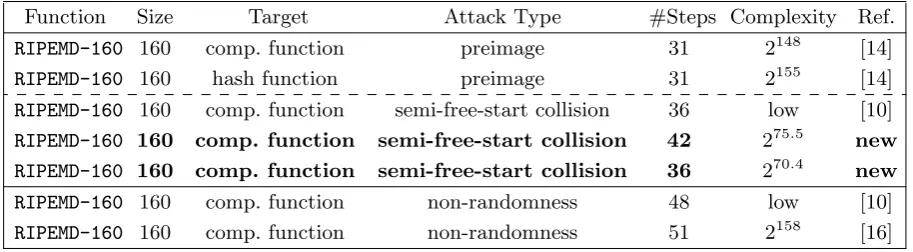
We give in Table 2 a comparison of our attacks to previous results on RIPEMD-160. Compared to the
previous best semi-free-start collision attack on RIPEMD-160 (36 middle steps), we have increased the
number of attackable steps by 6 and proposed a 36-step semi-free-start collision attack that starts from the first step.
Table 2.Summary of known and new preimage and collision attacks onRIPEMD-160hash and compression function
Function Size Target Attack Type #Steps Complexity Ref.
RIPEMD-160 160 comp. function preimage 31 2148 [14]
RIPEMD-160 160 hash function preimage 31 2155 [14]
RIPEMD-160 160 comp. function semi-free-start collision 36 low [10]
RIPEMD-160 160 comp. function semi-free-start collision 42 275.5 new
RIPEMD-160 160 comp. function semi-free-start collision 36 270.4 new
RIPEMD-160 160 comp. function non-randomness 48 low [10]
RIPEMD-160 160 comp. function non-randomness 51 2158 [16]
Conclusion
In this article, we have proposed an improved cryptanalysis of the hash functionRIPEMD-160, which is an
ISO/IEC standard. We have found a 42-step semi-free-start collision attack onRIPEMD-160 starting from
the second step and a 36-step semi-free-start collision attack starting from the first step. Compared to previous results, we have two improvements. First the number of attacked steps is increased from 36 to 42, and secondly, for the same number of attacked steps, we propose an attack that starts from the first step. Moreover, our semi-free-start collision attacks give a positive answer to the open problem raised in [10], in which the authors were not able to find any non-linear differential path in the first step, due to the XOR function that makes the non-linear part search much harder.
Our 42-step semi-free-start attack is obtained from a 48-step differential path. Unfortunately, we couldn’t add these extra 6 steps to our attack without reaching a complexity beyond the birthday bound
probabilistic part even further. If one can improve this part by a factor of about 27, a 48-step
semi-free-start collision attack would then be obtained directly with our proposed differential path. Another possible improvement would be that if one can find a better non-linear differential path in the first round, it might
be possible to merge both branches at the same time to a givenIV and eventually obtain a hash function
collision.
Acknowledgments
The authors would like to thank the anonymous referees for their helpful comments. Thomas Peyrin, Wang Lei and Wu Shuang are supported by the Singapore National Research Foundation Fellowship 2012 (NRF-NRFF2012-06).
References
1. Bertoni, G., Daemen, J., Peeters, M., Van Assche, G.: The Keccak reference. Submission to NIST (Round 3) (January 2011), available online:http://csrc.nist.gov/groups/ST/hash/sha-3/Round3/submissions_rnd3. html
2. Bosselaers, A., Preneel, B. (eds.): Integrity Primitives for Secure Information Systems, Final Report of RACE Integrity Primitives Evaluation RIPE-RACE 1040, LNCS, vol. 1007. Springer (1995)
3. Damg˚ard, I.: A Design Principle for Hash Functions. In: Brassard, G. (ed.) CRYPTO. LNCS, vol. 435, pp. 416–427. Springer (1989)
4. De Canni`ere, C., Rechberger, C.: Finding SHA-1 Characteristics: General Results and Applications. In: Lai, X., Chen, K. (eds.) ASIACRYPT. LNCS, vol. 4284, pp. 1–20. Springer (2006)
5. Dobbertin, H.: RIPEMD with Two-Round Compress Function is Not Collision-Free. J. Cryptology 10(1), 51–70 (1997)
6. Dobbertin, H., Bosselaers, A., Preneel, B.: RIPEMD-160: A Strengthened Version of RIPEMD. In: Gollmann, D. (ed.) FSE. LNCS, vol. 1039, pp. 71–82. Springer (1996)
7. International Organization for Standardization: Information technology – Security techniques – Hash-functions – Part 3: Dedicated hash-functions. ISO/IEC 10118-3:2004 (2004)
8. Landelle, F., Peyrin, T.: Cryptanalysis of Full RIPEMD-128. In: Johansson, T., Nguyen, P.Q. (eds.) EURO-CRYPT. LNCS, vol. 7881, pp. 228–244. Springer (2013)
9. Leurent, G.: Analysis of Differential Attacks in ARX Constructions. In: Wang, X., Sako, K. (eds.) ASIACRYPT. LNCS, vol. 7658, pp. 226–243. Springer (2012)
10. Mendel, F., Nad, T., Scherz, S., Schl¨affer, M.: Differential Attacks on Reduced RIPEMD-160. In: Gollmann, D., Freiling, F.C. (eds.) ISC. LNCS, vol. 7483, pp. 23–38. Springer (2012)
11. Mendel, F., Nad, T., Schl¨affer, M.: Finding SHA-2 Characteristics: Searching through a Minefield of Contra-dictions. In: Lee, D.H., Wang, X. (eds.) ASIACRYPT. LNCS, vol. 7073, pp. 288–307. Springer (2011) 12. Mendel, F., Nad, T., Schl¨affer, M.: Improving Local Collisions: New Attacks on Reduced SHA-256. In:
Johans-son, T., Nguyen, P.Q. (eds.) EUROCRYPT. LNCS, vol. 7881, pp. 262–278. Springer (2013)
13. Merkle, R.C.: One Way Hash Functions and DES. In: Brassard, G. (ed.) CRYPTO. LNCS, vol. 435, pp. 428–446. Springer (1989)
14. Ohtahara, C., Sasaki, Y., Shimoyama, T.: Preimage Attacks on Step-Reduced RIPEMD-128 and RIPEMD-160. In: Lai, X., Yung, M., Lin, D. (eds.) Inscrypt. LNCS, vol. 6584, pp. 169–186. Springer (2010)
15. Rivest, R.L.: The MD4 Message-Digest Algorithm. IETF Request for Comments (RFC) 1320 (1992), available online athttp://www.ietf.org/rfc/rfc1320.html
16. Sasaki, Y., Wang, L.: Distinguishers beyond Three Rounds of the RIPEMD-128/-160 Compression Functions. In: Bao, F., Samarati, P., Zhou, J. (eds.) ACNS. LNCS, vol. 7341, pp. 275–292. Springer (2012)
17. Wang, X., Lai, X., Feng, D., Chen, H., Yu, X.: Cryptanalysis of the Hash Functions MD4 and RIPEMD. In: Cramer, R. (ed.) EUROCRYPT. LNCS, vol. 3494, pp. 1–18. Springer (2005)
18. Wang, X., Yin, Y.L., Yu, H.: Finding Collisions in the Full SHA-1. In: Shoup, V. (ed.) CRYPTO. LNCS, vol. 3621, pp. 17–36. Springer (2005)
19. Wang, X., Yu, H.: How to Break MD5 and Other Hash Functions. In: Cramer, R. (ed.) EUROCRYPT. LNCS, vol. 3494, pp. 19–35. Springer (2005)
20. Wang, X., Yu, H., Yin, Y.L.: Efficient Collision Search Attacks on SHA-0. In: Shoup, V. (ed.) CRYPTO. LNCS, vol. 3621, pp. 1–16. Springer (2005)
Table 3.Initialization values in RIPEMD-160
X−4=Y−4=0xc059d148 X−3=Y−3=0x7c30f4b8 X−2=Y−2=0x1d840c95
X−1=Y−1=0x98badcfe X0=Y0 =0xefcdab89
Table 4.Word permutations for the message expansion inRIPEMD-160
roundj πlj(k) πrj(k)
0 1 2 3 4 5 6 7 8 9 10 11 12 13 14 15 0 1 2 3 4 5 6 7 8 9 10 11 12 13 14 15 0 0 1 2 3 4 5 6 7 8 9 10 11 12 13 14 15 5 14 7 0 9 2 11 4 13 6 15 8 1 10 3 12 1 7 4 13 1 10 6 15 3 12 0 9 5 2 14 11 8 6 11 3 7 0 13 5 10 14 15 8 12 4 9 1 2 2 3 10 14 4 9 15 8 1 2 7 0 6 13 11 5 12 15 5 1 3 7 14 6 9 11 8 12 2 10 0 4 13 3 1 9 11 10 0 8 12 4 13 3 7 15 14 5 6 2 8 6 4 1 3 11 15 0 5 12 2 13 9 7 10 14 4 4 0 5 9 7 12 2 10 14 1 3 8 11 6 15 13 12 15 10 4 1 5 8 7 6 2 13 14 0 3 9 11
Table 5. Boolean functions and round constants inRIPEMD-160, with XOR(x, y, z) :=x⊕y⊕z, IFX(x, y, z) := (x∧y)⊕(¯x∧z), IFZ(x, y, z) := (x∧z)⊕(y∧z), ONX(x, y, z) :=¯ x⊕(y∨z) and ONZ(x, y, z) := (x¯ ∨y)¯ ⊕z
roundj Φlj Φrj Kjl Kjr
0 XOR ONX 0x00000000 0x50a28be6
1 IFX IFZ 0x5a827999 0x5c4dd124
2 ONZ ONZ 0x6ed9eba1 0x6d703ef3
3 IFZ IFX 0x8f1bbcdc 0x7a6d76e9
4 ONX XOR 0xa953fd4e 0x00000000
Table 6.Rotation constants inRIPEMD-160
roundj sl16·j+k sr16·j+k
0 1 2 3 4 5 6 7 8 9 10 11 12 13 14 15 0 1 2 3 4 5 6 7 8 9 10 11 12 13 14 15 0 11 14 15 12 5 8 7 9 11 13 14 15 6 7 9 8 8 9 9 11 13 15 15 5 7 7 8 11 14 14 12 6 1 7 6 8 13 11 9 7 15 7 12 15 9 11 7 13 12 9 13 15 7 12 8 9 11 7 7 12 7 6 15 13 11 2 11 13 6 7 14 9 13 15 14 8 13 6 5 12 7 5 9 7 15 11 8 6 6 14 12 13 5 14 13 13 7 5 3 11 12 14 15 14 15 9 8 9 14 5 6 8 6 5 12 15 5 8 11 14 14 6 14 6 9 12 9 12 5 15 8 4 9 15 5 11 6 8 13 12 5 12 13 14 11 8 5 6 8 5 12 9 12 5 14 6 8 13 6 5 15 13 11 11
B
Notations for the differential paths
(x, x∗) (0,0) (1,0) (0,1) (1,1)
? X X X X
- X - - X
x - X X
-0 X - -
-u - X -
-n - - X
-1 - - - X
# - - -
-(x, x∗) (0,0) (1,0) (0,1) (1,1)
3 X X -
-5 X - X
-7 X X X
-A - X - X
B X X - X
C - - X X
D X - X X
E - X X X
C
Solving
X
C
0= (C
1X
≪8)
≫15Before solving this equation, we need to simplify it. First we consider the relation betweenA≪r
B≪r
and (AB)≪r. Let A = a
0||a1 and B = b0||b1, where A and B are n-bit values, a0 and a1 are r-bit
values,b0 andb1 are (n−r)-bit values. We can write:
AB= (a0||a1)(b0||b1) = (a0b0carry1)r||(a1b1)n−r
A≪rB≪r= (a1||a0)(b1||b0) = (a1b1carry0)n−r||(a0b0)r
wherecarry0= (a0b0)randcarry1= (a1b1)(n−r)are the carry bits which can only take the values
of 0 or 1. Notation (x)k stands for the lowerkbits ofx. Thus we can write equation (1) as:
XC0=C1≫15X≫ 7
y1y0·215
where y0 and y1 are the carry bits calculated from the higher 17 and lower 15 bits of C1X≪8, which
can be determined by the values ofX.
LetC=C0C1≪15y0·215y1, the equation is finally simplified to
XC=X≫7 (2)
Note that there are four possible values forC.
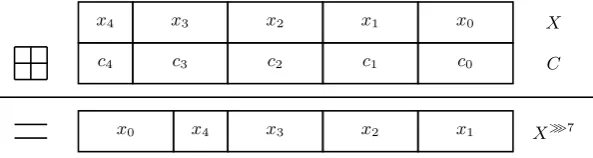
This equation can be solved with a Guess-and-Determine approach. Let X = x4||x3||x2||x1||x0 and
C = c4||c3||c2||c1||c0, where xi and ci are 7-bit values for i ∈ {0,1,2,3} and x4 and c4 are 4-bit values.
Then equation (2) is shown in details in Figure 5. Guess the value ofx0 and we can deduce the value of
x0
x1
x2
x3
x4
c0
c1
c2
c3
c4
x1
x2
x3
x0 x4
X
C
X≫7
Fig. 5.Demonstration of solving equation (2)
x1,x2,x3 andx4one by one and check if the original equation holds. One guess succeeds with probability
of 2−7and it takes 27computations to solve equation (2) Considering the guessing ofy
0 andy1, the total
complexity to solve equation (1) is 29.
Step X i Step Y i 12 ---12 ---13 ---13 ---14 ---14 ---15 ---W l i Π l i 15 ---W r i Π r i 16 --- x - -- - --- ---7 16 -- --- - -- --- ---6 17 --- -n--- - -- - --- ---4 17 -- --- - -- --- ---11 18 --- -0--- - -- - --- ---13 18 01 - 01 -- - --- --- ---3 19 ---1 --- -1--- - -- - --- ---1 19 ---1---- ---1 --- x-- - -- --- ---7 20 ---0 - - -- - --- ---10 20 11 ---1 00 ---1 -u---001 ---0 21 ---n - - -- - --- ---6 21 11-01---u10 1---11 1----111 --- - -- --- ---13 22 ---0 - - -- - --- ---15 22 unn ---0--1 -1 0--n uuuu 01----0u ---5 23 ---1---0 - - -- - --- ---3 23 ---00un- 011-uuu- --0--- -un0- --- - -- --- ---10 24 1----1-- - - -- - --- ---12 24 u11n1 ---11 -1 1-0- u----1n n0010 ---14 25 ---n-- ---1--1- ---0- - - -- - --- ---0 25 0-u110--n-0----1 11--u10--1-0n1nu --- - -- --- ---15 26 001-00---un nnnn--nu u1--0--- - -- - --- ---9 26 ----1--1 -11---1-00-n1nnn -nnnu --- - -- --- ---8 27 -n--n-un -u--0100 0000--11 1010---- - -- - --- ---5 27 1---1u--0-uu--1n 1---00---0-unn --- - -- --- ---12 28 1010001---00nu --n0-nu-u-un0110 - -- - --- ---2 28 ----u---n1--00 0--011----n0--n1 --- - -- --- ---4 29 0-nun-0-11-u--0u -1010101 1-u0nnu- - -- - --- ---14 29 - ---u-- 1-0u-1 1u-- ---0---0 ---9 30 -000-111 uu010n10 1u-1nu1n -00nn000 - -- - --- ---11 30 0n - n- -- 1 --- --- ---1 31 -n---1-u 0uu1-0-1 000011n0 0001n--- - -- - --- ---8 31 -1--- --1--- ---u-- --1-- --- - -- --- ---2 32 -10----0 -010---u -1--1u10 ----01-- - -- - --- ---3 32 --- --u--- ---1-- --0-- --- - -- --- ---15 33 -n---u --u----1 ---1-- 1----0-- - -- - --- ---10 33 - -- - --- --- ---5 34 -11----0 --0--- ----1--- u - -- - --- ---14 34 - -- - --- --- ---1 35 ---n --n--- --- 1--1---- - -- - --- ---4 35 -- --- - -- --- ---3 36 ---1 --0--- ----0--- u----1-- - -- - --- ---9 36 --- x-- - -- --- ---7 37 --- --n---1- --- 1----0-- - -- - --- ---15 37 - -- - --- --- ---14 38 --- --0---0- - - -- - --- ---8 38 -- --- - -- --- ---6 39 - - -- - --- ---1 39 -- --- - -- --- ---9 40 - - -- - --- ---2 40 -- --- - -- --- ---11 41 --- x - -- - --- ---7 41 -- --- - -- --- ---8 42 - - -- - --- ---0 42 -- --- - -- --- ---12 43 - - -- - --- ---6 43 -- --- - -- --- ---2 44 - - -- - --- ---13 44 - -- - --- --- ---10 45 - - -- - --- ---11 45 - -- - --- --- ---0 46 - - -- - --- ---5 46 -- --- - -- --- ---4 47 - - -- - --- ---12 47 - -- - --- --- ---13 48 - - -- - --- ---1 48 -- --- - -- --- ---8 49 - - -- - --- ---9 49 -- --- - -- --- ---6 50 - - -- - --- ---11 50 - -- - --- --- ---4 51 - - -- - --- ---10 51 - -- - --- --- ---1 52 - - -- - --- ---0 52 -- --- - -- --- ---3 53 - - -- - --- ---8 53 -- --- - -- --- ---11 54 - - -- - --- ---12 54 - -- - --- --- ---15 55 - - -- - --- ---4 55 -- --- - -- --- ---0 56 - - -- - --- ---13 56 - -- - --- --- ---5 57 ---0-- - - -- - --- ---3 57 -- --- - -- --- ---12 58 ---1-- --- x - -- - --- ---7 58 -- --- - -- --- ---2 59 --- ---n---- - -- - --- ---15 59 - -- - --- --- ---13 60 - - -- - --- ---14 60 - -- - --- --- ---9 61 --- --01---- - -- - --- ---5 61 --- x-- - -- --- ---7 62 - - -- - --- ---6 62 --- u- --- - -- --- ---10 63 --- nu--- - - -- - --- ---2 63 --- 0- --- - -- --- ---14 64 ---64
![Fig. 1. The previous (left-hand side) and new (right-hand side) approach for collision search on double-branchcompression functions introduced in [8].](https://thumb-us.123doks.com/thumbv2/123dok_us/7901219.1311619/5.595.76.520.82.199/previous-approach-collision-search-double-branchcompression-functions-introduced.webp)
![Table 7. Notations used in [4] for a differential path: x represents a bit of the first message and x∗ stands for thesame bit of the second message.](https://thumb-us.123doks.com/thumbv2/123dok_us/7901219.1311619/14.595.141.456.605.719/table-notations-dierential-represents-message-thesame-second-message.webp)