Study of the process
e
e
with the
CMD-3 detector at the
e
e
collider VEPP-2000
S. S. Tolmachev1,*,R. R. Akhmetshin1,2, A. N. Amirkhanov1, A. V. Anisenkov1,2, V. M. Aulchenko1,2, V. Sh. Banzarov1, N. S. Bashtovoy1, D. E. Berkaev1,2, A. E. Bondar1,2, A. V. Bragin1, S. I. Eidelman1,2,5, D. A. Epifanov1,2, L. B. Epshteyn1,2,3, A. L. Erofeev1,2, G. V. Fedotovich1,2, S. E. Gayazov1,2, A. A. Grebenuk1,2, S. S. Gribanov1,2, D. N. Grigoriev1,2,3, F. V. Ignatov1,2, V. L. Ivanov1,2, S. V. Karpov1, V. F. Kazanin1,2, A. N. Kirpotin1, I. A. Koop1,2, A. A. Korobov1,2, A. N. Kozyrev1,3, E. A. Kozyrev1,2, P. P. Krokovny1,2, A. E. Kuzmenko1,2, A. S. Kuzmin1,2, I. B. Logashenko1,2, P. A. Lukin1,2, K. Yu. Mikhailov1, V. S. Okhapkin1, Yu. N. Pestov1, A. S. Popov1,2, G. P. Razuvaev1,2, A. A. Ruban1, N. M. Ryskulov1, A. E. Ryzhenenkov1,2, A. V. Semenov1,2, Yu. M. Shatunov1, P. Yu. Shatunov1, V. E. Shebalin1,2, D. N. Shemyakin1,2, B. A. Shwartz1,2, D. B. Shwartz1,2, A. L. Sibidanov1,4, E. P. Solodov1,2, V. M. Titov1, A. A. Talyshev1,2, A. I. Vorobiov1, I. M. Zemlyansky1, and Yu. V. Yudin11,2
1Budker Institute of Nuclear Physics SB RAS, Novosibirsk, 630090, Russia 2
Novosibirsk State University, Novosibirsk, 630090, Russia
3Novosibirsk State Technical University, Novosibirsk, 630092, Russia 4
University of Victoria, Victoria, British Columbia, Canada V8W 3P6
5
Lebedev Physical Institute RAS, Moscow, 119333, Russia
Abstract. Existing Monte-Carlo generators with radiative corrections to the ee+ process are usually developed under the assumption that pions can be treated as pointlike particles. We study the ee + process with final-state radiation and test this assumption using simulated events from the MCGPJ generator based on the scalar QED hypothesis. In order to increase a fraction of events with FSR, the analysis was performed in the energy region to the left from the -meson peak (660785 MeV) that is based on the integrated luminosity of about 8.4 pb-1. The experimental data for the photon energy spectrum agree with the simulation results at 1% level.
1 Introduction
The physics program of experiments with the CMD-3 includes precise measurements of the cross sections of the ee hadrons processes [1]. Such experiments are necessary, e.g., for the calculation of the hadronic contribution (had) to the anomalous magnetic moment of the muon (=(g2)/2). The value of is of great importance as a Standard Model test. Among hadronic channels the process ee + is particularly important because it
gives the main contribution to the value had (~72%) in the low energy region (S < 2
*
GeV2) [2]. Radiative corrections to the ee + process are calculated under the assumption of pointlike pions. In this work we study the ee+process with photon radiation from the final state and test the hypothesis about pointlike pions used in the Monte-Carlo Generator Photon Jets (MCGPJ) [3].
The photon in the ee+event can be emitted by initial particles or from final state. Initial particles radiate mainly into a narrow cone along the particle movement path, but about 10% of the photons are emitted at the large angle, therefore it is impossible to separate events with radiation from the initial state from events with radiation from the final state based on the photon angular distribution. But there is an energy region to the left from the -meson peak where radiation from the initial state causes a ee+ cross section drop. The study of the ee+process in this energy region allows an increase of the relative fraction of events with the radiation from the final state.
For the test of the assumption about pointlike pions we analyzed an experimental photon-energy spectrum and compared it with the simulated one, which we produced using MCGPJ.
2 CMD-3 detector and dataset
The Cryogenic Magnetic Detector (CMD-3) is a general-purpose detector [4]. Coordinates, angles and momenta of charged particles are measured by the cylindrical drift chamber (DC) with accuracy about 120 μm in the r − φ plane and 2 mm along the beam axis. The cylindrical multiwire double-layer proportional Z-chamber provides z-coordinate determination with accuracy ∼0.5 mm. The calorimeter consists of three parts. The endcap BGO calorimeter consists of 680 crystals with a thickness 13.4 X0. The barrel part is placed
outside of the thin 0.08 X0 superconducting solenoid with 1.3 T magnetic field and consists
of the Liquid Xenon calorimeter (5.4 X0) and CsI crystals with a thickness of 8.1 X0 (1152
crystals) which are arranged in eight octants. The energy resolution of the barrel calorimeter was measured using Bhabha events and was found to be σE/E ∼ 4 ÷ 8%.
The analysis was carried out on the part of the statistics obtained at CMD-3 in the period from 04.12.2012 to 15.07.2013. Ten energy points in the c.m. energy region from 660 MeV to 785 MeV with the largest luminosity were chosen for the analysis. The total integrated luminosity in the processed data was ~ 8.4 pb-1.
3 Study of the process
e
e
3.1 Preliminary selection
For preliminary selection we imposed restrictions on the distributions of the main parameters of the processes for selection of events ee X+X, where X is an arbitrary charged particle.
The following criteria were used : two opposite charged tracks were reconstructed in the DC; the number of hits of each track exceeded 10; the distance from the intersection of tracks to the beam axis in the r-φ plane was less than 0.1 cm; the distance from the intersection of tracks to the interaction point along the beam axis did not exceed 6 cm; one or more photons clusters (not attached to the tracks) registered in the calorimeter; energy deposition in the photon cluster exceeded 50 MeV; the acollinearity angle between tracks in the scattering plane 0.06 rad < |∆θ| = | θ1 – (π – θ2) | <1 rad; the acollinearity angle between
tracks in the azimuthal plane 0.025 rad < |∆φ| = |(π – |φ1 – φ2|)| <1 rad; tracks and photons
missing momentum did not exceed 0.4 rad; the absolute value of the missing mass squared less than 9000 MeV2. The last criterion was used for suppression of the ee +0
events.
The kinematic reconstruction of each event was carried out. The 2 of kinematic
reconstruction must be smaller than 50. In events with two or more photons the photon with smallest 2 was chosen for the spectrum production.
In the energy region to the left from the -meson peak the main background processes are ee e+e, ee+ and ee+0.
3.2 Background suppression
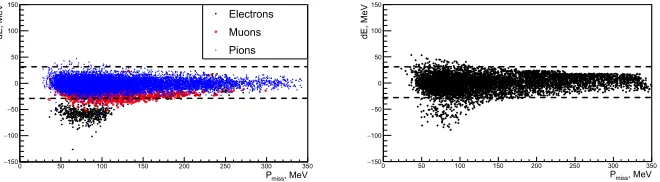
To suppress the ee e+e and ee+ we used parameters W, M and dE.
W = W1W2 (1)
Where Wi = Ei / Pi – ratio of the energy deposition in the calorimeter to the momentum
measured in the DC, M – mass of the charged particle.
- -
(2)
Where T = 2Ebeam – , Ebeam – measured energy of the beam, Pi – momentum of the
charged particle measured in DC, energy of the photon.
Fig. 1. (left) The value of parameter W for simulated events after preliminary selection. (right) Mass of charged particle for simulated events after preliminary selection and W cut. Dashed lines indicate selection criteria.
dE = 2Ebeam – E1 – E2 – Pmiss (3)
The energies of the particles were constructed with the pion mass assumption.
The selection criteria for described above parameters were obtained from the simulation of the signal process. W < 0.6, M > 100 MeV, |dE| < 30 MeV.
After all restrictions applied the detection efficiency of signal events was 0.25%.
4 Data-MC comparison
To compare the data with the theoretical predictions we simulated processes of the signal and the physical background (ee+, ee e+e, ee+ and ee+
0) using the CMD3SIM program developed on the basis of the GEANT4 package [5]. The
processes of the physical background were simulated with weights corresponding to the cross sections of the simulated processes. The CMD3SIM contains a description of all CMD - 3 systems and provides a complete simulation of the detector. The comparison was carried out with the same restrictions on the final state for the experiment and simulation.
According to the simulation, the cumulative application of the selection criteria described above allows us to distinguish events of ee + with the 6% impurity. ( ee e+e(<1%), ee+(56%) and ee+0 (<<1%) ).
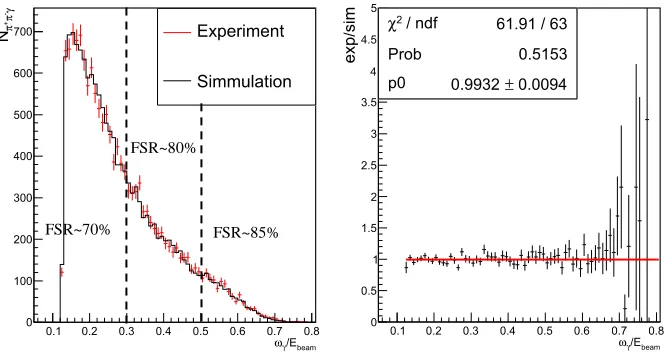
The level of agreement between the experiment and simulation was determined from the ratio of the experimental photon-energy spectrum to the simulated one. The photon energy
at each energy point was normalized to the beam energy Ebeam. The result of the analysis
is shown in Fig.3.
Fig. 3. (left) The photon energy spectrum in relative units for the data and simulation. Dashed lines indicate photon energy regions with the approximate content of FSR events. (right) The ratio of the data and simulation.
5 Summary
The analysis of the process ee + was carried out in the energy region 660785 MeV and based on the integrated luminosity about 8.4 pb-1. The applied selection criteria
allow to extract signal events of the process е+е-+- γ with 6% of background events.
The simulation is in good agreement with the experiment for е+е- +- γ and for е+е -+- γ. The ratio is stable in each energy region. The assumption of the pointlike pions
FSR~70%
FSR~80%
makes an insignificant contribution to the е е cross section measurement uncertainty (~ 0.01%) because the radiative correction to the ее process is about 1% [6].
6 Acknowledgements
We thank the VEPP – 2000 personnel for the exelent machine operation. The work was supported by the Russian Fund for Basic Research grants RFBR 17-02-00847-a and RFBR 17-02-00897-a.
References
1. G. V. Fedotovich, Nucl. Phys.Proc. Suppl.,B162 332 – 338 (2006)
2. M. Davier, S. Eidelman, A. Hoecker and Z. Zhang, Eur. Phys. J., C31, 503 – 510 (2003)
3. A. B. Arbuzov et al, Eur. Phys. J.,C46, 689 – 703 (2006) 4. B .I. Khazin et al., Nucl. Phys .B Proc. Suppl., 376, 181 (2008)