Current status of the compact 2.45 GHz ECR Ion
Source at FLNR JINR
Riyaz Fatkullin1,2,*, Sergey Bogomolov2, Andrey Efremov2, Vladimir Loginov2, Yuri Kostukhov2, and Andrey Bondarchenko2
1Institute for Theoretical and Experimental Physics (ITEP), 117218, Moscow, Russia
2Flerov Laboratory of Nuclear Reactions (FLNR JINR), 141980, Dubna, Moscow region, Russia
Abstract. This paper describes recent results obtained with a compact 2.45 GHz ECR Ion Source at the ECR ion sources test bench. The source was tested for production of helium and hydrogen ions with different configurations of Ultra High Frequency (UHF) coupler, UHF power and frequency. At the extraction voltage about of 10 kV and UHF power about of 100 W more than 500 µA of He + ions were produced with the extraction hole of 3 mm in diameter that corresponds to the current density of 7.5mA/cm2. The future possible upgrades of the ion source are also discussed.
1 Introduction
2.45 GHz Electron Cyclotron Resonance (ECR) [1] ion sources are widely used in various applications to produce singly charged ion beams for ion implantation, for accelerators, for production of radioactive ion beams etc. For these tasks, it is reasonable to use compact sources with small ionization chamber volume. The reduction of chamber volume is important for production of short-lived isotope [2]. The volume of plasma chamber can be reduced if the chamber will be based on a coaxial resonator loaded on a capacitor. Pseudo-closed surfaces should be located in the gap of the capacitor to achieve optimum conditions for plasma confinement.
The presented ion source can be considered as a prototype for creation of the source for production of radioactive ion beams and other applications.
1.1 Development of compact ECR ion source
The development of a 2.45 GHz compact ECR ion source (Fig.1) at the Flerov Laboratory of Nuclear Reactions (FLNR JINR) has begun in 2016 [3]. This source is based on coaxial quarter-wave resonator, which represents a source’s plasma chamber. Resonator creates an electric field with a high value of the electric field strength in the gap between the central coaxial conductor and the resonator wall. At a certain value of the input power and pressure in the chamber, a discharge appears in the gap, forming free electrons, which will be
captured by the magnetic field and heated by ECR. These electrons will ionize the neutral gas that is fed into the cavity of the resonator.
Fig. 1. Schematic view of ECR ion source based on a coaxial resonator: 1 - replaceable internal part of the resonator, 2 - external part of the resonator, 3 – coupling loop, 4 – permanent magnet ring, 5 - replaceable plasma electrode, 6 - pulling electrode.
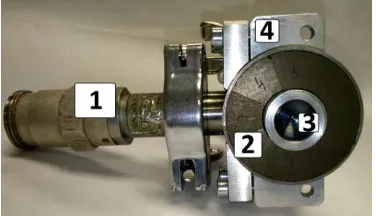
Compact ECR ion source was assembled (Fig. 2) and tested in 2017. The results achieved in 2017 showed us the dependency of output ion current on injected power, injected neutral gas flow and RF field frequency [4]. The maximum current value of 177
μA was achieved for helium ions.
Fig. 2. The view of ECR ion source: 1 – coaxial input, 2 – magnet ring, 3 – plasma electrode, 4 – resonator.
2 New results
After testing the RF properties of ion source, the spectra of ions, generated by this source were studied at the ECR test bench.
2.1 Experimental stand
extraction voltage up to 15 kV. The background vacuum in the system is about of 5x10⁻⁸
torr.
Fig. 3. ECR test bench: 1 - ECR source, 2 - extraction system, 3 - focusing solenoid, 4 - analyzing magnet, 5 - quadrupole lens, 6 - diagnostics block with Faraday cup.
2.2 Results
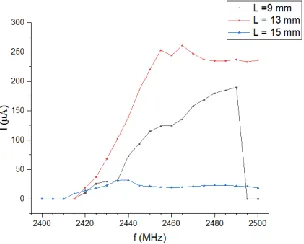
The influence of the length of coupling loop on the value of extracted current was investigated. Three additional loops were made (9, 13 and 15 mm) to establish overcoupling mode of communication with the resonator (Qex <Qo) [5]. Overcoupling regime is more preferable, since the quality factor of the plasma loaded resonator differs from the intrinsic quality factor of the "empty" resonator, therefore, in the critical coupling mode when the discharge is ignited in the source chamber, the Q factor of the resonator decreases, the Voltage Standing Wave Ratio (VSWR) increases and strong reflections arise. Unfortunately, it is nearly impossible to numerically determine the deviation of the intrinsic Q factor from the loaded one using mathematical modelling because of complexity of the processes taking place in the plasma. Therefore, the loops were alternately tested at the source.
The dependence of the He ion current on the generator frequency was measured for different coupling loop length (Fig. 4). The pressure in the beam line was maintained at the level of ~ 10-6 torr, extraction voltage U = 8.8 kV, microwave power P = 60 W. The
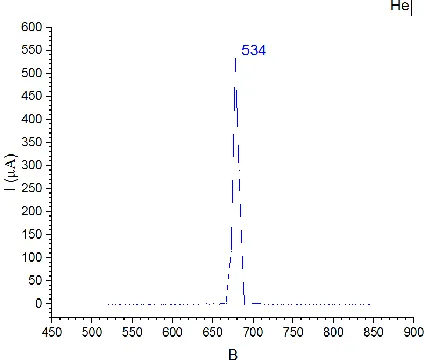
Spectra of helium (Fig. 5) and hydrogen (Fig. 6) were measured by using analyzing magnet. During the experiment, the frequency was maintained at the value of 2450 MHz, injected power P = 60 W, the pressure P = 3×10⁻⁶ torr, extraction voltage U = 8.9 kV.
Spectra of hydrogen contains 3.2% of atomic ions (protons), 82.5% of diatomic and 14.3% of triatomic ions, which is typical for such a low power of 60 W. Spectra of helium contains only 1+ ions. The magnetic induction of the analysing magnet is indicated in relative units in figures below.
Fig. 5. Spectrum of helium ions at 2450 MHz, 60 W and Ø2 mm extraction hole.
Fig. 6. Spectrum of hydrogen ions at 2450 MHz, 60 W and Ø2 mm extraction hole.
previous value. By this means, extracted current of He+ ions increased from 259 µA to 534 µA (Fig. 7), total current density j = 7.5 mA/ cm2.
Fig. 7. Spectrum of helium ions with the diameter of extraction hole 3 mm.
Conclusions
By increasing the extraction voltage, extraction hole diameter and altering the length of coupling loop we were able to achieve rather high value of extracted ion current of ~500
µA of helium. This value can be considered high enough for the wide spectra of tasks. Although, this value of current can be increased furthermore by placing the source on adjustment platform for precise positioning or optimizing the optical extraction system. In future we are planning to apply some well-known and widely used ECR techniques to increase output current (for example, bias-electrode).
Obtained spectra of hydrogen atoms from this compact source contains large amount of diatomic ions of hydrogen. This can be used for advantage in experiments, where diatomic ions are considered valuable.
References
1. R. Geller, Electron Cyclotron Resonance Ion Source and ECR Plasmas (Bristol, Institute for Physics Publishing, 1996)
2. P. Jardin et al. Nucl. Instr. Meth. Phys. Res. B 204, 377–381 (2003)
3. R. Fatkullin, S. Bogomolov, Design of the coaxial resonator for ion source, (Dubna, Russia, 2016) http://students.jinr.ru/en/jinr2016-participants
4. R. Fatkullin, S. Bogomolov, K. Kuzmenkov and A. Efremov EPJ Web Conf. 177, 08003 (2018)