Efficient CCA-secure Threshold Public-Key Encryption
Scheme
Xi-Jun Lin ∗and Lin Sun† November 13, 2013
Abstract: In threshold public-key encryption, the decryption key is divided into n
shares, each one of which is given to a different decryption user in order to avoid single points of failure. In this study, we propose a simple and efficient non-interactive threshold public-key encryption scheme by using the hashed Diffie-Hellman assumption in bilinear groups. Compared with the other related constructions, the proposed scheme is more efficient.
Key words: Threshold public-key encryption; Chosen-ciphertext security; Hashed Diffie-Hellman assumption; CCA-secure
1
Introduction
In a threshold public-key encryption scheme, the private key corresponding to a public key is shared among a set of n decryption users. In such a scheme, a message is encrypted and sent to a group of decryption users, in such a way that the cooperation of at least t
of them (where t is the threshold) is necessary in order to recover the original message. Moreover, no information about the message is leaked, even if the number of the corrupted users is up to t−1. Such schemes have many applications in situations where one cannot fully trust a unique person, but possibly a pool of individuals, such as electronic voting, electronic auctions, key-escrow, etc.
In a non-interactive threshold public-key encryption scheme, no communication is need-ed amongst the decryption users performing the partial decryptions. Furthermore, such schemes are often required to be robust in that if threshold decryption of a valid ciphertext fails, the combiner can identify the decryption users who supply invalid partial decryp-tion shares. Recently, we have seen many studies of such schemes in the crypto/security community [1, 3, 5, 7, 8].
In this study, we propose a more efficient non-interactive threshold public-key encryption scheme than the other related constructions, and the proposed scheme is proved to be CCA-secure under the hashed Diffie-Hellman (HDH) assumption in bilinear groups [2, 5].
In the proposed scheme, the decryption user needs to verify the ciphertext C before attempting to generate its partial decryption share. This validity check which is performed using two exponentiations in groupGis more efficient than that in the other related
construc-∗X.J.Lin is with the Department of Computer Sciences and Technology, Ocean University of China.
Qingdao 266100, P.R.China. email: [email protected]
†L. Sun is with the College of Liberal Arts, Qingdao University. Qingdao 266071, P.R.China. email:
tions in which the pairing computation is employed. Moreover, each of partial decryption share will be verified before running Combinealgorithm.
The rest of this paper is organized as follows: After recalling the relevant technical definitions in the next section, the definitions and the security models of the threshold public-key encryption scheme are given in Section 3. In Section 4 and Section 5, we propose a more efficient non-interactive threshold public-key encryption scheme based on HDH assumption in bilinear groups, and then prove its security. Furthermore, the comparisons with the related constructions are given in Section 6 which is followed by the last section to conclude our works.
2
Preliminaries
2.1 Bilinear Pairing
Let G be an additive group of prime order p, F be a multiplicative group of the same order. Bilinear pairing is a map ˆe:G × G → F which satisfies the following properties:
• Bilinearity: given any g, h ∈ G and a, b ∈ Z∗p, we have ˆe(ga, gb) = ˆe(g, g)ab = ˆ
e(gab, g), etc.
• Non-Degeneracy: There exists ag∈ G such that ˆe(g, g)̸= 1. • Computability: ˆe(g, h) can be computed in polynomial time.
2.2 HDH Assumption
LetG be a group of prime orderp and g be a generator ofG. LetH be a one-way hash function H :G → {0,1}l. LetA be an adversary. We define HDH advantage of A against G at a security parameter λas
AdvAHDH,G (λ) =|P r[A(g, ga, gb, H(gab)) = 1]−P r[A(g, ga, gb, T ∈R{0,1}l) = 1]|.
The HDH assumption is that for every polynomial-time adversary A, the function
AdvAHDH,G (λ) is negligible.
2.3 Lagrange Interpolation
Letf(x) =∑tj−=01ajxj be a polynomial overZp with degreet−1 wherep is a prime, and
let (x1, f(x1)),(x2, f(x2)),· · · ,(xt, f(xt)) be tdistinct points overf(x).
Then, given (x1, f(x1)),(x2, f(x2)),· · · ,(xt, f(xt)), f(x) can be reconstructed as follows
f(x) =f(x1)λxx1+f(x2)λ
x
x2 +· · ·+f(xt)λ
x xt, where
λxxj = (x−x1)· · ·(x−xj−1)(x−xj+1)· · ·(x−xt) (xj−x1)· · ·(xj −xj−1)(xj−xj+1)· · ·(xj−xt)
for any 1≤j≤t.
3
Definitions
We follow the notation of CCA-secure threshold public-key encryption scheme from [5]. A threshold public-key encryption scheme consists of six algorithms.
1. Setup(n, t, λ): Takes as input the number of decryption users n, a threshold t , where 1 ≤ t ≤ n, a security parameter λ ∈ Z. It outputs a triple (P K, SK, V K), where P K is the public key, SK = (SK1,· · ·, SKn) is a vector of n secret keys
and V K = (V K1,· · ·, V Kn) is the corresponding vector of verification keys. The
verification keyV Kiis used to check the validity of partial decryption shares generated
by using SKi. The secret keySKi is secretly given to theith user, fori= 1,· · · , n.
2. Encrypt(P K, M): Takes as input the public key P K and a message M to be en-crypted. It outputs ciphertext C.
3. ValidateCT(P K, C): Takes as input the public keyP K, and ciphertextC. It checks whether C is a valid ciphertext with respect to P K.
4. ShareDecrypt(P K, i, SKi, C): Takes as input the public key P K, ciphertext C,
a decryption user i and its secret key SKi. It outputs a partial decryption share
σi= (i, ϑi), or a special symbol (i,⊥) if C is invalid.
5. ShareVerify(P K, V Ki, C, σi): Takes as input the public key P K, the verification
key V Ki, as well as ciphertext C and partial decryption share σi. It checks whether
σi is a valid partial decryption share with respect toV Ki and C.
6. Combine(P K, V K, C,Ω): Takes as input the public key P K, the verification key
V K, as well as ciphertext C, and Ω = (σ1,· · ·, σt) a list of t partial decryption
shares. It outputs plaintext M or⊥.
We require, for all ciphertextC,ShareVerify(P K, V Ki, C,ShareDecrypt(P K, i, SKi,
C)) = valid. In addition, let Ω = (σ1,· · · , σt) be t distinct valid decryption shares of C,
where C=Encrypt(P K, M), then we require Combine(P K, V K, C,Ω) =M.
Security against chosen ciphertext attack is defined using the following game between an adversaryAand a challengerR, and both of them are given as input the system parameters
n, t, λ∈Nwith t≤n.
• Init: The adversary A outputs a set S ⊂ {1,· · · , n} of t−1 decryption users to corrupt.
• Setup: The challengerRrunsSetup(n, t, λ)algorithm to obtain a triple (P K, SK, V K), whereSK = (SK1,· · ·, SKn) andV K = (V K1,· · · , V Kn). It givesP K, V K and all
(j, SKj) (where j∈S) to adversaryA.
• Phase 1: Adversary A adaptively issues ShareDecrypt queries with (i, C), where
i∈ {1,· · · , n} and C∈ {0,1}∗.
Challenger Rruns the ShareDecrypt algorithm using C, SKi to get σi , and gives
• Challenge: AdversaryAoutputs two equal length messagesM0 andM1. Challenger
Rpicks a random bit δ ∈ {0,1}, and sendsC∗ =Encrypt(P K, Mδ) to adversary A.
• Phase 2: Adversary A makes further queries as in Phase 1 but is not allowed to make ShareDecrypt queries on C∗.
• Guess: Finally, adversary Aoutputs a guess δ′∈ {0,1}and wins the game if δ=δ′.
4
The Proposed Scheme
4.1 Construction
• Setup(n, t, λ): The trust center generates the system parameters (p,G,F,eˆ) by run-ning the group generator algorithm. It then does the following:
1. Pick two generators g, X ∈RG.
2. Pick two hash functions H1 andH2, whereH1 :{0,1}l× G × G →Z∗p is a secure
hash function andH2 :G → {0,1}l is a random instance of a hash function such
that the HDH assumption holds in bilinear groups.
3. Pick a random polynomial f(x) = a+∑tj−=11ajxj with degree t− 1 (where
a, a1,· · · , at−1∈RZ∗p ,tis the value of threshold).
4. Compute SKi =f(i) andV Ki =Xf(i), for i= 1,· · · , n.
5. Let g1 =ga.
6. Publish system parameters P K = (p,G,F,ˆe, g, g1, X, H1, H2) and verification
key V K = (V K1,· · · , V Kn). Secret key SKi is given to user i privately, for
i= 1,· · · , n.
• Encrypt(P K, M): To encrypt M ∈ {0,1}l , this algorithm picks k, r ∈
R Z∗p, and
computes
C0 =M ⊕H2(gk1),
C1 =gk, C2 =gr,
β=kH1(C0, C1, C2) +r (modp−1).
The output is C= (C0, C1, C2, β).
• ValidateCT(P K, C): To validate ciphertext C = (C0, C1, C2, β), this algorithm
checks whether
gβ =C2·C1H1(C0,C1,C2).
• ShareDecrypt(P K, i, SKi, C): Decryption user i uses its secret key SKi = f(i) to
partially decrypt ciphertext C= (C0, C1, C2, β) as follows:
1. Run ValidateCT(P K, C) algorithm to check whether or not C is a valid ci-phertext. If the verification fails, it outputs σi = (i,⊥);
• ShareVerify(P K, V Ki, C, σi): To verify a partial decryption share σi with respect
to ciphertext C = (C0, C1, C2, β) under verification key V Ki, this algorithm firstly
runs ValidateCT(P K, C) to check whetherC is a valid ciphertext. If C and σi are
well formed, it checks whether the following equation holds:
ˆ
e(ϑi, X) = ˆe(C1, V Ki).
• Combine(P K, V K, C,{σ1,· · · , σt}): To decrypt ciphertextC = (C0, C1, C2, β) using
the partial decryption shares {σ1,· · ·, σt}, this algorithm firstly checks whether σi =
(i, ϑi) is valid by running ShareVerify(P K, V Ki, C, σi), for i = 1,· · ·, t. Then, it
performs as follows:
1. Determine the Lagrange coefficients (λ01, λ02,· · · , λ0t)∈Ztq, and then compute
µ=
t
∏
i=1
(ϑi)λ
0
i.
2. Compute and output M =C0⊕H2(µ) to decryptC = (C0, C1, C2, β) withµ.
4.2 Correctness
If the ciphertextC = (C0, C1, C2, β) and partial decryptions {σ1,· · ·, σt} are valid, the
Combine algorithm will output the correct plaintext.
µ = ∏ti=1(ϑi)λ
0
i
= ∏ti=1(C1f(i))λ0i
= C
∑t
i=1f(i)λ0i
1
= C1f(0)
= C1a,
C0⊕H2(µ) = C0⊕H2(C1a)
= C0⊕H2((gk)a)
= C0⊕H2(gk1)
= (M ⊕H2(g1k))⊕H2(gk1)
= M.
5
Security
Theorem 1 Assume that H1 is a random oracle and H2 is a random instance of a hash function such that the HDH assumption holds in bilinear groups. Suppose that there exists a polynomial time adversary A that breaks chosen-ciphertext security of the proposed scheme with non-negligible advantage. We show that there exists an algorithm B that runs in poly-nomial time and runs adversary Aas a subroutine to break the HDH assumption in bilinear groups.
If T is equal to H2(gab), B outputs 1; otherwise, it outputs 0. Set g1 =ga. B performs by
interacting with the adversaryA in the following game:
• Init: The adversary A chooses a set S of t−1 decryption users that it wants to corrupt. Without loss of generality, we let S={1,· · · , t−1} ⊂ {1,· · ·, n}.
• Setup: B does as follows:
1. Pick x ∈R Z∗p and compute X =gx, and then give (p,G,F,e, g, gˆ 1, X) to A as
the system parameters. Two lists H1-list and H2-list are maintained by B to
answerH1 oracle queries andH2 oracle queries, respectively.
2. Pick integers ai ∈R Z∗p where i= 1,· · · , t−1. Note that there exists an
inter-polation polynomial f(x) with degree t−1, such that f(0) = a and f(i) = ai.
However,Bdoes not knowf(x) since it does not knowa. Bgives thet−1 secret keysSKi =f(i) =ai toA.
3. Construct the verification key V K = (V K1,· · ·, V Kn) as follows:
(a) Fori∈S,V Ki=Xai sincef(i) =ai which is known toB.
(b) For i /∈S, B computes the Lagrange coefficients λi0, λ1i,· · ·, λit−1 ∈Zp, and
setsV Ki =g xλi
0
1 Xa1λ
i
1· · ·Xat−1λ
i
t−1. We claim that V Ki is a valid
verifica-tion key of the decrypverifica-tion useri. To verify the correctness, we have that
V Ki = g xλi
0
1 Xa1λ
i
1· · ·Xat−1λ
i t−1
= Xaλi0Xa1λi1· · ·Xat−1λit−1
= Xaλi0+a1λi1+···+at−1λit−1
= Xf(0)λi0+f(1)λi1+···+f(t−1)λit−1
= Xf(i)
B gives the verification keyV K to the adversaryA. • Phase 1: A can adaptively issue the following queries:
– H1-query: After receiving (C0, C1, C2) fromA,Bperforms as follows:
If there exists an item [C0, C1, C2, h1] in the H1-list with respect to (C0, C1, C2),
B responds withh1; otherwise,B picksh1∈RZ∗p, stores [C0, C1, C2, h1] into the
H1-list and responds with h1.
– H2-query: After receiving γ fromA,B performs as follows:
If there exists an item [γ, h2] in theH2-list with respect toγ,Bresponds withh2;
otherwise, B computes h2 =H2(γ), stores [γ, h2] into the H2-list and responds
withh2.
– ShareDecrypt-query: A issues decryption queries of the form (i, C), where C = (C0, C1, C2, β) and i∈ {1,· · · , n}. For each such decryption query, B performs
as follows:
1. Check whether gβ =C2·C1H1(C0,C1,C2). If not, respond with σi = (i,⊥);
2. Otherwise, perform as follows:
If i∈S, compute ϑi =C1ai. Then, we have that ϑi =C1f(i) sincef(i) = ai
If i /∈S, compute the Lagrange coefficients λi0, λi1,· · · , λit−1 ∈ Zp. Suppose
C1=gk. SinceH2 is a random oracle, the probability of computing H2(gk1)
without issuing H2-query is negligible. Then, we claim that there exists
an item [γ = g1k = gak, H2(γ)] in the H2-list if the equation ˆe(ϑi, X) =
ˆ
e(C1, V Ki) holds, where ϑi = γλ
i
0C ∑t−1
j=1ajλij
1 . The correctness is given as
follows: Forϑi=γλ
i
0C ∑t−1
j=1ajλ
i j
1 , we have the following two equations:
ˆ
e(ϑi, X) = eˆ(γλ
i
0C ∑t−1
j=1ajλij
1 , X)
ˆ
e(C1, V Ki) = eˆ(C1, Xf(i))
= eˆ(C1f(i), X) = eˆ(Caλ
i
0+ ∑t−1
j=1ajλ
i j
1 , X)
= eˆ(Caλi0
1 C
∑t−1
j=1ajλij
1 , X)
= eˆ((gk1)λi0C ∑t−1
j=1ajλij
1 , X)
Then, the equationγ =g1k=gak holds.
B sends σi = (i, ϑi) to A. We claim that σi is a valid partial decryption
about C= (C0, C1, C2, β). To verify the correctness, we have that
ϑi = γλ
i
0C ∑t−1
j=1ajλij
1
= (gk1)λi0C ∑t−1
j=1ajλij
1
= (gak)λi0C ∑t−1
j=1ajλij
1
= (gk)aλi0C ∑t−1
j=1ajλij
1
= Caλ
i
0+ ∑t−1
j=1ajλ
i j
1
= C1f(i)
• Challenge: A outputs two equal length messagesM0 and M1 on which it wishes to
be challenged. B picksδ ∈R{0,1} and β∗∈RZ∗p, and computes as follows:
C0∗ =Mδ⊕T, C1∗=gb, C2∗ =gβ
∗
/(gb)H1(C0∗,C1∗,C2∗).
If T = H2(gab) =H2((ga)b), the challenge ciphertext C∗ = (C0∗, C1∗, C2∗, β∗) given to
the adversary Ais a valid ciphertext onMδ. To verify the correctness, we have that
C0∗ = Mδ⊕T
= Mδ⊕H2((ga)b)
= Mδ⊕H2(g1b)
C1∗ = gb
C2∗ = gβ∗/(gb)H1(C0∗,C1∗,C2∗)
= gβ∗−bH1(C0∗,C1∗,C2∗)
where r=β∗−bH1(C0∗, C1∗, C2∗) , i.e. β∗ =bH1(C0∗, C1∗, C2∗) +r.
• Phase 2: A continues to issue further decryption queries (i, C) under the constraint that C̸=C∗.
• Guess: Eventually,Aoutputs a guess bit δ′ ∈ {0,1} forδ. Bconcludes its own game by outputting a guess as follows.
If δ′ = δ, B outputs 1 meaning that T = H2(gab); otherwise, it outputs 0 meaning
T ̸=H2(gab).
We can see that B can break the HDH assumption in bilinear groups with
non-negligible advantage in polynomial time if A wins the game. 2
6
Comparisons
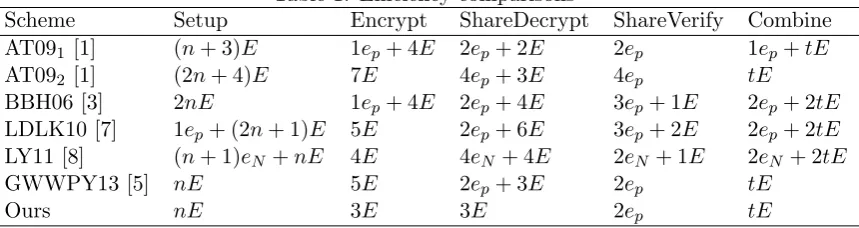
The comparison with other related constructions [1, 3, 5, 7, 8] is given in Table 1, where AT091 and AT092 denote two constructions, TPKE1 and TPKE2 in [1], respectively. Let
eN denote the pairing with composite order N = p1p2p3, which is about 50 times of that
for computing ep which denotes the pairing with prime orderp [4]. LetE denote the
expo-nentiation over finite fields which is more efficient than the pairing computation. The time of executing the ValidateCT algorithm in the ShareVerify algorithm is not counted, since the time of checking the validity of ciphertext is included in the ShareDecryptalgorithm.
With the comparison, we claim that the proposed scheme is more efficient than the other related constructions, especially inEncrypt and ShareDecrypt.
Table 1: Efficiency comparisons
Scheme Setup Encrypt ShareDecrypt ShareVerify Combine
AT091 [1] (n+ 3)E 1ep+ 4E 2ep+ 2E 2ep 1ep+tE
AT092 [1] (2n+ 4)E 7E 4ep+ 3E 4ep tE
BBH06 [3] 2nE 1ep+ 4E 2ep+ 4E 3ep+ 1E 2ep+ 2tE
LDLK10 [7] 1ep+ (2n+ 1)E 5E 2ep+ 6E 3ep+ 2E 2ep+ 2tE
LY11 [8] (n+ 1)eN+nE 4E 4eN + 4E 2eN + 1E 2eN + 2tE
GWWPY13 [5] nE 5E 2ep+ 3E 2ep tE
Ours nE 3E 3E 2ep tE
7
Conclusions
In this study, we proposed a simple and efficient non-interactive threshold public-key encryption scheme based on the HDH assumption in bilinear groups, and proved its security. Compared with the other related constructions, the proposed scheme is more efficient.
References
[2] M.Abdalla, M.Bellare and P. Rogaway. The oracle Diffie-Hellman assumptions and an analysis of DHIES. CT-RSA’01. 2001. pp: 143-158.
[3] D.Boneh, X.Boyen and S.Halevi. Chosen Ciphertext Secure Public Key Threshold En-cryption Without Random Oracles. CT-RSA’06. 2006. pp: 226-243.
[4] D.Freeman. Converting Pairing-Based Cryptosystems from Composite-order Groups to Prime-order Groups. EUROCRYPT’10. 2010. pp:44-61.
[5] Y.Gan, L.Wang, L.Wang, P.Pan and Y.Yang. Efficient Construction of CCA-Secure Threshold PKE Based on Hashed Diffie-Hellman Assumption. The Computer Journal. 2013.56(10).pp:1249-1257.
[6] E.Kiltz. Chosen-Ciphertext Secure Key-Encapsulation Based on Gap Hashed Diffie-Hellman. PKC’07. pp: 282-297.
[7] J.Lai, R.Deng, S.Liu and W.Kou. Efficient CCA-Secure PKE from Identity-Based Tech-niques. CT-RSA’10.2010. pp: 132-147.
[8] B.Libert and M.Yung. Adaptively Secure Noninteractive Threshold Cryptosystems. I-CALP’11.2011. pp: 588-600.