R E S E A R C H
Open Access
Global behavior of the solutions of some
difference equations
Elmetwally M Elabbasy
1*, Hamdy A El-Metwally
2,4and Elsayed M Elsayed
3,4* Correspondence: [email protected]
1Mathematics Department, Faculty
of Science, Mansoura University, Mansoura 35516, Egypt Full list of author information is available at the end of the article
Abstract
In this article we study the difference equation
xn+1=
axn−lxn−k bxn−p−cxn−q
, n = 0, 1, . . .,
where the initial conditionsx-r, x-r+1, x-r+2,...,x0 are arbitrary positive real numbers,r= max{l,k, p, q} is nonnegative integer anda, b,care positive constants: Also, we study some special cases of this equation.
Keywords:Stability, Solutions of the difference equations
1 Introduction
The purpose of this article is to investigate the global attractivity of the equilibrium point, and the asymptotic behavior of the solutions of the following difference equation
xn+1=
axn−lxn−k bxn−p−cxn−q
, n = 0, 1, . . ., (1)
where the initial conditionsx-r,x-r+1,x-r+2,...,x0 are arbitrary positive real numbers,r
= max{l,k,p,q} is nonnegative integer anda,b,care positive constants: Moreover, we obtain the form of the solution of some special cases of Equation 1 and some numeri-cal simulations to the equation are given to illustrate our results.
Let us introduce some basic definitions and some theorems that we need in the sequel.
LetIbe some interval of real numbers and let
f :Ik+1→I,
be a continuously differentiable function. Then for every set of initial conditionsx-k, x-k+1,...,x0ÎI, the difference equation
xn+1=f(xn, xn−1, . . ., xn−k), n= 0, 1, . . ., (2)
has a unique solution{xn}∞n=−k[1].
A pointx¯∈Iis called an equilibrium point of Equation 2 if
¯
x=f(x¯, x¯, . . ., x¯).
That is, xn=x¯forn≥0, is a solution of Equation 2, or equivalently,x¯ is a fixed point
off.
Definition 1(Stability)
(i) The equilibrium point x¯ of Equation 2 is locally stable if for everyε>0, there exists δ>0 such that for allx-k,x-k+1,...,x-1,x0 ÎIwith
|x−k− ¯x|+|x−k+1− ¯x|+· · ·+|x0− ¯x|< δ,
we have
|xn− ¯x|< ε for all n≥ −k.
(ii) The equilibrium point x¯ of Equation 2 is locally asymptotically stable if ¯x is locally stable solution of Equation 2 and there exists g>0, such that for allx-k,x-k+1,..., x-1,x0Î Iwith
|x−k− ¯x|+|x−k+1− ¯x|+. . .+|x0− ¯x|< γ,
we have
lim n→∞xn=x¯.
(iii) The equilibrium pointx¯ of Equation 2 is global attractor if for allx-k,x-k+1,...,x-1, x0ÎI, we have
lim n→∞xn=x¯.
(iv) The equilibrium point x¯ of Equation 2 is globally asymptotically stable if x¯ is locally stable andx¯ is also a global attractor of Equation 2.
(v) The equilibrium pointx¯ of Equation 2 is unstable ifx¯is not locally stable. The linearized equation of Equation 2 about the equilibriumx¯ is the linear difference equation
yn+1=
k
i=0
∂f(x¯,x¯,. . .,x¯) ∂xn−i
yn−i. (3)
Theorem A [2]
Assume that p,qÎ Rand kÎ{0, 1, 2,...}. Then
|p|+|q|<1,
is a sufficient condition for the asymptotic stability of the difference equation
xn+1+pxn+qxn−k= 0, n = 0, 1, . . ..
Remark 1 Theorem A can be easily extended to a general linear equations of the
form
xn+k+p1xn+k−1+. . .+pkxn= 0, n= 0, 1, . . ., (4)
where p1, p2,..., pkÎ R and k Î {1, 2,...}. Then Equation 4 is asymptotically stable provided that
k
i=1
Definition 2
(Fibonacci Sequence) The sequence{Fm}∞m=0={1, 2, 3, 5, 8, 13, . . .}i.e. Fm= Fm-1+Fm-2, m≥0,F-2 = 0,F-1 = 1is called Fibonacci Sequence.
The nature of many biological systems naturally leads to their study by means of a discrete variable. Particular examples include population dynamics and genetics. Some elementary models of biological phenomena, including a single species population model, harvesting of fish, the production of red blood cells, ventilation volume and blood CO2 levels, a simple epidemics model and a model of waves of disease that can
be analyzed by difference equations are shown in [3]. Recently, there has been interest in so-called dynamical diseases, which correspond to physiological disorders for which a generally stable control system becomes unstable. One of the first papers on this sub-ject was that of Mackey and Glass [4]. In that paper they investigated a simple first order difference-delay equation that models the concentration of blood-level CO2.
They also discussed models of a second class of diseases associated with the produc-tion of red cells, white cells, and platelets in the bone marrow.
The study of the nonlinear rational difference equations of a higher order is quite challenging and rewarding, and the results about these equations offer prototypes towards the development of the basic theory of the global behavior of nonlinear differ-ence equations of a big order, recently, many researchers have investigated the beha-vior of the solution of difference equations for example: Elabbasy et al. [5] investigated the global stability, periodicity character and gave the solution of special case of the following recursive sequence
xn+1=axn− bxn cxn−dxn−1
.
Elabbasy et al. [6] investigated the global stability, boundedness, periodicity character and gave the solution of some special cases of the difference equation
xn+1= αxn−k β+γki=0xn−i
.
Elabbasy et al. [7] investigated the global stability character, boundedness and the periodicity of solutions of the difference equation
xn+1=αxn
+βxn−1+γxn−2 Axn+Bxn−1+Cxn−2 .
El-Metwally et al. [8] investigated the asymptotic behavior of the population model:
xn+1=α +βxn−1e−xn,
whereais the immigration rate andbis the population growth rate.
Yang et al. [9] investigated the invariant intervals, the global attractivity of equili-brium points and the asymptotic behavior of the solutions of the recursive sequence
xn+1=
Cinar [10,11] has got the solutions of the following difference equations
Aloqeili [12] obtained the form of the solutions of the difference equation
xn+1=
xn−1 a−xnxn−1
.
Yalçinkaya [13] studied the following nonlinear difference equation
xn+1=α + xn−m
xk n
.
For some related work see [1-29].
The article proceeds as follows. In Sect. 2 we show that when 2a|b-c| + a(b +c)<
(b - c)2, then the equilibrium point of Equation 1 is locally asymptotically stable. In Sect. 3 we prove that the equilibrium point of Equation 1 is global attractor. In Sect. 4 we give the solutions of some special cases of Equation 1 and give a numerical exam-ples of each case and draw it by using Matlab 6.5.
2 Local stability of Equation 1
In this section we investigate the local stability character of the solutions of Equation 1. Equation 1 has a unique positive equilibrium point and is given by
x= ax
The linearized equation of Equation 1 aboutx¯ is
Theorem 1
Assume that
a(3ζ−η)<(b−c)2,
where ζ= max{b, c}, h= min{b, c}. Then the equilibrium point of Equation 1 is locally asymptotically stable.
Proof: It is follows by Theorem A that Equation 6 is asymptotically stable if
(b−a c)+ a (b−c)
+ ab
(b−c)2
+ ab
(b−c)2 <1,
or
(b2−ac)+a(b+c) (b−c)2 <1,
and so
2a|b−c|+a(b+c)<(b−c)2.
The proof is complete.
3 Global attractivity of the equilibrium point of Equation 1
In this section we investigate the global attractivity character of solutions of Equation 1.
We give the following two theorems which is a minor modification of Theorem A.0.2 in [1].
Theorem 2
Let [a,b] be an interval of real numbers and assume that
f : [a, b]k+1→[a, b],
is a continuous function satisfying the following properties:
(i)f(x1,x2,....,xk+1) is non-increasing in one component (for examplext) for eachxr(r ≠t) in [a, b] and non-decreasing in the remaining components for eachxtin [a,b].
(ii) If(m, M)∈[a, b]×[a, b]is a solution of the system
M =f(M,M,...,M,m,M,...,M,M) andm=f(m,m,...,m,M,m,...m,m) implies
m=M.
Then Equation 2 has a unique equilibrium x¯∈[a, b]and every solution of Equation 2 converges tox¯
Proof: Set
m0=aandM0=b,
and for each i= 1, 2,...set
mi=f(mi−1, mi−1, . . ., mi−1, Mi−1, mi−1, . . ., mi−1, mi−1),
and
Now observe that for eachi≥0,
a =m0≤m1≤. . .≤mi≤. . .≤Mi≤. . .≤M1≤M0=b,
and
mi≤xp≤Miforp≥(k+ 1)i+ 1.
Set
m= lim
x→∞miandM= limi→∞Mi.
Then
M≥ lim
i→∞supxi≥lim infi→∞xi≥m
and by the continuity off,
M =f(M,M,...,M,m,M,...,M,M) andm=f(m,m,...,m,M,m,...m,m). In view of (ii),
m=M=x¯,
from which the result follows.
Theorem 3
Let [a,b] be an interval of real numbers and assume that
f : [a, b]k+1→[a, b],
is a continuous function satisfying the following properties:
(i) f(x1,x2,...,xk+1) is non-increasing in one component (for examplext) for eachxr(r ≠t) in [a, b] and non-increasing in the remaining components for eachxtin [a,b].
(ii) If (m,M)Î[a,b] × [a,b] is a solution of the system
M =f(m,m,...,m, M,m,...m,m) andm=f(M,M,...,M,m,M,...,M,M)’implies
m=M.
Then Equation 2 has a unique equilibrium x¯∈[a, b]and every solution of Equation 2 converges tox¯
Proof: As the proof of Theorem 2 and will be omitted.
Theorem 4
The equilibrium pointx¯ of Equation 1 is global attractor ifc≠a.
Proof: Letp,qare a real numbers and assume that f : [p, q]4→[p, q]be a function
defined by Equation 5, then we can easily see that the functionf(u,v,w,s) increasing insand decreasing inw.
Case (1) If bw-cs> 0, then we can easily see that the functionf(u,v,w,s) increasing in u,v, sand decreasing inw.
Suppose that (m,M) is a solution of the system
M =f(m,m,M,m) andM=f(M,M,m,M). Then from Equation 1, we see that
m= am
2
bM = cm+am, bm=cM+aM,
then
(M−m)(b+c+a) = 0.
Thus
M=m.
It follows by Theorem 2 thatx¯ is a global attractor of Equation 1 and then the proof is complete.
Case (2) Ifbw-cs< 0, then we can easily see that the function f(u,v, w,s) decreasing inu,v,wand increasing ins.
Suppose that (m,M) is a solution of the system
M =f(m,m,m,M) andm=f(M,M,M,m). Then from Equation 1, we see that
M = am
2
bm−cM, m= aM2 bM−cm,
bmM−cM2 = am2, bmM−cm2=aM2,
then
(M2−m2)(c−a) = 0, a =c.
Thus,
M=m.
It follows by the Theorem 3 that x¯ is a global attractor of Equation 1 and then the proof is complete.
4 Special cases of Equation 1 4.1 Case (1)
In this section we study the following special case of Equation 1
xn+1=
xnxn−1 xn−xn−1
, (7)
where the initial conditionsx-1,x0are arbitrary positive real numbers.
Theorem 5
Let{xn}∞n=−1be a solution of Equation 7. Then forn= 0, 1,...
xn=
(−1)nhk Fn−1k−Fn−2h
,
wherex-1=k,x0=handFn-1, Fn-2 are the Fibonacci terms.
Proof: Forn= 0 the result holds. Now suppose thatn> 0 and that our assumption holds forn-1,n-2. That is;
xn−2=
(−1)n−2hk Fn−3k−Fn−4h
, xn−1=
(−1)n−1hk Fn−2k−Fn−3h
Now, it follows from Equation 7 that
Hence, the proof is completed.
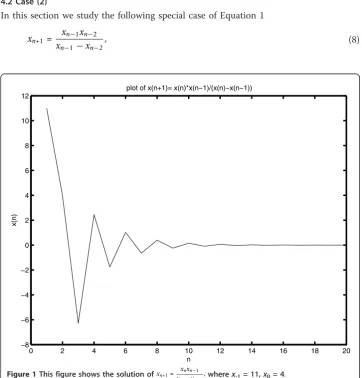
For confirming the results of this section, we consider numerical example for x-1=
11, x0 = 4 (see Figure 1), and forx-1 = 6,x0 = 15 (see Figure 2), since the solutions
take the forms {6, -12, 4, -3, 1.714286, -1.090909, .6666667, -.4137931, .2553191,....}, {-60, 10, -8.571428, 4.615385, -3, 1.818182, -1.132075, .6976744,...}.
4.2 Case (2)
In this section we study the following special case of Equation 1
xn+1=
Figure 1This figure shows the solution ofxn+1= xnxn−1 xn−xn−1
where the initial conditionsx-2,x-1, x0are arbitrary positive real numbers.
Proof: Forn= 1, 2 the result holds. Now suppose thatn > 1 and that our assump-tion holds for n- 1,n- 2. That is;
Figure 2This figure shows the solution ofxn+1=
xnxn−1
xn−xn−1
Hence, the proof is completed.
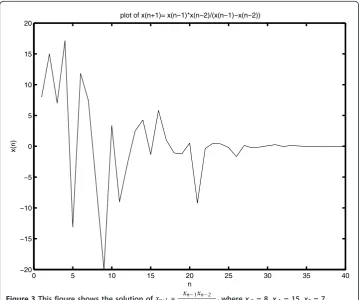
Assume thatx-2= 8,x-1= 15, x0 = 7, then the solution will be {17.14286, -13.125,
11.83099, 7.433628, -6.222222, -20, 3.387097, -9.032259,...}(see Figure 3). The proof of following cases can be treated similarly.
4.3 Case (3)
Let x-2=r,x-1 =k,x0=h,
−1 i=0
Ai= 1andF2i-1,F2i, F2i+1(wherei= 0to n) are the
Fibo-nacci terms. Then the solution of the difference equation
xn+1=
xn−1xn−2 xn−xn−2
, (9)
is given by
x2n= h
n−1
i=0
(F2i−1h−F2ir)
n−1
i=0
(F2i+1r−F2ih)
,x2n+1= kr
n−1
i=0
(F2i+1r−F2ih)
n i=0
(F2i−1h−F2ir)
,n= 0, 1, ... .
Figure 4 shows the solution when x-2= 9,x-1= 12, x0= 17.
0 5 10 15 20 25 30 35 40
−20 −15 −10 −5 0 5 10 15 20
n
x(n)
plot of x(n+1)= x(n−1)*x(n−2)/(x(n−1)−x(n−2))
Figure 3This figure shows the solution ofxn+1=
xn−1xn−2
xn−1−xn−2
4.4 Case (4)
Let x-2=r,x-1 =k,x0=h. Then the solution of the following difference equation
xn+1=
xn−1xn
xn−xn−2 (10)
is given by
x2n−1=
h h−r
n
k, x2n= hn+1
rn , n = 0, 1, . . . .
Figure 5 shows the solution when x-2= 21,x-1= 6,x0 = 3.
4.5 Case (5)
Let x-2=r,x-1=k,x0 =h. Then the solution of the following difference equation
xn+1=
xn−1xn xn−1−xn−2
, (11)
is given by
x4n=
h(hk)2n
(rk(h−k)(k−r))n,x4n+1=
(hk)2n+1 (rk(h−k))n(k−r)n+1,
x4n+2=
h(hk)2n+1
((h−k)(k−r))n+1(rk)n,x4n+3=
(hk)2n
(r(h−k)(k−r))n+1kn,n = 0, 1, . . . .
Figure 6 shows the solution when x-2= 9,x-1= 5,x0= 4.
0 5 10 15 20 25 30
−200 −150 −100 −50 0 50 100 150
n
x(n)
plot of x(n+1)= x(n−1)*x(n−2)/(x(n)−x(n−2))
Figure 4This figure shows the solution ofxn+1=
xn−1xn−2
1 2 3 4 5 6 7 8 9 10 −5
0 5 10 15 20 25
n
x(n)
plot of x(n+1)= x(n)*x(n−1)/(x(n)−x(n−2))
Figure 5This figure shows the solution ofxn+1=
xn−1xn
xn−xn−2,wherex-2= 21,x-1= 6,x0= 3.
0 10 20 30 40 50 60 70 80 90
−1 −0.5 0 0.5 1 1.5 2 2.5 3 3.5
4x 10
8
n
x(n)
plot of x(n+1)= x(n)*x(n−1)/(x(n−1)−x(n−2))
Figure 6This figure shows the solution ofxn+1=
xn−1xn
Figure 7 shows the solution when x-2= .9,x-1= 5,x0 = .4.
4.6 Case (6)
Let x-2=r, x-1=k, x0 =h, Then the solution of the following difference equation
xn+1=
xn−2xn xn−xn−2
, (12)
is given by
xn=
hkr
un−3hr+un−2hk+un−1kr
, n = 0, 1, . . . ,
Where{um}∞m=0={−1, 1, 0, −1, 2, −2, 1, 1, −3, . . .}i. e.um= um-1 - um-3,m≥0,u
-3 = 0,u-2= 0,u-1= 1.
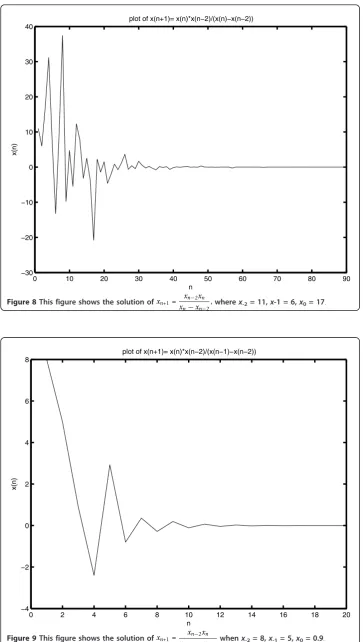
Figure 8 shows the solution when x-2= 11,x-1 = 6,x0= 17.
4.7 Case (7)
Let x-2=r, x-1 =k, x0=hand Fn-1F, n-2,Fnare the Fibonacci terms.
Then the solution of the following difference equation
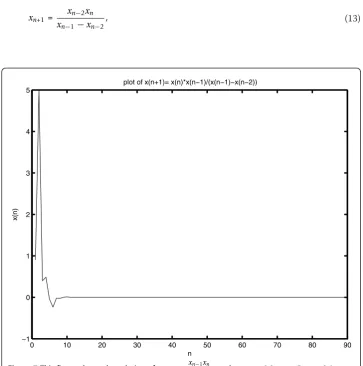
xn+1=
xn−2xn xn−1−xn−2
, (13)
0 10 20 30 40 50 60 70 80 90
−1 0 1 2 3 4 5
n
x(n)
plot of x(n+1)= x(n)*x(n−1)/(x(n−1)−x(n−2))
Figure 7This figure shows the solution ofxn+1=
xn−1xn
0 10 20 30 40 50 60 70 80 90 −30
−20 −10 0 10 20 30 40
n
x(n)
plot of x(n+1)= x(n)*x(n−2)/(x(n)−x(n−2))
Figure 8This figure shows the solution ofxn+1=
xn−2xn
xn−xn−2,wherex-2= 11,x-1 = 6,x0= 17.
0 2 4 6 8 10 12 14 16 18 20
−4 −2 0 2 4 6 8
n
x(n)
plot of x(n+1)= x(n)*x(n−2)/(x(n−1)−x(n−2))
Figure 9This figure shows the solution ofxn+1=
xn−2xn
is given by
Mathematics Department, Faculty of Science, Mansoura University, Mansoura 35516, Egypt2Department of Mathematics, Faculty of Science & Art in Rabigh, King AbdulAziz University, Rabigh 21911, Saudi Arabia3Mathematics
Department, Faculty of Science, King AbdulAziz University, P. O. Box 80203, Jeddah 21589, Saudi Arabia4Permanent
address: Mathematics Department, Faculty of Science, Mansoura University, Mansoura 35516, Egypt
Authors’contributions
EMEla investigated the behavior of the solutions, HAE-M found the solutions of the special cases and EMEls carried out the theoretical proof and gave the examples. All authors read and approved the final manuscript.
Competing interests
The authors declare that they have no competing interests.
Received: 5 April 2011 Accepted: 23 August 2011 Published: 23 August 2011
References
1. Kulenovic MRS, aa, Ladas, G: Dynamics of Second Order Rational Difference Equations with Open Problems and Conjectures. Chapman & Hall/CRC Press, Boca Raton, FL. (2001)
2. Kocic, VL, Ladas, G: Global Behavior of Nonlinear Difference Equations of Higher Order with Applications. Kluwer Academic Publishers, Dordrecht (1993)
3. Mickens, RE: Difference Equations. Van Nostrand Reinhold Comp, New York. (1987)
4. Mackey, MC, Glass, L: Oscillation and chaos in physiological control system. Science.197, 287–289 (1977). doi:10.1126/ science.267326
5. Elabbasy, EM, El-Metwally, H, Elsayed, EM: On the difference equationxn+1=axn− bxn cxn−dxn−1.
. Adv Differ Equ 1–10 (2006). Article ID 82579
6. Elabbasy, EM, El-Metwally, H, Elsayed, EM: On the difference equationsxn+1= α xn−k
β+γk i=0xn−i
.. J Conc Appl Math.5(2), 101–113 (2007)
7. Elabbasy, EM, El-Metwally, H, Elsayed, EM: Global attractivity and periodic character of a fractional difference equation of order three. Yoko-hama Math J.53, 89–100 (2007)
8. El-Metwally, H, Grove, EA, Ladas, G, Levins, R, Radin, M: On the difference equationxn+1=α+βxn−1e−xn.. Nonlinear Anal: Theory Methods Appl.47(7), 4623–4634 (2003)
9. Yang, X, Su, W, Chen, B, Megson, GM, Evans, DJ: On the recursive Sequencexn+1=axn−1+bxn−2 c+dxn−1xn−2
.. Appl Math Comput.
162, 1485–1497 (2005). doi:10.1016/j.amc.2004.03.023
10. Cinar, C: On the positive solutions of the difference equationxn+1= xn−1 1 +axnxn−1
.. Appl Math Comput.158(3), 809–812 (2004). doi:10.1016/j.amc.2003.08.140
11. Cinar, C: On the positive solutions of the difference equationxn+1= xn−1
−1 +axnxn−1
.. Appl Math Comput.158(3), 793–797 (2004). doi:10.1016/j.amc.2003.08.139
12. Aloqeili, M: Dynamics of a rational difference equation. Appl Math Comput.176(2), 768–774 (2006). doi:10.1016/j. amc.2005.10.024
13. Yalçinkaya, I: On the difference equationxn+1=α+ xn−m
xk n
.. Discrete Dyn Nat Soc (2008). Article ID 805460, 8 14. Agarwal, R: Difference Equations and Inequalities. Theory, Methods and Applications. Marcel Dekker Inc., New York
(1992)
15. Agarwal, RP, Elsayed, EM: Periodicity and stability of solutions of higher order rational difference equation. Adv Stud Contemp Math.17(2), 181–201 (2008)
16. Agarwal, RP, Zhang, W: Periodic solutions of difference equations with general periodicity. Comput Math Appl.42, 719–727 (2001). doi:10.1016/S0898-1221(01)00191-2
17. Elabbasy, EM, Elsayed, EM: On the global attractivity of difference equation of higher order. Carpathian J Math.24(2), 45–53 (2008)
18. Elabbasy, EM, Elsayed, EM: Dynamics of a rational difference equation. Chin Ann Math Ser B.30B(2), 187–198 (2009) 19. El-Metwally, H, Grove, EA, Ladas, G, McGrath, LC: On the difference equationyn+1=
yn−(2k+1)+p yn−(2k+1)+qyn−2l
.. Proceedings of the 6th ICDE, Taylor and Francis, London (2004)
20. Elsayed, EM: Qualitative behavior of difference equation of order three. Acta Sci Math (Szeged).75(1-2), 113–129 (2009) 21. Elsayed, EM: Qualitative behavior of s rational recursive sequence. Indagat Math.19(2), 189–201 (2008). doi:10.1016/
S0019-3577(09)00004-4
23. Elsayed, EM: Qualitative properties for a fourth order rational difference equation. Acta Appl Math.110(2), 589–604 (2010). doi:10.1007/s10440-009-9463-z
24. Wang, C, Wang, S, Yan, X: Global asymptotic stability of 3-species mutualism models with diffusion and delay effects. Discrete Dyn Nat Sci20(2009). Article ID 317298
25. Wang, C, Gong, F, Wang, S, Li, L, Shi, Q: Asymptotic behavior of equilibrium point for a class of nonlinear difference equation. Adv Diff Equ8, : (2009). Article ID 214309
26. Yalçinkaya, I, Iricanin, BD, Cinar, C: On a max-type difference equation. Discrete Dyn. Nat Soc (2007). Article ID 47264, 10 27. Yalçinkaya, I: On the global asymptotic stability of a second-order system of difference equations. Discrete Dyn Nat Soc
(2008). Article ID 860152, 12
28. Yalçinkaya, I: On the global asymptotic behavior of a system of two nonlinear difference equations. ARS Combinatoria.
95, 151–159 (2010)
29. Zayed, EME, El-Moneam, MA: On the rational recursive sequencexn+1=axn− bxn cxn−dxn−k.
. Commun Appl Nonlinear Anal.15, 47–57 (2008)
doi:10.1186/1687-1847-2011-28
Cite this article as:Elabbasyet al.:Global behavior of the solutions of some difference equations.Advances in Difference Equations20112011:28.
Submit your manuscript to a
journal and benefi t from:
7Convenient online submission
7Rigorous peer review
7Immediate publication on acceptance
7Open access: articles freely available online
7High visibility within the fi eld
7Retaining the copyright to your article