Learning Document-Level Semantic Properties from Free-text Annotations
S.R.K. Branavan Harr Chen Jacob Eisenstein Regina Barzilay Computer Science and Artificial Intelligence Laboratory
Massachusetts Institute of Technology
{branavan, harr, jacobe, regina}@csail.mit.edu
Abstract
This paper demonstrates a new method for leveraging free-text annotations to infer se-mantic properties of documents. Free-text an-notations are becoming increasingly abundant, due to the recent dramatic growth in semi-structured, user-generated online content. An example of such content is product reviews, which are often annotated by their authors with pros/cons keyphrases such as “a real bar-gain” or “good value.” To exploit such noisy annotations, we simultaneously find a hid-den paraphrase structure of the keyphrases, a model of the document texts, and the underly-ing semantic properties that link the two. This allows us to predict properties of unannotated documents. Our approach is implemented as a hierarchical Bayesian model with joint in-ference, which increases the robustness of the keyphrase clustering and encourages the doc-ument model to correlate with semantically meaningful properties. We perform several evaluations of our model, and find that it sub-stantially outperforms alternative approaches.
1 Introduction
A central problem in language understanding is transforming raw text into structured representa-tions. Learning-based approaches have dramatically increased the scope and robustness of this type of automatic language processing, but they are typi-cally dependent on large expert-annotated datasets, which are costly to produce. In this paper, we show how novice-generated free-text annotations avail-able online can be leveraged to automatically infer document-level semantic properties.
With the rapid increase of online content cre-ated by end users, noisy free-text annotations have
pros/cons: great nutritional value
... combines it all: an amazing product, quick and friendly service, cleanliness, great nutrition ...
pros/cons: a bit pricey, healthy
... is an awesome place to go if you are health con-scious. They have some really great low calorie dishes and they publish the calories and fat grams per serving.
Figure 1: Excerpts from online restaurant reviews with pros/cons phrase lists. Both reviews discuss healthiness, but use different keyphrases.
become widely available (Vickery and Wunsch-Vincent, 2007; Sterling, 2005). For example, con-sider reviews of consumer products and services. Often, such reviews are annotated with keyphrase lists of pros and cons. We would like to use these keyphrase lists as training labels, so that the proper-ties of unannotated reviews can be predicted. Hav-ing such a system would facilitate structured access and summarization of this data. However, novice-generated keyphrase annotations are incomplete de-scriptions of their corresponding review texts. Fur-thermore, they lack consistency: the same under-lying property may be expressed in many ways, e.g., “healthy” and “great nutritional value” (see Fig-ure 1). To take advantage of such noisy labels, a sys-tem must both uncover their hidden clustering into properties, and learn to predict these properties from review text.
This paper presents a model that addresses both problems simultaneously. We assume that both the document text and the selection of keyphrases are governed by the underlying hidden properties of the document. Each property indexes a language model, thus allowing documents that incorporate the same
property to share similar features. In addition, each keyphrase is associated with a property; keyphrases that are associated with the same property should have similar distributional and surface features.
We link these two ideas in a joint hierarchical Bayesian model. Keyphrases are clustered based on their distributional and lexical properties, and a hidden topic model is applied to the document text. Crucially, the keyphrase clusters and document top-ics are linked, and inference is performed jointly. This increases the robustness of the keyphrase clus-tering, and ensures that the inferred hidden topics are indicative of salient semantic properties.
Our model is broadly applicable to many scenar-ios where documents are annotated in a noisy man-ner. In this work, we apply our method to a col-lection of reviews in two categories: restaurants and cell phones. The training data consists of review text and the associated pros/cons lists. We then evaluate the ability of our model to predict review properties when the pros/cons list is hidden. Across a variety of evaluation scenarios, our algorithm consistently outperforms alternative strategies by a wide margin. 2 Related Work
Review Analysis Our approach relates to previous
work on property extraction from reviews (Popescu et al., 2005; Hu and Liu, 2004; Kim and Hovy, 2006). These methods extract lists of phrases, which are analogous to the keyphrases we use as input to our algorithm. However, our approach is dis-tinguished in two ways: first, we are able to pre-dict keyphrases beyond those that appear verbatim in the text. Second, our approach learns the rela-tionships between keyphrases, allowing us to draw direct comparisons between reviews.
Bayesian Topic Modeling One aspect of our model views properties as distributions over words in the document. This approach is inspired by meth-ods in the topic modeling literature, such as Latent Dirichlet Allocation (LDA) (Blei et al., 2003), where topics are treated as hidden variables that govern the distribution of words in a text. Our algorithm ex-tends this notion by biasing the induced hidden top-ics toward a clustering of known keyphrases. Tying these two information sources together enhances the robustness of the hidden topics, thereby increasing
the chance that the induced structure corresponds to semantically meaningful properties.
Recent work has examined coupling topic mod-els with explicit supervision (Blei and McAuliffe, 2007; Titov and McDonald, 2008). However, such approaches assume that the documents are labeled within a predefined annotation structure, e.g., the properties of food, ambiance, and service for restau-rants. In contrast, we address free-text annotations created by end users, without known semantic prop-erties. Rather than requiring a predefined annotation structure, our model infers one from the data. 3 Problem Formulation
We formulate our problem as follows. We assume a dataset composed of documents with associated keyphrases. Each document may be marked with multiple keyphrases that express unseen semantic properties. Across the entire collection, several keyphrases may express the same property. The keyphrases are also incomplete — review texts of-ten express properties that are not mentioned in their keyphrases. At training time, our model has access to both text and keyphrases; at test time, the goal is to predict the properties supported by a previously unseen document. We can then use this property list to generate an appropriate set of keyphrases. 4 Model Description
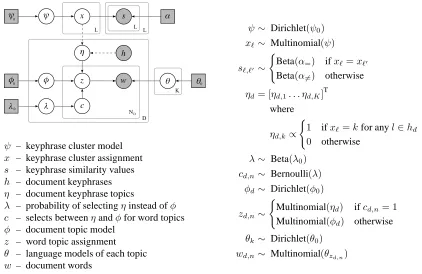
Our approach leverages both keyphrase clustering and distributional analysis of the text in a joint, hi-erarchical Bayesian model. Keyphrases are drawn from a set of clusters; words in the documents are drawn from language models indexed by a set of topics, where the topics correspond to the keyphrase clusters. Crucially, we bias the assignment of hid-den topics in the text to be similar to the topics rep-resented by the keyphrases of the document, but we permit some words to be drawn from other topics not represented by the keyphrases. This flexibility in the coupling allows the model to learn effectively in the presence of incomplete keyphrase annotations, while still encouraging the keyphrase clustering to cohere with the topics supported by the text.
asso-ψ – keyphrase cluster model
x – keyphrase cluster assignment
s – keyphrase similarity values
h – document keyphrases
η – document keyphrase topics
λ – probability of selectingηinstead ofφ c – selects betweenηandφfor word topics
φ – document topic model
z – word topic assignment
θ – language models of each topic
w – document words
ψ∼ Dirichlet(ψ0) xℓ∼ Multinomial(ψ)
sℓ,ℓ′ ∼
(
Beta(α=) ifxℓ=xℓ′
Beta(α6=) otherwise
ηd= [ηd,1. . . ηd,K]
T
where
ηd,k∝ (
1 ifxℓ=kfor anyl∈hd 0 otherwise
λ∼ Beta(λ0)
cd,n∼ Bernoulli(λ) φd∼ Dirichlet(φ0)
zd,n∼ (
Multinomial(ηd) ifcd,n= 1 Multinomial(φd) otherwise
θk ∼ Dirichlet(θ0) wd,n∼ Multinomial(θzd,n)
Figure 2: The plate diagram for our model. Shaded circles denote observed variables, and squares denote hyper parameters. The dotted arrows indicate thatηis constructed deterministically fromxandh.
ciated with a cluster of keyphrases. At test time, we are presented with documents that do not con-tain keyphrase annotations. The hidden topic model of the review text is used to determine the proper-ties that a document as a whole supports. For each property, we compute the proportion of the docu-ment’s words assigned to it. Properties with propor-tions above a set threshold (tuned on a development set) are predicted as being supported.
4.1 Keyphrase Clustering
One of our goals is to cluster the keyphrases, such that each cluster corresponds to a well-defined prop-erty. We represent each distinct keyphrase as a vec-tor of similarity scores computed over the set of observed keyphrases; these scores are represented by sin Figure 2, the plate diagram of our model.1 Modeling the similarity matrix rather than the
sur-1We assume that similarity scores are conditionally
inde-pendent given the keyphrase clustering, though the scores are in fact related. Such simplifying assumptions have been previ-ously used with success in NLP (e.g., Toutanova and Johnson, 2007), though a more theoretically sound treatment of the sim-ilarity matrix is an area for future research.
face forms allows arbitrary comparisons between keyphrases, e.g., permitting the use of both lexical and distributional information. The lexical com-parison is based on the cosine similarity between the keyphrase words. The distributional similar-ity is quantified in terms of the co-occurrence of keyphrases across review texts. Our model is inher-ently capable of using any arbitrary source of simi-larity information; for a discussion of simisimi-larity met-rics, see Lin (1998).
4.2 Document-level Distributional Analysis
Our analysis of the document text is based on proba-bilistic topic models such as LDA (Blei et al., 2003). In the LDA framework, each word is generated from a language model that is indexed by the word’s topic assignment. Thus, rather than identifying a single topic for a document, LDA identifies a distribution over topics.
distribu-tion from the clusters represented by the document’s keyphrases — this isηin the figure. ηassigns equal probability to all topics that are represented in the keyphrases, and a small smoothing probability to other topics.
As noted above, properties may be expressed in the text even when no related keyphrase appears. For this reason, we also construct a document-specific topic distribution φ. The auxiliary variable c indi-cates whether a given word’s topic is drawn from the set of keyphrase clusters, or from this topic dis-tribution.
4.3 Generative Process
In this section, we describe the underlying genera-tive process more formally.
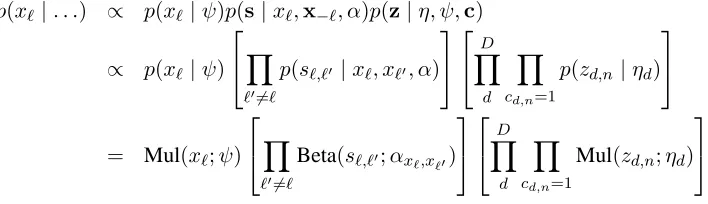
First we consider the set of all keyphrases ob-served across the entire corpus, of which there are L. We draw a multinomial distributionψover theK keyphrase clusters from a symmetric Dirichlet prior ψ0. Then for the ℓth keyphrase, a cluster
assign-mentxℓ is drawn from the multinomial ψ. Finally,
the similarity matrix s ∈ [0,1]L×L is constructed.
Each entry sℓ,ℓ′ is drawn independently, depending on the cluster assignments xℓ and xℓ′. Specifically, sℓ,ℓ′ is drawn from a Beta distribution with parame-tersα=ifxℓ =xℓ′ andα6=otherwise. The
parame-tersα=linearly biassℓ,ℓ′ towards one (Beta(α=)≡
Beta(2,1)), and the parametersα6=linearly biassℓ,ℓ′ towards zero (Beta(α6=)≡Beta(1,2)).
Next, the words in each of the D documents are generated. Document dhas Nd words; zd,n is
the topic for word wd,n. These latent topics are
drawn either from the set of clusters represented by the document’s keyphrases, or from the document’s topic model φd. We deterministically construct a
document-specific keyphrase topic modelηd, based
on the keyphrase cluster assignmentsxand the
ob-served keyphrases hd. The multinomial ηd assigns
equal probability to each topic that is represented by a phrase inhd, and a small probability to other
top-ics.
As noted earlier, a document’s text may support properties that are not mentioned in its observed keyphrases. For that reason, we draw a document topic multinomial φd from a symmetric Dirichlet
prior φ0. The binary auxiliary variable cd,n
deter-mines whether the word’s topic is drawn from the
keyphrase model ηd or the document topic model
φd. cd,n is drawn from a weighted coin flip, with
probability λ; λis drawn from a Beta distribution with prior λ0. We have zd,n ∼ ηd if cd,n = 1,
and zd,n ∼ φd otherwise. Finally, the word wd,n
is drawn from the multinomialθzd,n, wherezd,n
in-dexes a topic-specific language model. Each of the K language models θk is drawn from a symmetric
Dirichlet priorθ0.
5 Posterior Sampling
Ultimately, we need to compute the model’s poste-rior distribution given the training data. Doing so analytically is intractable due to the complexity of the model, but sampling-based techniques can be used to estimate the posterior. We employ Gibbs sampling, previously used in NLP by Finkel et al. (2005) and Goldwater et al. (2006), among others. This technique repeatedly samples from the condi-tional distributions of each hidden variable, eventu-ally converging on a Markov chain whose stationary distribution is the posterior distribution of the hid-den variables in the model (Gelman et al., 2004). We now present sampling equations for each of the hidden variables in Figure 2.
The prior over keyphrase clusters ψ is sampled based on hyperprior ψ0 and keyphrase cluster
as-signmentsx. We writep(ψ|. . .)to mean the
prob-ability conditioned on all the other variables. p(ψ|. . .)∝p(ψ|ψ0)p(x|ψ),
=p(ψ|ψ0) L
Y
ℓ
p(xℓ|ψ)
=Dir(ψ;ψ0) L
Y
ℓ
Mul(xℓ;ψ)
=Dir(ψ;ψ′),
whereψi′ = ψ0 +count(xℓ = i). This update rule
is due to the conjugacy of the multinomial to the Dirichlet distribution. The first line follows from Bayes’ rule, and the second line from the conditional independence of each keyphrase assignmentxℓfrom
the others, givenψ.
φdandθkare resampled in a similar manner:
p(φd|. . .)∝Dir(φd;φ′d),
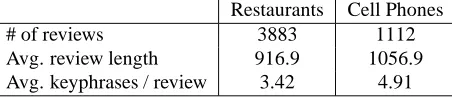
Restaurants Cell Phones
# of reviews 3883 1112
Avg. review length 916.9 1056.9 Avg. keyphrases / review 3.42 4.91
Table 1: Statistics of the reviews dataset by category.
standard, we hand-annotated a subset of the reviews from the restaurant category. The annotation effort focused on eight commonly mentioned properties, such as those underlying the keyphrases “pleasant atmosphere” and “attentive staff.” Two raters anno-tated 160 reviews, 30 of which were annoanno-tated by both. Cohen’s kappa, a measure of interrater agree-ment ranging from zero to one, was 0.78 for this sub-set, indicating high agreement (Cohen, 1960).
Each review was annotated with 2.56 properties on average. Each manually-annotated property cor-responded to an average of 19.1 keyphrases in the restaurant data, and 6.7 keyphrases in the cell phone data. This supports our intuition that a single se-mantic property may be expressed using a variety of different keyphrases.
Training Our model needs to be provided with the number of clustersK. We setKlarge enough for the model to learn effectively on the development set. For the restaurant data — where the gold standard identified eight semantic properties — we setK to 20, allowing the model to account for keyphrases not included in the eight most common properties. For the cell phones category, we setKto 30.
To improve the model’s convergence rate, we per-form two initialization steps for the Gibbs sampler. First, sampling is done only on the keyphrase clus-tering component of the model, ignoring document text. Second, we fix this clustering and sample the remaining model parameters. These two steps are run for 5,000 iterations each. The full joint model is then sampled for 100,000 iterations. Inspection of the parameter estimates confirms model conver-gence. On a 2GHz dual-core desktop machine, a multi-threaded C++ implementation of model train-ing takes about two hours for each dataset.
Inference The final point estimate used for test-ing is an average (for continuous variables) or a mode (for discrete variables) over the last 1,000 Gibbs sampling iterations. Averaging is a heuris-tic that is applicable in our case because our
sam-ple histograms are unimodal and exhibit low skew. The model usually works equally well using single-sample estimates, but is more prone to estimation noise.
As previously mentioned, we convert word topic assignments to document properties by examining the proportion of words supporting each property. A threshold for this proportion is set for each property via the development set.
Evaluation Our first evaluation examines the ac-curacy of our model and the baselines by compar-ing their output against the keyphrases provided by the review authors. More specifically, the model first predicts the properties supported by a given re-view. We then test whether the original authors’ keyphrases are contained in the clusters associated with these properties.
As noted above, the authors’ keyphrases are of-ten incomplete. To perform a noise-free compari-son, we based our second evaluation on the man-ually constructed gold standard for the restaurant category. We took the most commonly observed keyphrase from each of the eight annotated proper-ties, and tested whether they are supported by the model based on the document text.
In both types of evaluation, we measure the model’s performance using precision, recall, and F-score. These are computed in the standard manner, based on the model’s keyphrase predictions com-pared against the corresponding references. The sign test was used for statistical significance test-ing (De Groot and Schervish, 2001).
Baselines To the best of our knowledge, this task not been previously addressed in the literature. We therefore consider five baselines that allow us to ex-plore the properties of this task and our model.
Random: Each keyphrase is supported by a doc-ument with probability of one half. This baseline’s results are computed (in expectation) rather than ac-tually run. This method is expected to have a recall of 0.5, because in expectation it will select half of the correct keyphrases. Its precision is the propor-tion of supported keyphrases in the test set.
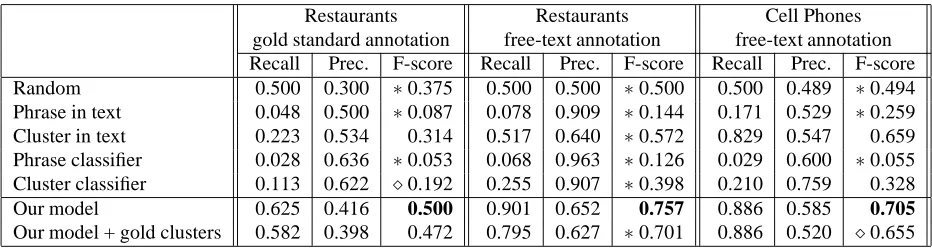
Restaurants Restaurants Cell Phones gold standard annotation free-text annotation free-text annotation Recall Prec. F-score Recall Prec. F-score Recall Prec. F-score Random 0.500 0.300 ∗0.375 0.500 0.500 ∗0.500 0.500 0.489 ∗0.494 Phrase in text 0.048 0.500 ∗0.087 0.078 0.909 ∗0.144 0.171 0.529 ∗0.259 Cluster in text 0.223 0.534 0.314 0.517 0.640 ∗0.572 0.829 0.547 0.659 Phrase classifier 0.028 0.636 ∗0.053 0.068 0.963 ∗0.126 0.029 0.600 ∗0.055 Cluster classifier 0.113 0.622 ⋄0.192 0.255 0.907 ∗0.398 0.210 0.759 0.328 Our model 0.625 0.416 0.500 0.901 0.652 0.757 0.886 0.585 0.705
Our model + gold clusters 0.582 0.398 0.472 0.795 0.627 ∗0.701 0.886 0.520 ⋄0.655
Table 2: Comparison of the property predictions made by our model and the baselines in the two categories as evaluated against the gold and free-text annotations. Results for our model using the fixed, manually-created gold clusterings are also shown. The methods against which our model has significantly better results on the sign test are indicated with a
∗forp <= 0.05, and⋄forp <= 0.1.
Cluster in text: A keyphrase is supported by a document if it or any of its paraphrases appears in the text. Paraphrasing is based on our model’s clus-tering of the keyphrases. The use of paraphrasing information enhances recall at the potential cost of precision, depending on the quality of the clustering. Phrase classifier: Discriminative classifiers are trained for each keyphrase. Positive examples are documents that are labeled with the keyphrase; all other documents are negative examples. A keyphrase is supported by a document if that keyphrase’s classifier returns positive.
Cluster classifier: Discriminative classifiers are trained for each cluster of keyphrases, using our model’s clustering. Positive examples are docu-ments that are labeled with any keyphrase from the cluster; all other documents are negative examples. All keyphrases of a cluster are supported by a docu-ment if that cluster’s classifier returns positive.
Phrase classifier and cluster classifier employ maximum entropy classifiers, trained on the same features as our model, i.e., word counts. The former is high-precision/low-recall, because for any partic-ular keyphrase, its synonymous keyphrases would be considered negative examples. The latter broad-ens the positive examples, which should improve re-call. We used Zhang Le’s MaxEnt toolkit3 to build these classifiers.
3
http://homepages.inf.ed.ac.uk/s0450736/ maxent_toolkit.html
7 Results
Comparative performance Table 2 presents the results of the evaluation scenarios described above. Our model outperforms every baseline by a wide margin in all evaluations.
The absolute performance of the automatic meth-ods indicates the difficulty of the task. For instance, evaluation against gold standard annotations shows that the random baseline outperforms all of the other baselines. We observe similar disappointing results for the non-random baselines against the free-text annotations. The precision and recall characteristics of the baselines match our previously described ex-pectations.
The poor performance of the discriminative mod-els seems surprising at first. However, these re-sults can be explained by the degree of noise in the training data, specifically, the aforementioned sparsity of free-text annotations. As previously de-scribed, our technique allows document text topics to stochastically derive from either the keyphrases or a background distribution — this allows our model to learn effectively from incomplete annotations. In fact, when we force all text topics to derive from keyphrase clusters in our model, its performance de-grades to the level of the classifiers or worse, with an F-score of 0.390 in the restaurant category and 0.171 in the cell phone category.
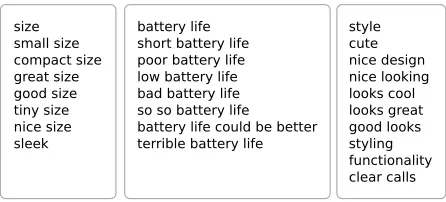
Figure 4: Sample keyphrase clusters that our model infers in the cell phone category.
confirmed by the dramatic difference in results be-tween the cluster in text and phrase in text baselines. Therefore it is important to quantify the quality of automatically computed paraphrases, such as those illustrated in Figure 4.
Restaurants Cell Phones Keyphrase similarity only 0.931 0.759 Joint training 0.966 0.876
Table 3: Rand Index scores of our model’s clusters, using only keyphrase similarity vs. using keyphrases and text jointly. Comparison of cluster quality is against the gold standard.
One way to assess clustering quality is to com-pare it against a “gold standard” clustering, as con-structed in Section 6. For this purpose, we use the Rand Index (Rand, 1971), a measure of cluster sim-ilarity. This measure varies from zero to one; higher scores are better. Table 3 shows the Rand Indices for our model’s clustering, as well as the clustering obtained by using only keyphrase similarity. These scores confirm that joint inference produces better clusters than using only keyphrases.
Another way of assessing cluster quality is to con-sider the impact of using the gold standard clustering instead of our model’s clustering. As shown in the last two lines of Table 2, using the gold clustering yields results worse than using the model clustering. This indicates that for the purposes of our task, the model clustering is of sufficient quality.
8 Conclusions and Future Work
In this paper, we have shown how free-text anno-tations provided by novice users can be leveraged as a training set for document-level semantic infer-ence. The resulting hierarchical Bayesian model
overcomes the lack of consistency in such anno-tations by inducing a hidden structure of seman-tic properties, which correspond both to clusters of keyphrases and hidden topic models in the text. Our system successfully extracts semantic properties of unannotated restaurant and cell phone reviews, em-pirically validating our approach.
Our present model makes strong assumptions about the independence of similarity scores. We be-lieve this could be avoided by modeling the genera-tion of the entire similarity matrix jointly. We have also assumed that the properties themselves are un-structured, but they are in fact related in interest-ing ways. For example, it would be desirable to model antonyms explicitly, e.g., no restaurant review should be simultaneously labeled as having good and bad food. The correlated topic model (Blei and Lafferty, 2006) is one way to account for relation-ships between hidden topics; more structured repre-sentations, such as hierarchies, may also be consid-ered.
Finally, the core idea of using free-text as a source of training labels has wide applicability, and has the potential to enable sophisticated content search and analysis. For example, online blog en-tries are often tagged with short keyphrases. Our technique could be used to standardize these tags, and assign keyphrases to untagged blogs. The no-tion of free-text annotano-tions is also very broad — we are currently exploring the applicability of this model to Wikipedia articles, using section titles as keyphrases, to build standard article schemas.
Acknowledgments
References
David M. Blei and John D. Lafferty. 2006. Correlated topic models. In Advances in NIPS, pages 147–154. David M. Blei and Jon McAuliffe. 2007. Supervised
topic models. In Advances in NIPS.
David M. Blei, Andrew Y. Ng, and Michael I. Jordan. 2003. Latent Dirichlet allocation. Journal of Machine
Learning Research, 3:993–1022.
Jacob Cohen. 1960. A coefficient of agreement for nom-inal scales. Educational and Psychological
Measure-ment, 20(1):37–46.
Ido Dagan, Oren Glickman, and Bernardo Magnini. 2006. The PASCAL recognising textual entail-ment challenge. Lecture Notes in Computer Science, 3944:177–190.
Morris H. De Groot and Mark J. Schervish. 2001.
Prob-ability and Statistics. Addison Wesley.
Jenny R. Finkel, Trond Grenager, and Christopher Man-ning. 2005. Incorporating non-local information into information extraction systems by Gibbs sampling. In
Proceedings of the ACL, pages 363–370.
Andrew Gelman, John B. Carlin, Hal S. Stern, and Don-ald B. Rubin. 2004. Bayesian Data Analysis. Texts in Statistical Science. Chapman & Hall/CRC, 2nd edi-tion.
Sharon Goldwater, Thomas L. Griffiths, and Mark John-son. 2006. Contextual dependencies in unsupervised word segmentation. In Proceedings of ACL, pages 673–680.
Minqing Hu and Bing Liu. 2004. Mining and summa-rizing customer reviews. In Proceedings of SIGKDD, pages 168–177.
Soo-Min Kim and Eduard Hovy. 2006. Automatic iden-tification of pro and con reasons in online reviews. In
Proceedings of the COLING/ACL, pages 483–490.
Dekang Lin. 1998. An information-theoretic definition of similarity. In Proceedings of ICML, pages 296–304. Ana-Maria Popescu, Bao Nguyen, and Oren Etzioni. 2005. OPINE: Extracting product features and opin-ions from reviews. In Proceedings of HLT/EMNLP, pages 339–346.
William M. Rand. 1971. Objective criteria for the eval-uation of clustering methods. Journal of the American
Statistical Association, 66(336):846–850, December.
Bruce Sterling. 2005. Order out of chaos: What is the best way to tag, bag, and sort data? Give it to the unorganized masses. http://www.wired.com/
wired/archive/13.04/view.html?pg=4.
Accessed April 21, 2008.
Ivan Titov and Ryan McDonald. 2008. A joint model of text and aspect ratings for sentiment summarization. In Proceedings of the ACL.
Kristina Toutanova and Mark Johnson. 2007. A Bayesian LDA-based model for semi-supervised part-of-speech tagging. In Advances in NIPS.
Graham Vickery and Sacha Wunsch-Vincent. 2007.