DOI : https://doi.org/10.32628/CSEIT195357
Smart Toll Payment System Using Android Applications
Srisailanath, JhansiRani P, B S Ramya Reddy, Anitha B L, Laxmi Swetha Yerramsetty Ballari Institute of Technology and Management, Ballari, Karnataka, India ABSTRACT
Today, due the increase in the vehicles, there is a lot of gathering of the traffic at the booths. The main reason for this traffic at the tollbooths is due the manual working of the toll tax collection the booths. Each vehicle on average need to stop at the booth for about a 2 minutes for the payment of the toll taxs. In order to decrease this traffic and time consistency we are coming up with an nobel idea based on Android app communication. In this application we will have three modules Admin, Tollgate, and Client. In which admin will verify the tollgater with his/her detail, clients get registered in this app and pay his /her tollgate payments which decreases the manual work and hence increases the vehicle speed passing by the toll booth. Also it allows the vehicles just to pass through the booth by just showing the QR code. This result reducing the traffic pattern at the toll collecting booths.
Keywords : Android Tollgate Application, QR Code, Tollgate, Smart Payments.
I. INTRODUCTION
While driving along high way, we all encounter single or multiple booths in which we have to pay a fixed amount of money. These booths are known as toll booths and the money we pay is the tax for using the road known as the toll road or toll way. Since most of the roads are built with the money that is raised by the state or national government through the taxes. So, toll is a kind of tax that we pay to the government for the maintenance of the highways. In the era of modernization where everything is being made online, toll systems have also undergone great changes. From past few years, the online payments are becoming more famous. The online systems, unlike a manual system do not involve a collector and in order to decrease this traffic and time consistency we are coming up based on Android app communication. In this application we will have three modules Admin, Tollgate, and Client. In which admin will verify the tollgater with his/her detail, clients get registered in this app and pay his
/her tollgate payments which decreases the manual work and hence increases the vehicle speed passing by the toll booth. Also it allows the vehicles just to pass through the booth by just showing the QR code. This result reducing the traffic pattern at the toll collecting booths.
II. RELATED WORKS
are derived from the legacy system is variable. After the transformation of legacy system, its service set can be described in a blueprint.
Models of vehicle mobility[2] have applicability in fields such as urban planning and environmental studies. Big Data, specifically, spatio-temporal data, enable novel ways of constructing such models, however privacy remains an issue. Unfortunately, there is no known way to anonymize location data since spatio-temporal data is highly unique to individuals and robust to changes over extended periods of time. Unlike simple anonymization, differentially private summaries of data provide a mathematical guarantee of privacy, while maintaining the utility of the mobility data. Using a dataset from Telecom Italia's Big Data Challenge, we construct a differentially private model of tollgate traffic in the city of Milan. We then use the model to generate synthetic tollgate data and compare its accuracy on various metrics to that of real data. Our findings show that it is possible to create an accurate, differentially private mobility model from this location data that preserves important characteristics of the original data.
These days, increasing traffic volume[3] makes congestion commonly around the tollgates of highway. So, reform measure of congestion around the tollgates is urgently required. One of the method is ETCS(electronic toll collection system), which mostly is studied recently. Several tollgates in Korea operates ETCS, named hi-pass system, as examples. However, actually it's too hard to build ETC systems in all tollgates because of system cost. Therefore we have studied indefatigably how to enhance efficiency of existing TCS(toll collecting system) with ETSC. Until Building ETC systems in all tollgates, several ways of TCS will have been operated mixedly. This study, therefore, has been aimed at developing the optimum operation method of combination ETCS
model, which reproduces the operation states of various tollgate systems: waiting time, passing time. With this simulator, we proposed the optimal operation strategy of highway tollgate by benefit-cost analysis on the basis of benefit in saving total waiting time and operating cost.
The existing research on analyzing the vulnerability[4] of road networks is largely dependent on the assumption of a known traffic model in the simulations. In this paper, we present a new approach for quantitatively evaluating the vulnerability of highway networks based on real-world highway tollgate data that reflect the highway's characteristics, such as structural and traffic movements. Specifically, O-D (origin-destination) tollgate data are collected across three major highway networks in China (Beijing city and Shanxi and Anhui Provinces) for three months. The case study examines the vulnerability of highway traffic networks from both macroscopic and microscopic perspectives. Moreover, a more in-depth study of vulnerability is conducted from residential and transportation perspectives. Our evaluation results will serve as guidelines for improving the toll highway system. i.e., to help the road administration identify the critical sections (that are highly vulnerable to congestion) and take early maintenance actions for avoiding monetary/time costs caused by disruptions.
PondokRanji Tollgate and to improve e-Toll services for existing e-Toll Card users. This research first determines the exact amount of e-Toll usage which is determined to be 22.46 %. This research then attempts to capture the opinion of user using a questionnaire. The survey results are then analyzed using descriptive statistics and Mann Whitney test to develop the advice. The result of the research are developed advices to improve the usage of e-Toll card and to improve existing e-Toll services for existing users which are socialization for e-Toll Card's other uses aside from payment at tollgates and that other Mandiri Prepaid Card under different brand could also be used like an e-Toll Card, a promotion system that is more noticeable to the customers, increasing the number of lanes for the Bintaro-Jakarta route, adding more locations to recharge the e-Toll card, implementing a recharge system that does not require a top up process, increasing the benefits of e-Toll Card, continuing the e-Toll Card sale in Toll Gate, a system to warn e-Toll Card user that their funds are running out, faster transaction times for e-Toll card, and making the OBU have lower prices and easier to purchase.
III. DATA AND METHODOLOGY
Existing system
In existing system, current times of increasing traffic on the road, it is important to collect the toll tax in a managed and controlled process so that it does not
where the tollgates are and they face a problem with cost of each tollgate.
Disadvantages
• It was very time consuming process
• We find heavy traffic in such areas. Proposed System
In order to overcome this problem we are proposing an novel approach with android development. In this application we are mainly focusing on Admin, Tollgater and client. In which admin will verify the tollgater with his/her detail, clients get registered in this app and pay his /her tollgate payments. It helps client to find the area of the tollgate and also he can view the cost of each and every tollgate.
IV.IMPLEMENTATION DETAILS
The implementation stage in system project involves careful planning investigation of the current system and its constraints on implementation design of the methods to achieve change over etc. The errors in the code will be rectified during the phases of testing.
Major modules:
In this application we will have 3 modules Administrator, Tollgate, Client
Administrator:
Admin allows the tollgater to add his tollgate
details(with latitude and longitude ) and the cost the client has to pay. Once the tollgater gets register admin verify the details and accepts request. Tollgate:
He will register in to the app provided by the admin and waits for his acceptance.
Clients:
Flow diagram:
Fig 5.1: Home page
The above figure shows the home page from where a user needs to select the model.
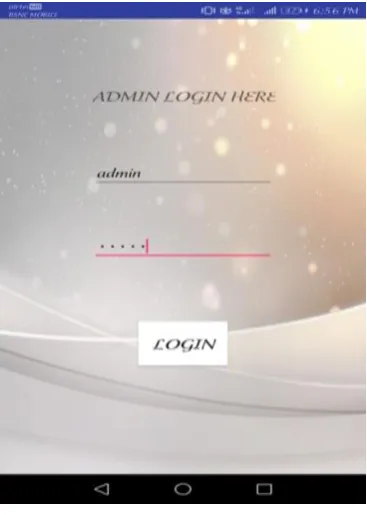
Fig: 5.2 Admin login page.
The above figure shows the login page where users need to enter his username and password.
Fig: 5.4 user login page
Fig: 5.5 User home page
Fig: 5.6 Tollgate login page
Fig 5.7 Tollgate home page
V. CONCLUSION
Our system is a user friendly toll fee method this can save time and reduce traffic congestion at toll gates and provide solution for users to reach their destination without wastage of time. It gives the toll authorities the flexibility to set variable pricing for toll services and thus a fair policy of tax collection can be followed. Here there is no cash transaction for the toll lanes, so cash handling is reduced. Thus difficulties with cash handling are eliminated and this way aid in enhanced audit control by centralizing user accounts. Information such as vehicle count over the time of the day, date, time etc can be obtained due to the deployment of this technology. This helps in making decisions regarding the pricing strategies for the toll providers. It also helps planner to estimate the travel time that aid in designing decisions.
VI.REFERENCES
international journal of science and research(IJSR), I:70,vol.no.4,issue 2.
[2].Priyanka C, Govinda P, Poonam B (2013) image processing based automatic toll booth in Indian conditions, international journal of computer science and information technology (IJCSIT). [3].Pranoti S, Poonam M, Kirti D, Jayshree D (2013)
automated toll collection system using RFID , international journal of advanced research in electrical electronic & instrumentation engineering (IJAREEIE).
[4].Rakhi K, Anand P, Akshay M, Rohan K(2014), RFID based toll collection system, international journal of electrical and electronics research (IJEER).
Cite this article as :
Srisailanath, JhansiRani P, B S Ramya Reddy, Anitha B L, Laxmi Swetha Yerramsetty, "Smart Toll Payment System Using Android Applications", International Journal of Scientific Research in Computer Science, Engineering and Information Technology (IJSRCSEIT), ISSN : 2456-3307, Volume 5 Issue 3, pp. 217-222, May-June 2019. Available at doi : https://doi.org/10.32628/CSEIT195357