Enhancing Invulnerability for Multi User Data Sharing using Key
Agreement Protocol in Cloud Computing
Vivek Jaysing Nagargoje, Manisha Darak
Department of Computer Engineering, Siddhant College of Engineering, Sudumbare Maharashtra India
ABSTRACT
Data sharing in cloud computing permits multiple participants to freely share the cluster knowledge that improves the efficiency of labor in cooperative environments and has widespread potential applications. However, a way to build positive the protection knowledge info} of information sharing among and therefore the because of efficiently share the out sourced information in Associate in Nursing terribly cluster manner unit of activity formidable challenges. Note that key agreement protocols have contend a awfully necessary role in secure and economical cluster knowledge sharing in cloud computing. throughout this paper, by taking advantage of the Centro parallel balanced incomplete block vogue (SBIBD), we've a bent to tend to gift a unique block design-based key agreement protocol that supports multiple participants, which can exile extend the number of participants in Associate in Nursing terribly cloud surroundings the structure of the block vogue. Supported the planned cluster knowledge sharing model, we've a bent to gift general formulas for generating the common conference key K for multiple participants. Note that by taking advantage of the block vogue, the tactic complexness of the planned protocol linearly can increase with the number of participants and also the communication quality is greatly reduced. To boot, the fault tolerance property of our protocol permits the cluster knowledge sharing in cloud computing to face to utterly completely different key attacks, that's analogous to protocol.
Keywords : Key Agreement Protocol, Centro Symmetric Balanced Incomplete Block Style (SBIBD), Data Sharing, Cloud Computing
I. INTRODUCTION
Cloud computing and cloud storage became hot topics in recent decades. unit dynamical the approach we've an inclination to measure and greatly rising production efficiency in some areas. At present, due to restricted storage resources and additionally the necessity for convenient access, we've an inclination to love higher to store all sorts of data in cloud servers, that's to boot AN honest chance for firms and organizations to avoid the overhead of deploying and maintaining instrumentality once data unit keep
householders would adore to firmly share their data throughout a cluster manner. Therefore, a protocol that supports secure cluster data sharing beneath cloud computing is needed. A key agreement protocol is utilized to urge a regular conference key for multiple participants to create certain the protection of their later communications, and this protocol is applied in cloud computing to support secure and economical knowledge sharing. Since it completely was introduced by Diffie-Hellman in their seminal paper, the key agreement protocol has become one of the essential crypto logical primitives. the essential version of the Diffie-Hellman protocol provides degree economical answer to the matter of constructing a regular secret key between a pair of participants. In cryptography, a key agreement protocol might be a protocol among that a pair of or further parties will agree on a key in such the method that every influence the result. By mistreatment the key agreement protocol, the conferees will firmly send and receive messages from each other mistreatment the common conference key that they agree upon beforehand. Specifically, a secure key agreement protocol ensures that the individual cannot get the generated key by implementing malicious attacks, like eavesdropping. Thus, the key agreement protocol is wide used in interactive communication environments with high security needs (e.g., remote board conferences, teleconferences, cooperative workspaces, oftenest identification cloud computing thus on). The Diffie-Hellman key agreement provides the thanks to generate keys. However, it does not offer degree authentication service, that creates it in danger of man within the middle attacks. this instance is addressed by adding some sorts of authentication mechanisms to the protocol, as planned by Law et al. in. to boot, the Diffie-Hellman key agreement can only support a pair of participants. afterwards, to resolve the varied key attacks
II. LITERATURE SURVEY
A. Main Contribution
In this project, we present an efficient and secure block design-based key agreement protocol by extending the structure of the SBIBD to support multiple participants, which enables multiple data owners to freely share the outsourced data with high security and efficiency. Note that the SBIBD is constructed as the group data sharing model to support group data sharing in cloud computing. Moreover, the protocol can provide authentication services and a fault tolerance property. The main contributions of this paper are summarized.
B. Related Works
It is well known that data sharing in cloud computing can provide scalable and unlimited storage and computational resources to individuals and enterprises. However, cloud computing also leads to many security and privacy concerns, such as data integrity, confidentiality, reliability, fault tolerance and so on. Note that the key agreement protocol is one of the fundamental cryptographic primitives, which can provide secure communication among multiple participants in cloud environments.
C. Papers
Paper 1. Privacy-Preserving Multi-keyword Ranked Search over Encrypted Cloud Data[1]
search service is of dominant importance. Considering the massive variety of knowledge users and documents within the cloud, it's necessary to permit multiple keywords within the search request and come documents within the order of their connectedness to those keywords. connected works on searchable encoding concentrate on single keyword search or mathematician keyword search, and barely type the search results. during this paper, for the primary time, we tend to outline and solve the difficult downside of privacy conserving multi-keyword hierarchal search over encrypted cloud information (MRSE). we tend to establish a collection of strict privacy needs for such a secure cloud information utilization system.
Paper 2. sanction Ative Cloud Storage Auditing with Key-Exposure Resistance
Cloud storage auditing is viewed as a very important service to verify the integrity of the info publicly cloud. Current auditing protocols square measure all supported the belief that the shoppers secret key for auditing is completely secure. However, such assumption might not invariably be control, because of the probably weak sense of security and/or low security settings at the shopper. If such a secret key for auditing is exposed, most of this auditing protocols would inevitably become unable to figure. during this paper, we tend to concentrate on this new facet of cloud storage auditing. we tend to investigate the way to cut back the harm of the shoppers key exposure in cloud storage auditing, and provides the primary sensible resolution for this new downside setting. we tend to formalize the definition and also the security model of auditing protocol with key-exposure resilience and propose such a protocol. In our style, we tend to use the binary tree structure and also the pre-order traversal technique to update the key keys for the shopper. we tend to additionally develop a unique critic construction to support the forward security and also the property of block less terribly ability. the safety proof and also the
performance analysis show that our planned protocol is secure and economical.
Paper 3. sanction ative Cloud Storage Auditing With Verifiable Outsourcing of Key Updates
Key-exposure resistance has invariably been a very important issue for in-depth cyber defence in several security applications. Recently, the way to wear down the key exposure downside within the settings of cloud storage auditing has been planned and studied. to handle the challenge, existing solutions all need the shopper to update his secret keys in when amount, which can inevitably usher in new native burdens to the shopper, particularly those with restricted computation resources, like mobile phones. during this paper, we tend to concentrate on the way to create the key updates as clear as potential for the shopper and propose a brand new paradigm known as cloud storage auditing with verifiable outsourcing of key updates. during this paradigm, key updates are often safely outsourced to some licensed party, and so the key-update burden on the shopper are going to be unbroken bottom. specially, we tend to leverage the third party auditor (TPA) in several existing public auditing styles, let it play the role of licensed party in our case, and create it answerable of each the storage auditing and also the secure key updates for key-exposure resistance.
III. PROPOSED METHODOLOGY
Android devices, mobile phones, laptops, nodes in underwater sensor networks and so forth.
Moreover, the group data sharing model is based on the SBIBD, where a trusted third party is not required. The construction of the SBIBD group data sharing model is described in detail in Section 4. With respect to this model, all the participants exchange messages from intended entities according to the structure of the SBIBD to determine a common conference key.
A. Architecture
B. Algorithms
for i = 0; i < k; i + + do for j = 0; j <k; j + +
do if j == 0 then Bi;j = 0; else
Bi;j = ik + j; end if end for end for
for i = k + 1; i < k2 + k; i + + do for j = 0; j < k; j + + do
if j == 0 then Bi;j = b(i - 1) /kL; else
Bi;j = jk+1+MODk(i-j+(j-1) b(i - 1)=kc); end if
end for end for
C. Mathematical Model
Input:
Large Bandwidth Network, movable device, sensor Output:
Successful communication between two devices System Description
1. Input: Set of outsourced data sets by corresponding data user.
2. Output: Securely data sharing with group participant and remove malicious user from group through TPA.
3. System Used:
1. TPA for auditing on data and remove malicious users Let S is the system, S= I, P, O,IS,OS,F,G,f1,f2 Where,I-Input,
P- procedure, O- Output. I-F,G
F- data les set of f1,f2,,fn
G- Group Users Query g1,g2,,qN Procedure(P):
Where :
TPA=Third Party Auditor, F=FaultTolerance
B=Set of block.
V=No of group participant. ei = PublicKey
di = PrivateKey H1,h2=HashFunction Identify failure cases as F
s=share data in group and give private key to all group participant and re-move malicious user from group.
IV.RESULT AND DISCUSSIONS
A. Adversary Model
The adversary model determines the capabilities and possible
actions of the attacker. Similar to, the adversary model is defined as follows.
1. The adversary reveals a long-term secret key of a participant in a conference and then impersonates others to this participant.
2. The adversary reveals some previous session keys and then learns the information about the session key of a fresh participant. Consequently, the adversary can impersonate the fresh participant with the session key to others.
3. The adversary reveals the long-term keys of one or more participants in the current run. Then, the adversary attempts to learn the previous session key
4. A malicious participant chooses different sub keys, generates different signatures and broadcasts the messages to the corresponding participants, which makes the conference key derived by different participants distinct
B. The Construction of Group Data Sharing Model
To support a group data sharing scheme for multiple participants applying an SBIBD, we design an algorithm to construct the (v; k +1; 1)-design. Moreover, the constructed (v; k + 1; 1)-design requires some transformations to establish the group data sharing model such that v participants can perform the key agreement protocol
FIGURES
1. Activity Diagram
Results Graph
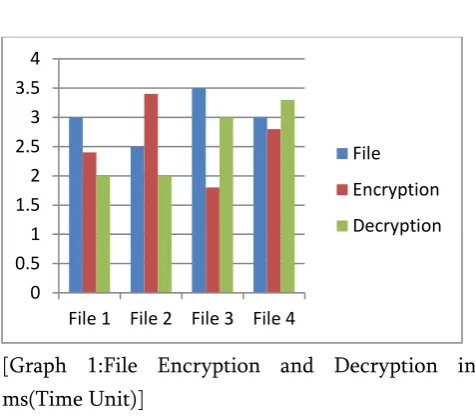
[Graph 1:File Encryption and Decryption in ms(Time Unit)]
Here X axis indicates file number and y axis indicates time in msec.
File Size
Encryption Decryption
File 1 3KB 2.4ms 2 ms File 2 2.5KB 3.4 ms 2 ms File 3 3.5KB 1.8 ms 3 ms File 4 3KB 2.8 ms 3.3 ms
[Table No.1]
Table 1 shows that File1 having size 3KB is encrypted in 2.4ms and it gets decrypted in 2ms.File 2 having size 2.5KB is encrypted in 3.4ms and it gets decrypted in 2ms.File3 having size 3.5KB is encrypted in 1.8ms and it gets decrypted in 3ms.File4 having size 2.8KB is encrypted in 2.8ms and it gets decrypted in 3.3ms.
V. CONCLUSIONS
As a development within the technology of the net and cryptography, cluster information sharing in cloud computing has opened up a replacement space of quality to pc networks. With the assistance of the conference key agreement protocol, the security and
0 0.5 1 1.5 2 2.5 3 3.5 4
File 1 File 2 File 3 File 4
File
Encryption
potency of cluster information sharing in cloud computing may be greatly improved. Specifically, the outsourced data of the information the info the information} house owners encrypted by the common conference key square measure shielded from the attacks of adversaries. Compared with conference key distribution, the conference key agreement has qualities of upper safety and responsible. However, the conference key agreement asks for an outsized amount of knowledge interaction within the system and additional computational price. To combat the issues within the conference key agreement, the SBIBD is used within the protocol design.
In this project, we tend to gift a completely unique block design-based key agreement protocol that supports cluster information sharing in cloud computing. because of the definition and therefore the mathematical descriptions of the structure of a (v; k + 1; 1)- design, multiple participants may be concerned within the protocol and general formulas of the common conference key for participant square measure derived. Moreover, the introduction of volunteers permits the given protocol to support the fault tolerance property, thereby creating the protocol additional practical and secure. In our future work, we might like to extend our protocol to produce additional properties (e.g., anonymity, traceability, so on) to create it applicable for a variety of environments.
VI. REFERENCES
[1]. L. Zhou, V. Varadharajan, and M. Hitchens,
“Cryptographic rolebased access control for
secure Cloud data storage systems,”
Information Forensics and ecurity IEEE Transactions on, vol. 10, no. 11, pp. 2381–2395, 2015
[2]. F. Chen, T. Xiang, Y. Yang, and S. S. M. Chow,
“Secure cloud storage meets with secure
network coding,” in IEEE INFOCOM, 2014, pp.
673–681.
[3]. D. He, S. Zeadally, and L. Wu, “Certificateless
public auditing scheme for cloud-assisted
wireless body area networks,” IEEE Systems
Journal, pp. 1–10, 2015.
[4]. W. Diffie and M. E. Hellman, “New directions
in cryptography,” IEEE Transactions on
Information Theory, vol. 22, no. 6, pp. 644–654, 1976.
[5]. J. Shen, H. Tan, S. Moh, I. Chung, and J. Wang,
“An efficient rfid authentication protocol
providing strong privacy and security,” Journal
of Internet Technology, vol. 17, no. 3, p. 2, 2016
[6]. L. Law, A. Menezes, M. Qu, J. Solinas, and S.
Vanstone, “An efficient protocol for
authenticated key agreement,” Designs Codes
and Cryptography, vol. 28, no. 2, pp. 119–134, 2010.
[7]. X. Yi, “Identity-based fault-tolerant conference
key agreement,” IEEE Transactions on
Dependable and Secure Computing, vol. 1, no. 3, pp. 170–178, 2004.
[8]. R. Barua, R. Dutta, and P. Sarkar, “Extending
joux’s protocol to multi party key agreement
(extended abstract).” Lecture Notes in
Computer Science, vol. 2003, pp. 205–217, 2003.
[9]. J. Shen, S. Moh, and I. Chung, “Identity-based
key agreement protocol employing a symmetric
balanced incomplete block design,” Journal of
Communications and Networks, vol. 14, no. 6, pp. 682–691,2012.
[10]. B. Dan and M. Franklin, “Identity-based
encryption from the weil pairing,” Siam Journal
on Computing, vol. 32, no. 3, pp. 213–229,2003. [11]. S. Blakewilson, D. Johnson, and A. Menezes,
“Key agreement protocols and their security
analysis,” in IMA International Conference on
[12]. I. Chung and Y. Bae, “The design of an efficient
load balancing algorithm employing block
design,” Journal of Applied Mathematics and
Computing, vol. 14, no. 1, pp. 343–351, 2004. [13]. O. Lee, S. Yoo, B. Park, and I. Chung, “The
design and analysis of an efficient load balancing algorithm employing the symmetric
balanced incomplete block design.”
Information Sciences, vol. 176, no. 15, pp. 2148–2160, 2006.
[14]. R. Curtmola, J. Garay, S. Kamara, and R. Ostrovsky, “Searchable symmetric encryption:
Improved definitions and efficient
constructions,” Journal of Computer Security,
vol. 19, no. 5, pp. 79–88, 2011.
[15]. N. Cao, C. Wang, M. Li, K. Ren, and W. Lou,
“Privacy-preserving multi-keyword ranked
search over encrypted cloud data,” IEEE
Transactions on Parallel and Distributed Systems, vol. 25, no. 1, pp.222–233, 2014.
Cite this article as :