Biomedical entity extraction using machine-learning based approaches
Cyril Grouin
CNRS, UPR 3251, LIMSI91403 Orsay, France [email protected]
Abstract
In this paper, we present the experiments we made to process entities from the biomedical domain. Depending on the task to process, we used two distinct supervised machine-learning techniques: Conditional Random Fields to perform both named entity identification and classification, and Maximum Entropy to classify given entities. Machine-learning approaches outperformed knowledge-based techniques on categories where sufficient annotated data was available. We showed that the use of external features (unsupervised clusters, information from ontology and taxonomy) improved the results significantly.
Keywords:Conditional Random Fields; Named Entity Recognition; Natural Language Processing
1.
Introduction
1.1.
Presentation
Scientific documents provide useful information in many domains. Because processing those documents is time-consuming for a human, NLP techniques have been de-signed to process a huge amount of documents quickly. In the biological domain, the availability of the GENIA cor-pus1(Kim et al., 2003), a huge corpus of 100,000 annotated
terms from the biological domain out of a total of more than 400,000 terms, led many teams to design NLP-based approaches in order to extract the knowledge from the doc-uments (Nadeau and Sekine, 2007).
Biologists need automatic methods to mine documents with scientific information in order to leverage knowledge from the scientific literature or from knowledge databases (genome databases, pharmacology patents), especially to study bacteria and genome. The main issue for biologists is to discover correlations between distinct kinds of informa-tion in order to confirm or disgard a given hypothesis. Over the past few years, an increasing number of NLP eval-uation campaigns have been organized on the biomedical domain, in order to design systems that allow scientists to automatically access document content(i2b2/VA,2BioNLP
Shared-Task,3ShARe/CLEF eHealth,4Drug-Drug
Interac-tion5). In each challenge, the first part of the work
usu-ally consisted in the identification of entity mentions (drug names, medical problem, test) before performing additional analysis: interactions between drug names (Segura-Bedmar et al., 2011), assertion and relationships between entities (Uzuner et al., 2011), coreference resolution (Uzuner et al., 2012), temporal links between entities (Sun et al., 2013), etc. The success of entity identification is critical for the success of the next steps.
1http://www.nactem.ac.uk/genia/
2http://www.i2b2.org/NLP/
3http://2013.bionlp-st.org/
4
https://sites.google.com/site/ shareclefehealth/
5http://labda.inf.uc3m.es/
DDIExtraction2011/
1.2.
Motivations
Herein, we describe the methods we used to extract knowl-edge from texts in biology and pharmacology, while partic-ipating in two challenges, with main objective to rapidly access the information. Our experiments rely on two machine-learning approaches: Conditional Random Fields (Lafferty et al., 2001; Sutton and McCallum, 2006) to pro-cess sequences labeling and Maximum Entropy (Guiasu and Shenitzer, 1985; Berger et al., 1996) to perform cat-egorization on already identified mentions.
The first set of experiments consists of the identification and the categorization of bacteria and biotope mentions from scientific abstracts. The main part of this work has been done within the framework of the BioNLP Bacte-ria/Biotope Challenge (Grouin, 2013), with additional ex-periments since it occurred. The second set of exex-periments extends this work on a corpus of pharmacology patents with new categories. Those new experiments rely on the catego-rization of already identified entities(i.e., entity frontiers were provided) in pharmacology patents, among twelve categories of entity which are similar to semantic types from the UMLS (Lindberg et al., 1993).
2.
Related Work
In 2010, the i2b2/VA NLP challenge focused on the pro-cessing of documents from the medical domain (Uzuner et al., 2011). Three tasks were proposed: (i) extraction of entities among three categories(problem, test, treatment),
3.
Material and Methods
3.1.
Corpora
3.1.1. Bacteria/Biotope corpus
The corpus used during the challenge comprises a total number of 131 web pages about bacterial species written for non-experts (description of individual bacterium and groups of bacteria, first observation, characteristics, evo-lution and biotopes). This corpus includes both raw tex-tual documents—without any tokenization performed over texts—and external reference annotations. Table 1 shows a few statistics on the annotations obtained over training and development corpora6 for each type of entity to be
anno-tated(bacteria, habitat,andgeographical).
Corpus Training Development
# Documents 52 26
# Words 16,294 9,534
Average # words/doc 313.3 366.7
# Bacteria 832 515
# Habitat 934 611
# Geographical 91 77
Table 1: Statistics on the bacteria/biotope corpus
Besides challenge data, we used an additional corpus of 1,884 textual documents7 from the same sources as those
used in the BioNLP 2013 shared task corpus. No external reference annotations have been made on those documents. We used this new corpus of 2,015 documents to build un-supervised clusters of words (see section 3.2.).
3.1.2. Pharmacology patents corpus
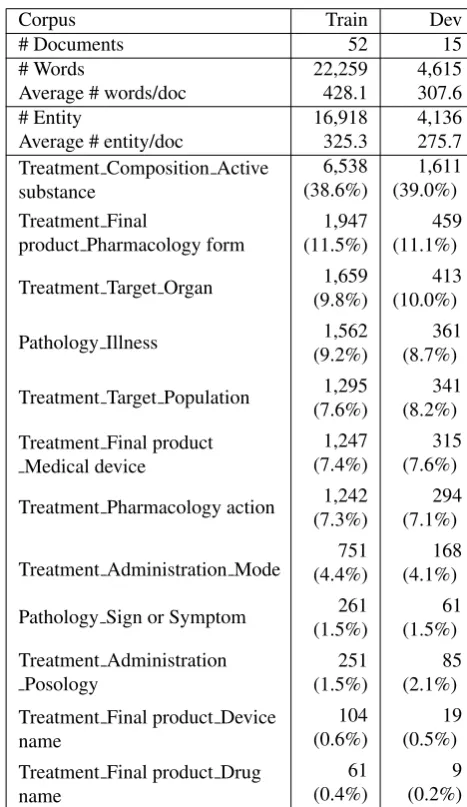
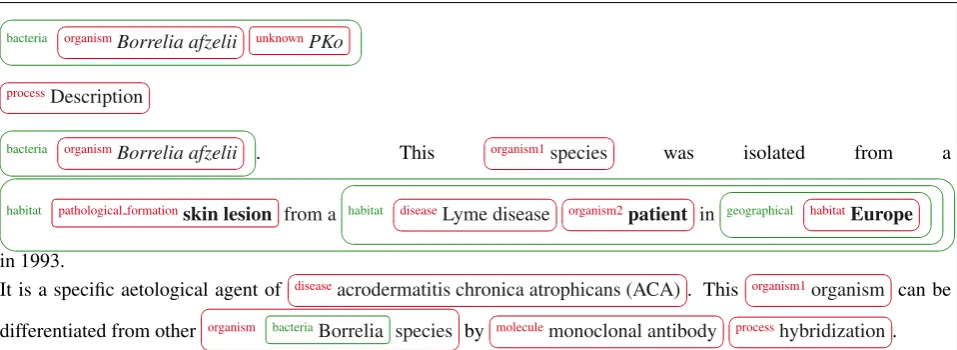
The corpus is composed of web pages of pharmacology patents valid for Europe. Each patent includes a detailed description of the invention in English, and a shorter de-scription written in German and in French. The pharmacol-ogy entities are annotated within the English part of each document with embedded tags, i.e., entity frontiers are pro-vided and an entity categorization must be performed. Table 2 shows a few statistics on both training and development corpora, with the number of annotations per category from the gold standard annotations in decreasing order. According to those statistics, the number of annotations per category is clearly unbal-anced: 50% of entities are, either of the category “Treatment Composition Active substance” or the cate-gory “Treatment Final product Pharmacology form” and four categories of entities include each one less than 2% of all entities. Figure 1 shows an extract from the develop-ment corpus with annotations of entity and relations.
6
The reference annotations for the test corpus have not been released by the organizers to the participants.
7
We obtained these documents as part of Quaero program, a research project in which both the Bacteria/Biotope shared task organizers and us are involved.
Corpus Train Dev
# Documents 52 15
# Words 22,259 4,615
Average # words/doc 428.1 307.6
# Entity 16,918 4,136
Average # entity/doc 325.3 275.7
Treatment Composition Active substance
6,538 1,611 (38.6%) (39.0%)
Treatment Final
product Pharmacology form
1,947 459
(11.5%) (11.1%)
Treatment Target Organ 1,659 413
(9.8%) (10.0%)
Pathology Illness 1,562 361
(9.2%) (8.7%)
Treatment Target Population 1,295 341 (7.6%) (8.2%)
Treatment Final product Medical device
1,247 315
(7.4%) (7.6%)
Treatment Pharmacology action 1,242 294 (7.3%) (7.1%)
Treatment Administration Mode
751 168
(4.4%) (4.1%)
Pathology Sign or Symptom 261 61
(1.5%) (1.5%)
Treatment Administration Posology
251 85
(1.5%) (2.1%)
Treatment Final product Device name
104 19
(0.6%) (0.5%)
Treatment Final product Drug name
61 9
(0.4%) (0.2%)
Table 2: Statistics on the corpora of pharmacology patents
3.2.
Methods
3.2.1. Entity identification and categorization
Resources. We used external resources to build our mod-els. First, we used OntoBiotope,8 an ontology tailored for
the biotopes domain that includes 1,756 concepts.
Second, we built a list of 357,387 bacteria taxa based on the NCBI taxonomy database9 (Federhen, 2012) so as to help
our system to identify the bacteria names. This taxonomy includes twelve categories of entities from the biological domain.10 From this taxonomy, we extracted all names
be-longing to theBacteriacategory (24.3% of the content). Third, we used lexical annotations produced by the Cocoa11 tool (Ramanan and Nathan, 2013). These annotations em-phasize 37 pre-defined categories, mainly from the molec-ular biology domain.
8http://bibliome.jouy.inra.fr/
MEM-OntoBiotope/OntoBiotope_BioNLP-ST13.obo
9
http://www.ncbi.nlm.nih.gov/taxonomy/
10
Bacteria, invertebrates, mammals, phages, plants, primates, rodents, synthetics, unassigned, viruses, vertebrates and environ-mental samples.
11Compact cover annotator for biological noun phrases,http:
# Features Expected answer 9 entity=Theophylline token=Theophylline cap=Mm local=Mm
sty=Traitement Composition SubstanceActive
Treatment Composition ActiveSubstance 21 entity=17β-estradiol token=17β-estradiol cap=O local=O digit=DIG
brown=11111001111
Treatment Composition ActiveSubstance 18 entity=powder form token=powder token=form cap=mm
lo-cal=mm local=mm brown=111101111001 brown=111100111101 key=T FormPharma
Treatment FinalProduct PharmaForm
168 entity=target cell token=target token=cell cap=mm lo-cal=mm local=mm brown=111110000111 brown=11111001010 sty=Treatment Target Organ
Treatment Target Organ
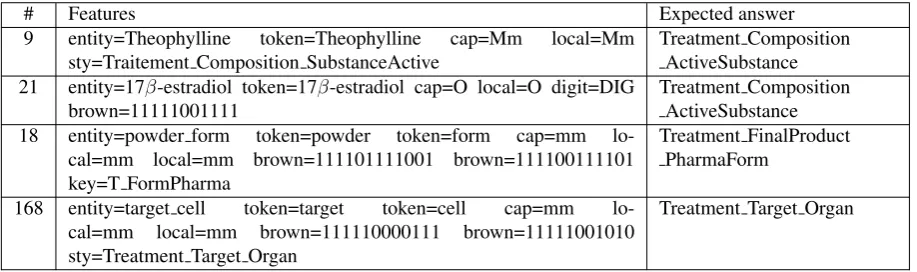
Figure 3: Extract from the train file
• Surface feature:
– capitalization of the whole entity and of each to-ken among four schemas(all in upper case, all in lower case, combination of upper and lower case, not relevant);
– presence of digit within the entity;
– presence of key-concept in the entity name: this would be beneficial for the categoriza-tion (“form” in “powder form” is a clue for the “Treatment FinalProduct PharmaForm” category);
– presence of special symbols within the name which are useful to detect drug name or device name: copyright “ c”, registered mark “”, andR
trade mark “TM”.
• External feature:
– the cluster ID of each token based on a Brown clusterization performed on the whole corpus;
– the semantic type of the whole entity and of each token from the UMLS (Lindberg et al., 1993), based on the UMLS file provided by the organiz-ers (i.e., only the term and its semantic type, no CUI).
Figure 3 presents an extract from the file used to build the model. As an example, the entity “power form” (#18) is composed of two tokens “powder” and “form”; both the whole entity and each token are capitalized in lower case (cap=mm, local=mm, local=mm); the Brown clus-ter ID for the first token is “111101111001” and the ID for the second token is “111100111101”; and the token “form” is a key-concept for the expected answer “Treat-ment FinalProduct PharmaForm”.
Experiments. We conducted four experiments on this task:
1. The first experiment is the result of the MaxEnt model;
2. The second experiment relies on post-processing of the output from the MaxEnt model: for each un-predicted category, if a key-concept suggested the category should be modified, we changed it accord-ingly, else we gave the mostly used category: “Treat-ment Composition ActiveSubstance”;
3. The third experiment is similar to the first experiment, except we did not use information from the UMLS thesaurus;
4. The last experiment is only based on the thesaurus; it consists in applying the UMLS list provided by the or-ganizers, either on the full corpus or on the test corpus.
4.
Results
4.1.
Entity identification and categorization
Table 3 shows the detailed results we achieved on the de-velopment set (in terms of recall, precision and F-measure) from the bacteria biotopes entity identification and catego-rization task. The results we achieved during the challenge are on the upper line while the results we obtained with the additional experiments are on the lower line.Category Recall Precision F-measure
Bacteria 0.8794 0.9397 0.9085 0.8872 0.9249 0.9057
Geographical 0.6533 0.7903 0.7153 0.6933 0.8387 0.7591
Habitat 0.6951 0.8102 0.7482 0.7197 0.8444 0.7771
Overall 0.7771 0.8715 0.8216 0.7950 0.8836 0.8369
Table 3: Results from the challenge (upper line) and from the additional experiments (lower line) on the bacteria biotopes identification (development corpus). The best re-sults appear in bold font
4.2.
Term categorization
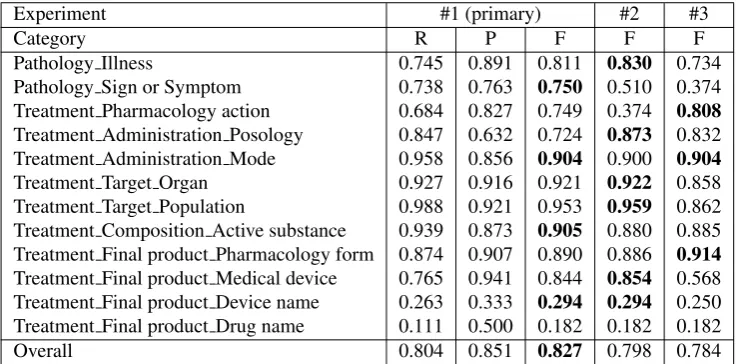
Table 4 shows the results our system achieved on the devel-opment set for term categorization. For the primary exper-iment (#1), results are shown in terms of recall, precision and F-measure for each category and overall. This exper-iment corresponds to the output of the MaxEnt model out of the box. For the other two experiments, we only provide F-measure.
Experiment #1 (primary) #2 #3
Category R P F F F
Pathology Illness 0.745 0.891 0.811 0.830 0.734
Pathology Sign or Symptom 0.738 0.763 0.750 0.510 0.374 Treatment Pharmacology action 0.684 0.827 0.749 0.374 0.808 Treatment Administration Posology 0.847 0.632 0.724 0.873 0.832 Treatment Administration Mode 0.958 0.856 0.904 0.900 0.904 Treatment Target Organ 0.927 0.916 0.921 0.922 0.858 Treatment Target Population 0.988 0.921 0.953 0.959 0.862 Treatment Composition Active substance 0.939 0.873 0.905 0.880 0.885 Treatment Final product Pharmacology form 0.874 0.907 0.890 0.886 0.914 Treatment Final product Medical device 0.765 0.941 0.844 0.854 0.568 Treatment Final product Device name 0.263 0.333 0.294 0.294 0.250 Treatment Final product Drug name 0.111 0.500 0.182 0.182 0.182
Overall 0.804 0.851 0.827 0.798 0.784
Table 4: Term categorization evaluation on the development corpus depending on the experiment. Bold font stands for the best result
Table 5 shows the results on the test set.
# Experiment F-measure
1 MaxEnt (primary) 0.7694
2 MaxEnt + post-processing 0.7545
3 MaxEnt w/o UMLS 0.7368
4a Thesaurus only (on the full corpus) 0.6621 4b Thesaurus only (on the test set) 0.6366
Table 5: Results on the test set
5.
Discussion
5.1.
Entity identification and categorization
The results on the bacteria biotope corpus show that our CRF-based system succeed to correctly identify bacteria mentions (F=0.906). Nevertheless, the biotope entities are more difficult to process than the bacteria entities ( geo-graphicalF=0.759, habitat F=0.777). A similar observa-tion has been made on the 2011 BioNLP Bacteria Biotope shared-task for all participants.The use of clusters of tokens produced on a huge cor-pus and annotations of part-of-speech sequence provided by BioYATEA slightly improved the results. In compari-son with the results we achieved during the BioNLP chal-lenge (Grouin, 2013), our overall F-measure increased from 0.8216 to 0.8369. In details, the use of BioYATEA and the new clustering increased the results for both geographi-cal(+4.38 points) andhabitat(+2.89 points) categories for which the gain is well balanced between precision and re-call. Nevertheless, global results are slightly lower for bac-teria(-0.28 point); the recall increased while the precision decreased. While precision is good on the whole, there is still room for improvement, especially in order to improve the recall. For geographicalandhabitat categories, post-processing rules would be beneficial.
5.2.
Term categorization
On both development and test set, our best results were achieved on the primary experiment (i.e., the MaxEnt model applied as it is without any post-processing task).
Our MaxEnt model obtained higher precision than recall on 8 categories out of 12. Higher recall was obtained for the three most frequent categories in the corpus (see Table 2).
While using post-processing improved our results on a few categories (especially on “Pathology illness” from F=0.7816 on the first experiment to F=0.7955 on the second one), the overall results are lower in the second experiment. Performance is lower in the third experiment. Applying the thesaurus without any training method on the corpus did not improve the results (fourth experiment).
The pharmacology patents challenge was restricted to part-ners from a research project. As we were the sole partici-pant, we can not compare our results with others. We as-sume our results would constitute a baseline.
6.
Conclusions
In this paper, we presented the two methods we used to pro-cess entities from the biomedical domain. We used CRF to both identify and categorize entities among three categories (bacteria, biotopes, geographical names), while we used a Maximum Entropy approach to only categorize entities on corpora of pharmacology patents.
To detect bacteria and biotopes names, we used a machine-learning approach based on CRFs. We used several re-sources to build the model, among them the NCBI taxon-omy, the OntoBiotope ontology, the Cocoa annotations, and unsupervised clusters created through Brown’s algorithm. This formalism and those external resources proved to be relevant to process both identification and categorization of entities from the biomedical domain (F=0.8369).
7.
Acknowledgments
This work was supported by Quaero Programme, funded by Oseo, French State agency for innovation.
8.
References
Aubin, S. and Hamon, T. (2006). Improving term extrac-tion with terminological resources. In Saloski, T., Gin-ter, F., Pyysalo, S., and Pahikkala, T., editors, Proc of FinTAL, pages 380–7, Turku, Finland.
Berger, A. L., Della Pietra, S., and Della Pietra, V. J. (1996). A maximum entropy approach to natural lan-guage processing.Computational Linguistics, 22(1):39– 71.
Bossy, R., Jourde, J., Manine, A.-P., Veber, P., Alphonse, E., van de Guchte, M., Bessi`eres, P., and N´edellec, C. (2012). BioNLP shared task – the bacteria track. BMC Bioinformatics, 13(Suppl 11):S3.
Bossy, R., Golik, W., Ratkovic, Z., Bessi`eres, P., and N´edellec, C. (2013). Bionlp shared task 2013 – an overview of the bacteria biotope task. InProc of BioNLP Shared Task Workshop, pages 161–169, Sofia, Bulgaria. Association for Computational Linguistics.
Brown, P. F., Della Pietra, V. J., de Souza, P. V., Lai, J. C., and Mercer, R. L. (1992). Class-based n-gram models of natural language. Computational Linguistics, 18(4):467–79.
de Bruijn, B., Cherry, C., Kiritchenko, S., Martin, J. D., and Zhu, X. (2010). Machine-learned solutions for three stages of clinical information extraction: the state of the art at i2b2 2010. J Am Med Inform Assoc, 18(5):557–62. Federhen, S. (2012). The NCBI taxonomy database.
Nu-cleic Acids Res, 40(Database issue):D136–43.
Golik, W., Bossy, R., Ratkovic, Z., and N´edellec, C. (2013). Improving term extraction with linguistic anal-ysis in the biomedical domain. In Proc of CICLing, Samos, Greece. Special Issue of the journal Research in Computing Science.
Grouin, C. (2013). Building a contrasting taxa extractor for relation identification from assertions: Biological taxon-omy & ontology phrase extraction system. In Proc of BioNLP Shared Task Workshop, pages 144–152, Sofia, Bulgaria. Association for Computational Linguistics. Guiasu, S. and Shenitzer, A. (1985). The principle of
max-imum entropy.The Mathematical Intelligence, 7(1). Jiang, M., Chen, Y., Liu, M., Rosenbloom, S. T., Mani, S.,
Denny, J. C., and Xu, H. (2011). A study of machine-learning-based approaches to extract clinical entities and their assertions from discharge summaries. J Am Med Inform Assoc, 18(5):601–6.
Kim, J. D., Ohta, T., Tateisi, Y., and Tsujii, J. (2003). GENIA corpus–a semantically annotated corpus for bio-textmining. Bioinformatics, 19(Suppl 1):180–2. Kim, J.-D., Pyysalo, S., Ohta, T., Bossy, R., Nguyen, N.,
and Tsujii, J. (2011). Overview of BioNLP shared task 2011. In BioNLP Shared Task 2011 Workshop Proc, pages 1–6, Portland, OR. ACL.
Lafferty, J., McCallum, A., and Pereira, F. (2001). Condi-tional Random Fields: Probabilistic models for segment-ing and labelsegment-ing sequence data. InProc of ICML.
Lavergne, T., Capp´e, O., and Yvon, F. (2010). Practical very large scale CRFs.Proc of ACL, pages 504–13, July. Liang, P. (2005). Semi-supervised learning for natural
lan-guage. Master’s thesis, MIT.
Lindberg, D. A., Humphreys, B. L., and McRay, A. T. (1993). The Unified Medical Language System. Meth-ods Inf Med, 32(4):281–91.
Nadeau, D. and Sekine, S. (2007). A survey of named en-tity recognition and classification. Journal of Linguisti-cae Investigationes, 30(1):3–26.
N´edellec, C., Bossy, R., Kim, J.-D., Kim, J.-J., Ohta, T., Pyysalo, S., and Zweigenbaum, P. (2013). Overview of bionlp shared task 2013. InProc of BioNLP Shared Task Workshop, pages 1–7, Sofia, Bulgaria. Association for Computational Linguistics.
Ramanan, S. and Nathan, P. S. (2013). Performance and limitations of the linguistically motivated Co-coa/Peaberry system in a broad biomedical domain. In Proc of BioNLP Shared Task Workshop, pages 86–93, Sofia, Bulgaria. Association for Computational Linguis-tics.
Segura-Bedmar, I., Martinez, P., and S´anchez-Cisneros, D. (2011). The 1st DDIExtraction-2011 challenge task: Ex-traction of drug-drug interactions from biomedical texts. InProc of Drug-Drug Interaction Extraction Challenge, pages 1–9.
Sun, W., Rumshisky, A., and Uzuner, O. (2013). Evaluat-ing temporal relations in clinical text: 2012 i2b2 chal-lenge. J Am Med Inform Assoc, 20(5).
Sutton, C. and McCallum, A. (2006). An introduction to Conditional Random Fields for relational learning. In Getoor, L. and Taskar, B., editors, Introduction to Sta-tistical Relational Learning. MIT Press.
Uzuner, O., South, B. R., Shen, S., and DuVall, S. L. (2011). 2010 i2b2/VA challenge on concepts, assertions, and relations in clinical text. J Am Med Inform Assoc, 18(5):552–6.