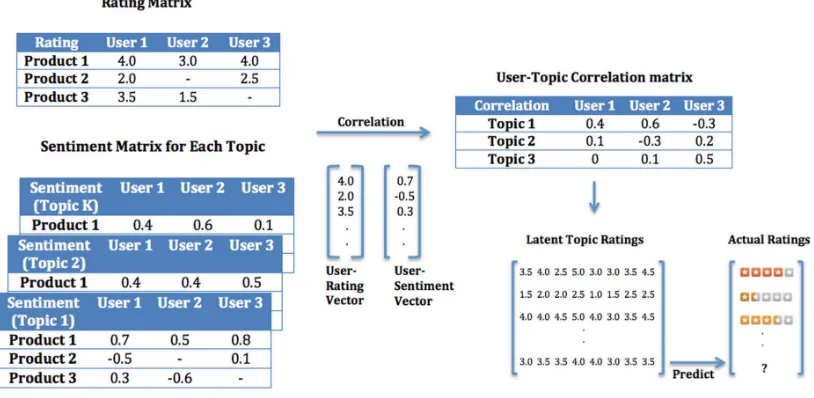
Figure 1: An overview of our proposed method
very few previous works have attempted to combine both review text and ratings. Our approach com-bines latent topics obtained from review text with users’ rating data to learn representative users for each product. This enables us to predict ratings for new products by just looking at the ratings of a small set of users, even when no review text is available. In traditional methods, product ratings are obtained by modelling the product factors from ratings data. However, (McAuley and Leskovec, 2013) suggest that this approach is not accurate in case of new products due to the lack of sufficient number of rat-ings. They, in turn, propose a model which fits prod-uct factors from a few review texts. Our approach is free from both these constraints.
In this study, we use the topic model Multi-Grain Latent Dirchlet Allocation (MG-LDA) described in (Titov and McDonald, 2008a) on restaurant reviews obtained from Yelp1to obtain latent topics that
cor-respond to ratable aspects of the restaurants. Since we segregate the reviews on the basis of restau-rant category, we notice some interesting variations across different cuisines. The words associated with the extracted topics are then used to perform review segmentation where we identify the sentences that describe each topic. This also enables us to anal-yse the sentiment expressed regarding each topic in a review. We then capture the intuition of
represen-1http://www.yelp.com
tative users to learn a set of users who best repre-sent each topic. Latent topic ratings for restaurants are then obtained by aggregating the ratings of those users who represent that topic. The overall ratings of new restaurants are then predicted using a regres-sion model. An overview of the proposed method is shown in Figure 1.
We also show how this concept could be used to better understand rating behaviour across different cuisines. For example: What do people who visit French restaurants care most about - food, service or value for money? How is this different from people who visit Italian restaurants?
The rest of the paper is structured as follows. Sec-tion 2 provides a review of related work. SecSec-tion 3 describes our proposed method. In Section 4, we describe the experiments performed and report the results of our evaluation. Section 5 concludes the paper with a summary of the work and the scope for future work.
2 Related Work
Figure 2: Review Segmentation
it does not capture the variation that may exist within the domain. For example: The aspects that affect ratings for French restaurants (e.g. ‘Drinks (wine)’, ‘Deserts’ etc.) may be different from those of In-dian restaurants (e.g. ‘Flavour (spiciness)’, ‘Vari-ety’ etc.). (Wang et al., 2010) approach the prob-lem of segmentation by measuring the overlap be-tween each sentence of the review and the seed words describing each aspect. However, these as-pect seed words are chosen manually which are, again, domain-specific.
Topic models are normally used to make the segmentation task transferable across different do-mains. The problem of mapping such topics into as-pects is studied in (Titov and McDonald, 2008b; Lu et al., 2011; Brody and Elhadad, 2010; McAuley et al., 2012; Jo and Oh, 2011). (Titov and McDonald, 2008b; McAuley et al., 2012) use explicit aspect rat-ings as a form of weak supervision to identify rated aspects while (Lu et al., 2011) use manually selected aspect seed words as a form of weak supervision. To remove the dependence on aspect ratings and aspect seed words, (Jo and Oh, 2011) develop a model that captures aspects using a set of sentiment seed words while (Brody and Elhadad, 2010) present an unsu-pervised method for extracting aspects by automati-cally deriving the sentiment seed words from review text. It is important to note that we do not map the latent topics we obtain into explicit aspects since it is not necessary for our final goal.
Rating prediction is also studied in (Gupta et al., 2010; Moghaddam and Ester, 2011; Baccianella et al., 2009) where the authors focus on multi-aspect
rating prediction and in (McAuley and Leskovec, 2013) where the authors build a recommendation system using a combination of latent dimensions ob-tained from rating data and latent topics obob-tained from review text.
3 Methodology
3.1 Dataset and Preprocessing
We use the Yelp Challenge Dataset2 consisting of
around 1.12 million reviews of more than 42000 restaurants across 4 countries. These reviews are provided by more than 250000 users. Reviews con-tain a single star rating, text, author etc. Details of restaurants like average star rating, categories (cui-sine) etc. are also available. We segment the restau-rants according to its category since we would like to better understand the variation that exists across dif-ferent cuisines. Note that we ignore the fact that cer-tain restaurants may have multiple categories. For example: Some Indian restaurants may also serve Thai food.
We tokenize the review text along whitespaces, remove all punctuation and stop-words, and lemma-tize the words using the NLTK Wordnet lemmalemma-tizer described in (Bird et al., 2009).
3.2 Topic Extraction
We run the topic model multi-grain LDA described in (Titov and McDonald, 2008a) on a corpus of restaurant reviews obtained from a single cuisine to extractKlatent topics. Unlike standard topic
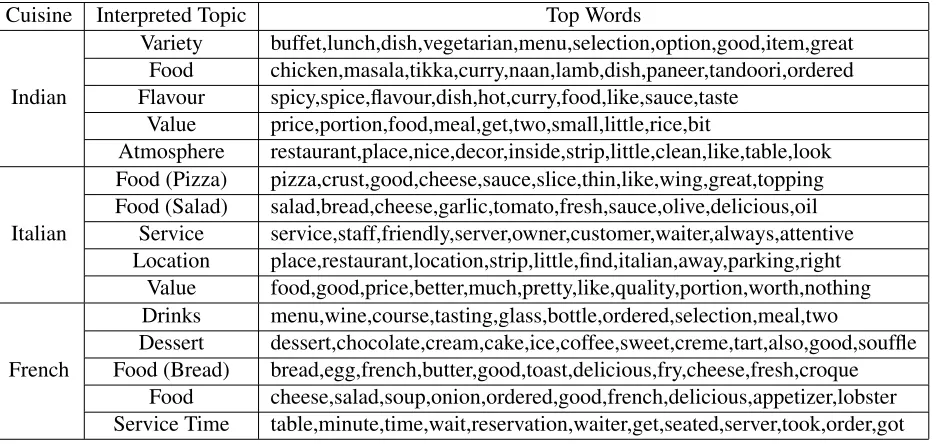
French
Drinks menu,wine,course,tasting,glass,bottle,ordered,selection,meal,two
Dessert dessert,chocolate,cream,cake,ice,coffee,sweet,creme,tart,also,good,souffle Food (Bread) bread,egg,french,butter,good,toast,delicious,fry,cheese,fresh,croque
Food cheese,salad,soup,onion,ordered,good,french,delicious,appetizer,lobster Service Time table,minute,time,wait,reservation,waiter,get,seated,server,took,order,got
Table 1: Local topics for Indian, Italian and French restaurants obtained using MG-LDA
modeling methods such as LDA and PLSA, which extract topics that correspond to global properties of a product, MG-LDA extracts much finer topics that correspond to ratable aspects of the product. To ex-tract topics at such granular level, the model gener-ates terms which are either chosen at the document level or chosen from a sliding window3. The terms
chosen from the sliding window correspond to the fine topics.
3.3 Review Segmentation and Sentiment Analysis
Once cuisine-specific latent topics are obtained, the review segmentation task is performed where each review sentence si is assigned to one of the latent
topicstk. The purpose of this task is to understand
which sentences of the review discuss which of the topics. The topic assignment is made as follows:
T opic(si) = arg max k
!
w∈tk
count(w, si)∗P(w|tk)
(1) where w is the word associated with each topic, count(w, si) is the count of word w in sentence si
andP(w|tk) is the probability as determined from
the word distributions obtained using the MG-LDA model.
3A sliding window is a set of fixed number of adjacent
sen-tences.
For every review, the sentences that discuss each topic are identified as shown in Figure 2. It is there-fore possible to determine the sentiment expressed by the review author regarding each latent topic by averaging over the sentiments of its constituent sentences. We use the implementation TextBlob4,
which is based on the Pattern5library, to determine
the polarity of each sentence. The polarity is ob-tained in the range of [-1, 1].
3.4 User Segmentation
We then proceed to learn the representative users for each latent topic. First, the feature vectorθoverallu is
obtained for each useru where each feature
repre-sents the users’ review rating for a restaurant. We assume that each user writes only one review per restaurant. Similarly,θtk
u is obtained where each
fea-ture represents the users’ sentiment regarding topic
tk.
The influence of a topic on a users’ rating is de-termined by calculating the Pearson’s correlation between θoverallu and θtk
u. Only users who have
provided a minimum of 5 reviews are considered. A user-topic correlation matrixC is thus obtained which indicates the dimensions along which each
4http://www.textblob.readthedocs.org/en/
dev/
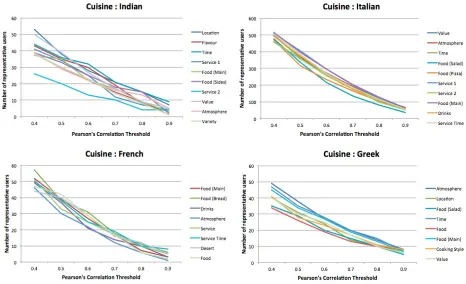
Figure 3: Number of Representative Users for various cuisines
user tends to rate restaurants. Simply put,
C(u, tk) =P earsonCorr(θuoverall,θtku) (2)
The representative users for a topic are those users whoseC(u, tk)value is above a certain thresholdT
for that particular topic. It is important to note that
C(u, tk)value may not be available for all user-topic
pairs since every user may not express sentiments regarding every topic.
3.5 Rating Prediction
We calculate the topic ratings of restaurants once we obtain a list of representative users for each la-tent topic. This rating is calculated as the average of the review ratings that are provided by the repre-sentative users of that particular topic. In case there are no representative users for a particular topic for that particular restaurant, this rating is calculated as the average of the other latent topic ratings. Such topic ratings provide some indication of the quality of various aspects of the restaurant (like food, ser-vice etc.), although we do not explicitly calculate the aspect ratings or map the topics to aspects.
Since the overall restaurant rating can be thought of as some combination of the ratings for food, ser-vice, atmosphere etc., we try to combine the latent topic ratings in some way. For this purpose, we fit a Support Vector Regression (SVR) model with ra-dial basis function kernel on the latent topic ratings and use it to predict the overall rating of restaurants. During test time, just the ratings provided by a few representative users would be enough to obtain the overall restaurant rating. Such a rating takes into ac-count the different dimensions of the restaurant and provides a ‘complete picture’ of the restaurant.
4 Experiments and Analysis
We use the topic model MG-LDA on a set of 8000 reviews each of Indian, Italian, French and Greek restaurants. The number of global topics is set at
Kglo = 40and local topics atKloc= 15(After
‘Dessert’ as topics. Greek restaurants have ‘Cook-ing Style’ as a topic with words like dry, fry, fresh, cooked, soft, tender etc. Also, certain words like table, minute, time, wait, hour, bar, seated etc. ap-pear together in case of French and Italian restau-rants signaling, perhaps, a long wait to get seated at such restaurants.
Review segmentation is then performed on around 8500 reviews of Indian restaurants, 61000 reviews of Italian restaurants and 17000 reviews of French restaurants, where each sentence is assigned to one of the 15 latent topics. Sentiment analysis is conducted and the user-topic correlation matrix is obtained for each restaurant category.
Using the user-topic correlation matrix, we seg-ment the users according to each latent topic. Fig-ure 3 shows the number of representative users for each topic for different correlation thresholdsT. For
the sake of clarity, we only show those latent top-ics that could be interpreted by us. It is interesting to observe that people who visit Indian restaurants tend to care the most about ‘Location’ and ‘Value (Pricing)’ and the least about ‘Service’ and ‘Atmo-sphere’. On the other hand, people who visit French restaurants care the most about ‘Food (Bread)’ and ‘Food (Main)’ and the least about ‘Atmosphere’. Similarly, while providing ratings, more number of users are influenced by the ‘Atmosphere’ at Greek restaurants than ‘Food’. We then proceed to obtain the latent topic ratings for each restaurant. For this purpose, we only select those users whose correla-tion threshold, T >= 0.4 as representative users. For each latent topic, we average over the ratings provided by such users to obtain the topic ratings (out of 5). It is therefore possible to obtain crude ratings for aspects like ‘Food’, ‘Service’ etc. which give an indication of the quality of the aspects. We
215 restaurants for test. The results are shown in Table 2.
Models RMSE
(a) MG-LDA, SVR with rbf kernel
(Proposed Model) 0.4909
(b) MG-LDA, SVR with linear kernel 0.5377 (c) LDA, SVR with rbf kernel 0.5812 (d) LDA, SVR with linear kernel 0.6277
(e) Baseline 1 0.6737
(f) Baseline 2 0.5831
Improvement
(a) vs. (e) 27%
(a) vs. (f) 16%
Table 2: Evaluation (Italian Restaurants)
An RMSE of 0.4909 is obtained when using MG-LDA and SVR with rbf kernel. Each restaurant has an average of 22 representative users. Inviting these users to rate new restaurants would help in predict-ing the ‘true’ restaurant ratpredict-ing (which is the ratpredict-ing obtained once a considerable number of users have rated the restaurant over a period of time). However, conventional methods just average over their ratings, without taking into account the different topics that they represent. Such an approach gives an RMSE of 0.6737 (Baseline 1). Our approach outperforms this method by 27%. Also, since most people provide a rating of 3, 3.5 or 4 when rating restaurants, pre-dicting a constant rating every time may also give a reasonable result. We find that predicting a rating of 3.64 (average over the test set) every time results in an RMSE of 0.5831 (Baseline 2). Our approach outperforms such a constant classifier by 16%.