Language Model Weight Adaptation Based on Cross-entropy for
Statistical Machine Translation
Yinggong Zhao, Yangsheng Ji, Ning Xi, Shujian Huang and Jiajun Chen
State Key Laboratory for Novel Software Technology at Nanjing University, Nanjing 210093, P.R.China
{zhaoyg, jiys, xin, huangsj, chenjj}@nlp.nju.edu.cn
Abstract. In this paper, we investigate the language model (LM) adaptation issue for Statis-tical Machine Translation (SMT). In order to overcome the weight bias on the LM obtained from the development data, a simple but effective method is proposed to adapt the LM for diverse test datasets by employing the cross entropy of translation hypotheses as a metric to measure the similarity between different datasets. Experimental results show that the cross entropy of a test dataset is closely correlated with the bias in estimating the language models and our adaptation strategy significantly outperforms a strong baseline.
Keywords: Statistical machine translation, Language model, Weight adaptation, Cross-entropy
1 Introduction
Language modeling is applied in many natural language processing (NLP) applications, including automatic speech recognition (ASR) and SMT. In reality, we often encounter the scenario in which the performance of language model learned from given dataset changes drastically among different datasets. Many adaptation techniques have been proposed to tackle this problem in the field of ASR. A similar situation arises with respect to SMT. In SMT we build language model from large amounts of monolingual data but incorporate it in the translation task of the dataset that is not well covered by the model. This inconsistency inevitably affects the SMT training procedure, making adaptation techniques a necessity.
Different from other tasks, language model is incorporated under a log-linear framework in SMT. Specifically, for each source sentencef, we search for the final translatione∗ among all
possible candidates under the following equation:
P(e∗|f) = arg max
e P r(e|f) (1)
Under log-linear model, the posterior probabilityP r(e|f)can be decomposed as:
P r(e|f) =pλ(e|f)
= exp(
PM
m=1(λm·hm(e, f)))
P
e0exp(PMm=1(λm·hm(e0, f)))
(2)
wherehm(e, f)is a feature function andλmis related weight form= 1, . . . , M.
Under the above framework, we tune the model weight on an independent development dataset, and then we use the obtained weight to translate diverse datasets whose domain or related informa-tion might be previously unknown. It is noticeable that the weight obtained from Minimum Error Rate Training (MERT) matches the development dataset well, whereas it would be bias-estimated
Copyright 2011 by Yinggong Zhao, Yangsheng Ji, Ning Xi, Shujian Huang and Jiajun Chen
for others. Although the value of each feature’s weight represents its importance in the decoding procedure, such type of importance might vary for different datasets under a specific language model. In this article we concentrate on the bias-estimation of language model weight, i.e., the difference between the oracle and actual LM weight as shown in section 3. We measure the simi-larity between datasets based on cross-entropy of translation output according to a given language model, adapt the LM weight based on the ratio of the cross-entropy and obtain the final results through a second-pass translation. Our LM weight adaptation method is also related with density ratio estimation, as mentioned in (Tsuboi et al., 2008), in which reweighting approach is proposed to overcome the bias due to the different distribution of test and training data.
The remainder of this paper is organized as follows: Related work of LM adaptation is present-ed in Section 2. In Section 3 we discuss the problem of LM weight bias-estimation in machine translation. And in Section 4, cross-entropy is proposed as a metric for measuring the similarity between different datasets and we further present our adaptation method. Experimental results are shown in Section 5. We conclude and present several directions for future work in the last section.
2 Related Work
Nowadays LM adaptation in SMT has been paid lots of attentions. There are two main categories for this problem.
The first one is data selection, i.e., when given a test dataset and a large general corpus, which tries to extract sentences from the whole corpus that are relevant to the test dataset under some met-ric. There are two main approaches for the measurement: One is to apply tf-idf metric (Hildebrand et al., 2005; L¨u et al., 2007; Zhao et al., 2004), which arises from information retrieval; while for the other approach cross-entropy (perplexity) is adopted for selection, as reported in (Axelrod et al., 2011; Moore and Lewis, 2010).
The second is model weighting. The main idea is to assign appropriate weight to each model according to the similarity between the model corpus and test dataset. In this approach, the models could be built from domain-specific corpus (Koehn and Schroeder, 2007) when domain of the test dataset is known, or from datasets that belong to different sources (Foster and Kuhn, 2007; L¨u et al., 2007) when it is unavailable in advance. Such weighting method even could be apply to either each sentence from the training corpus (Matsoukas et al., 2009) or phrase pair from the phrase-table (Foster et al., 2010). Besides, the work of (Mohit et al., 2009; Mohit et al., 2010) also belongs to such scenario, in which they attempt to build a classifier to predict whether or not a phrase is difficult, then the LM weight is updated for each phrase segment according to its difficulty.
The methods mentioned above try to overcome the difference between the training and the test data. However, the bias between the development and the test data is also an open issue. Not much attention has been paid to the such weight adaptation. In Li et al. (2010), the model weight is tuned on a subset of the development set, which is extracted based on the relevance to the test set.
In this paper, different from (Li et al., 2010), we focus on the adaptation of LM weight only, as LM is one of the key components of SMT and has its own characteristic. In our work, we adopt cross-entropy as a metric, just as (Axelrod et al., 2011; Moore and Lewis, 2010), to measure the similarity between different datasets. However, only LM weight is adjusted during the adaptation, and no extra model needs to be built. Although our method is quite simple and straightforward, the improvements obtained from the adaptation show that the bias-estimation of LM weight due to the difference between development and test dataset is also quite an important issue in SMT.
3 Language Model Weight Mismatch in Statistical Machine Translation
for different dataset pairs, we conduct the following experiment in this section: for development dataset pairD(development) andT(test), we firstly learn the weight via MERT onD. Then with
all other feature weights fixed, we translateT and record the change of BLEU score compared
with baseline during the step-by-step modification of the LM weight by starting from the initial weight with a constant value each time.
Based on the above approach, we use four dataset pairs for comparison under a large scale experiment setting (Section 5.1). Figure 1 shows the relation between the BLEU score of the test datasets and the corresponding LM weight. Specifically speaking, each point (x,y) in the figure
means that under new LM weightx∗baseline-LM-weight, the BLEU score of test dataset under
new weight changesypoints compared with baseline. We could observe that for some datasets pair like MT03 as development and MT08 as test, the weight is seriously bias-estimated. The detailed comparison is shown in table 1, in which the oracle performance represents the maximal BLEU score obtained when we manually modify the LM weight. The significant difference between baseline and oracle result (about 3 BLEU points) shows much room for potential improvement. Meanwhile, the weight fits well for dataset pair MT03(development) and MT04(test), since the baseline performance is close to the oracle.
Based on the above observation, we find that the LM weight mismatch is a common phe-nomenon in SMT. And the bias-estimation is different for various dataset pairs. Thus it is nec-essary to propose a metric that could measure the similarity between datasets and an adaptation strategy on LM weight, as we will discuss in the next section.
0.2 0.4 0.6 0.8 1 1.2 1.4 1.6 1.8 2 −12
−10 −8 −6 −4 −2 0 2 4
Language model weight variation percentage
BLEU score variation
Dev:MT03 Test:MT08 Dev:MT08 Test:MT03 Dev:MT03 Test:MT04 Dev:MT04 Test:MT03
Figure 1:The variation of BLEU score (in value) vs. variation of language model weight (in percentage)
DEV TEST Baseline Oracle
MT03 MT04 37.54 37.55(+0.01)
MT04 MT03 38.76 38.96(+0.20)
MT03 MT08 24.86 28.66(+3.80)
MT08 MT03 35.86 38.77(+2.91)
Table 1:Comparison between baseline and oracle performance under language model weight for different dataset pairs.
4 Dynamic Language Model Weight Adaptation Under Cross Entropy
Entropy is used as a metric to show how much information one dataset contains. Given sentence
be calculated as:
H(Xi) =−1
nlogPlm(x1, x2, . . . , xn) (3)
Given two datasets and one language model, we could use cross-entropy to identify which dataset matches the language model better. As the language model is built on target language in SMT task, we can use the entropy of the translation outputs for each dataset as a measurement of the dataset. Given a language model and two datasets (development and test), the model weights are tuned through MERT on development dataset. Then we compute their cross-entropy after translating both datasets under current weight. Specifically speaking, for a datasetXthat contains multiple
sentences, we obtain its cross-entropy according to the following equation:
H(X) =−
P
i
P
jlogPlm(Xij)
P
i
P
jlength(X
j i)
(4)
in which,Xijdenotes thejthbest translation or reference for theithsentence in the dataset. As the decoder generates translation outputs together with corresponding feature vectors, logPlm(Xij) could be viewed as equivalent to the language model feature.
According to the property of cross-entropy, we can know how the dataset fits the language model. Empirically speaking, a small cross-entropy value indicates a well-matching between the language model and dataset. The language model could thus play a more important role in the translating procedure, which further reveals a large value relatively. Hence, if the test data matches language model better than the development data, the language model weight might be under-estimated; otherwise it would be over-estimated. So we could conclude that cross-entropy difference can be used as a metric for how well the LM weight is estimated.
However, we encounter two problems: Firstly, how can we estimate the degree to which the LM weight is bias-estimated and the second is how we can adjust the weight appropriately. Here we hold the straightforward opinion that the difference of the cross-entropy between test and development data can be a metric for the LM bias-estimation. For the adaptation on the language model weight, we propose an effective method that merely uses cross-entropy. Let D be the development dataset andT be the test dataset. The adaptation approach is shown as follows:
1. Train a log-linear model based onDand obtain feature weightW.
2. TranslateDusingW and calculate the cross-entropy ofDasH(D), similarly translateT
and obtainH(T).
3. Modify the LM weight inWlmby:
Wlm =WlmH(D)
H(T)
and get new weightW0.
4. TranslateT again underW0and get the final result.
5 Experiments
5.1 Experiment Settings
We implement a hierarchical phrase-based decoder according to Chiang (2005). The development data includes NIST 2003 (MT03), NIST 2004 (MT04), NIST 2005 (MT05), NIST 2006 (MT06) and NIST 2008 (MT08). Besides the above four datasets, the test datasets contain all portions of MT06, including newswire (MT06nw), newsgroup (MT06wg) and weblog (MT06wl), and two portions of MT08, including newswire (MT08nw) and webgroup (MT08wg). The statistics are shown in Table 2. All results are measured in case-insensitive BLEU4 (Papineni et al., 2002).
Dataset MT03 MT04 MT05 MT06 MT08 MT06bc MT06nw MT06ng MT08nw MT08wg #Sentence 919 1,788 1,082 1,664 1,357 565 616 483 691 666
#Word 24,900 50,061 30,512 38,984 33,259 11,884 17,971 9,146 18,124 15,145
Table 2:Statistics on development and test datasets.
In the experiments, the training corpus includes LDC2002E18, LDC2003E07, LDC2003E14, LDC2004E12, LDC2004T08, LDC2005E83, LDC2005T06, LDC2005T10, LDC2006E26, LD-C2006E34, LDC2006E85, LDC2006E92, and LDC2007T09, which consists of about 8.5M sen-tence pairs. The word alignment result is trained by GIZA++ in both directions and refined under intersect-diag-grow heuristics. The plain phrases are extracted from the all bilingual training data, while hierarchical rules are only extracted from selected datasets, including LDC2003E14, LD-C2003E07, LDC2005T10, LDC2006E34, LDC2006E85, and LDC2006E92, which covers nearly 467K sentence pairs. We further train the 5-gram language model over the English part of training data plus Xinhua portion of the English Gigaword corpus.
5.2 Adaptation on 1-best Translation Result
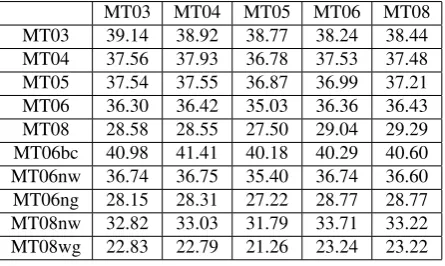
In this part, we will evaluate the performance of our method introduced in section 4. Under each development dataset, we calculate the cross-entropy of all test datasets, which are displayed in table 3. The results of both baseline and under our adapted method are also presented in table 5.
DEV MT03 MT04 MT05 MT06 MT08
TEST Baseline Adapted Baseline Adapted Baseline Adapted Baseline Adapted Baseline Adapted MT03 1.8842 1.8842 1.8507 1.8701 1.9953 1.9958 1.8058 1.7992 1.8800 1.8564 MT04 1.7556 1.7353 1.7264 1.7264 1.8720 1.8482 1.6900 1.6679 1.7600 1.7191 MT05 1.8880 1.8884 1.8621 1.8776 2.0022 2.0022 1.8109 1.8091 1.8759 1.8513 MT06 1.9287 1.9361 1.8997 1.9185 2.0459 2.0571 1.8408 1.8408 1.9224 1.9012 MT08 2.1462 2.1787 2.1176 2.1550 2.2890 2.3488 2.0376 2.0587 2.1224 2.1224 MT06bc 1.8324 1.8260 1.8262 1.8150 1.9425 1.9292 1.7657 1.7536 1.8352 1.7995 MT06nw 1.8480 1.8412 1.8175 1.8294 1.9535 1.9469 1.7607 1.7502 1.8378 1.8108 MT06ng 2.2962 2.3440 2.2660 2.3069 2.4436 2.5170 2.1692 2.2047 2.2637 2.2737 MT08nw 2.0602 2.0786 2.0208 2.0556 2.1913 2.2304 1.9548 1.9665 2.0271 2.0166 MT08wg 2.2649 2.3191 2.2544 2.2995 2.4204 2.5120 2.1511 2.1815 2.2527 2.2664
DEV:TEST Method 1-gram 2-gram 3-gram 4-gram BP BLEU TER
MT03:MT08 Baseline 0.7866 0.4155 0.2276 0.1278 -0.2282 0.2486 0.5904
MT03:MT08 Adapted 0.7708 0.4033 0.2186 0.1222 -0.1318 0.2646 0.5910
MT08:MT03 Baseline 0.7703 0.4611 0.2773 0.1679 0.0000 0.3586 0.5912
MT08:MT03 Adapted 0.7851 0.4733 0.2860 0.1735 0.0000 0.3685 0.5682
Table 4:Detailed analysis of BLEU scores, including n-gram precision and length penalty and TER scores, based on dataset pair of MT03 and MT08.
DEV MT03 MT04 MT05 MT06 MT08
TEST Baseline Adapted Baseline Adapted Baseline Adapted Baseline Adapted Baseline Adapted MT03 39.14 39.14 (|) 38.77 38.45 (↓) 38.61 38.69 (|) 37.31 37.44 (|) 35.86 36.85 (↑) MT04 37.52 36.74 (↓) 37.93 37.93 (|) 36.72 36.12 (↓) 35.81 36.84 (↑) 34.66 36.23(↑) MT05 37.33 37.37 (|) 36.94 37.24(↑) 36.87 36.87 (↑) 35.93 36.07(|) 34.15 35.29 (↑) MT06 33.58 34.04 (↑) 33.63 35.13 (↑) 33.44 33.49 (|) 36.36 36.36 (↑) 35.04 35.87 (↑) MT08 24.86 26.46 (↑) 24.18 27.03 (↑) 25.43 26.65 (↑) 27.74 28.86 (↑) 29.29 29.29 (|) MT06bc 24.22 27.20 (↑) 23.77 27.70 (↑) 24.64 26.26 (↑) 27.37 28.14 (↑) 28.87 28.43 (↓) MT06nw 40.36 39.91 (↓) 39.97 40.74 (↑) 39.85 39.72 (|) 39.57 40.26 (↑) 37.71 39.72 (↑) MT06ng 33.81 33.65 (|) 34.23 34.71 (↑) 33.79 33.45 (↓) 36.72 36.53 (|) 35.58 36.61 (↑) MT08nw 29.40 30.66 (↑) 28.95 31.32 (↑) 29.67 30.31 (↑) 32.47 33.31 (↑) 33.03 33.23 (↑) MT08wg 18.78 21.09 (↑) 17.81 21.04 (↑) 19.74 20.91 (↑) 21.35 23.06 (↑) 22.72 23.13 (↑)
Table 5: Comparison between baseline and LM weight adaption method using 1-best translation on dif-ferent dataset pairs, under large scale setting. Symbol(↑) indicates improvement over 0.2 BLEU points, (↑) indicates improvement over 0.2 BLEU points, (↓) means decline over 0.2 BLEU points, (|) shows no noticeable change.
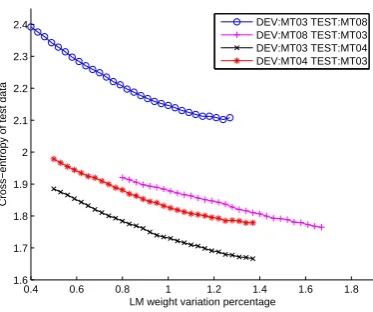
We also calculate the entropy on translations after adaptation of all dataset pairs, which is also listed in table 3. From the results in table 3, we find that the cross entropy usually changes according to the ratio of cross-entropy of development and test datasets. Specifically, the cross entropy of test dataset increases as LM weight decreases, as shown in figure 2, in which we use the same dataset pairs as in section 3. The reason for the phenomenon in figure 2 is that when the LM weight increases, the language model turns to play a more important role in the whole SMT system. As a result, the decoder prefers to select the translations with higher LM scores, which are also with shorter length and smaller cross-entropy.
Furthermore, we want to know what the improvements could be under our adaptation method. Here we take the pair MT03 and MT08 as example, the details of the results are shown in table 4. We may observe that for the pair of MT03 as development and MT08 as test, the length penalty is quite large. Meanwhile our adaptation method could notably reduce such penalty and get signifi-cant improvement based on BLEU metric. Although the n-gram precision decrease in some sense,
MT03 MT04 MT05 MT06 MT08
MT03 39.14 38.92 38.77 38.24 38.44
MT04 37.56 37.93 36.78 37.53 37.48
MT05 37.54 37.55 36.87 36.99 37.21
MT06 36.30 36.42 35.03 36.36 36.43
MT08 28.58 28.55 27.50 29.04 29.29
MT06bc 40.98 41.41 40.18 40.29 40.60
MT06nw 36.74 36.75 35.40 36.74 36.60
MT06ng 28.15 28.31 27.22 28.77 28.77
MT08nw 32.82 33.03 31.79 33.71 33.22
MT08wg 22.83 22.79 21.26 23.24 23.22
0.4 0.6 0.8 1 1.2 1.4 1.6 1.8 1.6
1.7 1.8 1.9 2 2.1 2.2 2.3 2.4
LM weight variation percentage
Cross−entropy of test data
DEV:MT03 TEST:MT08 DEV:MT08 TEST:MT03 DEV:MT03 TEST:MT04 DEV:MT04 TEST:MT03
Figure 2:The cross entropy of test vs. LM weight variation in percentage for different dataset pairs
the gain from the length penalty decrease could counteract reduction on the precision. While for the case in which MT08 as development and MT03 as test, the length penalty of both baseline and adapted results are equal, while n-gram precision of adapted method is higher than that of baseline, which leads to improvements on final performance. Meanwhile, we also apply another SMT metric TER (Snover et al., 2006) to evaluate the results of the dataset pair MT03 and MT08, as shown in table 4. When we use MT03 as development and MT08 as test, the TER result shows no improvement. This is consistent with observation from above discussion, as improvement for BLEU mainly comes from length penalty, not n-gram precision. Meanwhile, when we use MT08 as development and MT03 as test, we achieve significant improvement on the TER score. This inconsistency shows some potential difference between the TER metric and the BLEU metric.
However, for some dataset pairs, the adapted result is not so good as the baseline. The reason might be that the closeness of test and development measured through cross-entropy is more sig-nificant than the real difference. Taking MT03(development) and MT04(test) for example, from figure 1 we could find that the baseline is almost the same as oracle (0.01 BLEU points differ-ence), while the ratio of the cross-entropy from table 3 is larger than our intuition, making the LM weight over-adapted and the performance decreased. Nevertheless, the results in table 5 show that our method works well for most dataset pairs (33 of 50 groups increase, while only 6 of 50 groups decrease). Although our adaption method is in a sense empirical, we believe it reflects the inherent relations in the LM adaptation.
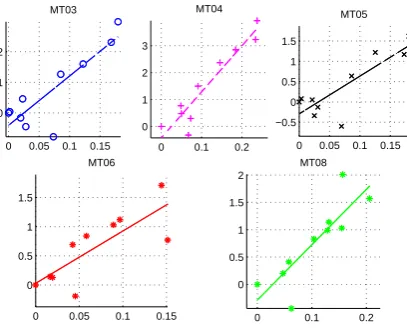
Furthermore, we want to know the influence of the cross-entropy variation on BLEU score im-provements. In figure 3, the X-axis represents the absolute value of relative change between devel-opment and test dataset (i.e.,|HH((DT))−1|), and the Y-axis displays the improvements of the BLEU
score under adaptation. We would observe that all five groups of points are well linear, show-ing strong correlations between adaptation improvements and cross-entropy difference. Based on above results, we can draw the conclusion that even if cross-entropy may not be the only factor that determines the bias-estimation of LM weight, it is still one of the most important.
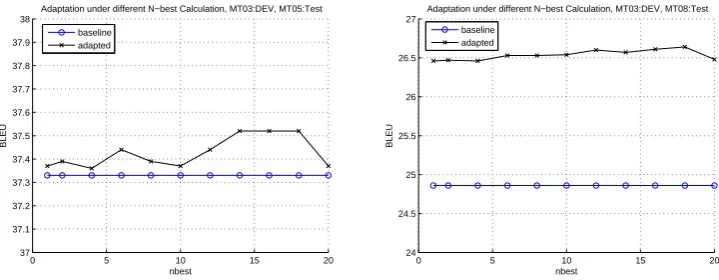
5.3 1-best VS. N-best Translation Result Adaptation
References
Amittai Axelrod, Xiaodong He and Jianfeng Gao. 2011. Domain Adaptation via Pseudo In-Domain Data Selection. In Proceedings of the 2011 Conference on Empirical Methods in
Natural Language Processing, 355-362, Edinburgh, July, 2011.
David Chiang. 2005. A Hierarchical Phrase-based Model for Statistical Machine Translation. In
Proceedings of the 43rd Annual Meeting of the ACL, 263-270.
Almut Hildebrand, Matthias Eck, Stephan Vogel, and Alex Waibel. 2005. Adaptation of the Translation Model for Statistical Machine translation based on Information Retrieval. In
Pro-ceedings of EAMT, Budapest, Hungary.
George Foster and Roland Kuhn. 2007. Mixture-Model Adaptation for SMT. In Proceedings of
the Second ACL Workshop on Statistical Machine Translation, Prague, Czech Republic.
George Foster, Cyril Goutte and Roland Kuhn. 2010. Discriminative Instance Weighting for Domain Adaptation in Statistical Machine Translation.In Proceedings of the 2010 Conference
on Empirical Methods in Natural Language Processing, 451-459, MIT, Massachusetts, USA,
October 2010.
Philipp Koehn and Josh Schroeder. 2007. Experiments in Domain Adaptation for Statistical Ma-chine Translation.In Proceedings of the Second Workshop on Statistical Machine Translation, 224-227, Prague, June 2007.
Mu Li, Yinggong Zhao, Dongdong Zhang and Ming Zhou. 2010. Adaptive Development Data Selection for Log-linear Model in Statistical Machine Translation. In Proceedings of the 23rd
International Conference on Computational Linguistics (Coling 2010), 662-670.
Yajuan L¨u, Jin Huang and Qun Liu. 2007. Improving Statistical Machine Translation Performance by Training Data Selection and Optimization.In Proceedings of the 2007 Joint Conference on Empirical Methods in Natural Language Processing and Computational Natural Language
Learning, 343-350.
Spyros Matsoukas, Antti-Veikko Rosti and Bing Zhang. 2009. Discriminative Corpus Weight Estimation for Machine Translation. In Proc. of the Conference on Empirical Methods in
Natural Language Processing, 160-167
Behrang Mohit, Frank Liberato and Rebecca Hwa. 2009. Language Model Adaptation for D-ifficult To Translate Phrases. In Proceedings of the 13th Annual Conference of the EAMT, 160-167.
Behrang Mohit, Rebecca Hwa and Alon Lavie. 2010. Using Variable Decoding Weight for Lan-guage Model in Statistical Machine Translation In The Proceedings of the 9th Conference of
the Association for Machine Translation in the Americas, Colorado
Robert C. Moore and William Lewis. 2010. Intelligent Selection of Language Model Training Data.In Proceedings of the ACL 2010 Conference Short Papers, 220-224, Uppsala, Sweden. Franz Och. 2003. Minimum Error Rate Training in Statistical Machine Translation. In
Pro-ceedings of the 41th Annual Meeting of the Association for Computational Linguistic (ACL),
Sapporo, Japan.
Kishore Papineni, Salim Roukos, Todd Ward, and Wei-Jing Zhu. 2002. Bleu: a Method for Automatic Evaluation of Machine Translation. In Proceedings of the 40th Annual Meeting of
the Association for Computational Linguistic (ACL), 311-318.
Yuta Tsuboi, Hisashi Kashima, Shohei Hido, Steffen Bickel and Masashi Sugiyama. 2008. Direct Density Ratio Estimation for Large-scale Covariate Shift Adaptation. In Proceedings of the
Eighth SIAM International Conference on Data Mining, pp. 443–454, 2008.
Bing Zhao, Matthias Eck and Stephan Vogel. 2004. Language Model Adaptation for Statistical Machine Translation with Structured Query Models. In Proceedings of International