Strategies to Improve a Speaker Diarisation Tool
David Tavarez, Eva Navas, Daniel Erro, Ibon Saratxaga
Aholab - Dept. of Electronics and Telecommunications. Faculty of Engineering. University of the Basque Country. Alda. Urquijo s/n 48013 Bilbao
email: david, eva, derro, [email protected]
Abstract
This paper describes the different strategies used to improve the results obtained by our off-line speaker diarisation tool with the Albayzin 2010 diarisation database. The errors made by the system have been analyzed and different strategies have been proposed to reduce each kind of error. Very short segments incorrectly labelled and different appearances of one speaker labelled with different identifiers are the most common errors. A post-processing module that refines the segmentation by retraining the GMM models of the speakers involved has been built to cope with these errors. This post-processing module has been tuned with the training dataset and improves the result of the diarisation system by 16.4% in the test dataset.
Keywords:Speaker Diarisation, Speaker Clustering, Evaluation
1.
Introduction
The aim of speaker diarisation is to detect speaker changes in an audio recording and to identify which of the resulting speech segments come from the same speaker, without any prior information about the number or identity of the speak-ers (Tranter and Reynolds, 2006). To achieve this goal sev-eral tasks are performed, usually in a sequential way. These tasks typically include speech detection, speaker change detection, speaker clustering and resegmentation of the au-dio stream. To objectively assess the validity of the al-gorithms developed, competitive evaluation campaigns like NIST Rich Transcription1 and Albayzin diarisation
evalu-ation (Zelen´ak et al., 2010) are organized. In these cam-paigns, different research groups tests their algorithms with a shared database, which allows for performance compari-son and helps identifying new trends.
We built a diarisation system for Albayzin 2010 evaluation campaign that obtained good results, even if it did not in-clude any resegmentation step (Luengo et al., 2010). In this paper, the strategies proposed to cope with the errors made by this system and the improvements in the results achieved are presented.
In section 2 the baseline diarisation system presented by our group to Albayzin 2010 evaluation campaign is described. Section 3 presents the database used in the experiments. Section 4 focuses on the analysis of the errors made by the baseline system and proposes the strategies to cope with them. The results of the post-processing module developed are presented in section 5. Finally, some conclusions are drawn in section 6.
2.
Baseline Speaker Diarisation System
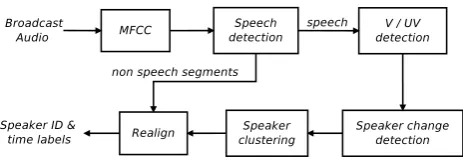
Figure 1 shows a schematic diagram of the baseline speaker diarisation tool. The algorithm is based on an efficient implementation of a BIC change detector and an off-line speaker clustering. In the following sections, each step of the algorithm will be explained with more detail.
1
http://www.itl.nist.gov/iad/mig/tests/rt/
Figure 1: Diagram of the baseline diarisation system
2.1. Speech detection
A separate GMM model with 16 mixtures was trained for music, noise, clean speech, speech+music and speech+noise, using the development recordings and the audio segmentation labels provided by the Albayzin 2010 diarisation challenge (Zelen´ak et al., 2010) organisation. These models are used in a Viterbi segmentation in order to detect audio segments with and without speech. Develop-ment experiDevelop-ments showed that the addition of derivatives of MFCC provides slightly better segmentation results, there-fore 12 MFCC with first and second derivatives were used for the classification. Finally the speech detection labels were post-processed in order to discard silences shorter than 500 ms. Only the segments identified as speech are then provided to the speaker change detection algorithm.
2.2. Voiced unvoiced detection
The speaker change detection step uses only voiced frames, discarding the unvoiced ones. In order to make the voiced/unvoiced (VUV) estimation, the PTHCDP algo-rithm described in (Luengo et al., 2007) was used. This algorithm uses cepstrum transformation and dynamic pro-gramming in order to estimate the F0 curve and the VUV information.
2.3. Speaker change detection
8.
References
M. Cettolo and M. Vescovi. 2003. Efficient audio segmen-tation algorithms based on the bic. InInternational Con-ference on Acoustics, Speech, and Signal Processing
(IC-CASP 03), volume 6, pages 537–540, April.
S. S. Chen and P. S. Gopalakrishnan. 1998. Speaker, en-vironment and channel change detection and clustering via the bayesian information criterion. InDARPA speech
recognition workshop, volume 6, pages 127–132.
T. Hastie, R. Tibshirani, and J. Friedman. 2009. The Ele-ments of Statistical Learning (2nd edition). Springer. I. Luengo, I. Saratxaga, E. Navas, I. Hern´aez, J. S´anchez,
and I. Sainz. 2007. Speaker, environment and channel change detection and clustering via the bayesian
infor-mation criterion. InInternational Conference on Acous-tics, Speech, and Signal Processing (ICCASP 07), pages 1057–1060, Honolulu, USA, April.
I. Luengo, E. Navas, I. Saratxaga, I. Hern´aez, and D. Erro. 2010. AhoLab Speaker Diarisation System for Albayzin 2010. InFALA 2010, pages 393–396, Vigo.
S. E. Tranter and D. A. Reynolds. 2006. An overview of automatic speaker diarization systems. IEEE Trans.
on Audio, Speech and Laguage processing, 14(5):1557–
1565.
M. Zelen´ak, H. Schulz, and J. Hernando. 2010. Albayzin 2010 evaluation campaign: Speaker diarization. In VI Jornadas en Tecnologa del Habla and II Iberian SLTech